
One of the questions frequently surrounding monotheism is that of angels. Surveys indicate that even non-religious North Americans, by far, believe in angels. So, where do they come from? In a monotheistic context where God is considered omnipotent what role could angels possibly fill?
Angels appear in ancient religions in medias res. Going back to the earliest attested religion, that of the Sumerians, we find winged divine assistants called apkallu. In a polytheistic world, gods could always use a little help. These divine beings, portrayed with wings, are sometimes called “angels” by modern commentators, and they do serve some of the basic functions of an angel, such as doing errands.
Other ancient polytheistic religions knew of differing classes of deities; not all gods were created equal! There were primordial deities, often old and retiring, and there were active ruling deities who received their authority from the primordials but who in fact ruled by might. Below the ruling gods were skilled-labor gods and messengers. It is from this class of messenger gods that angels eventually evolved. We don’t know that messenger deities were portrayed with wings, but in ancient times wings indicated speed — uninterrupted movement — so you could do worse than have wings if you were a messenger. The English word “angel” derives from the Greek term indicating a messenger. Indeed, by the time we reach the Hebrew Bible angels are often indistinguishable from humans.
The problem is that when monotheism developed during the Exilic Period, the Israelites had already become quite accustomed to having angels around. Before prophets showed up angels were often the means of learning the divine will. If there is only one god, what do you do with this tier of messenger deities? Demote them to angels! They are still supernatural, but not as powerful as God.
Probably under the influence of Greek Hermes, angels regained their wings to become the winged humans we know so well today. It is a mistake, however, to call all winged humans from the ancient world “angels.” Angels are the result of the religious evolution from polytheism to monotheism, and their ancient predecessors were truly gods.
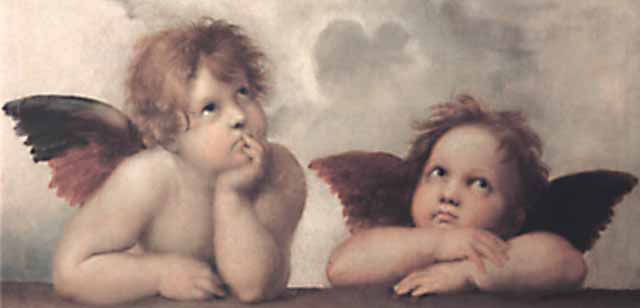
Remember when we used to be gods?
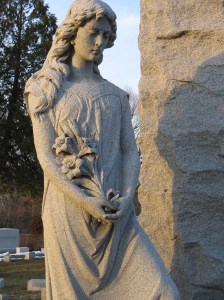 The specific form of penny offerings seems to go back to Benjamin Franklin’s burial, at least in America. A few years back while in Philadelphia, I saw for myself that people still leave pennies on Franklin’s grave in Christ Church Cemetery.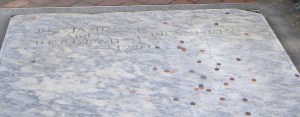
 I recalled having seen stones on tombs outside Jerusalem some years back, and I even had a student bring me a stone from Israel to keep as long as I promised to put it on her grave after she died. This practice in its recent form is associated with Judaism, but again, it has ancient roots. The building of cairns, or piles of stones, is often associated with the Celts or the pre-Celtic inhabitants of the British Isles. On our many wandering through the highlands and islands we saw several Neolithic examples in Scotland, particularly in the Orkney Islands. The practice of putting stones atop the dead also goes back to ancient times. One plausible suggestion is that it was intended to keep the dead in their graves. A more prosaic conclusion is that digging deep holes takes more work than hauling over a pile of rocks.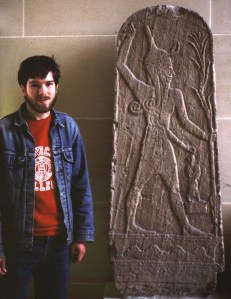


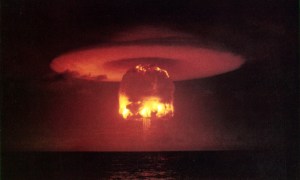


 Here is a Gnu-license photo of one of these clouds; there are more dramatic images, but they are mostly covered by copyright. What immediately caught my attention in the Wired article was the subtitle: “Weather Geeks Are Championing a New Armageddon-Worthy Cloud.” The Bible appears in the sky yet again.
 Steve A. Wiggins