
Memento Mori

This is the end, my friend, my only friend, the end

This is the end, my friend, my only friend, the end

Those of you who’ve listened to my podcasts have no doubt noticed my reference to George Pendle’s, Death: A Life (Three Rivers Press, 2008). This fictitious account of Death’s memoir, all things considered, is a fun read and a wild romp through various ancient religions. Postulating a loveable, if somewhat obtuse, God (no more obtuse, however, than the supreme being in Harold Bloom’s Book of J) Pendle populates his mythological world with a vast array of embodiments, personifications and supernatural beings, all slightly neurotic, and more or less on an equal playing field. Although the book is intended as fun, it does offer some serious consideration to the phenomenon of death.

One of the earliest intimations that Homo sapiens had begun to consider religious sensibilities is burial, the concomitant state to death. Burial serves an important biological function of preventing the diseases borne of putrefaction from infecting others, but it also serves as a condensed statement of a fledgling belief in an afterlife in some form. Even Neanderthal burials have been discovered with rudimentary grave goods. Concern for the wellbeing of the departed is surely a religious sentiment. Death and religion are never far from each other. Even the early Mesopotamians trembled at the etemmu, their version of a ghost, and marked it with the divine determinative on their clay tablets. Religion has been a fine-turned handle that humans have used to get a grip on death.

That is not to say, of course, that death is religion’s only concern, but there is some wisdom in that old saying that people seek out their religious leaders when they are “hatched, matched, and dispatched.” Mesopotamian (and Hebrew Bible, for that matter) afterlife was a gloomy prospect, yet it was certainly brighter than the alternative of the simple cessation of biological functions. Death as a concept inserts meaning into the all-too-natural act of dying. Not a religion exists that does not address itself to this great leveler of all human aspirations. If at times it seems that my posts tend toward the macabre, peopled with vampires, werewolves, zombies and Republicans, bear in mind that such creatures of the night are expressions of the essentially human and indisputably religious preoccupation with death. Its unbeating heart transfuses life to religion.

The Dark Light

Like many Americans, last year I was fascinated by Christopher Nolan’s gripping and gritty Batman film, The Dark Knight. Admittedly, the untimely death of Heath Ledger added to the poignancy of the film, but his unfaltering performance as the Joker was no laughing matter. I was transfixed. Not only was this vision of the character previously immortalized by Cesar Romero and Jack Nicholson a sea-change, it was also an epiphany.

In attempting to understand ancient religion, you can’t get far without having to address priests and prophets. Priests appear at the dawn of civilization, the establishment’s religious functionaries. They had (have) a vested interest in the continuation of the reigning power structures. Priests make their living from a population settled enough to tax. Prophets, however, have a far older pedigree. Israel recognized prophets as we all know from the Hebrew Bible, but other ancient religions also had their prophets too. Prophets were religious functionaries from outside the established power structures — they challenged conventions, demanded radical changes, and caused migraines for more than one priest. The prophet seems to have evolved from the shaman.

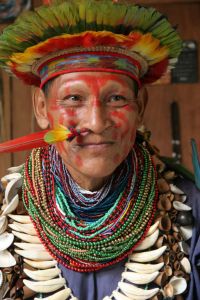
Not a Joker! An Amazonian shaman

Not a Joker! An Amazonian shaman

The shaman was what anthropologist call a “liminal character,” an outsider. They simply do not play by society’s rules, but they are feared and respected by society. The shaman may see or hear things that are beyond the perception of your average citizen. The shaman may be dangerous. This is what I saw in Heath Ledger’s Joker. A disturbing character who challenges and yet at the same time brings focus and resolution to a fractured society. A wounded healer. He represents a fossil, a shaman in twenty-first century Gotham. The other Jokers, Romero and Nicholson, didn’t quite attain this level of spiritual catharsis. Although I knew Batman was the good-guy, the Joker, laughing when he should have been crying, the agent of chaos, was the most religious character in the movie. He was the Dark Light to Batman’s Dark Knight.


Origins of the Undead

With all the talk of organ harvesting in New Jersey (see any Jersey paper over the past couple of days — you can’t miss it), my mind naturally turns to zombies. I have to confess to having enjoyed Pride and Prejudice and Zombies (Jane Austen and Seth Grahame-Smith, Quirk Books, 2009) very much, particularly when the Bennett girls form the “Pentagram of Death” at a ball. Like most creatures representing humanity’s deepest fears, however, the undead have religious origins.

The evils of the slave trade and missionary work concocted a dangerous brew in the West Indies. Shamanistic “voodoo priests” claimed to have the ability to arrest a person’s soul, making that person an unthinking mercenary of their bidding. (The mind again turns to missionaries!) A similar idea enlivened the golem in medieval Jewish lore, only dirt was used to construct a golem rather than an already occupied fleshy apartment. The concept of the inculpable perpetrator of revenge in West Indian religion was first introduced into popular consciousness by the writing of William Seabrook, a noted traveler and author. Seabrook spent some time in Haiti and his account of zombies in The Magic Island captured the public imagination.

The undead aspect of zombies is largely due to the unexpected success of George Romero’s 1968 cult hit film, Night of the Living Dead. In an interview Romero noted that the zombie idea had been applied to the film rather than having been its driving plot device. The undead are called “creatures” at several points but never “zombies.” The zombie connection nevertheless took off from the movie and landed the undead directly into the supernatural monster pantheon. As people continue to struggle with death and all its implications — one of the largest psychological roles of religion — it may seem difficult to believe that zombies have only been with us since the 1960s. William Seabrook committed suicide after having committed himself to an asylum in his later years. In one of his travelogues, Jungle Ways, he describes in detail the experience of eating human rump roast while in West Africa. Perhaps he was well on his way to becoming a zombie (or at least a New Jersey public servant!)?


Religious Origins

There’s no question that religion is a distinctly human phenomenon. Although the concept of “religion” is used to lump together all kinds of belief and praxis systems around the world, it is now an aspect of every culture ever studied. When on an interview recently for a religion teaching post, I pondered whether to be entirely frank or to play it safe: should I discuss the origins of religion or a more conventional topic? (I went the safe route and did not get the job, if anyone wonders if there might be a moral to all this…)

For several years now I have been exploring whether it is possible to trace religion back to the animal coinhabitants of our planet. While my musings have taken me from singing Neanderthals to mourning penguins, it has become quite clear that at least the most basic levels of religion also exist in what is often termed “lower” life forms. My epiphany began while watching David Attenborough discussing the purpose of birdsong. Religion and music have been nearly inseparable in human experience (if one can overlook some extremist reformers). My thoughts turned to elephants who “bury” their dead with branches and penguins who clearly mourn the loss of their young — watch March of the Penguins if you doubt it! Death and religion have walked the long and disjointed journey of humankind hand in bony hand. By the time we get to primates we find baboons stopping to watch the rising sun (an act the ancient Egyptians supposed to be solar worship) and chimpanzees raging against thunderstorms as if they despise Baal even more than Hosea. A bonobo was recently documented as uttering the word “yes” to a keeper’s question, officially making her more articulate than some clergy I’ve known. Even today there are churches that still call their leaders Primates! For those who doubt that animals are capable of worship I would suggest the true acid test — purchase a dog.

The C of E's newest primate?

The C of E\’s newest primate?

We guard far too jealously that which makes us better than our animal companions. As observation and research progress and that line in the speciological sand grows ever more effaced, I wonder why religion might not have its roots in our very animal nature. While reading a book on biblical flora recently, I pondered if a even larger step back might be taken. Consider the heliotropes, for indeed they do toil and spin.


Changing Faces of the Divine

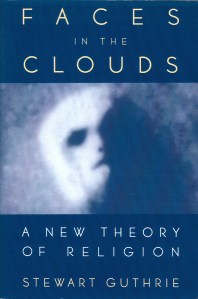
One of the most intriguing books I’ve read on the origin of religion in the past few months has been Stewart Guthrie’s Faces in the Clouds (Oxford, 1993). Guthrie offers the suggestion that our in-born, evolutionarily driven need to see people or faces, even where these are false positives, may have led to the concept of god/s. As a respectable academic, I am obligated never to agree completely with anyone, but Guthrie seems to be onto something here. When I’m jogging in the pre-dawn hours it is amazing how many people are about — that is, until I get close enough to see that they are a small tree or a tall newspaper stand. We do see what we consider important everywhere.

The picture says it all.

The picture says it all.

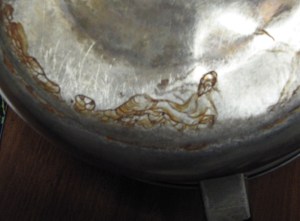
Having recently stumbled upon “Ghost Hunters,” I am amazed at how quickly some people (with the obvious exception of Jason, Grant, and the TAPS team) are inclined to claim a human shape to be a supernatural entity. This phenomenon is ubiquitous. On the web, while looking to find a good example of pareidolia to present to my class, I found an image of Michael Jackson’s face seared onto a piece of toast. If ever a divine sign was needed, here it is indeed! A more prosaic example was a natural water-stain I found on a saucepan in my own kitchen. I picked it up and asked my wife what she saw, just to assure myself I alone wasn’t crazy. Take a look and see what you see!

It looks like an oriental man reclining to me; perhaps an oriental Jesus?

It looks like an eastern Asian man reclining to me; perhaps an oriental Jesus?

Ancient religions were quick to put human forms on dangerous, threatening, or awe-inspiring phenomena. Lightning and thunder became the purview of Baal. It is a natural defense mechanism: you can pray to or offer a tasty animal sacrifice to Baal and the terrible storm will stop. Of course, in time nature itself would take care of it too. One summer at Nashotah House, however, the storms kept on coming. It was termed a “recurrent mesoscale convective system” by the meteorologists, but to the Baal worshiper it would seem that nothing could assuage the divine anger. Baal kept coming back at you. I have a photo in a shoebox somewhere of me standing nearly up to my knees in the icy rain water. Better to consider it human than to face unfeeling nature.

Today people still look for faces in the clouds to allay their fears. But we also have a rudimentary understanding of the physics of our universe. When people are forced to choose between facts and faces, when fear or extreme desire comes into the equation, the safe odds are always on the faces.