Prophet Margins

One of the most misunderstood of biblical phenomena is prophecy.  One of the reasons it’s so misunderstood is that other ancient peoples came to associate it with predicting the future.  Now, what prophets said often had implications for the future, but they were more forth-tellers, as they say in the biz, than fore-tellers.  Amos, for instance, was a prophet concerned with social justice.  We know little about his life, but we can discern that ancient prophets could be paid to become “yes men” (“yes persons” just doesn’t sound right, and most were male) for the establishment.  Kings then, as now, surrounded themselves with sycophants who would tell them their policies were approved, or even ordained by God.  Amos was not one of those.
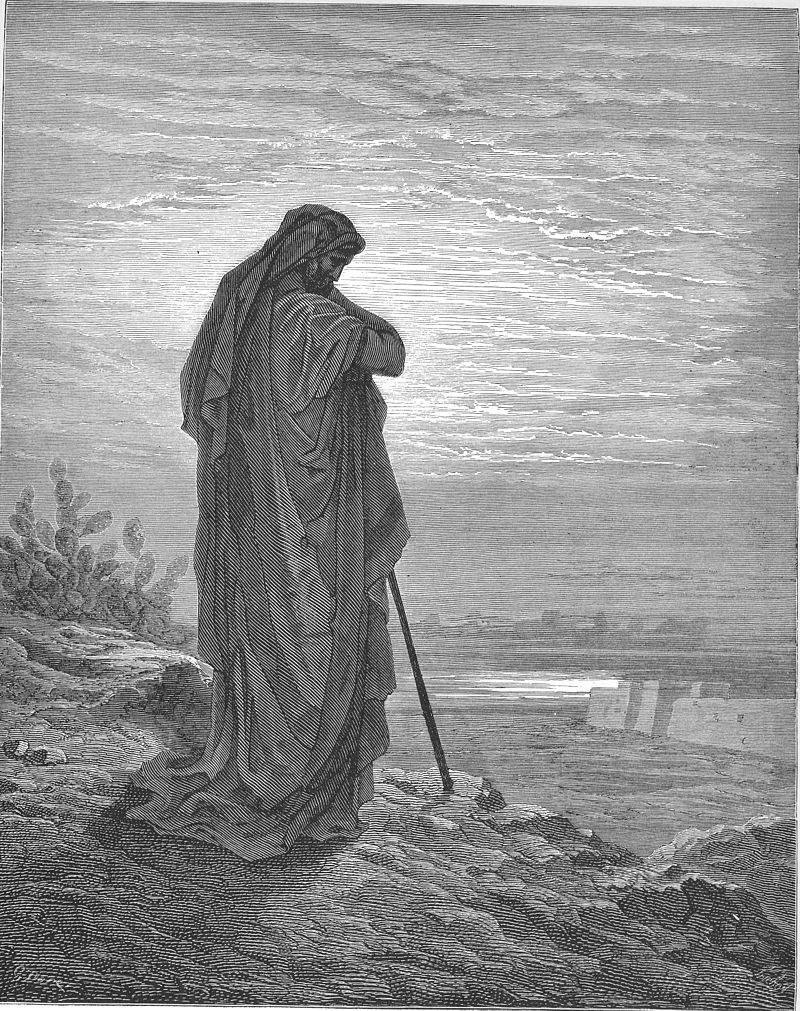
Amos points out in the book attributed to him that he was no paid prophet.  He was an honest worker with a great concern for social justice.  He lived in a prosperous time, but the wealth disparity between the rich and the poor troubled him.  (Amos has never been a favorite among prosperity gospelers, since his message has always been recognized as authentic among both Jews and Christians and he condemns the inequality rampant in society.)  Many in the eighth century BCE believed ceremonial actions—like, say, holding up a Bible in front of a church—pleased God.  Amos boldly declared such things sickened God as long as society favored the rich at the expense of the poor.  There’s a reason Evangelicals and Republicans tend to avoid Amos.  “But let judgment run down as waters, and righteousness as a mighty stream,” is not an easy thing to hear when you’re busy giving tax breaks to those who earn more than enough while refusing basic health care to the poor.

Prophets tend to speak of the future in conditional terms.  If your ways don’t change, then this will happen.  Some Christians, anxious to prove that Jesus was the messiah, came to see prophets as great predictors of the future.  Amos would likely have taken exception to them.  Even in his own day Amos made people uncomfortable.  His favorite image for God was that of a lion ready to attack.  His contemporaries told him to shut up.  Amos then made the famous statement that he was no professional prophet.  He would not adjust his message so that the comfortable could feel good about themselves.  If Amos were in America the last four years would’ve had his throat raw with pointing out to “Christians” how they’d come to misrepresent everything the prophets stood for.  We need more like him today.


Christian Fragility

Having read White Fragility, I was intrigued when a friend asked me if there might be such a thing as Christian fragility.  I think he was onto something.  To see how this might work, it needs to be understood that white fragility is the intense fear of having whiteness problematized.  We have been raised, conditioned, to think of it as the default form of humanity.  All others are “minorities”—aberrations, as it were.  Because of that “Caucasians” are reluctant to discuss race.  What my friend was suggesting, I think, is that there might be such a thing as Christian fragility as well.  Long considering itself the default true religion, Christianity has falsely convinced millions of Americans that this country was founded as an explicitly Christian one.  Many are surprised to learn Islam was here very early, largely because of African slaves.  And what of the indigenous religion of American Indians?

The idea of America as the ideal Christian nation is so deeply rooted that it’s something we bristle at talking about.  Think about it: educational institutions of the secular stripe don’t like to admit that many of them were founded as seminaries.  When I was growing up the two forbidden topics of conversation were politics and religion.  It seems that fragility may be a useful explanation.  Many academics refer to our culture as “post-Christian.”  They haven’t gotten out much.  Our culture is thoroughly suffused in Christianity.  It’s the air we breathe.  It’s the basis for many of our laws.  Much of science training (as I’ve argued before) is based on Christian assumptions.  Because Christianity shares so much background with Judaism clearly the picture is more complex than this, but the point I’m trying to make stands: we feel very uncomfortable when that implicit Christian identity is challenged, no matter how secular we are in reality.

Prior to Trump fear of “godless Russians” or “godless Communists” ran deep.  Ironically, evangelical Trump supporters now look to Putin’s Russia as a kind of model for political leadership.  We’re flailing about in Christian waters, baptizing the worst of human behaviors because we can’t bear to discuss whether something beyond Christianity might be worth considering.  I can’t claim to have absorbed the concept of white fragility fully, but I think the basic idea is sound.  American culture is extremely reticent to open discussions that suggest white, and Christian, aren’t defaults.  That people come in all kinds of shades of pink, tan, brown, red, yellow, and black are just as American.  That Islam, Buddhism, Hinduism, Jainism, and any number of other religions belong in a melting pot.  Christian fragility might well explain why this is so.


It Happened on Epiphany

Photo credit: Martin Falbisoner, via Wikimedia Commons

Can you spell treason?  It does begin with the letters “T-R-.”  The events of yesterday made it difficult to sleep securely in “the land of the free” as thugs took over the capitol building in Washington, and even after that Republicans still contested the electoral votes from Pennsylvania, preferring a treasonous president to a democratically elected Joe Biden.  As all of this was playing out, Georgia gave control of the senate to the Democratic Party.  Like many Americans born in a democracy, I stared at the news aghast yesterday as Republicans, fully in the public eye, tried to dismantle the very system by which they themselves were elected and even went so far as to claim they were patriots for doing so.  They draw the evil courage to do this from their “Christian” faith.

Yesterday was Epiphany, a Christian holiday.  To see Republicans—claiming the name Christian—attempting to overturn democracy on that very day was sickening.  To my mind it will live on like 9/11 as one of the most dangerous days in US history.  When asked to get the crowds that he personally incited to disperse, Trump released a video on Twitter telling his followers that the election was stolen and fraudulent but they should go home.  Pouring gasoline on a fire he himself lit, sending both houses of congress into hiding, his snakes-in-the-grass continued to support the myth that Trump hadn’t been defeated.  When the smoke clears this American thinks it’s time to dust off laws about treason and start applying them again.

Congressional leaders, and the president, swear to uphold the Constitution—hand on the Bible.  In the most closely watched election in history, with no evidence of fraud, when the loser wouldn’t concede his party backed him.  The Republican party has been infected with evil, I fear.  Even after seeing the turmoil that their posturing caused, they tried to discount the votes from my state just to keep a very dangerous man in power.  Our democracy didn’t die yesterday.  It died four years ago.  Claiming the name “Christian” without ever reading the Bible or attending church or caring about their fellow human beings, the Republican party has gone down in infamy on the feast of Epiphany.  The electoral vote count by congress is a mere formality, and I, a native and resident of Pennsylvania, am outraged that anyone claiming the power of a democratically elected office—disputing the very process that gave them any influence at all—questions my right to vote.  Why hasn’t treason been invoked?  Four years under the influence of the Evil One has shown its effects, and it happened on Epiphany.


Yankee Doodle

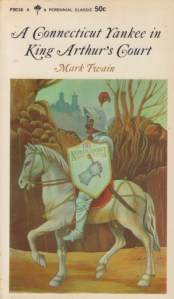
Some books stay with you in a way that hits very close to the nerve.  Since I read Mark Twain’s A Connecticut Yankee in King Arthur’s Court many years ago, memories of how it left me feeling prevented me from re-reading it.  That’s pretty unusual for Twain, in my experience.  I’ve read some of his other novels and there’s not a similar feeling toward them.  The racist elements are disturbing, but overall the stories manage to overcome some of the darkness with either levity or sarcasm.  The scenes that scared me off from re-reading Connecticut Yankee were the two episodes in which young women were murdered.  I realize Twain was simply being honest here regarding the cheapness of life in medieval times, but I found both these instances so saddening that I had a difficult time coming back to it.

Now, some two or three decades later the book speaks to me in a new way.  Something else I recently read reminded me of it, and I was struck at just how much Twain’s Arthurian peasants resemble the unthinking crowds of Americans who simply accept what people like Trump say.  One of Hank Morgan’s banes is how the uneducated refuse to question what they’re told.  In many ways this is humorously narrated but a dark undercurrent remains behind.  Twain had clearly supposed that nineteenth-century America had overcome this brainless gullibility.  A century and a half after Twain’s Connecticut Yankee we’ve clearly been involved in retrograde motion.  Twain levels much of the blame on the church.  His choice comments in this regard also still apply.

“I was afraid of a united Church; it makes a mighty power, the mightiest conceivable, and then when it by and by gets into selfish hands, as it is always bound to do, it means death to human liberty and paralysis to human thought.”  So Morgan states in chapter 10, and indeed, in the novel it is the church that largely leads to the downfall of the civilization Morgan had built.  Or again, in chapter 17: “I will say this much for the nobility:  that, tyrannical, murderous, rapacious, and morally rotten as they were, they were deeply and enthusiastically religious.  Nothing could divert them from the regular and faithful performance of the pieties enjoined by the Church.”  Twain couldn’t admit in public,  even in his own nineteenth-century life, what he really thought about organized religion.  It’s pretty plain in his fiction, but disguising fact as fantasy is a tried and true method of getting at the truth.  If I weren’t so sensitive to the human plight, I might read it more often.


Winter Rebirth

It seems like 2020 has already had many longest nights.  The Trump administration has hurt so many people so badly (many of them his own supporters) that this feels like four years of night finally beginning to experience dawn.  It is finally the solstice!  This ancient seasonal holiday, coopted by Christianity for its own purposes, retains great symbolic value.  The story of Jesus’ birth is about light coming into the world.  So are the myths behind Saturnalia and Yule and even Hanukkah.  We tend to want to view things literally when the true meaning comes in the form of symbols that strike at the very heart of what it means to be human.  We fear the dark, and we’ve been living in it for so long now that perhaps the light hurts our eyes.

A friend pointed out the Winter Solstice Fest, put on by Shift.  It streamed (I almost wrote “aired”) over the past weekend.  Involving many indigenous, and even some new age practitioners, it was a celebration of light’s return.  Although I couldn’t watch all of it—weekends are so necessary when work becomes the only reality of five days per week—but what I did see inspired me.  The chauvinism of one religion asserting its superiority over other explorations of spirituality can contribute to the darkness.  When we take symbols literally we’re capable of great damage.  Being inclusive forces us to recognize that we are all seeking light while learning to walk in the dark.

One of the reasons I watch horror is because, on the balance, it is dark half the time.  Perhaps because I can’t seem to sleep until sunrise any more, I spend quite a lot of even summertime in the dark.  Since there’s much that can only be done in the light of day, I explore how darkness might contribute to our spiritual growth.  Although horror often receives a naughty reputation, it too is about exploring the dark for meaning.  Today, at this latitude, we’ll have only nine hours and sixteen minutes of light.  It’s easy to believe illumination might never return.  Humans have created rituals to assure ourselves, to encourage the courses of nature to continue as they have for countless eons before we ever evolved.  While we’re in the darkness, perhaps we should consider making friends with it.  It’s quiet.  And shy.  And if we don’t learn to live with it, half of our time may never blossom.


Time for Golem

I don’t claim to understand how the film industry works.  My two books on horror and religion deal with interpreting the movies, not their native cinematic environment.  I say this because I limited my treatments in them to films with a theatrical release.  Mainly this was so that readers would have had easy access to them.  Some films, of course, never go to theaters and it seems that happened, in the United States, to the Israeli movie The Golem.  I saw a trailer for it last year and patiently waited for it to arrive.  I recently found it on an online streaming service and finally had a chance to watch it.  Golems, as original Jewish monsters, have shown up in a variety of popular media including The X-Files and Sleepy Hollow.  Film treatments have been rare, and this one makes for a fascinating monster movie.

What makes the golem so compelling is that it is an explicitly religious monster.  To create a golem (according to the film) the maker must use Kabbalah, Jewish mystical texts, to learn how to bring it to life.  Hanna (Hani Furstenberg), the female protagonist, is the only one in her seventeenth-century village willing to try.  The real hook, for me, is that the golem she creates is a little boy.  The role must’ve been fun to play.  Golems cannot speak, so there are no lines to learn.  Kirill Cernyakov nails the part with an ability to portray emotionless menace.  The problem with a golem, you see, is that it goes on rampages, killing even those it’s conjured to protect.  Since the movie is intended to be a retelling of the classic story (involving the golem of Prague), it doesn’t have too many surprises.  It is, however, a thoughtful movie.

Write-ups on it call it “the Jewish Frankenstein,” but scholars who research Frankenstein often go the other way, seeing Frankenstein’s monster as a form of golem.  The basic idea is taking something inert and bringing it to life.  Afterward the creator is unable to control it.  It’s too bad that The Golem didn’t get a wide theatrical release.  I’ve seen far worse horror films that did.  Perhaps the focus on religion was too blatant?  One of the points I make in Holy Horror and Nightmares with the Bible is that religion and horror belong together.  Some Jewish viewers will undoubtedly spot inaccuracies (even this goy did) but the movie isn’t a religious text.  It is an appropriate rebuff to Trumpian “politics” and even features a plague.  It is a movie for our time.


Chick Tracks

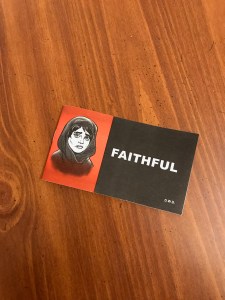
Goodreads isn’t the only booklover’s website, but it is one that publishers pay attention to.  Having a following on Goodreads helps for making marketing manageable.  Or so the thinking goes.  In any case, I recently had a message on Goodreads about Holy Horror.  It seems someone has, against all odds, found the book and is reading it.  This particular reader asked me in a comment about Chick tracts.  I’ve written about Jack Chick before.  He was a veritable one-man evangelical force of super-nature.  He is responsible for many of my personal nightmares with the Bible.  His cartoon tracts were designed to scare the Hell out of kids, literally.  I read them religiously.  My Goodreads reader pointed out that I could’ve made use of them in Holy Horror.

This made me ponder the reticence of academics to address religion as a cultural force.  Chick tracts are extremely common, even today.  As I posted last year, we were handed one while walking between venues at the first annual Easton Book Festival (an event forced virtual this year by, well, you know).  Not that Chick’s intellectual ability deserves study, but his influence is undeniable.  How many of us fundamentalist kids were set on our life trajectories by tracts that looked like mini-comic books but which had an unwavering, uninformed viewpoint held as gospel?  Chick tracts broached no dissent.  The Bible alone, and the Bible as interpreted by fundamentalists alone, was the only possible way of avoiding everlasting hellfire.  Nightmares indeed.

Chick died in 2016 after half-a-century of terror (his first tract was published in 1960).  Apparently Chick was a shy evangelical and his prolific cartooning was a way of assuaging his own fears of not evangelizing.  Ironically, in his tracts he offloaded that burden onto others—kids were made to feel inferior if they didn’t talk about Jesus to their friends, no matter how shy they might have been.  There’s not much information easily available on this influential man.  A motivated scholar, I’m sure, could dig up information—nearly any life can be illuminated to some degree—but I’m not sure the will is there.  If it ever happens, I suspect the study will be done by someone like me, raised on Chick and fed steady doses of childhood Bible reading.  My Goodreads interlocutor was perhaps onto something by suggesting my watching horror has something to do with Chick tracts.  Stranger things have, I’m sure, happened.


Recent Religions

A project at work has made me curious about Christian Science.  Oh, I know the basics, as many religionists do, but when trying to find a neutral treatment of the tradition I was struck by how little was out there.  It is a symptom of academia, I fear, to ignore that which isn’t conventional.  I’m fascinated by what are called New Religious Movements (NRMs)—many of which have sprung out of some form of Christianity.  New religions never cease to emerge, but the nineteenth century was a hotbed of new faith explorations.  The Mormons, Jehovah’s Witnesses, the Shakers (started a little earlier, now extinct), Christian Science—these traditions hold fascinating beliefs and even though some are thriving (Mormons), others seem to be slowly dying out (Christian Science).  

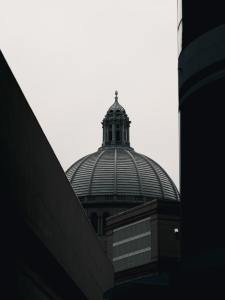
While in Boston as a student I made a point of visiting the Mother Church of Christian Science.  The campus is impressive and architecturally pleasing.  I took a tour and I still remember the vast and impressive map room.  The denomination is having difficulty because, I suppose, of lawsuits against parents refusing medical treatment for children.  This puts their theology at odds with the larger society’s understanding of children’s rights.  Indeed, if you look for books on Christian Science the most prominent are those from people who’ve left the religion.  Many NRMs have become extremely secretive and some have tried to make leaving difficult.  The same, however, could be said for mainstream Christianity.  We tend to think moderate Christianity benign, if benighted.  But all religions possess the power to abuse.

Religious beliefs make people behave in unconventional ways.  I think of how politics in this country is dominated by a biblicist agenda.  It doesn’t matter which party is in power, it’s the material with which we have to work.  The beliefs, from any quasi-objective point of view are strange.  The Bible, for example, says nothing of abortion.  Life in the biblical world began with the first breath.  Their concept of conception didn’t involve eggs and sperm.  In other words, it’d be ill-advised to take your biology lessons from the Good Book.  But this single issue drives many thousands of voters to one particular party.  I don’t know about you, but I would think that few topics deserve more thorough consideration than religion.  It’s what motivates people.  Instead, we live in a fascinating array of beliefs, often merging official teaching and personal experience and when we try to investigate we find a dearth of interest.


Rest and Be Thankful

Many years on Thanksgiving I find myself distressed.  Don’t get me wrong, I’m thankful for all the good things in my life—and they are more than I regularly stop to count—but life has a way of tossing reality bombs into the mix.  This year, though, there is much for which I’m feeling particularly grateful.  Family and friends foremost.  Fairly good health and a day or two off work.  These are all wonderful.  This year gave us a couple more great gifts: the rejection of a leader who always and only thought of himself and convinced millions that he cared for their interests and beliefs.  A “leader” who refused to acknowledge defeat but just this week began a transition that should’ve begun nearly three weeks ago.  Many are inexpressibly thankful for this.

Although on a much smaller scale, I’m thankful for Nightmares.  Nightmares with the Bible, that is.  Although it’s expensive (I’ll thankfully give a discount code to all askers), it is with a publisher that will promote it better than Holy Horror.  It was a very pleasant surprise to receive the book before Thanksgiving, even with its Halloweenish theme.  Anyone who puts years of their life into a project knows the gratitude in seeing it come to fruition.  Nightmares was a labor of love and I hope all who venture to read it will be thankful that they did.  I know I”m grateful for having lots of other book ideas.  That’s one area where there’s a substantial surplus.

Like many people I’m becoming aware of the dark under-narrative to the American Thanksgiving myth.  What we were presented in state-sanctioned school curricula was a story of grateful pilgrims wanting to share abundance with the American Indians.  History shows that their motivations in colonizing were actually subjugation and making slaves of the indigenous people, something we now recognize as a form of evil.  Such lessons are difficult to learn as an adult when the holiday has so many happy, cozy memories associated with it.  We have just been through four years of national chaos in which “othering” became a wedge intended to fracture the fragile unity of this country.  Yes, the guilt is real.  We cannot, or at least should not, deny what history reveals about our motives.  Instead we should widen our tables.  Invite others to join us.  (Virtually this year.)    And be truly thankful for the many good things—some very large, and others very small—which we have.


Timely Terror

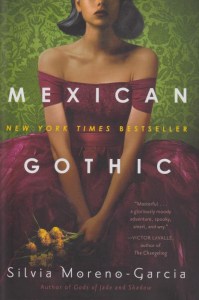
Fear comes in many colors.  Silvia Moreno-Garcia’s Mexican Gothic was getting such positive press that I didn’t wait for the paperback.  At first the title threw me a bit, but creepy old houses can be found in many places around the world, and the gothic often lurks in such structures.  The story builds slowly until the supernatural begins to seep in steadily and the reader realizes they’ve been hooked along the way.  In some ways it reminded me of Jeff VanderMeer’s Annihilation, but the setting in Mexico gives Moreno-Garcia’s tale its own kind of zest.  Having a strong hispanic, female protagonist is a nice corrective to the political rhetoric we’ve been fed for the past four years.  As I said, fear comes in many colors.

Perhaps I’m not as afraid as I used to be when I read fiction.  Gothic, however, is all about setting the right mood.  It’s a creepy sensation that boundaries are being crossed and such things often take place in isolated locations.  The house owned by the Doyles—not exactly colonialists, but symbols are seldom exact matches—is marked by greed and power.  A kind of rot is everywhere evident, but the family must keep power within its own circle.  The parallels to a Trumpian outlook were perhaps not intentional, but national trauma can make you see things in a different way.  As Noemí attempts to rescue her cousin from the house, High Place itself participates in thwarting their escape.

Reflection after reading draws out some further insights.  Not only is the white Doyle family the  oppressive element here, they do so by religion.  Secret rituals and practices have made the patriarch a god—and here let the reader ponder—who builds his power on the oppression of others.  I have no idea if Moreno-Garcia was influenced by the nepotistic White House we’ve just experienced—eager to use political office for overt personal gain, and yes, worship—but she’s laid bare the ugly truths of white power.  I dislike racializing people, but race was invented by Europeans as a mean of oppression and keeping wealth within the grasp of a few individuals who would be surrounded by an empowered “white” race.  It worked in Nazi Germany and it came close to working officially in the United States that fought to vanquish it just seventy years ago.  Mexican Gothic is a moody book indeed.  It’s also a book, whether intentionally or not, that is an object lesson for our times.


Raven Wisdom

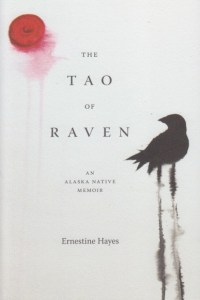
Just twenty pages in and I was reflecting on how Christianities and the cultures they cultivated have caused so much suffering in the world.  Assuming there is only one way to be, and that way is pink, European, and monotheistic, has led to so many displaced people thrown aside as collateral damage.  Ernestine Hayes’ The Tao of Raven is a remarkable book.  A native Alaskan, Hayes participated in the colonialist venture of higher education to try to also participate in the “American dream.” If this book doesn’t make you feel uncomfortable in your own skin, I don’t know that you’re human.  As I mentioned in a recent post, I have a deep interest and lasting guilt to learn about indigenous peoples of the country where I was born.  About the culture that is so Bible-driven it can’t see the human beneath.  The capitalism that takes no prisoners.

The Tao of Raven is one of the most honest books I’ve ever read.  Hayes refuses to sugar-coat the alcoholism, the broken promises, the poverty offered to native Alaskans.  Even as Trump’s final rages go on, he has opened the Alaskan Wildlife Refuge for drilling, to the highest bidder.  Apart from those whose wealth will increase as a result, we will all suffer.  Those who lived in Alaska before the colonists arrived the most.  The idea of colonizing, without which capitalism just can’t work, reveals its evil here.  When a voice like that of Hayes is able to make itself heard we cannot but feel the condemnation.  When over seventy-million people vote for a hater, we all tremble.

The book ends much as it begins.  A sincere regret for those who’d been fed the contradictory messages of missionaries.  Those told to accept suffering on earth so that they could go to the white person’s Heaven, while those inflicting the suffering lead comfortable lives with modern conveniences.  The double-standards that allow people to die on the street like dogs.  The double-standards that can’t see that you need not be Christian to upend the tables of money-changers.  Indeed, the last time someone dared to such a thing was two millennia ago.  When Christianity slipped its fingers between those of capitalism a monster would surely be born.  The cost would come in human lives, even as a quarter-million lay dead in this country from a virus a rich man can’t be bothered to address.  Do yourself, do the world a favor.  Read this book.  Read it with your eyes open and learn from Raven.


Documented Error

Back in September I wrote a post on documentaries.  One of those I’d watched was Hostage to the Devil, on the life of Malachi Martin.  Curious, I began looking for biographical information, only to find conflicting reports.  Robert Blair Kaiser, a journalist, was interviewed in the documentary and he claims that Martin is not to be trusted.  Given that Martin had academic credentials and academic publications, it’s clear that something is up here.  So I decided to read Kaiser’s Clerical Error.  As an award-winning journalist, Kaiser had written a book on Vatican II that sold fairly well, establishing his own credibility.  Clerical Error is a book, in large part, that was intended to discredit Malachi Martin because Martin had an affair with Kaiser’s wife.  That spices things up a bit.  (And explains the cover photo.)

It’s an odd book, overall.  Kaiser begins by describing how he became a Jesuit.  Autobiographical works are generally most interesting during the early years, and Kaiser does a good job illustrating how he was naive and probably joined the Jesuits out of fear of sexuality.  Some of the disciplines (including self-flagellation) are difficult to reconcile with the twentieth century (when they took place) but demonstrate the command religion can have over life.  Confronting church politics, he decided to become a journalist instead of a priest.  When he was assigned to Vatican II a couple things happen—his book gets lost in the weeds, and, he meets Malachi Martin (spelled Malachy throughout).  At first taken with Martin, the two became friends.  Martin helped him access places in the Vatican that would’ve otherwise been blocked to him, as a layman, even if a former Jesuit.

Then the tale becomes sordid.  According to Kaiser, Martin, still a Jesuit priest, began an affair with his wife.  The final third of the book has the draw of a soap opera as Kaiser tries to confirm what he suspects.  Overworked, he checked into a mental health facility, and this fact gave his detractors the grounds for claiming that Kaiser was mentally unbalanced and that Martin was really as he presented himself—a Jesuit priest, academic, and exorcist.  According to this book, which never made a large splash, the evidence is clear.  And the ability of the church to cover up scandals is legendary.  The most damaging parts, in my purposes for reading the book, are the allegations that Martin was a pathological liar.  (Why do we have so many of these?)  If true, nothing he wrote can really be trusted.  This is the very reason that of late I’ve been obsessed with the idea that lies are a clear sign of the one the Bible calls “the father of lies.”


Constipated Democracy

Vows apparently mean nothing anymore.  I suppose that’s what happens when you begin your administration with “alternative facts” and keep it up for four years.  When you vow to uphold the Constitution—hand on the Bible—that means you’ll play by the rules.  Instead we find ourselves with a bad case of constitutional constipation and we all know that we need a national enema.  It has been a week now since it’s been mathematically impossible for Trump to win the electoral college.  Yet even his evangelical followers can’t seem to recall that hand on the Bible, that promise to obey.  Apparently it’s okay to lie before God, if you think like we do.  If you don’t want to have conversation but want to talk at others and say you’re right.  It saddens me that so many Americans simply don’t care what the majority clearly wants.

This is especially the case because Trump is being treated as some messianic figure.  An overweight, womanizing, pathologically lying Jesus.  And people are saying, “Yes, that’s what the Bible tells us is good, and right, and just.”  Those who are settled in good paying jobs—people of my generation—have been beneficiaries of the systems of education and government programs that the Trump administration has spent four years dismantling.  And they have the audacity to call themselves Christian while their lives are saying “I got mine, I don’t care about anybody else.”  And they’re the ones who wore WWJD paraphernalia just a couple decades ago.  WHCB?  What Has Christianity Become?

Many of us (the excluded majority, in fact—Trump won the 2016 election while losing the popular vote) knew the greatest danger would be that he would be “normalized.”  This would all come to be seen as the normal course of politics.  People from Trump’s own family have gone on record that his run for office was a publicity stunt meant to drum up business for his failing empire.  And those who acted/wrote/supposed that he had any “plan” or “strategy” at all were simply failing to see a career grifter fleecing the country while playing golf and having his “fixers” do the work.  Until he one-by-one threw them under the bus.  This was all done in the public eye and yet his followers think he really has the best interests of this country at heart.  He has torn countless families apart, and not just at the border.  And now that he’s been defeated he keeps the charade going while his followers bow down and worship.  Excuse me, but I think I need to use the restroom.


Childhood’s End

Childhood.  It’s a time of many lessons that we soon learn to apply to all of life.  One of those earliest lessons is “Don’t be a sore loser.”  When someone else wins you congratulate them with a smile, even if you’re inwardly aching.  Fair play, it’s called.  Or morality.  All of these characteristics are sadly lacking in the Grand Old Party, it seems.  There has been no evidence of voter fraud, Biden currently leads by over 5 million votes, and yet Trump refuses to concede.  Not only that, the dissembler in chief, Mitch McConnell encourages such behavior.  In my fundamentalist church you’d have failed Sunday School for less than that.  And where are the biblical literalists?  Right there with them, thumping their Bibles but not reading them.  What happened to turn the other cheek?  Or even, for God’s sake, an eye for an eye?

Instead the world is watching as a putatively grown man throws a temper tantrum about losing.  Hilary Clinton conceded on the night of the election.  I’m sure it didn’t feel good to do so.  Nor did it feel pleasant for the 44 other losing candidates (in fact, more) who had to go home with their hats in their hands.  Not content to act like a king, Trump is behaving like a monarch for life.  His followers, perhaps aware that Americans will never again put up with such a travesty of a presidency, insist that someone must’ve miscounted by about five million.  They won’t be content until they can count themselves, throwing away any ballots they disagree with.  And they’ll continue to call themselves Christians.  Because, like the Donald, they can.

I’ve reached the stage in life where childhood has become a lingering preoccupation.  I sure got some things wrong.  Not being a sore loser isn’t one of them, however.  Like all people I’ve lost my fair share of contests.  Sometimes the stakes have been very high.  If you want to retain any dignity or moral standing at all, you know you simply have to admit, “I lost.”  We knew as soon as Trump was nominated in 2016 that he wouldn’t admit he lost then, even if he had.  We knew four years ago he’d never admit he lost when he would.  The Republican enablers stoked those fires in which to burn the Constitution.  Some of us, at least 77 million at latest count, are tired of all this political theater.  Big boy pants, it seems, are difficult to locate this season.


Favorite Color

Blue has always been my favorite color.  Even growing up Republican, I preferred it.  Like many Americans I awoke last Wednesday to a national map mostly red and pink, and watched gradually as more and more states turned blue.  I don’t mind confessing I wept when Biden took the lead in Pennsylvania.  These past four years have been torture against all that’s descent and humane.  White people killing blacks and being told there are very fine people on both sides of the issue.  Watching a virus run out of control here like nowhere else in the world because one man can’t be bothered with the troubles of 330 million (stop and think about that number) people.  A man personally enriching himself while not paying his own taxes and getting breaks for those wealthy like himself.  Endless lies.  Loud, brash, and crude.  Groping women as if they are commodities to be owned.

We have, at the embarrassingly late age of 244, finally elected a female vice-president.  Many other nations have realized that gender should not be the basis for electing leaders.  Poisoned by various forms of Christianity that assert male superiority, our culture has feared female leadership since it has become a real possibility.  I voted for Geraldine Ferraro as much as for Walter Mondale in that fateful year of 1984.  We’ve actually reached Orwell’s vision of it in 2016, but now it seems there might be legitimate hope.  I could never have imagined a presidency that would make me think Nixon, Reagan, and Bush weren’t so bad after all.  (And they weren’t good.)  This reconstruction of the Republican Party has been courtesy of the religious right, which is really neither.

Today, however, I’m enjoying my favorite color and thinking that hopefully we’ll have some peaceful years to work on true equity and the ideals on which this nation was founded.  I’m hoping it will signal to the other fascists of the world that gaming elections only works if people with consciences are complacent.  I’ve been told that many Trump supporters think Democrats incite violence.  The Dems I know are tree-hugging, owl-saving, vegan types.  We value all people, even Republicans, and ask only that all people be accepted.  We don’t tote weapons to state houses or threaten those who are counting ballots.  Yes, we may fear election outcomes—we’re just humans—but we believe in the process.  The many protests in which I’ve marched over the past four years have all been peaceful.  And I breathe, as I tear up again at the sight of blue, dona nobis pacem.