Chick Trick

Yesterday was our local town’s Earth Day clean-up day. I have always thought we lived in a clean town, and generally it’s true. When you look closer, however, the litter becomes all too obvious. Now, I know the purpose of this exercise is to get rid of pollution—my family filled five trash bags in the morning’s jaunt. As I reached for a bit of paper, I instantly recognized that I had found a half-torn page of a Jack T. Chick tract. Jack Chick is an old school Fundamentalist who draws some of the scariest cartoon evangelistic tracts imaginable. He is personally responsible for many of my childhood nightmares and phobias. Even as an adult, I still find myself believing, at some level, the tripe he serves up at the food of salvation. Children, you see, are extremely vulnerable to suggestion. Chick unremittingly claims we all deserve to burn in Hell, literally, and that only those who buy his version of Christianity can avoid it. He scares me. Instead of putting the torn comic strip in the trash, it went into my pocket. I needed to exegete it.

As a child I purchased every single Chick tract available from our local Christian bookstore. I was terrified of Hell and absolutely wanted to make sure I had double-covered every single base. A Chick tract can be read in a matter of minutes, but they can stay with you for decades. The one I found yesterday was one I’d never read. It consists of part of pages 5 and 6 of a black-on-black violence story involving a seriously looking tough guy called Ice Man. As the story opens, in media res, a photograph of “the preacher’s boy” is on a cell phone. Ice Man is seriously pissed off, and on page 6, in a drive-by shooting with an assault rifle, blows the young man away. His death, as in most Chick tracts, is violent, but bloodless. Chick spares most of the blood for the cross, where, sometimes it trickles eerily down over the repentant sinner.

IMG_0669

If I might be forgiven for some textual criticism, in which I might be guilty of a modicum of eisegesis, let me guess that the preacher’s boy had been suggesting that Ice Man change his sinful ways in the previous lacuna. In a fit of Icy rage, the PK becomes a sacrificial victim. Most likely, by the end of the pamphlet, Ice Man will have come to realize the evil of his ways and will end up on his knees. Depending on Chick’s mood that day, he may even end up dead. One thing is certain, the story will attempt to scare a youngster to a life of righteousness. The area where we were gathering trash is on the relative “wrong side of the tracks” for my little town. Some real violence does occur here, but it is mostly out of sight. Having grown up with Chick tracts guiding my every thought, I wonder if somebody got the message before it was too late. I see this torn page as a small sign of hope.


Lady Madonna

IMG_0611

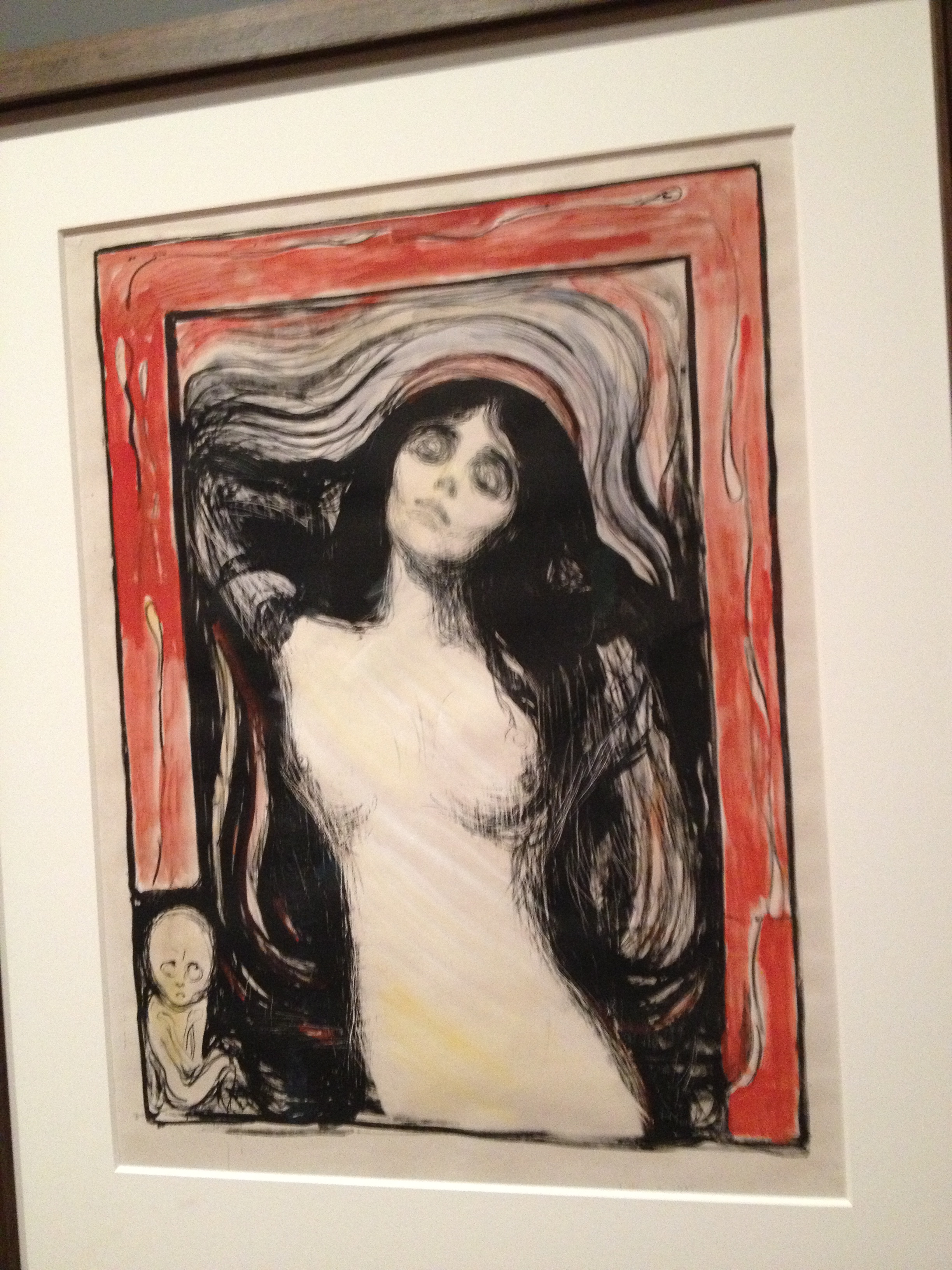
Among the paintings and prints in the Edvard Munch collection on display at the Museum of Modern Art in New York is a rendition of his famous Madonna. I first saw a reproduction of this piece in a discussion of Christian art. The question, of course, was whether it could be considered Christian art or not. Munch was not known for creating religious-themed art. Angst was his more natural home. While not the only Madonna to pose naked, Munch predated the aging pop star by a fair number of decades, and named this piece after an icon of Catholic orthodoxy. The problem is the female body. Religion in the western world has pretty much always had difficulty dealing with embodiment. My generation grew up with Charlton Heston and any number of bare-chested, sculpted idols of manhood playing such characters as Tarzan, Ben-Hur, and Moses. Moses? Yes, even Cecil B. DeMille knew the draw of having a biblical hero bathed by a bunch of young, Egyptian women. We are used to seeing Jesus nearly naked on the cross—but Mary?

The issues tied to embodiment, although they effect every person who has a body, fall more heavily upon females. While there is little agreement as to the why, the excuse is often given that “man” is in the image of God and “woman” is derivative. In actual fact it seems more likely to me that men prefer an easy excuse for bad behavior. Biology sends a pretty strong reproductive message to most males, but, in the human realm at least, the larger burden rests with the females. By blaming the victims the male hierarchy—undeniable in the case of the church, as in many religions—insists that the female body is the problem. Males perform as God intended, thank you. But the reasoning is all backward here. Munch, if he intended this to be the Madonna, is problematizing the discourse.

Art, like holy writ, is open to interpretation. Munch did not explain his enigmatic Madonna, but like Leonardo da Vinci, lets the silent woman speak for herself. Scholars have long noted the multiplicity of Marys in Jesus’ life. At some points the Gospel writers leave a little too much inference up to the reader. It is pretty clear that Jesus had no trouble with women. But he was a singular visionary in a time when cheap blame was easily found. So Edvard Munch may have been following in the footsteps of the master when he portrayed the Madonna who accuses the world of double-dealing and false standards. It is an arresting artwork, and not for prurient reasons. What is being exposed here is a soul. She may be called the blessed virgin or the mother of God, but her gender is still castigated even by those who mouth such holy epithets. We may never know who Munch intended this to be, but we know she is every woman who has been repressed by the religion of men, yearning to be free.


Buy Their Fruits

A lot of things get thrust at you in Midtown Manhattan. Many of them are religious. As I was out on my lunch break, a Buddhist monk walked up to me on Second Avenue. He thrust out a pretty token that looked like those skinny cards that used to come in with Sugar Daddies. I get a lot of things held out at me, and since I can imagine how dispiriting it must be to have people ignore you all day long, I have taught myself to take their chit as a matter of reflex. The monk looked pleased. We were outside 815, the headquarters of the Episcopal Church in the United States. I reached out my hand and he said “Buddha peace.” That was nicer than most of what I’d heard from the people who worked inside the church to which I’d dedicated years of my life. Without a beat my Buddhist friend continued, “temple donation.” I had to wave him off with a smile. Religions, no matter how placid, are out to earn a buck.

In the neighborhood of my office lurks a psychic named Sharon. I wouldn’t know Sharon if I ran into her, but I suppose the reverse wouldn’t be true. Actually, I have no way of knowing if she’s really psychic or not. She has guys. These guys hang out on the four corners of my block and hand out fliers for Sharon’s psychic readings. The guys with the leaflets aren’t psychic, I take it, because a walk around the block, on which I recognize each and every one of them, always lands me back in the office with a pocket full of psi. I see that Sharon is a third generation psychic and that she is adept at foreseeing negative energy. I would advise her not to walk past 815. If I bring in my slips of paper I get five dollars off a reading. I don’t know how much Sharon charges, but I do know that I don’t need anyone to foresee negativity in my life. I’ve got a hard enough time dealing with it when I don’t see it. And I save five bucks each time.

I sometimes wonder, as I walk past 815 Second Avenue, if anyone in there knows how badly one of their faithful was hurt by priests and bishops who had the blessing of the church. No one from the central office ever consoled or tried to comfort a person whose career had just been lifted off the rails and flung off the cliff by the machinations of some of their own. Even now those who go in and out the doors as I stand there have no idea what was done to a lonely guy on the street. In the name of the church. I think of the hollow sound of coin ringing in the coffers. I think of Judas trying to return his thirty pieces of silver. I think of money lenders’ tables being overturned. I think of Buddha peace. One hand holds out a medallion for me. The other is palm up, waiting for a return on the sacred investment.

you shall know them

you shall know them


Sacred Sexism

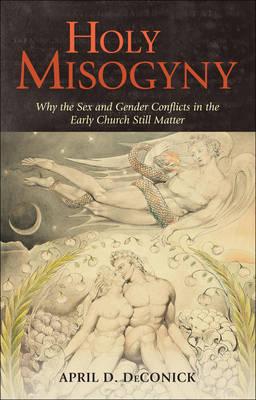
holymisogyny How terrifying to observe religion from the eyes of women! In the monotheistic traditions it begins as early as Genesis 2 and continues unbroken through to the twenty-first century. While the origin of such views seems a mystery, they may be partially understood by reading April DeConick’s Holy Misogyny: Why the Sex and Gender Conflicts in the Early Church Still Matter. Not that anyone fully comprehends the insidious idea that women are somehow less than men, but DeConick offers some insight into the issue. She suggests that sacred misogyny is, like much of life, an embodiment issue. The monotheistic traditions from the beginning have had trouble with women’s bodies. Men can’t control their urges and blame the victim. That is over-simplifying, I know, but the basic gist is about right. What can’t be missed from reading Holy Misogyny is that the idea has embarrassingly deep roots in religious thought.

The Bible starts out pretty fair. Except from the beginning the masculine pronoun is used for God, even though theologians from very early days declared God neither male nor female. How do you believe that an “it” really cares for you? Wants the best for you? Loves you? We are gender embodied. We want to know who it is that’s loving us. Genesis 1, on the human level, has man and woman created together on the same day, at the same time. The essence of their embodiment appears to be divine: “in the image of God created he him, male and female created he them.” “Human” is gendered humanity. But then the apple falls. We turn the page to find that the not yet monotheistic religion of the Bible is already pointing sticky fingers at Eve. I know that I can’t read Tertullian without wanting to hide my face when he castigates women as the source of evil.

Holy Misogyny is a disturbing book. It should be. What it does demonstrate, however, is that a wide variety of opinions and options existed for early Christianity when it came to the perception of women. Some of the Gnostic sects of Christianity came much closer to a kind of equality, but they lost out to an unremittingly masculine “orthodoxy.” The Bible itself, although written in a patriarchal world, is an ambiguous document. At points even Paul seems to indicate the genders are equal in God’s eyes, but then, he (or someone writing in his name) tells women to keep quiet in the church. Ask your husband at home. I’ve talked to a lot of church guys in my time, and Paul, I have to contest you here. Women who want to get proper instruction in matters of the soul—or of the body—would be better off reading DeConick than asking their husbands. We’ve got two millennia of unfortunate history to prove the point.


HRH vs C of E

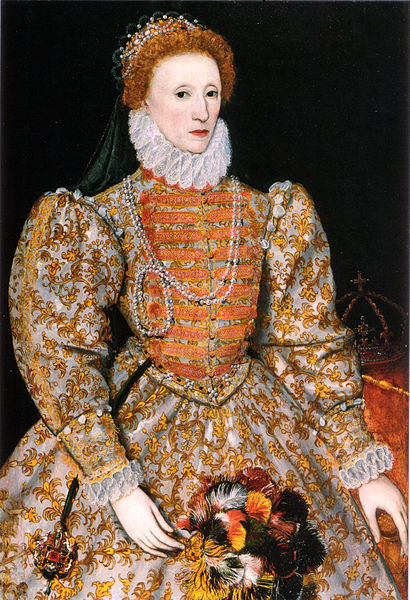
An article from the Sunday Daily Mail, the UK newspaper, opens with the headline “Queen fights for gay rights.” I was pleased, as most even-minded individuals would be, that discrimination is being addressed by Her Royal Highness. Then the implications began to kick in. Having domiciled many years among the Episcopalians, I couldn’t help but smile knowing that the monarch is the head of the Church of England. Figurehead maybe, but on the books, the buck stops in Buckingham, not Lambeth. For decades I’ve seen the Anglican communion fracturing over what is a non-starter, theologically speaking. The only reason to protest homosexuality is the loss of potential life. For anyone who believes that sex is for procreation only, I would advise trying to counsel all the spermatozoa who just didn’t make it to the egg in time. Procreation is filled with an extravagant exuberance of over-production. Walk under any oak tree or stand among the wondrous helicopters of a maple tree in early summer and ponder what’s falling at your feet.

It seems to me that what’s lacking in the religious world is love. Loving, committed couples are ostracized for being just what God made them, while self-righteous critics wag their parsimonious fingers. And this is done in the name of God. I have friends of all gender orientations, and never have they given me cause for moral concern. In fact, I have trouble categorizing them together as a group; they are individuals to me, not pigeonholes. Some churches have trouble because prejudice has become dogma. Even the Roman Catholic Church allows for sex between couples when conception is virtually impossible, as when a woman is pregnant yet doesn’t yet know it. Just try not to enjoy it too much. The life potential ends the same way. Millions must lose for every winner. Consider the ethical implications of a deity who didn’t design a one-shot, sure-fire sperm for each act. Surely it would’ve been possible to engineer for an omnipotent divinity.

Instead many mainstream churches are assiduously drawing lines in the sand, claiming that one gender, one orientation, one race, only is welcome on the side of the 144,000. The rest can, quite literally, go to Hell. Is this what religion has become? Imagine what good might be done if all that energy were poured into addressing poverty, starvation, or inadequate water supplies. Imagine those who represent the winners in the reproductive race receiving care and attention rather than those who will, by a massive margin, stand no chance of survival whatsoever. We could make this a better world instead of prolonging the suffering of those who’ve done no wrong. Those holding the balls are trying to make up the rules of the game. The Queen of the Realm seems to be saying it’s time to start playing fair. Long live the Queen!

The first queen of the Church (of England)

The first queen of the Church (of England)


International Women’s Day

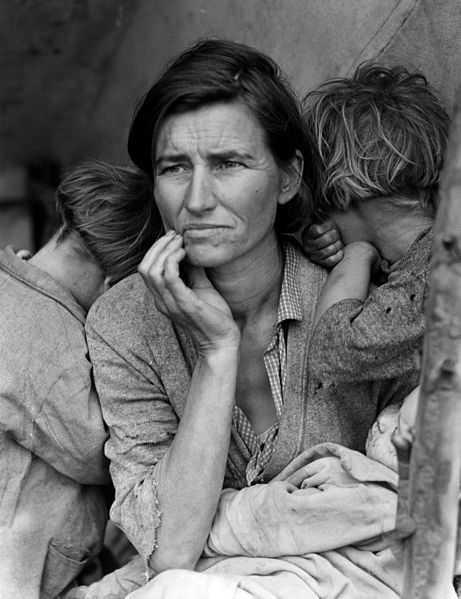
So it’s International Women’s Day, and I’m thinking about what various religions might do to celebrate it. How about equality? True equality. With rare exceptions religions have been spawned and gestated in masculine wombs. Increasing the asperity, monotheism had to, by definition, introduce a single-gendered god to match at least half of the human race’s expectations. No surprise he is a deity with a Y chromosome. For whatever reason, religions nearly always promote male experience as normative and female experience as supportive. If you disagree, well, talk to the man upstairs.

In those few precious moments when I’m allowed the luxury of a daydream, I wonder how differently the world would’ve developed without the mythology of the alpha male god. If god had been conceived as feminine in the beginning, would it have made a difference? Would the rules be more or less stringent? More humane?

Lange-MigrantMother02

Polarities are a funny way to view the world. As evolved, gender-differentiated animals, we easily slip woman and man into that category of natural polarities. Over time, however, it has become clear that reality is more complex than X or O (or I and O, or X and Y—where the male is missing something the female secretly possesses). What if the overall category were simply “human?” As we’ve evolved, we’ve learned to keep many animalistic tendencies in check. Our vast and complex societies, unique only in degree, have demonstrated that it is possible. To judge half of the human race as less able to provide spiritual leadership is an exploitation well past due for extinction. With all eyes on the Vatican over the past couple of weeks, the largest Christian denomination in the world doesn’t seem ready to shift even a nanometer on this one. Mother Mary, pray for us.

In a world where conception was a mystery (which it still is, to a point), women were the sole life givers. Men had the role of sustainers, the help-meets who brought home the meats. Somewhere along the sociological lines the order somehow switched. Might it have been religion itself that led to the subordination of the god-like ability to give life that only women possessed? By attributing the origin of life to a being, generally male, outside the realm of normal reality, religion bestowed a foreign primacy upon the human race. We became the victims of our own longing for transcendence. So celebrate International Women’s Day. If it weren’t for a woman, a goddess in her own right, you wouldn’t be reading this right now.


Beg Your Martyr

Despite the extreme antipathy shown toward religion by the educational establishment, the Chronicle of Higher Education doesn’t shy away from the topic. In the March 1 edition of The Chronicle Review, a piece by Candida Moss presents one of the uncomfortable facts of religious history to the academic world. Many of us who are “specialists” have known for quite some time that the record for mass persecution among early Christians is sketchy at best. In “The Myths Behind the Age of Martyrs,” Moss reveals that historical documents don’t present the first few centuries of Christendom as quite the blood-bath that early hagiographies do. It is true that perceptions vary depending on one’s point of view. If your auntie were thrown to the lions, it might look like everyone you knew was being persecuted. If you were a Roman historian, the numbers might seem small in comparison with, say, those pesky Carthaginians, heathens the lot of them. Still, it was this persecuted self-image that left a lasting imprint on Christianity. Until Constantine, anyway. When Christianity became imperial, it didn’t hesitate to get medieval on a few posteriors.

As Moss points out, early Christians (as well as Jews and those of other bookish traditions) rewrote their stories over time. Even altering the Bible—not yet the Holy Bible—was fair game. The whole discipline of textual criticism grew up to answer the question of what the original Bible likely said. As soon as believers take their writings as factual, however, the story will change. Were early Christians persecuted? Almost certainly. By the tens of thousands that tradition asserts? Less likely. The Romans were practical. Like most domineering classes, lording it over someone isn’t nearly as satisfying when your subjects are dead. You want that superior feeling? Keep the masses in servitude. But alive. That’s not to say that it didn’t feel like everyone you knew was being murdered for trying to do the right thing.

When I was little, I was taught that it is more important to put others’ needs and wants in front of your own. It is a basic Christian teaching. Somewhat naively, I approached the academic empire with that simple basis deeply embedded in my mind. I didn’t realize just how often others would use this trait to their own advantage. Other Christians as well as the non-religious are happy to take from the willing giver. This didn’t prepare me well for life in the business world where, I am learning, the delight in taking from the giver has only grown stronger over the centuries. So I end each day spent and weary and feeling like I’ve been thrown to the lions. Not literally. Still, I believe in the plain idea that if we all treated others’ needs before our own the world would be a much better place. I’ve never outgrown my idealism. Until others join in, however, I’m sitting in the stands trying hard not to watch what the lions are doing down below.

800px-Jean-Léon_Gérôme_-_The_Christian_Martyrs'_Last_Prayer_-_Walters_37113


Religion and Its Discontents

IMG_0575

Travel broadens the mind. I’ve always felt that travel, for those who pay attention when they do it, is one of the best forms of education available. When I do campus visits for work, my time is spent talking to faculty, but on my walks between appointments I keep an eye out for my own education. This past week at the University of Texas in Austin, I couldn’t help but notice how much religion still plays into the lives of many people—even undergraduates. One of the first things I noticed as I approached campus was the sign outside a Methodist Church announcing a sermon series entitled “When Christians Disagree.” Anyone with experience within, let alone between, denominations knows that disagreement is endemic. It would be difficult to find a single point of Christian teaching that is universally held among Christians without at least one group of dissenters. In my own experience, disagreements run deeply within Christian denominations, and the hatred experienced is often more fierce than that between Christians and “heathens.”

IMG_0574

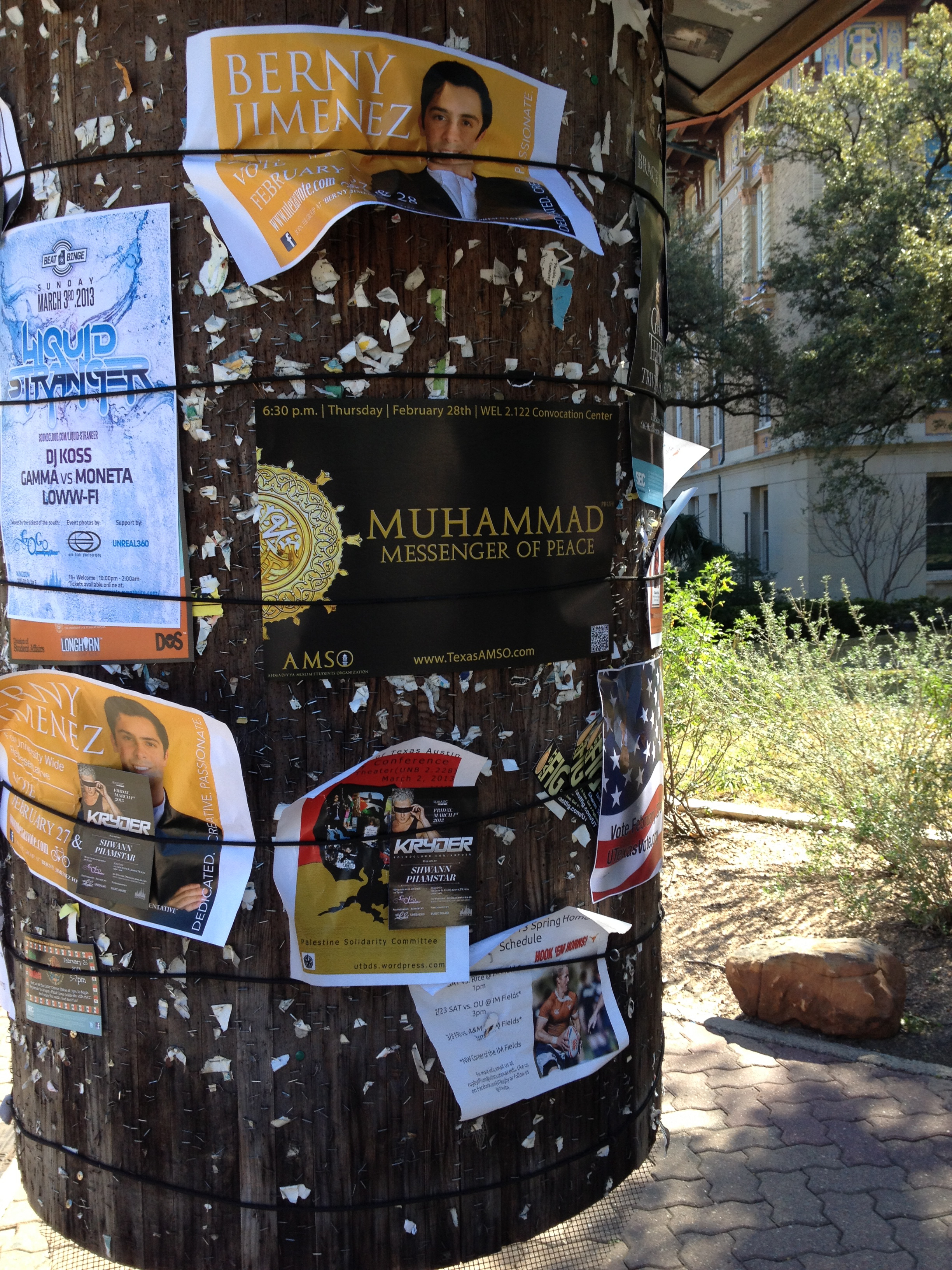
Well, maybe not between some Christians and Islam. So on a campus kiosk I found posters for a seminar entitled “Muhammad: Messenger of Peace.” In a largely Christian context, Muslim students have a difficult time with their religion being castigated in the media and in popular thought. Almost all religions are capable of violence (I was going to write “All religions” but I couldn’t think of any instances where Jains have incited violence), but most highly value and promote peace as the ideal. Few religions are actually founded on violence. I’ve heard many Christians make the claim that Islam is about conquest, pointing to the rapid expansion of Islam following the time of Muhammad. They often overlook the Crusades, one of the most violent Christian reactions to another religion in history. Is Christianity all about violence? Who is “the prince of peace” anyway?

IMG_0579

On a bulletin board I saw a notice for Asatru, the Pagan Student Alliance. If any religious group is misunderstood, surely it is Pagans. Christian missionaries liberally used “pagan” to denigrate the old religions they encountered throughout the world. Often attempts were made to eradicate such beliefs completely. With some success. Many forms of paganism today are revivals of the old religions, and a few are actual survivals. The Pagans I know are moral, peace-loving people as well. Claims of human sacrifice (often fabricated) aside, paganism was, and is, an attempt to make peace with the planet upon which we find ourselves. Peace, it seems, is a desideratum of many religions. If we studied college campuses, where such beliefs are encouraged to coexist, we might find a model that would work for people in the “real world.” And perhaps peace really would have a chance.


Persistent Idealism

Few spans of human life are so idealistic as our college years. There we meet many people from beyond our hometown, and we learn the treasures of diversity and different ways of doing things. Ideas mix and blend, and with professors who’ve learned so much telling us all the places we can go, the possibilities seem endless. I find the idealism of college kids refreshing. That’s one reason, I suppose, that I enjoyed teaching them so much. At work you’re far more often told why things won’t work and how they can’t be done. And I find myself thinking back to college and wondering when people lost their sense of vision. When did idealism die?

Yesterday I spent on the campus of the University of Texas at Austin. Between appointments I was crossing a quad area and noticed a bunch of blue and white balloons. We’re all still kids inside when we see balloons. I stopped to look. Then I noticed, across the street (in which sat a very obvious police car) a small group of students waving a Palestinian flag. Several police, frankly looking bored, stood between the two peaceful groups.

IMG_0581IMG_0580

Looking back to the balloons, there were a series of tents set up and a sign read “Israel Block Party.” Obviously this had been a carefully planned event, and we all know the heinous story of the constant persecution of the Jews throughout much of “civilized” history. The simple table across the street bore the sign “Free Palestine.” Less than ten students stood around, handing out literature, peaceful, yet literally flying their flag. Yes, the Palestinians have also been oppressed for much of their history. If only adults could live so peacefully as these students. My heart went out to them.

The issue of Israel and Palestine is one of the deepest scars in our collective human psyche. Indirectly, that conflict is responsible for many tragic terrorist acts, including the attacks of 9/11. And it is so frustrating because both sides (and there are actually more than two) are victims. We like our good guys in white and our bad guys in black. I’m still an idealist, after all. Yet in Israel/Palestine we have two historically oppressed groups vying for the very same land. And in the middle of this maelstrom, the Bible. The very book that can be read as an eternal promise by God that the people of Israel should own this land. By 1947, however, we’d stopped relying on God and began relying on guns. And atomic bombs. And life has never been the same since.

Images of the wall going up between Israelis and Palestinians just after the wall went down in Berlin reminded me of Bush’s proposed wall between Texas and Mexico. Here in Texas just about everyone in the lower paying jobs I’ve met is hispanic. And friendly. Grateful in a way that many of us wouldn’t emulate in such low stations. We are all people. We all experience the same feelings, needs, and desires. Why not tear down the walls and let us look at one another? Take a good, long look. And my idealistic self says, if we face another human being with love everything will be all right.


Austin City Limits

Maybe it’s just because Texas feels like the brass buckle of the Bible Belt, but I had moral qualms about landing in George Bush International Airport this afternoon. Texas has so many worthy heroes, but in the land of Rick Perry, recent Republican politics is king. Not queen. But king. It felt like a work of supererogation to drive to Austin after a three-and-a-half hour flight to Houston, but Texas reminded me of Illinois with palm trees. And cacti. Well, okay, and longhorns. One could get culture-lash flying here from New York. Before I embarked I had visions of my rental car being a huge Cadillac with real steer horns for a hood ornament. I just couldn’t picture myself in a ten-gallon hat.

I sometimes wonder how religion could’ve come to divide a nation such as the United States. Founded on the principles of religious liberty, lately one party has been claiming the right to legislate morality for all, deeply polarizing a populace that should be able to accept differing viewpoints. Still, there are issues on which human rights insist there can be no compromise: women have equal rights with men, and have the right to self-determination just like men. It truly amazes me that such common sense can even become a divisive issue. If we could agree on even that, we’d have to declare it progress over the objections of the Religious Right. My thoughts wander that way when I tarry in the south. It’s really a pity. The people are friendly here and the landscape has its own beauty. Are we really that different?

I’m not altogether convinced that this isn’t just a case of prejudice masking as religious sensibility. Religions can be all too gullible when they feel their honors might have been impugned. While I regularly express my opinion here, I do respect nearly every form of sincerely held religious belief. None of us has all the answers, and it seems the height of hypocrisy to insist that anyone is right all the time. Nevertheless, my sojourn beneath the Bible Belt has me wondering about the origins of various religious squabbles. Or maybe it was the just the long drive along the “presidential corridor” after touching down at an facility that most websites still refer to as simply, Houston International Airport. Travel broadens the mind—it is, in fact, an excellent form of education. Maybe if we got out more we would all get along better.

From here we all look the same.

From here we all look the same.


Gods and Goliath

EyreAffairNot only gods are proficient at creating worlds. Writers, as readers know, are the creators of worlds too. I first discovered Jasper Fforde via a friend’s recommendation. With the depressing demise of bookstores, however, I end up picking up whichever one happens to be on the shelf. Not that this is a bad thing, but I find myself in a melancholy cast when I think of all the joy that is not being had by avoiding reading. It’s all rather hollow, wouldn’t you agree, Mr. Eliot? All of which is to say Jasper Fforde’s The Eyre Affair was great fun. As usual when I read fiction, I kept an eye out for how religion appeared in this alternate world—most fiction that ignores religion completely somehow seems to be less realistic than Fforde’s fantastic tale. In the world of Thursday Next, the churches are dedicated to GSD, the Global Standard Deity. As one of the characters explains, the GSD is a combination of all religions intended to stop religious wars. It’s a great idea on paper, but religions are prone to wars as sparks fly upward.

Somewhat later in the novel Thursday encounters a crucifix-wearing vampire. Fooled by the sigil, she almost becomes a victim to the blood-sucker. When Thursday points out the supposed impossibility of a vampire wearing a crucifix, he replies, “Do you really suppose Christianity has a monopoly on people like me?” Although Fforde can be a great comic writer, some of his quips are quite profound. Indeed—does Christianity have the only vampires? All religions have their monsters, whether that’s what the author meant (score one for reader-response theory). The truth is the truth, no matter whether intentional or not.

The idealized world of The Eyre Affair is one in which religion has become universal. The great military conglomerate in the book is called Goliath not because of the Bible but because of its size and apparent strength. It is brought to its knees, however, by Thursday—a female David, if you will. In practical terms, throughout the book the military is much more powerful that the church of GSD. Perhaps that’s because people are afraid. Religion, which once upon a time allayed fears, has now become one of their main generators. “Nothing frightens me more than religion at my door,” John Cale once sang. In this rich complexity the reader is invited to bask as Jasper Fforde works his magic. Do yourself a favor and pick up one of his books. Before it is too late. You might find yourself learning a thing or two about religion. I did.


No Play-Thing

Childs_PlayPossession. It’s one of the scariest concepts in the religious arsenal. The idea that a person could be taken over by a different entity and surrender his or her selfhood to a malevolent saboteur is frightening indeed. Horror films have been deft at exploiting this. As a college student I was slow to watch the latest horror flicks. Some I’m only now beginning to find. Over the weekend I watched Child’s Play for the first time. Like most people who have some sense of popular culture I knew that Chucky was an evil doll, but I never really knew the backstory. Despite the utterly untenable hypothesis of the movie, it still manages to be scary in our CGI world, despite the bogus lightning. The frightening part comes from what is an admittedly creepy doll in the first place becoming possessed by a religious serial killer. Charles Lee Ray, named after three infamous assassins, displays facility with a religion that some identify as voodou, although that association comes primarily from the voodoo doll that Chucky uses to dispatch his mentor.

At least Child’s Play makes the effort to explain what forces exist that might bring plastic and stuffing to life. In true horror fashion, it is not the Christian god, but forces that are somehow more powerful, more malevolent. It would hardly behoove the maker of all the universe to inhabit a Cabbage Patch knockoff. The Lakeshore Strangler has been in training to cheat death and remain alive forever. He takes lessons from a mystical character whose religion is referred to only obliquely, yet whose efficacy is obvious in the malevolent toy. Willful suspension of belief is necessary to make this resurrection story plausible, but that disbelief must include belief in religious powers. The horns of this self-same dilemma hoist all religious believers in a scientific world.

Chucky is participating in one of the oldest of all religious traditions—death avoidance. Some of the earliest evidence that we have showing that hominids were developing religious sensibilities is the burial of the dead. There is really no reason to bury if we are only carrion like every other meat-based product. Whether it is out of fear or reverence, we turn to religion to assure us that there’s something more. It may not be scientific, but that’s largely the point. For many even today, a concluding scientific postscript leaves a body cold. Time for a leap of faith. Horror films are often decried as lowbrow and unsophisticated. Chucky, however, like many mythic monsters, is rapping his inhuman fingers on the door of religion. Specifically resurrection. Although in this case, it might be best to keep that door firmly closed.


Maltese Faction

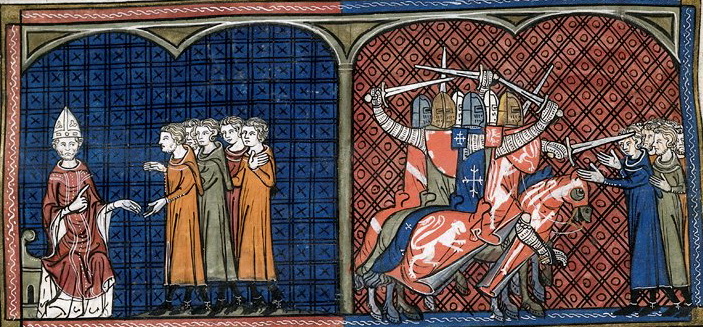
The Crusades remain one of the most celebrated episodes of religious violence in the history of the church. I am certain that many would put forward other instances of official violence to rival the piecemeal warfare of the Middle Ages, however, the Crusades still jolt many Muslims for their unflappable conviction that God gave the Holy Land to them. Ironically a bit of good emerged from the carnage in the form of sometimes secret orders of knights whose charge was originally to care for injured and sick Christians. Thanks to Dan Brown everyone knows of the Knights Templar. There were, however, several of these orders spanning the eleventh to the sixteenth centuries, and some of them survive today. In Sunday’s New Jersey Star-Ledger a story appeared of the 900th birthday of the Knights of Malta. I don’t recall having heard of them before, but then, it has been many years since my last class in Medieval Christianity. And no wonder—they don’t even appear in Wikipedia under that name.

What is so interesting about the Knights of Malta is that, like the Vatican, they have the authority to act like a country. According to the Associated Press, the knights can issue their own passports, stamps, and money, and have diplomatic relations with real countries and even have observer status in the United Nations. The blurring of the lines between religion and politics, as any student of history knows, has deep roots indeed. The Knights of Malta, however, own no territory (no, their eponymous island isn’t theirs). A nation with no territory. At least the Vatican has its own city. The Knights still exist for their charitable works and, it is to be hoped, not for the conquest of lands legitimately owned by others.

The Sovereign Military Order of Malta (“sovereign” and “military” were omitted in the press), is a sub-branch of the Knights Hospitaller, the oldest surviving chivalric order in the world. It is nice to think that the church might still have a few knights up its sleeves. The concept of chivalry has largely been absorbed into chauvinism, however, and even now the Knights of Malta are men. Along with the Vatican, that makes two entities run completely by males that assert their own sovereignty. In the twenty-first century it would be nice to think that we wouldn’t need monied men in robes in order to help out those in need. But then I’ve always been prone to believe in myths. And knights tend to follow after daze. Crusades, however, have far outlived their putative usefulness.

Good knight?

Good knight?


God’s Country Club?

Heaven is a sparsely populated place. Considering its vast celestial real estate, vis-a-vis the earth, it must be downright lonely. Maybe that’s the way the elect like it.

Official teaching, as it is often called, for many churches is downright brutal for those who dare explore. This past week the sin of Rob Morris, a Lutheran Pastor (Missouri Synod) who had the audacity to pray for the children slaughtered in Newtown, Connecticut in the same room as—gasp—Jews and Muslims, has been in the news. You see, Missouri Synod pastors aren’t allowed to worship with those outside their brand, and the president of the Synod, Matthew Harrison, insisted on an apology from Morris. Never mind the twenty-six coffins in the room. This is about doctrine!

Exclusion is part of what gives religion a bad name. Yes, there are some people who appear evil—I’m glad I’m not often put in the place of judging that. For some Christian sects, however, the gate is very narrow indeed, and the path exceptionally difficult. More than one Christian denomination, presumably those not so good with arithmetic, officially teaches that only 144,000 will be saved. A thousand gross, and not one more. These poor sinners keep hoping they’ll get in without adding up the hundreds of generations standing in line before them. I get the sense that their heaven wouldn’t exactly be paradise for any of the rest of us who happened to slip in. If the world were full of people like me, I think I’d be on the first space shuttle off to parts unknown.

Overlooking the gross insensitivity to the fact that Morris was trying to heal his community after a tragedy where children—children! To whom most religions give a free pass into heaven—were being mourned, we must wonder what the paradise of Missouri Synod Lutherans looks like. A heaven without diversity. Smiles must be rare indeed. And long, long, long naps very common.

For those of us committed to the common good, heaven on those terms is no ideal place. In fact, I doubt that God would be tempted to spend much time there. I think that God was present at the interfaith prayer vigil, and that Rev. Harrison has yet to receive an apology postmarked “Heaven.”

Rules is rules.

Rules is rules.


Rise of Religions

mansdominion Imagine my surprise when, as a boy raised in a fundamentalist family, I arrived at a liberal seminary to find myself accused of sexism. Like most kids I had been taught not to question religious dictates. Majoring in Religious Studies, even in as conservative a college as Grove City in the 1980s, even there I learned that to be educated meant learning to question. I’d thrown off fundamentalism by the time I reached seminary—I supposed I was making great strides. I’d always been in favor of equal rights for all, just because it seemed right. I supported gender and racial equity, but I was obviously still guilty of something. It has taken me decades to realize it, but being male is sufficient grounds to be despised. Perhaps it’s not as bad as all that. Maybe it’s worse.

Sheila Jeffreys’ Man’s Dominion: The Rise of Religion and the Eclipse of Women’s Rights was nevertheless a sobering read. I supposed that it might be a historical introduction to the problem, but instead it is a bold declaration of some uncomfortable facts. All ancient religions, at least those that survive, had subordinated (and continue to subordinate) women. That’s not path down which a liberated religionist wants to stroll. I found myself resisting these assertions at first, but as Jeffreys keeps the examples coming, they are difficult to deny. Yes, religions have been founded by men and they favor men. Not that belief necessitates that, but history seems to. Even in religions where women’s leadership is allowed, it is because some men have decided it is okay. There’s no changing the historical trajectory to the past. Religions were invented by men. Given their druthers, they will, at best, treat women as somehow less important than men. The missing element here, however, is sincerity of belief.

I doubt that Jeffreys would claim that religions were devised by males in order to subordinate females. It’s hard to say whether that first inventor of religion really believed all the stories he told, but soon people came to do exactly that. And those stories grew into something more than myths, and became the basis by which lives were lived. They became literal. And women, who played only supporting or villainous roles, soon became the victims. I know that’s too simplistic. I also know there’s some truth in it. I went to seminary to learn more about religion. What I discovered was often an unwelcome reality. Although I never personally tried to oppress women, I participated actively in a club that did—the club of masculinity. It may be that religion itself will always lead to oppression of the other, for religions don’t form in perfect worlds. If you have any doubts about that all you have to do is ask half the human race.