Digging Deeper

A propos of apes, I’m not sure whence derives the draw of Planet of the Apes on me. I watched the movie with fascination as a child—since the obviously satanic delusion of evolution was impossible this had to be pure fantasy (and perhaps just a little dangerous). The movies just kept on coming, Beneath the Planet of the Apes, Escape from the Planet of the Apes, and Battle for the Planet of the Apes, each with their new twist on the theme that we are the beasts. Recently I watched the second installment, Beneath the Planet of the Apes. It had been years since I’d seen it, although I remembered the terrible mutants and their possession of an atomic bomb. Although the geography is badly distorted, it is made amply clear that the church where the bomb is stored is St. Patrick’s Cathedral on (beneath?) Fifth Avenue. As Brent makes his way into the partially intact cathedral he finds a priest praying to a missile with the letters alpha and omega inscribed on one of its fins.

Since last seeing the movie I spent a lengthy stint among the Episcopalians. Naturally I became thoroughly acquainted with the liturgy and therefore could appreciate subtleties in the movie I had missed before (nothing is ultimately wasted, it seems). As the mutants prepare to set off the doomsday bomb that will obliterate the entire planet—both apes and humans—they recite many prayers from the mass, substituting the word “bomb” for “God” and “Holy Fallout” for “Holy Spirit.” Okay, so maybe “subtleties” was the wrong word. Of course, back in the early 1970’s this was a very real concern, the arms race was well underway. Despite the overacting and forced script, the movie did offer considerable social commentary. Ironic and iconic Charlton Heston condemns the unadulterated praise of such a lethal weapon (or was it just missile envy?), even as he falls, shot, onto the controls, accidentally destroying the earth.

The fascinating aspect of this social critique is that the players may have changed, but the drama remains the same. Those who protest evolution praise the build-up of native strength so that the true Christians might obliterate their enemies first and better than they will obliterate us. One gets the feeling that destruction is not so bad a fate as being proven wrong. Somewhere along the millennia religion slipped its mooring from being an ethical way of life to become an extreme way of believing. And yet people are still the same. And the Planet of the Apes movies continue to appear, ever evolving. When it comes down to the final scene, however, it is not the evolved apes who destroy us. No, it is the utterly self-righteous humans who decide that if they can’t have it all, nobody will have any of it. In the name of the bomb, and the holy fallout, amen.



Flea the Obvious

In one of my personal ironies of history, the period of ancient times that I find least interesting is the one I’ve been reading most about. Part of that is based on my lack of coherence when it comes to selecting reading material. I take recommendations seriously, so when a friend suggested Justinian’s Flea by William Rosen, I figured I’d better read it. I had fairly recently read Philip Jenkins’ Jesus Wars, about the nearly unbelievable shenanigans of post-apostolic Christendom, and so I felt up to taking on the Plague. Justinian’s Flea is about the fall of the Roman Empire. At Gorgias Press, where Justinian’s former prostitute wife Theodora was subjected to revisionist history that made her a lifelong saint, I learned to discount most of what went on during this time period. I was, it seems, a bit too hasty. Justinian and Theodora’s reign is quite interesting, and it is, as intimated, largely because of ecclesiastical politics.

Rosen begins his study by laying out the background to Justinian’s imperial days in Constantinople. In describing the disputes between what specialists now call various Christianities (formerly true believers versus heretics), Rosen notes that Christians had particular disdain for Gnostics, largely based on interpretations of what Jesus’ death might mean. At one point he writes, “Monotheistic religions are famously intolerant of apostasy, even when they disagree about what constitutes it.” Here he hit the flea on the head. “I doesn’t know what it be, but I’m ag’in it.” This attitude of religions has long been the motivation behind massive campaigns of bloodshed and intolerance. Often in the name of religions that claim peace and tolerance as the highest goods. So it was in the early church; heretics were routinely martyred for their “wrong” belief.

Not to throw in a spoiler, but the first great wave of the Plague does nearly draw an end to the ailing Roman Empire. Justinian’s expansions were mere band-aids trying to hold together a Frankenstein’s monster of many nationalities. So riding home on the bus I was surprised first of all that the driver engaged a passenger in conversation (generally frowned upon) and second of all, that he ranted for many miles about politics. It isn’t very comforting in the stressful traffic around New York City to hear your bus driver cry out, “the Roman Empire collapsed—maybe it’s time America did as well!” The prospects of getting home seldom looked dimmer. And I had just been reading about that very empire’s last days. I try to stay away from predictions because I dislike being proven wrong—the end of the story hasn’t been written yet. Rosen, however, has given us a great cautionary tale; if the humble flea can help bring down the world’s mightiest empire—one ruled by a leader overwhelmingly concerned with religion—maybe it’s time to canvass what the infidels like to take in their coffee.


Heat Wave

Stewing in the heat of the wave washing over much of the east, my thoughts sometimes turn to the cool, refreshing flood of Genesis. I’ve been Tweeting the Bible for some months now, and I am in the midst of the stories of the flood. Noting the many contradictions and discrepancies, it is a wonder to me how many of the religious are able to overlook or harmonize infelicities for the sake of a consistent faith. Most famously the story states that Noah took one pair of the clean animals, but also seven pairs of clean animals. The rain came down forty days. Or was it 150? One of the reasons that people continue to believe this story may be its specificity. No approximations or guesses, the numbers are precise, as if written down by an eyewitness at the scene. In actual fact, the story is among the oldest of recorded civilization and has its origins at least as far back as ancient Sumer. For as long as people told stories about the gods, they told stories about world-wide floods.

As a species that is able to think ahead, we have long been concerned with the fate that might befall us. Consider the amount of hype about the end of the world that has accompanied the random calendrical dates we’ve assigned to the cosmos: the world has been expected to end nearly every year since 2000, and that is only the most recent incarnation of this foreboding. If there are gods out there, they must have it in for us. The very fact of our being human seems to anger the deities. Even after God promises the world will never again be destroyed, he adds a caveat—not by flood, anyway. By the time we reach the letters near the end of the Christian Scriptures the future torment has turned to fire. There’s always something out there looming on the horizon.

“Prometheus teacher in every art brought the fire that hath proved to mortals a means to mighty ends,” so reads the quote from Aeschylus behind Paul Manship’s statue of Prometheus. Prometheus was the Greek god (Titan, actually) favorably disposed toward humanity. His name means “forethought.” When humanity cowered and shivered in the dark, Prometheus brought the light and warmth of fire. It is easy to suppose the Greeks to have been more enlightened than earlier or contemporary civilizations, but Prometheus had offended Zeus and was subject to eternal torment for his thoughtful gift. Perhaps it is just the divine way—gods are jealous of us although they hold all the power. As I continue to tweet the good news of an angry god, I am starting to understand the power deities will always have over their vulnerable creatures.


Burned Over

Western and central New York State, in any religious history of America, have acquired the nickname, “The Burned-Over District.”  This graphic metaphor arises from the constant evangelizing and, more importantly, the fertile soil for new religious movements left in its wake.  This region could claim to be the home of Seventh-Day Adventism, Spiritualism, the Oneida Society, and the Latter-Day Saints.  It was also an early home of the Shakers and the land chosen by the Publick Universal Friend for her new Jerusalem.  The sense of place is important to religions.  The Latter-Day Saints, however, grew restless in this region where Joseph Smith translated the Book of Mormon and began a torturous trek that would land the Mormons in Utah.  Joseph Smith never made it that far.  Religious leaders being persecuted are nothing new; Smith had been tarred and feathered, was wanted on charges of fraud, and was eventually murdered for his beliefs.  He was also one of the most intensely creative individuals America has produced. His extraordinary creative venture is often overshadowed by the religion that grew out of it.

With Mitt Romeny’s campaign stoking up steam, many people find themselves wondering about Mormonism.  I first learned about the Latter-Day Saints from a rather biased World Religions course at Grove City College.  One aspect which was true in that course, however, was the great secrecy surrounding Mormon teachings. Of course, the Book of Mormon is in the public domain and is easily available to those who wish to read it.  Official Latter-Day Saint beliefs, on the other hand, are frequently inscrutable.  For all its problems (and they are sometimes significant), mainstream Christianity is very open (and often vocal) about its belief system.  The same holds true for Judaism (mostly) and Islam.  If you want to know what they believe, just ask.  Americans tend to be a little perplexed by the Latter-Day Saints because there is always a feeling that there is something they’re not telling you.  It goes all the way down to the underwear.  All religions are concerned with sex.  Some may not disclose the details in public, but they all deal with it somehow.  Latter-Day Saints have rules about underwear–I’m sure other religions do too.

If Americans are really, seriously curious about the religious heritage of a potential president, a great way to find out is to read a bit of our own history.  I learned about the Burned-Over District back in college and have periodically read about it several times since then.  It is no secret.  Our society is not likely to expend the energy needed to learn about its own heritage.  As several of my recent posts have intimated, even higher education has no time for the study of religion (or history, or anything that doesn’t make money–Romney surely does!). Instead we will charge fearlessly ahead into the dark.  And when we are in the dark we may start to wonder why we’re wearing this unusual underwear. Wondering about religion is far easier than supporting those who study it.

Have you seen this man?


Cabin Fervor

It’s a sure sign that work is growing overwhelming when I’m too tired to watch my weekend horror movies. Well, I decided to fight back the yawns and pull out Cabin Fever this past Saturday night. I’d seen the movie before, and I’m not really a fan of excessive gore. The acting isn’t great and the characters aren’t sympathetic, yet something about the story keeps me coming back. In short, a group of five teenagers (it always seems to be five) are renting a cabin for a week when they get exposed to a flesh-eating virus. They end up infecting just about everyone in the unnamed southern town before they all end up dead. It doesn’t leave much room for a sequel, but that hasn’t stopped one from being made. One of the unfortunate victims of the virus is torn apart by a mad dog. The locals, fearing their safety, decide to hunt down the surviving youths.

On the way to the now gore-smattered cabin, one of the locals mutters that they’ve been sacrificing someone—a natural enough conclusion when body-parts are scattered around, I suppose. He says, “it ain’t Christian.” Well, yes and no. Sacrifice is at the putative heart of Christianity, although human sacrifice (beyond infidels and women) was never part of the picture. As is often the case with horror film tropes, the victim who has been dismembered is a woman. The guys whose deaths are shown are all shot. Now, I have no wish to attribute profundity where it clearly is not intended, but there does seem to be a metaphor here. Our society and its staid religion tolerate the victimization of some over others.

One of the hidden treasures of the best of horror movies is the social commentary. George Romero made an art form of it in Night of the Living Dead and its follow up Dawn of the Dead. Many other writer/directors have managed to do it quite effectively. We can critique our world when hidden behind the mask of the improbable. While the commentary for Cabin Fever may be entirely accidental, I still find a little redemptive value in it. That, I suppose, is the ultimate benefit of social commentary—it is true whether intentional or not. Is there a larger message here? I wonder if the fact that when women are victimized no one survives is pushing the metaphor a little too far. It’s hard to say; I’ve been working a little too much lately.


Problematizing Noah

As I continue to Tweet the Bible, I’ve been working through the story of Noah. Considering the number of children’s items imprinted with the friendly, smiling Noah and Mrs., and the cute, predatory animals they’re taking aboard their private yacht, the utter belligerence of the story is frequently lost. There is one seriously peeved God behind this. “And it repented the Lord that he had made man on the earth, and it grieved him at his heart,” Genesis 6.6 states. And it only gets worse from there: “I will destroy man whom I have created from the face of the earth… for it repenteth me that I have made them.” Indeed, the wrath of God is emphasized more than the wickedness of the humans that have spawned it. No matter what is done, it seems, God will still be in a rage.

The truly striking aspect of this account comes, however, when Noah is instructed on whom to save. “Thou shalt come into the ark, thou, and thy sons, and thy wife,” verse 18 dictates. Men first. Now, we cannot judge a product of the past against standards of the present day, but it is quite clear why many women find the biblical text less-than-friendly. Even the animals are explicitly paired from the start do not receive the radical disjointing that the women receive from the men. If the purpose is to procure a new generation, arguably pregnant women could have done that with the men treading water above the remains of Eden. If survival is the point of the story, as the saying goes, ladies first.

The flood story is a complex account of a deity with anger management issues and a preference for the company of men. Although theologians may say with a wink that God has no gender, clearly the Bible begs to differ.

Humans and animals alike are victims of the divine wrath, and even though humanity survives the flood can the relationship with deity ever be the same again? How do humans face a creator turned destroyer, knowing that they will never really please him again? The weight of such divine displeasure is surely greater than all that water pressing our ancient cousins into fossils on the primeval sea bed. I think back to all the children’s toys with the happy little animals and a smiling Noah and I know they resemble the biblical version only in the most fleeting of fashions. Yet the myth lives on.

What shape is your ark?


Lies, Damn Lies, and Statistics

“The fear of the Lord is the beginning of wisdom,” so the books of Psalms and Proverbs agree. It must be true. Religion and fear walk happily along hand-in-hand. Some have suggested that religion began as a human response to fear. So this week I felt a little conflicted as I read Daniel Gardner’s The Science of Fear: How the Culture of Fear Manipulates Your Brain. The book had been recommended to me by one of my brothers. As a child fear defined me—it seemed that in a world where God was meant to be feared (for I was a literalist) that fear was the basic operating system for life itself. Gardner’s book is a fascinating exposé of the culture of fear. Gardner doesn’t really suggest that fear should be eliminated, but he does show how many of those in power manipulate fear into a faulty perception of risk management, for their own advantage. Beginning with 9/11 he demonstrates how the irrational responses of people to the tragedy led to even more deaths that quickly became buried in the white noise of everyday society. Comparing Bush’s response to FDR’s “the only thing we have to fear is fear itself,” Gardner demonstrates that the United States emerged from the depression and Second World War weary but confident and strong. After Bush’s two terms, the country is cowering and weaker. Why? The Bush administration heavily mongered fear.

Funnily enough, the release from fear comes from two main sources: statistics and psychology. Statistics reveal the true odds of common fears—these can be inflated so as to create an atmosphere of threat. People, as herd animals, will gladly give more power to the alpha male when serious treat is perceived (don’t kid yourself, politicians have long known this). Psychology enters the scenario because people think with both reason and emotion. Our immediate, visceral response (the “gut reaction”) is instantaneous and powerful, developed from millennia of evolution. It is, however, irrational. Reasoned responses, often better for us, take longer and people do not like to force themselves to think hard. We have a whole educational system to prove that. Faced with hard thinking or quick solving, which do you prefer? Be honest now!

Ultimately The Science of Fear is an optimistic book. Being made aware of the problem is half the struggle. Garden-variety fear is fine. Systemic fear paralyzes. Religion is often defined as one of the building blocks of culture. Instead of offering release from fear, religions frequently add their own ingredients for recipes of even greater fear. The concept of Hell is a great example: think of the worse thing you possibly can. Multiply it by several orders of magnitude. Repeat. And repeat. You’re still not even close to how bad Hell is. There’s your motivation right there. Place that religion in the midst of a society rich with natural resources and led by schemers who know that xenophobia increases power, and voila! Paradise on earth for some, a life of fear for the rest. Manipulation characterizes both the evolution of religions and societies. Gardner doesn’t directly address the religious side, but that’s the beauty of reason: he doesn’t have to. The cycle can be broken; think of Mark Twain’s words I’ve selected as a title. Think hard.


No God for Women

A friend recently asked me to write a post on the feminine image of God. Specifically, she noted that images of God tend to be overwhelmingly male, even today. Having written a book on the goddess Asherah, and being very interested in gender equality issues, I was intrigued by this request. Growing up male it seems natural in our culture to find representations of God as a man. It stands to reason that in a culture more open to feminine experience we should find female images of God. They are, however, still lacking. This combination of improbable facts kick-started some ideas about both religion and culture. To begin at the beginning, although the Bible makes passing references to God as either non-gendered or even female in rare places, clearly the predominant metaphor is masculine. The third-person masculine singular pronoun (i.e., “he”) is almost always used for God, beginning in Genesis 1 and running straight through. The Judeo-Christiani-Muslim deity is decidedly male in his demeanor. All three religions developed in circumstances of male social dominance.

Enter the 60’s (1960’s, that is. C.E.). Women were able to begin expressing their needs without the whole weight of a social McCarthyism bringing down the girth of the government upon them. Instead of finding feminine traits to the god of the Bible, interest in goddess worship revived. Now, serious scholars disagree on just how much a role the goddess played in the development of monotheistic religions. The end result, no matter how you parse it, is pretty masculine. Therefore some women found the goddess to be more conducive to fulfilling their needs. Problem is, there never was, historically, a goddess monotheism. There were always goddesses, plural. Without the unifying force of a single, female deity societies just never fully coalesced around a single, strong image of feminine deity. Some have tried to put Asherah in that role, but she was defined by her husband El and shared the stage with Anat, Shapshu, Ashtart, and a host of other potent females. In a world of two basic genders, monotheism favored the male.

Are there female images of god? Undoubtedly there are. There will be a great deal of difficulty finding them because Christianity very quickly invented the idea of heresy (something Judaism fortunately lacked). This assured that the “orthodox” voice would always be the loudest in the shouting match that we call religion. This situation has had two millennia to ferment and brew. Theologians (mostly male) early on stated that God really has no gender. After all, a male god does imply a lady somewhere in the wings—otherwise human maleness is really superfluous, theologically speaking. Rather than embrace castration, let’s just keep god male, the thinking seems to go. Religions are conservative by nature. They may breed radical free thinkers, but natural selection comes to their rescue by reinforcing the bearded, chastely clothed, divine father. Until society is ready to embrace true equality, however, religion will continue to privilege the big man upstairs.

Monotheism’s bete noir?


Lunchtime in Midtown

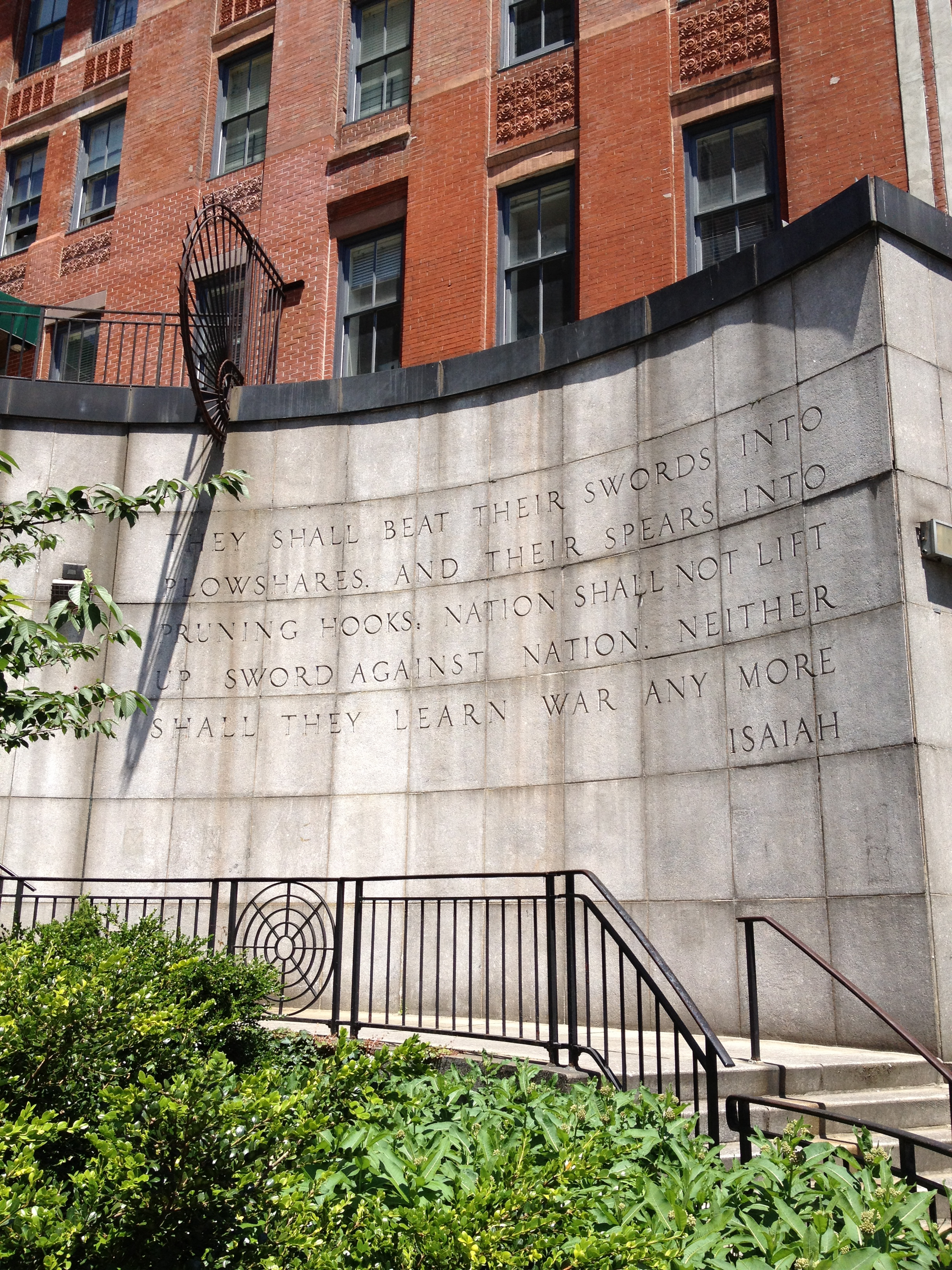
It was a brilliantly sunny day and there seemed to be rain nowhere in sight. It wasn’t even hot. Days like this have been rare this spring, so I went out for a lunchtime walk in my neighborhood. I’d been by the United Nations with some visiting family the day before, so I went down again and pondered the words attributed to Isaiah carved in the wall across from one of the largest intentional organs of peace in the world. I was reminded that a copy of the Edict of Cyrus resides in the UN; as a historical text it is often considered to be the first document promoting religious tolerance among lesser powers allowed by a greater power. The world could use a few more like old Cyrus the Great these days. I think Deutero-Isaiah would agree. So with biblical thoughts in my head, I strolled back toward Grand Central.

Along the way I saw a phrase from the Eucharistic Prayer on a building and it was like meeting someone from college that moved halfway around the world to disappear from your life. I saw that I was standing outside 815 Second Avenue. To the majority of the world—even the majority of Christians—this will mean nothing. At Nashotah House, however, “815” was regarded as the source of all evil. It is the headquarters of the Episcopal Church in America. It is hard, as a disowned son, to describe the feelings that assailed me there. Those good Christians who intended me such harm did not seem to realize all I had sacrificed to join them. Some of the clergy whose daggers remain in my back are well-paid priests right here in New York. Yon Cassius has a lean and hungry look, I thought.

With that cloud in my sky, I turned the corner back to work. Parked in the street was a truck labeled “Divine Moving & Storage.” That sounded an awful lot like a trope for my life. The reproduction of Michelangelo’s God reaching to Adam contrasting with a phone number ending in 666, this bundle of contradictions might just have been a small sample of the human experience. Caught constantly between Heaven and Hell with doleful prophets and profit-loving dolers of sacramental grace living one next to the other. New York is a religious city in every sense of the word. Somewhere off in the shadows I think I hear Isaiah whispering, “I make weal and I create woe…” I love a sunny day in Manhattan.


WaterFire

Providence is not always as assured as the divine aid its name suggests. Rhode Island’s capital, like most cities, hosts significant dualities—people who have more than an abundance and those who struggle to get by. There are also those who don’t. In an effort to revitalize the downtown, artists have created WaterFire—an organic sculpture bringing together the pre-Socratic four elements, but focusing on the two encompassed in its name. Great braziers are dot the middle of Providence’s rivers and WaterFire is a new performance art that suggests a religious underpinning. On Saturday, during Brown University’s commencement exercises, WaterFire was performed. Watching fire erupting in the iron braziers as the fire dancer twirled flaming sphere in intricate and dangerous patterns, I felt a primal sense of awe. Indeed, the fire dancer’s motions would be classified as religious by anthropologists in an unfamiliar context.

Religion is generally a response to that which we cannot control. Conscious beings like to think they have some measure of control over their destinies—indeed, people behave that way constantly. It doesn’t take much, however, to demonstrate that our sphere of control is actually miniscule and tenuous. Religions assure us that some cosmic older sibling (whether deity or force or principle) is on our side, watching our backs. Ceremonies propitiate any angry being and bring us back into the graces of elements beyond our control. Is this not the very meaning of the name Providence?

Watching the blazing bonfires tracing the contours of the river, lit by a dancer in time to moving music, WaterFire felt like more than simple performance. Fire is a powerful element, necessary and dangerous to our existence. Water too is crucial, but threatens to overwhelm us as our planet is mostly covered in it. Earth and air often seem the more comfortable elements, often inert and unconsidered. We never confront fire or water in the natural world without giving pause to consider their significance. Whether it is crossing a river or opening an umbrella, water forces itself onto our consciousness. Fire even more so. WaterFire taps into something vital and may just be the real divine guidance that Providence requires at this time.


After Before the Dawn

Apropos of reading Nicholas Wade’s Before the Dawn, as a sometime scholar of religion a number of points struck me. According to both material artifacts and DNA, several changes took place among human beings some 50,000 years ago. Having just read P. W. Singer’s Wired for War as well, the early coalescence of war and religion in human history was unavoidable. Wade ties the emergence of both with the development of language. It is only when we can speak that we can begin to express our theological speculations and, as history continues to teach us, despise those who disagree with us. It becomes clear quite early in the tome that Wade has an interest in explaining religion. Like many science writers he struggles with the issue of why religion persists, despite the explanatory value of science. We know how multiple aspects of our world work, yet we still defer to a divine that no one has ever seen or registered in any empirically verifiable way.

Not only does this tendency stretch back to our distant, distant relatives. The Natufians, about whom I generally lectured my students (itself ancient history), are marked as well by the dual achievements of religion and war. Wade is one of the few scholars I’ve discovered who concurs with my assessment that religion was among the earliest of human behaviors. In my mind, it is tied to consciousness and its evolution. Once we begin to realize that we are not in control of our destiny, we start to seek explanations from above, and hope that God loves us. Otherwise the picture isn’t so pretty. Indeed, Wade suggests that religion evolved as a socially cohesive force. Tying the concept to ethics and trust, he suggests early people had to learn to get along with strangers and religion cemented that bond.

I’m not a scientist, so I cannot assess whether this explains religion or not. It does seem clear, however, that if Wade is right religion itself has evolved into a more aggressive beast. Sure, religions still serve to bind people together—but only so far. As populations separated, their various religions evolved and led them to distrust one another. Instead of bonding humans together, religion began to put them into competition for the truth. Here, Wade’s analysis is sadly true—religion and war evolve together. Our small planet is yet too big for everyone to get along, to know and trust the stranger. Religion had helped us at the critical stage when we needed social bonding, and now it has naturally evolved into the opposite—a socially divisive force of orthodoxy and heresy. If Wade is correct, we all need religion to take on its most ancient role and bring people together instead of giving us excuses for war.

Waiting for the dawn


Whose Call?

I think about religion quite a bit. Well, it’s actually a big part of my job. I also spend quite a bit of time sorting out where religion is represented in the spectrum of human learning, specifically in higher education. One can’t help but notice a profound disconnect between reasoned thought on religion and the often brainless way that it is played out in public forums. Often this ineptitude comes through the mental fumbling of politicians, but just as often the culprits are well-heeled preachers who learned their trade at the hand of like-minded individuals who castigate the usual methods of examining evidence. Even as recently as this week I saw disparaging remarks made in a Chronicle of Higher Education article about seminary education—something I understand a little too well. For all their faults, most seminaries try to teach students to interpret their faith intelligently.

Perhaps it is too fine a line to be etched in the sand, but the study of religion and the promotion of religion are entirely different entities. Our society desperately needs more of the former. I quite often lament the short-sighted lack of education about religion in higher education. Given the frequently destructive nature of religious teaching, it would behoove us to understand it a bit better. In my research on the state of education about religion in the United States, it has become clear that many—perhaps most—high-powered institutions of higher education do not offer the opportunity to study religion. Many secular schools, seeming to fear religious cooties, simply avoid the subject like Yersinia pestis. There is nothing particularly alarming about that. Until one starts to count the number of accredited institutions that teach indoctrination as education.

A simple survey of institutions of higher education in the United States will reveal hundreds of doctrinally based colleges that generally teach uncritical attitudes towards religion. Students graduate from such schools with bona fide parchments that claim them to be proficient in the subject. Meanwhile, at the local state university, no one can study religion because it is considered a subject unworthy of academic research. Maybe it’s just me, but I have trouble reconciling this lack of interest with what I see in a society where Tea Parties are steeping and sabers are rattling in the name of religion. Same sex unions are being shouted down. Women are paid lower wages for the same work as men. The ground is being fracked beneath our feet. The impetus for these destructive behaviors takes is fueled by religion, and they only scratch the surface. I would humbly suggest that if we want to see the state of the union clearly it is best done with eyes open rather than hiding behind an amendment and pretending religion is not there.


Fighting God

Quoting Orson Scott Card, P. W. Singer notes in Wired for War that two of humanity’s “primary occupations” are war and religion. These two aspects of life are simultaneously very distant while abutting each other. While analysts cite many causes of war, there is no agreement concerning why we seem to be constantly belligerent. As a species we are keenly aware of small differences, perhaps like ants, and use those minor points to excuse the exercise of violence. Yet we are also a profoundly religious species as well, believing in supernatural powers that sometimes deliver us from, sometimes into, war. The Bible, just by way of example, contains many accounts of war. Often they are undertaken at the behest of deity. Religion and war coexist a little too comfortably.

Although Singer’s purpose in this book is to analyze the impact of robotic technology on the practice of war, he also finds indications about the origins of war itself. In today’s affluent world, dominated by technology, we should expect that armed conflict would be on the decline. Instead, it would be difficult to find any historic era when unfair distribution of basic goods has been more pronounced. As Singer notes, social disruption today tends to begin in cities, places where those in squalor daily see the opulence of their neighbors’ lifestyles. Our culture awards the aggressive—those with bigger houses, bigger cars, bigger payrolls. To these we defer. At the same time, the vast majority have difficulty finding enough to survive, let alone thrive. Still, we offer tax breaks to those who don’t need them and remind the poorest of their social obligations. This is often done in the name of religion. God is the ultimate capitalist.

The sum result, it seems, is not to lessen human hopes for religious deliverance. The belief in fairness, biologists inform us, is deeply embedded in primate evolution. We believe in fairness, and when it is elusive we thrust it toward the heavens, trusting in divine justice. Millions have died awaiting that justice that isn’t forthcoming. Again, another quote from one of Singer’s sources, “Amid galaxies of shining technologies there is a struggle to redefine human meaning… Half the world is looking for God anew, and the other half is behaving as though no god exists” in the words of Ralph Peters. Although the reference here is to technology, it could just as easily be to money or war. It appears as though we have an actual trinity of casus belli that are inseparable: technology, money, and God.

Some of our earliest technology


Lost Purpose

In a move that demonstrates its love of Inquisitions, the U. S. Conference of Catholic Bishops is officially investigating the Girl Scouts. Seemingly forgetful of the fact that a bunch of unmarried men with a record of protecting pedophiles is not above scrutiny itself, the Catholic Church now seems to think it has the right to police other organizations. The concern these men show for what goes on in other people’s underwear is beyond perverse—WWJD indeed? Both my daughter and my wife are Girl Scouts, and so I know it is not a perfect organization. I also know that it lives up to its goal of offering girls the chance to gain self-confidence and become empowered women. Women who are not trodden under the heavy feet of doctrine are tied to stakes and burnt, in good old-fashioned Christian charity. And why the fuss among our Roman companions? They’re afraid because of demonstrably false allegations that Girl Scouts “associates with” organizations to which the church also objects.

I was a Boy Scout for a few years. Already in those days jokes of homosexual leaders—and a few actual cases—were de rigueur. Where was the Catholic Church? Yet this year alone they have made strident moves against their own nuns and now, again, against the Girl Scouts. Where two or three women are gathered together, the Catholic bishops will begin to pick up stones. Better not read what Jesus is scribbling in the dirt. Some of my readers have problems with my biblical interpretation. I will now ask if anyone can produce a biblical prooftext for the church’s mandate to oversee the organizational structure of secular, non-profit, non-religious associations. What does the Bible say about that? Clearly what the Bible does allow sexually favors men. Where your testosterone lies, there will be your heart also.

All of this belies a lost of purpose for the church. Like the empire whose epithet it shares, the Roman Catholic Church is perceiving paranoid threats from every quarter. The purpose of Christianity, at least according to a guy called Jesus, was to help the poor and underprivileged and to love all people. Even those who crucify you. Now the message the headlines declare is that any organization offering women sexual autonomy will be investigated by the bishops. It matters not whether any allegations have a basis in fact. Christianity’s purpose? To assert male authority. To prevent any organization of women from achieving confidence or equality. To subjugate an entire half of the human race to the will of a single man. Does that sound like the true purpose of religion to you?


Same Sex Sanity

When the people speak, sometimes it’s just nonsense. So the people of North Carolina believe in the exclusive rights of dysfunctional heterosexuals over committed homosexuals. And President Obama makes a powerful statement. As Americans we are reared to respect personal freedom. And what freedom could be more personal than the open expression of love? The reasons given for exclusivity of heterosexual marriage are spurious—certainly the Bible considers marriage in purely pragmatic, not sacred, terms. As citizens of their own time they were as much programmed by their environment as are people today. Marriages were arranged and the concept of sexual orientation simply did not exist. It is not that I castigate marriage—having been married nearly a quarter of a century myself I would be a fool to do so—but I in no way feel threatened by anybody falling in love with anybody else. Nor is it the right of any loving Christian to stand in anyone else’s way.

A God who created gender-changing fish to fry in Hell (particularly on Fridays) seems unnecessarily cruel. (Yes, such fish do exist.) A God who created other animals that exhibit homosexual behavior (bonobos, penguins, elephants, lizards—at least 450 animal species have been caught in the act) and then condemns it is surely working at cross-purposes with the nature he (always he) created. It has become quite clear from nature that sexuality is far more than procreational activity. If your kit is for kid making only, why do so many good, Christian couples have trouble conceiving? And don’t say “God only knows” because Fundies have no monopoly on questions that demand a verdict. What is God playing at here?

Intelligence and sexual behavior seldom go together. Religions, however, have a hard time keeping themselves out of the bedroom. Loving, committed relationships hurt no one. For a religion claiming to be based on love, declaring various expressions of love wrong is diminishing the good in the world. The Bible has very little to say about homosexuality. Good, Bible-believing Christians often turn blind eyes to the many more stringent passages about divorce and remarriage, but single out the very few that mention specific same-sex acts. Do they not see how such cherry-picking makes a mockery of calling anything holy? With all the excised bits, it might be more appropriately called the Holey Bible. For me, it seems they might find it more instructive to observe the moray eels rather than trying to cover their wrasses.