Who’s Got the Keys?

Having grown up Protestant, I assumed that was normal. Adults, who have the benefit of years of negotiating with other adults in ways that may seem unsavory to children, have the definite advantage here. Children believe what their parents tell them, and should the matter come down to eternal life or everlasting damnation, you sure want them to have your back. Sunday’s New Jersey Star-Ledger has a perspective piece by Tom Moran, whose parents raised him Catholic. Catholics and Protestants are Christians divided by a common religion. As I have studied the teachings of each over the years, it has sometimes felt impossible to fit the two together in any meaningful way. They both think Jesus is cool, but beyond that, the disagreements almost immediately begin. Moran notes that in the US fewer than one in four adults identifies as Catholic although one in three was raised in that tradition. His article goes on to outline how Catholicism has frequently aligned itself with law at the sacrifice of compassion. Sounds like religion to me.

Religionists place great, perhaps even eternal, stock in being right. The Catholic Church has traditionally considered itself expert in issues of reproduction, a conceit that is only more bold when it is regulated by celibate men. And the source can’t really be the Bible since there are plenty of places where the good book is a little naughty. The biblical understanding of reproduction was a conclusively unscientific postulate. When microscopes, not telescopes, revealed what was going on at the microscopic level, theology should’ve blushed and excused itself from the room. Instead, the church proclaimed that it knew better than any bespectacled intellectual; after all, unwavering tradition must count for something. This bears the imprint of a system with little left but theological bluster. And it’s losing its thinking members.

Moran interviewed Newark Archbishop John Myers, a man concerned with the sanctity of marriage and who has a questionable record of reporting abuses, for his story. As Moran pointed out, Myers has not been the outspoken advocate of the poor, but he does back the candidate with sacred underwear. I’m not sure when the last time was that the good Archbishop took a drive around Newark. It is hardly a little piece of heaven on earth. Even waiting for a train in the station can fill a customer with a sense of despair. God’s will, apparently, is somewhat more narrowly focused on what consenting adults do behind closed doors. The level of disjunction is enough to throw the Popemobile out of alignment. Of course, I write all this from the sidelines. I was raised Protestant, and no matter what the Mormons or the Catholics say, I was taught from my youngest years that they’re just plain wrong.

Those are some big keys…


Shopping for Fear

So I decided to visit a Halloween store. These have been showing up with metronomic regularity in September for several years now and are usually good for a cheap thrill. My personal preference for Halloween is more somber than garish, but the affirmation that other people enjoy a safe scare has a way of drawing me in. Those who read this blog on a regular basis know that I frequently point out commonalities between fear and religion. They both seem to hover around the same orbit in the brain, and, in some accidentals are very similar. Horror films therefore often indulge in religious imagery, and monsters do not infrequently partake of the divine. So it is no surprise to see my thesis borne out in shops intending to capitalize on fear.

I will freely admit that there may be cultural references that I’m missing here. A movie that I’ve neglected, or some television show or graphic novel may be informing some of the images in ways I can’t comprehend. Nevertheless, we all know of the power of the crucifix when it comes to vampires. I wasn’t aware that the cross had horrific effects on other species of monsters as well. Take this guy here. I’m not sure what he’s supposed to be—perhaps a zombie? It seems a little too corporeal to be a demon. The teeth just don’t look right for a vampire. In any case, he seems to have an extreme reaction to religion, with the cross melting right into his skull. Is there a conversion message hidden here somewhere? Of course it could be just a chinzy attempt to scare a real religiophobe. The cross has become the backup weapon against all supernatural evil.

The use of a grim-reaperish ghoul rising from the grave to illustrate The Rapture was a new one on me. Last I heard only the squeaky clean and friends of the Tea Party got to go on the Rapture. (Well, the latter category might explain it.) The idea of the Rapture, as it was fabricated late in the nineteenth century, involved the chance for all the good Christians to escape before things really got rough down here for us normal folk. I would’ve thought that scary guys like this joining the heavenly crusade might take a little bit of the joy out of the occasion. Or maybe they’re being left here to haunt the rest of us. In either case it is clear that consumers respond to religious sounding language and symbolism when looking for a scare. Obviously there is plenty in the store with no religious significance at all, but finding hints of religion scattered in with the plastic scares does show a kind of Frankenstein’s monster of human sentiments and emotions. It’s only appropriate when the nights are now longer than the days.


Battle Bots

Our local high school robotics meetings start up again this week. Actually, they’ve been going on all summer since robots do not require the rest and mental downtime that we mere creatures of flesh do. Glancing through the headlines of the Chronicle of Higher Education I saw a leading article on a topic I’ve been reading about: the military use of robots. On a college campus visit last semester I came across a robotics display and, since I’ve picked up some of the lingo, I engaged an engineering student sitting nearby. He told me that most of the funding for robotics at the collegiate level (there, anyway) came from the Department of Defense. Earlier this year I had read Wired for War, a book as stunning as it is frightening. In fact, P. W. Singer is cited in the article. What makes this interesting, however, was the role of Ronald Arkin, a Georgia Tech professor of robotics and ethics. Dr. Arkin believes robots to be morally superior to humans at making battlefield decisions. He’s not alone in that assessment.

The more I pondered this the more troubled I became. Morality is not a scientific purview. Ethics that have been quantified always fail to satisfy because life is just a little too messy for that. Who is more morally culpable: the policeman who shot a thief dead when the man was only stealing bread because his family was starving? Hands down the most challenging undergraduate class I took was bio-medical ethics. It was thornier than falling into a greenhouse full of roses. Sick minds and reality cooperated to draw scenario after scenario of morally ambiguous situations. I left class with two more things than I’d taken in: a headache and a conviction that there are no easy answers. Having a robot vacuum your floor or assemble your car is one thing, having one decide who to kill is entirely another.

The article cites the rules of war. The main rule seems to be that no matter what, some people will always kill others. We try to sanitize it by making the inevitable death-dealing follow ethical conventions. While religion often takes a bad rap these days, one of the things that it is capable of doing pretty well is providing an ethical foundation. People may not always live up to the standards, but religions only in very rare situations give people an excuse to hurt others. Nearly all religions discourage it. The rules of a science-based morality would likely fall along a logical algorithm. Unfortunately, there’s more gray than black or white in this equation. Algorithms, in my experience, are not so forgiving. So as I get ready for my first robotics meeting of the year I need to remind myself that the robots are capable of great good as well as great evil. Like with humans, it all depends on who does the programming.


Psychotic Vampires

Over the past several months, and unrelated to the current vampire craze, I have re-watched some of the classic vampire movies: Dracula, Bram Stoker’s Dracula, Nosferatu (both Murnau and Herzog), and even Shadow of the Vampire—a movie about making vampire movies. Although the prototype of the vampire goes far back in civilization, in some form back to even the earliest of civilizations, the modern rendition rests mostly on the imagination of Bram Stoker. I’ve been re-reading Dracula to recapture a sense of why this particular telling of the tale has become iconic. One suggestion that comes as I’m reading is that it presses the religious taboos of its Victorian era sensibilities. Indeed, Stoker consciously wrote religiously provocative elements into his story. Of course, in movie form the story is altered to fit the needs of both time and scope.

A character that transforms in these various films is Renfield, the lunatic. In Stoker’s original Renfield is the foil for Dracula himself, his devotion interpreted as insanity by the science of the day. At one point Dr. Seward, Van Helsing’s protege and the man in charge of Renfield, notes with clarion penetration, “for a strong man with homicidal and religious mania at once might be dangerous. The combination is a dreadful one.” Renfield is, as a servant of Dracula, complicit in both homicide and religious mania. He uses Christianesque language when referring to his master. In describing his devotion, Seward notes, “He thinks of the loaves and fishes even when he believes he is in a Real Presence.” To a generation raised without Bible, this confession makes little sense.

I have contended throughout this blog that religion and horror are intimate familiars. To understand the appeal of the vampire, one must explore the religious context. Surely the simple neck-biting and blood-sucking without religious underpinnings would soon grow tedious. It is the sense of mystery—most fully realized in religious thought—that brings the vampire to life in the imagination of a generation lacking traditional religion. Not to mix metaphors too intimately, but there is a dose of Melville to be mixed in as well. Renfield is the epitome of madness, blindly following where he believes he is called. But the reader knows how sadly mistaken he is. So it is that I return to Bram Stoker’s Dracula and in so doing find a form of true religion.


Under the Rainbow

Great irony attends the bearing down of Hurricane Isaac on Florida, disrupting the start of the Republican National Convention. Ironic not because of the damage or destruction that normally accompanies hurricanes, but because of the silence concerning divine intent. When natural disasters—does anyone remember Katrina?—have struck against “sinful” collections of people in the past, the religious right has always been swift to designate them examples of God’s wrath. Now that God’s Own Party is being inconvenienced by a hurricane this time, well, it’s just nature. I wonder what it is that so easily distinguishes divine punishment hurricanes from benign, natural ones? In a perfect world we would perhaps have a God that saw no need to create hurricanes at all. In the world we inhabit, however, we face disasters of all sorts and have the added burden of deciding which God has sent and which s/he has not.

One of the main strands of this skein of tangled thinking is the blithe unawareness that politicians often use religion insincerely. People, just like our other primate cousins, learn to respect the alpha male and acquiesce when we might get hurt. Politicians, at least for centuries, have known that few people will chase down the logic of their muddled theological declarations. We all know and experience gut-level, emotional responses to issues that matter to us. We all desire to claim the sanction of higher power—who wants to come out and admit that their opponent has some aspects of the truth and that this is purely a human matter to be decided by reason? Reason tells us that certain behaviors are not tolerated by group leaders—just ask a chimpanzee—and those in power have trouble facing up to the facts.

In one of the saddest legacies of championing nationalism is the unshakeable belief, for any nation or leader that has not embraced an atheistic approach, that God is on their side. Both Allies and Axis powers claimed divine support in both wars to end all wars. During Vietnam Bob Dylan wrote “With God on Our Side.” Politicians still hum along but they have forgotten the words. No, it does not please me that once again a hurricane threatens life and property. I’ve been told that every cloud has a silver lining, however, and I wonder if that applies even to hurricanes. If Isaac, like his biblical namesake, can change perceptions of what God requires, maybe we can see politicians without their masks and ask what it is they really want. That, I believe, would be more stunning than any divine punishment delivered via giant bags of wind.


Criticism Is Not Attack

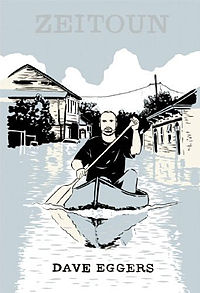
Each administration of George W. Bush was marked by a major disaster. 9-11 was followed four years later by Hurricane Katrina. The United States had received a one-two punch. I recently read Zeitoun by Dave Eggers. This is a book that should be read by every American, and it wouldn’t hurt others to read it too. This account follows the lives of a New Orleans family through the aftermath of Katrina. The main character, a tradesman named Abdulrahman Zeitoun, is a permanent resident of the United States from Syria. His wife Kathy, a convert to Islam, was American. When Katrina bore down on New Orleans, Kathy took their kids to safety with friends while Abdulrahman (known by many as Zeitoun) stayed in the city to look after the properties they owned. When the flooding had engulfed entire sections of the city, Zeitoun paddled about in a canoe, rescuing those he could, and even feeding abandoned dogs. Family and friends urged him to evacuate, but he felt he was doing good. Until he was arrested on his own property and imprisoned for being Syrian.

In a wrenching account based on interviews with Zeitoun and Kathy, Eggers describes how the US government quickly set up Guantanamo Bay-style prisons rather than attempting to rescue those stranded in their homes. Zeitoun was arrested and never informed of the charges, although he heard paramilitary guards armed with machine guns uttering “Taliban” and “al-Qaeda” at him. He watched as a mentally disabled man was pepper-sprayed by soldiers when he clearly couldn’t understand what they were commanding him to do. Despite having government issued ID and good standing as a business owner in New Orleans, Zeitoun was presumed guilty because of his profile: “Arabic” and Muslim. As Eggers reminds us, Homeland Security is now the administrative head of FEMA, and those that Homeland Security distrusts (all of us) are potential terrorists rather than citizens in need of help during times of disaster.

I grew up in a rather monochromatic part of the country, but as I traveled I met and befriended those of differing nationalities, including Syrians. Those considered “the others” by xenophobic bureaucrats are just as kind, loving, and good as those of us born under the sign of the cross with “white” skin. Zeitoun stands as an indictment of the jingoism that has come to be recognized as the only legitimate American citizenship. Zeitoun spent nearly a month in maximum security prison before being released after a makeshift trial, when no evidence existed that he’d done anything wrong. What has happened to the tired, the poor, the huddled masses yearning to breathe free? They’ve become the enemies of the state. I know, Katrina engendered extraordinary circumstances. Extraordinary circumstances, from a “Christian” view, however, demand extraordinary sympathy. Do the nation a favor. Before November, read Zeitoun.


The Naked Vicar

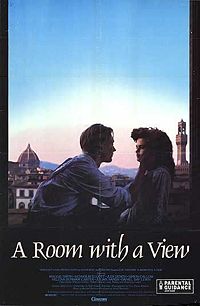
In a fit of nostalgia, for lack of a better excuse, I recently re-watched A Room With a View. I suspect I saw it with my wife near the time it first came out since I had trouble recalling having viewed any of it before. Until the skinny-dipping scene. Even then, it was unfamiliar until Mr. Beebe, the vicar, jumped into the pond. Now perhaps in the Victorian era same-sex cavorting was permitted for the young, far from repressed eyes, but it was the implications of seeing a priest in the nude that was particularly jarring. As Lucy Honeychurch comes primly along with her fiancé, she is scandalized to see the boy she truly loves unclothed, but the minister in similar state is a laughing matter, a novelty. In the light of the many church scandals that have become public knowledge since 1985, this particular scene has perhaps accrued additional, unintended freight.

Embodiment is a popular topic for theologies these days. I’m no theologian, but as a member of the human race I do participate in the embodiment question. Everyone from biologists to psychologists seems to be rethinking the implications of the soft machine. Some theorists are already preparing to leave behind their bodies to have their consciousness electronically preserved. Their new bodies may be robotic or simply virtual, but I suspect they will find the experience deeply disappointing. We are closer to the cockroach and the goldfish than we are to the disembodied divine. Our bodies are who we are, and embodiment analysis is the attempt to make sense of it all. At the same time, some neuroscientists are speculating that human brains work perhaps in closer concert than we generally suppose. We human beings are more like cells in a great organism that encompasses all of us. The Portuguese Man O’ War, which resembles a human brain in some respects, is a communal organism and not a single creature. The implications are worth considering.

Our rules for getting along with biological bodies include some pretty straightforward permissible behaviors. We don’t penetrate the body of another person without their express approval. They have to be competent enough to give valid approval. We don’t end the existence of another human being’s life unless they’ve been convicted of being exceptionally naughty and they live in the United States (the only “first world” country where the death penalty is still routinely carried out) or unless we are mentally unstable or emotionally overwrought and have easy access to firearms. Bodies are limited, and so are brains. Although, since I’ve upgraded my operating system I notice that my laptop has now claimed my name as its own identity—(if anything looks weird, please let me know!) In the Victorian era it was assumed that the brains of the clergy were attuned to higher things. The naked vicar accepts the good-natured laugh at his expense because he is no threat to either young ladies or young men. In the technological era we are more savvy and less carefree. And given the choice, the religious would prefer a room without a view, thank you.


Last Genesis

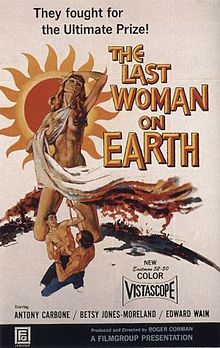
Roger Corman was famous for saving a buck on his movies. When it came to low-budget sci-fi and horror, he could be counted on to stretch pennies into dollars. The B quality with which this impresses most of his films makes them all the more addictive. I watched my share growing up, but I’m still discovering ever more as an adult. The Last Woman on Earth is one I recently found and the religious implications of the film were so obvious that they seemed worthy of a little exegesis. The plot is simple enough, three skin-divers, a man, his wife, and his lawyer friend, are the only survivors of an anoxic episode. When Harold Gern (the man) wonders what happened his friend Martin says, “A new and better bomb, act of God, it doesn’t really matter.” The destruction of humanity is a time-honored divine pass-time, so no one considers the statement blasphemous.

Naturally enough, within a short time Martin starts to feel that Harold’s claim on his wife Evelyn (clearly, by choice of name, an Eve figure) is a bit unreasonable under the circumstances. Biology is, in this instance, the misogynic element as the men increasingly step up their hostilities. Evelyn eventually decides to run away with Martin, but Harold is in hot pursuit. The entire episode takes place on Puerto Rico, and so there are a limited number of places to hide. Martin tells Evelyn to await him in the church, which she dutifully does. Harold catches up with Martin and blinds him. Martin finds his way to the church and when Harold comes in Martin provides a final homily (including some lines from Alice Cooper’s “School’s Out”) declaring that there is no more God. He then dies on the church floor.

The movie ends with Harold and Evelyn leaving the church to try to learn what life is all about. Reading up on the movie, I learned that Corman wanted to keep the costs down so that the writer of the script was cast as Martin for the film. The script wasn’t finished before they started shooting. Nevertheless Robert Towne’s story brings the overall trajectory back to an updated Garden of Eden story. Puerto Rico, a tropical paradise, where the one woman is Eve, is the scene of the first sin—the murder of Martin by Harold. Throughout the movie, Martin is clearly the Abel character while Harold is selfish, unsympathetic, and emotionally absent. Cain wins the epic struggle and God, we are told, is no more. Not the most profound of story-telling, but the themes and concepts are very much biblical. And when the final couple leave the church the remainder of world history is set to begin. I’d gladly give this one a B.


Father Abraham’s Faith

Okay, so this is the scene: Abraham is old and he has just one son to whom a promise has been made (this is the biblical version, by the way). God had promised him that he’d have as many descendants as the stars in the sky, so it seem that Isaac has a long way to go. And the boy’s not married yet. Abraham calls in his trusted servant and gives lengthy, detailed instructions on how to go back to ancestral Iraq and find a wife for Isaac. Just to make sure the servant understands just how serious this is, Abraham says, “Put, I pray thee, thy hand under my thigh,” (I can’t help thinking he added a big wink) and instructs him to swear to obey the instructions precisely. Readers of the Bible since at least the Middle Ages have recognized that “thigh” here really means genitals. The more we’ve learned of the ancient world the more we’ve discovered that men touching each other’s privates was a sign of a most serious oath—it’s a touch that can’t be taken back, and any promises made in this way must be kept.

I’ve been reading about monkeys. More precisely, about evolution. When reading about how baboons show intent to form an alliance, I was surprised to learn that males utilize scrotum-grasping. Since all’s fair in love and war, when baboons fight ripping off another guy’s jewels is considered perfectly acceptable. That means that allowing another male to fondle your testicles is a sign of ultimate trust. Baboons, it seems, have been doing it long since before Abraham showed up on the scene. I wonder if this then is a case of convergent evolution of whether Abraham’s oath goes back to nature in its most basic form. Once castrated, especially in antiquity, a man had no choice about going back. To invite another man to put his hands “down there” was a serious matter indeed.

The only requirement really given to Abraham by God was circumcision. Again, from what we know of ancient times this was not unique to Israel, but the theological freight associated with it was. For a man who’s been promised as many descendants as the sand on the sea shore, allowing another man to cut away part of your reproductive organs is a sign of ultimate trust. This is a behavior that seems not to go back to nature, however. Not even chimpanzees have quite figured out how to make knives or use them to carve up sensitive areas. This has none of the marking of evolution. An act like that seems to have come directly from the gods. Abraham, in a way most modern believers would find incomprehensible, was the paragon of faith.

Contemplating the ineffable


Longer Nights

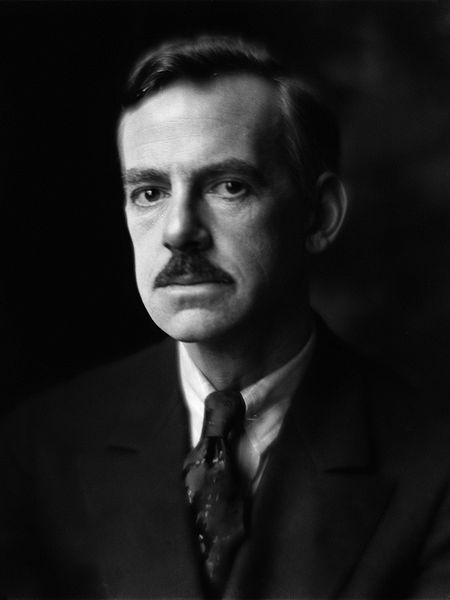
Those who write put part of themselves into every piece. Sometimes that tiny fragment of the author is nearly invisible, while at other times fiction becomes difficult to separate from biography. One of my daughter’s assigned summer readings is Eugene O’Neill’s Long Day’s Journey into Night. Since I use the opportunity of her assigned readings to catch up on what I should’ve read long ago, I recently sat down to see what the play was about. A dysfunctional family. Alcoholism, tuberculosis, and self-loathing are the unholy trinity of much writing from the nineteenth and turn of the twentieth centuries. But God also comes into the mix. Perhaps the divine was nearer to the surface back in the days when you might assume every other American had been raised in a Christian household. O’Neill’s dark and disturbing Tyrone family might be considered good candidates for irreligion were it not for the fact that being Catholic was so much a part of Irish identity in those days. Perhaps in some quarters it still is.

In Act Two, Scene Two James Tyrone is discussing his wife’s as yet unrevealed addiction with his two sons. Edmund, the scholar (and in reality bearing the family position of O’Neill himself), has rejected belief in God. He asks his father if he prayed for Mary in the days when her difficulties began. “I did. I’ve prayed to God these many years for her,” James Tyrone declares. Edmund responds, “Then Nietzsche must be right.” The debate is the classic issue of theodicy—where is God when things go wrong? Mary, the wife/mother believes she was bound for a convent, having been raised in Catholic school. When her life spirals in unexpected directions, she chooses morphine over faith in God, and the men, soused in whiskey, wonder who’s to blame. James, the father, declares atheism to be the culprit.

I found this an interesting study. Characters either unthinkingly accept the religion with which they were raised, or reject religion altogether. Edmund follows up his declaration by quoting Thus Spake Zarathustra: “God is dead: of His pity for man hath God died.” Nietzsche is never simple to comprehend, but even in the declaration of the divine death is an implicit indication of the existence of deity. The subtle nuances here are often lost in family debates where God’s abstract existence is far less important than the human suffering that raises the question in the first place. O’Neill was writing not only in the shadow of Nietzsche, but also of Karl Marx and other theorists whose nails had been pounded into the heavenly coffin over the past two centuries. So Mary, in her morphine vision, returns at the end of the play to state, “I went to the shrine and prayed to the Blessed Virgin and found peace again because I knew she heard my prayer and would always love me and see no harm ever came to me so long as I never lost my faith in her.” The reader, however, along with Karl Marx, knows that this is really the opiate of the people finding voice through one of the faithful.


The Price of Tolerance

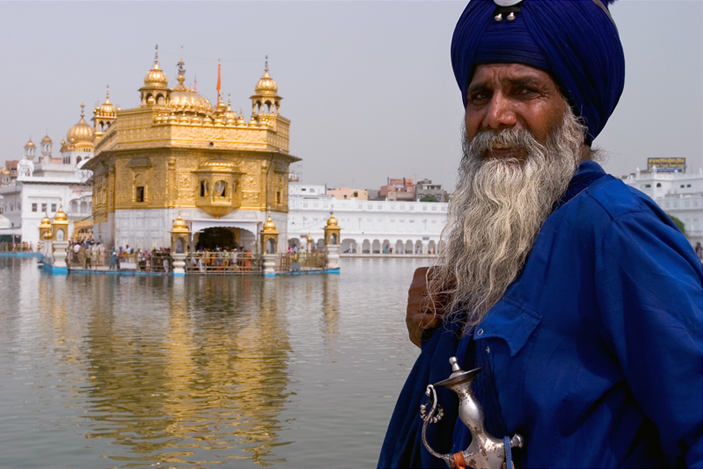
While on a trip to New England recently, my family had taken an exit to look for a bite of lunch. We followed one of those innocuous dinner-plate symbols that often grace roadside signs next to a stylized hotel bed and a gas pump that looks like a suicidal robot. This particular exit, however, seemed unwilling to deliver on the food part. As we wound down an unfamiliar road, we came across the golden cupolas of a Sikh temple. This was the first Sikh temple I’d ever seen, and my daughter asked why she’s never heard of Sikhs before. “Because they never cause problems,” was my reply. Of the major world religions, Sikhism is notable for its lack of overt violence even though a sword is one of the religion’s symbols. Unfortunately, over the weekend, violence found some innocent Sikhs.

As of the moment, no one is able to identify the motives of the man who gunned down four Sikhs preparing to worship in Wisconsin. For many Americans the religion is a mystery. We hear of Hinduism and Buddhism in the course of many historical and literary ventures. Sikhism is somewhat newer on the world religious scene, but it still predates regular European trade with India during the “age of exploration.” Although the classification of religions is always disputed, Sikhism is generally considered around the sixth largest world religion in terms of numbers, and they have avoided the limelight in the western world, showing that a religion can rest on its principles. One of the truly praiseworthy principles of Sikhism is toleration, an idea that his held in very high regard.

From WikiCommons

Toleration often clashes with gun ownership in the United States. Just weeks after twelve people were murdered for going to the movies, we have more headlines of private citizens (some mentally disturbed) with ready access to firearms. And more innocent people are dead. Even the shooter is dead, so we will never likely know whether this was simply a case of mistaken identity or hideous intolerance at work. In my time in Wisconsin I came across many Christians who were extremely intolerant of any viewpoint other than their own. Fortunately, they were the vast minority among the people that I knew. Still, the paradigm that I see emerging disturbs me to the core: we claim it is our right to own guns while identifying with a deity who let himself be tortured to death rather than harm anyone. I wonder if a culture can spell schizophrenia?


Danger de Nuit

I am on a boat—maybe it’s the Titanic. Far from land. For some reason, vaguely unclear, the ship is sinking. There’s panic—people are running and flailing, trying to save themselves. I’m frozen with terror as the icy water encroaches. I can’t swim. I prepare to die. So goes a nightmare I had several times in association with a former place of employment. Nashotah House felt traumatic to me with forced liturgies and daily reminders of my inferior status. The terror of the nightmares was very real, and the day I was fired did nothing to improve them. As a child I was plagued with phobias and frequently experienced horrific nightmares. They still come once in a while, but since I’ve left the employment of the church, they have become, gradually, less frequent. Nightmares are just dreams gone bad, and I’ve always been a dreamer.

Last month Time ran a story on nightmares. The subject of nightmares has now caught the attention of the military because of cases of Post-Traumatic Stress Disorder. When the military decides to show its humane side, it doesn’t fear backing it with big bucks. Soldiers confess to frequent nightmares after witnessing the atrocities of war. (One psychologist said that many at Nashotah House seemed to be suffering from a similar phenomenon.) Theorists now suggest that nightmares might lead to mental illness, and sleep deprivation, as we all know, can lead to bad judgment. Not a good thing on the battlefield. Or behind the wheel of a car. Or, in a recent real-life nightmare, while flying a jet.

In many ways nightmares seem like minor annoyances—they don’t physically hurt anyone, and they end when you wake. Time probably wouldn’t have reported on them if it hadn’t been for the military angle. This seems a paradigmatic situation. A common problem goes ignored until it affects the military, then it is deemed worth research funded by tax-payers. I am well acquainted with nightmares. As a child they became part of my identity. I am heartened that serious research is considered worthy of federal money. It seems, however, that perhaps a better way to end battle-induced nightmares would be to stop the horrors of warfare. When war ends, some nightmares will cease. Of course, I’ve always been a dreamer.

Is all that we see or seem
But a dream within a dream?
-Poe


Another Dark Knight

Batman was dreamed up in the late 1930s as an ambiguous character that fought crime and protected innocent civilians. The backstory emerged that he had witnessed his parents being shot down as a child, and eventually adopted the identity of a bat to frighten the perps. Batman never, in principle, used guns. Of course, the DC Comics character eventually scored a wonderfully campy television series that entertained many of us as children. It even spawned a movie. Then, fifty years after the original, Tim Burton gave us a darker, more serious Batman. The series of promising movies degenerated into the unforgivable Batman and Robin, and many assumed the flash in the pan was over. We didn’t need any super heroes. Christopher Nolan resurrected this bat in Batman Begins, and when I first saw The Dark Knight I was stunned. Good and evil danced a waltz so delicate that you were never sure who was leading. The frisson was palpable.

Thursday night the Nolan series’ final episode was released. I’ve not seen it yet, but from the moment I step out of the Port Authority Bus Terminal in Times Square until I arrive at work, I will have seen several multi-story Batmen looking down on the real life Gotham, explosions erupting and everyone wondering if Batman will survive this film. Yesterday morning the news opened with a horrifying story from real life in Aurora, Colorado. A gunman opened fire on a crowd of opening night movie viewers, killing at least twelve. Several children were shot. The gunman, like a real-life character from Arkham, was apprehended and claimed to have explosives in his house. I stared at the story and wondered what has become of humanity.

Facebook has turned into a venue for flying political banners. I’m always surprised to see how conservative people I knew in school have become—in those days no one had me beat for non-progressive thought. I’m truly amazed, at times, by the glorification of America’s gun culture that accompanies conservative causes. People want to shoot and want to glorify their right to shoot. I have, on rare occasions, shot rifles for sport—only at targets and only when others have asked me to. There is no denying the rush of power one feels, knowing that, like God, you can destroy the thing far distant from you with just a squeeze of the finger. I’m not sure I’m happy in a universe populated by such gods. I grew up a conservative, but also a pacifist. I grew up watching Batman defeat evil so clearly defined that no room remained for ambiguity. Yes, I grew up a conservative, but then I just grew up. I will watch The Dark Knight Rises and will not know what to expect.

Neither good nor bad.


Like Clockwork

It is probably safe now to reveal something that occurred at Grove City College over a quarter of a century ago. I often feel I must justify my choice of college, but I was a first-generation college student who knew nothing about higher education. I was raised with a Fundamentalist orientation, Grove City was a “Christian college,” and it was only about 30 miles from home. I do give Grove City credit for shaking me out of my Fundie way of thinking; as a religion major I met some genuine honest thinkers in the department who let me question the inconsistencies of Fundamentalist beliefs. I broke free in my own time. One of the literature professors, however, insisted that we both read and watch the movie version of A Clockwork Orange. It was my senior year and I felt ready to handle it. As I watched the movie again over the weekend, the first time since college, I was shocked that the institution Grove City College has become would have ever allowed such a movie to be shown. Although there is Kubrickian nudity, the movie was initially given its rating because of the violence, which, by today’s standards, is somewhat tame.

Anthony Burgess’ book is so well known that I don’t need to summarize the story here. What struck me in a new way was the religious element in the plot. While Alex is in prison, and wanting to be reformed, it is the prison chaplain who advises him against it. Undergoing the famous movie treatment, Alex indeed proves docile after testing, leading the priest to declare, “He has no real choice, has he? Self-interest, fear of physical pain, drove him to that grotesque act of self-abasement. Its insincerity was clearly to be seen. He ceases to be a wrongdoer. He ceases also to be a creature capable of moral choice.” Of course, the government is satisfied with this kind of morality, the sort that upholds appearances at any price to humanity.

What I find particularly disturbing is Burgess’ prescience. A Clockwork Orange was published fifty years ago, and since that time we have seen politics shift from care of the citizen to the ultimate window dressing of courting the Moral Majority to make it look as if all governmental decisions are moral. The Tea Party seeks to underscore that charade, claiming that all who would argue for Alex’s humanity deserve the fate that he so wrongfully dispensed before his “reform.” This view of the world suffers for its lack of complexity. Humans do not come in black and white. Ironically, Burgess chose to make the clergyman the only the objector to the inhuman treatment imposed on Alex. This is the kind of dilemma on which Stanley Kubrick thrived, but it has become even more poignant in the decades since his movie was released. True, Kubrick’s film is based on the apocopated American version of the novel, perhaps obscuring the intended meaning of Burgess. But isn’t that exactly what he was attempting to do?


New Salzburg

For some reason Austria is on my mind. It been more than two decades now since I have been there, but I recently decided to read a little of the history of Salzburg. My interest revolved around a case of religious intolerance that took place well before the days of political correctness, but after the idea of religious freedom was being promoted in New World colonies. Two centuries after Martin Luther’s theses stirred the world (perhaps the last time in history a religious thesis has received such attention), the Roman Catholic Archbishop—and Count! (rank has its privileges)—Leopold Anton von Firmian decided to expel the Protestants from Salzburg. Religious diversity was frequently seen as a threat to civil authority. Either Protestants would recant or be forced from their homes in the winter, often losing everything they had in the process. A substantial number of citizens were exiled and found little in the way of refuge. Prussia finally offered some quarter and others made their way to England or to a then religiously tolerant Georgia.

Religious imperialism is a funny phenomenon. Religions, as sets of teachings, often emphasize the just and fair treatment of other people. When powerful people (or power-hungry people) become religious they find a great mind-control technique available in it. Popes, for instance, very quickly ceased being pastors and instead styled themselves as princes. This was a safe move since Jesus was king, and since he’s in heaven any attempts at usurpation are bound to be suspect. As a co-regent, however, various privileges apply! This is something Protestant reformers very swiftly learned as well. John Calvin was practically in charge of Geneva, and who can think of Lynchburg, Virginia without accounting for Jerry Falwell or Virginia Beach without Pat Robertson? Religion, by its genetic nature, seeks to take over and control.

In this it is not so different from other aggressive ideologies such as capitalism or communism. The problem is that religions claim sanction from the highest authority, and once a believer is convinced of that no amount of reason is sufficient to dissuade him or her. So it was that an Austrian Count, also an Archbishop, decided to turn out members of his own putative religion (Christianity) into a harsh winter where many would die and others would live the remainder of their lives in exile. Were this the hallmark of one religion alone we might have united together as a species and cast it out. Unfortunately history has repeatedly shown us that even the most placid religions can quickly form the dark face of a demonic storm front if certain of their privileges are threatened. No one likes to be wrong. In the game of religions, however, there must be losers if anyone is right. Where is the New Salzburg? It may be going by a different name these days.