Homeland Security

I work just two blocks from the United Nations building in New York. While out to grab my lunch yesterday I was engulfed in a peaceful, if vocal demonstration. Many people were standing along Third Avenue with a perplexed look, myself included, I suppose, when a protestor from a great, surging throng thrust a paper into my hand. Headlined “Bring Justice to Guinea,” the paper outlined the brutalities being perpetrated against the Fulani in Guinea. I have to confess to being ignorant of most of the world’s trouble spots. In a society that is relatively free, we’ve been struggling to attain any real form of social equity without success for over two and a half centuries. When I read of the atrocities against the Fulani outlined on the flier, I wondered why I’d not heard of them before. I didn’t have to wonder long, however, because many of us have not received any real education beyond what has happened in the developed world. I decided to learn what I could in the brief moments after the commute home and before bed time. I discovered that the Fulani were once an empire in West Africa. Today in Guinea, according to the information at hand, they are subject to truly horrific treatment. The flier asks, “Would you stop a genocide if you saw it coming?”

I honestly cannot know what lies behind the suffering of the Fulani in Guinea, but historically genocides have either been about, or excused as being about, proper religious belief. One of the saddest commentaries on religion is that even in varieties of religion that claim peaceable teachings and human welfare, violence frequently breaks out. The distrust of the other runs very deep, and if the clearest dividing line is religion, so be it. The very nature of our brains causes us to divide the world about us into categories. The problem with categories is that they are often mental constructs that do not correlate to the reality they attempt to describe. Take people, for example. Does anyone really ever stick to a category or a label in all ways and at all times? Are we not prone to inconsistency and evolution? To use a label as an excuse to harm another is rightly called a hate crime today. Unfortunately, hate crimes are very common, if illegal in some places.
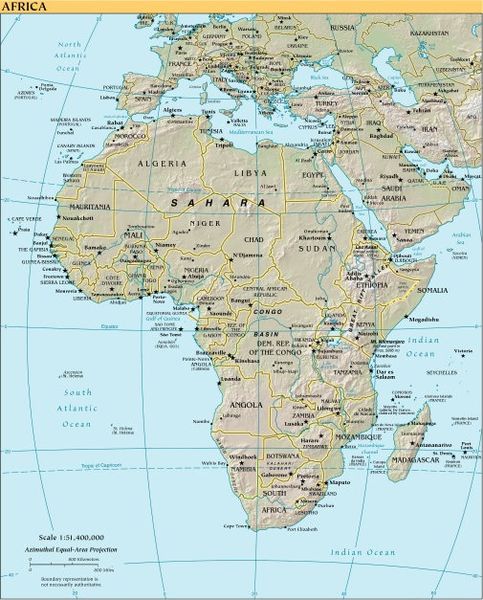
Homeland of the human race.

Difference may be perceived at least two ways—we might respond to it negatively or positively. As a culture, all but the extremist groups seem to have accepted that people are people and deserve equal treatment. On the religious front, however, we lag far behind. Religions often make universal claims, and if a universal claim is truly universal no variation can be accepted. Our deep-seated distrust of those different from ourselves often finds its release in the guise of religion. No other human institution claims a divine prerogative for abusing others. Some people would admit that their animosity stems from basic human motives. If they act upon it, they wind up imprisoned. If, on the other hand, it becomes a crusade with divine standards proudly waving, the perpetrator is more likely to run for public office than to be sequestered in jail. Religion thrives on double standards. Until we find an objective way to assess them (those who have ears, let them hear) we will find ourselves dealing with unreasonable religious demands until our genocidal distrust spreads to the entire remainder of the world.

Dark Materials

After three years we have finally finished Philip Pullman’s His Dark Materials trilogy. The Golden Compass, a fantastic story made into a very disappointing movie, followed the adventures of Lyra as she struggled against the insidious designs of the Magisterium, Pullman’s not-so-subtle code for the church. The story picked up again when Lyra met Will in The Subtle Knife and revolves back to the Garden of Eden in The Amber Spyglass. It becomes clear early in the book that Lyra is a type of Eve, about to open a Pandora’s box for the entire universe. Along the way Metatron and the symbols of the old religion, including God, die. Detractors like to hurl accusations of atheism at the author, although Pullman tends to call himself agnostic. Whatever label is pasted to him, the fact is the message of the trilogy is profoundly in keeping with what is purported to be the message of Jesus. Not to put too fine a point on it, the message is “Christian.”

Of course, these days that word has to be qualified. “Christian” has been co-opted by so many special interests theologies that its vagueness is useful for little more than winning presidential elections. Part of the difficulty begins with the fact that we don’t have any objective way to assess what Jesus actually said. The earliest canonical Gospel, Mark, was written some three decades after the events that it recounts. There can be no doubt that Matthew and Luke borrowed heavily from Mark while John, written much later, blazed his own trail. Some of the statements attributed to Jesus in these variant accounts differ, but the basic idea seems to be: love others, try not to harm each other, and be willing to be the victim once in a while. These precepts permeate that story of Lyra and Will as they flee from an institutionalized church that seeks to destroy them. Yes, the parable is transparent here and even today many would-be rulers understand the power in the blood of the lamb. Accusations of someone being non-Christian can turn a red tide against them.

Ironically, today “Christian” often has the connotation of intolerance and lack of forgiveness. We see the wealthy and powerful adopting the rhetoric when it suits their purposes but refusing to live by its principles when the poor reveal their underprivileged faces. Taking Jesus out of context they like to say, “the poor will always be with you.” As if Jesus never spoke a harsh word to the wealthy. Something that Pullman makes abundantly clear is that power corrupts. The church in his books is not evil, but corrupt. It is too powerful for its own good. Above all, the books are a tale of growing up. Lyra realizes the danger that the Magisterium poses, and fights it with the conviction of the young. She learns to love and liberates the dead. She learns the pain of loss. Indeed, her sacrifice is for the salvation of the universe. Sounds like something Jesus might have approved of—when he wasn’t busy lining the pockets of the wealthy, that is.


Lead us not into Dominion

Christian dominionists emulate the Roman Empire, it seems. The Viewpoint in last week’s Time magazine, entitled “In God We Trust,” points out several of the objectives of the dominionist camp. Taking their cue from a decidedly modern and western understanding of Genesis 1, this sect believes the human control over nature to be a divine mandate in which our species dominates the world, with divine approval. As Jon Meacham points out, that dominion does not end at other animal species, but includes control of the “non-Christian” as defined by their own standard. This non-negotiable “Christianity” is a religion guided by utter selfishness and self-absorption. So thorough is this directive that those indoctrinated in it cannot recognize Christians that do not share its perspective as part of the same dogmatic species. It is a frightening religious perspective for a nation founded on the principle of religious freedom.

Rehearsing the rhetoric from Rick Perry’s “the Response” rally, Meacham rightly points out that when dominionists quote the Bible it is most important to note what the Bible does not say. Herein lies the very soul of the movement—filling in the void where God does not talk with human desires and ambitions. As any good marketer knows, however, packaging can sell the product. Introduce a rhetoric that claims to be biblical to a nation where most people have never read the Bible and smell the recipe for success. People want to believe, even if what they think they believe is not what it claims to be. Christianity is claimed by so many vastly differing factions as to have been drained of its meaning. This is the danger in the game of injecting religion into politics. Surely the Perrys and Palins and Bachmanns know what they believe, but they do not say it aloud, for their Christianity does not coincide with the various forms of the religion advocated by the churches historically bearing the torch of Christ’s teachings, insofar as they might be determined.

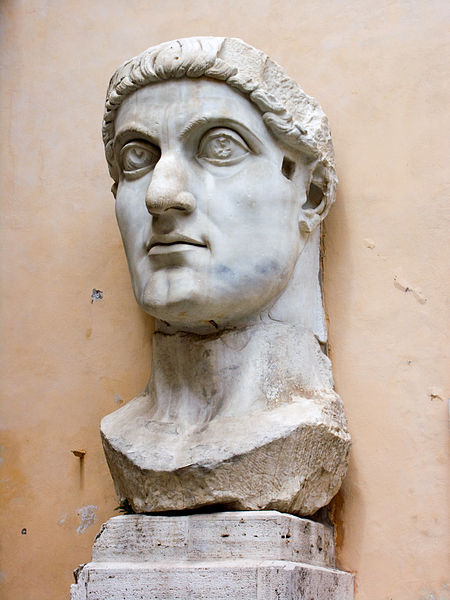
Dominionism is nothing new. Even the most pristine believer must see that Constantine had more than a warm fuzzy feeling in his heart when he adopted a foreign religion and fed it to his empire. No, Christianity was an effective, non-violent means of control as well as a way of achieving life after death. Rome was nothing without dominion. The parallels with the United States have been noted by analysts time and again. As we watch the posturing of political candidates wearing some form of their faith on their sleeves, the unsuspecting never question what might be up those sleeves. It is fairly certain that when the parties sit down at the table and the cards are dealt, it won’t be Bibles that we find scattered there. This is not a kingdom of God’s making. When dominionists take over all others must scan the horizon for the advent of the Visigoths who will not be dominated.


Bibles and Broomsticks

Continuing my musings on Kent Nerburn’s The Wolf at Twilight, I must pause for a moment on chapter eight, “Bibles and Broomsticks.” I must confess to having learned quite a bit in this account, and among the more disturbing facts is that government agents routinely removed Lakota children from their homes so that they would be sent to boarding schools to learn “white ways.” Many of these schools were run by Christian groups; in “Dan’s” case, the school was Roman Catholic. Confused and frightened, away from home, these children were compelled to give up their traditional ways so that they would be more accommodating to the people who had taken over their land. In the midst of the difficulties faced, Dan makes some pointed observations about the difference between what he had been taught as a child and what the establishment schools proclaimed. In punishment for speaking his own language, Dan was once sentenced to kneel on several marbles while holding a heavy Bible out at the end of each outstretched arm. Later he reveals that many of the children were sexually abused by the priests out on the prairie, far from the help of any non-religious adult.

Despite the grimness of this scenario, a parable may lurk for those of us who live in supposedly more enlightened times. The Bible being used as a physical weapon may be rare today, but it certainly has lost no force as a metaphorical one. We see this constantly when overly eager televangelists and politicians unilaterally declare that natural disasters are of divine origin, the god of the black book punishing the country he founded. Their logic twists like the rubber band on the balsam toy airplane of their mental depth. Complexity is the work of the devil when God can be blamed for every misfortune against those of whom they disapprove. The truly sad part is that they are continuing the oppression that was behind the mistreatment of the Native Americans. Books only enlighten minds when they are opened. Making a Bible into a cross is about as pagan an idea as can be conceived (my apologies to any pagans reading this—pagans are not nearly so barbarous).

At one point Dan explains to Nerburn that the Creator’s lessons could be found by observing nature, such as listening to the song of a bird. He said, “We could have taught your people, too. But they never listened…They just looked in their Black Book. They said it had everything they needed to learn the Creator’s lessons.” We are starting to learn this lesson, but very, very slowly. It was not by accident that the Navi in Avatar were portrayed as symbolic of Native Americans while the greedy industrialists mining their planet considered it manifest destiny to take charge. The Bible does not have all the answers. Those which it does contain in no way justify the abuse of others for one’s personal gain. It is one of history’s legitimate mysteries how an intelligent people can shut out reason when personal gain is at stake. It is easier to do, apparently, when there is a divine book to blame. When the Bible is used to punish others, however, it is always a safe bet that it has never been opened.

Differing worldviews


Who Are the Wolves?

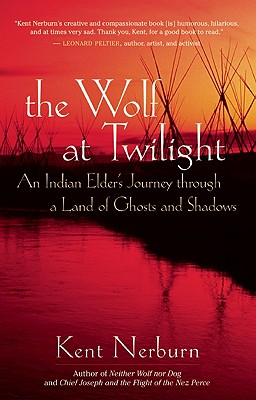
Last week I finished reading The Wolf at Twilight by Kent Nerburn. To be transparent here, I’d picked up the book at a Borders’ closing sale based largely on the subtitle: An Indian Elder’s Journey through a Land of Ghosts and Shadows. It sounded like a good book for autumnal reading. The first chill breezes of fall swept through Manhattan last week, and I curled up with the book on the bus. I’m not sure what I expected, but what I found was nothing short of epiphanic. Those of us who’ve spent long years in religious studies, no matter what specific branch, know of the deeply spiritual writings of Native Americans. Black Elk Speaks is a classic often required in Religion 101 and it is still as potent today as it was back when first penned. The danger, which Nerburn clearly states, is in assuming a mystical kind of stereotype for a very real people who have continually been—and still are—hidden away as an embarrassment of the United States’ melting pot image.

The Wolf at Twilight is a follow-up to Nerburn’s Neither Wolf nor Dog, a book that I have not read. In that original narrative, Nerburn describes his encounters with “Dan,” a Native American, Lakota elder. The Wolf at Twilight is the story of how Dan finds closure in locating the resting place of his sister, from whom he was separated at childhood. The journey, spiritual though it may be, is a wrenching one. Speaking from my experience, many children grow up in America learning only cursory pieces of the large and tragic mosaic of how the Native Americans were treated by own government. The story of Dan is one of clashing worldviews where any system that stands against the ideal of private ownership—sadly embodied in the Christian settlers of this nation—is inevitably shredded, and, if embarrassing enough, hidden from future generations. Our ancestors did a great disservice to our fellow human beings, in the name of religion. Manifest destiny had an overly healthy dose of the divine right of Christians in it. An idea poisonous to anyone who might challenge the concept of personal gain.

As a neophyte in this field of reading, I was sickened by much of what I read here. It will take more than a single post to outline some of the more poignant inconsistencies between Christian practice and preaching perpetrated upon those who were here before us. A people forcefully converted to a religion that was openly oppressive to them reveals the dark underbelly of missionary zeal and the truth of the evils religion can hide. Or even justify. Often Dan decries the religion that believes all the answers are in a black book. What was done to his own family in the name of Christianity led to several restless nights for this reader. Kent Nerburn writes with the conviction of a man haunted by an experience of rough reconciliation. From the title, I had expected maybe werewolves or specters to roam this book, but instead what I found was much more terrifying. It was the naked lust for personal gain—a monster that no crucifix or prayer ribbon can ever banish or dispel.


A Peculiar Resurrection

Although it is not my regular practice to splash melodrama across my blog, my recent experience with losing the Internet for four days prompts me to consider resurrection. After consulting with three technical agents and giving my laptop a kind of electronic enema, I am now once more able to access that mysterious nirvana called the world-wide web (and even the www2, whatever that is). This experience has taught me something about the human craving for resurrection. I began this blog in July of 2009. Since then I’ve added new entries almost daily. Even in places as remote as the northwoods of Idaho, if my laptop receives a signal, I can post my unorthodox thoughts for the world to read (at least the very small cross-section of the world that stumbles upon my pages). Being forced to go without Internet connectivity in New York City, of all places!, was itself a surreal experience. I literally wept in frustration. No one could help. This morning the Verizon tech assistant had me connect via an Ethernet cable and with his omnipotent hand remotely guiding my cursor, brought these dry bones back to life. Praise the landline!

The writers of the Hebrew Bible did not believe in resurrection. The book of Daniel, written just before the death of Antiochus IV Epiphanes (“the manifestation” as he humbly called himself) in 164 BCE, is the earliest hint that Jewish thinkers were beginning to consider the resurrection concept. The Egyptians had, many centuries earlier, played with the idea. They eventually developed it into a national pastime—building pyramids to ensure the king got to live again—but other ancient people were more pragmatic. Death was the end, so live this life to the fullest. As far as we can tell, Jesus taught his followers about the possibility of life beyond life. Some take that to mean a literal reconstituting of life after death while others understand it metaphorically. Both ideas can be, broadly speaking, labeled “Christian.” Some Jewish thinkers accept resurrection, others do not. Other religions, as mentioned earlier this week, go for the cyclical approach of reincarnation.

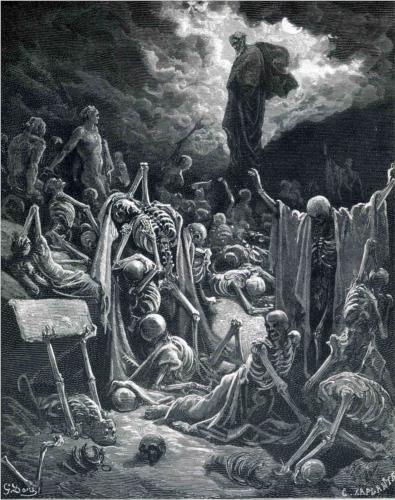
Ezekiel, according to chapter 37 of his surreal book, saw a valley of dry bones. These people were, as the Munchkin coroner croons, “really most sincerely dead.” Ezekiel did not believe in resurrection. If he had the miracle would have been lost on him. Reviving the dead was considered the most extreme, impossible feat in his entire (if limited) universe. The people of Judah, defeated by Babylonia, carried into exile, their temple—God in their midst—destroyed, believed it was all over. There was nothing to bring home into such a desolate landscape. Some suggest Ezekiel was schizophrenic or perhaps addicted to psychedelic mushrooms. In reality, I believe, he owned a MacBook that could not connect to the Internet. Once that divine signal from on high penetrated the arid air of exilic lassitude, he rebooted and without the aid of any drugs, saw God in all his/her glory. (Ezekiel refuses to give God a gender, but that is a topic for another post.)


Remembrance Day

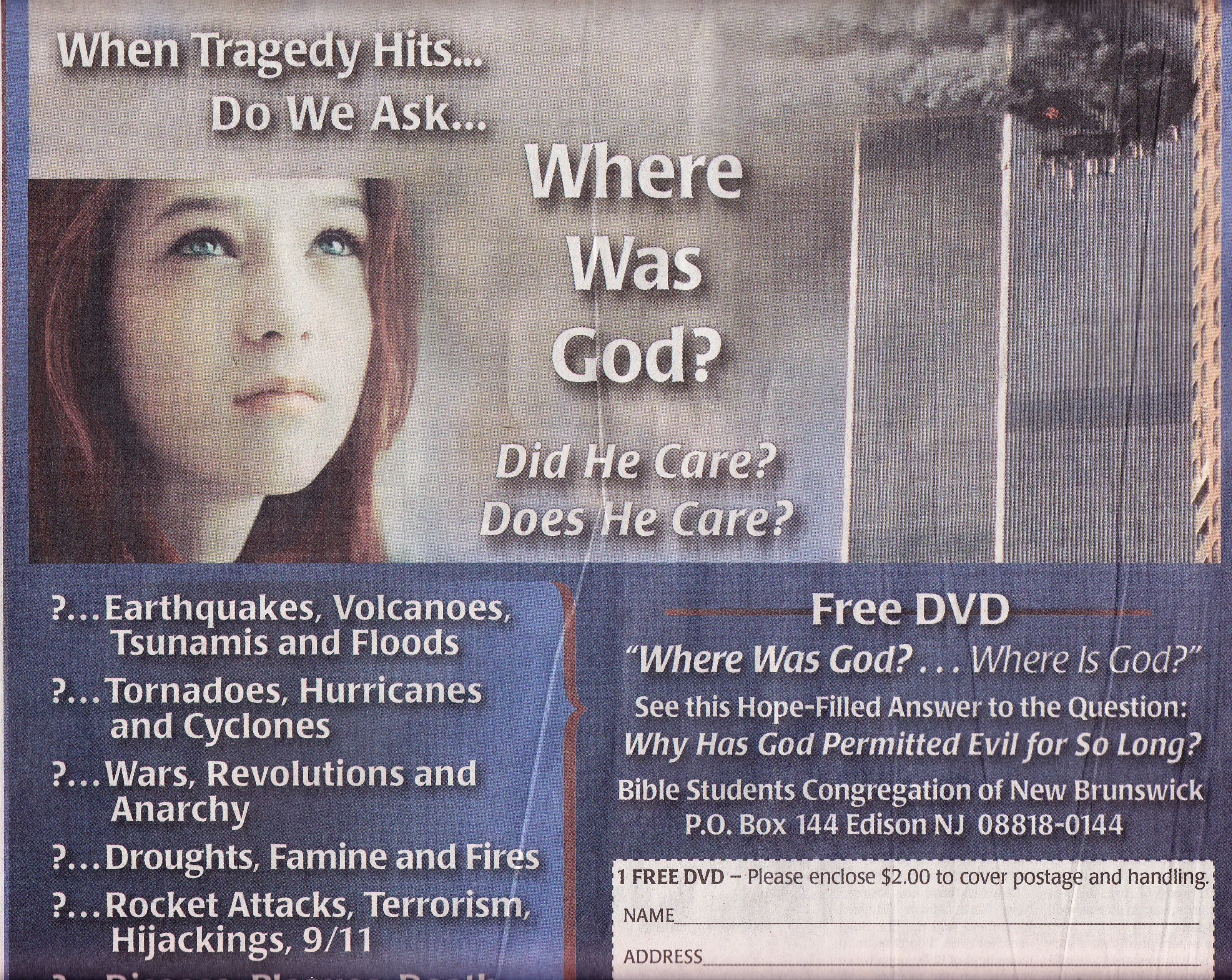
September 11, 2001 is on America’s collective consciousness. A decade ago thousands lost their lives in a religiously motivated and misguided attack on what some see as a wicked culture. Those who hate America have never come to know it. What a sad commentary it is that religious belief lends its strength of conviction to those whom it has convinced that evil is righteousness and that terror is divine. It is somber to experience this tenth anniversary so close to New York City. When I ride in to work now every day I see the new World Trade Center rising, literally, from the ashes. It is a monument to what America tries to embody.

Twin towers, 13 years old.

Our nation is not perfect. None is. Too easily we accept the casual relegation of various minority groups to poverty. Too easily we allow the obscenely wealthy to escape all sense of social obligation. Too easily we focus on our selves rather than our community. No, we cannot claim to be perfect. Nevertheless, we strive for an ideal that will not die.

Some have boldly claimed twentieth century notables as “the greatest generation.” I believe that praise, although deserved in a sense, to be misplaced. The greatest generation was that rag-tag group of colonial citizens who’d fled from cesspools of oppression to find freedom in a new world. They were not perfect. They oppressed and displaced Native Americans who still suffer under repressive policies that ensure the great embarrassment of their treatment will remain out of sight. The greatest generation I envision is those who, at the risk of their own lives, decreed that the world should, must contain a haven for those who cannot live without a free conscience. A place where religion, or even the very words you say or write, cannot be dictated by the government. A place where people could go on to become the putative “greatest generation”s of the future.

When I first heard about the attacks on 9/11 I was at Nashotah House. Those first moments of confusion were terrifying—our daughter had just started school and was not close enough to hold. My wife and I watched the television in sheer unbelief, tears on our faces, our lives being forever wrenched and twisted in new directions. In was a day that sobered up an entire country.

(Please read the remainder at Full Essays.)


Do Unto Others

Having just finished my first week as Religion Editor at Routledge, I have learned many things. The lengthy commute into New York City is filled with many lessons along the way and working for a publisher of some distinction is a privilege. My working life began with the work of a common laborer at 14. Conditions weren’t bad although the work was hard—we have laws to protect minors against exploitation. Funnily, after people reach a certain age exploitation is freely allowed, as long as someone benefits from it (not the one doing the labor). Being from a working class family, I gravitated towards dirty jobs. My college career was supported by many long hours in the dishroom, washing the cups and plates sent back by kids whose parents could foot their bill. I didn’t complain—physical work has always been relaxing to me. Mind work is much harder.

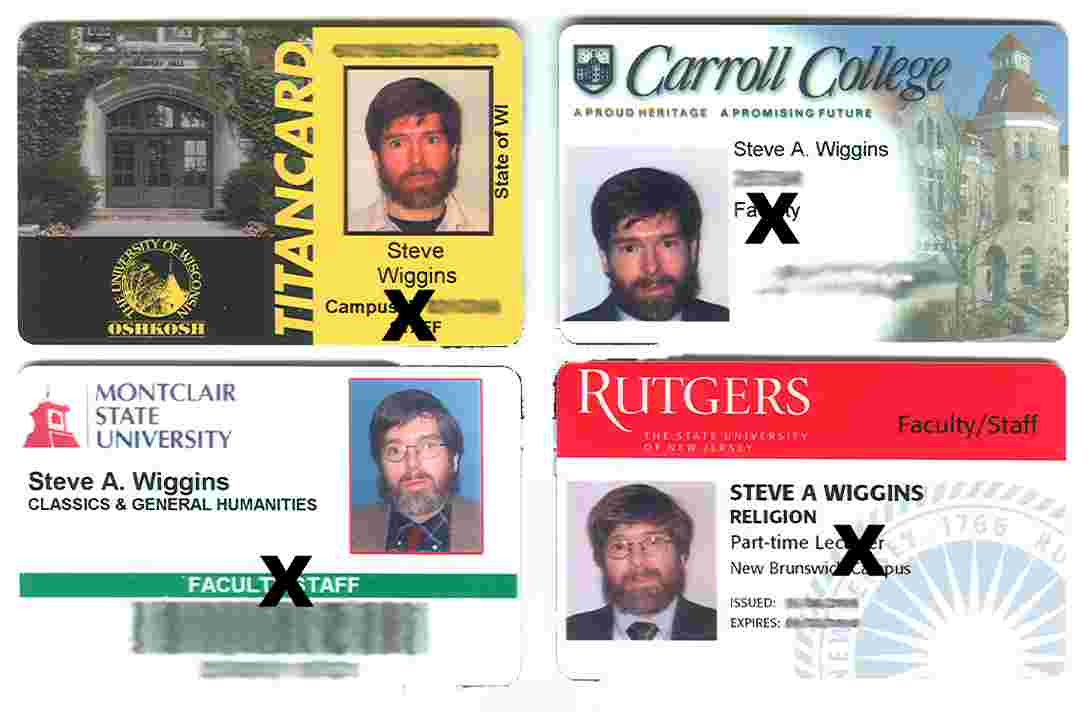
The majority of my adult life has been whiled away under the Damoclesian stare of religious institutions or individuals. Christians don’t make good bosses. My years at Nashotah House felt like some combination of Alcatraz and Bedlam. Under the authority of the religious I was taught to quake and fear. After over a dozen years of this, released into an empty academic void, I found a job with a Christian publisher who once again lived to dominate. I try hard to believe it is not inherent in religion itself, but often those who wish to bend others to their whim have some sacred sanction. For a brief respite I had a wonderful experience at the University of Wisconsin Oshkosh. My boss was secular and very caring. The same applied at Rutgers University. When Gorgias Press tired of my efforts, the secular academy came to my rescue.

Routledge once again reinforces that paradigm. For the first time in my professional life I feel that I am truly valued. As a rule, adjuncts are like Kleenex—there when you need them, but disposable after used. The university people were kind but could offer little. Now I am accepted among the secular and the little knowledge I’ve gained over the decades is appreciated. The scars, however, still show. The fear of long years of subservience are not easily dismissed. It is my hope that some day they may become effaced enough that the terrors wielded by the religious might be only nightmares recalled vaguely in the full light of day. If such deliverance comes it will have been because of my non-religious bosses. Such a parable should teach us about what religion has become in this “Christian country.”

No mean city.


Glass Act

One of the main cultural Meccas of central New York state is the world-renowned Corning Museum of Glass. I recall visiting the museum three decades ago, as a child. Since then the museum has continued to expand and diversify its programs and displays. The Corning Museum of Glass is perhaps the greatest collection of art glass in the world. The history of glass is laid out chronologically, and along about the Middle Ages, religious glasswork comes into fashion. Some of the pieces were manufactured as intentionally religious artifacts. Others acquire a religious significance through less orthodox means.

Traditional religious glass

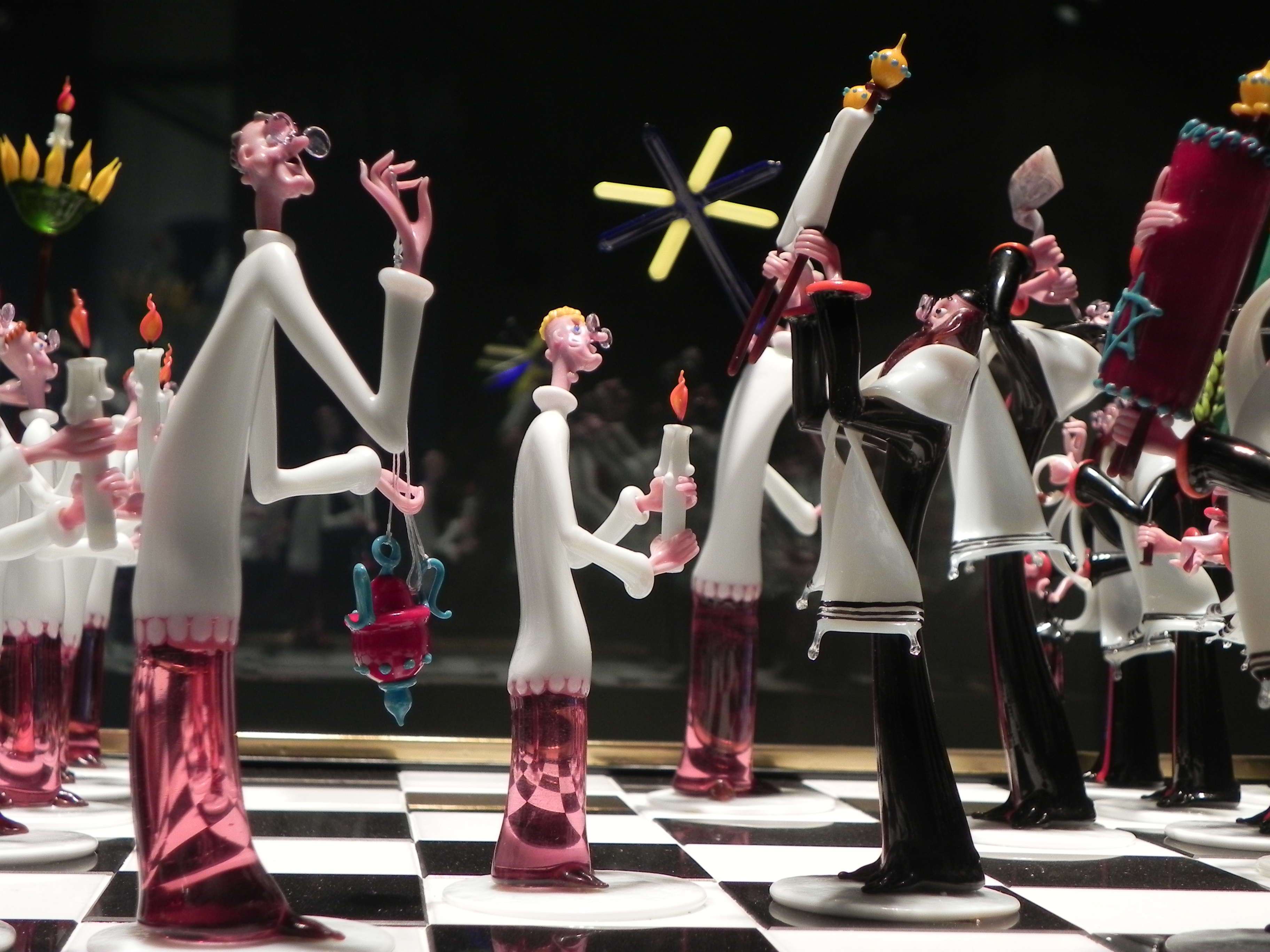
Near the end of the display is a piece by Gianni Toso, done around 1981. Entitled “Chess Set,” the glass sculpture features Roman Catholic pieces facing off against Jewish rabbinic pieces. The sculpture is intended to be comic as the expressions and the postures of the figures clearly indicate. Each piece bears some symbol of their faith: thuribles, lulavs, crosiers and Torah scrolls face off against one another, each side wearing unmistakable looks of superiority on their faces. Countless hours obviously went into the fabrication of such an intricate piece, and as with most art, it contains a serious message.

Toso's Chess Set

The figures here may be Jewish and Christian, but they could really be any religious traditions. The concept of putting them into a chess match is an inspired commentary on the constant struggle for superiority among religious traditions. In a world of differing religious outlooks, and where such outlooks are taken with deadly seriousness, no one is willing to relinquish religious superiority. The aggressors are difficult to discern since, as in life, any true believer must be a kind of missionary.

Toso's face-off

The medium of an artwork also makes a statement about its subject. Glass is a difficult medium to manipulate. Since it often must be very hot, the artist is familiar with the burns that accompany such intense heat. Glass produces a superior shine as an artistic medium, but it is also very fragile. Like the conflict presented on this chessboard, the religions behind it bear the limitations of the medium: they shine at times, yet they can also cause severe burns. And above all, they are fragile.


Tomorrow Ever After

Last night as we said goodnight to Irene, my family decided to watch The Day After Tomorrow. Beyond The Perfect Storm and Twister we didn’t have any other weather-related disaster movies on hand. I became convinced long ago that weather was somehow key in the conception of divinity. Working at a seminary that required attendance at chapel twice daily where we would lugubriously and laboriously recite every verse of every Psalm according to the unforgiving schedule of the Book of Common Prayer, I began to notice the weather. Among the more common images used in the “hymnal of the second temple,” weather was seen as an essential aspect of divinity. Religions with celestial orientations frequently view the sky with a sacred aura. I began to compile all the Psalm references to the weather and eventually brought them together into a book, still unpublished. What became clear at the end of this exercise was that ancient people had no way to interpret the weather other than as a divine phenomenon. Listening to all the hype about Irene, it still seems to be the case.

In The Day After Tomorrow, our ill-fated teenagers are trapped in the New York Public Library as a super-chilled tropospheric wind freezes New York City. They build a fire and when you’re in a library, naturally, you burn books. I kept looking at all the furniture they spared as they consigned the books to the flame. A minor character called Jeremy is shown clutching a Bible. A girl named Elsa asks if he thinks God will save him. Replying that he is an atheist, Jeremy says that this is a Gutenberg Bible, “This Bible is the first book ever printed. It represents the dawn of the Age of Reason. As far as I’m concerned, the written word is mankind’s greatest achievement. You can laugh, but if Western Civilization is finished I’m gonna save at least one little piece of it.” This little dialogue represents the full circle of the celestial god. Jeremy doesn’t believe in this god, and the Bible requires human protection. Instead of being the instrument of war and political badgering and tea parties, it is seen as a symbol of enlightenment. It represents the first steps toward reason.

As Hurricane Irene still gusts outside my window, dropping rain as if New Jersey were a desert receiving its first drink in a century, the Tea Party is busy crafting ways of getting the Bible back in the White House. Their Bible is the antithesis to the Age of Reason. It is the symbol of superstition and prejudice and authoritarianism. It is the means of political power. The god of the Tea Party is a white-bearded man living in the sky, sending his fury against the liberal cities of the East Coast in a mighty wind. He is the punishing god of the Psalms. As the helicopter lifts off over a frozen Manhattan, the teenagers saved by a flawed father who walked from Philadelphia to New York to find his son, the camera pans across Jeremy as he hugs the Bible to his chest. I was in Boston for Hurricane Gloria back in 1985. Watching the waves crash on the beach at Winthrop I felt the power of fierce nature at the beginning of my own journey to, I hope, enlightenment. When it was over, however, there was not yet a Tea Party threatening an even worse, unnatural disaster to follow.

Irene, the early days


Calm Before the Storm

All the build-up for Hurricane Irene masks a deep-seated fear of the uncontrolled. If the storm devastates anyone, there will be Biblicists who say, like Job’s friends, that they must have sinned. Such pronouncements accompany nearly every natural disaster, as if God is huddled over the globe attempting to concoct more horrid and sinister ways to punish sinners. Natural disasters, however, have a way of effecting good and bad alike, just as the benevolent sunrise and the soft kiss of the rain (both according to someone mentioned in the Bible as being the son of someone important). But when danger looks down its barrel at human communities, they don’t neatly divide into sheep and goats. All people are a mix of virtuous and vice-ridden in varying ratios, and only the God of the Marquis de Sade would slam the iron maiden shut on all alike. The East Coast saw this earlier in the week when a benign earthquake shook our world. Barely had the ground stopped trembling before we were informed it was divine punishment. For what, no one could really say.

Interpreting nature according to the Bible is so misguided that it is difficult to know where to begin the critique. Yes, some biblical writers with a flare for the dramatic will claim that Yahweh was behind some disaster. Of course, they had no concept of science, in this case, meteorology, upon which to draw. Nature acts in unexpected ways because God has his fingers in the bowl. Even the early church gave up on that way of interpreting things as soon as natural processes could substitute for God. When religion because politicized, however, we started to see a backlash of backward thinking. It is a simple enough deception to utilize. People fear natural disasters, and the politically savvy know that few have any theological training. You can very easily encourage panicked masses to follow you if you claim to have read the Bible. From years of teaching it, I can certainly affirm that many clergy have not read the whole thing. Yet we use it as the barometer of divine wrath.

I, for one, am not worried about Hurricane Irene. As New Jersey has zigzagged in and out of the predicted track of the storm, it seems as though God may be wavering. If it misses the politically astute will say it is Chris Christies’ righteous policies of helping the wealthy at the expense of the poor. If it hits they will claim it is the sinfulness of the liberal camp that led the winds this way. It is all wind. Having written a book-length manuscript on weather in the Psalms, I know a fair bit about biblical perceptions of weather in the world of ancient Israel. Although over-zealous translators ill-informed about meteorology used to translate a word or two as “hurricane” the fact is that biblical Hebrew has no such word. Due to the rotational direction of the planet (about which they also did not know) hurricanes never hit Israel. Herein lies the basis of my confidence in the face of Irene. If the Bible doesn’t mention hurricanes, they can’t possibly exist. Literalists up and down the coast should heave a sigh of relief. But just in case, I have stockpiled several gallons of water, right next to my Bible.

Good morning, Irene -- if that is your real name.


Girl Meets God…

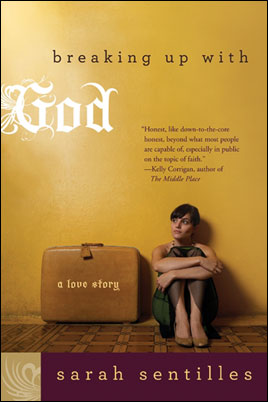
Once in a very great while I find a book that I simply can’t put down. It is a rare windfall when that book feels like it was written especially for me. I was instantly engrossed in Sarah Sentilles’ Breaking Up With God. Like Susan Campbell’s Dating Jesus, this book reinforced the fact that women experience a side of God’s character generally closed to men—the idea that God might be a lover. In our distorted, still patriarchal culture we have yet to grow beyond the idea that God is male. This simple, persistent teaching ensures that a gender-divide will always remain in effect when it comes to monotheistic religions. What truly spoke to me from Sentilles’ book, however, was not the theology, but the heart. Although the gender view from which I approach concepts of divinity must necessarily be different, here I found someone with a journey in many ways similar to mine. The honesty with which the author lays open her experience is beautiful and terrifying.

One of the recurring questions on this blog is whence the concept of God arose. Anthropologists, psychologists, and theologians come up with varying answers but the fact is the real impact is felt in very human minds. We have, perhaps unwittingly, devised a punishing image of the creator of the universe. A God who causes, allows, or at least condones arbitrary human suffering. A God who permits atrocities daily to be committed in his name (for this is a masculine god). A God who has left a burning ruin in his wake. Those of us who’ve attended seminary, as Sentilles makes vividly clear, are taught perceptions of the divine that can never be translated into the pulpit. Those of us who go on to graduate school are permitted a rare glimpse behind the veil to see something that it frightens us to contemplate, let alone write or speak about. It is a burden best worn like a hairshirt—beneath other clothes so that people don’t know it’s there. Many of us are then cast into the career outer darkness with nothing but our highly educated, disturbing thoughts for comfort.

Sarah Sentilles has given the world a gift with her revealing, sensible, and very human story. Having grown up with the image of God as a father, it was a shock when a seminary professor once revealed to me that God could never really fill that role. Nor, he added, could the church. While it cannot be the same as breaking up with God, the realization that what you were taught as a child was merely a metaphor forces a grand reevaluation of perceptions. My professor was, of course, correct. Carrying around a faulty image of God will lead only to intractable complications further down the road. Although Sentilles started down the path some years later than I did, it seems we have wound up in the same neighborhood. Her book deserves to be read widely, thought over carefully, and pondered for a time. We need to consider: what hath man wrought?


Six Red Flags

Answers in Genesis’ biblical theme park with its life-sized ark was back in the news yesterday. Journalists just seem to be fascinated that people really do believe in their religious convictions. Having grown up in a religious family, I understand where they’re coming from. The version of the Bible they offer to the public, however, is much too tame. I spent the day dreaming about a literalist Bible theme park that would put Evangelical Christianity back on the map. I’m thinking it should be in Rick Perry’s Texas and we could call it the Literalist Six Red Flags.

The first attraction would be the Garden of Eden—sans clothes. If we’re going for the full Bible experience we should go all the way. The full Methuselah. For those who are worried that this might lead to morality concerns, I would assure them that experience belies that. From the few nude beaches I’ve stumbled upon—who would’ve thought there’d be one in New Jersey? New Jersey!—it is my guess that this might be the most effective way to scare kids into religion. Why pass up an evangelical opportunity like that?

Station number two would be the Egyptian Late-Term Abortion Clinic. By this I mean Exodus chapter 1, with a nice tie-in to Leviticus 20 and Psalm 137. The pro-lifers could leave a little green but very self-righteous after seeing what the Bible prescribes for uppity children.

Our third flag could be the battle of Jericho. Especially interesting for the kids would be the visit of Joshua’s spies to the prostitute who betrayed her city. Children could blow on ram’s horns, carry a plastic ark with authentic death-rays emanating from it, and shout while the Styrofoam walls come tumbling down. If they wanted to be really literal, however, they’d have to explain that archaeology demonstrates that Jericho had been abandoned for a century before Joshua showed up, but who wants to dampen all that youthful, Christian bloodlust?

Flag four could be the story of Samson. After leaving his first wife to visit a prostitute, kids could watch in fascination as Samson heaves the city gates of Gaza from their place, showing that the Lord approves. Since he’s a muscleman who likes to have affairs, maybe we could check to see if Arnold Schwarzenegger is too busy to take on the role of God’s version of Hercules. I’m sure that Delilahs would not be too difficult to recruit. Perhaps this could be an audience participation event.

Attraction five has to be the Story of David. This would be a good opportunity for parents distraught after the previous stations to take out some aggression with the sling. I’m sure my friend Deane could come up with some giants for them to practice on. Otherwise, maybe something could be worked out with the NBA. After killing a few giants, the station could lead to the palace roof with a view to Bathsheba’s bathroom. Since David didn’t want to send her to the clinic (see station number two), he decided to have her husband killed instead. Maybe we could have a side exhibit: Uriah’s Last Ice Cream Stand. (He was only a Hittite, after all.)

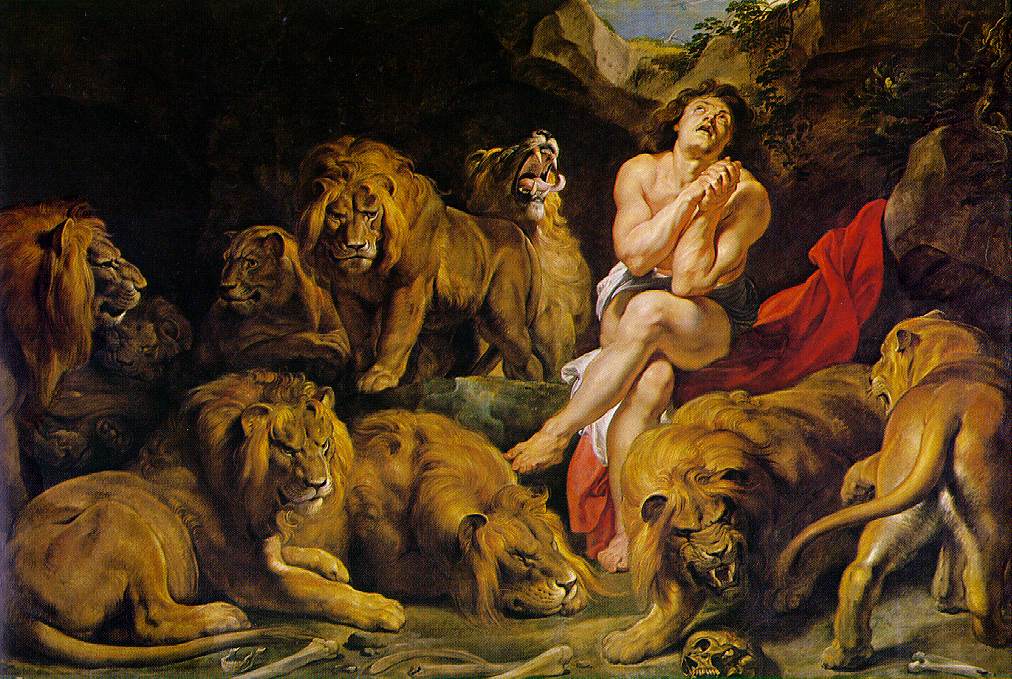
Our sixth red flag would be the Lion’s Den. Here we could offer Tea Partiers and NeoCons the opportunity to prove their faith by spending a night in a den of hungry lions. They like to claim loudly that their faith is being castigated, just like Daniel’s was—here would be the opportunity to prove it! Somehow I believe that the lion’s den would remain empty and crickets could be heard chirping throughout our Literalist Six Red Flags even before it opened its festively decorated gates.

"Oh please let Rick Perry be nominated!"


Last Rites

Last night at 9:40 p.m., my last class at Rutgers University ended. I began a teaching career in higher education back in 1992 when I was still younger than most of my students (that was in a seminary). Despite the difficulties of that setting, I had lowly dreams of a reasonable teaching post in a small college where good teaching was emphasized and serious research was allowed. It was never to be. Now, facing an exciting career move, it feels like a giddy run suddenly played out. The finish line crossed halfway through the race. Higher education simply never made room for the likes of me. Students have frequently commented on how they like my courses and find me a congenial instructor and wonder why no full-time positions ever emerged. My answer has always been that Religious Studies is the one field where religious discrimination is legal and regularly practiced. Denominational schools are permitted to hire on the basis of faith—I have been declined more than one position because I was not the right brand of religion. State schools are afraid of the field.

State universities, where I ultimately ended up, are very cagey about Religious Studies. I’ve known otherwise highly educated individuals who suppose that such departments are glorified Sunday Schools or Catechisms. They always seem surprised, when a religiously motivated person decides to become a mass murderer on the basis of conviction, that universities don’t know more about religions. It is, however, a dying field. Religion in America has been hijacked by the NeoCon camp. Over the years I’ve had mainstream Christian students explain to me why they are not really “Christian” since they assume that the title goes with conservative political and social values. To my humble eyes, it appears the battle may have been already lost. State schools fear interference with the establishment clause while NeoCons plow ahead to mandate a state church. It is the religious makeover of America.

I will miss teaching, but it has been a punishing career. My years at Nashotah House were filled with abusive situations and unrealistic expectations. Since then I have never had a full-time teaching post. In some cases I have spent more time driving to campus than I spent in the classroom. It is time to launch on a new career direction—even my previous editing experience was under the shadow of a conservative religious outlook. I have told many students over the years that teaching careers are not what they used to be. I have many horror stories to back me up. That doesn’t mean that a tear or two didn’t fall as I left my last classroom after nearly twenty years in the biz. It has been an education to me, and I hope a few students among the hundreds I’ve taught out there feel that it has been the same for them.

Nevermore.


Whatever Happened to Marshmallows?

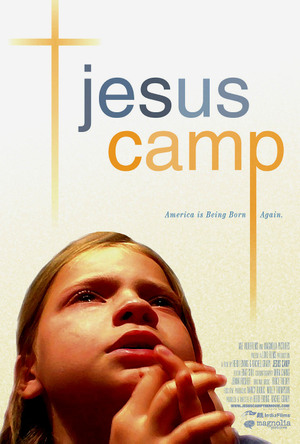
A rainy Sunday evening seemed like a good time to watch a scary movie. I had already viewed an exorcism movie or two over the last couple of days, so my wife and I decided to try something scarier: Jesus Camp. This 2006 documentary shows the workings of an evangelical, Pentecostal children’s camp run by Becky Fischer. By not skewing the evidence but by letting the organizers and children speak for themselves, a disturbing political agenda is revealed. Even more disturbing is the psychological scarring that accompanies such childhood indoctrination in a religion of fear. Fischer is obviously concerned with militant Islam, but her tactic of countering it with militant Christianity where children are soldiers (“this is war!” she shouts at one service) feels equally wrong. Part of the problem with such “Bible based” groups is that the Bible contains many contradictions and the Fundamentalists must pick and choose. For example, Rev. Fischer has chosen to disregard 1 Corinthians 14.34, stating that women should keep silent in the church. (I certainly do not advocate the literal application of that verse, nor of many others that made their way into a misogynous Bible.)

Utilizing the Bible only goes so far as a political tool. At the Kids on Fire camp the children are geared up to an emotionally intense state and lectured about the evils of abortion, evolution, belief in global warming, and Harry Potter. No mention is made that the Bible says nothing about abortion or evolution, and global warming had not yet become an issue. I can’t seem to recall Harry Potter being mentioned by name in the Bible, but other fictitious characters are from time to time. The Bible, having been written over a span of about a millennium, contains differing voices making statements for specific circumstances, and never intended to be used as political platforms. One gets the sense that “Bible believers” seldom read the Bible seriously themselves. Certain favorite passages are committed to memory and rehashed to death while others molder in dank corners of Fundamentalist basements.

What is lacking here is the long view. Once such groups win political power—they should be taken far more seriously in this arena—the religious freedom that will have launched them to that position will disappear. Like all human enterprises, however, it too will eventually crumble. Ted Haggard was spotlighted in the film, shot before his own hypocrisy came to light. At the camp George W. Bush is held up as a saint with Samuel Alito as his acolyte. The psychological manipulation and emotional abuse that the children trustingly accept is condemnation enough in itself. The camp was shut down after the film was released, but Becky Fischer, like Arnold Schwarzenegger has declared, “I’ll be back!” This is one Terminator I truly fear. Having watched a couple of exorcist movies over the weekend as well, I am left wondering which is scarier: demons that possess children or false prophets who do the same?