Strange Ending

Perhaps it’s from growing up as a biblical literalist, but I’ll probably always have problems with post-modernism.  You see, when you’re taught as a kid that there is one absolute right and you already know it (it’s Genesis to Revelation, no Apocrypha, please), you kind of get the idea that things are just what they seem.  Po-mo teaches, among other things, that there’s no true objectivity—reality is subjective and there is no neutral ground upon which to stand.  I’m down with that, but the old ways of looking at things remain.  This is a long-winded way of saying I finished Kohta Hirano’s ten-volume manga, Hellsing.  Over the past year I’ve been reading for a friend of mine, but manga has never really been my thing.  I read The Watchmen as a graphic novel, but looking at pictures somehow feels like cheating.  It’s that literalist thing again.

I might be dropping some spoilers here, so if you’re even slower than me be warned.  There’s quite a bit of shape-shifting here and it’s not always easy to tell who’s who.  In a kind of homage to my childhood monsters there’s vampires, werewolves, and even a Frankenstein’s monster in the series.  All of them are engaged in a constant state of combat against which the Protestant Hellsing organization stands for a stable civilization.  The Catholics are associated with Nazis along the way.  It’s a fascinating look at how an eastern culture might view the religious wars of those in the west who all go by the name “Christian.”  I think this is the genius of the series.  The friend who lent me the volumes has no declared faith, but he finds the dynamic fascinating.  Real religious fighting has made it easy for him.

The story, however, falls clearly into the generation of those without absolutes.  For someone my age a plot clearly laid out is a thing of beauty.  In college we used to argue about how absolutes might exist.  Where did they come from, and which is the strongest?  Did God make them or does God have to conform to them?  Even without the answers, the fact that absolutes existed was assumed.  Argument-driven science tells us that a theory is never proven.  Science is the best explanation we have at the moment, based on the evidence amassed.  In its own way, it has become post-modern.  Hellsing is a kind of mind-blowing work.  It will likely be a long time before I attempt another manga series.  Although I accept the po-mo premise, I still find old-fashioned fiction my favorite.

Goliath and Company

First UltraViolet.  Then Google +.  Well, actually neither of these was first—tech initiatives cease to exist all the time.  Giants aren’t immune to extinction, it seems.  I’ve got to be careful with my confessions toward Luddite sympathies since, as it turns out, tech is king.  Emperor, in fact.  But since tech only works as long as society holds together, I still want paper knowledge in my library.  I don’t own a Kindle and despite what visitors say, I don’t want to “save room” by getting rid of books.  I like books.  I wink at them from across the room.  Sidle up to them when in private.  Get to know them intimately.  Books are a way of life.  If the grid breaks down, I’ll have books to read and candles to do it by.  For a while there I even made my own candles, although most of those were used up in the aftermath of Hurricane Sandy.

Just sayin’

You see, my hairs bristle when I hear tech experts complain that “authors should be taught to write in XML.”  Said techies have apparently never written a book.  Ideas, you see, flow.  When you’re in the zone, there’s no stopping to mark-up your text.  In fact, the best, purest kind comes in scribbles on paper with misspelled words and all.  You can hold it in your hands and remember the Muse who had you at the time.  For me the hours of inspiration are before dawn.  I mostly use a computer now, but I can still find myself typing too slow to keep up with manic inspiration, desperate to record my ideas before paid work starts.  Work is the Medea of creativity—both mother and slayer.  Once I login I check out.  I need to wait for another day to dawn.

We’ve invested heavily in technology.  The internet is largely responsible for the globalization against which the world has recently rebelled.  No matter how many times people like me say we love books somebody will say, “Have you considered a Kindle?”  Why?  I bought a house as a place to keep my books.  These little bricks are bits of my mind.  Pieces of my soul!  What we read makes us who we are.  The last person who said the remark about authors learning XML literally sighed with disgust as he said it.  How could, you could feel him thinking, anyone be so backward as to think this is a problem?  I recall Hurricane Sandy.  Sitting in an apartment lit by candles we’d made ourselves, we read old-fashioned books and were eerily content.


Evolving Intelligence

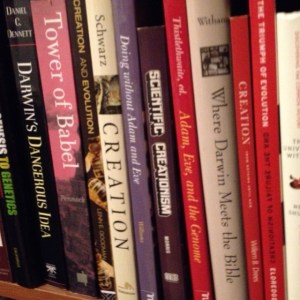
In the process of unpacking books, it became clear that evolution has been a large part of my life.  More sophisticated colleagues might wonder why anyone would be concerned about an issue that biblical scholars long ago dismissed as passé.  Genesis 1–11 is a set of myths, many of which have clear parallels in the world of ancient West Asia.  Why even bother asking whether creationism has any merit?  I pondered this as I unpacked the many books on Genesis I’d bought and read while teaching.  Why this intense interest in this particular story?  It goes back, no doubt, to the same roots that stop me in my tracks whenever I see a fossil.  The reason I pause to think whenever I see a dinosaur represented in a museum or movie.  When a “caveman” suggests a rather lowbrow version of Adam and Eve.  When I read about the Big Bang.

The fact is evolution was the first solid evidence that the Bible isn’t literally true.  That time comes in every intelligent life (at least among those raised reading the Good Book).  You realize, with a horrific shock, that what you’d been told all along was a back-filled fabrication that was meant to save the reputation of book written before the advent of science.  The Bible, as the study of said book clearly reveals, is not what the Fundamentalists say it is.  Although all of modern scientific medicine is based on the fact of evolution, many who benefit from said medicine deny the very truth behind it.  Evolution, since 1859, has been the ditch in which Fundies are willing to die.  For this reason, perhaps, I took a very early interest in Genesis.

Back in my teaching days it was my intention to write a book on this.  I’d read quite a lot on both Genesis and evolution.  I read science voraciously.  I taught courses on it.  I’d carefully preserved childhood books declaring the evils of evolution.  To this day Genesis can stop me cold and I will begin to think over the implications.  When we teach children that the Bible is a scientific record, we’re doing a disservice to both religion and society.  This false thinking can take a lifetime to overcome, and even then doubts will remain.  Such is the power of magical thinking.  I keep my books on Genesis, although the classroom is rare to me these days.  I do it because it is part of my life.  And I wonder if it is something I’ll ever be able to outgrow.


Turnabout

Fair play, so the adage dictates, includes turnabout.  Well, that may be overstating it a bit, but after reading Joe Nickell I decided to give the other side a shot.  Guy Lyon Playfair’s account, This House Is Haunted: The Amazing Inside Story of the Enfield Poltergeist, was originally written in the aftermath of the truly bizarre happenings at that location in the late 1970s.  My reason for reading the book, as maybe you’ve guessed, is that Ed and Lorraine Warren had a hand in the story.  Or at least a finger.  The movie The Conjuring 2 was based on the Enfield case and it placed the Warrens front and center in its resolution.  This is Hollywood, however, and since I’m working on a book on demons I need to try to dig beneath the surface a bit, into regions where tenure-seeking academics often fear to tread.

Interestingly, the Warrens are not even mentioned in Playfair’s book.  The edition I read was updated in 2011.  Playfair himself was one of the two primary investigators from the Society for Psychical Research.  The other was Maurice Grosse (who features in the movie).  Before eyeballs start rolling, it’s worth noting that the Society for Psychical Research is actually a respectable academic association.  As Playfair makes clear in his book, many of the members are skeptical and few believed that the evidence gathered by Grosse and Playfair indicated anything paranormal at all.  The book isn’t shy about dropping the names of the many investigators who dropped in—some uninvited—to either study or debunk the infamous poltergeist.  The incident, however, went on to inspire the movie Poltergeist by giving it free license to change almost all of the details.  Of the many investigators the Warrens remain unmentioned.

On this blog I’ve been chronicling the on-going struggle of trying to figure out what Ed and Lorraine Warren were up to.  Those who met and interviewed them invariably state that they were/are sincere.  They didn’t accept payment for their investigations, and often seem to have been genuinely interested in helping the people plagued by what mainstream science claims simply can’t exist.  Nevertheless, they had and have detractors even amid the parapsychology crowd.  Playfair’s account is quite interesting.  Called in early after the onset of strangeness on Wood Lane, Playfair recorded and recounted what he saw.  He caught some trickery and wasn’t shy about pointing it out.  At the end of the episode, however, he remained convinced that something unexplained had happened there.  Nickell dismisses it all with a sentence or two.  In the interest of fair play it would seem only right to hear the other side of the story.


Quantum Magic

This history of ideas is perhaps the most stimulating of intellectual topics.  At least to me.  The pedigree of an idea tells us something of its validity—its authority, as it were.  I have been reading about the early days of science.  (Even the idea that science is modern is a mistaken concept; the earliest tool-makers were in some sense scientists.)   A book I was reading made the point that in the Renaissance, magic was a proper competitor to science.  Magic was sophisticated, based on much of what we would now call “science”—the belief was that the connections between an interconnected universe were hidden.  All things were tied together, nevertheless.  This presages not only the concept of evolution but modern cosmology as well.  The more I thought of this, the more it occurred to me that oppositional thinking, in some sense, dooms the possibilities of finding the truth.

Quantum mechanics, which I understand only on a lay level, has been puzzling over entanglement for some years now.  Entanglement was characterized by Einstein’s phrase “spooky action at a distance.”  Still, experiments have show that particles that have no way of “knowing” what each other are doing, are nevertheless connected.  That connection is nothing physical, nothing material.  Indeed, it makes materialists quite nervous.  The inert world of quanta should show no tendency towards “will” or “intention” at all.  So we call it something else—entanglement.  As I read about Renaissance magic, I realized that it was suggesting just this.  Of course, they had no means of observing what particle accelerators, such as that at CERN, reveal.  Their “science,” however, successfully predicted it.  Were it not for the history of ideas we could let materialists think they’ve discovered something new.  Historically, though, they haven’t.  (I’m not suggesting that quantum mechanics work on the macro level, but I’m observing that magic supposed some kind of entanglement existed.)

This is some kind of entanglement!

Often I have made bold to challenge Occam.  I wear a beard for a reason.  One size does not fit all in the entangled universe.  Some consider the exploration of spiritual aspects of life to be a waste of time.  Look at any university pay scales and be so bold as to differ.  The funny thing is, science is only now beginning to catch up with what we historically have called magic.  There seem to be multiple explanations to the behavior of the material world instead of a single one.  Once an idea becomes orthodoxy it becomes dangerous.  Reason is very, very important.  But reason sometimes get entangled in a world only revealed in the history of ideas.


Fossilized Ideas

In our current political climate, perspective helps quite a bit.  Indeed, one of the shortcomings of our conscious species is our inability to think much beyond the present.  In either direction.  Because of the biblical basis of western civilization, a significant portion of otherwise intelligent people believe that the world was created 6000 years ago.  I grew up believing that myself, before I learned more about the Bible and its context.  I also grew up collecting fossils.  Somehow I had no problem knowing that the fossils were from times far before human beings walked the earth, but also that the earth wasn’t nearly as old as it had to be for that to have happened.  Faith often involves contradictions and remains self-convinced nevertheless.

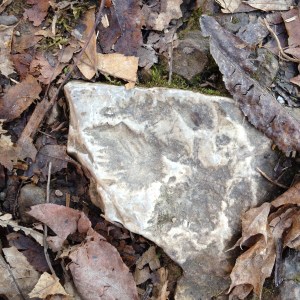
While out walking yesterday I came across a fossil leaf.  Unbeknownst to our movers last summer, I have boxes of fossils that I’ve picked up in various places that I’ve lived.  I find it hard to leave them in situ because of the fascinating sense of contradictions that still grabs me when I see one.  There was an impression of a leaf from millions of years ago right at my feet.  It was in a rock deeply embedded in the ground and that had to be left in place.  Never having found a floral fossil before this was somewhat of a disappointment.  Still it left an impression on me.  Perhaps when dinosaurs roamed Pennsylvania—or perhaps before—this leaf had fallen and been buried to last for eons.  How the world has changed since then!

After that encounter, I considered the brown leaves scattered from the recently departed fall.  Some lay on the muddy path, but few or none of them would meet the precise conditions required to form a fossil.  If one did, however, it would be here after humanity has either grown up and evolved into something nobler or has destroyed itself in a fit of pique or hatred.  We know we’re better than the political games played by those who use the system for their own gain.  The impressions we leave are far less benign than this ossified leaf at my feet.  The Fundamentalist of the dispensationalist species sees world history divided into very brief ages.  God, they opine, created the entire earth to last less than 10,000 years.  All this effort, suffering, and hope exists to be wiped out before an actual fossil has time to form.  It’s a perspective as fascinating as it is dangerous.


Solstice Musings

Should my posts of late be castigated as against the Christmas spirit I would rely on Andy Williams’ song, “The Most Wonderful Time of the Year” in my defense.  “There’ll be scary ghost stories,” the crooner sings amid images of cheer and celebration.  What may not be appreciated by my less sober celebrants is that the long nights of winter have as close an association with ghosts as they do with the numerous religious holidays that fervently pray for the return of the light at this time of year.  In merry old England, which along with Germany developed the modern concept of Christmas, the holiday was observed with evening ghost stories as is well represented by Charles Dickens’ A Christmas Carol (likely the source behind Williams’ lyric reference).

So I read about ghosts when the light begins to fail.  Or at least that’s my excuse.  When Ghost Hunters took to the air in 2004 the world became aware that electronic devices can pick up anomalies and other ghost-hunting groups began to appear.  Alan Brown, apparently curious about this development, wrote Ghost Hunters of New England as a field guide of sorts to paranormal investigators.  The book divides the region by states and includes the answers to survey questions asked to each of them.  The result isn’t especially inspirational, however, as these groups share in common the obvious absence of scientists.  It may be that professional scientists fear the career impact of such associations, but as is the case in many academic disciplines, their lack of participation simply erodes the credibility of science in the eyes of many.

Human investigation of the world has reached a point where many academic specialists can no longer communicate effectively with the average person.  I work in academic publishing and it is clear that many specialists simply do not recollect the level at which those without advanced training read.  We therefore see the rise of hoi polloi as self-appointed experts.  If scientists won’t investigate ghosts, plumbers will.  And since, no matter what science declares, many people experience ghosts, they will listen to those who at least seek answers.  The problem with books like Brown’s, of course, is that if a fad fades the groups disappear leaving the information outdated.  A couple of the groups were interesting enough to send me to the websites listed only to find the domain name for sale and the ghost hunting shingle removed from the door.  Still, the book had some useful information for those willing to consider the possibilities.  After all, the nights can be awfully long in December.  And there’ll be scary ghost stories…


Reflecting on Light

Now that we’re approaching the winter solstice, light is pretty much on the minds of those of us in the northern hemisphere.  Or lights.  The use of Christmas lights and Hanukkah lights may have symbolic value to the religions that promote them, but both also reflect the pagan use of sympathetic magic to bring back the light.  Human beings tend to be visually oriented, and many of us feel the increasing darkness deeply.  Days are brief enough to be awake for the entirety of daylight’s duration, and then you still have to get home after work.  After dark.  All our enlightened hours are spent for the benefit of the company.  It takes its toll.  And so we string holiday lights, bringing cheer into the preternaturally long hours starved for illumination.

Although the snow hasn’t stayed around here, I did notice an interesting reflection of light outdoors the other day.  The windows of a house were casting a light-shadow on a fence that had the look of a cross.   It took some convincing to assure me that this was pareidolia—the assigning of intentionality to random “signal.”  We see faces where they don’t really exist, and when we see crosses in this evangelical haven of America we have to assume they’re intentional.  Sometimes, however, they’re simply a trick of the light.  The sun has a low angle this time of year, and the light that is otherwise scattered back into what is wonderfully termed airglow—the natural illumination caused by sunlight as its luminosity brightens the daytime sky—is focused lower.  Light takes shape and sometimes it seems religious.


In New York City, where repeated patterns are pervasive, such reflections often appear on neighboring buildings as “X-Files” symbols of Xs in circles, giving the city a mysterious look.  Out here, however, they appear as crosses.  You see what you want to see.  Or, sometimes you can’t help seeing what appears utterly obvious to credulous eyes.  I’ve had people insist that crosses like this are intentional.  In reality, they’re a natural result of rectangles reflecting the morning light when the sun follows its low profile ecliptic during the waning of the year.  That doesn’t mean that it can’t be read for something else, of course,  Religion is all about interpretation.  Light forms patterns and seems strong enough to banish darkness.  And given how many hours it’s dark these days, I’m willing to take what help I can get.  The solstice will soon be here.


Straining Credulity

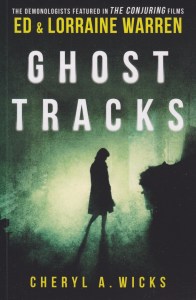
Ed and Lorraine Warren aren’t easy to figure out.  I realize that for someone who holds an actual doctorate from a bona fide, internationally recognized research university this might be something strange to say.  That’s because the standard academic response is simple dismissal.  Ed, at least, was known to have stretched the truth from time to time, but that’s not the same as never having reported weird things that actually happened.  This is why I’ve long advocated academics at least looking at the evidence—rare though it may be—before the simple hand-waving dismissal.  Part of the problem is that the Warrens’ books were written by credulous followers who don’t question things nearly enough.  Ghost Tracks, by Cheryl A. Wicks, may be the last of this strange genre of hortatory, biographical accounts “by” the Warrens written while Ed was still alive.

Skepticism is very important.  But so is listening to people.  What I find compelling is that similar weirdness—frequently dismissed out of hand—has been recorded throughout the length and breadth of history and across the entire globe.  The problem is that many of these things fall outside current scientific means of testing.  While perhaps not widely known, very reputable universities quietly explore these possibilities with actual science.  Part of the problem of the Warrens, as well as various other “ghost hunters” is that they use scientific equipment and think that makes them scientists.  It doesn’t.  Science requires deep engagement and many years of strenuous study.  And yes, skepticism has to be part of it.  The thing the Warrens have to offer is that they realize(d) that when science does engage the supernatural interesting things emerge.

Sensationalism, however, is the slave of capitalism.  Books sell better when they make extraordinary claims and declare they’re based on true events.  Trying to make a living investigating the paranormal led the Warrens, it seems, to tip the balance a little too far in the way of credulity.  Some of the stories in Ghost Tracks are more believable than others.  Some are just plain frustrating.  Ed’s interview with George Lutz (of Amityville fame), for example, is full of dropped balls.  A good question receives an intriguing answer only to have the subject immediately switched by the interviewer.  Even just a little skepticism and a follow-up question would have done scads to improve the believability of the story.  This is something a scientist would have known.  Someone as smart as Sir Arthur Conan Doyle, although his Sherlock Holmes generally found  ratiocination led to physical explanations, believed in the supernatural.  If only his Holmes might’ve been brought to this discussion we might possibly have learned something.


Reasonable Religion

Part of the pushback against religion, it seems to me, is based on the fear that there might be something rational to it after all.  Sorry to get all philosophical on you on a Saturday morning, but the idea has been bothering me all week.  You see, reductionist thinking has already concluded that religion is “emotion” and science is “reason,” and only the latter has any validity.  When’s the last time you met somebody and asked “How are you thinking?” instead of “How are you feeling?”  Neurologists are finding that reason and emotion can’t be divided with a scalpel; indeed, healthy thinking involves both, not reason alone.  Funnily, this is a natural conclusion of evolution—we evolved to survive in this environment—our brains developed rational faculties to enhance emotional response, not to replace it.

I know this is abstruse; go ahead and get a cup of coffee if you need it.  What if emotion participates in reality?  How can emotion be measured outside of individual experience?  We experience it all the time without thinking about it.  From the earliest of human times we’ve had religion in the mix, in some form.  Perhaps we are evolving out of it, but perhaps neurology is telling us that there’s something to it after all.  Something immeasurable.  Chaos theory can be quite uncomfortable in that regard—every coastline is infinite, if you get down to nano-divisions.  When you measure something do you use the top of the line on the ruler or the bottom?  Or do you try to eyeball the middle?  And how do you do it with Heisenberg standing behind you saying there’s always uncertainty in every measurement?

Absolute reality is beyond the grasp of creatures evolved to survive in a specific environment.  Religion, in some form, has always been there to help us cope.  Yes, many religions mistake their mythology for fact—a very human thing to do—but that doesn’t mean that emotion has nothing to do with rational thought.  It seems that instead of warring constantly maybe science and religion should sit down at the table and talk.  Both would have to agree on the basic ground rule that both are evolved ways of coping with an uncertain environment.  And both would have to, no matter how grudgingly, admit that the other has something to bring to that table.  Rationality and emotion are entangled in brains whose functions are simple survival.  Pitting one against the other is counterproductive, even on a Saturday morning.


Changing Times

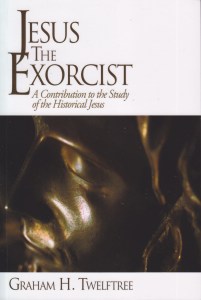
Demons are an embarrassment.  The typical scholar of the historical Jesus can’t avoid the fact that one of Jesus’ main activities is exorcism.  You can go the whole way through seminary not hearing about that aspect even as you become very well acquainted with the two-source hypothesis.  That’s why I found Graham H. Twelftree’s Jesus the Exorcist: A Contribution to the Study of the Historical Jesus so refreshing.  Here is someone willing to address the topic generally swept off the table.  If the gospels are to be believed, then Jesus was an exorcist.  And if he was an exorcist, that must imply a thing or two about demons, no matter how embarrassing.  There’s a lot to this question, of course, and things are never as simple as they seem.

Many of those who look for the Jesus of history suggest that the Galilean sage simply accepted the framework of his era in which various diseases such as epilepsy were considered demonic.  As he healed such people—also somewhat of an embarrassment since it implies the supernatural—he understood their maladies in the same way his contemporaries did.  That tidy package, however, doesn’t sit well with narratives that assume a world full of demons.  Things have changed since the first century, of course.  After the Middle Ages demons fell out of favor.  And yet, the gospels remain pretty much unchanged, trying to fit into a new worldview.  This is the uncomfortable place in which those who seek the historical Jesus find themselves.

Twelftree approaches and analyses the text at its word.  The casting out of demons was an eschatological (end-times) act.  It was the beginning of the end for the evil spirits that torment this world.  Of course, two thousand years have come and gone and, according to some, demons are still with us.  The number of requested exorcisms has been on the rise.  The end times have lasted a lot longer than anyone anticipated.  It’s beginning to look like politicians can do what God seems reluctant to affect.  Bringing about the end of the world is no matter of clearing the house of demons, but rather letting evil take the helm.  If that’s a mixed metaphor, let’s just say demons are masters of confusion.  Since medical science has given us a great deal of comfort and relief from suffering, we’re glad to let demons go as the explanation of diseases.  But that doesn’t make things any easier for those looking at the first century when, as Twelfree demonstrates, Jesus was an exorcist.


Keypad of Heaven

There are those who celebrate technology, and those who mourn it.  I fall somewhere in the middle.  One of the selling points for our house was keyless entry.  The great thing about it is you never have to worry about forgetting your keys.  The bad thing is that batteries don’t like cold weather.  The former owners of our house seem to have had it even less together than we do,  They had no instructions or emergency keys for these electronic locks.  So it would happen on a cold, blustery weekend morning we would find ourselves locked out of our most expensive possession.  Now, you have to understand that this “well-maintained” house—so claimed by the not-inexpensive inspector—has turned into a money pit.  The list of derelict pieces and appliances grows weekly and we haven’t even paid off the roof yet.  Emergency locksmiths, I now know, earn their keep.

As I stood on the porch in the gusting wind, waiting in a thin jacket (we were not out for a long trip) for someone I would pay handsomely to break into my house, I considered technology.  If you can afford to keep up with it, it must be great.  If, say, electronic keypads were solar, wired to panels on the roof so that the batteries never died, that would be fantastic.  Even a key would be an advance on a day like this.  So once our teeth stopped chattering and we added yet another creditor to our growing list, I thought how that very morning my computer told me it needed a systems upgrade.  “Didn’t you just have one?” I asked, almost out loud.  I know what it is to be a servant.  My thoughts wandered, as they frequently do, to The Matrix.  When the machines take over, their problem is battery power.  Since we scorched the sky, they began using us as wet cells.  

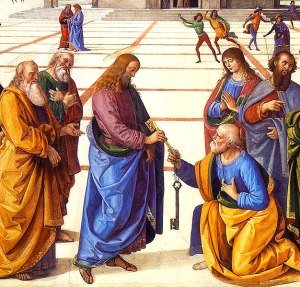
Later in the day, for cheap entertainment, we went to a local parade.  Among the many vehicles on display were old cars and tractors.  Tractors that even I might have a chance of understanding because they were merely open engines on a frame with seats and large wheels.  This was technology that fed people rather than preventing them from entering their houses.  I couldn’t help but notice that they started with keys.  There’s a reason that the key has always been a potent symbol.  Its simple technology leads to hidden wonders.  And on a cold morning those hidden wonders might well include your own house.

“Now, put these where you won’t lose them!”


Look It Up

So my current book project involves addressing The Conjuring universe.  A few weeks back I posted on The Nun, the newest member of that diegesis and one with no claim to be based on real events.  Nevertheless, the film circles back at the end to “Frenchy” and his exorcism shown in the original movie.  One of the frustrating aspects of Ed and Lorraine Warren ’s oeuvre is that documented sources are difficult to locate.  When I found out Satan’s Harvest (by Michael Lasalandra and Mark Merenda, with Maurice and Nancy Theriault) was the “true story” behind Frenchy Theriault’s possession, well, let’s just say working on a book is a good excuse.  Overly dramatized, and somewhat padded, this account may be the closest we can come to this particular demonic encounter.

I don’t pretend to be certain about many things, so I reserve judgment about what actually might’ve happened to Maurice Theriault.  Unlike portrayed in The Nun’s storyline, he never lived in Romania.  He was physically abused by his father and was made to participate in unwanted sexual acts.  His was not an easy life.  Still, when Lasalandra and Merenda try to explain the origin of possession they go back to the same source as the original movie—Salem.  Credulously claiming that the Devil was behind what happened in 1692, they believe that demonic possession accounted for that unfortunate miscarriage of justice.  It’s difficult to say if they considered that such speculation implies that the innocents killed there were actually witches.  (They state that the Devil asks people to sign his book.)

Herein lies part of the problem with academics and the supernatural.  Sensationalized claims don’t help since academics are all about being taken seriously.  At the same time it’s clear that conventional explanations don’t always fit.  Neither credulousness nor extreme skepticism will lead to solving such mysteries.  This is why we need the monstrous.  That which falls outside the parameters of what quotidian experience leads us to expect.  Science can make everything fit only by leveling off the exceptional.  Academics won’t risk exploration of the anomalous.  This leaves the curious few means of finding out what happened beyond simple dismissal or overly gullible popularizing accounts.  Satan’s Harvest contains information that calls out for explanation.  Perhaps a hoax was involved, but that doesn’t add up when all the evidence is in.  Beyond that, we’re left to guess.  And some things it feels better to be sure about.


Goblins out There

From Wikimedia Commons

You step away from the telescope for a few months and see what happens.  That may sound like a recipe for some kind of cosmic soup, but as we find ourselves so busy with earthly matters it’s hard to keep up with the heavenly.  I’ve just been reading about the discovery of “The Goblin”—appropriate as we tiptoe into October.  The Goblin is officially a dwarf planet named 2015TG387, which falls trippingly off the tongue.  For those of us who never even saw Pluto before it was demoted as a planet, the distance of this planetoid boggles the mind.  It also makes space feel somehow less empty.  In fact, our solar system’s much more crowded than it was when I took astronomy class in college.

The universe—space—is close kin to our ideas of religion.  “God,” however defined, is “up there.”  As Galileo encouraged telescopes turned outward we began to discover mundane, if complicated, ways of explaining the universe.  Nobody looked through the eyepiece and saw the deity waving back.  Space was cold, dark, and largely empty.  Then the idea eventually grew that it was full of dark matter which, like spiritual entities, can’t be seen.  Unlike spiritual entities, however, it can be hypothesized.  Calculated, even if not measured.  And since it isn’t supernatural, it’s just fine to keep in our cosmic soup.  The problem with any recipe, however, is that it seems that each time you make it the results are slightly different.

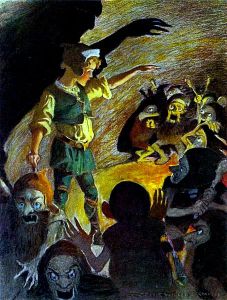
It’s somehow appropriate that our new space neighbor is called the Goblin.  The idea of a cosmos devoid of any intelligent life—supernatural or no—is somewhat scary.  Looking at the headlines of what we’re doing to one another down here, and nobody willing to take the reins of reason, we increasingly hope for something beyond mere nature in the cold, dark reaches above.  And that we’ve found such a thing as a goblin—a supernatural entity if there ever was one—is telling.  In fact, all our planets are named after gods.  We can blame the Greeks and Romans (and even the Mesopotamians) for that.  Still, the tradition continued onto the worlds they couldn’t see: Neptune and Uranus and, for a while, Pluto.  We can’t escape the idea that what’s up there is more powerful than our minuscule human troubles.  Our slowly eroding atmosphere is all that keeps us alive down here.  And now there’s a goblin circling all around us, so far away that few will ever even catch a glimpse.


Just Sagan

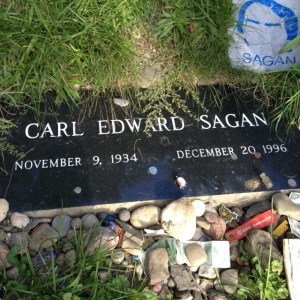
Perhaps the most famous resident of Ithaca, New York, during his career at Cornell was Carl Sagan.  The astrophysicist had had a noteworthy career, becoming a household name with his popularizing television programs and books.  When he died prematurely, there was a real sense of loss among many of us who appreciate those who dumb down science so the rest of us can understand.  Over the weekend in Ithaca, which still bears his physical legacy in a scale model of the solar system, we went to find his final resting place in Lakeview Cemetery.  There is something oddly peaceful about passing time among the dead.  It was late afternoon and we were the only ones in the graveyard.  We also had no idea where his plot might be, so we surveyed a good bit of the grounds, finding the Cornell family mausoleum along the way.

When my wife found his plot, with a simple tombstone laid into the ground, it was impossible not to notice the grave goods.  The leaving of mementos at the burial places of the famous is nothing new.  Douglas Adams’ grave in Highgate Cemetery in London had a profusion of pens pressed into the ground.  H. P. Lovecraft’s final resting place in Providence likewise had remembrances scattered about.  Among the items at Sagan’s grave were various bits of money, a teddy bear, and a somewhat lengthy letter written to the late scientist, expressing how much he had influenced the life of the writer.  After paying our respects, it struck me how even in a cemetery where death, the great leveler, has visited all, we still seek out the famous.

I couldn’t help pondering the implications of leaving behind something for the dead.  Money is of no use where goods and services can’t be traded.  Approaching the cemetery from the upper entrance, we first encountered a Jewish burial area where many of the tombs had rocks characteristically laid on top.  Sagan’s grave is on the border where stones on tombs begin to give way to crosses.  The custom of placing rocks on gravestones is ancient, but the reasons it’s done are disputed.  One of my favorite explanations is that flowers die but rocks do not.  There’s a simple elegance to it.  Many Christian graves appear neglected by comparison.  We don’t live in Ithaca, and it’s difficult to guess how often this somewhat hard-to-find cemetery is visited.  When it is, however, it is in the spirit of remembering a life that was ever focused outward, to an infinite yet expanding universe.