Monk over Matter

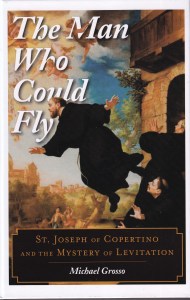
ManWhoCouldFlyPeople can think with their emotions. At a young age we begin formal schooling to teach us the rational ways that we must develop to live in society. Emotions are trained, tamed, and sometimes repressed as we are taught that “higher brain” functions are what make us distinctly human. Even in our supremely rational world, however, we can’t figure out consciousness. It remains elusive, provocatively bordering on the supernatural, and the experience of being human gives the lie to consciousness being emergent from a physical brain. These are the kinds of issues that underlie the strange case of Joseph of Copertino. The subject of Michael Grosso’s recent book, The Man Who Could Fly: St. Joseph of Copertino and the Mystery of Levitation, Joseph may well be off the radar of most people. In fact, in the seventeenth century church in Italy, his presence was downplayed and hushed, almost as an embarrassment to Roman Catholicism of the day. Why? Joseph was known to levitate. In fact, his levitations were often in public and were witnessed by individuals whose credibility was not in doubt. With the Reformation going on, however, the last thing the church needed was a miracle.

The standard historical line of dealing with Joseph is to laugh and wave our hands in the directions of those credulous early moderns. They thought they saw him levitate, but it was all imagination. Even if we have to invoke mass hallucination. People just can’t levitate. Grosso’s book, however, takes a different approach to Joseph. Looking at first-hand accounts, carefully considering the political situation of seventeenth-century Italy, and being open to parapsychology, this book presents a very different portrait of the flying saint. There was nothing to be gained by hiding such a prodigy unless, as Grosso argues, there was actually something to the story. It may come down to a basic misunderstanding of consciousness, his book suggests.

No doubt The Man Who Could Fly will be simply dismissed by many. Those who dare to read it, however, will find a cogently argued, rational exploration of a man who was lifted by spiritual ecstasies in a way we have yet to understand. Grosso demonstrates that, depending on perspective, such events do not violate laws of physics so much as demonstrate that we have much yet to learn about them. Categorizing events as supernatural puts up an artificial barrier to exploring scientifically events that have evidence in the form of multiple witnesses. Obviously we can’t go back to the 1600’s and visit Joseph in some obscure convent where he’d been shuffled by church authorities to keep him out of the public eye. Even if we could there would be no way to prove his extraordinary gifts. When it comes to the life of emotion, the only way to accept the impossible is with belief. And at times belief may be the most rational response at hand.
Head of STEAM

The market producing doctorates in the humanities is showing no signs of slowing down. The fact is we’re all human, and many of us aren’t very technically inclined, unless we have to be. There are fewer and fewer jobs for these bright students who graduate with doctorates in the humanities, but the plight of the “privileged” is no concern to wider society. Let the eggheads figure it out. At the same time, wisdom in the job market is that careers in Science, Technology, Engineering, and Math (STEM subjects) are growing and showing the most promise for future careers. The pace of technological change is so rapid that yes, obsolescence for new devices is six months or less. My iPhone 4 is a dinosaur, although when I first held it some three years ago it was so advanced that I was afraid of it. A moment’s reflection will reveal that the most advanced technology is already in use in the military since staying ahead of the enemy is always the bottom line.

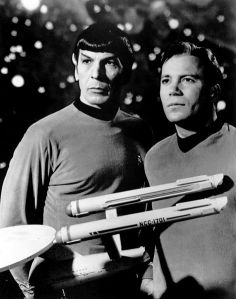
This situation has led to some concern, and not just among those of us in the humanities. Some in the world of STEM are saying that quality of life suffers. To indulge a stereotype, try to imagine geeks without Star Trek. We know that Star Trek was as much fantasy as science fiction. My iPhone makes a communicator look just plain silly. Star Trek is, however, creative indulgence. While many would hesitate to raise it to the status of “art” it is part of the Arts: fine arts, literature, film, music, and some television. The stories it tells are the stories of human beings (and one alien) struggling against often more advanced civilizations. In the end, humanity always wins. If we exit the stereotype, scientists are often musicians and writers as well. Some become novelists or consultants on box-office busters. We are more than meat machines.

Recently voices have been heard suggesting that STEM should be STEAM. The Arts have an integral role to play in the scientific and technological fields. Even some numbers are imaginary. The basis for developing imagination is the Arts. Although we could have made it to this point in our development without Star Trek, the fact is that many of us growing up with it, as well as the more silly, but also influential Lost in Space, and what we now know is a most assured cash cow, Star Wars, know that these shows helped shaped the present we inhabit. Arts give us visions. There continue to be those who castigate the Arts as “soft” and “weak” and tangential to the cold hard facts. But they are wrong. Humans can’t survive without a source of warmth and energy. And the first great engines of advancing civilization still have much to teach us, for those engines ran on steam.


First Stronghold

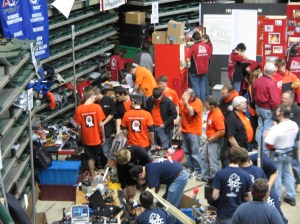
FIRST Robotics has a way of getting into your blood. Like many people of my generation, I learned about FIRST Robotics through my daughter. Our local high school has a robotics team and, as we quickly learned, the decision to join FIRST is a four-year family commitment. My wife and I were both involved at some level, despite being the world’s least likely engineers. I even served a term as the president of the foundation (responsible for funding the team). We made lasting friendships and grew in the lingo and odd humor that is FIRST. The founder and chief promoter of FIRST, Dean Kamen, is an unapologetic geek and has helped develop what some journalists are calling “the new cool.” Yesterday was launch. If you are a FIRST follower, I don’t have to explain that. In case you’re not, “launch” is the revelation of this year’s game. Teams now have six weeks to plan, design, and build their robots.

IMG_3125

Launch is a big deal. We haven’t been part of the competition for three years now and we still watch the live web-broadcast. The major players (Kamen, and Woodie Flowers) get in character and meet kids from various teams. They give inspirational talks. Dean Kamen told the kids “Don’t get stuck into today.” Technology changes too fast. What you learn in school are tools, because facts are available instantaneously on the internet. Those of us who retain facts are so yesterday that we’ve become the trivial pursuit generation. Any computer, let alone robot, could beat us. Woodie Flowers told the young audience thinking about careers that they must do what machines cannot do, otherwise their jobs will become obsolete. What could be more human than religion? What’s religion got to do with it? This is science and technology!

This year’s competition is FIRST Stronghold. The entire buildup of yesterday’s launch was a takeoff on Monty Python and the Holy Grail. What is this I see before me? History? The Middle Ages were nothing if not religion run wild. This was a world ruled by bishops, popes and nobility. It was a world where no matter who you were, God trumped all. Technology meant that a trebuchet was a pretty sexy device and long distance communication traveled at the speed of a horse or human runner. (Or, I suppose, a trebuchet missile.) Now that the humanities have fallen victim to science, we look back to them for inspiration. It reminds me of John Keating in Dead Poets Society: “And medicine, law, business, engineering, these are noble pursuits and necessary to sustain life. But poetry, beauty, romance, love, these are what we stay alive for.” This hasn’t changed since 1989. Or even 932 for that matter.


Simple Gifts

Thing Explainer, a whimsical gift for my daughter at Christmas, is perhaps the trendiest present found here this year. Randall Munroe, who makes a living as a web comic artist (who knew this was even possible?) wrote/illustrated the book to explain complicated things in simple words. Indeed, he limits himself, with some license, to the thousand most common words in English. Due to the almost viral success of the book, websites now exist so that even those of us with advanced degrees can explain things with common words. It reminds me of the Common English Bible in that it attempts to make something complicated easy to understand by using a level of writing accessible to the majority of readers. Thing Explainer is, naturally, for fun. There is, however, an underlying question.

Have we reached a point where reading itself has to be enhanced by making it simple? Some things are, by their very nature, complex. At a time when more and more kids are being encouraged to attend college, the traditional basis of higher education (the classics, classical languages, the humanities) has eroded so far that higher education is not what it once was. My daughter’s engineering program is highly technical and doesn’t naturally promote the things I recall as “college.” Maybe I need someone to explain it to me in simple words. What’s wrong with being literate? With finding challenging books worth the effort to get through? Some things are complex.

A young couple's anniversary in Wales.

A young couple’s anniversary in Wales.

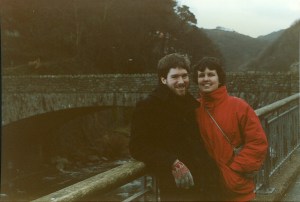
I wonder how a society survives when complexity disappears. Today my wife and I celebrate our twenty-seventh anniversary. Marriage can be a complex thing, but it is something that can be explained in simple words. When we decided to marry the idea was lifelong commitment, not knowing the twists and turns that life would take. If the Internet existed in those days I didn’t know about it. (Certainly, being a web comic artist wasn’t a job that yet existed.) Doctorates still led to teaching careers. 9/11 hadn’t happened so that living in a modified police state wasn’t yet part of daily reality. There weren’t really words to explain it. It was one of those most basic human things. Turning to Thing Explainer I find that love is one of the thousand most-used words. It does perhaps show, after all, that complex things can be stated in a word we all understand.


Imagine the World

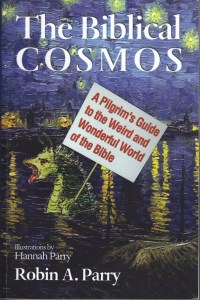
Biblical CosmosRobin A. Parry’s, The Biblical Cosmos: A Pilgrim’s Guide to the Weird and Wonderful World of the Bible is a fun trip through territory already familiar. Familiar, that is, to anyone who has studied the biblical world on its own terms. Fundamentalists, I think, would benefit from taking this guided tour seriously. The fact is, most people have no real sense of how mythology might inform a scientifically inclined world. Not that Parry will convince everyone, but the dangers of literalism are best disarmed by a believer. This little book endeavors to demonstrate just how odd a world produced the Bible we still use today.

Although the point of the book may not be what I took away from it, I would suggest that the most important aspect is that times change.  A biblical worldview, unless one is mentally able to hold two realities simultaneously in mind, is simply not possible today.  I told generations of students that the world described by the Bible does not exist.  It is a flat world, held up by pillars and with a solid bowl inverted over it for a sky.  At the same time, those who lived in the biblical world were not simpletons.  The basics of science were well understood and their engineering capacity easily bypassed that of the current writer.  It was a world based on different assumptions than ours.  The problem occurs when people who know better (i.e., anyone born since about the time of Copernicus) try to pretend that the Bible can be taken literally.  It is disingenuous to say so.  The Bible, regardless of divine status, is a document of its time.  No dinosaurs had been discovered.  The processes of geology were understood only in the most rudimentary of ways.  Stars were not millions of light years away.
 
So what are we supposed to do with this information?  Parry concludes his book by describing ways in which the biblical view of the cosmos might fit, conceptually, into a modern theology.  For many of those starting out in the academic study of the Bible such a demonstration can be quite valuable.  Those who’ve been at it a while will surely have come up with their own systems.  When books become sacred, in the minds of the believing community, the “truth” attributed to the book is the truth of that era.  As any scientist or historian will attest, truth is contingent.  We haven’t learned everything yet.  Given the limitations of the human mind, we likely never will.  We should accept our universe with a little mystery.  Humility can be a good thing, and it is more effective not having to make excuses for what will surely become outdated information sooner than we think.


Seeing Things

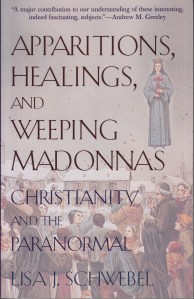
SchwebelWe have to learn to see the world. Traditionally religion and science both had roles to play, but as science grew better at explaining physical causes, many consigned religion to mere superstition. In such a paradigmatic world, Lisa J. Schwebel’s Apparitions, Healings, and Weeping Madonnas is something of an anomaly. Schwebel begins by noting that the Catholic Church has long accepted the reality of psi. As the branch of Christianity with the strongest commitment to furthering science, this itself might seem unusual. We are taught to see the world in a binary way: either this or that, not both. Books such as this challenge that convention, asking us to look at a world that doesn’t always conform to expectations. Parapsychology has made inroads from superstition to science because of testable hypotheses and statistically significant results. What it might mean is up for grabs.

Some claim that Catholicism is credulous. Actually, as Schwebel adequately demonstrates, criteria for declaring even spectacular events as miracles are amazingly high. Merely paranormal events seem common in comparison. In many ways, this is a disorienting book: the supernatural is assumed to exist, but miracles are treated as less common than the everyday supernatural. Those of us raised in a rationalist scholarly world might find the acceptance of that which we’ve learned is impossible just a bit unexpected. No doubt, visions of Mary are reported. Crowds often visit trees or highway underpasses where pareidolia impresses an image on the faithful. Schwebel, however, is discussing visions of another sort, and finds that they may involve the power of suggestion rather than the miraculous.

Faith healing, on the other hand, is something for which empirical evidence exists. Doctors still disagree about whether prayer speeds healing, but there have been many instances of unexpected healings that have occurred, apparently in relation to a person noted for bringing wellness about. Causality, of course, can’t be proven, but many people find themselves believing in a spiritual world after such an encounter. Perhaps that is what is so intriguing about books like this; they make readers uncomfortable in a world that is purely material. Finding a credentialed author who actually believes and has evidence to back her up is a rarity. Challenging conventions is part of the territory in most religions. Schwebel is simply straightforward about it.


Musical Mind

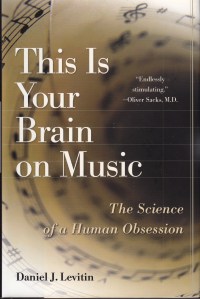
BrainOnMusicMusic is perhaps the most natural of human arts.  We are all, as Daniel J. Levitin says, expert listeners from an early age.  This Is Your Brain on Music: The Science of a Human Obsession is a fascinating study of neuroscience and music.  I began exploring this connection about a decade ago when studies on religion and neuroscience were only just beginning to appear.  Music, although closely related to religion in many ways, does not bear the stigma of “belief” and although music programs are often tragically cut from school budgets, we all value music because not to do so makes us less-than-human.  Levitin shows clearly how music accompanies the most important parts of our lives and how it forms and develops the brain.
 
Music is somewhat easier to define than religion.  Those who decry the humanities, I suggest, should be locked away with no access to music for a few years to see if they change their tune.  I suspect they would.  We need music, and music’s impact on the brain is an analog to that of religion.  More studies of religion and the brain have begun to appear, and one gets the sense that materialists are a little bit angry and disappointed that religion hasn’t disappeared the way that it was predicted to have done by now.  That’s because being human is more than being molecules and chemical reactions. It involves what we call the humanities.
 
Our brains are our gateways to all of human experience.  They are complex in ways that computer designers emulate, but there’s a messy something about biology that straightforward mechanics seems to have trouble replicating.  Our brains are part of one large, organic whole that encompasses life on this little planet.  While studying the brain to understand it is indeed a good idea, calling it a meat computer is not.  While software may be coded to compose music, of one thing we can be sure. Computers can’t enjoy music.  It takes a brain to appreciate music, and the brain that appreciates music is mere synaptic connections away from seeing why religion is still important.


The Religion Industry

The American Academy of Religion and Society of Biblical Literature annual meeting can be a heady place. Religionists tend to be “big picture” people, looking at things from the perspective that this is what life is all about. How much bigger can you get? Religion is, after all, a matter of perspective. As quickly becomes clear from glancing across the crowds—there is a literal myriad here—a great diversity exists. Ironically and irenically violence, beyond an occasional rudeness, is absent. There are believers and non-believers and they actually talk to each other civilly. They want to understand, and in an increasingly polarized world understanding religion seems like a very sensible thing to do.

It feels, however, like an industry to me. Religion evolved out of primal fears. Nobody knows for sure where it started, but someplace (or someplaces) along the course of human development, the idea took hold that humans weren’t the final word in terms of power or direction of their own destiny. There is something beyond us. It may be a tao, or it may be a god, or it may be something we haven’t even conceived yet, but there is something larger than us. The scientific paradigm, on the other hand, starts by assuming human superiority, at least in terms of rationality, over the entire universe. Teasing things apart, looking at the smallest units and building up a big picture from there, it all comes down to equations and concepts understandable in empirical terms. If there is a tao, or gods, and if they don’t leave some physical footprint, they must be left outside the frame. Until the religion industry arrives.

Every field of study has its crackpots, but those thousands milling about me as I stand in a booth with knowledge for sale are mostly sincere. The official study of religion takes place in higher education. Its practice is left elsewhere. The Dalai Lama is not here. The Pope is not passing through adoring crowds. Even Mike Huckabee hasn’t put in a guest appearance. We are not always the friends of those who do religion, for this is a complex industry. Our role is to ask how religion works. Beyond that, we try to fit it into a larger picture—one that expands beyond the universe itself. Out to where a mysterious force may lurk. A force that reminds us that human effort, as strenuous as it may be, must acquiesce in the presence of the unknown.

IMG_2612


All for Naught

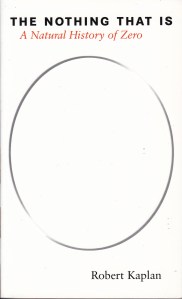
ZeroPhilosophy, it used to be said, was the handmaid to theology. According to some among the scientific establishment the whole lot should be thrown out, baby, bath water, and tub. It has always distressed me to read scientists dissing philosophy (theology I can understand). Empirical outlooks are definitively based on a philosophy, and no matter what we may think of post-modern theorists, we are indebted to philosophers far more than we probably realize. I just finished reading Robert Kaplan’s The Nothing That Is: A Natural History of Zero. I noticed the book when it was first published, but found it recently at a book sale for almost nothing. I’m glad I did.

I can’t pretend to understand all the equations in the book. There aren’t that many, thank goodness, but Kaplan uses them to make his point. He shows, through a combination of history and logic, how zero has made our modern world possible. One of the features that immediately stood out is how often religion entered the discussion. Kaplan isn’t hostile to it, he merely notes that some theologians resisted it along the way while others declared that nothingness was necessary and inevitable. Likewise philosophers. And mathematical proofs lead into some strange neighborhoods when zero’s your traveling companion. Indeed, some chapters of this little book so resembled philosophy that it was easy to forget a mathematician was our actual guide. I took some advanced math in high school that I survived only with the aid of my brother, but this book helped to make some sense of a past largely forgotten.

Science is all about numbers. Quantification. In fact, many scientific theories would simply fall apart without the math to back them up. A scientist learning math, as Kaplan demonstrates, is learning a philosophy. Even in the strange world of quantum mechanics, we’re told, the math holds up. We wouldn’t even know about some worlds if it weren’t for the equations. If math is near kin to philosophy, how can any right-minded scientist reject philosophy as nonsense? Isn’t this, logically, rejecting the basis for your own quantified discipline? And, if I may be so bold, philosophers generally acknowledge that their discipline has a, perhaps estranged, relationship to religion. If we look at it holistically instead of calling each other names, we might come to see that knowledge comes in many forms. Perhaps the most unexpected among them is that of the lowly zero.


Make Believer

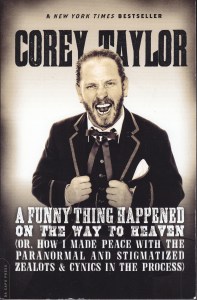
SmthgFunnyMy brother is way cooler than I ever hope to be. While I was busy learning all a tween and teen could about the Bible, he was listening to Lou Reed and David Bowie and Black Sabbath. Since the “door” between our rooms was only a curtain, I heard the forbidden sounds and, despite myself, had to admit that I liked what I heard. In fact, I once gave a lecture on Christian influence in secular rock music, and found many students staring at me in surprise for knowing so much about such debased music. In any case, when my brother recommends a book I know it will always be an adventure. Thus I came to read Corey Taylor’s A Funny Thing Happened on the Way to Heaven: (Or, How I Made Peace with the Paranormal and Stigmatized Zealots & Cynics in the Process). I didn’t want to admit to my brother that I’d never heard of Corey Taylor and that I couldn’t identify a Slipknot song even on Spotify, but the book sounded interesting, blending as it does bad-boy attitude with ghost hunting. November seemed a perfect time to read it. It could lead to some street cred on the bus.

It is difficult to distrust people like Taylor who write with absolutely no pretension (I’m a working-class kid, too). You know that what you’re getting is the real deal. It is also clear that like my brother and many rockers, Taylor is of above-average intelligence. Being smart can sometimes feel like a curse, and Taylor lashes out in several ways during the course of his narrative. He finds it odd to be an atheist who believes in, and has personally experienced, ghosts. I’m not sure that he would find it comforting to know that such a position is not at all as rare as he seems to think it is. Science deals with neither gods nor ghosts, and the average person is left to their own devices to decide who might speak with authority on such issues. Where are we supposed to look when scientists refuse to address such things? Personal experience is a powerful influence.

As with most books by opinionated, brash extroverts, it is difficult not to find yourself liking the writer. Trust may be too strong a word, but I do believe that Taylor writes without guile. After all, people have experienced ghosts for as long back as we’re aware. Why should it be any different for a celebrity? Is Taylor’s house haunted? (Or, more accurately are his houses haunted.) That’s a question no one can answer with certainty. Ghosts are beyond our realm of knowledge. Although plumbers can use scientific instruments, until actual scientists try to explain the immaterial we will be left to choose whom to believe. A metal singer can know just as much as a priest. Or even more, depending on the context.


Upgrade Downgrade

I don’t have to have the latest toys. In fact, I am happy to stay with what I have as long as it works. I’ve been a frugal lad all my life. The increasing demands of technology worry me. Nobody has to tell me that I keep odd hours. Waking up between 3:00 and 3:30 is hardly normal. Since I post on this blog before I go to work, I get up and turn on the computer, ready to write. As I learned three laptops ago, if you don’t keep your updates updated, you soon find yourself unable to do anything on the web. With my last laptop, whenever an update notice came, I immediately acquiesced. “What humble work I have to do, sir, pales in comparison to your mighty plans.” Now updates begin automatically. Most often I have no say in the matter. In fact, the first thing I saw when I started up my most recent computer was a message saying that a software update was ready to install. So what does all this have to do with my insomniac habits?

2015-11-07 18.47.57

Computer companies assume nobody is getting up and working at 3 a.m. While we’re sleeping our computers are making their electronic deals and sending out their electronic handshakes. We mortals need our slumber. I don’t even know what half this software on my computer does. I know that if it’s out of date, problems are sure to arise. So when I awake to find my computer’s too busy to accommodate me, I wonder how to post on my blog. Some updates politely run in the background, but others necessitate that I turn off the software I actually know how to use until it’s done updating. By the time it’s finished, I’ve forgotten what I was going to write. The computer now determines what might be expressed. When something goes wrong, we’re forced to learn its language. We’re in its country now. Technology is its national language, by law.

Once I was told that travel faster than the speed of light was impossible because of navigation. If you can’t see what’s in front of you because you’re traveling as fast as anything can, how do you know you won’t run into a planet, comet, or software update? You have no means of getting feedback in time to react. It strikes me that we’re already traveling well beyond the speed of light. I grew up writing without a typewriter. I wrote stories and articles on paper with lines, using a pen or pencil. Now I rely on my devices to store my ideas, but they’ve got other plans. I have to wait until they’re done to do my work. Of course, we must conform. At 3:30, human, you should be in bed. My advice to you, dear reader, is this: don’t wake your machine at the witching hour. You might not like what you find.


Think Bigger

PlanetRagesI’ve spent a lot of time with academics. Having been one myself, I know something of their habits. Getting through a doctoral program involves, at least in some fields, becoming the specialist on a very tiny piece of information. Since people have been thinking about things for millennia, finding something new to say can be a challenge. Often, by the time they’re done, newly minted doctors know an incredible amount about a very specialized topic. This is, in many ways, simply an intensification of the human experience. We think small. Part of the problem is that our brains haven’t evolved to think big. Having learned an awful lot about the weather in the book on Psalms, I have instinctively taken an interest in natural disasters. Charles Officer and Jake Page share this interest, as is evident in When the Planet Rages: Natural Disasters, Global Warming, and the Future of the Earth. This, however, is a big idea book. Globally big.

Throughout the first two sections of the book, which deal with humans in the face of nature, God often comes up. As scientist and science writer (respectively) Officer and Page simply reflect common beliefs. Nowhere do they advocate invoking God, but they note that throughout history, in the face of just about any species of natural disaster, people have. Many people still do. Disasters and God. What a team! We worship what we fear. Once Officer and Page reach the third section of human impacts on nature, however, God drops out of the picture and the fingers are pointing solely at us.

When I read about what we’ve already done to this planet, I, as a colleague once said, start seeking another species to join. We have destablized the atmosphere so throughly that it will take at least ten-thousand years to return to it’s pre-Industrial Revolution state. Ten-thousand years. At the same time, the largest industrial pollutor (the United States) has jury-rigged politics so that only the wealthy can attain high office. Votes can be bought and we simply won’t sign the Kyoto Protocol. Those who knowingly doom their children are the smallest thinkers of all. We have changed the course of the biosphere well beyond our share of time, and even those scientist who deny global warming know that it is true. You don’t bite the hand that signs the pay check. After all, specialists have a tendency to be very small thinkers.


Northern Ghosts

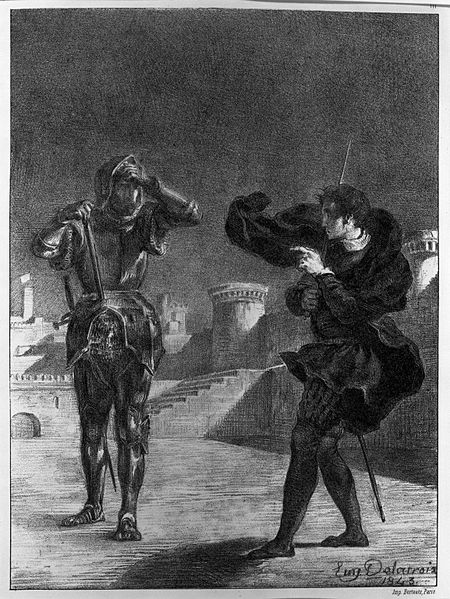
It is the time of year when respectable publications can, in a half-serious way, address the unconventional. The New York Times, for example, recently ran a story on ghost hunting in Norway. Andrew Higgins points out that Norway, among the most secular nations in the world, has come under the spell of ghosts. In a country where church attendance and religious belief seem to be endangered, there is a growing belief that people might somehow survive this mortal coil. Since such a story has to come off as bemused, we don’t get any indication that people have good reason for believing in ghosts—as one of the officials in the story says, they represent something that isn’t “generally accepted as existing at all.” But I wonder if that’s true. Scientifically, in our heads, there just doesn’t seem to be any room in this godless world for ghosts. Skeptics ask questions like “why do they wear clothes?” or “how can a soul remain behind if we have no souls?” Who told you that you have no souls?

Even with the constant materialist discourse of only physical reality, some ghosts cases have been very well documented. So have some hoaxes. People have the spirit of being tricksters, and that doesn’t always help when it comes to understanding the unseen. The point that the article is making, however, is that ghosts seem to be filling a need that the church hasn’t. Church has long been understood as being trapped in the past—concerned with issues deemed irrelevant by people who are just trying to get by in the world. I’ve heard hundreds of sermons in my life and remember less than ten. What is it that we’re trying to do?

Eugène_Delacroix._The_Phantom_on_the_Terrace,_Hamlet

I don’t know if ghosts exist. Many days I’m not sure what reality is, because if it is simply crawling out of a warm bed into a cold apartment before 4 a.m. so that I can go to work, I’m not sure this isn’t some kind of afterlife already. And maybe not the best kind. I know that as soon as people began to record their thoughts in writing, ghosts have been assumed to exist. Despite Ghost Hunters and other popularizers, vague traces are caught by enough people that we can legitimately wonder about the narrative we’ve been fed that says if it can’t be measured it can’t exist. There isn’t a nation in the world where people don’t see ghosts of some kind. Why should Norway be any different? And we wouldn’t even be asking this question if Halloween didn’t provide us with a buffer that makes forbidden topics chic.


Loving It

Given my remarks on occasion, some readers may conclude I dislike science. Nothing could be further from fact. Ever since I was a child I’ve been fascinated by science and secretly—or not so secretly—wanted to be a scientist. Complex mathematics, however, has always been beyond me. My brain simply doesn’t think that way. My gray matter is more inclined towards literature and abstracts, ideas. I am, it is true, distressed by a type of science that starts making philosophical claims as dogma: materialism. Those who make this claim have no scientific basis for doing so—it is a belief. They are entitled to their beliefs, of course, but to belittle those who suggest that maybe we don’t know everything there is to know about the unseen world seems poor sportsmanship to me. Case in point: IFL Science is a fun website. I enjoy the articles I read and it is refreshing to have those who stand up to creationists and other posers get such limelight. Interestingly, a recent article strayed into the uncanny valley.

Clown

Leading with the questions “Why Are So Many People Afraid of Clowns?” the article is categorized The Brain. Or psychology. This is one of those fields where we’re really out of our depth. We don’t understand the way that we think, and even raising the question of clown phobias seems a little odd. History can help to answer some of the questions, but IFL Science does a nice job of suggesting a scientific approach. Historically clowns were outcasts. They are liminal figures who create unease by their very existence. Those who didn’t feel accepted came to do what those who don’t feel accepted often do: try to get others to laugh at you. Sad comedians are more than a stereotype. Those who’ve clowned already know that.

Since I was a clown in college, I’ve read quite a bit about the history of the craft. Clowns were a way of laughing at misery, but also of gaining some sympathy. By exaggerating human features, they become caricatures. We aren’t allowed to discriminate against those who are different, but clowns exist to be excoriated. And deep inside, I think we all know, that those who are ill treated will eventually demand payback. It is a lesson that the world could stand to learn even today. Of course, we don’t want to be told that those who are different share something as personal and important as human feelings. Clowns make natural targets for our fears because they represent something that we know shouldn’t exist—inequality. If you can’t get accolades through hard work, making others laugh provides its own reward. The phobia may arise, I suggest, because we know that every laugh comes with a price.


To the Tower

A recent article in The Independent shows once again how deep our human need of magic can be. The Tower of London, among the oldest buildings in the city, and often considered the most haunted, was apparently protected by magic. Archaeologists have discovered ritual marks on the support timbers of the representative of the Queen’s residence that they believe were intended to keep the devil out. Given that building has been around for a few hundred years, that’s really not all that surprising. The amazing aspect, at least to me, is that the signs are a rare admission on the part of those in power that they are occasionally not in charge. In any case, now that Halloween is in the air, it seems appropriate to think about how even the most rich and powerful aren’t secure from spiritual anxieties. It’s no wonder that bishops were so powerful, back in the day.

IMG_0338

Since I’m writing a paper that discusses grimoires, magic has been on my mind lately. Anyone who follows the books I post on either this blog or Goodreads might easily discern that. The concern that Medieval people had with witches was their supposed ability to work magic. Ironically, historians of science are now suggesting that the study of magic may have led to what we now think of as science. In order to manipulate the physical world, you have to understand how that world works. Magic might have had some benefits for society after all. And we are still prone to magical thinking. It is deeply embedded in the human psyche. Magic, like miracles, can be fortuitous, but the prudent know better than ever to count upon them.

The Tower of London was the, or one of the, castle(s) of the city. Political prisoners were held there and often left with their heads in separate compartments. Even a regular tour of the grounds will include references to ghosts. A city as large and as sophisticated as London still can’t escape the past. The hex marks found by archaeologists may date from the early modern period—the time of the Reformation and thereabouts—but the human mind has not much changed since then. While we may not put secret marks on our buildings any more, we still instill them with a sense of magic. And people move out of haunted houses so often that some states have requirements to reveal troubling histories of properties before someone decides to buy. We are a society enamored of technology and future progress, and yet we stop and wonder when Halloween is in the air.