Religion, He Wrote

A friend recently sent me the New York Times obituary for Carol Serling, the wife of one of my heroes, Rod Serling.  Perhaps it’s a personal weakness, but I often wonder about the religion of my favorite writers.  More often than not I discover that they’re affiliated with tolerant faiths, sometimes unattached to any specific tradition.  Rod Serling grew up Jewish but became a Unitarian-Universalist by marriage, and—it doesn’t stretch the imagination—remained one by conviction.  I’ve read a bit about the UU tradition, and it is based primarily on values rather than beliefs.  In fact, the idea that religion is a matter of what you believe is only one way of defining it.  Historically one’s religion was a matter of what one did, not necessarily what she or he believed.

Authors that I read often deal with religious issues.  It’s important to confess that I don’t select fiction based on its having religious themes.  Anyone who’s read more than one or two of my posts will know my reading is eclectic and many of the books represented here have shown up because of wildly different circumstances.  Reading challenges, friends’ recommendations, and preparations for educational presentations are often driving forces.  In the fictional realm I’m drawn to the speculative, but also often to the catch-all category called “literary.”  Stories that feel authentic in either category have an element of religion in them.  Life portrayed without it doesn’t seem believable.  I’ve been re-reading some Ray Bradbury.  There’s often suggestive material there.

Raised a Baptist, Bradbury is often also claimed as a Unitarian-Universalist.  Apparently he didn’t like the label, but his behavior was more a selection of tenets that he found compelling from various religions.  All of this may sound strange in a context where “religion” is increasingly a dirty word.  (To be honest, it has been doing much to earn such a reputation.)  Still, it is a very deep part of being human.  Rod Serling’s stories advocated fair treatment of all people and often his sense of justice landed him in trouble with advertisers for The Twilight Zone.  Religions comfortable with maintaining prejudice, or turning a blind eye to lawbreaking in the name of false virtue would certainly not understand refusing to take money from questionable sources.  I suppose there’s a reason I enjoy the stories from the days when America still had a conscience.  The legacies of such writers, it is to be hoped, will outlast what passes for religion these days. 

Any other gods before me…


Strange Powers

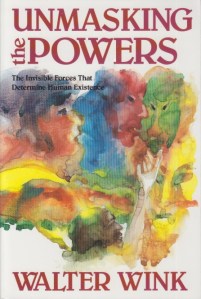
Some books take you to strange places.  Not all of them are fiction.  I began Nightmares with the Bible as a way of understanding the many, disparate ideas of demons I encounter in popular culture.  (I can’t tell you too much about my conclusions, otherwise you wouldn’t be tempted to buy the book!)  One of those nagging questions is: what does “based on a true story” mean?  I’ve known of Walter Wink’s powers trilogy for many years.  Because of my research I’ve now settled down to read Unmasking the Powers (number two, for those keeping count).  This book will take you into strange places.  Wink was very much a Christian in his outlook and orientation.  At the same time, he raises questions I’ve had other Christians put to me—were the “gods” of other nations, as in the Bible, real?  That word real is slippery, and Wink tries to hold onto it.

Unmasking the Powers is a kind of systematic exploration of the various “spirits” found in the universe we inhabit.  One of these is the Devil, and although Wink doesn’t see him as necessarily a “being,” neither does he find the Bible making him entirely evil.  Indeed, one of the great conundrums of monotheistic belief is theodicy; how is it possible to justify the goodness of a single, all-powerful deity in a world with so much suffering?  Wink approaches this question from an angle we might not anticipate.  He then deals with demons.  Since this is my subject in Nightmares, I found his discussion apt.  And yet again, strange.  Powers emanate from the institutions we create (you might have correctly guessed this was the book I wrote about on Tuesday).  Wink is willing to challenge materialism and take such powers seriously.

Finding a new perspective when we’ve been reared in a materialistic one, can be difficult.  For those of us raised religious, there was an inherent schizophrenia involved.  Our teachers told us of a mechanistic universe, but had Bibles on their desks.  (Yes, this was public school, but let’s not kid ourselves.)  While physics taught us everything could be quantified, church taught us that spirit couldn’t.  At least not by any empirical means.  Wink will unblinkingly take you there.  He offers both scientific and spiritual points of view on these entities, although he tries to refrain from calling them such.  Still, he records many people who have seen angels.  And although quantum entanglement wasn’t really known when he wrote this book, if it had been, Wink would’ve been nodding his head.


United, We Divide

I was a teenage Methodist.  Or, I should say, a teenage United Methodist.  My family had moved to a town where there were no Fundamentalist churches.  Indeed, the only Protestant church was the UMC.  Although very aware of religion, I hadn’t studied it deeply at that point—I’ve come to understand a bit better the marketplace of Christianties and how it works in a capitalist society.  The thing is, the more I learned about John Wesley and the Methodist movement, the more I saw how well it aligned with my own thinking and experience.  I became an Episcopalian largely because John Wesley never left that tradition and urged his followers in the same direction.  Of course, the “United” in United Methodism was due to mergers during the ecumenical period when Christians were learning to overlook differences and a strong base remained from which to draw.

The news has come out that the United Methodist Church has decided to split over the issue of homosexuality.  Most major Protestant denominations have made their peace, albeit uneasily, with the issue.  They recognized that while a source of guidance in spiritual matters the Bible’s a little outdated on its scientific understanding.  If God had revealed evolution to good old Moses things might’ve been a bit different.  We now know that homosexuality isn’t a “choice”—it is found in nature, and not rarely.  Homo sapiens (if I’m allowed to use that phrase) have developed in such a way that sexuality is a main preoccupation of religions.  Some animal species are monogamous and in our case many cultures adopted this as conducive to an ordered society.  Then it became codified in some sacred writings.

While homosexuality is mentioned in the Bible, every book of that Bible has a context.  Like it or not, close, serious study of Scripture raises questions you just don’t get if you read only authors who think the same way you do.  It is far easier to do that—who doesn’t like being right?—but thinking seldom gains credibility by never being challenged.  Iron sharpens iron, someone once said.  The emotion behind the issue, I suspect, is driven by a couple of things: fear of that which is different, and the inability to see the Bible as anything but “da rules.”  In those cases where the rules contradict one another you just have to choose.  At least in Christianity.  In Judaism they ended up with the Talmud.  In any case, we’re now seeing the fracturing of society based on party lines.  We could always use a few more choices, I guess, for competition is what spiritual capitalism is all about.


Conversations

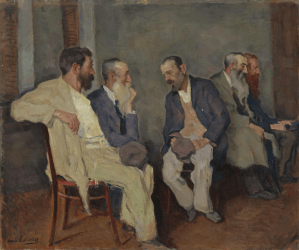
Arnold Lakhovsky, The Conversation, via Wikimedia Commons

While I tend not to discuss books on this blog until I’ve finished them, I realize this practice comes with a price tag.  Reading is a conversation.  Your mind interacts and engages with that of another person (or persons, for books aren’t usually individual efforts).  I find myself as I’m going along asking questions of the author—whether living or dead doesn’t matter—and finding answers.  Materialists would claim said answers are only electro-chemical illusions spawned by this mass of gray cells in my skull, only this and nothing more.  The realia of lived experience, however, tells us something quite different.  These interior conversations are shaping the way I think.  There’s a reason all those teachers in grade school encouraged us to read.  Reading leads to an equation the sum of which is greater than the total of the addends.

I’ve been reading through Walter Wink’s oeuvre.  Specifically his trilogy on the powers.  Although this was written going on four decades ago, I’m struck by how pertinent and necessary it is for today.  As he posited in his first volume, the embrace of materialism has blinded us to spiritual realities.  Wink was bright enough to know that biblical texts were products of their times and that simple acceptance of these texts as “facts” distorts what they really are.  He also convinces the reader that institutions have “powers.”  Call them what you will, they do exist.  Throughout much of western history the “power” cast off by the church has been somewhat positive.  Christianities has established institutions to care for the poor and for victims of abuse and natural disaster.  Orphans and widows, yes, but also those beaten down by capitalism.  They have established institutions of higher education to improve our minds.  Until, that is, we start objecting that our improved outlook demonstrates that the biblical base isn’t literal history.

Churches then often fight against those educated within its own institutions.  Ossified in ancient outlooks that value form over essence, many churches take rearguard actions that we would call “evil” if they were undertaken by a political leader such as Stalin or Hitler.  Those evil actions are justified by claiming they are ordained by an amorphous “Scripture” that doesn’t really support those behaviors at all.  I’ve been pondering this quite a lot lately.  Although I taught Bible for many years my training has been primarily as an historian of religions.  I specialized in the ancient world of the northern levant, for that culture provided the background of what would eventually become the Bible.  Reading Wink, I think I begin to see how some of this fits together.  I won’t have the answer—we many never attain it—but I will know that along the way I’ve been engaged in fruitful conversation.


The Truth Lies

I recently saw a Trump supporter claiming, unsurprisingly, that everyone’s lying except Trump.  Of course, I could be lying.  According to the Washington Post, Trump has made over 13,000 lying or deceitful statements since being in office.  For those who did their homework before he became the great protector of the unborn (ah, there’s one born every minute!) he was known as a crooked businessman to begin with.  With well over a thousand lawsuits against him even before being elected, we have no choice but to believe the entire legal system is lying, as well as anyone who’s had business dealings with him.  I’m just so glad that we have such a moral, upstanding paragon of Christ-like behavior in the Oval Office.  Never mind that all those witnesses in the impeachment case were speaking under oath—they all lie, but Trump.  Hey Donald, is that your real hair?

Ironically, some of the people making such claims hold the belief that divorce is not excused in the gospels (see Matthew 5:32, but Jesus could’ve been lying here—he’s not Donald Trump, after all).  It’s a matter of public record that Trump is twice divorced.  It’s a matter of sworn legal testimony that he paid hush-money to cover up affairs while married.  Well, that is if we believe this lying world rather than the one, solid, shining bastion of truth in the White House.  Someone once said (but he may have been lying) that it is easier for a camel to pass through an eye of a needle that for a rich man to get into heaven.  Just sayin’.

I have said before that all politicians lie.  It comes with the territory and only the most naive among us don’t accept that fact.  There is a difference, however, between the occasional mistruth and a lifetime, documented record of indiscriminate lying.  If it weren’t for the fact that all facts are lies (except those Trump makes up) we would see that the phenomenon of pathological lying is well known.  The presidency of the United States has never before tolerated a pathological liar.  But then again, they never had an incumbent more Christian than Jesus himself.  Now I think I remember who made that crack about rich guys.  He also said something about having no place to lay his head.  If he’d been born rich, though, you can bet the gospel message would’ve been very different.  Too bad the Bible lies.  If it didn’t such musings as this would hardly be necessary.  I could be lying, of course.  It is, after all, the new truth.


Shortest Day

This is it.  It’s here.  Today marks the winter solstice, the longest night.  Those who campaign to keep Christ in Christmas prefer not to acknowledge that the date of said holiday was an attempt to displace Sol Invictus, the Roman (therefore pagan) celebration of the invincible sun.  The Romans, like other ancient peoples, celebrated the return of light, albeit slowly, from darkness.  While teaching at Nashotah House a colleague mentioned being “almost pagan” in the eagerness for the return of light.  You can strike the “almost.”  Deep down we all look for signs of hope in dark times, whether Christian, Muslim, or Hindu.  “The people who walked in darkness,” Isaiah rejoiced, have seen light.  Sometimes light comes from an unexpected quarter.

There are two high circulation Christian magazines: Christianity Today and The Christian Century.  The latter is more progressive and was launched as an answer to the former.  One of the founders of Christianity Today was Billy Graham and its readership is largely evangelical.  Just yesterday Christianity Today ran an editorial stating the opinion that Trump should be removed from office.  If I were a card-carrying member of the Republican Church, I’d be trembling.  Long touted as “Trump’s base” evangelical Christians have found themselves besieged by the flagrant and constant contradictions their party has thrown them.  Fear of divorce was enough to keep at least one woman I know in an abusive relationship for years.  Now a thrice-married, philandering man who pays hush money to keep his affairs secret is upheld as the new Messiah.  Many of us who grew up evangelical were certain that their old tribe simply wouldn’t cotton onto a straw man.  But  cotton they did.  They’ve become the very lint in his miserly pockets.

Those encrusted with hardcore hatred, of course, will not be swayed.  They’ve found a poster boy who says it’s okay to claim white male supremacy.  They can pick their political issues (usually having to do with protecting the unborn or the right to shoot those already born) and they can be certain that this protean protestant will have their posteriors.  Their leadership, however, has begun to show itself clearsighted.  Christianity Today is no friend of liberal Christianity.  The editorial makes it clear that Democrats had it in for Trump from the beginning.  There is, however, absolutely clear evidence of his crimes.  Even as southern senators state outright that they have no interest in seeing a fair trial, their base is speaking up.  Tonight is the longest night of the year.  Tomorrow it will be a little bit lighter than today.  At this time of year we fervently hope that the light will continue to grow.


Fearful Faithful

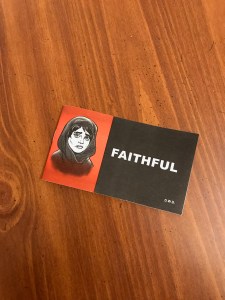
It’s sitting on the table next to my chair and I’m afraid of it.  It all started during the Easton Book Festival.  I feel sorry for those people who have to stand on the street corner and pass things out for a job.  In Manhattan I used to see them being completely ignored by swarms of people passing by.  They’re only doing their job.  I made a habit of accepting their chits, and even if they didn’t mean anything to me, I felt that the person handing them out might have experienced a small measure of satisfaction that someone accepted what they were offering, and had said “thank you.”  In Easton back in October, my wife and I were heading to one of the venues to hear an author talk and a guy was passing out paper, and I accepted one as a matter of habit.

It was a Chick tract.  If you’ve been reading this blog a while you’ll have run across the concept before.  Jack T. Chick was a cartooning evangelist.  He drew hundreds of tracts and comic books that formed a steady diet for me, growing up.  Although they looked like cartoons, these intolerant, Fundamentalist tracts were quite often very scary.  Especially to the young.  More than once I’d spiral into a childhood depression after reading one.  Although it seemed simple—say the prayer at the end and you’d be saved—how could you be so sure?  The disturbing contents stayed with me long after the sixteen pages were done.  Now, as an adult, I was being offered a road back to a childhood I fervently wished to avoid.

I stuck the tract in my pocket and forgot about it.  When I got home I emptied my pockets and found it again.  Curious, I was tempted to read it.  I know, however, that doing so will only drag me back to a memory of younger days when a kind of terror permeated my days.  And nights.  My theology, which was formed of a mosaic of these tracts (what child really listens to sermons?), was a scary one indeed.  It was populated by demons, Catholics, and servants of the Antichrist.  Anyone who wasn’t straight and pretty waspish was a threat to my eternal salvation.  Is that somewhere I want to go again?  The tract sits, unread, on my table.  It reminds me of the abuses to which religion might be put.  And I’m thinking I might start refusing free handouts on the street once again.


I Swear

The ongoing political fiasco of our nation (and within several states as well), raises a very basic issue.  We trust our legislators to do what we pay them to do (they’re our employees) because they take an oath to uphold the Constitution.  Problem is, liars don’t keep their word.  When an elected official opts to lie pathologically rather than to tell the truth, how can we expect him (or her) to uphold an oath they took?  Doesn’t lying behavior suggest that they were lying when they took that oath?  A hand on the Bible means nothing if you don’t suppose God is waiting with a lightning bolt in the metaphorical Heaven described, none too clearly, in the Good Book.  This is the greatest crisis a democracy can possibly face—lying leaders.

This isn’t just alarmist talk.  Societies—even capitalistic ones—rely on a great deal of trust.  Those who don’t mean what they say end up on the business end of the Better Business Bureau, or fail to stay solvent.  There are laws that ensure you are protected if someone sells you a false bill of goods.  What then, if the highest office in the land is occupied by someone who can’t be trusted?  Instead of appealing to the rule of law to set such a person on the right path, the Republican (Church) Party has decided that lying is now a commandment.  I may be lying, but how can you tell?  If no one has the backbone to stand up and declare that the whole system has toppled, what can a nation do?  An even more worrisome fact is that there’s no going back once this has happened.  The Republican Church has instilled this behavior for three years and is showing no sign of repentance.

Oaths were taken very seriously in the world of the Bible.  Violating one (lying intentionally) was considered the surest way to arouse God’s anger.  Ironically the Republican Church, which claims to be biblically based, is, according to its own Scripture, angering God.  I often consider myself a cynic, but my cynicism falls far short of this.  Psychological studies have demonstrated that the average person is reluctant to outright lie when the idea of God is introduced into conversation.  God’s Own Party, however, has inured itself to that minor phobia.  The Good Book, after all, says God’s the father of lies, right?  If they’d bother to open that book they’re thumping, I think they’d discover that that is truthfully the worst kind of blasphemy a human can utter.


New Religion

Republicanism, it seems to me, has become its own religion.  It started off when the GOP married evangelical Christianity, but the offspring of that unholy union has become a religion all on its own.  It certainly doesn’t adhere to classical Republican principles (tariffs?  Really?).  Nor does it adhere to Evangelical standards (turn the other cheek?  Love thy neighbor as thyself?).  Like most blendings, this new religion has some elements of each parent and it has no lack of fanatic supporters.  The traditional Evangelical, for example, considered the Devil “the father of lies”—one of his biblical titles.  The Republican, however, considers pathological lying to be signs of messiahood.  There’s a tiny disjunction here, but it proves that what we’ve got is the birth of a new religion.

Books and articles have begun to appear on how Evangelicalism has changed.  I don’t believe it’s so much a matter of Evangelicalism evolving as it is Republicanism fulfilling the need for intolerant religion.  In every culture there are those who want to go back to the day of Moses and golden calves and stoning those you hate.  It’s a little more difficult these days, what with secular laws that protect the rights of others, but the GOP has found a way.  My heart goes out to old fashioned Republicans, it really does.  Fiscal conservatives have found themselves in church with a bunch of people with whom they agree on very little.  They have no choice, for their political party has been sanctified.  And the only thing worse than an Evangelical is a bleeding-heart liberal.  Next thing you know the Democrats will start quoting the Bible at you.

The lying thing really takes some wrapping my head around, though.  I’ve always said nobody believes in a religion they know to be false.  This new development challenges that, if it doesn’t challenge the very idea of religion itself.  Republicanism is a religion based solidly on bearing false witness.  Self-aware of it, even.  You can’t tell me that these educated white men don’t know a criminal activity when they see one.  That they can’t read, and reason, and trust their intellect (although it takes the back seat to their overwrought emotions).  Sound like a religion to you?  It sure does to me.  It’s been coming a long time, but it took the last three years (the tradition length of Jesus’ ministry, it’s often said) for this to dawn on me.  The religion of the lying messiah.  I’ve got to wonder what kind of future it’s got.  I smell the fires rekindling in the burnt over district and wonder who’s for dinner.


What Remains?

As our government continues to pretend it has an interest in anything but enriching the individuals in Washington, a rather constant refrain of “broken system” has emerged.  It heard that phrase repeatedly in conversations in San Diego, on a variety of topics.  Now, I’m no stranger to buzzwords, but this strikes me as particularly apt to describe what we’re seeing.  A democracy within a republic builds safeguards to prevent the abuse of power, but when abuse of power occurs and one political party insists on enabling such abuse, the system is indeed broken.  Not only that, but there’s no will evident to fix it.  The GOP glories in it, feeling like it’s somehow winning the game as families and individuals suffer as a result of it.  In the past, it seems to me, there was a desire to repair what was an obvious problem.

Self-delusion, it seems, has become very common.  That, and some older politicians may not be aware how frequently they’re shown in their foibles on the internet.  Information that used to take weeks or months to filter out is now known instantaneously, and everybody’s overloaded and confused.  Politicians, instead of trying to show us the way in such a landscape are rather acting like my late stepfather in saying “Do as I say, not as I do.”  A fine bit of hypocrisy, that.  At least he tried to mend his ways, even if not successful in his efforts.  He would’ve known, however, that he had no business being president.  I reflect on this broken system quite a lot and I wonder what is next for us.  When trust in government is completely eroded, where do we turn?

Many have celebrated the decline of religion.  Let’s be more precise here and say organized religion.  Survey after survey reveals that we aren’t necessarily becoming less religious, but we’ve been watching prominent religious leaders throw their unstinting support behind a broken system.    Many of them continue to ignore the truth to support an incumbent who’s demonstrated that he’d just as soon turn on them as help their cause.  And for what?  Simply to prop up a tottering system, to squeeze out the last drops of what can be used to make things better for themselves before it all falls down.  As I was flying essentially coast to coast, it was evident from the air just how diverse a nation we are.  For nearly 250 years we’ve been able to make it work.  Now that it’s clearly broken, it seems the will to make it better has vanished.  And only politics remain.


Thanks for the Giving


The wonderful thing about Thanksgiving isn’t the food.  I object, on more than one level, to calling it “Turkey Day.”  No, the wonderful thing about Thanksgiving isn’t the food, but rather the universal aspect of the holiday.  From Fundamentalist to atheist, everyone can be thankful and we all have things for which to be thankful.  The holiday may have begun in a Christian milieu, but you need not believe in a God in the sky to give thanks.  We can thank one another, we can thank the universe, we can thank whatever powers that be, or we can simply be thankful, no matter to whom.  As I write this in the early morning hours, I’m thankful for being home after spending several days on the west coast.  Hearing the November wind howling outside, I’m thankful for this warm cup of coffee.  I’m thankful for the ingathering of family.  There’s so much goodwill today.

Thankfulness leads to a kind of optimism.  Thankful people can perhaps see that we need not hate others to feel good about ourselves.  I think of Thanksgiving as a feeling of love and acceptance.  Perhaps more than any other holiday.  I’ve heard people of many religions and backgrounds wishing others a happy Thanksgiving.  Would that all holidays could be so accepting!  Of course, holidays themselves have their origins in religions.  Were it not for beliefs, one day would be the same as any other.  There are religions that refuse to celebrate holidays, but when critics become too harsh on religious beliefs I’m thankful to remind them that they have religion to thank for both holidays and weekends.  We could all use a break.

Thanksgiving comes at different times in different countries.  In some places no equivalent holiday exists.  There are secular holidays, of course.  The very concept, though, of a “holy day” comes from that great generator of calendars—religion.  As chronologically challenged as I am (I can’t figure out time changes or time zones or even what time it is anywhere non-local) I often think of the marking of time and how a religious impulse started our species doing so.  Sure, it may have been the urge to start planting, or the awareness that the herds of prey were moving on, but in those early days such things were infused with religious significance.  And when calendars became canonical, there were religious impulses present to drive it.  So, in a way, it is good to be thankful even for religions—as problematic as they can be—on this Thanksgiving.  


Focus on Religion

Publishers Weekly, or PW to those in the biz, is a great place to get information about, well, publishing.  I often spend AAR/SBL telling authors and prospective authors something that I wish I’d been told when teaching: time spent learning about publishing is never wasted.  PW every year has a “Religion and Spirituality Update” released in time for this meeting.  Despite the relatively small number of sales, religion is a discipline that loves its books.  I’ve only been quoted in PW’s special edition once, and it’s not been for a few years, nevertheless I always learn a thing or two from this free—yes, if you’re here in San Diego it’s free!—update.  It may seem odd to suggest that religion titles can be hot, but it is indeed possible.  Sexuality is hot.  I suppose that goes without saying.

A number of titles dealing with religion and sexuality appear every year.  What caught my attention, however was an observation from Jennifer Banks, from Yale University Press.  Noting the rancor that sexuality often introduces to discussions of religion, she observes that (and this is a quote from PW, not directly from Banks) “some Christians apparently need others to go to hell.”  (I can send the full citation, if you want to know.)  In an era when academics have been stressing inclusion, the retrenched religious world has been spinning in the opposite direction.  Instead of inviting everyone to Heaven, as might, say a Universalist, many conservative Christians consign fellow believes to Hell, and gleefully so.  It’s almost as if Christianity and capitalism have merged into a zero-sum game.  If some win, all the others have to lose.  They haven’t however, studied the history of Hell very well.

It’s kind of an insidious idea.  Given that we all want to justify ourselves, some go to the extremes of demonizing those who see things differently.  This form of religious thinking was original neither with Christianity nor the Judaism from which it grew.  There was no Hell in the Hebrew Bible.  The idea, when it did develop, wasn’t a place to torture your enemies, but rather a place demanded by justice.  Those who were utterly and unrepentantly wicked couldn’t hobnob in God’s country club with those who tried to be righteous.  In the modern evangelical narrative those who make certain medical decisions for basic human situations are among the utterly wicked.  Not surprisingly their sins are usually sexual.  If you want to see this in a wider context, pick up a PW when you pass by the stand.  “Anything free,” to quote another sage, “is worth saving up for.”  And who knows, it might keep you from Hell?


What I Meant to Say

So I try to illustrate each of my posts. I do this because in the days when the internet was young I often found blogs during image searches. I’ve grown more cautious over the years, regarding copyright. I try to stick to the “fair use doctrine”—and that’s what it’s called, a doctrine—or images I “own.” In the latter case it often means searching WordPress for a picture I’ve posted before. Since nobody has time to name all their photos, I use the assigned DSCN or IMG nomenclatures. There aren’t so many that a search won’t turn up an image in my library. Thing is, WordPress likes to anticipate what I’m looking for. What’s more, it “autocorrects” after I’ve begun scrolling through everything. DSCN becomes “disc” in its addled electronic brain, and IMG becomes “OMG.” Naturally, the image you’re seeking can’t be found until you manually correct autocorrect.

OMG has become very common shorthand these days. Growing up evangelical, there was a debate whether “o my God” was swearing or not. Those who like to hedge their eternal bets argued that this was taking the Lord’s name in vain, thereby breaking one of the big ten. This was to be avoided at all costs. Those with a little less fear (or perhaps a bit more courage) argued that “God” wasn’t “the Lord’s name.” God is a generic word and can refer to any deity, except, of course, for the fact that there is only one God. This led straight back to the conundrum. Exegetes tell us that technically this commandment isn’t about saying the deity’s name, but rather it’s a prohibition against using said name when you don’t intend to do what you say you’ll do. In other words, lying.

It’s truly one of the signs that evangelicalism has evolved that the world’s best known liar is unstintingly supported by this camp. When I was a kid, saying, well, OMG, could get your mouth washed out with soap. Lying could lead to other forms of corporal punishment, such as being, in the biblical parlance, smitten. Now it gets you elected to the highest office in the land and supported by all those very people who won’t spell out OMG, even when they’re busy cutting you off in traffic with their Jesus fishes flashing in the sun. When I was a kid presidents would step down rather than go through the humiliation of being shown a liar in the face of the world. Times have changed. And I have no idea how to illustrate such a post as this. What comes up when I search OMG?


The Happy Science

Many seem to be wondering, if the media are to be believed, why America, like REM, is losing its religion.  (And yes, I know that the expression for the latter means to lose one’s temper, not literally to lose one’s faith.)  Derek Thompson at the Atlantic recently wrote about how the more literal loss took place around 1990.  He posits that the rise of the Christian Right, the Cold War coming to an end, and 9/11 are behind the loss.  As an historian of religion, even with a more ancient focus, I have to wonder if his gaze goes back far enough.  Being born early in the sixties was an opportunity to have a front-row seat.  My family was very religious.  To us, the rest of the world may have been going to Hell, but locally we were trying to please God, as most everyone we knew was.

Theologians and sociologists thought God had died.  Nietzsche, always ahead of his time, had declared as much nearly a century before the sixties got underway.  The public face of religion, however, is never the same as what’s going on below.  The religious right was built on a deep-seated hypocrisy from the beginning.  Now hypocrisy is so very human it’d be easily forgiven were it not for the constant insistence on self-righteousness followed by the revelation of some base human vice.  Time and time again televangelists didn’t cover the tracks of their peccadillos well enough, and Catholic priest couldn’t fight that feeling.  They were doing what humans have probably always done, but while wearing the vestments of public respectability.  Like Cthulhu, it seemed like God was dead but dreaming under the sea.

Religion, as all scholars of the phenomenon know, changes only very slowly.  Church attendance began dropping in the seventies, but back then there was such a thing as the rule of law and a real concern that your neighbors didn’t think you a Commie.  Fast forward to the era of Trump when the rule of law broke down completely and religions rank right up there with Republicans as being the most dishonest elements of humankind.  We look back at when the slow trickle seemed to breech the dyke in the 1990s.  The real game changer (since 9/11 was still in the future) was the birth of the internet.  People began to talk freely about the two subjects—religion and politics—that those of us from the sixties were taught assiduously to avoid in polite company.  Nietzsche published Die fröhliche Wissenschaft in 1882.  It would take about a century to sink in, and human religious leaders would be the ones to prove his point.  At least in this world of choosing our confessions.


The New Light

Sometimes you meet kindred spirits in books.  Barbara Brown Taylor’s Learning to Walk in the Dark has been waiting patiently.  It’s one of those books that I suspected would meet me where I live, and regarding this I was correct.  Brown Taylor, a former Episcopal priest and professor of religion (both of which I attempted but failed to achieve), has the courage and insight to suggest that darkness might just be a friend.  The darker half of the year settled hard on me this year.  As its black wings gathered about me I reached for this book.  I’ve been struggling with a question I’m sometimes asked: why do I let my thoughts linger in what must be considered darker corners?  I watch horror and write books and stories about monsters.  What’s wrong with me anyway?

One accusation may be fairly leveled at much of American religion is that it is shallow.  Light is uncritically accepted as good and dark becomes somehow evil.  There are biblical prooftexts that can be used to “prove” this, but they change color when you wrestle with them.  Learning to Walk in the Dark contains many ways of reflecting on realities which are inevitable.  Brown Taylor visits museums that give the sighted the experience of being blind in a safe environment.  She spends time in caves.  She stretches out beneath the stars and contemplates the dark night of the soul as well as the cloud of unknowing.  These latter two are, of course, spiritual classics.  There’s quite a bit that can be learned from experiencing darkness and listening intently.

My own predilections toward subjects called “dark” are forms of therapy.  My religion simply can’t be shallow.  I need enough water to swim.  And yes, I’m afraid of deep water.  Darkness perhaps comes more naturally to those of us who are awake for every sunrise.  If I move far enough north that may cease to be the case, but for the last decade or so my internal alarm goes off a couple hours before the first sliver of light creeps over the eastern hills.  And I seem to have assimilated to it.  As I read Learning I could imagine the accusations flying from my former Nashotah House context.  Looking at that patriarchal theology of sin and misery, however, I think there’s no question whence true darkness comes.  Without the dark we could never tell that it was light.  Since we need both, it seems wise to follow the sage advice here offered and get to know the dusky side a bit more intimately.