All Is Calm

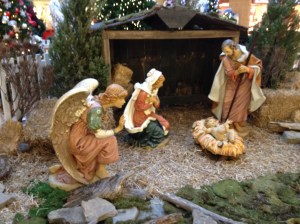
For those who prefer their solstice celebrations in Christian flavor, today’s Christmas Eve. As various denominations warn us to keep Christ in Christmas, secular NORAD provides a radar tracker to follow Santa through the skies. One hopes he’ll be cautious over North Korea this year. He may skip the White House altogether. And yet some will insist that there was no Christmas before Christ. But there was. Celebrations of the lengthening of the days began when humans reached temperate zones, at the very least. Prehistoric monuments throughout the British Isles were aligned with the sun’s position at solstices even before the Bible was scribbled on its first bit of parchment in warmer climes far away. We eagerly await the light.

Many religious traditions tell of that light within. Quakers, Unitarian Universalists, and some Asian religions focus on the divine spark, or secular light, within humankind. We are light-bearers, no matter what our religion. Back in my Nashotah House days, when Evening Prayer was a communal, daily expectation, the hymn Phos Hilaron, “gladsome light,” or, in the more liturgical mode, “O gracious light,” was the part that moved me most. We observe the coming of darkness with the hope that light might somehow continue. When days grow brief our hope grows fervent that the light will miraculously return. That it does so by the working of nature makes it no less of a wonder. We have been living in nighttime, and that light within us seems to flag at the persistent gloom. Then solstice. Christmas Eve captures that light in angelic voices.

Those who insist it’s all fake—the Tiny Tim crutch of feeble minds—need only look at NORAD today. The defense system built to keep the northern hemisphere safe from the endless winter of the nuclear species today shows a mythical object streaming across the stars with good will and cheer. Not just for Americans. Not just for Christians. Not just for true believers. No, Christmas Eve, the solstice, is for all people. Not just men. All people. Perhaps I’ve let my guard down just a little, and I’m letting my naiveté show just a bit much, but I do believe in that light. It may be that the tilt of the planet’s axis makes it inevitable, but a night when shepherds are startled and a woman brings hope to the entire world, we bask in what we deem a silent and holy night, knowing dawn will bring a longer day. And hopefully a world at peace.

Who Can You Call?

They’re scratching their heads. The media, I mean. In this distorted world of Trumpism, newspapers have rediscovered religion. Some say Trump is the altar boy of the evangelical right with people like Franklin Graham wetting himself over the president. Others say evangelicals want to change their name to distance themselves from Trump. Everybody seems to want to know who evangelicals are, but they’re afraid to ask. The weird, or perhaps expected, thing is universities decline to help. For years now they’ve been cutting positions in religion, a topic no longer relevant or of any interest. Academics aren’t always good at seeing what’s right in front of them, of course. So it is that the media’s scratching its collective head. Is he or isn’t he? What can you say about a man who’s so clearly heathen and yet a sparkling example of Christ-like compassion and values?

It’s doubtful whether any university administrator or televangelist could finger Jesus of Nazareth in a police line-up. They have no idea of who he was or what he taught. All that matters is he was God and he protects unborn babies so that he can arm them with automatic rifles when they’re of age. Oh, and he’s definitely not a woman. Or gay. Is that about it? Just in the past week major media outlets have run stories about the evangelical relationship to the commander-in-thief who’s told more lies in his first year than all other presidents combined. Who said Jesus of Nazareth was honest? He just stood for the right causes.

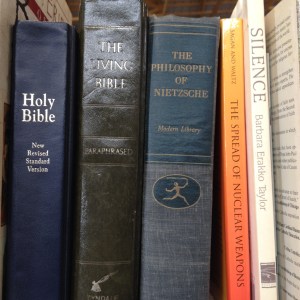
Having grown up evangelical, studied religion with evangelicals, and having been fired by evangelicals, I know them well. They have a mental capacity for biblicism that’s nearly incomprehensible. The Bible is so sacred that no other book should be placed atop it. It should never be set on the floor. Memorizing chapter and verse is more important than knowing what they might mean or how to live by them. This is old-school blind faith. And proudly so. Trump doesn’t know the Bible but he says he does. His actions resemble the carpenter from Nazareth’s about as much as Joseph Stalin’s. He was a good Christian, too, wasn’t he? After all, the Bible says Russia is our ally. Reagan—another evangelical—may’ve said they were our worst enemy, but one thing we know for sure about the Good Book: it never lies. For that it takes evangelicals and politicians.


Basic Catholic

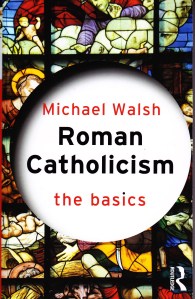
One thing upon which we all might agree is that we don’t have enough time. Publishers, eager to find an angle that will help them survive an age when we believe knowledge should be free, have shown a preference for short books. (An exception to this seems to be novels—consumers appear to like getting lost in a long story.) One result of this is the brief introduction format of book. That’s what Michael Walsh’s contribution to The Basics series is. Roman Catholicism is somewhat of a challenge to explain in less than 200 pages. You have to stick to, well, the basics. Having sojourned among the Episcopalians many a year, I felt that I had a fairly good grasp on Catholicism, but as I was reading it struck me that to really understand it, you have to be it.

One thing the Roman church has going for it is direct continuity. Making claims of having been there since the beginning, as an organization they have a leg up over other groups that boast more recent origins. We respect, or at least we tend to, organizations with such longevity. Tracing itself back to Saint Peter, the Catholics have continuity with spades. Or crosses. Of course, one of the things Walsh addresses is how change happens in such a long-lived group. Councils and synods, new scientific information and new Popes. Catholicism today isn’t the same as it was in Pete’s day. Walsh does a good job of guiding us through all that up to the time of Pope John Paul II, who, it turns out, raised global awareness of the papacy in the world as it existed then.

One thing we might agree upon is that Pope Francis has changed perceptions of what it means to be Catholic. The church remains mired in medieval thinking about matters such as gender and sexuality, but since this little book was published there have been steps forward. Even this popular pontiff, however, can’t change the decrees that went against the majority opinion regarding birth control, as Walsh somewhat guardedly notes. Or the ordination of women. He observes at the very beginning of his little book that Catholics know all about and deeply respect authority. This brief introduction helps to get a sense of how things ended up the way they are. We know that Pope Francis has started to speak out on such things, but men like to keep authority, as we all know. And even Popes have just so much time.


Dominus Flevit

I couldn’t believe I was actually there. Ever since I was a child I’d read about this place. The city conquered by David and visited by Jesus. The city around which most of the Bible rotated. Jerusalem the golden. One of the perks of working on an archaeological dig was the opportunity for weekend travel, and here I was, amid camels and cars and churches and synagogues and mosques, in Jerusalem. No amount of reading prepares you for such an experience. Suffused with the rich mythologies of three major religions, this city is like a dream. So much had happened here. The church I was attending at the time was only the latest in a long succession that informed me that God himself had actually been killed here and had risen again. The ultimate game-changer. The once in forever event of all time had taken place right here.

Gnu Jerusalem from WikiCommons

But this was not a city at peace, despite its name. There was a bombing the first weekend I was there. Young men and women in military garb carried scary looking weapons openly in public. Even civilian bus drivers wore pistols. Jerusalem had a long history of violence, but that didn’t justify it. If God had really been here—in either Jewish, Christian, or Muslim contexts didn’t matter—how could this city be so prone to terror? In the old city old men sat around hookahs, placidly smoking. Tourists, many bearing crosses, thronged. Jerusalem, however, was also a very political place. The fragile, Christmas bulb-thin peace of the region involved the city being divided up and not being claimed by Israel alone. Even that man driving his goats through these ancient streets knew that.

Trump, to the cheers of evangelicals who want nothing so fervently as the end of the world, has said he’ll recognize Jerusalem as the capital of Israel. This political move of weaponized ignorance will almost certainly lead to war in the Middle East. Another war. An illegitimate presidency leaving a frothing sea of corpses in its wake. Negotiating in this part of the world is like haggling with that street vendor for a pair of sandals. You go back and forth on the price. You act insulted and walk away. You come back and haggle some more. It’s a delicate dance. This is no place for egomaniacs who can’t understand such subtleties. Just ask the last Caligula who wanted his statue set up as a god in this city. Jerusalem is home to too many jealous gods, and those who are self-appointed divinities will only leave the city, the world, in tears.


Not So Gnostic

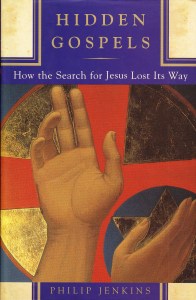
A certain, amorphous indignation comes over those of us trained in history when we encounter abuses of the same. In my case, some thought me conservative when I argued in my first book that Asherah as Yahweh’s wife wasn’t nearly the slam dunk some scholars were making it out to be. Don’t get me wrong, I wanted to see Yahweh as happily married as the next deity, but it was a matter of the evidence being weak and not thoughtfully examined. That is to say, I sympathize—maybe even empathize—with Philip Jenkins. His book, Hidden Gospels: How the Search for Jesus Lost Its Way, is an historical dressing down of many in the New Testament scholarly community who’ve perhaps let a bit of historical rigor slip in order to understand the world of early Christianity.

You see, once upon a time, scholars took the Gospels as, well, the gospel truth. Contradictions were simply harmonized or glossed over. When newer ancient material began to be discovered, however, adjustments had to be made. Perhaps the “orthodox” story of Christian origins wasn’t the only option available. In the twentieth century some spectacular manuscript finds were made, including the “library” of Nag Hammadi—largely Gnostic—and the Dead Sea Scrolls. New understandings of early Christianity were possible when these texts were considered. Some scholars engineered sweeping theories about revolutionary ideas concerning Jesus and his buds. Jenkins laments the lack of historical precision that many of these reconstructions demonstrate, and he comes across as somewhat annoyed.

Sensationalism, as we all know, sells publications and gets presidents elected. We all like a good story. In the case of Jesus, this means that the reconstructions of scholars often challenge traditional views, and popular publications love it. Jenkins finds it distasteful. Although this book is well written, as all of Jenkins’ material tends to be, it probably doesn’t do his arguments any favor to have retained the tired trope of heresy. Heresy means nothing without a supernatural bias, something that historians must avoid. Heresy, after all, assumes that one and only one version is correct (orthodox) and the four Gospels demonstrate that such a simple dichotomy is more difficult to sustain than it might appear to be. Yes, the Gnostic texts may not be as early as the traditional Gospels, but the ideas may have been circulating from near the beginning. We know surprisingly little about Jesus, so it’s not unexpected that rumors would’ve flown, even in antiquity. A solid source of information on some of the early “other gospels,” Jenkins’ book serves as a useful reminder that history is almost never as simple as it seems it should be.


Museum Piece

So the Museum of the Bible is now open in Washington, DC. It actually opened while a quorum or more of biblical scholars were busy making their way to Boston for the annual meeting of the Society of Biblical Literature. Many of the guild realize that the museum’s a conservative, evangelical venture, but it brings some attention to the beleaguered field and so it’s strangely welcome. This shows itself in the rather surprising names on museum publications. Renowned scholars don’t seem to think through the implications of supporting such places with the star appeal of their names. Indeed, many in the professorate are starved for attention—I’m not judging; I implicate myself even by making such a suggestion. When such an institution opens, it validates those it implicitly condemns.

A Bible museum?

Scholars can be woefully naive. Visiting places such as the Museum of the Bible, or the Creation Museum, or the Ark Encounter, pumps money into the already very well-funded Christian right. Such believers are extremely political and seek to get candidates like Trump elected. By slaking our puerile curiosity, we’re funding those who’d have us stripped of our very freedom to believe as we do. The paper trail’s there for any who wish to follow it. Supporting such ventures in any way will lead to headaches in the future. Sure, I’d love to see dioramas of dinosaurs on the ark so that I could feel superior for a little while. There’s a price for such vanity, however, and that price is the loss of freedom itself. We see it at work in our government at this very moment.

Museums are places for artifacts that are outdated. This is an ironic statement to make concerning the Bible. Especially by those who believe it is the final word. Why put that word into a museum? The irony’s worth it if enough paying customers arrive. Scholars meanwhile try to find ways to analyze this. Articles and books are appearing, stating what we already essentially know. The Green family, motivated to repressive political action because of their Bible belief, have spent money to build an elaborate museum, money that could’ve been used to help the poor. The book that appears in that museum suggests that the poor should be our concern. And although it actually does say that idols shouldn’t be worshiped, it has the great potential to become one itself. All you have to do is pay the admission price to find out.


More than Baptism

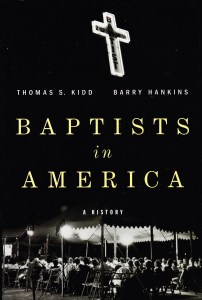
Few things distinguish American Christianity as much as its divisions. These aren’t precise, however, and often the borders are fuzzy and held more by cultural history than by theological outlook. One of the denominations—indeed, the umbrella for the single largest Protestant denomination in America—often faces the question of its identity. Who are the Baptists? Many Protestant groups can trace their histories to defining moments; consider Martin Luther and his hammer, according to the Lutheran origin myth. Baptists are a little tricker to pin down. Dissenters, yes, convinced that adult baptism should accompany conversation, yes, but beyond that widely divergent. Thomas S. Kidd and Barry Hankins have provided a service by writing Baptists in America: A History. Going back before America, they trace the origins of the sect and quickly bring it into the context in which it would thrive.

Persecuted early in American life, Baptists grew in numbers and recognition during the period commonly known as the Great Awakenings. Suited to frontier individualism, non-doctrinal, and advocating for freedom of conscience, the Baptists gained large sums of converts in this era. With their congregational polity, Baptist cultural influence really only took off when mass media gave its more aggressive preachers a venue not limited by church walls. As Kidd and Hankins point out, however, the denomination proved friable. Splitting apart over various issues, the number of Baptist denominations grew. Their political influence would also grow so that they would become a force with which to be reckoned even today. Few, however, really understand who the Baptists are.

The Southern Baptist Convention is the largest single Protestant denomination in the United States. It defines itself by a radical conservatism that masquerades as “orthodoxy.” Heavily biblical, many in the tradition have a strong preference for inerrancy. Social causes that appear outdated to most modern people are do-or-die issues for this sect within a sect. Baptists in America does a good job showing how contradictory Baptists can be. They were, after all, dissenters from the beginning. Their championing of religious freedom often doesn’t apply outside their own borders. The more political of the denomination know very well how to game a democratic system. Perhaps the lesson they’ve learned most acutely is that being unseen carries with it great advantages. They play the sport of legislative chess very well. In a culture that loudly and repeatedly claims that religion no longer matters, those with conviction have a natural hiding place. From there pieces are easily moved to positions of power.


Devolving Apes

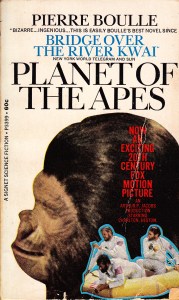
It would be difficult to overestimate the effect the movie Planet of the Apes had on me as a child. Raised a biblical literalist, evolution was, naturally enough, anathema to me. And yet here was a movie based on the idea that evolution had taken a different course. It was a transgressive film, but the screenplay had been written by Rod Serling, so well known for his trusted work on The Twilight Zone. I was utterly fascinated by it. Until the most recent iteration, I’d seen every sequel, spinoff, and reboot ever made. So important was this story line that as a child I found a copy of the book, in English, of course. Pierre Boulle told the story somewhat differently. Spying the book on my shelf after some four decades of my own evolution, I decided to read it again.

We all evolve. I noticed the improbabilities more this time through. The fact that, unlike the movie, humans wore no clothes at all must’ve scandalized my young eyes. I would’ve agreed, however, with Ulysse Mérou’s sentiments that humans were created in the image of God, not apes. In fact, there is an undercurrent of a somewhat conservative theological outlook here. Humans may experiment on animals, but when it’s reversed, it’s evil. In many ways, the cinematic version improves the story, but Boulle’s telling grows in intensity as the novel unfolds. Mérou develops a moral sense that includes the apes as well as human beings. The story, of course, is largely about prejudice and its evils. In that respect, it’s timeless.

As a child I realized that we lose something if we accept the fact of evolution. We lose that special feeling of having been intentionally created by a deity that made us God-shaped. Ironically, I also came to realize that those who rejected evolution often treated their fellow humans like animals. They held onto prejudices against other “races.” They castigated the poor for being lazy. They wish to remove healthcare from those made in the image of God. The contradictions and cruelties simply don’t comport with the Good Book they adore and ignore. Evolution, with the realities of nature impinging on our security, is far less dangerous than what biblical literalism has evolved to be. I can’t say why this book and its cinematic renditions became so deeply embedded in my young mind. But having read the book again, it’s pretty clear that the ideas have remained there, even as they have modified, with descent, over time.


Ordinary Sacraments

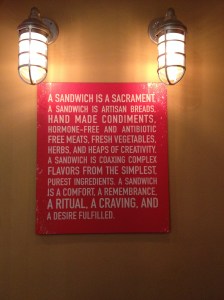
It’s like they knew we were coming. The towns that host AAR/SBL must remember the event after we leave. We make quite an impact around the convention center, and since everyone wears their name tags in public, it’s pretty clear that we’re all related. So when I stepped down into a local sandwich stop on Newbury Street, I saw a sign that could’ve been commissioned just for us. “A sandwich is a sacrament” it began. Going on to list the wholesome ingredients, the sign concluded “A ritual, a craving, a desire fulfilled.” I’d been taught that a sacrament was an “outward and visible sign of an inward and spiritual grace.” Of course, it could be more carnal than that. I’m not a priest, after all.

Food is indeed intimate. With packed restaurants full of religion scholars hungry for more than just sustenance for the mind, the city makes way for what may be a secular sacrament. Those who cook for a living do so in exchange for lucre. Everyone has to contribute something, and while we’re burning our calories debating fine points of theology, or in lexicographal deliberation, someone’s stoking the fires for the lunchtime rush. We hand over our credit cards and don’t stop to think about what we’ve just experienced. We’ve been given the means to convert matter to energy, an energy we’ll expend in purely cerebral consultation. The meeting of the minds. After the outward and visible sign of a sandwich becomes in inward and digested energy. And so the cycle spins on and on.

Large conferences like this bring the blessings of cash flow to local economies. Even in the poorest of times eating out’s a necessity. We’re not, after all, close to home. Time is at a premium with papers peppering each hour of three-and-a-half days, lined up like items on a menu. We select and choose, keeping to our intellectual diets. Or not. It takes plenty of energy to think so much. Some sit in the restaurants and return thanks. Others pay their respects in less visible ways, for this is the world of sacraments. Not ordinary time. What goes into a person, a sage once said, does not defile. Rather, what comes out does. We sit in respectful silence and listen to what emerges from our fellow conventioneers. It’s like being in church, almost. And we all know, deep down, when the talking’s done it’ll be time to eat.


Horror Divine

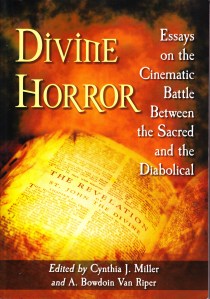
There’s a validation about finding something you figured out written in a book. For me that happened just about this season, some years back. At the Society of Biblical Literature annual meeting I found Sacred Terror by Douglas Cowan—the first book I’d discovered that discussed religion and horror films. Not only discussed them, but made the case that they have considerable common ground. Divine Horror: Essays on the Cinematic Battle Between the Sacred and the Diabolical, edited by Cynthia J. Miller and A. Bowdoin Van Riper, addresses the same theme but in more detail. Some of the essays in this volume get to the heart of the relationship between the sacred and the scary. As I mentioned, there’s a validation here for those of us who find horror movies fascinating. Others have noticed.

Genre fiction, as many fans know, comes with a subtle sense of shame. Low brow. Unsophisticated. Garish. Those with more refined tastes prefer subtlety and muted colors. Horror appeals to more basic instincts—but it’s also a form of expression that allows for the safe exploration of fear. There’s good horror and there’s bad horror. The eighteen essays in this book explore a bit of both. One conclusion that is unavoidable, however, is that religion—particularly Judeo-Christian religion—thrives in the context of horror cinema. The surprising part is that they often affirm the same message, but you need to look for it. Those who seek the origins of religion itself peer into the realms of awe and fear.

My own forthcoming book looks at similar territory. I don’t mind being classified as low brow. Raised in a blue collar world, that’s a fair assessment. What’s more, life confirms the reality of the connection between fear and religion. Consider the political moment in which we find ourselves. Much of the horror coming out of DC originates in religious “think tanks” trying to make evangelical Christianity the default faith stance of all our legislation. It means death and suffering to many, but the view of heaven for some becomes the tax haven for all. I know low brow when I see it. Horror comes in many forms—some lurid and some insidiously sneaky. Miller and Van Riper have pulled together a collection for our times here. The movies their authors discuss are part of a culture that is prominently religious and very afraid. If we want to understand what’s happening around us, we have to be willing to be scared.


Persecution Myth

The myth of persecution is a great cover. Christians, we are accustomed to think, are timid and loving individuals eager to turn the other cheek. In this sophisticated world of science and technology, they might appear a little naive, but they’re not really out to hurt anyone. Or at least some of them aren’t. I grew up among what would now be called Fundamentalists. Harsh to their own sins, they’d not imagine harming others. The story went that in the Roman Empire days it was open season on Christians and the oppressors liked nothing better than killing off a dozen before breakfast. That myth has largely been debunked by historians. Yes, there were some brief periods of intensive persecution, but for the most part the early Christians were left alone.

Many of the more zealous among the literalist sects today feel the loss of that mythology keenly. What can you do when you learn that your primitive ancestry wasn’t as heroic as you thought it was? For some, that myth must be kept alive today. When it is acknowledged that our world has become a smaller place because of technology, we get exposed to those who give the lie to our prejudices. Moral Muslims (despite the media portrayals), Hindus, Buddhists, and even secular humanists, abound. News, however, thrives on negativity. After all, it too is a capitalistic enterprise. We see the violence, the hatred, the bigotry. The myth lives on. Christian Dominionists have simply given up on the rest of the race. The Bible, after all, says few will be saved. And they have thrived for decades based on the simple fact that nobody takes them seriously.

I have seen the lack of compassion in evangelical eyes firsthand. A coldness that declares education to be evil since the only truth was revealed long ago in unchanging form. The word of God stands forever. It says so itself. And among the most despised of all human beings are those who study that word instead of “just reading” it. Those outside this camp know there is no such thing as “just reading.” They also know that we have no original biblical manuscripts at all and that translations are merely approximations. It’s difficult to build absolute laws on approximations. Among themselves these groups claim that legislation to treat others equally is a direct affront and insult to them. In fact, they claim they are persecuted because of the fair treatment of others. The thing about democracy is that any system can be gamed. Even Putin can be your friend, for this is the world of myth.


Christian Story

The problem with the Bible is anybody can “interpret” it. As a book of unrivaled status in the American imagination, it can be tapped for anything from advertising to justifying pedophilia. So when stories of Roy Moore’s sexual dalliances with minors emerged, Alabama’s state auditor, Jim Zeigler drew the comparison with Mary and Joseph from his half-hearted knowledge of the Bible. There is no auditor for Bible interpretations. It’s the ultimate free market. Many, including evangelical clergy, were quick to jump on the inappropriateness of the analogy. What they didn’t see is that the Bible can justify just about anything. Despite what it says. That’s the problem with worshipping a holy book.

What the Good Book says about Mary and Joseph is very, very little. We do not know their ages—they are never mentioned in the Bible. The tradition about Joseph being older seems to go back to having to explain his continence to preserve Mary’s perpetual virginity—also not in the Bible. The church, in the early days, had issues with ideas such as “original sin.” When Augustine suggested it passed, along with bodily fluids, during sex, it became clear that Mary could have none of that. Even if she was a virgin by misquoting Isaiah, then she still had original sin from her parents. So Mary had to have been immaculately conceived. The Bible, of course, knows of none of this. Anybody can interpret it. And what senator-to-be wants to be bothered with consulting a Bible scholar? They’re hard to find. And besides, they might not interpret it the way you want it.

GOPolitics have sunk so low as to pressgang the Bible into justifying pedophilia. What’s more, the faithful don’t seem to mind. The Bible’s big enough that you can find just about anything in there. Except morality, apparently. You’d think that anyone running for public office would examine his—and it’s usually a guy problem—life pretty closely for possible scandals. We’ve lived to see the radical right, diligently groomed and oh-so-righteous, go after anyone who can spout insanity and be counted on to vote against women’s rights. You can be sure Roy Moore will be forgiven—already has been by many—because the Bible swings that way. We’ve already seen what happens when people like Moore take public office. They make America grope again. For the Bible tells them so.


Joshua Fit

“Horrible things are going to happen!” shouts Grandpa Simpson. He ends his epiphany in church with the strange words “Epa, epa!” The Simpson’s Movie, among many other popular outlets, has had some fun at the expense of the Environmental Protection Agency. Over the years many people have concluded that it is ineffectual and that the heart of the government isn’t really behind it. One of the Dominionist creeds is that the government as we know it must be disbanded. Trump has been working hard at that, on his breaks from the back nine, since January. Appointing heads of agencies tasked with dismantling them, the underlying plan (not Trump’s, for he has no plan) is to take the current government apart while self-important Republicans simply can’t understand that they’re being used as pawns to be sacrificed as soon as a knight or rook comes along. Bishops don’t seem to be of much use anymore.

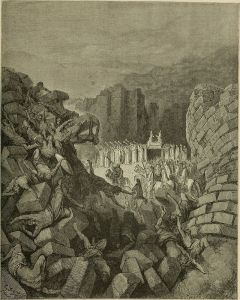
So when the head of the EPA cites the book of Joshua as science, some were surprised. Scott Pruitt, according to a story on BuzzFeed my wife sent me, has decided that the Old Testament is the new frontier. You have to choose who you’re going to follow. As for Pruitt and his house, it will be the Lord. And by “Lord” I mean money. Those who stand to gain by deconstructing the EPA are big businesses. Those who stand to loose? Only Homo sapiens and every other species on the planet. Although, in all fairness, rats and cockroaches have a way of thriving in our wastelands. In fact they seem to be thriving in Washington DC. I almost tripped over a rat on my way to work just the other day. They’re not just for the subway tracks anymore.

The Bible is the most abused book in history. This is what idolatry looks like. You take an object and make it a god. Nobody would be more surprised to find their words worshipped than those who wrote the Bible. Not one of them realized that their words would be taken the way that they are today. It’s pretty obvious that Paul of Tarsus would’ve taken a little more time in his letter writing had he known they’d be one day mistaken for God’s words instead of his own. And Joshua—well, we don’t even know who wrote that material. Whoever it was believed the earth was flat and that to stop a day from progressing all God had to do was hold the sun still for a day. No hot mitts needed either. This is, after all, the most powerful government in the world.


Stranger Things

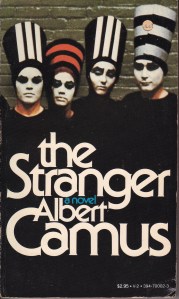
Albert Camus preferred the label “absurdist” to “existentialist” to describe himself. The problem with labels is that we don’t always get to pick our own. As a young man fascinated with existentialism, I was introduced to Camus as one of their number that I should read. Categories, of course, are only abstractions to complex realities. So, for learning about existentialism Camus was recommended reading in those days. I selected The Stranger. So many years have passed since then that I only recollected a single part of the plot. Coming back to it as an adult is like walking down that beach a second time, unaware that you’ve just been down this way and something bad happened last time. Existentialism is like that.

Meursault is little effected by life. He has no strong opinions since, at the end of the day, everything seems pointless to him. He sheds no tears at the death of his mother because death is to be expected. When a heat stroke confuses him sufficiently he unintentionally kills a man. At his deposition the examining magistrate finds Meursault’s atheism inexplicable. In the face of the possible consequences of his actions, such indifference leads him to refer to the prisoner as “Mr. Antichrist.” Awaiting his execution, Meursault has a final confrontation with the priest that has come to his cell unbidden. The prisoner is convinced that even on death row he believes more sincerely than the man of the cloth. Camus’ story is surreal but realistic. A parable for his day and ours.

I’ve lamented before about the decline in philosophical literature. Taking philosophy straight requires the kind of concentration that I lack on the bus or before going to bed. Novels like The Stranger express such ideas in digestible form. The reader identifies with and despises Meursault. Why doesn’t he do something to help himself? Boredom and indifference will literally kill him. He is, however, steadfast, and that is something to admire. Along the way existential ideas are woven into the character’s thoughts and dialogue. Everyone is like an actor in a play—they did not write it, they simply perform the roles assigned to them. When it’s all over they end up in the same place. Absurdism and existentialism aren’t very far apart. They’re both categories devised to help us comprehend the enigma that we confront in books such as The Stranger. Meursault can’t give the chaplain any false belief since, as he notes, those who believe have more need of convincing than those who don’t.


Turn the Other What?

The man next to me on the bus is reading his Bible. At one point in my life that would’ve made me feel safe. I would’ve known that the person next to me was committed to the same value system as mine—love for all, peace, equality, and acceptance. Now, however, I see that Bible and I’m afraid. You see, I’m reading Chris Hedges’ American Fascists: The Christian Right and the War on America. I can’t remember the last time I’ve been so scared. Hedges’ book was published a decade ago. What he wrote about then is coming true now and it’s because the elites of society—university folk and all—don’t take the radical religious seriously. In their delusional ways, they assume all will be well. If you think like that, read this book.

Dominionism is fascism dressed in Christian garb. It has no room for tolerance. It teaches that those outside its circle are to be ignored at best, and murdered without compunction at worst. This is not exaggeration. It is their teaching. It’s like that computer game that used to come with Macs where a time-traveling dinosaur collected the eggs of other species to save them from the coming asteroid. You could kill other dinosaurs without guilt because you knew they were going to die in 20 minutes anyway. That is very much the way Dominionists feel about you and me. We aren’t saved—their word is “Christian”—God has rejected us, and therefore we deserve to die. Many of them stockpile weapons just for this reason. Their goal, not at all hidden, is to take over the United States and make it a Christian nation. Already many in the houses of Congress are their candidates. They have a president who shares their values. We should be very afraid.

Hedges does a very good job providing the statistics that back his assertions. There is no question that this is real. Those who blithely vote Republican out of fiscal conservatism have risen to the bait. Trump has proved that once and for all. These “Bible believers” do not value or treasure love. They treasure treasure (many of them are very wealthy) and what they desire is power. Tolerance, in their view, is evil and compromising with the literal Satan in which they believe. Their Jesus does not love. He fights. And he fights for white, straight, privileged men. If you’re willing to forsake sleep, read this book. And if you think it’s exaggerating read the headlines.