Bible Riots

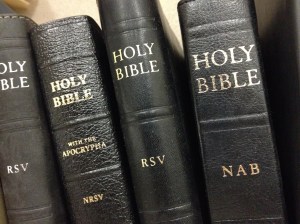
One of the more embarrassing questions I get asked is “What do you do?” This has been true throughout my career (if what I do can be called that). I should clarify—I don’t mind saying “I’m a professor,” or “I’m an editor”—it’s the follow-up question that’s difficult. “What do you teach/edit?” Mentioning the Bible is a conversation-stopper. In the silence that inevitably follows you can almost hear the electronic buzzing in the interlocutor’s brain as s/he tries to come up with something nice to say while backing away. In actual fact my degrees have been more in the history of religions rather than Bible per se, but those who’ve done the hiring haven’t tended to see it that way. This is not a nostalgic post, asking to go back to yesteryear (that’s happening politically without my help), but it is a reflection of what James Wallace Harris says on BookRiot—the Bible is a good book to read.

It’s easy to get swept away in the criticism of religion, and particularly Christianity. Those who profess it, historically, have a lot to answer for. What we’ve allowed religion to do to others is inexcusable. What we sometimes miss is that the motivation is one in which all people participate—learning the truth. This is more difficult than it might seem. If someone had discovered “the truth” we’d all know by now. The fact is we’re deeply divided about what that truth is and that alone proves no one has found it. We’ll recognize it when we see it. We just haven’t seen it yet. What sometimes gets forgotten along the way is that the Bible was, and is, a great milestone of humanity’s search. As I keep having to remind myself, there’s some really good stuff in there.

IMG_2634

Harris isn’t alone in suggesting that atheists should study the Bible. Some very prominent non-believers have declared the same thing from time to time. The Good Book is densely interwoven with western culture—even secular western culture. I’m currently at work on a book that explores one thread of that complex fabric, and it’s amazing to me how much we miss when we ignore holy writ. We shouldn’t throw out the baby with the bathwater, as the old saying goes. That’s not biblical, but it does hint at the truth, I think. Or maybe it’s just that I want to be able to answer that most basic of questions without having to make excuses for what otherwise looks like a series of poor life choices.


What You Eat

The future of Sleepy Hollow is uncertain. The successful FOX television program has suffered the slings and arrows of outrageous scheduling over the past year and speculation abounds that the current fourth season may be its last. It has been, in my experience anyway, one of the most literate supernatural horror shows ever. Books and reading abound and an interracial team fights evil week after week. Having done some research on the first season of the program, I continue to be surprised just how detailed the homework of the writers is. My wife sent me a story from Atlas Obscura on the “sin eater.” This is a term, I readily confess, that I never heard before the introduction of Henry Parrish to Sleepy Hollow. Ichabod Crane, guilty over the death of a freed African American freedom fighter, ingests poison to kill himself and severe his connection to the Headless Horseman. Abbie Mills, believing there is another way, locates the sin eater.

The idea is fairly simple, if unorthodox. A sin eater can literally devour the sins of another. In Sleepy Hollow this comes at a considerable cost, but the article by Natalie Zarrelli demonstrates that this too reflects research on the subject. There were, it turns out, sin eaters in the early modern British Isles. Often a poor person with no other options, a sin eater would consume bread placed on the chest of the deceased, incorporating, in an almost Christ-like way, the sins of the recently passed. The dead could then be safely buried, forgiven, while for a pittance a poor soul could walk around with someone else’s sins in his or her body. Sounds like capitalism writ large, to me.

Watching Sleepy Hollow I had assumed this idea was invented for the show. Like so many details, however, it turns out that some digging had brought an obscure historical practice to the surface. Sin eating, as the article makes clear, was never sanctioned by the church. People have often worried that official religion might not deliver the salvation it so readily promised, bound up with rules and rites as it was. Here was a sacrament of the people. Bread could be visibly consumed and symbolically, or literally, sin with it. The sin eater was paid, making this a legal transaction. Although sin eating is thought to have died out, it seems that with the recent, high-level resurgence of evil-doing, perhaps it is a practice that should be recalled. In many ways Sleepy Hollow has been ahead of the times since the beginning.

IMG_1960_2


Publishing Weakly

Those of you who aren’t professional religionists might not understand the cultural impact of the American Academy of Religion and Society of Biblical Literature annual meeting. Every November a largish city (New York and Los Angeles are too expensive, but many of the other biggies have hosted us) is inundated with religion scholars. Nearly a literal myriad of them. Church attendance spikes, that weekend, as do the takings in the local bars. Restaurants near convention centers are swamped and tips, I expect, aren’t that great. And publishers show up in spades. We tout our recent books, attractively displayed for the book-hungry, and hope the cash rolls in. It’s not a cheap conference to which to send your staff. Books, though, make you think and we have to get our ideas out there.

img_3042

The conference is big enough for the book industry that Publishers Weekly, a standard periodical for the biz, generally has a story about it. Even when people were worried about the election results, we had to get together and discuss what’s God got to do with it. Or so it would seem. In the story by Emma Koonse and Lynn Garrett, it is noted that InterVarsity Press, a stalwart of conservative Christian publishing, has generated its own Trump-like crisis. Owned by InterVarsity Christian Fellowship, the press has been instructed that anyone who disagrees with the parent company’s stance against gay marriage must resign. They hasten to add that this doesn’t apply to their authors. There is such a thing as a double-standard, you know. You need to bring in that money, otherwise you can’t afford to oppress your employees.

The idea behind publishing is that ideas should be—must be—shared. There is an educational imperative. Many IVP readers may be surprised to learn that the Bible says nothing about gay marriage. I’m pretty sure it doesn’t mention Donald Trump either, although reading the account of Balaam I might have to admit being wrong about that. It’s funny what you can make the Bible say when your theology is merely thinly veiled prejudice. Perhaps we should put belief meters on our government houses. Of course, if we did that I’m not sure the national budget could cover the cost of all the lie detectors they’d need to install as well. Publishers, of all people, should be the ones with the most open minds. Unless they find the wallet more compelling than the truth. Let’s just ask Jesus’ wife about that.


Mark of the Beast

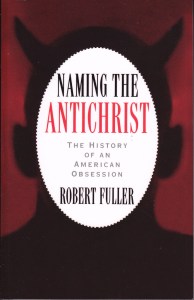
namingantichristI grew up believing in “the Antichrist.” As I came to realize that much of the New Testament pointed to contemporary problems (for them) with the Roman Empire and that what appeared to be predictions were actually safe ways to discuss forbidden topics, I began to worry less. It was about the past, not the future. Recent political events have ratcheted up my anxiety level again—maybe there is such an evil after all. Robert Fuller’s Naming the Antichrist: The History of an American Obsession is an important book in this regard. Although end-time worries have diminished among some now that we’re safely into a new millennium, for the true believer none of that matters. The Antichrist is a great motivator. I hadn’t realized until reading this book just how much of contemporary culture has grown from this fabricated fear.

Let’s get this straight from the beginning. In the Bible there is no figure known as “the Antichrist.” The generalized word antichrist is used only twice and in neither instance is the book in question Revelation. Early Christians speculated that the beast of Revelation might be “the Antichrist” but that identification wasn’t solidified until the beginnings of the Fundamentalist movement in the late 1800s. By the time Fundamentalism was a fully developed system, by about the 1920s, believing in the Antichrist and trying to identify him had become a cottage industry. I grew up in the shadow of Hal Lindsey and the pressing concern that “the Antichrist” was alive in the world today. Face it, The Omen loses something if he isn’t. This strange, non-biblical belief has come to define a large number of true believers.

Fuller’s book is important for the insight he brings into why some “Christians” are avowed enemies of peace, toleration, and the improvement of human conditions. Those who believe their tribe is the only correct one hold the double standard of ethical treatment of those inside and scorn and hatred of those without. This view believes that the world is to be condemned, natural resources used up, wars started, and civil rights suppressed, in the name of Christ. Perhaps you may begin to see why a chill ran down my spine as I was reading this book. We need to try to understand this perverted way of looking at the world in order to understand the forces that would rather see a dictatorial billionaire run the country than an eminently qualified woman. Reason’s got nothing to do with it. It’s all about conviction. Failure to understand that is perhaps the surest way to bring about the end of the world. We ignore religious thought to our own peril.


Daily Bread Plus

I have a confession to make. I’m not a foodie. These days such an admission is tantamount to a venial sin, but the fact is I’m one of those who eats to live, not lives to eat. Still, like many people I’m concerned about whence my food comes. I can’t grow my own and just about all of it comes wrapped in plastic. Thus I found a BBC article my wife sent me to be of great interest: “An uncanny mixture: God, alcohol and even cannabis” by Kait Bolongaro. Focusing on monasteries and their brewing and distilling traditions, Bolongaro uses the foodie angle well. People want to know where their grub comes from, and the current interest in knowing the location of the source plays well into this. European monasteries have long been known for their production of alcohol. Even Jesus drank wine.

I’m no connoisseur of spiritous liquors, but the story is quite interesting. Many people don’t realize that monastic orders, in addition to praying and not having sex, also support themselves through industry. Many make goods to sell. Those in this article make booze. As Bolongaro points out, the fermentation and distillation process is an exacting one. In fact, it is a science. In the case of Chartreuse only three monks know the secret formula. They control the temperatures and conditions remotely, by computer. And I thought Bible Gateway was the only place the religious spent their time.

IMG_2642

Science and religion actually have a very long history of cooperation. Gregor Mendel, whose work gave Darwin’s theory of evolution by natural selection its actual mechanism, was a monk. Other religious have been close observers of nature and processes. There is no commandment against good beer, as many Teutonic brothers would no doubt point out. But to get it right you have to know your chemistry. As the article says, some things can’t be rushed and monastic life lends itself to such slow processes. The rest of us in our secular pursuits rush through life far too fast for religion or science. Contemplation requires “down time.” Time off the clock. The kind of time, we’re told, that simply doesn’t exist any more. The story, after all, appears in BBC Business. I’m no foodie, but I have to confess that the cheese and pretzels purchased from the Amish in Lancaster do tend to taste better than those that come wrapped in plastic. There may be a religion to science after all.


Before and After

Fresh from seminary with a head full of historical-critical theory competing against my immortal soul, I was lost in the Church of the Holy Sepulcher. I’d learned enough in class and in my own reading to know that the association of Jesus’ burial here only dates back to the fourth century. And also that the identification was made by a politician—Helena was the mother of Constantine—and not a archaeologist, or even a theologian (God help us!). The location was, in other words, hearsay. Three hundred years is a long time to keep track of where something happened. I sit on a bus trundling through Weehawken every day and ponder that we don’t really know where Alexander Hamilton was shot. Such are the ravages of time. I was young and, presciently didn’t know if I’d ever return to Israel, so I wanted to make sure at the time. It was holy confusion. Finally an elderly Coptic monk beaconed me into his edicule to touch the stone. He gave me a cheap rosary and asked for a donation.

churchoftheholysepulcher1885

The scene returned to me when a friend sent me a story about the “discovery” of the actual chamber behind the build-up. The report by Fiona MacDonald in Science Alert briefly tells the background to the location and describes the hurried excavation. Still, we have no idea if, as Indiana Jones might say, “They’re digging in the wrong place.” Tradition has nevertheless hallowed the spot. For seventeen-hundred years some people have suggested this is where it all happened, and where many of the liturgical churches agree. Some Protestant groups, attuned to the Bible a bit more than tradition, have suggested The Garden Tomb is the correct location. The years ago when an academic future seemed in store, I stopped by there too, just in case. There were no crowds.

An enormous amount of effort was poured into building and maintaining the Church of the Holy Sepulcher. Crowded with tourists and various orders of clergy, I wondered how anyone might find such an experience spiritual. Territories are marked out between the various denominations seeking legitimacy in stone. Who wouldn’t want to own the spot where it actually happened? Wouldn’t that be the ultimate truth claim? So more money is being spent. More digging is taking place. Science, some believe, might come to the rescue of religion. From my experience, brief though it was, trying to make sense of the Holy Sepulcher, I have my doubts. But what do I know? I’m not even sure if Copts use rosaries.


Sects These Days

fisherreligionNew Religious Movements (NRMs) have long fascinated me. As a natural historian, looking back over where we’ve been has been my usual source of orientation. The idea that a new religious truth could emerge used to strike me as unlikely, especially in the western hemisphere. All major religions of ancient times have come from Asia. (I’m using “major” here only in terms of numbers, not importance.) I wasn’t sure if Mary Pat Fisher’s Religion in the Twenty-first Century was going to be about those traditional religions or NRMs. Both, it turns out. This little book, spun off of a bigger book, looks at very brief histories and contemporary expressions of traditional religions as well as some newer expressions of the spiritual quest. As such, it really doesn’t strive to reveal too much that’s new, but I found it interesting nevertheless.

To begin with Fisher reveals a bit of her own spiritual journey. This may be the first time I’ve ever read of a major textbook author (her larger world religions books are bestsellers) admit to having had a near death experience (NDE, as long as we’re using abbreviations). I know for a fact that Fisher is not the only academic to have experienced such, but trying to get anyone to admit as much requires, well, the confidence of a bestselling textbook, I guess. The fact is, human beings have a spiritual sense. Even academics. It can be effaced, sublimated, buried, or neglected, but it is there. There’s no other way to explain the persistence of religion. Even Nones, to update the discussion a little, often list themselves as spiritual, but not religious. It is part of the human condition, and it is well worth trying to understand.

This little spin-off text, at seventeen years old, does look a bit dated. Some of the predictions for the then coming new millennium were a touch optimistic. I suppose that’s the danger of any description of contemporary developments. Interfaith dialogues and initiatives, I suspect, still continue although we hear little of them. We continue to use religions as a way to divide between insiders and outsiders. Although our common yearning for spirituality has great potential to bring people together, historically it has wrenched them apart. I’m not sure that this particular book by Fisher is still available any more. Or it may have been updated. As one who tends to look back over history, however, I find the optimism refreshing. Perhaps as we continue to struggle with what it means to be human we will come to realize that religion is about what is inside, not out.


The Grammar of Evil

I stepped into a devil of a situation. Elevators are strange spaces. Given the choice, I’ll take the stairs any time. At work, however, as one of the many quirks of Manhattan, our elevators only stop on certain floors and we’re not able to use the stairs unless it’s an emergency. After a meeting on a floor where the only option was to elevate out, I stepped into a crowded elevator where a conversation was going. “You always capitalize Satan,” someone was saying. The usual questions among non-religion editorial staff ensued. Why is that? What about “devil”? “It’s never capitalized,” came the reply. My profile at work is about the same as it is on the streets of New York. Not many people know who I am or what I do. Although I’ve struggled with this very issue before, on a professional level, I kept silence and waited for my floor.

So, was the elevator authority right? “Satan” has become a name, rather along the lines of “Christ.” Both started out as titles. In the Hebrew Bible “satan” is “the satan.” The accuser, or the prosecuting attorney—something like that. As one of the council of gods, the satan’s job was to make sure the guilty were charged of their crimes. Diabolical work, but not evil. By the time of early Christianity, however, Satan had evolved into a name. It is therefore capitalized. It was specifically the name of another title, “the Devil.” Or is it “the devil?” Do we capitalize titles?

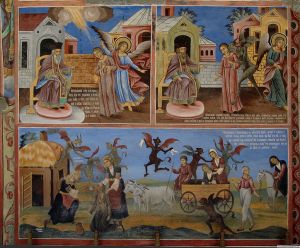
The Devil wears underpants.

The Devil wears underpants.

In seminary and college the received wisdom among those of my specialization was that there is only one Devil and the title should be capitalized. My elevator colleagues were discussing the number of devils when I stepped out. Traditional theology says there’s only one. Not that the Bible has much to say about the Devil—he’s surprisingly spare in sacred writ. Demons, however, are plentiful. Some people call demons devils, just as many believe that when good people die they become angels. The mythology behind demons seems to be pretty well developed in the biblical world, but again the Bible says little. Demons can be fallen angels or they can be malign spirits who cause illness. Either way they’re on the Devil’s side. But should we capitalize his title? The Oxford English Dictionary doesn’t help, giving examples of both minuscule and uncial. I suppose that’s the thing about the Devil; you never really know where you stand.


Majority Report

In your mind’s eye, picture American 500 years ago. What do you see? Even those of us who’ve studied history have trouble envisioning the past with so different a set of parameters. At least if we’re honest with ourselves. 1516. The Salem Witch trials are almost two centuries in the future. The landscape is occupied by Native Americans. There are some European settlements. Protestantism is something new. In fact we’ll need to wait another year for Martin Luther to drag out his hammer and nails, theses in hand. The America we see then, not called “America,” let alone “United States,” is a diverse—some might say “wild”—world of decidedly non-European sensibilities. Global warming wasn’t an issue, and King James hadn’t even been born yet, let alone been commissioning the most famous Bible in English ever. So why am I asking you to look back?

luther_at_erfurt_-_justification_by_faith

This presidential campaign has largely been a waspish one. During the turmoil, books have been published proclaiming the end of “white, Christian America.” In an interview on PBS one of the authors of such a book, Robert Jones, talks about how America has changed. He notes that what he really means is that white Protestants are, statistically speaking, no longer the majority. Just a few centuries ago that was also the case. Think about Protestants a minute. They’re the ones who invented the Bible as we know it. Oh, the book had been around, in some form or other, for a couple of millennia (well, a millennium and a half, back then). Other than scholars in need of more fresh air, few spent much time with it. The church told Europeans what God demanded and the majority of people just got on with their daily lives not worrying about what some book they couldn’t even read might say. How things have changed!

We worry about the end of our majority. I like to look back and see that this world we’ve built is one based largely on a book that was mainly the invention of those who had some discussion points with the church. Not quite a hundred of them, even. They were largely Anglo-Saxons. If they knew about “the New World” their knowledge was hazy and imprecise. From that perspective it doesn’t seem like much is being lost in the changing religious demographics of this country. Back in the old world, if one wished to feel nostalgic for such things, they would’ve taken their complaints and found the nearest church door. Now we nominate candidates who think this country was ours in the first place, without ever even reading the Bible used to support that myth. What a difference a few centuries can make.


Buying Faith

Can belief be quantified? Apparently yes. I’ve spent my life trying to avoid the dismal science, yet it seems that everyone else is pretty much agreed that money is the measure of all things. Higher education has certainly been chasing that rabbit for years. My choice of “careers” has always been aimed at those which downplay finance while paying enough to cover the bills. One has to be practical. My wife recently sent me an article in The Guardian by Harriet Sherwood entitled, “Religion in US ‘worth more than Google and Apple combined’.” At first, I have to admit, a kind of triumphalism overcame me. A vindication that I had chosen a valuable aspect of human existence with which to while away my years here on earth. Then came the troubling implications.

img_1264

We tend to hear only the bad news about religion. Religion, we’re told, is only super-sized superstition. It supports prejudice. It capitalizes on fear. And nobody really believes anymore. And so the trite truisms march past like tin soldiers on their way to a real war. You see, if we can’t put a dollar value on religion—or any belief system—then we have no way to assess whether it’s worth wasting our time on or not. Maybe people will begin to pay attention now. There’s gold in them thar hills. Yes, the religious are more likely to open their wallets and keep the economy moving than are the wealthy. Yes, those are antithetical groups, for the most part. When we can start toting up dollars and pence it is time for those with more dismal scientific interest to take notice.

Religions, like all human institutions, have faults. They are prone to takeover by self-interested individuals who look for the angle that will lead to personal power or fame. They do often insist that they alone have the correct interpretation of what life means and how we should go about pleasing a deity that only they truly understand. And they bicker amongst each other. It’s easy to forget that religions are based, without exception, on the belief that human life can be improved. We can do better, people. Takeovers, sometimes hostile, can occur. One sect may take out a contract on another. Love may be recast as hatred. Overall, however, religions are, to borrow a phrase from a sage, “our better angels.” And of course, the fact that you can put a dollar value on that only sweetens the deal. The dismal science has studied the matter and its conclusions are indisputable.


Bad Theology

train_wreck_at_montparnasse_1895

Perhaps the most overused simile for a real mess is that it’s “like a train wreck.” No doubt this is because train wrecks are messy, and deadly. Few things speak to human vulnerability more than airborne hunks of heavy metal flying in indeterminate directions. Trains don’t stop fast. If they do people get hurt. No, I wasn’t on the train that crashed into the Hoboken station yesterday during the morning commute. I’m just one of many thousands of people who make their way into the city every day, but I go by bus, which is more affordable. Still, there’s something in every commuter that mourns a tragedy like this. We’re not in competition for getting into New York. It’s only after we’re off our conveyances that we compete. The stories after the crash, however, emphasized something I’ve always known—people are basically good.

A strain of Christian theology makes the extremely dubious claim that people are “totally depraved.” Assaulted again and again with this misanthropic theology in college, I was bound to fight back. Some guys with minimal psychological training decided, in the early modern period, that God had created the vast majority of people for Hell. Because we share the primates’ evolved taste for fruit, we participated in “original sin.” It wasn’t exactly sex (since God had declared that good) but it was a consequence of it. We were born fallen and had to be redeemed. These theologians declared, however, that very few ever would be. Most of us were Hell-fodder and deserved to be since we’re so naturally evil. A few centuries earlier Jesus had said you’d know the righteous by their fruits. There’s no getting away from the fruit.

Life in the big city is impersonal. Commuters share their conveyances each day with many strangers. After the wreck, however, as my wife pointed out, those in the cars far enough back that the injuries weren’t grievous first turned to everyone else and asked if they were all right. If they need help. If they could walk. Strangers helping one another. Good Samaritans. It doesn’t sound like total depravity to me.

Our economic system thrives on hyped-up competition. When we’re taken out of that context and placed into a human one, we cooperate. We want to help one another. Perhaps it’s not the people who are totally depraved, but the system they’re forced into. No, I wasn’t on that train. My bus had pulled into New York an hour and a half earlier. But even from a distance I could see what I’ve known all along. People are basically good.


Godnapped

“Has anybody seen my god?” So we might imagine an ancient victim of godnapping wailing after a hostile takeover raid. We might smirk to ourselves, knowing that gods only really come in paper or plastic. The only godnapping that goes on these days is when someone hacks our credit card number. These were my thoughts when a friend sent me a link from ASOR’s website, “‘Godnapping’ in the Ancient Near East” by Shana Zaia. Stories of godnapping are known from the Bible, like where the Philistines defeat the Israelites and take the ark of the covenant to the temple of Dagon. It’s easy to congratulate ourselves in this post-theistic age that we’ve developed more spiritualized versions of deities to disbelieve. At least we didn’t believe some hunk of wood was an actual god. We at least had a person nailed to it.

I used to ask my students what the difference between an “idol” (not the American variety) and a “god” was. The usual understanding is that an idol was made out of something like wood or metal. The ancients weren’t so naive, however, as we suppose them to have been. Before any carven or graven image could be considered a “god” it would have to undergo a ritual to make it one. Elaborate ceremonies attended the process in which even ancient sophisticates realized that this piece of rock or wood wasn’t actually the fullness of the deity it represented. It was a symbol. A symbol invested with power, to be sure, but a symbol nevertheless. What was an “idol” then? Merely a modern way of degrading another religion. “Idol” can never be a neutral term.

img_0188

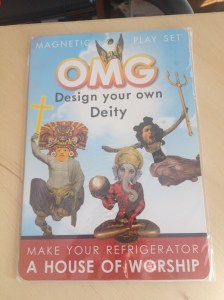
Imagine the ark of the covenant in the temple of Dagon. It was a box overlaid with gold, on top of which sat cherubim. Two of them. Images, but not “idols.” Inside, depending on what passage you read, you might find the original ten commandments, a jar or manna, or Aaron’s rod. Or all three. You might find nothing inside. The point was in the power of the symbol. Godnapping was a real fear in ancient times. A deity captured left its people vulnerable to the whims of others. Today we may rely on the high priests of encryption to keep our divine numbers safe from those who hack at the new idols. Gideon, after all, was the original hacker, and we all know how he ended up. Those who destroy others gods often fall into worshipping them once the hewing is done. The only question left is if one prefers paper or plastic.


Colorful States

red_state_poster

Kevin Smith is one of New Jersey’s own. I’ve always considered it one of life’s great ironies that Loki and Bartleby, the fallen angels in Dogma, move from Wisconsin to New Jersey, the exact same route my career took. (Feel free to read into this.) I was therefore curious when I heard, a few years back now, that Smith had come out with a horror movie. Now I’m not a fan of horror for its own sake as my sensibilities are more towards the ambiguities of gothic, but I finally decided to view Red State. I had no prior idea what the movie was about, but it speaks volumes that the title suggests quite a bit with just a simple adjective and noun. If there’s anyone out there even slower in getting to movies than me, and who is hoping to watch Red State, consider this a spoiler alert. Read further at your own risk.

Red State deals with religious fundamentalists—the Five Points Trinity Church, to be exact. The group is loosely based on the Fred Phelps gang, and the film actually makes reference to Phelps to say that Abin Cooper’s group is even worse. They’re weaponized. You’re probably starting to get the picture already. Cooper’s congregation is his extended family, and they’ve been protesting against homosexuality and other forms of what they consider immorality, but in an extreme way. They lure sinners into one of their sting operations, incapacitate them, and then murder them during church ceremonies. When the Feds discover evidence of a murder, a Waco-like Branch Davidian stand-off occurs with the predictably bloody gun fight that follows. There are moments of humor, but it is a bleak parable—yes, there is a wholesome message here—that speaks loudly about intolerance.

Analysts, well actually just some analysts, have realized that horror movies and religion are very close compatriots indeed. Reading the Bible may be a little easier on the eyes, but even some parts of the Good Book can inspire nightmares. Indeed, as Adin Cooper’s sermon emphasizes, fear of God is very important. As is fear of fear of God. The regression can go back as far as you wish. Religions develop in response to fears. Not only in response to fears, but clearly this is part of the mix. Horror movies show us what we fear the most. Is it any wonder that they cross paths with religion so often? The only unusual aspect for Red State is that it is so explicit about it. It is a traumatizing film in many ways. Maybe because (spoiler alert) the one who concocts the whole religion is alive and well at the end and is the last character that we see. Such are parables.


The Religion Code

People have strange ideas about what religion can and cannot do. Yes, many religions face the past—founders of various sorts gave dictates and statutes that were appropriate for all time. At their time. Few religious visionaries can see very far into the future, so their rules have to be massaged over time. When we see an Amish buggy clopping along next to a highway we suppose that this is a religion mired in the past, but we could be wrong. The BBC ran a story the other day expressing some surprise at “ultra-Orthodox Jews” and their getting into tech fields. What hath the Talmud to do with coding? Stop and think about that.

One of the aspects of this dynamic unaddressed by this story is how unescapable the internet has made learning tech. Your religion may have you following outdated principles at home, but unless your community can get on without the outside world, like the Amish, you’ll need to learn to negotiate technology. As the article points out, learning Torah and Talmud are transferrable skills. People genuinely seem surprised when what we might broadly call “the humanities” come in handy. Religion, when it requires serious reflection, builds critical thinking skills. It is only the blind adherence to principles that haven’t been thought through that leads to trouble. Even a Fundamentalist knows that this all has to make some kind of sense or something’s wrong. In fact, the article doesn’t suggest that a Fundie as a tech expert would be any cause for wonder. A humanities education might have helped with that.

Photo credit: Musée d'art et d'histoire du Judaïsme, Wikimedia Commons

Photo credit: Musée d’art et d’histoire du Judaïsme, Wikimedia Commons

One can’t speak of Judaism as a monolithic religion. In fact, religion scholars regularly speak of “Judaisms” just as they speak of “Christianities.” The various branches of Judaism hold study of scriptures in common, and the BBC article makes the point that this kind of thinking helps with problem solving. The great irony here is that when the problem solving comes in the form of getting computer glitches worked out it is considered valuable. When the problem solving merely helps people figure out how to get along in the world it is backward and parochial. Such is the strangeness of a world impressed by its own creation. The internet has brought a great many religions together. It has, I would suggest, created new religions as well. It is a myth to suppose that the rational rules of any hypertext markup language are that different than sages and rabbis arguing over the best way to make progress in a confusing world. No matter what our religion, we all need to make money, don’t we? And isn’t that the most truly ecumenical enterprise of them all?


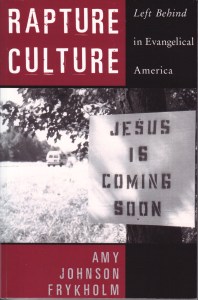
Behind Left Behind

Now that September’s here, we can begin thinking back over the summer, scratch our heads, and say “huh?” We’ve been so blinded by the Trump that we haven’t had time to reminisce over what’s been happening fundamentally. I mean among the Fundamentalists. This summer Timothy LaHaye went to his reward, followed this week by Phyllis Schlafly. I’m sure they’re basking in an all white, straight, and Protestant Heaven. For those of you unfamiliar with LaHaye’s name, you’ll know his fruits. The Left Behind series was his brainchild and many other aspects of this not-yet-raptured world spun from his squeaky-clean mind. He and Ms. Schlafly spent their lives telling others how to be good. I’m sure their only regret is that they won’t be here to be raptured away so they can see the look on the rest of our faces. No matter, they’ve gone to a better place.

Also this summer Lyle Jeffs, another sort of Fundamentalist, also disappeared. Under arrest for some suspected crime or other, Jeffs escaped from the FBI by worming out of an ankle monitor. His attorney, however, has suggested that Jeffs was raptured instead. Come to think of it, that could explain these other disappearances as well. It’s a regular Bermuda Triangle of Fundamentalists, it seems. The rapture is the ultimate excuse because the Almighty can trump any suit, any hand. Maybe they all just wanted to get off the earth before this fall’s elections. Fundamentalism, it seems, is missing from the political docket this year. Whereas since I’ve been able to vote candidates have been raising issues of concern to the more right-wing contingent, this year the fundies seem to have vanished. Maybe the rapture did occur after all.

teachings_of_jesus_39_of_40-_the_rapture-_one_at_the_mill-_jan_luyken_etching-_bowyer_bible

You see, I’ve read enough of the scenarios to know that those left behind are always confused. They don’t believe in a rapture and the missing people are only part of the problem. Things are going awry (again, look at the politics and differ!). What will life be like in this post-rapture world? How will we survive with our conscience gone? All things considered, it’s going pretty well. Missing the rapture was one of my greatest childhood fears. Like all good Fundamentalists I assumed I wouldn’t be deemed worthy of that first reaping. I’d be left to suffer through tribulation and, hopefully, beyond that salvation might lie. LaHaye and Schlafly got out before the action started. Lyle Jeffs, his lawyer suggests, did too. The FBI found olive oil all over the ankle tag and, perhaps, the signs of a struggle. I’ve watched enough movies to know that when someone is raptured, however, all their clothes are left behind. The only way mortals ever face the Almighty is naked as the day they were born again.