Losing My Religion (Excuse)

I’ve always appreciated New Jersey inventiveness. This is a state where lottery winners register with the social security numbers of dead people to avoid taxes. Politicians and honest folk both seem to resort to inventive means of getting around the system. A recent article in the New Jersey Star-Ledger brought this home. An uproar has developed, it seems, over a more stringent regulation concerning religious exemptions for vaccines. If the bill passes, parents and guardians opting out of vaccines for their children will have to state their religion and the cause for the objection. Many have been suggesting this is government of the worst kind, because, well, it wasn’t really a religious reason that they used the religion waiver. Have you met my dead relative? He recently won the lottery.

A timeless problem that arises from a situation such as this is the issue of defining religion. We’re not really sure what it is, other than a reason for not preventing disease. Experts disagree about the essential components of religion. Since the concept of God is up for grabs, doing what pleases said deity (or not, depending on whether a religion has a deity) would seem to be part of it. Most religions, whatever they are, suggest honesty is a virtue. And honestly, most religions have no trouble with vaccines. The paper even had a helpful chart of religions, even indicating that Christian Scientists and Jehovah’s Witnesses have no issues, really, with vaccines. Clearly some churches do. One suspects other may have had such regulations, but they eventually died off.

Since we can’t bother to define religion, it becomes a most convenient excuse for just about any kind of deviant behavior. Many religions exist; more than most people even suspect. Sects of Christianity alone number around 40,000, and that’s leaving aside all other religious traditions and their many splinter groups. Truly held religion, as the media often underscores, can lead to extreme behaviors. The only way to come to grips with this is to try to understand what religion actually is. The most logical locus for such study would be universities. Many of them are run by states. States that are afraid of breeching that wall of separation. Even in the cause of public health. In my opinion, funding the study of religion could be a real shot in the arm. But then, so could winning the lottery.

800px-Typhoid_inoculation2


Getting Exorcise

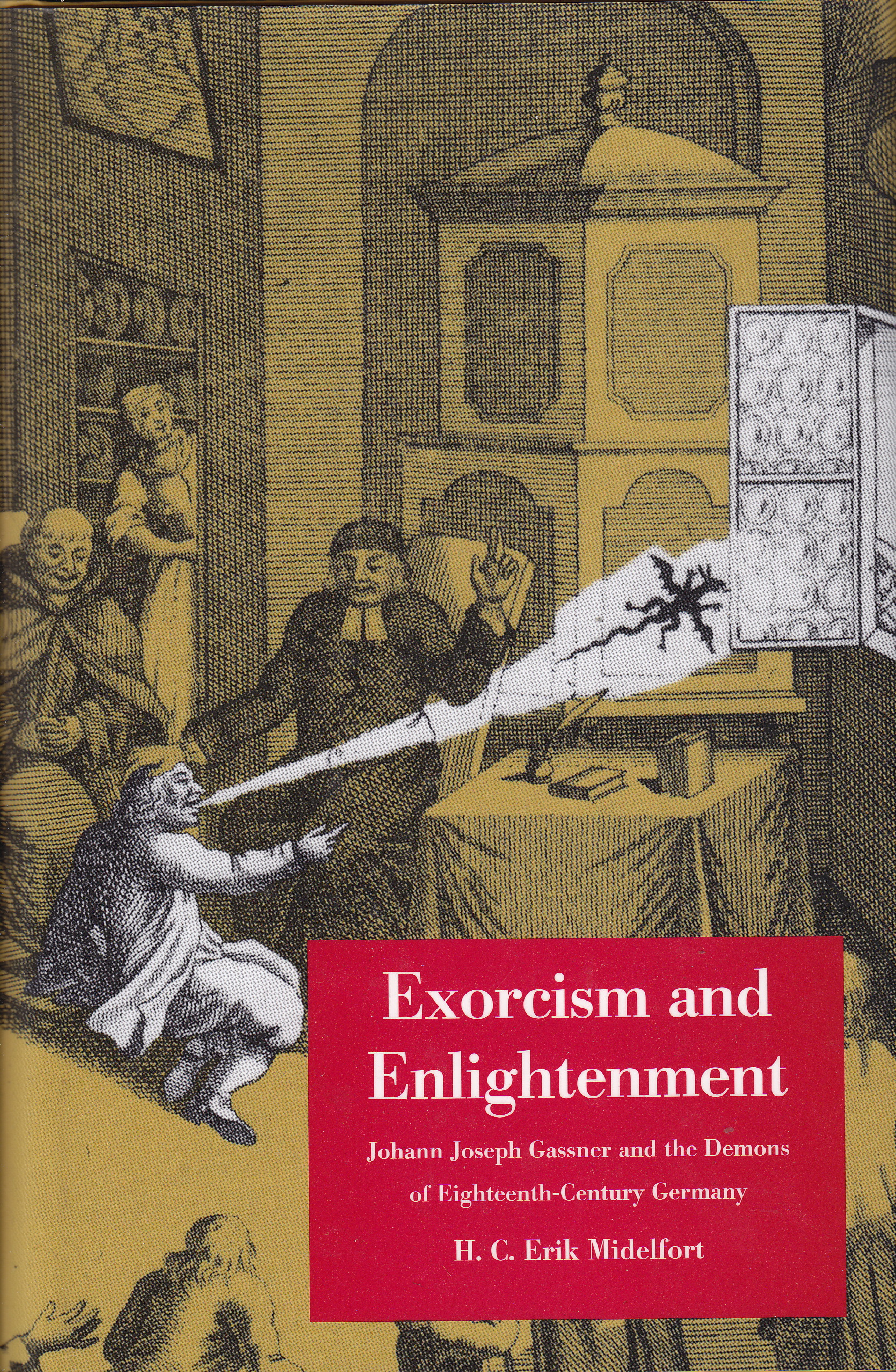
ExorcismTo be honest, I can’t recall having heard of Johann Joseph Gassner before. Given his role in the European witch-hunting culture, however, I must have read his name a time or two. As with most names out of context, it was quickly forgotten. H. C. Erik Midelfort, therefore, is to be congratulated with bringing out not only Gassner’s name, but his remarkable career. Exorcism and Enlightenment: Johann Joseph Gassner and the Demons of Eighteenth-Century Germany, like so many other books, came to my attention in a bookstore. Books on demons have a strange kind of draw to someone interested in both religion and monsters, and since it was on an overstock shelf, I found it impossible to let it lie. This proved to be a wise decision.

Midelfort proves himself one of the rare academics who doesn’t talk down to his readership, yet makes what could be a complex topic understandable. Complex is about the only word to describe what would become Germany in the Eighteenth Century. The remnants of the Holy Roman Empire left a divided region with prince-bishops—clerics with political control outside their own dioceses—vying for all kinds of authority. Although the Enlightenment was well underway, the region was embroiled in the controversy of a priest by the name of Gassner. Gassner was a healer, but also an exorcist. Believing that many torments suffered by the populace were demon-spawned, he used highly public and, to some, incredible exorcisms before healing those in need. His success was unquestioned, but the church, struggling between Catholicism and Lutheranism, as well as struggling to find a place in the Enlightenment world, found Gassner a bit of an embarrassment. What do you do with demons in a world where science says they don’t exist?

One of the most notable takeaways from Midelfort’s book, for me, is that the Enlightenment did not suddenly change the world. Even fully aware of empirical experimentation and the use of reason, the scholarly world did not utterly acquiesce to a subdued materialism. It still hasn’t. As the case of Gassner demonstrates, our comfortable, physically predictable world holds some surprises for us yet. At least for Gassner, believing demons don’t exist doesn’t stop them from tormenting people. As he cured his thousands, skeptics gathered (including his contemporary Franz Mesmer) to explain away what was happening. Even today, as Midelfort points out, we can’t explain the placebo effect. There’s no question, however, that it works. As does, if the media is to be believed, the occasional exorcism in the twenty-first century.


Pauline Resurrection

271px-Bartolomeo_Montagna_-_Saint_Paul_-_Google_Art_ProjectPaul is dead. Has been since the first century. In biblical studies, however, he is undergoing a kind of resurrection. Studies of Paul are coming thick and fast, with many claiming, with some justification, that Christianity was his invention. Biblical scholars have long realized, however, that many New Testament letters do not come from Paul. Some never made that claim (Hebrews), while others seemed to have played on the popularity of the epistle genre and added Paul’s name to gain authority. Or maybe they were written by somebody else called Paul. Far more intriguing to me is the fact that in the authentic Pauline letters, the apostle from Tarsus mentions other letters he wrote that were not preserved. This should strike no one as unusual; would Luke’s grocery list have been preserved as scripture if it had been found? Probably not. Still, these missing letters do raise an issue that might crinkle brows with thought. What have we been missing?

Paul, like other scripture writers, had no idea he was writing “the Bible.” In fact, the Bible is one of the most obviously cobbled together holy books in world history. It is inspiration by committee. We have known for many many decades that there were other Gospels, for example. Some scholars treat the Gospel of Thomas as canonical, while others have reconstructed Q down to chapter and verse. The Hebrew Bible cites some of its sources that have gone missing. Some of the existent biblical books in their current state are obviously somewhat garbled. An imperfect scripture. And I’m wondering what Paul might have written in those missing letters.

The process of constructing a Bible has been examined time and again by scholars. Mostly they accept the material we have to work out some scheme of how Christianity decided “thus far and no further” and these books only will be Bible. Isn’t there, however, a problem when we know that other bits of parchment were floating around out there with the apostolic stamp of approval? What if Paul changed his mind over time? His current letters, the ones that survive, aren’t always consistent. It’s the job of exegetes to try to tell us what Paul really meant, but the fact is we know that this founder of Christianity sent more advice to more people and nobody bothered to keep a copy. Those bits that were preserved are not systematic or comprehensive, making me wonder just how solid a foundation a theology built on such small bits might have. Nobody, it seems, wrote a life of Jesus in real time. It took a couple decades at least before people started to sketch out his life’s story and teachings. By then Paul had already been killed. His letters, slowly gathered over time, formed a nucleus of a faith that grew to be the world’s largest. And, despite all that, we don’t know what he fully said. And we never will.


Hallowed Be Thy Income

IMG_1924

Some time ago, I was invited to attend a “best practices” session where the language was businessese. As I suffered through statements about how everything can be quantified as numbers and how emotions should be left at the door but creativity should flourish, I began to wonder when I’d become so cynical. I mean, the presenter really believed this–it was clear from his eyes. He’d been so indoctrinated that he really believed selflessness was letting somebody else have their way when they’re your supervisor. Then it hit me. It was so obvious that I felt silly for not seeing it sooner. Corporate culture is a religion. The business world has its own specialized vocabulary, belief system, deity (Mammon), prophets, and ethics code. Those who believe it pass their teachings on to the next generation with the zeal of converts. It gives their lives meaning and purpose. It even has its own origin myth, going back to Adam Smith. All the elements are there.

A point that I come back to repeatedly on this blog is that a solid definition of religion does not exist. I once had a boss who told me there was no such thing as “religious studies.” Too many universities also believe that. When we see terror all around committed in the name of religion and our response is to decide the business curriculum is far more worth saving, I believe we’ve just decided on our religious preferences. Reward and punishment. The price of non-conformity is high. Ironically, our motivational speaker indicated that we shouldn’t be just like everyone else. Only, just don’t be too different.

I couldn’t help but to think back to an episode of Ruby Wax. While living in the UK some friends had a television license and we watched an episode or two. Ruby Wax is an ex-patriot comedian. On one episode she followed a vacuum cleaner salesman for an upscale vacuum manufacturer. Her path took her to a motivational convention which was—there’s no other way to describe this—an emotional religious ceremony. Although their god (Mammon) may not suck, his prophet (the vacuum) most surely did. At the time I saw the episode I thought it was simply entertainment, something at which to laugh. I’ve been to enough business seminars now to find that I’m a heretic in this faith. I may not know much, but I do know selflessness when I see it. And it is a trait that takes a lifetime to master and those who have belong to a different line of work altogether.


In Praise of Eve

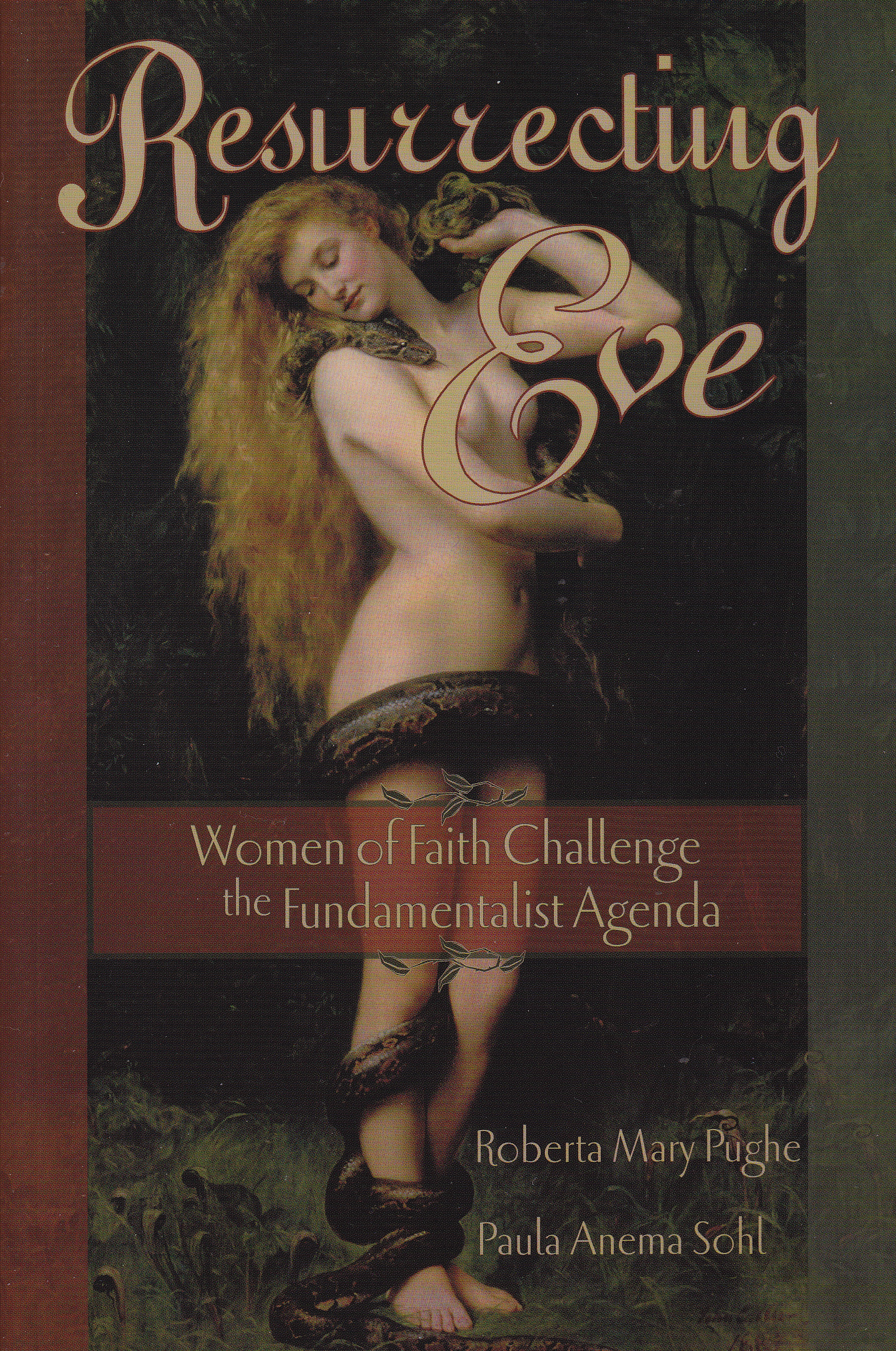
Resurrecting EveI once told some colleagues that reading even basic children’s books as Dick and Jane or The Cat in the Hat was a different experience for girls than it was for boys. Although Dr. Seuss was far more enlightened than much of the standard children’s literature from the era, there’s no doubt that the Cat is an active male, as are Things 1 and 2. The human girl (and her brother) are somewhat more passive, and thus the raring, rollicking action is mostly male. I try to stop frequently and notice how the message is still broadcast too widely that gender stereotypes contain the truth. Back when the American Academy of Religion and the Society of Biblical Literature met in San Francisco, a west-coast publisher, White Cloud Press, showed up. One of their books, Resurrecting Eve: Women of Faith Challenge the Fundamentalist Agenda, seemed appropriate for someone who’d been at Nashotah House as long as I had. Written by a psychologist and a pastor, Roberta Mary Pughe and Paula Anema Sohl, it raises many points that, while not new, again reminded me that men have to take responsibility to learn how women experience the culture that masculinity continues to dominate.

Reading stories of women who’ve suffered at the hands of a hyper-masculine fundamentalist Christianity, it is difficult not to cringe. Young girls molested by ministers in a culture where no one’s voice trumps that of the preacher, have no chance of justice. The mere thought of the few who’ve managed to build the courage to speak out suggests that far more choose to suffer in silence. The abuse isn’t always sexual. Damage to the esteem is rather a specialization of literalist groups, but males get off comparatively easy. Women and girls are provided with a unfair framework from the beginning and they often spend their entire lives conforming to it. These stories, even with the new age-ish kind of framing the book gives, must be told. More importantly, they must be heard.

In a world where our technology is so advanced as to make a Wright brother’s head spin, we still refuse to admit the equality of women. The United States comes nowhere near the top of democracies that have a significant portion of women in government positions of power. We like to think we’re advanced, but we still keep half of our people back from their true potential. We sent a satellite out of our own solar system before a woman president was ever elected. We call ourselves civilized. Of course, Pughe and Sohl are mainly concerned with fundamentalist Christianity. When we look at the demographics of government officials, however, the picture in this regard is not encouraging. Fundamentalism won’t be changed by scholars, for they are easily ignored. It will be changed by everyday men who pick up a book, perhaps because of the seductive painting of a woman on the cover, and realize that there’s far more at stake than cheap thrills and Sports Illustrated swimsuit issues. Treating women equally is merely the first step in becoming truly human.


Alas, Babylon!

Religions tend to be backward looking. That’s not intended to be a universal, nor a condemnation. Few would want to admit that their religion is new, especially in this scientific era. We tend to believe the truth is old. But not too old. In the monotheistic traditions, real religion started with Abraham, or more properly, Abram. Beyond that we were all pagans. One of the sad stories brought to my attention this past week involves the IS (you know it’s bad when we have to use acronyms) decided to destroy Nimrud, one of the ancient Mesopotamian cities that has helped us understand whence we’ve come. In an era of political and social correctness, we’ve decided that the right to keep artifacts rests with those who’s heritage it reflects. The future, however, is just as unstable as the past. As someone who has spent many years trying to understand the material remains of our pre-Judeo-Christian heritage, it is a tragedy of the first degree to have unthinking guardians destroy what can’t be replaced because they represent “idols.”

In my Ancient Near Eastern Religions class, I used to begin by asking students what the difference was between an idol and a god. At first it seems that idols are images, and, by definition, offensive to the religion that names them “idols.” Then, as we probed deeper, it would become clear that all religions use images of some description, and that likenesses of deities were considered to be gods in sophisticated ways. Those who built the pyramids and the great walls of Babylon were not simpletons. Their images, many of them powerful still today, were psychological expressions, often backed with theological finesse. Even Protestants accuse Catholics of idolatry, and they worship the same deity.

It would be a mistake, however, to blame religion for such wanton destruction. All religions breed extremists. Extremists, like those who believe science can explain everything, are simply drawing their reasoning out to its ultimate conclusion. That’s not to condone their actions, but to try to comprehend them. All religious groups have those who slip past the bounds of conventionality into the realm where an all-consuming zeal requires excessive action to be noticed. Human beings are complex that way. A pagan philosophy of ancient Greece held that all things in moderation was the ideal. Religions with a concept of Hell, however, breed excessive ideologies. As a child I would have done anything to avoid Hell. In fact, with the little power that children are accorded, I conscientiously did what I could. When I wasn’t distracted by the other attractions life seemed to offer. If, perhaps, we considered that socio-economic justice would go a long way toward engendering a kind of contentment, we might find less extremists in the world. No matter what we do, however, we will not find ourselves in a world without religion.

DSCN1835


Almost Heaven?

HeavenCanWaitLike most kids raised Protestant, I had little idea about the Catholic worldview.  Despite family wishes, I had Catholic friends, and topics such a Purgatory inevitably came up.  (Well, they did if you were me, with my insatiable interest in religion and its trappings.)  Purgatory was a concept both just and unjust at the same time. It seemed only fair to give people who’d made mistakes a chance at Heaven, yet, at the same time, to make them suffer when they already realized that they’d made mistakes seemed like, to put it bluntly, bad parenting.  The key was in the name: Purgatory.  A place to purge the evil.  Melvillian try pots. Given this background, I couldn’t wait to read Diana Walsh Pasulka’s Heaven Can Wait: Purgatory in Catholic Devotional and Popular Culture. The afterlife is the ultimate 64-dollar question. It pays to be informed.

This fascinating study demonstrates that the idea of purgatory has long roots into Christian history. The Bible does mention Heaven and Hell, concepts borrowed from Zoroastrianism, but it doesn’t directly mention Purgatory. For this reason most Protestants reject it out of hand as Popish and superstitious.  Heaven Can Wait, however, explores how the idea grew into an almost inevitable aspect of Catholic theology. Most intriguing to me was the concept that, like Belinda Carlisle’s Heaven, Purgatory is a place on earth. Specifically, in many Medieval minds, in Ireland. There a cave of torments, guarded by monks, on an island in Lough Derg provided those brave enough to enter the chance to purge their sins before death.  In short, those who braved this cave could bypass Hell by suffering in advance.  Heaven on an installment plan, crudely put.  As Walsh Pasulka describes the accounts of Lough Derg, archetypes begin to fly thick and fast, like proverbial bats out of Hell. This single location, sometimes venerated by, sometimes destroyed by the church, was a vortex of torment.

Over time, as the rationalism of the Enlightenment settled in, the idea of a state of being having a physical locality led to changes in the concept of Purgatory.  The kids I knew took it for granted that it existed, and, with tween angst, accepted that that’s probably where they’d end up.  At least for a while.  Protestant that I was, my choices were a bit more stark. If I messed up, as I well knew I did, my torment would be neverending. Heaven Can Wait is a rewarding exploration of how an idea, logical in its original context, survived long after the worldview of the church had begun to change. Indeed, it survives to this very day.  And like most doctrines of the church, it has a way of scaring even the most inoffensive souls straight.


Geneva Conventions

As an alumnus of Grove City College, I generally don’t have the chance to consider other colleges as unreasonably conservative. College taught me, after all, that education involves thinking things through, and that, of all things, doctrine is one of the many human constructs that wilts under close examination. Both religious and political doctrine fall under this rubric. So when an article in the Chronicle of Higher Education fingered Grove City’s near neighbor, Geneva College, I was both relieved and not really surprised. Grove City was strict, but Geneva, located down the road in Beaver Falls, was even more Reformed. Tales at the Grove said that even off-campus dancing was an infringement of the student code there, and that even a legal sip of beer with dinner, off campus, could get you expelled. You know how students talk. In any case, both cut from Presbyterian fabric, Grove City and Geneva Colleges hold out against the world and its multiple evils. So why did humble Geneva merit notice in the exalted Chronicle?

Geneva College recently sued for exemption of the contraception-coverage mandate of the Affordable Care Act. You see, in many conservative religious traditions pre-marital sex is not only from the Devil, it practically never happens among true Christians. If it doesn’t happen, why should you be forced to pay for its treatment? Denial runs profoundly through these conservative colleges. While at Grove City, in a first-floor dorm room, my roomie and I were awakened one night by a group of pretty obviously drunken frat boys from the third floor. Cursing loudly, one of them rammed his fist through our window, showering the floor with glass before stomping loudly up the stairs. When I went to the housing office the next morning, they wondered about my story. Students at Grove City, drunk? It simply did not happen. In all likelihood, I’d broken the window and made up the story so I wouldn’t have to pay. I pointed out that campus security had noted the glass was inside the room and my roommate and I were both there at the time. Reluctantly, while still withholding judgment about the drunken part, I was believed.

Conservative Christian colleges often face the specter of reality. College kids were killed driving drunk. Girls, gasp!, did get pregnant and did not always decide to keep the baby. Real world issues declared anathema by a magisterium with its hands firmly over its eyes. No matter one’s view of morality, singling women out for punishment of sexual sins is just plain unfair. The issue here is health care, not the consequences of a decision made in the heat of passion. How often the anonymous male gets to scamper off, his health fully covered. The co-ed, however, is treated like Eve holding a newly bitten apple. Students attend Christian colleges for a wide variety of reasons, and the education, apart from the theology, can actually be excellent. It is the ethical obligation of the schools to cover all the human needs of emerging adults, not just those based on a morality still mired in the Middle Ages.

Time for a Reformation?  Photo credit: Roland Zumbühl, Wikimedia Commons

Time for a Reformation? Photo credit: Roland Zumbühl, Wikimedia Commons


Hot Pants

Over a decade ago now, the populace was buzzing about Stella Liebeck’s suit against McDonald’s. You may remember the case. Liebeck was handed very hot coffee through a drive-up window in one of those flimsy cups, and suffered second-degree burns when it spilled in her lap. The incident spawned a documentary movie and even a New York Times retro report a couple of years ago. No doubt the injury was serious enough to cause medical treatment including skin grafts, and McDonald’s does, as we all know, process its customers just like it processes everything; you can’t serve over 100 billion burgers and be the world’s second largest private employer without process. Food injuries in a world of business feeding can be serious. “Eating out” is a way of life for many and when people eat out they take their religion with them. That’s why Hiram Jimenez’s case is so interesting.

According to the New Jersey Star-Ledger, Jimenez decided to bow in prayer over a plate of sizzling steak fajitas at Appleby’s. For those who’ve never witnessed fajitas being served, they are an attention-demanding dish, served loudly steaming and popping with smoke rising up forever and heads being turned. I suspect that’s part of the appeal. According to the paper, Jimenez bowed over his food and the grease popped, burning his face, causing him to knock the plate of food onto his lap. None of the burns left scars, and a Superior Court here in New Jersey found the restaurant not negligent as the danger was “open and obvious.” What makes this story so interesting is not the injury but the cause behind it. Food being hot is somewhat universal. Praying in restaurants, however, is an evangelical cultural practice.

Growing up with evangelical friends, I learned to pray in restaurants. (My family was of rather humble circumstances and we didn’t eat at restaurants.) Partly it was in actual thankfulness, but clearly it was partly also in show. We were witnessing by invoking our gustatory gratitude. For being literalists, we didn’t take Jesus’ injunction to go into the closet and shut the door before praying too seriously. The culture around public prayer involves bowing. The bow is a mammalian display of submission. Thy will be done. In the biblical world being thrown into a blazing furnace for public displays of faith didn’t lead to lawsuits. Everyone knows infernos are hot. I can’t help but wonder whether a martyr complex is at play here. A praying customer is doing what his religion demands and gets burned for it. Yeah, I know what that feels like. And, I suspect, so do countless others who find no hearing in courts at all.

Photo credit: Bryan Hong (Brybry26), Wikipedia Commons

Photo credit: Bryan Hong (Brybry26), Wikipedia Commons


Wag the Tail

Among the most respected of intellectual endeavors is political science. Analysts who read and reason beyond national borders, finding implications in countries many of us have never heard of, they can be an intimidating lot. Experts in economy and psychology, they tell us what the big picture looks like—why we do what we do. And almost universally they disdain religion. We’re talking politics here, why don’t you go sit at the kid’s table? Religion is the stuff and nonsense of make-believe. What politics is about is who has the biggest bombs and bank accounts. Those who impact the world in real ways. And yet.

I would never claim to be up-to-date on current events. I don’t have time to read newspapers and if my friends didn’t send me pertinent articles now and again I might still believe that social justice is more important than the color of an anonymous dress. When no less than an authority than the New York Times speaks, however, I do have to pause a minute or two to consider the implications. Frank Bruni has recently been writing on the Opinion Pages about those ultimate strange bedfellows, religion and politics. I may have got the order wrong, but that’s for political scientists to determine.

Many people don’t consider that religion can be, in some respects, scientifically analyzed. As a deeply divided nation, one factor that even political scientists should note is that yes, religion does count. No matter how naively conceived, people vote with their faith behind that polling curtain. The Republican Party realized this in the 1980s. If you take just one or two religious issues and make them the platform on which you stand, you can garner a disproportionate amount of the conservative evangelical vote. A new study from the Public Religion Research Institute, according to Bruni, demonstrates just how disproportionate the outcome can be. Surveys may not be precise, but less than 20 percent of Americans are white evangelical Protestants. Yet their issues are the ones that make or break elections.

Life has a way of making one cynical. I grew up a white evangelical Protestant. Although my viewpoint has evolved with my education, I can’t shake two of those qualifiers even if I want to. I read political scientists dismissing religion as a bogus topic, mere twaddle to fill the daub of inert minds walled in by primitive thinking. And I read the occasional news story that demonstrates that the facts don’t fit the premise. Do we need to understand religion? Absolutely not, I’m told. But in the end, even the analysts of the political beast will have to realize that tails wag dogs just as surely as raising hackles will make any mammal appear larger than it really is.

Not a tail to be seen...

Not a tail to be seen…


Holi Daze

It’s pretty white out there. For many parts of the eastern United States it has been a season of snow on snow on snow (why does that sound familiar?). The wisdom back in old white Wisconsin was there’d be three snows on the crocuses. This year the crocuses have remained buried, even in New Jersey. Judging from the number of people not driving, it looks like most people had a snow day yesterday. The color white has often been treated as a symbol of purity in various religions, but today is also the celebration of Holi, a Hindu festival of color. I’m no expert on Hinduism, but I do find the concept of a day of color to be immensely appealing. Anthropologists trace its roots to some fertility festival, but the fact is, we could all use some color right about now.

DSCN5027

Winter technically lasts, in this hemisphere, until the vernal equinox. Religions around the world have festivals to celebrate this slow turning of the seasons, and the lengthening of days. A long while back I wrote a little book on the holidays. In it I tried to find the basis for various holiday colors. We all know red and green clash, but when we see them together we think of Christmas. Black and orange make a standard Halloween combination, and red by it self suggests St. Valentine, while green alone gives St. Patrick his identity. A more recent addition is black and silver for New Year. Easter, coming in the spring, however, is a celebration of color. We don’t dye the eggs just one hue—it has been a long winter and we celebrate its close with a burst of color. Even the staid old Episcopal Church reverences the liturgical seasons with distinct colors. In other words, colors mean something.

Years ago a friend recommended Jasper Fforde’s Shades of Grey (this was before Fifty Shades of Grey took over the world). It quickly became one of my favorite novels. It’s all about color. Apart from a few years under the influence of a friend with a strong personality, I’ve always been a subdued haberdasher. I tend to wear understated colors because I don’t like people commenting on the way I look, or, even for that matter, looking at me. I enjoy public speaking, but having someone single me out on the street or the bus has always felt distinctly uncomfortable. Still, I think we may have lost something that Holi has retained. Color exists to be celebrated. And shared. It is so important that commerce and trade apparently stopped last week to figure out the color of a certain dress. I may not be a Hindu, but I think I might wear my brightest shirt today to welcome color back to the world.


Once Bitten

TheologyOfDraculaOnce vampires sink their fangs into you, it’s hard to shake them. I’m referring to an intellectual connection here, instead of a physical one. M. Jess Peacock’s book on theological vampires spurred me to read Noël Montague-Étienne Rarignac’s The Theology of Dracula: Reading the Book of Stoker as Sacred Text. It has been on my “to read” list for some time, and since I finished re-reading Dracula recently, I felt the canonical text was still fresh enough in my mind to take on an analysis. I have to confess that even though I grew up as a religious kid, and I loved monsters, I had no idea that the two were connected. Strangely, religion tended to elicit a fearful response while monsters gave me a kind of comfort. Of course, I always supposed that was normal. Then I learned that mature adults didn’t talk about, or even think about, monsters. I had to try to find solace in religion instead. Rarignac clearly figured out, however, that Dracula was a sacred text long before I came along.

What exactly does it mean to treat a book as a sacred text? Before anyone gets any funny notions, I need to say that Rarignac is not suggesting vampirism is, or should be a religion. That hasn’t prevented other people from seeing it that way, but that’s not what this book is about. It is about Bram Stoker’s Dracula. Devoting the kind of attention to detail that is often reserved for biblical texts, The Theology of Dracula examines the many religious traditions (not all of them Christian) that lie behind the novel. Stoker drew on many “pagan” traditions, including those of ancient Egypt and of Nordic mythology. Clearly Dracula responds to Christian symbols pretty violently, but he isn’t a classic Catholic. In fact, he seems to shy from Catholicism while admitting that its symbols work.

Rarignac, however, suggests more than this. He suggests that Dracula was written intended to be a sacred text. Not a Bible—we already have one of those, thank you—but a text that has its own mythology and symbols. Dracula‘s characters are not always what they seem. Careful scrutiny reveals that they often have celestial connections that tie them to ancient mythologies long forgotten by most modern people. We read the book expecting it to be about a vampire. Well, clearly it is. But not only a vampire. There is a much larger story at work in Dracula, and Rarignac has done an admirable job tracing its Vorlage (if I may step into jargon for a moment) and its wider context in the world of literary creations that specialize in our nightmares. There is much at which to marvel in this little book. I’m not convinced that Stoker intended his book to be read this way, but it is nonetheless a richer experience for it. Rarignac gives a simple monster tale real teeth.


Our Gods, Ourselves

The near-death experience, made popular by Raymond Moody in the 1970s, has hit the cultural mainstream with movies like Heaven Is Real. The now-familiar scenario of going through the tunnel toward the light and meeting something like God is so widespread that mention of “staying away from the light” can be a metaphor for remaining alive. Although experts (one of which I’m decidedly not) disagree on interpretations, nobody doubts that the dying often report such things. Some say it is the impression left on an oxygen-starved brain about to implode, while others postulate a soul has made an actual bid for freedom only to be returned to sender. No matter what you believe, it’s hard not to be intrigued. Not all the experiences are identical, however. A friend recently sent me a story from World News Daily Report that headlines “Catholic Priest Who Died for 48 Minutes Claims that God Is a Woman.” The story by Barbara Johnson, which ran earlier this month, is an interesting variation on the standard. Often the “being of light” met at the end of the tunnel is kind of asexual. After all, there are no physical bodies there.

This story has me thinking. Traditional Christian, indeed, Judeo-Christian thought posits that God is neither male nor female. Of course, given human experience, many people find that difficult to conceive. It does occur in intersex persons, and it is actually pretty widespread in nature where some animals change gender over their lifespans. Still, when it comes to the Almighty, people want to know with whom they’re dealing. Think about it. When you walk into a doctor’s office and meet a physician for the first time, your response will differ depending on their gender. The same is true of going into a car dealership, or a daycare facility. We use gender to give us the first hint on how to respond. A genderless God, let’s admit, is somewhat disquieting. What is the message you want to send to a person without knowing their gender? Or maybe like me you’ve read a book and discovered halfway through that you had the gender of the author wrong. Doesn’t it impact how you read the rest? So, what if God is a woman?

Interestingly, the case of Father John O’neal comes from a Catholic context. Along with Evangelical Christians, Catholics are among the most likely to hold a residual maleness to God’s identity. Theology of the Trinity, always beginning with “the Father” makes it hard to escape. Perhaps what Fr. O’neal unexpectedly encountered was a God-concept without judgment. That would certainly be disorienting to a faith that has a multi-layered afterlife including limbo and purgatory as well as heaven and hell. A deity who decides the fate of souls must be a judge, and although Judge Judy rules daytime television, the church still has a traditional mensch on the bench. What if Fr. O’neal really did get to heaven? What if he found God really was female? Could human religions ever recover? I, for one, am intrigued. Still, I’m content to wait another few decades before finding out. And maybe for the time we have down here we should all start practicing by realizing that gender is always far less important than the personhood that we all share.

IMG_1858


Four Gods’ Sake

AmericasFourGodsStatistically speaking, most people don’t like statistics. I’m one of those. Numbers can do funny things to a person’s perception of things, nevertheless, I appreciate those who can work with them and make sense of them. When I saw the title America’s Four Gods, my disappointment engine kicked in. Is this book going to be about numbers? It was written by a couple of sociologists after all (and even a couple is a number). I’ve read enough of Christopher Bader’s work, however, to trust him. Paul Froese should be the same. Subtitled What We Say about God & What That Says about Us is an appropriate introduction to the book. Based on the Baylor Religion Survey, this study looks at what one of the most religions nations on earth believes about God. Since God is a key political player these days, that’s not a bad idea. Their conclusions are well worth noting.

Froese and Bader find that belief in God is highly idiosyncratic. It is likely the case that, similar to sacerdotal snowflakes, no two ideas about God are precisely the same. Categories, however, help to analyze things, and America’s Four Gods does just that, suggesting four main images of God that have very different characteristics. The Authoritative God we all know well. This is Jonathan Edwards’s deity that dangles spiders above the fire—active and angry in the world. The Benevolent God is also active, but more avuncular and kind. The Critical God is not very active, but is still annoyed with us. The Distant God tends to be kindly, but is rather remote. Using these four kinds of God, Froese and Bader examine what people believe about all kinds of issues, from war to social reform to adultery. When Americans say “God bless America” they mean very different things.

When it comes time to troop to the poles, we listen to what our candidates say about the Almighty. It is a virtual certainty that an atheist is unelectable in these religious states, so we want to hear what the candidates have to say about God. What they say and what their listeners hear, however, are clearly different things. Still, religious conviction is one of the most important variables when it comes to selection a President, Governor (at least in some states), or congress-person. Some candidates, with God off the plate, have nothing left to commend them at all. So it is in one of the wealthiest, most powerful nations in the world. A basic truth that we choose to ignore decides our fate for us. Mired in a Gulf War? Who you gonna call? Chances are we all know the answer to that. Chances are equally as high that we all mean something different by it.


Biblical Weather

On President’s Day, my wife pointed out an article in the New Jersey Star-Ledger headlined, “‘Biblical’ snowstorms battering New England.” She asked, reasonably enough, “What makes a snowstorm biblical?” Since I have written a book on the weather in the book of Psalms, I might be able to speak to that. First off, yes, there is snow in the Bible. It’s not mentioned often and it is a rarity, but the Israelites knew what snow was. In fact, one of the most difficult Psalm weather references is to snow, in Psalm 68. The man interviewed in the newspaper, however, was not being literal. “Biblical” has come to mean disastrous. I can exegete that a bit more: disastrous because of quantity. Too much of a good thing. Or bad thing. In Boston this year the weather just won’t quit. The topic that really has people talking, however, is the temperature. It has been very chilly. My daughter complained when her university didn’t cancel classes with the air temperature at about 9 below. Her note prompted my thoughts of a day to remember.

When I taught at Nashotah House, the weather did not stop us. Ever. It was a residential facility with both faculty and students living on campus. Everything was within walking distance. My close exposure to the weather was one of the reasons I wrote the book. One Lent, and this must have been in February, we had a quiet day. Quiet days were taken very seriously. On this particular occasion the day was to be used for a meditation in the Milwaukee Cathedral, some 35 miles away. The problem was the air temperature was -42 Fahrenheit. That isn’t wind chill, that’s how cold the air actually was. (For those of you reading in Europe, Fahrenheit and Celsius are the same at -40, then they begin to diverge again.) It did not stop us. We piled into the van and prayed earnestly that we’d get there safely. On the way home we manically recited Evensong from memory. When the wind blew the chill dropped to -70 (my Minnesota friends will believe me here). If ever weather was biblical, that day was.

I do wonder if overusing “biblical,” however, will wear it out. Where do we go after biblical? What is conceptually bigger than God? Anselm would panic. What if next year it’s even worse—how will we describe it? We’ve already used up the apocalypse. We’ve entered into a crisis of superlatives. Nothing is big enough any more. As I look at the early fading light of this President’s Day, the snow is beginning to fall again. When I was a child we had, I seem to recall, a simple word to describe it. We didn’t invoke the Almighty. We didn’t hear the galloping of distant hooves. We didn’t act as if a day out of the office were the end of the world. Our simple word for it was this: winter.

DSCN0099