Monument to Madness

Reflections on the implications of my recent trip to the United Kingdom will likely continue to filter into conscious expression over the next few days. Jet lag will inevitably fade, and some concepts will shake down and settle into place as the reality known as work once again demands its pound of flesh per day. One of the realities that struck me during my time in St Andrews was how violent the Reformation was when it came to Scotland. Truth holds the world hostage, since everyone wants to believe they own it. And it’s my word against yours unless one of us can pull in a larger authority—and who is larger than God? There was a lot of credibility riding on the Reformers’ certitudes. And resistance was strong. Fatal even.

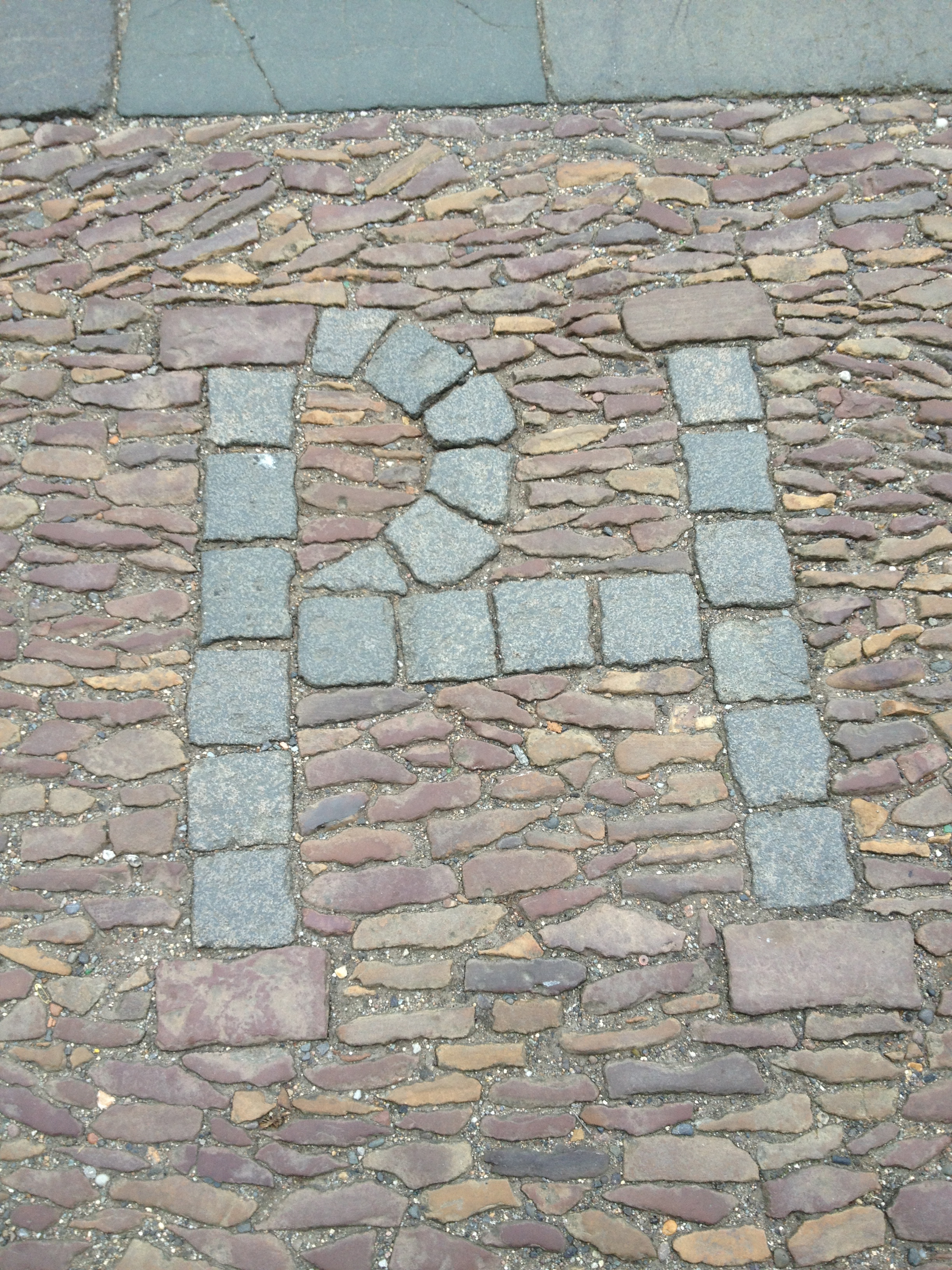
Reform is nearly never gentle, especially religious reform. After the Society of Biblical Literature’s meeting disbanded last week, I wandered around the old, medieval section of St Andrews, trying to get a sense of what such conviction must have been. One of the participants narrated to me more of the stories of those who’d died in the course of conversion. Patrick Hamilton, it turns out, may have been the first victim of the Reformation, but he was not the last. Walking along on a sunny afternoon in a country where several religions consciously coexist (I was, as an American, surprised to see so many large mosques in the UK), it seemed difficult to believe that humane individuals would torture someone to a horrendous death by burning just because of religious differences. The killing times seemed so long ago. Or perhaps our killing has just become more subtle.

IMG_0814

Following the directions I’d been given, I came upon the Monument to the Martyrs. Not wishing to belittle the atrocity of undeserved deaths, I could not help thinking of the pillar as a Monument to Madness. Is the need to feel right so great that others must be made to die for it? After all, among those generally considered to be sane, we all believe that we are right. Who consciously accepts untruth as reality? In such circumstances the best, the only reasonable response is to agree to disagree. I can let you accept your truth, if you’ll let me accept mine. And perhaps such tolerance would serve our planet well. Even the number of trees spared had autos-da-fé been forbidden provides a silence to the wisdom of allowing difference to thrive.


To Be, Or

Science and Nonbelief

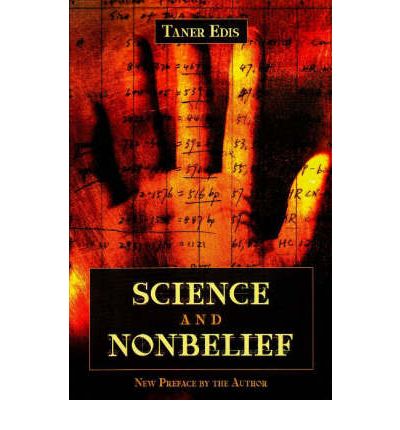
Science is, according to Taner Edis, ambitious. While Science and Nonbelief is somewhat sympathetic to the religiously minded, Edis demonstrates how science aggressively tackles the issues steadfastly claimed by religions, and ultimately triumphs. Interestingly enough, early on in the book Edis notes that “truth” is a philosophical concept, and science operates on the principle of the best explanatory theory of the moment. So far I am in complete agreement. I guess the part that gives me the most trouble is the assumption that reason is the only way of knowing. Perhaps I’m just not enough of a scientist to know such things, but it appears to me that all “lower” animals appear to get along very well in the world without great doses of “reason” that supposedly catapult humanity far above the other species. Scientific observation would seem to confirm that many animals feel emotion—after all, what is fight or flight if not an emotional response? And since we are animals, I reason, have we lost something when we leave feeling aside as a way of knowing?

Edis is quite fair-minded. He notes that science has no way to prove or disprove the existence of a deity, or deities, but he also states that the empirical method is so successful that a spiritual world is no longer required. He may be correct. The vast majority of the people in the world feel he is wrong, however. I may state this since we know, statistically, that most people in the world believe in some form of religion. Rational or not, here they come! It would seem that evolution has endowed us with religion, or an awareness of something we feel rather than reasoning out. And yet, we are told, science takes no prisoners.

I often ponder the fact that no one person has all the answers. Part of the human condition involves possessing limited resources for specializing in too many fields. Polymaths become rarer each year as specialists grow more and more precise. In this great mix of human learning, science often steps in and claims all the marbles belong to it. The rest of us have lost ours, apparently. There’s no denying that applied science has been very successful in bettering our understanding of our universe and our lot in the world. That doesn’t mean that all will believe in it. The title of Edis’ book is apt; belief is the real issue in attempting to fit religion and science into the same world. It is quite clear that religion doesn’t explain much in the way of the natural world. I wonder, however, if science is really capable of encapsulating all of what it means to be human.


Reflections on a Ruined Cathedral

On my final day in St Andrews, the symbol of its ruined cathedral weighs upon my mind. In a world both increasingly secular and religious, it is the latter that led to the fall of this house. I’ve toured many impressive cathedrals in my time, from Chartres in its gothic splendor to the plain majesty of Durham. These engineering feats of medieval “superstition” still draw theists and atheists alike, in wonder. In crass terms, they represent a large economic investment. It terms of spirit, they are sublime. Under the duress of ecclesiastical prestige, those who couldn’t really afford the resources nonetheless stretched their stonework toward God. In secular Europe, some of the best known sites are sacred.

St Andrews Cathedral fell victim to the Reformation. Religions are notoriously selfish in this way. When a new divine regime takes over, the wonders of the previous god become spoils. Hagia Sophia (which I’ve never seen) went from basilica to mosque, and Roman Catholic St Andrews became an eviscerated shell at the hands of Protestant thinkers. Even in ancient Israel the temple of Jerusalem was build atop a site of even more ancient heathen shrines. We conquer to stoop.

St Andrews, named for the patron saint of Scotland, is better known for its golf than its god. The divine may have built this city, but the divot has captured its heart. Priorities change with time—we call this progress. Not far from the crumbling cathedral lies a ruined castle. Not the haunt of royalty, the castle was build to house powerful bishops and archbishops. Some of these were the warrior bishops who were knights as well as prelates. Some, like Alexander Stewart, led troops to war. And yet the cathedral could not survive the change of religious climate. If we can’t have it, then it must be destroyed. The great cathedral, once the largest church in Scotland, and among the largest in Europe, perhaps represents the fate of all acts of faith, when something more insistent comes along. Or maybe I just don’t want to leave.

DSCN3593


Burning Faith

1528. February 29. St Andrews, Scotland. 24 year old Patrick Hamilton was burned to death for espousing the teachings of Martin Luther. St Andrews University is the oldest of Scotland’s four ancient centers of higher education. Heterodox religious teaching was considered a very dangerous thing in those days, especially in the halls of academe. Once infected with Lutheranism, like a zombie, you had to be burned so that the rest of the world could be safe, the virus contained. Only the problem in this case was an all too human one—difference of opinion regarding religion. The Thundering Scot, John Knox, would’ve been all of about 14 at the time, and reformation for the Catholic Scotland was still years in the future. Now, one of the largest European cathedrals, in St Andrews, lies in ruins because of that very reformation.

Religious bickering has a tendency to move beyond the ridiculous to the insane. Burning young men, after decades of burning hundreds of young and old women alike throughout Europe, was one of the most heinous symptoms of a horrid madness that had grown from religious fervor and fear. Religion itself is not to blame as much as the human tendency to use it as a weapon against those who are perceived as different. Some five centuries later and the physical stakes are gone but the fervor and fear are as strong as ever. As we hear politicians and televangelists lash out against those of whom God disapproves, the smoke still rises from the spot where Patrick Hamilton, late of the University of St Andrews, was sacrificed for his faith.

IMG_0729

Ironically, as I sat on the quiet morning train from Edinburgh to Leuchars, from the headphones on the young man behind me wafted AC/DC’s “Highway to Hell.” Was Patrick Hamilton aware that he was on a literal highway to hell as he returned home to Scotland? Did he have an inkling that his own people would torture him to death because he taught such dangerous ideas as salvation by faith alone and Scripture as the instruction for that salvation? Could anyone have guessed that the then teenaged John Knox would introduce what was to become an even less forgiving form of Christianity to Scotland by the time young Hamilton should’ve reached his dotage? Religion is funny that way. Even those who give their all to defend it easily become its victims. And a few yards down the road the Society of Biblical Literature meets in a university building dedicated to the sciences. History’s ironies never end.


Unspoken Reality

In that impressive cultural marvel known as Facebook, a few gems amid the overburden occasionally appear. The post of a friend brought to my awareness a site known as everyday feminism, where, last year a post about religious privilege appeared. The brief piece entitled “30+ Examples of Christian Privilege” highlights one of the persistently overlooked aspects of religious liberty. No matter how much the founders of the United States valued freedom of religion, the colonials were, at least on the part of the non-slave side of the equation, Christians. Whether Jamestown, Plymouth Rock, or Guanahani, those Europeans who first set foot ashore did so under the banner of one variety of Christianity or another. (Such a case might be made for Vineland as well.) Religious liberty meant fleeing the oppressive practice of state religion—always Christianity—that kept shifting according to the whims of frequently unstable monarchs. For all its wide variety, Christianity is cut from a bolt of the same cloth. At least in the lining.

The Christian Privilege cited on everyday feminism is the most insipid kind brushed with the widest strokes. Still, it does reveal just how thoroughly Christian even the secular can be. Christianity, as I often told my students, pervades our culture. We live it, breathe it, ingest it. Often subconsciously. America was and wasn’t founded as a Christian nation. Intentionally, according to the wishes of the founders, no. Unintentionally, according to the dictates of privileged classes, yes. The problem here is not Christianity—it is privilege. Depending on whence you read the words of Jesus, his message seems to have been one of a general equality, or at least fairness. Those same words, however, can be distorted to support the monolith of the privileges granted those who follow the “one true faith.” The privilege to own slaves, for example. Or to oppress others born into less fortunate circumstances.

Ironically, among academics, I’m told, there is a push to hire those who are authentically unprivileged. Although I must, by my accidental Caucasianness, maleness, and inherited Christianity, be classified as privileged oppressor, I did grow up in economic privation. So much so that my wife feared to take our infant daughter to the unsafe house in which I was reared (which was, fortunately, condemned and demolished before that became an issue). It still shows in my natural, placating obsequiousness to supervisors and bosses—I was raised knowing my place. Yes, sir. As a first generation college student, I still find myself confused by why I was rejected by a higher education into which I poured all my youthful energy. Yes, in such circumstances, it is difficult at times to see the privileges. They are there, however, as anyone willing to walk across town with their eyes open may see.

IMG_0714


Seems Reasonable

Florida is a state of contrasts. A news story from the Associated Press highlights that divergence. On the lawn of the Bradford County courthouse is a monument to the Ten Commandments that American Atheists sued, unsuccessfully, to have removed. In response to their legal defeat, they have placed their own monument to atheism alongside it. Well, what’ fair’s fair. Local reaction, according to the story, has been anything but positive. Nevertheless, I wonder what a monument to atheism must look like. The partial photographs reveal the atomic symbol-based American Atheists logo on top, and words on the sides. The monument, the story indicates, bears quotes from Thomas Jefferson, Benjamin Franklin, John Adams, and Madalyn Murray O’Hair, the last of whom was gruesomely murdered as an early martyr to the atheist cause. There are those who suggest that the atomism of Democritus in the fifth century BCE already tolled the death knell of the gods. Deities and very small particles, however, have continued to get along for the past 2500 years.

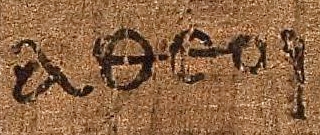
Ephesians_2,12_-_Greek_atheos

David Silverman, the current president of American Atheists, is quoted as saying the monument is an attack on Christian privilege, not Christianity. This may seem a fine point, but it is valid. Most reasonable atheists have no difficulty granting freedom of religious belief to anyone (only the more radical members of the atheist camp suggest religion ought to be stamped out). Does that mean governments should not display monuments to Moses’s magnum opus but not to, say, that of Lao Tzu? Or, perhaps in this instance, Lucretius? It might appear to be over-protesting, but what would a Hindu’s thoughts be, should s/he be ushered past the statutes of a foreign god on the way to court?

One of the most difficult things for a person to do is envision their normal as another person’s weird. Religions that seem perfectly logical to those raised within them have a way of seeming unbelievable to those who encounter them as a part of an exotic culture. To me it is difficult to suppose anyone would see American culture as “exotic.” I mean, we’re talking Wal-Mart and MacDonald’s here. It seems pretty ordinary to me. When I take a mental step back a little further, however, I begin to see a nation of widely varying traditions. Little pockets of true culture punch through the plastic here and there, and the light that shines through can be brilliant at times. And if you happen to run afoul of the law while visiting, you might end up in a courthouse that not only advertises the Ten Commandments, but also has a monument to humanistic spirit as well.


Dirty Laundry

Wirathu may not be a household name, although Time magazine devoted an article to his teachings last week. The media has become fascinated with religiously motivated violence of late, although such violence is nothing new. Capitalizing on the fact that many of us in the western hemisphere see Buddhism as a religion of peace, Hannah Beech’s article, “The Face of Buddhist Terror,” reveals the growing conflict between some Buddhists and Muslims in Myanmar. The article took me back to my seminary days where, in a class in systematic theology, our professor was extolling the virtues of Buddhism as a religion of peace as opposed to Christianity with its history of warfare. Not denying that history, I raised my hand and asked how Christians then had come to know Jesus as the Prince of Peace. And Muslims, as any student of religion learns, also value peace. The ideals of most religions promote peace. The problem is that the practitioners of religions are humans.

Gandhara_Buddha_(tnm)

Like our chimpanzee cousins, we humans distrust those of other tribes. In one of the more disturbing aspects of chimpanzee research, encounters between especially a male isolated from his troop and another family group often end badly. Biology has programmed us to keep valued resources for ourselves. It’s as if nature knows there are limits to her bounty, and in order to survive and thrive, some will need to starve. Or be killed. Critics of religion—and there are many who are quite vocal—often overlook the aspect of religions that call for the reversal of our natural tendencies. Yes, I’m selfish. As a biological creature, I’m concerned that I get enough to eat, and have sufficient space. I want to stockpile money so that I may retire (unlikely to happen in reality), and spend my final years in peace and relative comfort. Yet, my religious upbringing has left the door open for others. What about those with even less than me? My empathy reaches out for them. Don’t they deserve what I deserve?

The problem is always at the friction point where belief systems rub passed each other like immense tectonic plates. The Buddhists of Myanmar say they just want to be left alone. The Muslims of Myanmar say they just want to survive. Their religions are pressure points building along fault lines. Still, I suspect that there are other sources of tension and violence in Myanmar, besides religion. I know there are in American society. In fact, most everyday violence, I suspect, has nothing to do with religion. Violence is part of human nature. Religion, at its best, urges us to fight this compelling biological message of self-preservation at any cost. Religious violence is a very real cause for concern, but to get to the root of the problem we must look past religion to biology. And sometimes—just sometimes—religion turns off the flame beneath the simmering pot.


ABCD

Among the sensitive crowd known as biblical scholars, the chronological designations Before the Common Era (BCE) and Common Era (CE) have long been in use. Perhaps it is because, at some point in the recent past, Christian scholars realized that the Hebrew Bible, until then called the Old Testament, was also the Bible of Judaism. All of history, in the European version, is divided by the figure of Jesus, or more properly, Christ. BC stood for Before Christ, after all, and AD not for After Death (which would leave an embarrassing gap of about three decades), but Anno Domini, “in the year of our Lord.” The conventions of BC/AD had become so entrenched that few bothered to linger over the implications, but implications there are. A case might be made, purely on historical grounds, for maintaining BC. There was a time before Jesus—even the Bible agrees on that point. And, again, from an historical view, the worldview of Christianity forever changed the direction of events for at least two millennia thereafter. It still does, if we pay any attention to the posturing of the Religious Right. We have to start counting somewhere, don’t we, to know where we are in time?

Anno Domini is a tad more colonializing. Short for Anno Domini Nostri Iesu Christi, “in the year of our lord Jesus Christ,” those two letters make an assumption that the shared lord of the readers is indeed Jesus. For centuries in Europe and the New World, apart from those Muslims that from time-to-time made their presence felt, and the Jews who were conveniently suppressed, this worked for just about everybody. If you disagreed, after all, you were welcome to return to your backwater homeland and count your time by burning hour candles between your toes, if you wished. For the forward march of history, it was onward, Christian soldiers. AD held a proselytizing imperative. But then Christians began to notice two more ancient religions, Hinduism and Buddhism, both with pedigrees that predate AD. Not that this was a problem from a missiological point of view—we can just convert them, after all—but scholars began to consider the implications.

Photo credit: Isabelle Grosjean ZA, Wikipedia

Photo credit: Isabelle Grosjean ZA, Wikipedia

Time is inexorable. At least in our experience of it. No one stopped to begin counting when Adam and Eve were wandering about Eden, and the simple reference to the lifetime of a monarch seemed sufficient for most pre-capitalist business. What fueled the change to attempt an absolute time was the conviction that it was all about to end soon. Jesus seems to have predicted an imminent apocalypse; “some who are standing here will not taste death,” Luke tells us Jesus said. If that is the case, AD is the final countdown. With a delayed onset. Instead of Anno Domini, it might stand for Announcing Doomsday. And since that clock is still ticking, it might be time to acknowledge that we do indeed live in a Common Era.


Liberty and Justice for

Looks like America will be divorcing the self-proclaimed “Defense” of Marriage Act. It’s a small step, but a small step in the right direction. Religious dogma has too long held sway over politics in this land of religious freedom. It must seem astonishing to rational people the world over how a country founded for the very purposes of religious liberty has homed in on a very narrow sect of one religious tradition and used that as the basis for discriminatory laws. After all, even the Bible says very little about marriage—something about taking your main squeeze into the tent with you and voila, you’re married. The Bible never asks what they’re doing in the privacy of their own tabernacle. Now we have a political system that legislates what can legitimately turn you on. Finally we see some light beginning to dawn in the judiciary system.

I don’t take marriage lightly; those of us who are married seldom do. I also don’t take my status as being the only possible way of finding love in a world that sorely needs more of it. Every day I witness acts of uncaring and sometimes outright cruelty, often in the name of the progress of business. And until yesterday I had to live with the knowledge that it was perfectly legal to discriminate against committed couples just because their gender’s don’t fit a preconceived mold. The land of the free? Maybe, just a little bit yes, now.

Our legal system, which pours out its love on corporate culture, protecting business owners more readily than employees, shielding the wealthy whose lifestyles are beyond scrutiny, ends up telling citizens whom they may love and whom they may not. And we complain against countries with arranged marriages. Freedom for some is not freedom for all. Until we as a nation recommit ourselves to life, liberty, and the pursuit of happiness, we’ll have to take the small steps towards freedom when they come. Yesterday, for at least a little while, I was glad to see that the system can work for the good of all, when it puts its mind to it. America, you can be proud. Say it loud!

800px-Joseph_Anton_Koch_006


Con-Ception

Sometimes you see something so often it become invisible. I pass by a local cemetery every day, and it wasn’t until a friend from out of town came to visit that I knew of the irony of its iron gates. Immaculate Conception Cemetery is one of several Catholic cemeteries in the area. In a deeply symbolic gesture, most cemeteries are designed as the ultimate gated communities. One of the great thrills for the young is to hang out in graveyards at night to test their mettle and for boys to impress the girls and each other with their bravery. But this can lead to vandalism issues. I remember how distressed I was, upon visiting a cemetery in upstate New York on a genealogical trip, to find a family marker for several of my ancestors heartlessly toppled over. I wrote to the cemetery custodian (people still used letters in those days), and the next time I visited, it was, to my utter relief, repaired. Part of my past had been restored.

None of this, however, was what my friend pointed out. When the gates to the Immaculate Conception Cemetery are opened, the left hand gate reads, “Immaculate Con.” My curiosity aroused, I walked over the next morning to look. Indeed, “Immaculate Con” standing just beneath the cross. The right hand gate, cross-less, reads “ception Cemetery.” Without treading the road to Inception, I stood before the openly inviting gates with some wonder. Is there something deeper to this Immaculate Con? Is there something the church wants to tell us? Were the iron-mongers insinuating something covert? Or is it just the giddy over-imagination of yet another overstimulated religionist?

DSCN3298

Surely this is just the case of pragmatic spacing and pacing. The dead lie here in faith that they are counted among the chosen. Across town is a cemetery where, I noticed some years before, one half contains headstones facing east and another half has headstones facing west. Those facing east are inscribed with Roman letters, those toward the west with Hebrew. The Jewish and Christian dead lie next to each other, facing opposite directions.

Cemeteries say, despite their silence, volumes about what we believe. We put our dead out of our midst, but our cities grow and consume our necropoli, forcing us to face our beliefs yet once again. Do our deepest hopes and fears, tied so intimately with our mortality, make us who we are? We will all face death at some time. When we face the iron gates before the pearly ones, what will we see? If the gates are open, it might be that we’ll read, with our undead eyes, “Immaculate Con.”


Guiding Girls

Girl Guides are the British equivalent to the Girl Scouts. I first learned about them during the three years that I lived in the UK, although, as far as I know, they don’t sell cookies. An article in the Huffington Post last week announced that the Girl Guides have decided to drop God from their pledge, as a move toward inclusiveness. I’ve often pondered the place god holds in various social societies. At my daughter’s Girl Scout bridging ceremony a couple weeks back, I noticed God in the pledge. In New Jersey, where diversity is synonymous with breathing, I wondered how this antiquated oath felt to those who maybe grew up without the concept. Stretching my mind back a few years, when my daughter was in Middle School, she was awarded a good student prize by the Elks. As I sat in the tastefully decorated meeting room, with only a very faint tinge of beer in the air, I wondered if I might ever join a fraternal order. One of the officers stood to welcome us, inviting applications for membership. Democratically, she was a woman in a “fraternal” organization. She reeled off the requirements. As an afterthought she said, “and you have to believe in god.”

How does one measure belief in divinity? It has been my experience that many beliefs fluctuate with time. I can decide to believe, but in many ways, belief decides me. As a mantra to modern society, on the old X-Files series Fox Mulder’s famous poster read, “I Want to Believe.” To join the Girl Scouts, the Boy Scouts, or the Elks, you have to say you believe. Nobody’s going to hook you up to a polygraph machine, but you need to make your public declaration. At least in the last case, beer come later.

Religious diversity is a reality of our lives. From the invention of the steam engine, it became inevitable. Our world was going to grow smaller as we met people who had previously been isolated from us by distance. In 1893 the World Columbian Exposition was held in Chicago. As part of it, the Parliament of the World’s Religions introduced many Americans to the religions of the world for the first time. Hinduism, once an exotic strain quaintly captured in the archaic spelling “Hindoo,” became a sudden fascination. Buddhism was a curiosity. How had it been that the United States seemed only to know about Christianity, Judaism, and Islam (in that order) when other belief systems existed? How could we have missed them? More importantly, what were we going to do now that we knew about them? We couldn’t unknow them, like you can unfriend someone on Facebook. We were going to have to learn to live together. After all, we all have just one planet to share. Social organizations are great places for introducing tolerance. You can be moral without being Judeo-Christian. And if our social organizations want to promote equality of membership, maybe the Girl Guides are truly living up to their name.

1918_girl_guides


Holy Hostage

HostagetotheDevilA chance glimpse at a textbook shelf in a university bookstore made me aware of Malachi Martin’s Hostage to the Devil, although it is several years old. I was intrigued that a major, secular, state university would offer a course requiring a book about demonic possession. I’m not completely naive about college students, but this seemed just a tad extreme. Nothing is more dangerous than a book dangling in such a context, like the Necronomicon of Abdul Alhazred. The world of the demonic is freighted with arcane rules and a decided Catholic superiority. Even to the rational it can be insanely frightening. As I read Martin’s account, I frequently found myself puzzling over the unseen world he so meticulously describes—after all even the Bible has little to say about it. And Martin is a great lover of verbosity, detailing more than the reader needs to know about the five exorcisms he elaborates. If you want to know what a dying priest looks like, in great detail, you’ve come to the right place.

Perhaps the most jarring aspect of reading such a book is how such obviously intelligent people can come to such diametrically opposed worldviews while looking at the same evidence. Here was Malachi Martin, convinced that demons lurk about the world in great numbers. There is Richard Dawkins, convinced that we are nothing but particles and proteins walking around. Manhattan—the haunt of countless demons, or the febrile accident of firing synapses that means ultimately nothing? Although much of what Martin describes could probably be mental illness, one has the distinct impression Dawkins has never attended an exorcism. Both write with great authority and even greater conviction.

Hostage to the Devil is not an easy book to read. Martin’s style is smooth, like a novelist, but the length of his book keeps demons on your mind for a protracted period. Rationality can be worn down by attrition, and even the non-believer can be made to wonder. Would priests and their chosen attendants lie? Do the possessed really levitate, and contort, and cause objects to fly around the room in defiance of the physics so highly valued by atheists? For over 450 pages Martin will keep you wondering. You’ll also find out what an exorcist ate for his boyhood breakfast back in Ireland decades before facing the Prince of Darkness. Hostage to the Devil is a deeply disturbing book where the monsters we’ve all learned to shove deeply into the closet come springing back out. And the only effective help in the known world is the Catholic priest who happens to be an exorcist. And who can argue with that?


Sleepy Jean

Last week in the Chronicle of Higher Education, an article by Cristina Richie entitled “The Scandal of the (Female) Evangelical Mind” appeared. Richie points out that despite great strides being made in employing women in religious studies positions, Evangelical institutions still fall behind. This dynamic is not unexpected, however. Those of us who grew up evangelical know that no matter how much it may talk the talk of equality, evangelicalism walks the masculine walk of deeply seated patriarchalism. For those who literally “believe the Bible” there is simply no way around a male Jesus. Even if you go that dangerously risqué step and suggest that the Holy Spirit is somehow feminine, when the divine couple gets together (and Father is always in charge), the offspring must be either male or female. In any literal reading, women cannot possibly claim equality. For their very salvation they are dependent on a male. A god with testosterone. As in heaven, so on earth.

Evangelical institutions have a difficult time with women leading men. They’re not alone. As early as the first century of the Common Era, Paul had the same issues. Literal religion in a biologically dimorphic world will always be problematic. Either there is one god, or there are three. In either scenario the males outnumber the females. Should we posit a divine couple (as some in ancient Israel appear to have done—please wave “hi” to Asherah for me) we still have a culture that is dominated by men. The divine couple will always have the goddess deferring to the will of the god. And you can be sure that he will never pull over and ask for directions. We already know which way this chariot is going.

Every once in a while, the Chronicle likes to sit back and take stock of the religious landscape. Religious studies is, despite the bad press, a thriving area of academic interest. Surely to those in more quantifiable fields, our little squabbles over whether god is a man or a woman must seem pedantic and a little pathetic. And yet, the evangelical institution has an instruction book. That book, if followed word-for-word, leads to eternal rewards for those who are willing to foot the hardships. And for at least half of those (and likely much more than half) that will mean living on an earth that mirrors that realm beyond the sky. Although you can’t see it with any telescope, if you believe hard enough, it is there. And in that ideal place, the god in charge is a man’s god.

540px-Paradiso_Canto_31


Religion, Generally

Attempting to keep this blog focused on religion, has, of course, relegated it to the hopelessly outmoded pile for many people. I run into this all the time, professional, sophisticated individuals who have moved beyond the need for religion don’t see why we should waste our time with it. It’s about as useful as a room full of year-old newspapers. Like most people who end up studying religion, for me it began as an outgrowth of a religious upbringing. When you get to college they ask what you’re interested in. When your response is “Not going to Hell,” they’re likely to send you over to the Religion Department (if there happens to be one). One of the early lessons you learn as a religion major is (or at least should be) tolerance. Sure, the beliefs of other religions, when encountered for the first time, may seem weird. If you step outside your own tradition, however, chances are a great deal of what you believe could be considered odd as well. In such circumstances tolerance is perhaps the only way to avoid violence.

The few readers who leave comments on my posts give me pause to think. I largely study religion in isolation now, without the give-and-take of academic colleagues. It is not unusual for someone to point out the bizarre, or even unethical behavior of someone else’s religion (New Atheists do this all the time). When trying to understand religion, however, we have to be honest about the fact that all religions, and non-religions share instances of bad behavior. As my grade-school teachers said, “one bad one ruins it for everyone.” Religions are just as subject to human perversions as any other activity. People do bad things occasionally. Sometimes in the name of religion (or non-religion). Rationally it is obvious that we shouldn’t blame the religion for the poor behavior of some adherents. Yet we often do.

Religion-bashing is a popular sport. Those who engage in it, however, frequently fail to take into account just how widespread religion is. By far the vast majority of people in the world, educated or not, believe in a religion. This is complicated by the fact that an agreed definition of religion is still lacking. We don’t know what religion is, but we know it when we see it. Our universities and public intellectuals often ridicule it as unsophisticated and naive. As someone who has spent a lifetime thinking about religion, I suppose I’m obligated to say it, but there is a deep truth here: religions do motivate for good as well as for evil. Both non-religious and very religious people can be bad or good. What we require to get along in such a world is tolerance. And a willingness to listen to others. Otherwise both religion and non may not survive to criticize each other.

Jacob-angel


Continental Religion

In the course of my duties as an editor of religious studies, I was pondering the origins of the world’s major religions. Now, agreeing on what the major religions are is an exercise fraught with political incorrectness. What does “major” mean, after all? In any case, when we count in terms of numbers, there are more Christians, at the moment, than any other single religion. They are followed by Muslims and Hindus. So far there is little upon which to disagree, at least according to self-professed affiliations. Buddhists are usually counted as the next largest group, followed by Sikhs. When religionists mention “the big five,” however, they usually mean Judaism, Christianity, Islam, Hinduism and Buddhism. There are likely far more followers of traditional Chinese folk religion, perhaps mixed with Confucianism and Taoism, than most accountings record—such beliefs aren’t neatly categorized. Jains make up a sizable population, and Shinto is often classed in with all those religions of the far east. Many of the more modern religions, such as Mormonism and Jehovah’s Witnesses, sprang from Christianity, and so can safely be classed as a form of that faith.

What occurred to me that day was that all the major religions of the present world began in Asia. Judaism and Christianity, with all their numerous progeny, started in Israel or Palestine. Islam, as we all know, began in Arabia. Hinduism, Buddhism, Sikhism, and Jainism all have their origins in India, the big winner for the seed-bed of religions. Traditional Chinese religions and Shinto trace themselves to the far east. Yes, there are indigenous religions throughout the world. Native American and African religions are not to be discounted, yet they never quite attain the level of public awareness to be qualified as “major” religions. In this spiritual accounting, “major” has nothing to do with importance. For the religions with the largest followings we must turn our eyes to the one-stop continent, Asia.

Where major religions begin

Where major religions begin

Considering this, the obvious question is why. Why Asia? Civilization itself began in Asia, and one of the marks of a civilized society, at least until the day of the New Atheists, has been religion. Religion may be abused, as might any human innovation, but it has also been a harbinger of a more civil world. Not only fear of the divine, but also a sense of gratitude toward whatever forces might be greater than humanity, allowing us to survive for another season, or through another storm. Even in the world of science, religion has been a motivator. Gregor Mendel, the scientist who gave us genetics, was a monk experimenting in a monastery. Sir Isaac Newton was an occultist. Francis Collins is an evangelical Christian. Religion is at least as old as civilization. Its forms may be morphing, but, I suspect something our Asian forebears knew: religion will never truly go away.