Strixology

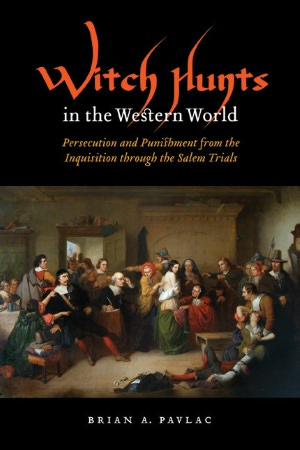
One of the fascinations of parenthood is learning to see things through the eyes of a young person again. When my daughter was fascinated with dinosaurs, I found myself learning such tongue-twisters as micropachycephalosaurus (I spelled that without looking it up just now) and struthiomimus just to remain conversant with her. (That, and I never really grew up.) When she took a childhood interest in insects, I found myself picking up bugs that would have sent me running just a few short years before, in my bare hands, to take them home to show her. All of this is by way of introducing my current continuing interest in witch trials. My wife (and consequently our daughter) is a direct descendent of the Towne family that included three innocent women accused as witches in the 1690s—Rebecca Nurse, Mary Easty, and Sarah Cloyce. When my daughter found out, the next long weekend from school we drove to Salem. I’ve been reading about witches ever since. I recently finished Brian A. Pavlac’s excellent Witch Hunts in the Western World. Well, as excellent as any book about such a gruesome topic can be. In the course of reading it, an unexpected connection dawned on me.

Many of those accused of witchcraft in the early modern period in Europe were accused of killing babies. The vast majority of them were women, often midwives. Those so accused had their bodies stripped and examined in public venues, generally only to have confessions tortured out of them later, under the eyes of male magistrates. The church had given credence to the superstition that witches actually existed and were in league with the Devil. Suddenly as I read, I heard the echo of a familiar refrain that comes from modern witch hunters. Those who, like the magistrates of old, are men; men telling women what they may or may not do with their bodies. Who draw their self-righteousness from their religion and who claim that birth control is of the Devil. Who accuse women of killing babies. Texas begins to sound like the rebirth of the Holy Roman Empire. In all of Europe that was where the most women were slaughtered, in thousands, by men who burned with the zealotry of a religion that had lost touch with reality.

Time spent on history is never wasted. At times we seem to have come so far, but then I look back over my shoulder and see the suchomimus of unbridled male fantasy closing fast. We have worked hard to bring equality to all people, but at the start of yet another millennium, we are still measuring the worth of humans by the gonads they carry. Based on outdated views from a book that was once meant to be inspirational. Sadly, the legacy often left by religion is only a residue of superstition. The reasoning behind the witch hunts of yesteryear and those of today is the same—the desire to control the behavior of others. It is the cocktail of religion and politics that inebriates those who crave power. What was true then remains true today. In the words of Pavlac, “A history of the Middle Ages shows the intensifying entanglement of magical thinking with political power, which produced the European witch hunts.” Substitute “Modern Day” for “Middle Ages” and “Planned Parenthood” for “European” and see if you can’t find a pattern.


Where’s Waldo?

I first learned about Waldensians in a class on the Middle Ages. In the centuries before the Reformation took place, some Christians in Europe resented the wealth and ostentation of the Catholic Church—the only show in town. In response the Waldensians preached a radical simplicity, including poverty. The established church, enamored of plutocracy and power, didn’t appreciate this challenge. To the average peasant, I suspect, the sincerity of the Waldensians was a bit more obvious than those who represented an institution enamored of its stature. When Catholicism learned about Waldensians and their imitation of Jesus’ lifestyle they did what came naturally. They killed them. Accusing those who insisted on helping the poor and needy of heresy gave the justification to the church’s decision to eliminate them.

What occasioned the most surprise, as I was recently reading about them again, was the discovery that the Waldensians still exist. The church has often been thorough in its elimination of those who cross it (note the antics of Rick Santorum), but somehow some Waldensians managed to live on through the persecutions of the trials of heresy. Yet the church still likes to bluster and condemn many to Hell, even if just metaphorically. I must admit that such posturing worries me. It is not in vain that the church has frequently insinuated itself into politics. Anyone who has been awake in America since the 1980’s can’t have helped but to have noticed.

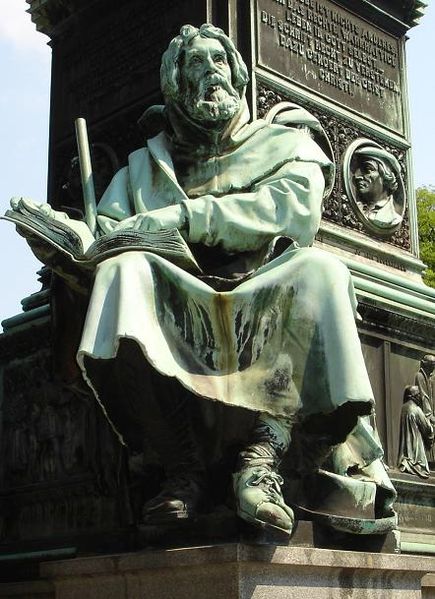
Ironically, the three major monotheistic traditions began as counter-cultural movements. Once the religions gained political power the oppression of others began, thus starting the cycle all over again. The Waldensians are an excellent paradigm of what occurs when a religious body attains too much power. Heresy is so dangerous because it highlights hypocrisy. Claiming divine sanction for human weakness is a charade easily understood by those who take the time to watch closely. The revisionist history of America that we hear presidential hopefuls espousing are warning signs. The church may not have reached all the Waldensians in the Dark Ages, but it still keeps on trying. Fortunately the followers of Peter Waldo are sometimes hard to find.


A Tiger’s Tale

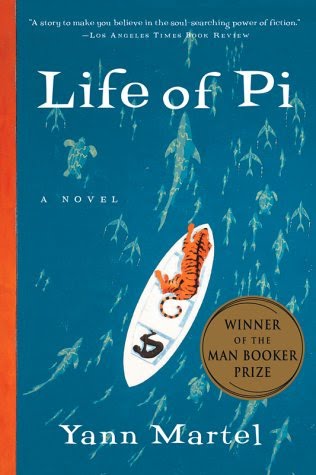
When my wife finished Yann Martel’s Life of Pi she said, “You’ve got to read this book!” Philosophical novels don’t often capture the interest of publishers or agents, but when they manage to slip through the fine-mesh mail-armor of the guild, they sometimes become best-sellers. Publishers often underestimate the intelligence and the hunger of the average reader. I was glad to have something so provocative to read on my long daily commute. Since the book was published in 2001 I won’t worry too much about spoiler alerts. It should come as no surprise that the biblical flood theme comes through a book where a zookeeper’s son is stranded on a lifeboat with various forms of wildlife. The most unexpected and endearing member of this menagerie, the tiger Richard Parker, is also the most deadly. How easy it would be to spin off in a Melvillesque direction of the beast as a representation of an uncomfortable God! Indeed, when Richard Parker scampers away when the boat runs aground, Pi laments how it was like losing God.

Setting the stage for this development is the tale of three religions. As a boy raised in India Piscine (Pi) is surrounded by traditional Hindu culture. On a family vacation he notices that atop the three hills are three houses of worship: Hindu, Christian, and Muslim. Curiosity draws the young boy in, and by the end of part one he is happily and concurrently Muslim, Hindu, and Christian, to the deep chagrin of the various religious leaders. They, coincidentally, all meet Pi with his parents one day in the park and each insists that although they encourage the boy’s continued membership in their tradition, he must drop the other two. Like any sensible person, Pi has chosen the safe road when it comes to conflicting religions: accept them all. It is only religion itself that deconstructs his triune belief system.

After his eventual rescue, Pi is questioned by insurance agents concerning the fate of the ship. They cannot believe his incredible tale, because they can only believe what they have seen for themselves. Pi asks, “What do you do when you’re in the dark?” An appropriate question for us all. This story is a parable about perceiving more than what can be seen. Tigers are hidden all around. Sometimes we call them Hobbes. Sometimes Richard Parker. They are protectors and they are dangerous. Some people call them God. In the end our protagonist is left without the divine presence that had kept him alive all the way across the Pacific Ocean. When the book is over, I think we would all admit, it is the tiger that we miss most of all.


Professor Little

There I was, some 3000 miles from home, in the office of a professor I’d never met before. On her desk a Gorgias Press catalogue. In that catalogue a miniscule picture with my diminutive face. Such are the little ironies of life. My ric rac career began when others started making suggestions about how being a janitor might not be living up to my full potential. Sometimes, often, I wonder if they were correct. Cleaning up after other people’s messes in the halls of our educational system seems like an incredibly honest career to me. Instead I have steered a course between the halls of academia and the halls of commerce. It is easy to suppose that I’m not really in control since even if I choose the general direction, I haven’t selected the specific circumstances. Recently I attended a conference where Gorgias Press had a booth. I looked over the tables, spying names of authors whom I had given their first start in publishing. With books struggling for elbow room in my own head, it is a bittersweet experience.

Watching the glacial ballet of higher education unfold, it often occurs to me that universities are not smart. Many brilliant minds work in them, and much light shines from them, but on an institutional level decisions are often made that jeopardize the entire enterprise. Over-emphasis on sports, over-utilization of adjuncts, over-payment of administrators—these are not signs of soaring intelligence. They are signs of institutions in a muddle as to their true identity. Are they businesses or centers of creativity and education? The basic business model is not “one size fits all,” and universities managed to maintain an enviable idealism until they began to emulate the corporate world. The tattered results lie all around us.

All through my educational journey, there was no guiding light. In my experience, higher education was a wondrous journey that suddenly terminated when I didn’t measure up to someone else’s standard of Christianity. By that point, I was ill-prepared for the savage politics of higher education. The transition from author to editor may sound simple enough, but things are seldom what they seem. Education may not make one smart, but it sure puts ideas in one’s head. Sometimes I reflect on those books that will never be written. I’ve never been any publisher’s darling, but here I am staring at a little picture of a little man. I’m sure there must be a lesson here somewhere, but I’m not smart enough to figure out what it might be.


Unholy Brides

Hollywood is seldom accused of being a religious venue. Indeed, carrying on from an earlier distrust of theater as idle entertainment, some Christian groups early on deemed movies as tools of the devil. (Some relaxed that harsh assessment when Cecil B. DeMille came on the scene and started offering biblically based epics.) Many directors and writers, to judge from recent vapid box office successes, consider action or titillation sufficient to draw in the dollars. Yet, movies have often proven to be an outlet for the intellect as well, with profound, intricate, and important themes unfolding against the silver screen. The movies we watch reveal much about who we are. A surprising number of them, despite early evangelical concerns, have decidedly religious themes or messages. My regular readers know of my confession to being one of the monster kid generation, and as an adult I re-watch those movies with senses attuned to their religiosity.

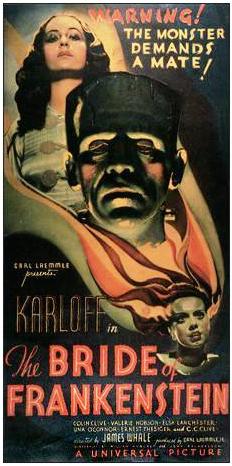
Last night, as I watched The Bride of Frankenstein, I was repeatedly reminded of the role religion plays throughout the film. From the opening lines of Lord Byron through to the monster’s moral judgment on humanity as he is about to pull the switch, religious language, symbols, and implications practically tumble over each other to get to the audience. The concept of life—the divine prerogative—being absconded by human scientists forms the skeleton of this story based on Mary Wollstonecraft Shelley’s original work. While Shelley can hardly be considered the poster-girl for religious scruples, her work, and its adaptation into this movie, bristle with the implications of usurping the divine. In the words of Dr. Pretorius, “To a new world of gods and monsters!”

The Bride of Frankenstein is not alone in this aspect of mixing religion and monstrosity. Hollywood of the 1930s was a money-hungry haven, but the classic monster tales that began to shape movie-watchers’ sensibilities often included religious themes. Dracula has his resurrection and aversion to crucifixes. The Mummy arises from ancient Egyptian ritual magic. The Wolfman suffers a gypsy curse. Frankenstein is the power of God incarnate. When the final reel is placed on the projector, we discover that God has rejected all these human attempts to ascend to the heavens. Hollywood gives us conventional religious endings. More recent and daring approaches have emerged, but seldom have they captured the American imagination like the creature features of the 1930s. The religious veneer may have been thicker in those days, but the underlying message could have chilled the blood of the finger-waving evangelists. Even the Bible, from the beginning, has its monsters.


Battle Billboards

Perhaps the oddest intangible accompanying democracy is the concept that all things are negotiable. Add to that a capitalist sensibility that everything has its price and even truth itself feels like a matter of debate. We see this all the time with Creationists so desperately wanting the Bible to the “true” that they twist science into a fairy tale noose from which to hang their literalist god. The tendency, however, does not stop with them.

Surely one of the most tense stretches of pavement in the country is NJ 495 leading into the Lincoln Tunnel. The aorta pumping countless metallic cells into the heart of Manhattan, drivers and passengers often sit motionless in it for seemingly endless periods to crawl forward like an inchworm entering the Olympics. It is there that Battle Billboards takes place.

I have followed the Atheist billboard development with some interest. In my limited experience with the Lincoln Tunnel, I have noted the digital billboard on the Jersey side bears the message of atheist.org near the major Christian holidays, so as Easter approaches the newest one reads “Celebrate Living Without God” to promote a rally on the Mall in DC. Both religion and science make claims of how to know the truth. Truth with a capital T should be non-negotiable by definition. The problem is that nobody has the Truth. We’re still trying to figure it out. Atheist.org holds a firm conviction that life would be better without religion. Clearly not everyone agrees. Clarity, it seems, is the chimera of debates over Truth.

A few seconds after the atheist.org ad flashes off the big screen, an ad for Wrath of the Titans (coming soon to theaters) flashes on. Irony can be sweeter than honey and as bitter as the Dead Sea. The most recent Clash of the Titans (2010) borrowed little from classical mythology beyond the names and large plot lines. An atheistic Perseus just doesn’t fit the classical taste. In the new film, Zeus—surely one of the prototypes for modern conceptions of God—is captured by Hades and has to be rescued by his unbelieving son. Could any movie be a more thinly disguised Easter story? Atheists? Wrath of the Titans? Which way to jump? Fortunately for me, traffic going into the Lincoln Tunnel in these lanes is one way. That’s the kind of certainty we all can live with.

Light from above or hopeless ambiguity?


Alternate Reality

Recall a time when you did something bad. We have all done it now and again. Even the memory possesses the power to churn the stomach and lower the brow. I just finished reading Native Voices: American Indian Identity and Resistance, edited by Richard A. Grounds, George E. Tinker, and David E. Wilkins. The essays in this volume are about Native Americans by Native Americans. Many of us are taught to believe that the United States government had found some way to deal peacefully, after some bloody battles, with those hostile to the arrival of Europeans, but the truth is much sadder and more sordid. While some may say the essays in this book dismiss academic standards, I have been on the receiving end of academic standards enough to know that even highly educated people can sometimes only cower and the reality is how you feel. That is what comes through every page of this book: what it feels like to be misrepresented, demonized, caricatured, forgotten. European colonizers stole what they could in the name of Christianity and left a legacy of tears.

I nevertheless learned a great deal from this book. Here, I came to understand, not everyone agrees with the standards that Euro-Americans use to measure the world. Nowhere is this clearer than in the Native American critique of science. Those of us trained in this method feel a knee-jerk reaction when it is questioned, but those willing to consider, to ponder, will realize that a scientific worldview is a culturally conditioned form of interpretation. Other forms exist, although they have frequently been silenced. There is more than one way of knowing. In many Native American religious traditions the land itself is sacred. Being removed from tribal lands was tantamount to being separated from tribal divinity. We might be better able to dismiss it all as ancient history were it not for the fact that the oppression continues to this day.

Comparison with another oppressed religion came to mind. Ancient Israel is understood only imperfectly, but we know that the land was crucial to Israel’s sense of identity. We should, as heirs of the Judeo-Christian tradition, be sympathetic to Indigenous American sensitivity to the bond between land and religion. In the former case, the United States supported the re-formation of Israel in the 1940s. We still keep our own indigenous people out of sight and use their land with impunity. Reading Native Voices raises some very troubling specters indeed. The colonizing religion here was Christianity, a religion that says it is more blessed to give, but is more than willing to take. And to invent a tortured theological justification for the action; it’s manifest destiny—whatcha gonna do? It is time we confront what was done to the people who were here first. I have no solution, but reading Native Voices is an appropriate way to start the discussion.


The Afterthought

This week I finished Genesis 2 on my venture to tweet the Bible, and even before reaching the famous snake scene in Genesis 3, I blushed. Not in a good way. Reading each word of the text in King James English (ironically, technically Elizabethan English), it becomes clear just how androcentric the text is. As a reader with sensitivity to historical eras, it is important not to judge the past by present standards. Nevertheless, it is difficult not to be offended at the assumed male primacy that had begun to be dismantled, only to be propped up again by sacred writ. As soon as people began to realize that sexual dimorphism did not equate to sexual dominance, the Bible came into the hands of the laity and there, beginning in Genesis 2, became the prooftext that women were made for men. Note: “for Adam there was not found an help meet for him. And the Lord God caused a deep sleep to fall upon Adam, and he slept: and he took one of his ribs, and closed up the flesh instead thereof; And the rib, which the Lord God had taken from man, made he a woman, and brought her unto the man. And Adam said, This is now bone of my bones, and flesh of my flesh: she shall be called Woman, because she was taken out of Man.”

One of these things is not like the others...

This passage is, of course, very familiar. Too familiar. Accompanying the ready availability of the Bible was the concept of divine writing. To a society of chamber pots and horse manure in the streets, the idea that God could write a book was sensible enough. The problem is, as our sophistication grew, our biblical sense couldn’t keep pace. Centuries later with probes soaring beyond our solar system, rovers on the moon, and space stations circling the planet, we still believe God wrote a book. And since God is male, the man’s point of view is normative. Of course, no one knows the reason for the story of Adam’s rib, but there is no doubt that ancient society, at least in this instance, was hopelessly patriarchal. It is society that determined which words would be considered sacred. The tale they chose matched their worldview.

The problem is that worldview gave an excuse to a patriarchal tour de force that has lasted for dozens of generations leaving women in their biblically predetermined place. There may be no sin as insidious as literalism. Those who cling to the King James do so only with special pleading, for anyone who has studied Hebrew (or any foreign language) knows that translation is an inexact science. Even Genesis 1 with man and woman created the same day, both in the image of God, still lists man first. Ironically the literalists miss the humor of a God who thinks man will be satisfied with the animals. Presumably all the animals were guys at this point, although the Bible literally doesn’t say. No religion that claims victims has the right to declare itself universally true.


Saints and Snakes

I am not now, nor have I ever been, Catholic. So why am I wearing green today? It could be that a drop or two of Irish blood courses through my veins from a stow-away great-great-grandmother, or the assurance that, as an American mutt some Irish must have gotten in somehow. Or maybe it is more than that. From my youngest days, even before I knew of my family history (and nobody had bothered to inquire), I still wore green on Saint Patrick’s Day. Getting off the bus at school and seeing so many people with otherwise so little in common coming together to wear shades of green on the same day was somehow inspiring and made me feel like part of something larger than myself. It was a day of fun, and decidely not one of doctrine or repressive decrees about women or homosexuals or even Protestants. It was a day of unity.

Can a day based on church mythology ever long remain a day of peaceful inclusion of others? In college I met militant Protestants who insisted that orange be worn on Saint Patrick’s Day to stand in solidarity with the Protestant minority. I heard news reports of gays being excluded from otherwise festive Saint Patrick’s Day parades in major cities. Maybe the snakes driven out of Ireland have lodged themselves in the souls of those who plant divisiveness—but it occurs to me that I’m being unfair to the snakes.

In a tiny time capsule of twenty-four hours, Saint Patrick’s Day is a miniature paradigm of the ambivalence that we call religion. At its best it draws people of all backgrounds together for a celebration as large as life itself. At the same time, it is the ultimate in exclusion—the statement that we are special in a way you are not. Green, the color of Ireland, is an apt symbol for the day. In the planet world, the large swaths of earth seen from high above, green is the color of life. Each spring the shooting forth of green is eagerly awaited as the plant kingdom reveals to us that a refreshing change is in the air. Among many animal species, however, green stands for illness, and perhaps impending death. So here I am wearing green—not Catholic, not plant, not wishing to make unequal divisions. It is just like a religious holiday to celebrate ambiguity.

What's love got to do with it?


Stuff and Nonsense

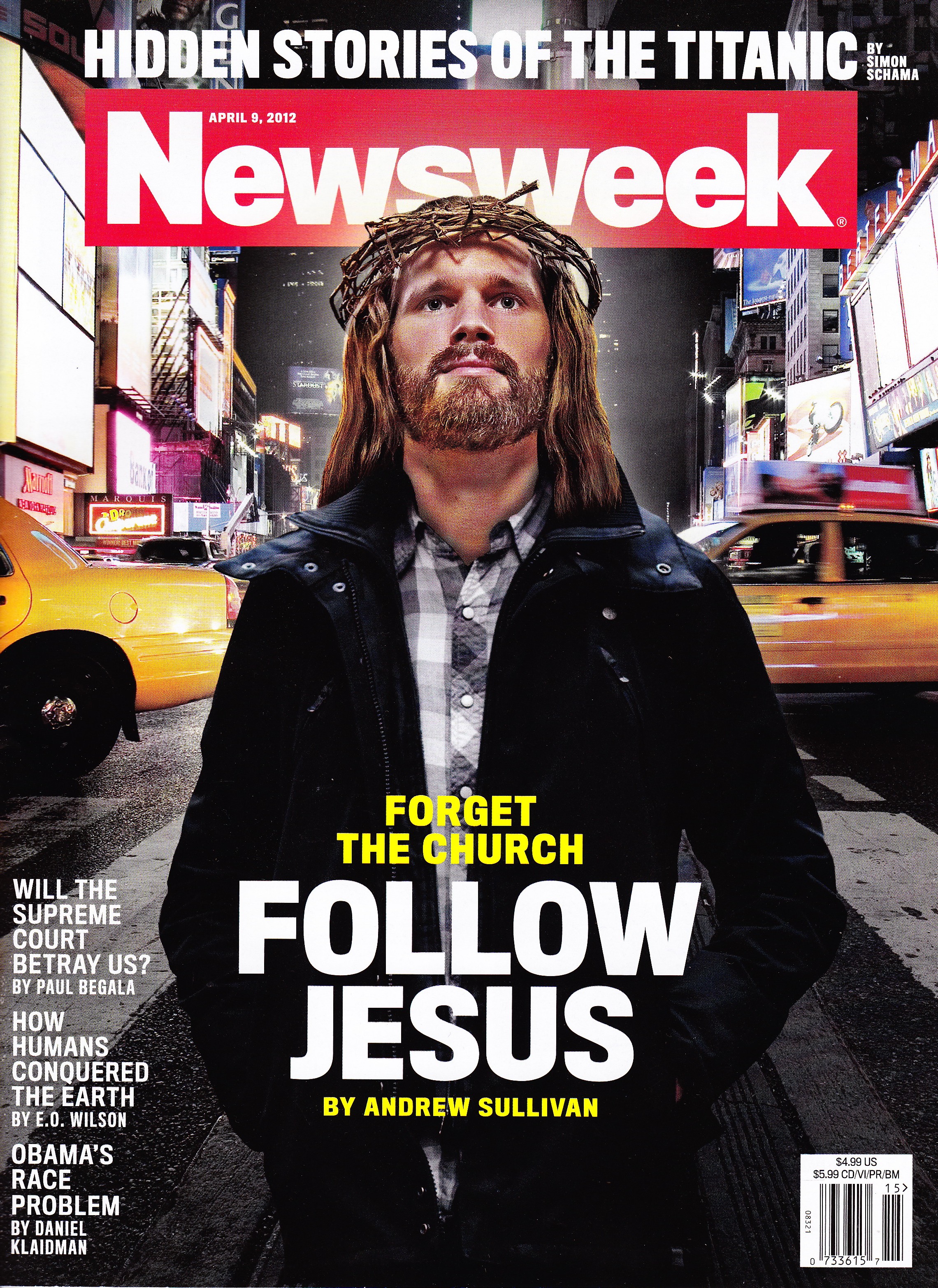
I don’t pretend to know much about politics. Beyond the required social studies classes through which I was channeled as a high school student and as an undergraduate I glimpsed the halls of power and they seemed pretty dirty to me. Not that studying religion was a much better choice, but then, enough Bible-dust in the eyes can obscure any vision. So I see some political pundits claiming that Santorum’s victories in the southern states demonstrate that his conservative platform resonates with the electorate. In their sense of surprise, I wonder why the elephant in the room is generally ignored. No matter how enlightened the modern political scientist may be, the fact is that Mormonism is held to be a “cult” by many evangelical churches. Religion specialists have long made the mistake of dismissing right-wing conservative Christian groups as an aberration, a mirage that will disappear when the coolness of evening settles the turbulent air over the pavement. The Republican primaries should shatter such illusions, but it won’t.

Just an ordinary guy, with his millions

While many of us have been trained to treat all religions as striving after the amorphous other, many others are raised to believe that Mormonism is a danger to society. Not that I agree, but I know from personal experience this is what they teach. I was raised on the tracts and texts that spelled it out in black-and-white claiming Mormonism to be a “cult.” The very word “cult” is eschewed by scholars of religion as a description for non-conventional theologies. As a term it is so 1980’s. Tell that to the electorate. The political pundits, it seems to me—and I may be wrong—underestimate how much people vote with their faith. Over the past twenty years, the Roman Catholic Church has demonstrated itself a champion of conservative causes. It has gone from pariah among the parishes to pontiff of the politicos. When evangelicals can’t stay in the race, it is difficult to distinguish Catholics from Pentecostals. Even scholars of religion should be scratching their heads.

The fact is we simply do not know enough about religion. Media treatment of the field is often dismissive or facile. Meanwhile, it is fueling the political engines that will lead to a showdown of worldviews in November. Maybe the Maya were correct after all. I don’t know much about politics. I’ve studied religion long enough to admit that I know little about it as well. I fear the experts with too many answers. If I turn out my pockets I find they are full of nothing but questions. (And lint.) Religion is what wins elections, yet our universities dismiss its study as juvenile and irrelevant. I read the headlines from the primaries—only a farce like this could make me miss Sarah Palin.


Sh*t Apes Say

Knowing from experience that when I stay alone in a hotel, despite my best intentions, I will get bored and end up watching Mudcats or Dual Survival until my brain feels like a boiled egg, I anticipated my trip to California. I packed Planet of the Apes, the original and best of the lot, hoping for some intellectual stimulation. Having grown up in an anti-evolution household, we were curiously allowed to watch Planet of the Apes, a kind of forbidden zone of the mind. It remains one of my favorite movies of all time. It is also a manifesto of science besieged by religion. Note what Dr. Zaius says, “There is no contradiction between faith and science… true science!” And he is the Minister of Science, and Chief Defender of the Faith. The trial of George Taylor, a thinly disguised parody of the Scopes Trial, has Honorious (read William Jennings Bryan) stating, “It is based on our first article of faith: that the almighty created the ape in his image, that he gave him a soul and a mind, the he set him apart from the beasts of the jungle and made him lord of the planet,” and turning on his fellow apes Zira and Cornelius, he accuses them of being “perverted scientists who advance an insidious theory called evolution!”

Dr. Zira, as one of these “perverted scientists,” asks Cornelius (incidentally, the name of the first non-Jewish Christian, according to Acts), “How can scientific truth be heresy?” This is echoed by Dr. Zaius in the trial where he states, “It is scientific heresy that is being tried here.” Indeed, the entire simian culture is based on the blurring and blending of science and religion. Throughout the film various characters make barbed statements about the human propensity to ignore the obvious. Landon, challenging Taylor about the time change they experienced in space, says—in a line that could come straight from Answers in Genesis—“Prove it! It’s still just a theory.” The exact rhetoric currently used by creationists in school board meetings around the country. To which the most apt reply seems to come from Dr. Zaius, speaking of humanity: “his wisdom must walk hand-in-hand with his idiocy.”

Occasionally even the gun-toting humans get the picture clear. In his opening monologue George Taylor wonders about the world seven hundred years from now, “Space is boundless. It squashes a man’s ego. I feel lonely. That’s about it. Tell me, though. Does man, that marvel of the universe, that glorious paradox who sent me to the stars, still make war against his brother? Keep his neighbor’s children starving?” This seems to be the true measure of heresy—a religion that puts fellow humans on the same level as animals (and even animals deserve far more credit than we are willing to give). Among my favorite lines is Cornelius’ response to Taylor shaving his beard; “Somehow it makes you look less intelligent,” he opines. Endlessly remade, Planet of the Apes is a movie that still answers some of the issues that plague our society nearly half a century later. Perhaps the last line should go to the apes, adjusted of course, for gender sensitivity, “[hu]man[ity] has no understanding.” Well said, Dr. Zaius, well said.

A piece of childhood


California State of Mind

California, it is sometimes said, is a state of mind. I leave today after a few days in Santa Barbara with a bag of mixed impressions of one of our nations great schools. My first impression on the University of California Santa Barbara campus was almost a physical one. Literally. I had no idea of the bicycle culture and nearly stepped into a bike lane with the flow of a New Jersey storm drain during a Nor’easter. California is a culture of wheels. I’d never been to a campus before that has four traffic lanes for non-motorized travel: two bike lanes going opposite directions, a skateboard lane, and the humble pedestrian walkway. There are so many skateboards here that the counter-culture has become conformist. Sorry, Bart, it’s true. And concern for the environment is palpable. Reclaimed rainwater feeds the lush plant life, every possible recycled item is sorted and sent to the correct facility, students bicycle instead of drive, smart cars are very evident for the two-wheel impaired, and almost nobody smokes. And as I ate my supper alone in the student union two separate groups of Christian students were having very vocal conversations about their faith. Free spirits not realizing that they’re trapped.

One conversation with a Native American specialist stayed with me. She spoke of how missionary work has damaged indigenous cultures irreparably. I listened in fascination as she told me about the local history. How an historic Spanish mission was publicly adorned with the skull of a murdered Native American and how it took years of persuading to get them to take it down, even in the late twentieth century. Across campus students are praying to Jesus for the courage to continue witnessing. In Newark, I suspect, a couple of guys are still laughing.

On a brief respite from my busy day of meetings, I walked the Lagoon (sorry, I can never see or say that word without thinking of Gilligan’s Island) Trail. Emphasizing the environmental features of this wetland habitat, the trail leads down to the ocean where flocks of pelicans and egrets fly overhead, unperturbed on the shores of the vast Pacific. In 1969 what had been to date the worst US waters oil spill took place from Platform A, still visible in the distance from the beach. My thoughts turn from Gilligan’s Island to Deepwater Horizon. My laughter to tears. The Lagoon Trail winds through the headland to a labyrinth. In today’s resurgence of interest in the labyrinth, it is viewed as a spiritual journey. Labyrinths appear in churches as early as the Roman Empire, but nobody knows what they mean. I silently stand beside the maze. What does it mean? Platform A leers from the ocean. Christian undergrads look to convert the world. And under the cross is not the skull of Adam, but that of an anonymous Native American. What does it mean?


Religion Undisclosed

I’m getting to be a pat-down connoisseur. In Raleigh-Durham it was a more intimate affair with Mr. TSA—I don’t even have his name or number—narrating the intimate details. “I will move my hands up your thigh until I encounter ‘resistance,’” he said. At Newark the pat-down was quicker, more business-like, almost as if Mr. TSA were embarrassed. In Raleigh-Durham, nobody batted a lash when I said full-body scanners were against my religion. At Newark, they laughed. The gate attendants began asking me what my religion is. Private. My religion is as private as my “resistance.” And I was being ridiculed for it. This is the Patriot Act vision of America. Regular readers of this blog know that I have never revealed my religious convictions. They are a very private matter with me, and I had supposed that I’d been born in a nation where that was respected. Instead, I am laughed at.

We extend religious liberty to those who wish to handle rattlesnakes. To men who wear black dresses and have an historic penchant for young boys. To people who believe the world was created in six days. To people who believe golden tablets only seen by one man through rose-colored glasses are the basis for sacred scriptures. To the traveler who believes in the integrity of the human body and cannot divorce it from the respect and dignity of human modesty, this does not apply. Religions arm military forces. Religions rape women. Religions murder children as well as adults. Who’s laughing at them?

I wonder if I might have a legal case here. When has the free practice of my religion—which decrees that full-body scanners are immoral—been opened to public scorn? And don’t tell me it’s the price of security. I walked through “security” with my eyes open; first class passengers do not get scanned like hoi polloi. It’s not a matter of security—it’s about control and money. When will the people take back control of their own country from officials inebriated with power? I feel no safer with a stranger’s latex-gloved hand on my resistance. I feel no safer when people who couldn’t cut college get jobs in the US government and look at their fellow citizens naked. You’ll blank out my face? That makes it even worse. If someone’s going to violate my dignity I want him to look me in the eye and realize that it’s a human being he’s humiliating, not just a hunk of meat. Or in the language of the TSA, mere resistance.

First, show me yours


Watch Your Tower

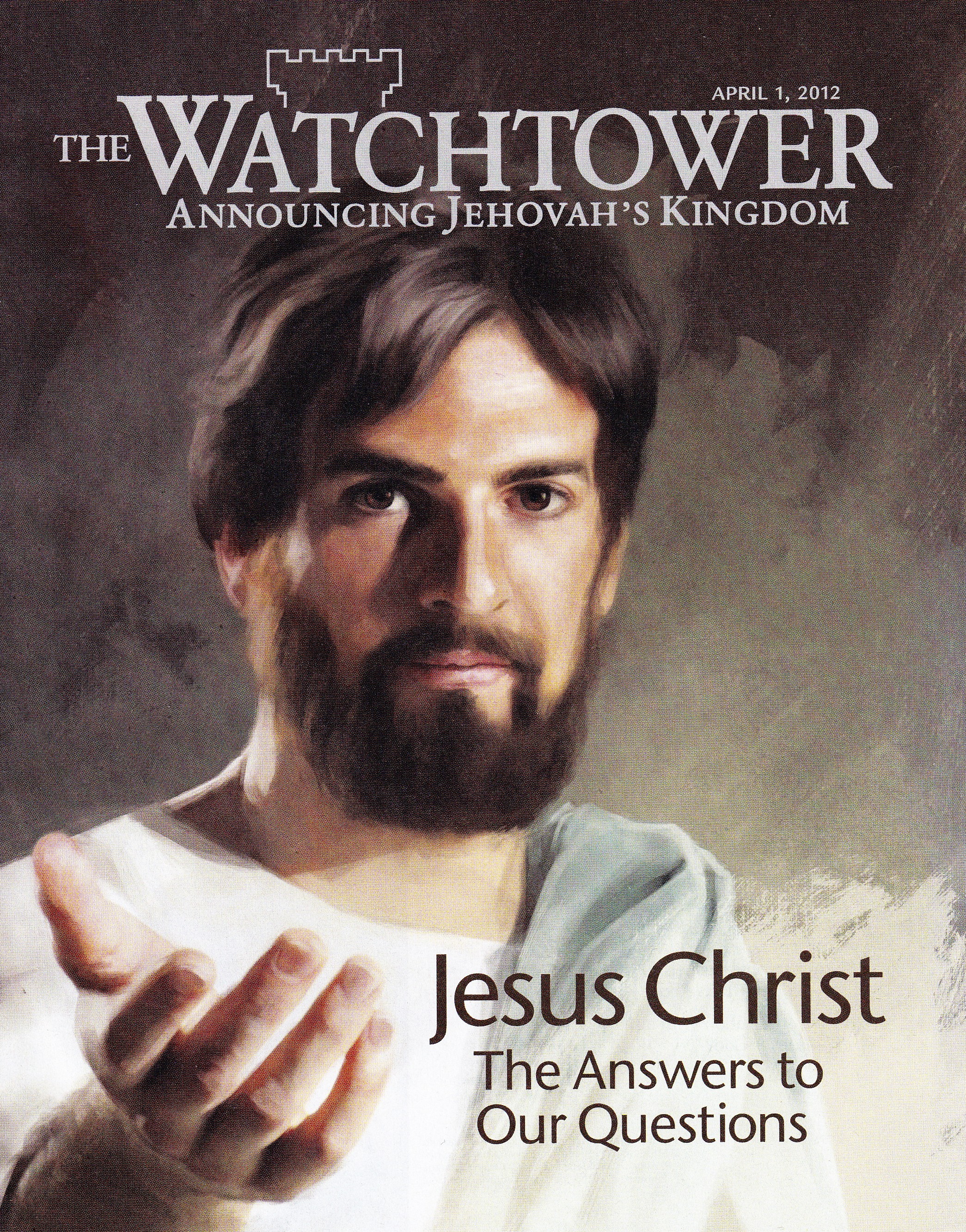
So when the smoke clears from another leap day barely survived, and my Apocalypse calendar tells me about the looming end of all things, and the Jehovah’s Witnesses stop by and leave a Watchtower with the headline “Armageddon” at my door, I start to get a little paranoid. Did I miss the memo on this? I tend to be suspicious of any religion that is less than 150 years old—call me a historical snob in that respect. By the time of the nineteenth century of the Common Era, we were getting industrialization, evolution, and the Whig party sorted out. It was hardly a propitious time to be starting new religions. Well, I was curious about Armageddon, so I read a bit of the Watchtower in any case. It goes best with salt.

“The original Hebrew word Har-Magedon literally means, ‘Mountain of Megiddo.’ Although no such literal mountain existed, a place known as Megiddo does exist.” So I learned. But there was a mountain at Megiddo. Literally. I’ve been there. It’s not an impressive mountain like the Front Range of the Rockies, but it is sufficient for the purposes of the Bible. Megiddo overlooks the broad plain of the Jezreel Valley. In ancient times such valleys were highly valued for fighting because of a basic engineering difficulty with chariots: they don’t work well on hills. Chariots have open backs, so falling out would hamper effective up-hill battles (literal ones), and your chariot bumping into your horses or chasing them downhill would have resulted when the fighting was done. Or when you were fleeing. Valleys like Jezreel were perfect for fighting. And Megiddo has a front-row seat on its little mountain. The site of Megiddo has been excavated by archaeologists and is well worth the time it takes to get there.

By coincidence (or is it?) my apocalypse wall calendar begins March by saying, “Make Archaeology Your Friend.” Hmm, is there a message somewhere in here? When the Jehovah’s Witnesses and the Mayan interpreters agree, should we not at least admit a little doubt? I don’t think so. Both traditions, as certain of special revelation as they may be, are human attempts to make sense of our world. We know of nothing that doesn’t end. The great Eastern religions seem to have caught on more readily to the idea of impermanence than Western cultures have, but they all share this in common—it’s gotta end sometime. I would, however, point out to Mr. Santorum, as he begins to think about his concession speech, that the Jehovah’s Witnesses seem to agree with the amateur Catholic on the part about Satan. My Watchtower says “Satan will marshal the nations for an assault on those who worship Jehovah God.” Perhaps politicians should stick to following the Mayans.


Walking Monsters

It was a moment of weakness, or at least tawdry cheapness, that made me watch The Monster Walks. Just the day before the Cable Vision guy had stopped by, detailing how much money we could save by switching. We haven’t had television service since 2004, and even then it was only with a cheap aerial. Back in the days of Borders, I sometimes caved in and purchased the “Classic Features” movie boxes with 50 B, C, or D movies for what seemed a steal at less then 25 dollars. Maybe five or six of the movies from each set were actually worth the time spent watching them, but many of them proved an education. So it was with The Monster Walks.

Now, I readily confess to having a weakness for B movies. Made by people who were really trying, but who seemed to lack talent, I often identify with their efforts. So when I popped The Monster Walks into my DVD player, I had no idea what I might learn. The first revelation occurred in the opening credits where a character named “Exodus” was introduced. Since this was 1932, the character had to be African American. And comic relief. To spare you the pain of watching the movie, the plot is rather simple: rich man dies, helpless daughter inherits all to the chagrin of surviving brother and domestics, who plot to kill her by pretending to be a murderous ape. There also happens to be a murderous ape locked in the cellar. You get the picture. Aptly named Exodus is purely there as a foil for the educated, privileged white family. He was played by the talented but underappreciated Willie Best. As might (nay, should) be predicted, the scheme of killing the girl backfires and the ape kills the killer. Okay, so I can confess an hour wasted and get on with my reading. But the final scene arrested me.

Exodus wonders to the lawyer (who is there to read the will) why the rich man even had an ape. The lawyer, metaphorically transformed into a judgmental William Jennings Bryan, states that it was because he believed in Darwin’s theory of evolution. Exodus responds by noting some family resemblance to the ape. The blatant racism was hard to take, but in Black History Month the painfully obvious collective sins of our society should be laid bare. In 1932 Fundamentalism, often implicitly allied with racist causes, castigated Darwin’s theory for bringing all of humanity down to the same level. As long as a white god is creating the universe, the Anglo-Saxon can claim superiority. Never mind that Genesis was written by a Jewish writer living in Asia. Self-righteousness comes in many forms, but it always involves bringing others down to a rung below where the blessed stand. Has not the great Rick Santorum told us that even the Crusades were merely misunderstood?