WWJWF?

On the way to work yesterday, my wife spotted an old billboard ad that read, “My birthday wish: Protect life from conception until natural death. Jesus.” Now, I realize that this is a belated birthday response (or perhaps premature – scholars of the Christian Scriptures tell me Jesus was likely born in April), but I felt compelled to exegete this wish. In the biblical world, which, by definition, includes Jesus, there was no such thing as conception as we know it. Ancient folk did not know about sperm and ova, and so “conception” was simply the act of carrying a child. When it began they did not know. The Bible is pretty clear that breath indicates life, so life begins at the moment of the first breath. Everyone in the first century knew that.

As a good Jewish believer, Jesus also knew that the Bible dictates scores of reasons that life would not end naturally. Many acts considered normal and healthy today were singled out in the Torah as offenses against the almighty, and many were worthy of the death penalty. If natural death is the divine will, well, father and son ought to have a heart-to-heart talk. I will go on the record as opposed to capital punishment. Heck, I’ll go on the record as a pacifist and a vegetarian too. I do so, however, fully aware that the Bible has a different view.

My concern with billboards like this is that they co-opt a figure who cannot correct the human errors of misreading emotion for righteousness. Anyone with money can make up a birthday wish for Jesus and, with a willing vendor, splay it out for all passing motorists to see. I respect the sanctity of life, but I don’t force my wishes into Jesus’ mouth. We have the Bible, we have brains. For those who want to know what Jesus really wished for, it is a simple a matter as reading a book.


Burning Crosses and Aftershocks

In a small blurb I would have missed had my wife not pointed it out, today’s paper carried a brief follow-up on the religious implications of the Haiti earthquake. The story (caption) ran: “A Christian mob circles a burning stack of items to be used for a Haitian voodoo ceremony for earthquake victims while singing church hymns in the Ti Ayiti neighborhood in Cité Soleil. The voodooists were run out of the central pavilion under a hail of rocks, and all the ceremonial items they left behind were destroyed and burned.”

My mind, at seeing burning religious symbols in the picture, turned to the infamous burning crosses used by equally intolerant “believers” in the last century in this country. Perhaps the motivation for burning the symbols is different, but the message is the same – a very narrow band of the wide continuum that is Christianity has decided that another variety of human being must be brought under control or destroyed. I don’t seem to recall reading in the Gospels, or even Paul for that matter, that throwing stones at believers in other faiths was a recommended activity. The voodou service, according to the blurb, was intended to help earthquake victims. Instead, the Christian faction forcibly drove them out and violated their religious symbols. Could they not have been spending helping victims instead?

I am not the sort to throw the first stone, knowing my own faults all too well, but the rampant supersessionism of an entitlement generation Christianity is showing its ugly side in such an instance as this. If religions are not here to improve the lives of others, then what is their purpose? To placate mythical gods to ensure one’s own blessed future, no matter who has to be hurt along the way? It seems to me that less time burning religious symbols and more time helping the needy is a platform worthy of any honest religion.


Fear of Voodou

The Associated Press fed a story this morning entitled “How an earthquake shook the Haitian’s faith.” Among the aftershocks of last month’s horrific disaster, many groups have ignored Rush Limbaugh’s charitable advice and have gone to Haiti on humanitarian missions. The story reports how many of these groups, generally Christian, dispense their aid outside churches and that many of the native believers in Voodou are being encouraged to convert to mainstream Christianity. Voodou priests are worried about this since, in the words of one, “by rejecting Voodou these people are rejecting their ancestors and history. Voodou is the soul of the Haitian people. Without it, the people are lost.”

Many of the missionaries bearing gifts, among them Jehovah’s Witnesses, Scientologists, and members of the Church of Jesus Christ of Latter Day Saints, see Voodou as a strange and pagan religion. The fact is that Voodou is a form of Christianity blended with indigenous African religions during the unfortunate days of slavery. Retaining their African spirits in the guise of Roman Catholic saints, the slaves of the Caribbean developed a religion they could truly believe in as they were forced to “believe” in Catholicism. In mainstream Christianity their religion is viewed with fear and distrust primarily because the religion it blends with is non-European in origin. Most Christians are unaware of the blended variety of their own faith. Early Christian missionaries into Europe found it much easier to convert native gods into saints in order to convince local populations that Christianity wasn’t such as radical a switch as it seemed. The old gods could still be worshiped, only as lesser deities.

In the “New World,” Christianities continued to evolve. Today’s Fundamentalism has very little in common with the Christianities of the first century. Jehovah’s Witnesses, Scientology, and the Church of Jesus Christ of Latter Day Saints are all religions that have developed in or since the nineteenth century in America, quite often from blends of traditional Christianity and new religious sensibilities. Religion is not immune to evolution, and the history of religions proves that fact beyond any doubt. And yet to those who do not know the origins of Voodou it appears non-Christian and worthy of conversion. Is it not possible to help those of another variety of religion simply because they are humans in need rather than requiring a baptismal certificate in order to claim your daily bread?

A Voodou service from WikiCommons


Constantine’s Dilemma

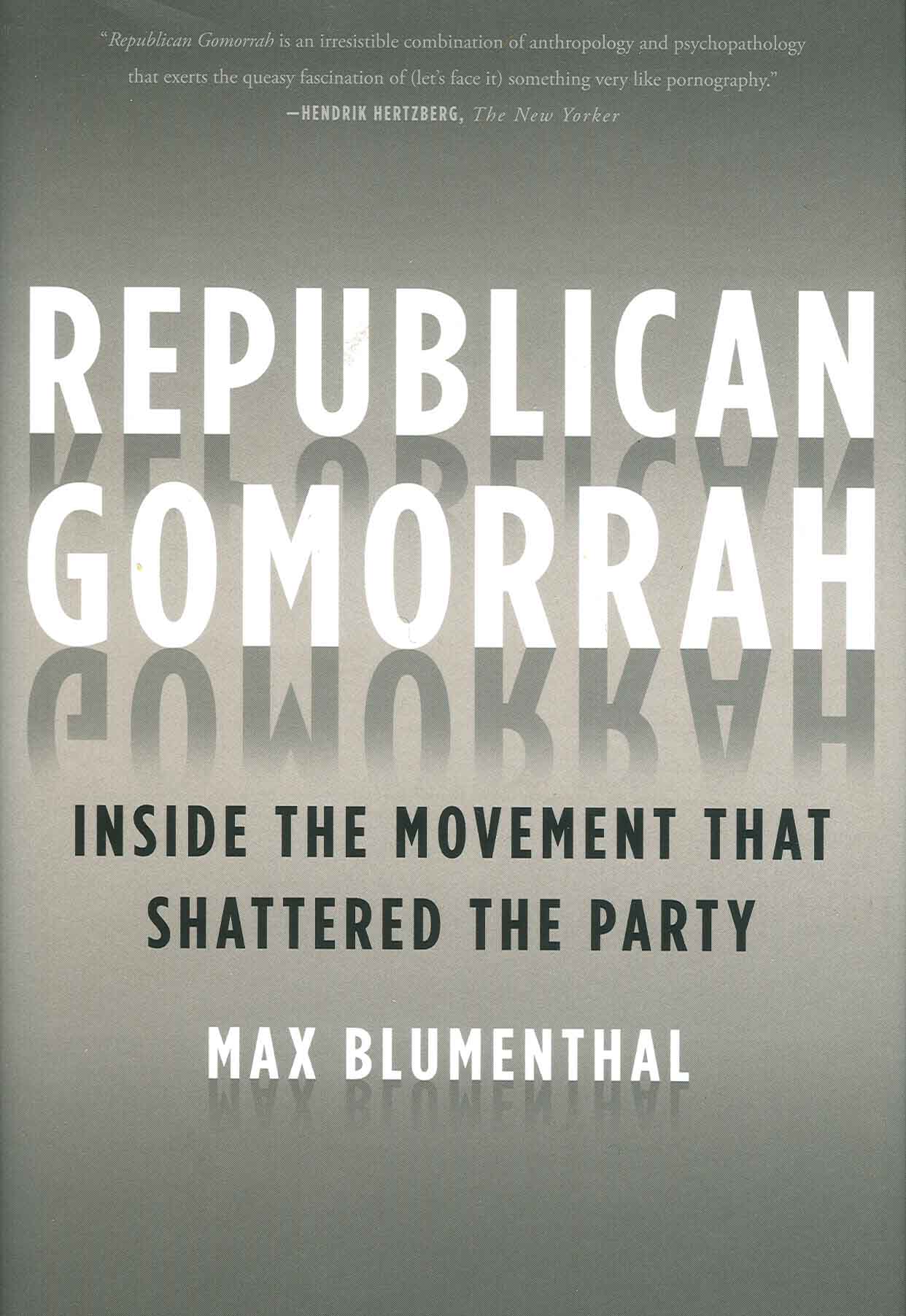
A time-honored adage educates each generation not to discuss religion or politics in polite company. The reasons for this are transparent; both religion and politics tend to be fiercely held belief systems and clashes between differing parties seldom end without scars and regrets. I recently read Max Blumenthal’s Republican Gomorrah: Inside the Movement that Shattered the Party. Initially my impression is that this book ought to be required reading for members of any political party so that they might find documented evidence of whence the real power struggles lie. It is known by anyone with a modicum of political savvy that the past several presidential elections have been decided on the success of courting voters of the evangelical variety of Christianity. What Blumenthal reveals and other sources confirm is just how intermixed religion and politics have become.

One of the most important books of last year

This is a very thorny issue. America was founded as a nation advocating religious freedom and also as a nation that would open its leadership to any qualified (more-or-less) candidate. Clergy have historically served in politics, but presidential candidates who are actively ordained and practicing their office have been rare. Not so rare in recent years, however, are those who forsake the adage and boldly proclaim their faith as a key to garnering votes. This has led to a public interest and scrutiny of what used to be the extremely private life of an individual. Religious beliefs, quietly held, motivate many people – presidents and politicians included. The difficulty Blumenthal highlights erupts when the genuinely religion-driven charge for political office with the hopes of implementing policy based on their personal faith. Americans have taken a new interest in discovering what the Church of Jesus Christ of Latter Day Saints is all about with the recent candidacy of Mitt Romney. We covered that religious landscape in Religion 101. Reading Blumenthal, however, I learned something new about Sarah Palin’s religious convictions.

Deemed “the Third Wave” movement (see also Bruce Wilson’s article in the Huffington Post), Palin’s religion is a variety of Christianity I’d never heard of even with a lifetime in the field of religious studies. What seems clear from the sketchy information available is that the putative wave began in the 1980s (when I was too busy studying religion to notice) with the work of Rev. C. Peter Wagner. Its goal, according to its theologians, is the takeover of first the church and then the world. Not just metaphorically. Since Palin told reporters, according to today’s paper, that she is seriously considering a run for the presidency in 2012, I wonder if it is time for all of us to go back to school and learn a little more about this variety of religious belief. I’m old enough to remember a time when politics was politics and religion was religion, and ne’er the twain did meet. That day is gone, and Americans will find it necessary to learn about religions again to discover the sometimes hidden motives behind politicians’ decisions. Max Blumenthal’s book is an excellent primer, but frankly, I long for the days I still recall when politics and religion had separate, securely locked bedrooms.


Father Freeze

Photo credit: Dmitry Lovetsky, Associated Press

This picture appeared in the newspaper this morning. At a monastery in Valdai, some 250 miles to the northeast of Moscow, Russian Orthodox believers were celebrating Epiphany by leaping into a cross-shaped hole in the ice on a nearby lake. The temperature, as noted in the caption, was 18 degrees below zero (Fahrenheit). What the caption did not explain is that Epiphany, at least in this context, translates as Russian for “severely clenched scrotum.” Hypothermia, the Lord is frozen! Blessed is he who comes to freeze. The ice-man cometh in the name of the Lord.

Many years ago, well into the decades mark, I was talking to a friend about the liturgical churches, as opposed to the strictly Protestant ones. She had grown up staunchly Protestant and was put off by the ceremony of the sacramentally-identified churches. In our discussion she paused and mentioned a televangelist (I can’t recall which one; they all look alike after a while) who had agreed to ride down a water-slide at an amusement park, in a full three-piece suit, if his audience would raise a certain payload of cash. Although the details escape me, it seems entirely plausible ⎯ there is little a televangelist won’t do for money! Then she said, “I can’t see the Pope doing that. I guess there is some dignity to that.” I was pleased; I had made the point that some Christian groups do not need to be in the spotlight of artificial flamboyance in order to proclaim the seriousness of their message. Shortly after that I began to work at Nashotah House.

To speculate from the photo above, there was not a large gathering of the faithful on the Siberian ice. Just a few believers in an extreme masculine Christianity dressed in liturgical underwear. Nevertheless, such displays of faith have been part of religions from the very beginning. Ancient believers used to carry their statues of gods around Babylon for a day out to remind the secular that the eyes in the sky are still watching you. When a sartorially perfect prefect steps out in all his finery, what other option is there but to drop one’s hands and stare? A favored photograph at Nashotah House when I was there featured the “Fond du Lac circus,” a gathering of such high rollers in the Anglo-Catholic corner of the Episcopal Church that even a future Russian saint deigned to show up. The event was the consecration of Bishop Weller, coadjutor of the Diocese of Fond du Lac, in 1900. As I look at the Orthodox man poised over his cross-shaped hole, I wonder if my friend had it right after all. The Fond du Lac circus haunts me to this day. What is religion without the show?

The Fond du Lac Circus


Rushing in Where Angels Fear to Tread

As my daughter’s public school undertakes its humble efforts to raise funds for the devastated nation of Haiti, contributing the little that unemployed children can raise, Rush Limbaugh unapologetically proclaims that Americans shouldn’t contribute to the earthquake relief. The New Jersey Star-Ledger notes that on Wednesday Limbaugh declared that Americans already support Haiti through their tax dollars and shouldn’t feel the need to contribute anything beyond that to the poorest nation in our hemisphere. This is true Christianity, according to the Neo-Con gospel.

Rush Limbaugh basks in the limelight as the outspoken representative of the “Gott und Ich” school of religious politics. With an estimated annual salary around the $400 million mark, Limbaugh comfortably sits back and watches the world burn around him. Together with James Dobson, Pat Robertson, and others who support the new, compassionless version of Christianity (Christianity 2.0), they inveigh directly into the ears of high-ranking politicians with coarse voices declaring that God wills for them to be the sole arbiters of what is right. I only hope that Americans are really listening. Really listening.

Religion has always been a form of social control. From earliest times, those who claim to know the will of the gods tell others what they need to do to placate the angry deities that hover all around. Earthquakes are the work of such angry gods. What do they demand? Listen to your local priest. America has been beset with a plague of Religious Right voices that are well-funded and so parsimonious that seldom can the gentle voice of reason be heard. While Limbaugh enjoys his enormous wealth kids who have never known anything like basic comfort are dying in the thousands in a nation right next door. And the people say, “Amen.”


Theodicy Versus Idiocy

Among the leading reasons generally given for atheism in developed countries is the problem of theodicy. Theodicy is the act of justifying God, as implied by the roots of the word itself. In a world where many innocent suffer, as well as many guilty, the question of how a loving God and divine fairness fit into such a warped and corrupted system presents questions often left unanswerable. My class tonight will be reviewing Job, a book steeped in the issue of misfortune. The best that the narrator can offer is that Yahweh made a bet with the Satan and Job came out on the losing end. Not much hope for justice there.

This week’s horrific earthquake in Haiti has elicited high levels of sympathy and support as this poorest of western hemisphere nations struggles to find some kind of balance in a reeling world. The question of where God is amid all this tragedy, perhaps 100,000 dead, pensively teeters in minds sensitive to the human condition. Other minds, however, blare idiotic platitudes that only drive mourning theists closer to the other side. Pat Robertson, a major political player who has been a card-holding member of the Religious Right from its unholy inception, has declared that Haitians are paying the price for an ancient deal they made with the devil. In a theology that makes a mockery of even the Charlie Daniels band, Robertson stated, according to MCT News, that Haiti had made “a pact with the devil.” He said, “Something happened a long time ago in Haiti, and people might not want to talk about it… They were under the heel of the French… and they got together and swore a pact to the devil. They said, ‘We will serve you if you’ll get us free from the French.’ True story.”

This drivel, based on hearsay history and implicit racism, does not justify a loving, or even neutral, God. Instead, the Conservative deity is shown in his true colors: racist, supersessionist, arrogant, and uncaring. This is the deity behind the Religious Right. Some people castigate Pat Robertson for being outspoken and perhaps senile. I applaud him. He shows clearly what intellectual rubbish the Religious Right promotes. He simply has fewer inhibitions to admitting it.

In Job, there was a deal made with the Satan. The perpetrator of that deal was Yahweh. No answer is given as to why the innocent suffer. Job is a most profound book, wrapped in a childlike story of two supernatural beings trying to show each other up. If we look hard enough we can find the Religious Right in the book as well. Their voices are those of the “friends” that Yahweh ultimately condemns when he finally speaks from the whirlwind.


Prosperity Fail

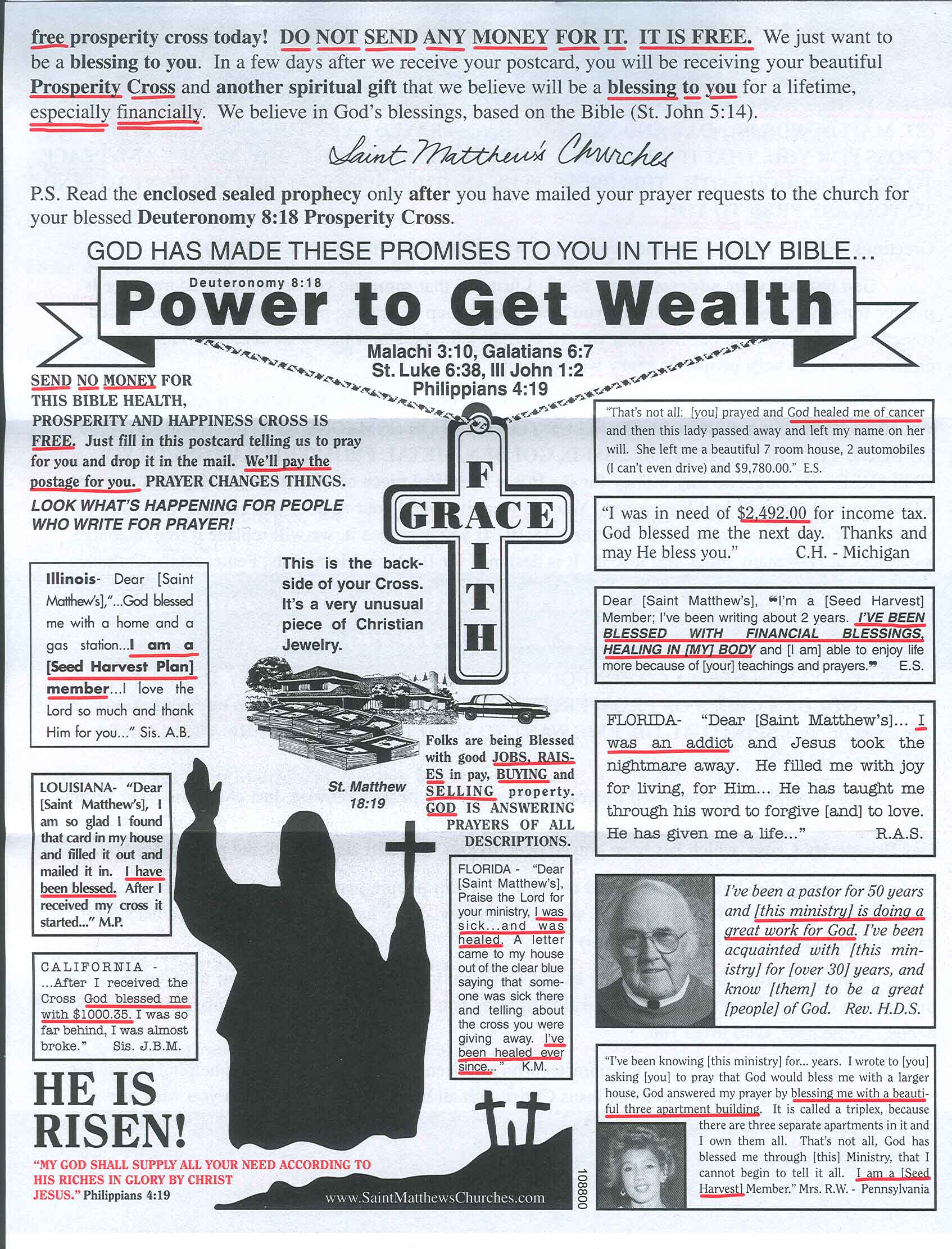
Every so often I receive unsolicited mailings from impersonal churches intimately addressed to “Resident.” Invariably these churches tell me that God wants me to prosper (although he has a funny way of showing it sometimes), offer to send me some totem to make it possible, and assure me of their general goodwill. Yesterday’s mail brought me a packet from Saint Matthew’s Churches offering to help me become wealthy by receiving a free golden cross just for responding — post paid! — to their offer. Clearly such mailings are intended to target readers down on their luck. Since I’ve been without a full-time job since July, I meet their demographic rather well. My response, however, may not be what they hoped for: I plan to send no money.

I wonder how deeply these prosperity clergy consider the impact of an unemployed individual receiving their vain promises. Sometimes when the under-employed receive such hollow promises it feels like a god-slap. Oh! If only I had been wearing this free cross I wouldn’t have had to suffer such bouts of depression and self-doubt! It was just that simple! And the Holy Bible says so too!

Those of us who’ve tried to make a living of studying the Bible don’t just read the cheery bits. The Bible is full of suffering, despair, and difficulty endured by those who tried to do the right thing. So, in fairness to the spirit of empirical inquiry, I’ve decided to respond to this offer. The control will be the last seventeen years of my professional life, during which prosperity has eluded me. It may take another seventeen years, but if I carry my free cross around, things are sure to turn my way. The accompanying literature says so. I’ll set myself a task in Outlook for 2026 to see if, A. the world hasn’t ended in 2012, and B. the magic golden cross really works.


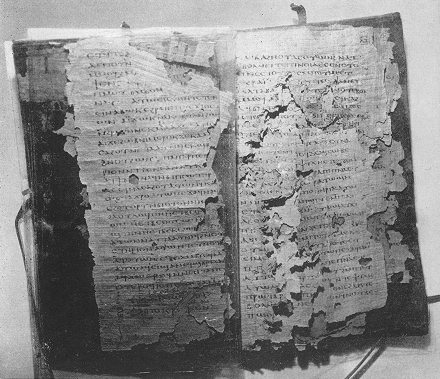
Nag Hammadi

Want to create some excitement in the middle of a gaggle of scholars of ancient history? Just throw some newly discovered ancient text in their midst and sit back to watch the fun. This scenario has been (metaphorically) repeated many times in the last century and a half. New texts come to light and revolutionize what we know of ancient religions. The Nag Hammadi library represents one such flair up of excitement and intrigue. Discovered in 1945, this cache of mostly Gnostic texts has forced a new paradigm upon early Christianity. It has become clear that several flavors of early Christianity existed side-by-side until one group, claiming divine support, became the “true Christianity” (orthodox) while the others were just plain wrong. The Gnostic field of study received a shot in the arm with the publicity fair surrounding the Gospel of Judas, a Gnostic text not found at Nag Hammadi, early in the new millennium.

Good News, Gnostic Style

Discovery can be a dangerous luxury. When new evidence surfaces it can’t be ignored. When the religions of the ancient world reached their imperial stages it had already become too late to admit that mistakes may have had been made way back in ancient times. You can’t conquer a country and then just take it back. We now know that it is far more appropriate to refer to Early Christianities and Early Judaisms than to utilize their singular (if more prevalent) forms.

Nag Hammadi, a mid-size town in Egypt, has been back in the news since Coptic Christmas (just a couple of days ago) saw the death of six Copts when a Muslim extremist gunned them down on their way out of church. In turn, the Coptic community has been running riot in the town, destroying ambulances and shattering shop windows and driving Muslims off the streets. Those who hold their religions to be unchanging have the most to lose when new discoveries surface. It seems unlikely that exploration will cease; more ancient interpretations will emerge. When they do it also seems unlikely that they will find parent religions mature enough to accept their long-lost children. We could still use a little bit of secret knowledge, it seems, even today.


Syncretism Synchronicity

By strange coincidence I had two friends ask about syncretism over the last few days. As generally understood, syncretism refers to the blending of religions. In the ancient world when one culture came into contact with another inevitable sharing resulted. Since all religions at the time were polytheistic, there was no concern about sharing deities too. Ancient people wanted to assure their good fortunes and survival just like modern folk do, and so the safest course of action when you become aware of a new deity is to placate her or him. There are few risks at worshipping additional gods in a polytheistic system, since all deities thrive on adoration. Some ancient societies, such as that of the Mesopotamians, realized that the number of gods could grow well beyond reasonable proportions. After all, many kinds of phenomena had gods, including the natural world, human inventions, and the cosmos. Recognizing overlap between the roles or functions of certain deities they began to draft up lists equating the various gods. Some of these lists are quite extensive.

This is the practice of syncretism. Your Yarikh is my Sin, and why offer two sacrifices when one will suffice? Ancient worshippers did not worry about the endless confusion that this would cause for future monotheistic scholars rediscovering their lost civilization. James Frazer, of Golden Bough fame, was a Victorian scholar who saw syncretism everywhere. Ancient cultures became a melting pot with countless variations on every theme. With more sophisticated anthropological methods Frazier’s work eventually fell into disfavor, and syncretism with it. Each ancient culture was distinct, with nuances and subtleties unguessed by rampant blending and blurring of the lines. Some scholars today shy away from the word syncretism since it has such unholy associations.

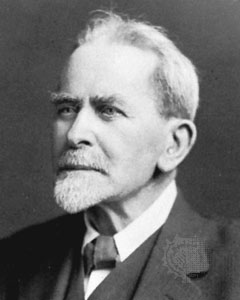
Fallen Saint James George Frazer

Part of the issue is where our culture stands. We are not the final word in discovery or understanding of our world, and yet monotheistic religions, the majority position in the western hemisphere, make absolute claims. Those of us who examine ancient religions are born into these outlooks, assured that modern-day religion is the true religion and that it, unlike other aspects of culture, will cease to evolve. Religion, however, changes as soon as it leaves its founder’s mouth or hand. The multiplicity of human perceptions and outlooks assures us that each believers’ religion is unique. We may be ashamed by the implications, but syncretism, it seems, will always have the last laugh.


Tale of Two Anarchies

While snowbound over the weekend, I reread William Golding’s Lord of the Flies. I recalled a profound sense of awe from when I read it the first time in college, when students are invincible and optimistic. The second reading was still rewarding, but the message seemed darker, more true-to-life. Children on an isolated island devising their own schemes of democracy cannot repress the deep urge for self-advancement. When it comes to working together for the common good or promoting one’s own will, the latter wins out and seeks to destroy all dissenters. Anarchy becomes their natural state.

A few weekends ago I finally got around to watching V for Vendetta, the Wachowski Brothers’ dim and hopeful dystopia where individual conviction wears away at a conformity that benefits the privileged class. Recasting Guy Fawkes as a hero, albeit a tragic one, is a bold move in the post 9/11 world. The anarchy here leads to a rule by consent, the oppressed rising up as one to say “no more.” Even V is dead so there is no one to lead.

Better together?

Anarchy is a frightening prospect. Most people feel more comfort in the rule of law. One time I joined a discussion my brother-in-law was having with some friends on the rule of law. They were suggesting that if rule of law could be brought to bear on the Middle East then the seemingly continual crisis there might terminate. I disagreed from the far end of the table, not close enough to hear the whole conversation. My rationale is that the utter conviction of religion trumps the rule of law. Rule of law assumes all are equal, but religion in a monotheistic theater always assumes only one is right, and therefore superior. All others must submit. Problem is, many monotheistic religions feel the same way. We see it in the extreme power structure of the Religious Right in this country. Who is willing to say maybe the rule of law is superior to the rule of God? Watching the graceful anarchy of V, and reading the disturbing anarchy of Lord of the Flies, sometimes even the most stalwart free-thinker wishes everyone would bow to the rule of law.


A Walk Around the Watchtower

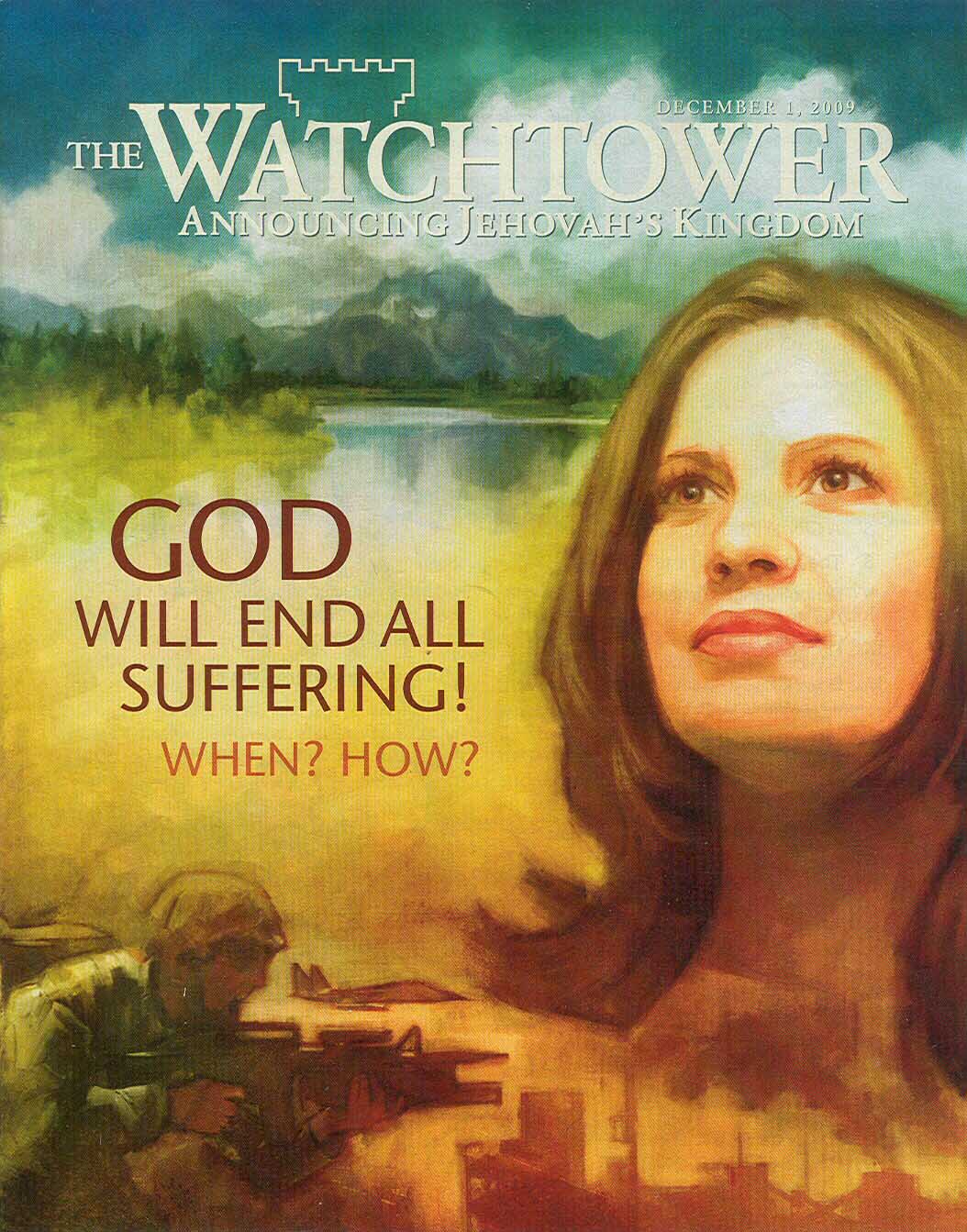
The Jehovah’s Witnesses stopped by yesterday. I never pretend not to be home, and when I’m less stressed out I like to engage them in terms of biblical exegesis — religion is all about conflict. Yesterday I was still recovering from the disappointment of not getting a job I really wanted, so I simply answered their questions and accepted their Watchtower magazine. Thumbing through it, I ran into some hermeneutical obstacles — an occupational hazard for those of us who’ve spent a little too much time with the Bible, I suppose. A story about Joshua informed me that “Jehovah wants you to succeed.” It tasted a little too much like prosperity gospel and not much like life in the present. So I flipped a few more pages.

An article on Lunar New Year (Chinese New Year, as it is traditionally called), warned against Christians celebrating it, in part because of ancestor veneration. The Watchtower declares, “the Bible show that the ‘ghosts’ and deceased ‘spirits’ are really wicked spirit creatures pretending to be the deceased. For what purpose? To mislead people and bring them under their evil control!” Now, I admit to being drawn into the Ghost Hunter fan-base, but I do recall the story of Saul summoning Samuel from the dead. The Bible doesn’t indicate that he’s evil; in fact, it is Samuel himself! If ghosts want to deceive then they need to show up a little more clearly and give more direct messages.

I then learned about King David’s remarkable musical prowess in the story about music in the Bible. It is truly amazing what can be extrapolated from a literal reading of the Psalms. The magazine informs us that King Sennacherib, emperor of Assyria, demanded male and female musicians from Hezekiah. “It seems that they were first-class performers.” This seemed a little too much like the stereotype of Jewish entertainers, and since it was extra-biblical I couldn’t accept it. The story concludes by indicating that music is not a human invention. “The Bible describes music and singing in the heavens themselves, where spirit creatures play figurative harps and sing praises around Jehovah’s throne.” As I pondered what a figurative harp would sound like, I could swear I heard the sound of one hand clapping.

Being that time of year, the issue has an Epiphany story. Well, most Christians associate the wise men with Christmas, so I’ll call it a Christmas story. Eager to be honest, the author notes that the wise men were really foreign astrologers. And although they were into witchcraft, the angel announced Jesus’ birth to them to lead them away from this abhorrent practice. Then a divine revelation came to them in a dream in order that they could avoid Herod and his wicked plan. So the astrology that led them to Jesus was bad, but the end result was good.

When the Jehovah’s Witnesses ask me if I know about the Bible, I look at my feet and kick at an invisible speck of mud on the floor as I admit that I have taught Bible for nearly twenty years. But when they ask what I believe about the Bible I tell them the same thing I tell my students — what I believe is personal and I choose not to share it. I don’t begrudge any person of their religion. I even share the Jehovah Witnesses’ hope that the future may be brighter than the present. If you want to convert a religion professor, even an adjunct one, however, it will take more than a Watchtower to do it.


Happy Whatever

Over the past couple months I had been interviewing for a position at the Tanenbaum Center for Interreligious Understanding in Manhattan. Although I did not get the position, I still recommend the center for those who are dealing with religious conflict. One of Tanenbaum’s concerns is the “December dilemma.” The month of December is dominated by the celebration of Christmas, and many people are barely hanging onto sanity awaiting those few days off near the end of the year to catch their breath before jumping back into all of it again. Yet, with the continual mixing of cultures and traditions that makes America such an interesting place, other traditions have difficulty competing with Christmas. Well, it is hard to compete with such a capitalistic holiday, one that is based around getting stuff.

There has been a movement afoot in recent years to mash the December holidays together. One such movement is the celebration of Chrismukkah, albeit somewhat tongue-in-cheek. Hanukkah naturally falls around the usual time of Christmas, and Kwanzaa was created to add yet more texture to the month. Despite all this, Christmas is still predominant. As I tell my students, the mindset of America as a whole (not demographic or even factual, but perceptual) continues to be Protestant Christian. Apart from Kennedy all of our presidents bear this out. And Protestants, although they don’t care much for the “mas”part, are big Christmas fans.

A Dickensian Christmas

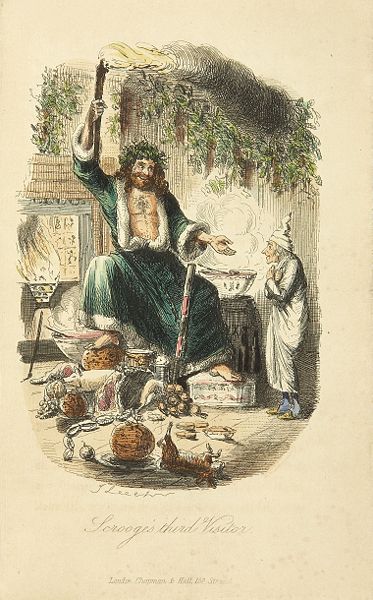
A few years back I wrote a book for tweens that examined the roots and traditions of the major American holidays. (So far publishers haven’t been impressed.) One of the facts I learned about Christmas is that its celebration as a major holiday is a recent phenomenon. Before the nineteenth century Christmas was barely noted in America at all. In the wake of Charles Dickens and his influential stories, Christmas became an institution that celebrated family and home and goodwill. Eventually it grew into a major commercial holiday and everyone wanted to get in on the fun. Now we have a largely secular Christmas and other religions are eager to join in the non-confessional part of the holiday. Everyone would like to have Christmas day off work (except the clergy), and those who don’t have it feel lonely, I’m sure. I don’t see the reason for the big fuss about whose holiday it is. Christmas is symbolic of peace and togetherness, and no matter what it is called or who claims ownership, this is by far the superior path over religious fear and hatred.


Biblical Science Fiction

1950s science fiction films are perhaps the most parsimonious celluloid genre. Standard Saturday afternoon fare in my childhood, I still have a soft spot for the unapologetic self-confidence of these movies with their painted backdrops and hokey effects. The messages are frequently self righteous and often biblical. So yesterday as I treated myself to a viewing of The Mole People, I went on instant alert as the biblical references began right away for an audience that would have known the Bible well enough to take it all in. Set in “Asia,” the archaeologists are digging for Sumerian artifacts when then discover a stone tablet “below the great flood level.” That makes it at least 5,000 years old, the assembled academics declare. A diffident Dr. Roger Bentley tells his fellow excavators, “in archaeology all things are possible!” When a young boy of the indigenous population discovers an oil lamp shaped like a boat, the archaeologists note, “the flood’s been proven to be a historical fact.” The boat is a model of Noah’s ark, the Sumerian version. The scene of the expedition climbing Mount Kuitara includes footage from the 1955 Fernand Navarra trek up Mount Ararat during which a wooden beam was found, reputedly from Noah’s ark.

If you can stomach the bogus Sumerian you’ll learn that ancient Mesopotamians also survived the flood, a kind of “children of Cain” motif. These Ishtar-worshiping pagans are practitioners of a kind of social Darwinism, killing off their own kind when resources in their underground world become strained. Their great underground civilization parallels that of ancient heathenism while more advanced civilization on the surface of the globe has the benefit of an enlightened Christian worldview. Even the Sumerians whipping the actual mole-men is reminiscent of the Egyptians whipping the Hebrews in the Ten Commandments (released the same year).

Fast forward fifty years. We now live in a technologically advanced civilization where the myths of ancient people have little place. Science provides logical explanations for most of what we encounter in the world around us. Yet there are still otherwise intelligent people seeking Noah’s ark on Mount Ararat. The past is impossible to escape. The Sumerians in the film (whose walls are inexplicably decorated by Egyptian artwork and hieroglyphics) represent those who hold onto a confused religion that has become a form of terrorism in the eyes of the more advanced archaeologists. Perhaps the paradigm has shifted, and those who use religion today to gain political power and personal gain have become the self-righteous Sumerians of The Mole People.


Christian Movementarians

After a distressing day of job-hunting yesterday, I turned to the Simpsons for solace. Often the most intelligent program on American television, as well as being the longest running series, the Simpsons frequently hits religion with a few good-natured and well deserved whacks. Last night I watched The Joy of Sect from season nine. It has been a few years since I’ve seen the episode, and I was pleasantly surprised how it correlates with the overall theme of this blog.

Although the episode ends with a normalcy returning to Springfield after the appearance of a cult called the Movementarians, the parallels between the cult and Rev. Lovejoy’s church are numerous and poignant. This perhaps hits too close to reality for many religious believers — what separates a “cult” from a “church” is more a matter of perspective than a matter of practice or accident.

Even early Christianity had considerable connection to and similarity with Gnosticism. When religions collide, they must emphasize their distinctiveness to survive. Like biological organisms, those that meet the needs of their societies (“the fittest”) survive, while others go extinct. It seems to me that the main cause of religious violence is the need to claim exclusive access to the truth. People are not comfortable believing a religion that might be proven wrong. Like the Simpsons they wish everything will return to normal at the end of the day.

The very definition of normal