Hadad in Copenhagen

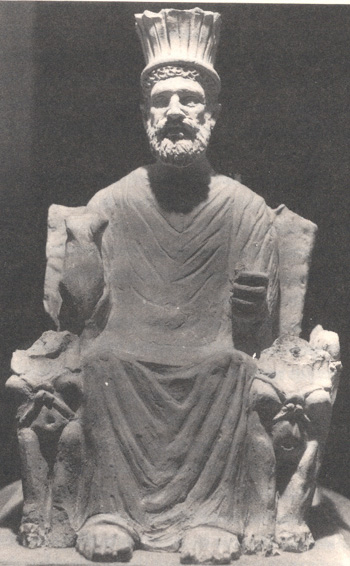
Let us talk plainly about the weather. Global warming is a reality, and yet the issue is clouded by religious conservatism. To be precise, it is difficult to determine whether it is really greed or the religious right that stands so firmly behind free-market capitalism that is driving this chariot of the sun. The strange and unholy alliance between religious and political conservatism, however, has become a force daily striving against reality and its proponents want to be on the top of the pile when the whole thing collapses.

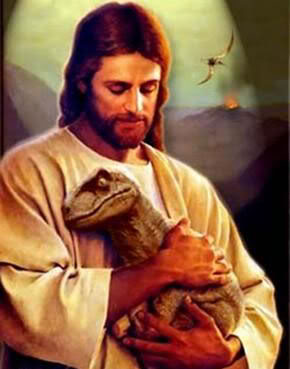
I can not speak to the political end of this continuum; I am not a political scientist or economist. As a “religionist,” however, I recognize a deeply disturbing trend that I have followed since my youth. Fundamentalists have consistently taught their young that the “Second Coming” is only minutes, possibly seconds, away. Undaunted by the two-millennium delay in wish-fulfillment, they suppose the words supposedly uttered by Jesus indicate a kind of divine “I’ll be right back” just before pushing off from the Mount of Olives. The signs of the times given in the Bible describe the then current condition, yet modern-day Fundamentalists wish to force the almighty hand, call the bluff of the Texas Hold-‘em expert above. If the general in the sky said wars would come, well, we’ll make wars. If the only way to get his attention is by destroying the planet around us, so be it. Deny global warming for the sake of the religious right, since their world is about to end.

Baal in Copenhagen?

The rest of us might want to stick around for a while. Ancient meteorologists believed that particular gods controlled the weather. At Ugarit Baal, or Hadad, took responsibility for drought and plenty. If there was a problem, they knew just to whom to offer a sacrifice. In our monotheistic western world, we’ve pared the gods down to a single man. Not everyone agrees on his mood or character, but some are convinced that he has his bead trained right on this planet and they want to help from here below. Others believe — o the heresy! — that natural processes control the weather and that we can do something to make our situation better. We might be in a better place if those who believe the gods control the weather were relegated to theology classes rather than political offices.


Be Kind to Your Canaanites

You can never find a Canaanite when you need one. This has been the bane of scholars of the Ancient Near East for many years. While teaching my class on Ancient Near Eastern Religions the question frequently arises: who are the Canaanites? Problem is, nobody really knows.

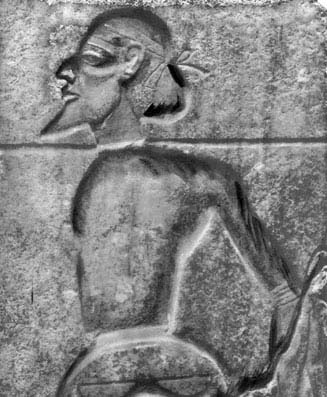
The Canaanites have prominence in the ancient world due to the Bible. The people already occupying the land that would one day become Israel are called Canaanites. They appear to have been culturally contiguous with Aramaeans in what is now Syria, the Phoenicians in what is now Lebanon, and even with the Israelites. While there are references to the Canaanites in antiquity, we have yet to discover a people who call themselves Canaanites (unless the Phoenician inscription from Brazil is legitimate!). Canaanite, at this point in time, is only attested as a name used for somebody else. “They are Canaanites,” not “we are Canaanites.”

An Egyptian version of a Canaanite

In this we have a useful paradigm. Today religions continue the “us versus them” mentality. In the Hebrew Bible it is often open season on Canaanites since they worship other gods. Today this fear and distrust continues with members of some religions declaring war on those in other traditions. Sometimes it is even within a single religion: Catholic versus Protestant, Baptist versus Catholic, or everyone versus Unitarians.

Religion is, however, always taken on faith. No technique exists to determine, empirically, which is the “true religion” or whether they are all paths up the same mountain. Religions are not fact, they are belief. And religions evolve. It would be the greatest evolutionary leap forward for religions to accept each other, to do away with the ersatz Canaanites. Not that Canaanites should be decimated or eradicated, but they should be accepted for who they are. Who are the Canaanites? They are anyone who practices a religion different from your own.


Dog-Headed Saints

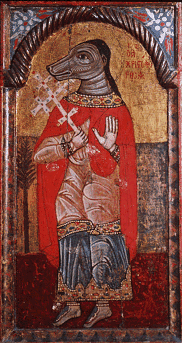
Eastern Saint Christopher

In Stephen Asma’s recent book, On Monsters, he discusses the role of early Christianity in perpetuating or perhaps even inventing various monstrous creatures. As is clear from sources going all the way back to Sumerian times, ancient religions are the spawning beds for monsters. One of the monsters Asma mentioned that caught my attention was the familiar St. Christopher. According to sources as orthodox as St. Augustine, there lived races of dog-headed people in Late Antiquity and the early Middle Ages. These Anubis-like cynocephali were barbarians in the extreme, eating human beings like the more familiar werewolf.

In some Eastern Orthodox traditions, St. Christopher was said to be among the cynocephali. Converted to Christianity, the dog-headed saint was martyred and entered the great kennel in the sky. The message proclaimed by this strange story is the tolerance of the early Christian movement. While battles raged over Orthodox vs. heterodox vs. Gnostic vs. pagan, there was still room to allow dog-headed humans into the fold. (They could be quite useful in rounding up straying sheep as well, one supposes.)

One of the hallmarks of modern Christianity is its exclusiveness. Naturally, not all Christians fit this profile, but many of the current movements define themselves by those not permitted to enter. In the sordid history of the Religious Right there are many chapters demonstrating a stark mistrust of non-Anglo believers. Roman Catholicism maintains that it is the only historically correct version of the faith. Other religions also erect barriers to keep others out. If religions truly promoted tolerance we might see a few more dog-headed saints in the news today instead of those who earn headlines for their exclusive claims on the truth.


Sunday Morning Football

There is a Baptist Church in East Orange, New Jersey that celebrates Football Sunday to draw the menfolk in. Complete with a tailgate party after the service, this event may boost numbers, but the winner of this divine gridiron has not yet been determined. Not being a fan of football (or any other sport — oh, the heresy!) this particular tactic would not appeal to me, but knowing that when guys get together the topic of sports always seems to come up, well, it just makes sense.

According to the canonical Gospels, Jesus never played football. (The Gospel of Judas, however, does mention a quarterback-sneak, I believe.) The few times I’ve watched games on television (generally under duress) I see a bunch of men trying their physical best to beat some other guys up. Rampaging after a pig-skin (definitely not kosher), they attempt to score and prevent the other team from doing so. This is my amateur analysis of what I am told is a very complex game.

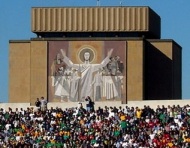
Rewind. Stop. Replay. The Baptist Church. Founded to protest against the vicissitudes of the Church of England, the Puritan-inclined Baptists wished to establish a church free from the constraints of the formalism inherent in the staid worship of either Roman or Anglo-Catholic England. Breaking from tradition was an honored principle here. Like our football heroes, they joined a team against the competition for that Super Bowl in the sky. Will the men stick around for the post-season slump? Maybe not, but as Notre Dame has always known, the divine man is a big fan of the Catholic team.

Notre Dame's famous Touchdown Jesus


What Would Dinos Eat?

A recent edition of Science Illustrated ran an article about a potentially revolutionary understanding of mammalian evolution. Reponomamus robustus, a large mammal from the Cretaceous Era has been found with dinosaur bones in its stomach. The implication, of course, is that this early mammal may have eaten dinosaurs instead of the conventional reverse of the scenario. Science is open to such radical ideas, but my thoughts turned to the culture war being waged on automobile bumpers across the United States.

Several years ago the Jesus Fish or ichthus symbol began appearing on the backend of cars in what seemed at first to be a “baby on board” tactic with a don’t-ram-me-I’m-a-Christian subtext. Some drivers, however, associated the Jesus Fish with an evangelical power play, a showing of numbers that indicted all other drivers as “non-Christian,” and therefore, by implication, accident-worthy. The Darwin Fish showed up soon thereafter, a counter-symbol for those who seemed to be declaring that Christians could be evolutionists as well. Sensing a challenge — which always appears as a threat in neo-con eyes — the Jesus Fish or Truth Ichthus swallowing the Darwin Fish swam onto car posteriors. Then the dinosaur eating a Jesus Fish came out, and I am certain that I once saw a Jesus Fish eating a T-rex on some oversized vehicle hind-end.

A friend once asked me why I spent my time arguing with those who are so obviously wrong (the anti-evolutionists). The unfortunate answer showed up in the White House at the turn of the millennium and the radical restructuring of society encouraged by the “religious right” gains credibility from the sheer number of people willing to adorn their cars with Jesus Fish. The real victim in this volley of statements in chrome is a guy who said nothing about evolution and who, I’m sure, would be amazed at how misrepresented he is. As the love-hate relationship between Jesus and dinosaurs continues to wax and wane, I’m staying out of it, but I’m more frightened by the fish than by the dinosaur.


Highway Homiletics

“Over the river and through the woods to grandmother’s house we go,” is an assertion to be taken literally in my case. Crossing the Delaware River and trekking through the forests of Pennsylvania are the only means to reach my childhood home from New Jersey. Each time I make the trip I am amazed at how strident the highway preaching along the way has become. Signs on both the interstates and the backroads announce the truths of a certain vociferous brand of Christianity that maintains that everyone must think that way or spend an eternity in hell. Having experienced this kind of fear-driven faith firsthand, I can’t protest too much without being labeled a hypocrite, but some of what I observed over the river and through the woods leapt out at me anew this Thanksgiving.

Firstly it seems that Jesus saves big rocks. Several large, obtrusive boulders worthy of the land time forgot bear the message that Jesus Saves. Locally this form of homiletics can be as persistent as the Trust Jesus notes spray-painted on just about every interstate overpass between here and Illinois. A religiously aware lumber company in rural Pennsylvania hosts a sign declaring, “Read, Heed, Live & Obey the Bible!” When I think of lumber, I think of 2-by-4s and of their standard use of knocking sense into others who look at things differently. This sign said more than its owner might have intended. A few miles down the road I read, “Why not try Jesus? If you don’t like Him the Devil will always take you back.” The assumption, naturally, is that anyone reading the sign is already devil’s food.

One of the great things about freedom of religion and freedom of expression is that such messages declare their writers’ fervent beliefs, but they hold no force beyond the rhetorical. Having met many sincere believers in other faiths over the years, I do wonder what kind of good news such non-negotiable advertisements really send. Some of the writers, I believe, are railing against the godless world they see around them (although the number of churches along these backroads would seem to testify to religion a-plenty) while others can’t accept any form of any religion that differs from their own, even if it be a different flavor of Christianity. Perhaps it is time I put up a sign advocating a vegetarian version of Thanksgiving — no turkey need die for anyone’s sins. In some religions such a message is considered trustworthy indeed.


Sacraments and Sea Cucumbers

Directly across the fold from each other on pages 4–5 of today’s New Jersey Star-Ledger are two articles that my brain comprehends as related by more than mere proximity. On page 4 the headline reads, “In sunless depths, marine life thrives.” In an Associated Press article bi-lined New Orleans (where many of my colleagues are currently enjoying the Society of Biblical Literature annual meeting), scientists reported that over 17,000 deep-seas species have been found below the point where sunlight ends. What was thought to be a barren zone just decades ago, it turns out, is teeming with organisms adapted to living without light.

One page 5 the headline reads “Bishop admits barring Kennedy from sacrament.” In a ploy that has become distressingly frequent of late, the Roman Catholic bishop claims that Representative Kennedy’s political views on abortion effectively excommunicate him. I find it unconscionable that clergy feel that they have the right to direct public policy when they are not publicly elected officials. Any clergy attempting to coerce officials democratically elected are guilty of abusing their putatively divinely appointed trust. The millions of Catholic laity who privately support freedom of choice they may rhetorically chastise from the pulpit or by some papal bull but they do not deny them the sacrament. Let’s be honest here, this is about politics, not theology.

I have been reading Max Blumenthal’s Republican Gomorrah, perhaps the scariest book I’ve ever read. In it Blumenthal demonstrates how the Catholic Church got onto the pro-life bandwagon in the intricate political maneuverings of the “Religious Right.” They quickly learned techniques up to and including lying to get their agenda across. It should distress all members of a democracy that their leaders are being led by dishonest clerics of all stripes. Those who mix their religious views with politics seek to end the religious freedom that allowed them to be born in the first place. They practice late-term religious freedom abortion.

What does this have to do with the wondrous world of the great deeps? They represent, to my mind, two forms of life that thrive far from the enlightening rays of the sun.


The Call of Balu

After writing a post on Natib Qadish, a modern revival of Canaanite religion in the United States, I received some comments from Lilinah of Qadash Kinahnu, another modern Canaanite religion revival. These movements are a fascinating development in an overly technological era — both movements have online resources that include serious scholarly treatment of ancient religions of the Levant. Both appear to be sincere attempts to get in touch with what modern religions seem to have lost. Both have heard the call of Balu.

In a society where universities seldom offer programs to study the Ancient Near East, people are starved to know about it. I realize that the field of study will never bring in the money that the sciences or finance do, but obviously there is something deeply satisfying about it. And students are hungry for it. Not only appreciated by those who start revivals of ancient religions, many of those who read more recent popular treatments are intrigued. Neil Gaiman’s American Gods was a New York Times bestseller. Although much belatedly, H. P. Lovecraft’s Cthulhu Mythos has become a paradigm for many undergraduates I’ve met. I was reminded of this as I watched Stuart Gordon’s 2001 movie entitled Dagon. A relentlessly tense and macabre film, the Lovecraftian base assures a constant draw for those who hear the call of the ancient deities.

We love technology. I’m posting this entry on an internet where ideas are simply electrons forced into recognizable patterns. We can’t imagine what life was like before being able to communicate with people just about anywhere in the world instantaneously, and where we can live our entire lives without ever actually touching physical money. Over all the noise of technological progress, however, can be heard the distinct call of Balu — a call to a simpler era, pre-Christian, pre-Judaism, pre-Iron Age. It was an era when human destiny fell into the hands of ancient gods.


Marmots and Briny Deeps

While driving through Utah some years back, I spotted a large rodent next to the road. Born with a need to announce automatically every land-animal I see while driving, I called out “there’s a marmot!” My wife, half-asleep, said “A Mormon? Where?” We were headed toward the Great Salt Lake with an ultimate destination of Dinosaur National Monument. Naturally we saw many more Mormons than marmots. The story of the Church of Jesus Christ of Latter-day Saints has always fascinated me. The whole concept of the “Great Awakening” and “Burnt-over District” conjure images of apocalyptic vividness where nineteenth-century evangelists are shaking angry fists at the declining modern world around them and are warning of the imminent approach of an angry deity.

I naturally found it interesting when the paper declared yesterday that the Mormon Church has decided to back anti-homosexual discrimination legislation. This doesn’t mean the Latter-day Saints approve of the practice, just that they don’t want gays to be unfairly treated in the secular world. One of the implications of a changing world is that modern readers often lose sight of the fact that the world in which the Bible originated was a very different one than the one we inhabit. “Homosexuality” was not a lifestyle in biblical times, but that does not mean there were not men and women born gay. The real issue was the misplacement of “seed” that vital element that mysteriously led to new people. The only references to same-sex “love” in the Bible commend the depth of friendship. The only problem is where the seed ends up.

The story of Sodom and Gomorrah is an etiology for the Dead Sea. The major crime of Sodom, as even Ezekiel directly says, was lack of hospitality, not homosexuality. The city that does not extend hospitality to the needy and the traveler is truly wicked. It is buried under fiery brimstone covered with stagnant water. I dipped my pinkie into the Dead Sea and touched my tongue when I was there (this might explain my current state of mind). The saline brew was gut-wrenchingly revolting. So as we parked beside the Great Salt Lake a couple decades later, I decided to repeat the experiment. I was disappointed; nevertheless, if salty lake basins are a sign of God’s wrath we really ought to wonder whether the salinity will lighten up just a bit more now that an act of human decency has occurred in Utah.

GreatSaltLake

NASA-eye view of the Great Salt Lake


Make Room on the Ark — Another New Dinosaur!

Enter Aardonyx celestae! A new dinosaur announced yesterday in South Africa is being hailed as a missing link in the sauropod chain of development, much to the chagrin of Creationists. I have to admit that I never outgrew my childhood fascination with dinosaurs, and when we purchased the life-like models for my daughter as she was growing up I secretly coveted them for myself. The rate of discovery among new genera of dinosaurs is between 10 and 20 per year, meaning that the maybe 20 different dinosaur types I knew as a kid has ballooned into well over 500 different species and 1,800 genera. Late at night I still hear the call of paleontology and I slip Jurassic Park into the DVD player and weep.

With each new dinosaur discovered Noah’s ark must evolve into a larger boat for some among the Creationist camp. After all Genesis says “two of every kind” lumbered aboard. The newbie this time is a proto-sauropod, a missing link between bi-pedal herbivores and their earth-shaking descendants who required four tree-like legs to support their immense weight. It seems that Noah must have been quite the engineer to handle all this displacement. And it is a good thing too — scientists predict that the new genera to be discovered represent only about 30 percent of the total, and the number will likely continue to climb for a century and a half yet.

Dinos

Wikipedia proto-sauropods race for the top deck

So it seems that the God-of-the-gaps grows smaller while the ark grows larger. Of course, the dinosaurs might have evolved into all these different genera over time, but then, Creationists can’t allow for that, since it would admit room for evolution. And that seems about as likely as the Church of Jesus Christ of Latter-day Saints backing anti-discrimination laws against homosexuals!


Let’s Do the Time-Warp Again!

Yesterday MSNBC reported that the Vatican has again called for a conference involving serious scientists to discuss the implications of astrobiology — life in space. Despite the mocking sneers of the media, growing numbers of serious thinkers are doing the calculations and scratching their heads. When I was a child, I was assured that earth-like planets elsewhere in the universe were virtually impossible, statically. Now we know of several rocky orbs circling distant suns. Our own sudden advances in technology have started some to think that if we raced from heavier-than-air flight to the moon in only 66 years, and from landline to audio implant in about a century, maybe other intelligent life could do the same? What would the implications be for the geocentric world of Genesis and the Gospels?

The Catholic Church and Science are hardly best buddies; frequently they are not even on speaking terms. No, the tide did not change to a warm embrace with the (centuries late) apology to Galileo or the sudden realization under John Paul II that evolution is “more than just a theory.” All one has to do is think of the issue of stem-cell research and the eagerly offered hand is suddenly withdrawn. But on the issue of aliens, perhaps the church can race ahead of the projected God-of-the-gaps, do an end-run, and be ready to embrace E.T. when he finally makes himself known.

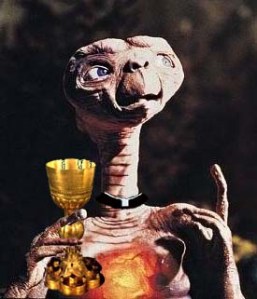
Don’t get me wrong, I am grateful that the Vatican has embraced evolution and thumbed its Roman nose to the creationists. (They deserve even more than that!) I am glad they are considering the possibilities of extra-terrestrial life. There is, however, a nagging doubt in my mind that they may be coming to the conclusion that the late Larry Norman once did that “if there’s life on other planets, then I’m sure that he must know, and he’s been there once already and has died to save their souls.” What good is advancement in science if mythology refuses to budge? What would an extra-terrestrial priest look like? What if they don’t have blood to fill their chalices? Do they have trumpet-horns on their saucers to announce the second coming? Yes, let’s explore our universe, but let’s not forget to update our credibility meters as well.

ETpriest

Our father which art in heaven?


Rhode Island Blue

Rhode Island is often overlooked as the smallest state, a place seldom happened upon by accident, somewhere that one has to intend to go. Drawn by family, I made a trip to Rhode Island and serendipitously learned the lesson of Roger Williams. Roger Williams was the founder of Rhode Island, and, for those only familiar with the Southern Baptist movement, a rather unbelievably liberal Baptist. The founder of the first Baptist church in the nation, Williams was also the advocate of a form of religious freedom that is still railed against today by conservative Christian factions that wish to make America a “Christian nation.”

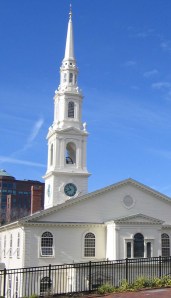
FirstBaptist

Roger Williams' first Baptist church (in the country)

We are accustomed to religious propagandists today telling us that the “founding fathers” were Christians just like they are (simply not true), and that America should remain a “Christian country.” Roger Williams, although not often spoken of in the same tier as George Washington or Benjamin Franklin, classifies as one of our founders and he was an outspoken advocate of conscience as the guiding force behind religion, not state or federally mandated compliance. Rhode Island was offered as a “shelter for persons distressed of conscience.” It was a state where a mind was free to follow its lead.

I confess to overlooking Rhode Island often. But as a refuge for “Papists, Protestants, Jews, or Turks,” it is the Dreamland of religious liberty. Progressive to the point of welcoming Jewish believers and Muslims, Williams went as far as to declare, “none [should be] compelled from their own particular Prayer or Worship, if they practice any.” Even the unbeliever was welcome. How far the “religious right” has fallen from this original ideal of a humble Baptist who envisioned a homeland where residents were free to believe as their conscience dictated!


Religion’s Double-Edged Sword

This podcast discusses a recent visit of Westboro Baptist Church’s “protesters” to Rutgers University. The issue is whether religious freedom includes the right to encourage hate crimes on the part of those not directly involved in the “protests.” Religious freedom is the phenomenon that allows such groups to develop in a democracy, but the end results of such groups is destructive to the democracy that engendered it. This is compared to the Scientology case that is simultaneously taking place in France and noting the differences between them.


We Don’t Need Another Bible

This podcast addresses the issue of agenda-driven Bible translation. Although all translators, being human, have agendas, typically they are for the advancement of knowledge. The news about Conservapedia’s Conservative Bible Project suggests that progress should be turned back to the first century and fast-forwarded to the Neo-Con agenda. The trend is disturbing because not many Americans have the essential background to assess critically whether Bibles are translated with serious scholarly intent or not. The ten principles of conservative Bible translation from Andrew Schlafly’s Conservapedia are examined.


In Our Own Image

Word is out that Andrew Schlafly, spawn of Phyllis, is working on a new Bible. In a stunning move that will amaze even many conservative Christians, Schlafly has decided that the Bible itself is too liberal. On his alternative to “liberal” Wikipedia, Conservapedia, he cites the ten principles for translating the Bible in a conservative-acceptable way. Unable to attain the lofty heights of rhetoric on Conservapedia’s Conservative Bible Project page, I need to quote verbatim the 10 Commandments of Schlafly’s ideal Bible:

1. Framework against Liberal Bias: providing a strong framework that enables a thought-for-thought translation without corruption by liberal bias
2. Not Emasculated: avoiding unisex, “gender inclusive” language, and other modern emasculation of Christianity
3. Not Dumbed Down: not dumbing down the reading level, or diluting the intellectual force and logic of Christianity; the NIV is written at only the 7th grade level
4. Utilize Powerful Conservative Terms: using powerful new conservative terms to capture better the original intent; Defective translations use the word “comrade” three times as often as “volunteer”; similarly, updating words that have a change in meaning, such as “word”, “peace”, and “miracle”.
5. Combat Harmful Addiction: combating addiction by using modern terms for it, such as “gamble” rather than “cast lots”; using modern political terms, such as “register” rather than “enroll” for the census
6. Accept the Logic of Hell: applying logic with its full force and effect, as in not denying or downplaying the very real existence of Hell or the Devil.
7. Express Free Market Parables; explaining the numerous economic parables with their full free-market meaning
8. Exclude Later-Inserted Inauthentic Passages: excluding the interpolated passages that liberals commonly put their own spin on, such as the adulteress story
9. Credit Open-Mindedness of Disciples: crediting open-mindedness, often found in youngsters like the eyewitnesses Mark and John, the authors of two of the Gospels
10. Prefer Conciseness over Liberal Wordiness: preferring conciseness to the liberal style of high word-to-substance ratio; avoid compound negatives and unnecessary ambiguities; prefer concise, consistent use of the word “Lord” rather than “Jehovah” or “Yahweh” or “Lord God.”

Am I the only one to sniff a strong scent of Orwell here? Principle 1 stipulates that the translation, by converse logic (the kind apparently in favor) should be biased, as long as the bias is neo-con. In principle number 4 we are told that the word “word” has changed in meaning. Suddenly I’m reaching out for the railing – steady, steady! Principle 7: “free market parables”? Here is Jesus made-over in the image of Rush (I Can’t Have the Rams) Limbaugh; remove the kindness and compassion please. Jesus’ only goal is to be the CEO, or at least his only son. The translators reserve the right to remove objectionable material traditionally attributed to Jesus. Even Mr. Rogers could spell Revisionist!

Sure, Bible translators need to give the readership what they want. Thomas Jefferson removed the miracles and divinity claims for Jesus before publishing “the Jefferson Bible.” And he was a president! Suffragist Elizabeth Cady Stanton led efforts to produce the Woman’s Bible, removing masculine bias from the text. Bible scholars, however, do not accept their efforts as original biblical manuscripts. Even the general public knows better. What Mr. Schlafly is proposing is giving a gullible readership a Bible that contains what God meant to say; i.e., if God were me. What is disturbing about this is not that one person is offering his or her own version of the Bible – that’s been done before – but that it is intended to lead the unwary to a vision of Christianity that is new but claiming to be apostolic.

I think I feel a podcast coming on.
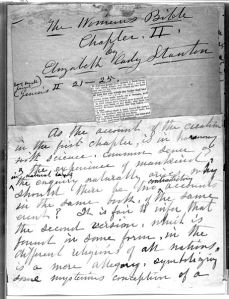
Woman's Bible

Woman's Bible

Jefferson Bible

Jefferson Bible