Daniel in the Lyin’s Den

Yesterday I found myself. Online, that is. I was cited ambivalently as “some guy” in the Uncommon Descent blog comments, noting my Creationism’s White Box podcast. For those unfamiliar with Uncommon Descent, this is a blog hosting many posts by William Dembski, a leading creationist. Finding myself there, I instantly recalled that Daniel was never masticated in the lion’s den.

Not being one to judge without good cause, I read the critique with care. It read: “Some guy I read in the last few days here [link to my podcast] has suggested (to the approval of a few clerics) that creationism is an early 20th century phenomenon but all he’s really done is conflate creationism with the Creationist movement that grew out of, or was associated with, the publication of ‘The Fundamentals’.” Since academics like to split hairs (and even atoms), I thought I’d use today’s post to explain, in History 101 style, the problems with this assertion.

Creationism, like any other human enterprise, has a history. Christianity was born in a literalistic age, of sorts. Early Christians took the Hebrew Bible (pretty much The Bible in those days) literally. Belief in a flat earth and mythic beings still predominated the upper cortices of early brains too. My detractor could have been correct had the conflationism charges been laid at my door prior to the Enlightenment. The fact is that everyone born since the eighteenth century (academically speaking) has had access to science and the facts we’ve ascertained about our world. One of those sets of facts has had to do with evolution, and another with the history of the Bible. Interestingly, both of these sets of facts coincide perfectly: biological evolution took place and the Bible was a product of its environment. These truths have been available for centuries for any who would look at them.

The veracity of this statement is attested by the nearly universal acceptance of evolutionary theory by Christians in the western world in the late nineteenth century. Creationism, as such, did not exist at this time. It was in reaction to a number of social and theological factors that Creationism first hatched around the turn of the twentieth century. It was a new bird (I’ll avoid saying “hopeful monster”). Any claim that it was a default version of Christianity is strictly Retro — any such claim is tantamount to declaring that the Enlightenment never happened. I’m not a supporter of revisionist history, so I just can’t accept this flimsy construct. Fact is, Creationism is relatively new.

There is a great bibliography out there for anyone interested in getting the actual facts. Start with Ronald Number’s The Creationists: The Evolution of Scientific Creationism (University of California Press, 1992) and read on. Otherwise, feel free to believe in a flat earth — you can find good proof of this in central Illinois or Kansas.

Papal bull?

In world news, yesterday’s paper ran an article entitled “Pontiff praises Africa as font of spirituality” (New Jersey Star-Ledger). This brief piece concerning a clerical meeting about Africa (held in Italy), dredged up some interesting concepts: that the African continent is a font of spirituality, but it suffers from materialism and fundamentalism. Having never been to Africa, I am not in a position to assess how materialistic the continent is, but from the images seared into my brain of barely clothed, starving children who own nothing, having this comment come from the opulence of the Vatican is jarring. Teaching by example is far more effective than, well, pontificating. Perhaps if some of the art and Christian swag were sold to invest in the poor, there might be reason to listen to rebukes from foreign potentates.

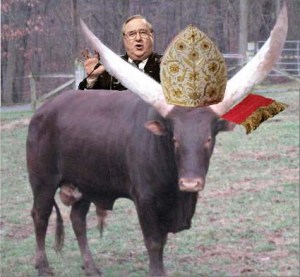
Catholics and Fundamentalists sometimes share political agendas and cooperate to get their holy candidates elected, but clearly they clash when it comes to issues of religious praxis, and especially, authority. I watched with horror over the last two decades as Roman Catholic bishops paired up with the likes of Pat Robertson and Jerry Falwell to support the Bush family legacy because they agree on the same conservative side of the issues. I even saw this on a small scale at Nashotah House. Once the victory is won, however, the honeymoon is over and the claws come unsheathed and fangs are bared.

Religious fundamentalism is an extremely dangerous force, and Rome is right to call it a “virus.” Like Catholicism, however, it is based on fear of dissing the almighty. If we dare probe deeper, underlying all the obsequious servility towards the divine, both forms of Christianity thrive on their own power. Being able to control the masses with claims of sole spiritual authority — sorry, only one set of keys to the kingdom — is also a dangerous thing. Benedict IX, meet Jimmy Swaggart; Jimmy, meet Bennie.

Jerry blesses a papal bull

Jerry blesses a papal bull


Let Us Make Moses in Our Own Image

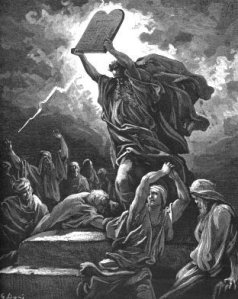
This week’s Time magazine contains an article entitled “How Moses Shaped America” by Bruce Feiler (actually it is an abstract from his book, America’s Prophet: Moses and the American Story). Feiler points out how Moses has been manipulated and utilized by various factions of American society from the earliest pilgrims up through President Obama’s campaign. There’s some interesting stuff here, from the proposal of the Great Seal that depicts the parting of the Red Sea to the Mosaic elements in the Statue of Liberty. No doubt about it, America loves Moses.

As intriguing as I found Feiler’s thesis, I couldn’t help but be a little bit disturbed by it. Serious biblical scholars are early taught to avoid prooftexting like a plague of frogs. Prooftexting is part of a Fundamentalist’s daily spiritual calisthenics, right after chapter-and-verse-presses. Prooftexting is pulling random Bible verses out of context to support a confessional position on any issue. You can always tell it’s coming when someone opens with “the Bible says…” Then you get a chapter-and-verse punctuation mark. What Feiler is describing in his article is just that, a use of Moses that fits the crisis of the moment. While there is nothing wrong about looking to a great leader in time of need, whether that leader be mythical or historical, I wonder how different this is than marching into battle with “Gott und Ich” inscribed on your belt-buckle.

One statement Feiler makes, however, I must take exception to: “With the rise of secularism and the declining influence of the Bible in the 20th century, Moses might have melted away as a role model.” No doubt secularism was in the ascendant during the twentieth century, but the influence of the Bible was never stronger. The twentieth century saw the Bible co-opted as part of a powerful political agenda that drove this nation to the brink of destruction. Never before had the Bible been used to deceive many thousands of untrained religious believers in the ways of war and greed and inhumanity. Bible-thumping had become more effective than rational thinking or coherent speech in the political debates we all so painfully watched. No, the Bible’s influence has not been shrinking. What is needed is a Moses to wrestle it back to its proper place. Even the Bible can be a golden calf.

Moses gets down

Moses gets down


The Hardest Job

Being a religionist is the world’s hardest job. That’s because you are trying to peddle something that everyone gets for free – their own religious opinion. No other professional field has such universal competition. From the time our parents mutter their first bedtime prayers to us, we begin to become masters of religion. With an entrenchment deeper than any wisdom tooth, we know, on a sub-atomic level, that we are right. We consult lawyers about the law and physicians about aches and pains, but on the level of religion, we already know we are right. We seek houses of worship that agree with our way of looking at things, and if the minister strays too far from our views, we go shopping again. Never try to make a career out of studying religion – it is a dead-end street.

I bristle whenever someone calls me a “theologian.” I am not. I have spent my life studying religion, sometimes participating in it, sometimes sitting back and watching it, but always analyzing it. Theologians deal with abstract concepts that can never be verified or falsified. The unquantifiable is their realm, and their rarefied debates seldom touch those of us of less exalted mental energy. And they are also never wrong. Those of us in religious studies watch how people’s religious outlooks impinge on the real world. Put your tin cup on the sidewalk in front of you. Everyone knows the answers already.

For some 25 years I have been specializing in religious studies, and I still assert that it is the most important, yet neglected academic field in the humanities. Twice I have been released from a living in the field by religious folk with less theological acumen than Cal Meacham. (If you don’t recognize the reference please educate yourself!) Not even eight years of a brutal Bush administration could convince university folk that the study of religion should be given priority. The most powerful nation on earth run by a recycled fundamentalist, and we don’t care to understand, thank you. Everyone is an expert. As we watch religious leaders of “foreign” nations posture with their weapons and rhetoric, we can sit back and be assured that even if they start a nuclear war, we were right about religion all along.

Better burn than learn

Better burn than learn


Clergy Letter Project

A few years back I had the privilege of working at the same university as Dr. Michael Zimmerman, currently a biology professor at Butler University in Indianapolis. In my temporary stint as a Lecturer in the Religious Studies department at the University of Wisconsin Oshkosh, I discovered that Dr. Zimmerman, then the Dean of the College of Letters and Science, was the very man responsible for the Clergy Letter Project. I had read about the project before; in an attempt to demonstrate that Creationism is not mainstream Christianity (nor science, for that matter), the Clergy Letter Project was attempting to acquire a few thousand signatures from the ordained of various denominations who were willing to admit that evolution posed no threat to their religion.

As an occupational hazard of someone with my background, I know many, many clergy. I offered to solicit some help in reaching the goal on the list and spent the rest of the semester contacting various sacerdotal practitioners who rightfully saw the Creationist ploy for what it was and continues to be. Creationism is nothing short of an attempt to break through the church and state separation clause and attain federal support for a particular religious viewpoint. That particular viewpoint is not shared by the majority of informed Christians, but the population is easily swayed by Creationist rhetoric. Creationists do not deserve sympathy, for they are much more aggressive than they pretend to be. Subterfuge in the cause of truth is a contradiction in ethics.

Religion may be hardwired into human brains, but it need not seek to pick fights with factual truth as it is learned. At each stage along the progression of human achievement, various religious believers have felt that the new knowledge discovered confronted their faith with unsurpassable barriers. Faith, however, is a belief system, not a factual construct. If faith requires proof, as even the Bible itself says, it is not really faith at all. If you know any clergy who are willing to sign on for common sense and belief in the rational world in which we find ourselves, please send them this link and ask them to weigh in on the question. Nearly 12,000 clergy have signed to date. There are even separate lists for Rabbinical and Unitarian-Universalist clergy. Don’t worry about the Creationists. They will always be back for more.

An early Creationist attempt at intelligent design

An early Creationist attempt at intelligent design


Fundamentalist Foibles

Podcast 11 deals with the phenomenon of Fundamentalism, particularly biblical Fundamentalism, and its history. The podcast begins by setting the historical parameters, in the early part of the twentieth century, and considers some of the reasons that the movement may have begun. German biblical criticism, Darwin’s theory, and the First World War among them. A brief sketch of the movement is then offered, starting with the Niagara Bible Conference and the publication of The Fundamentals. The basic tenets of the belief system are summarized, again with suggestions as to why this may have been the case. A cautionary conclusion ends the presentation.


Bible Land

Once upon a time I took a trip to visit a friend in West Virginia. I made the drive from New Jersey across parts of Pennsylvania and Maryland. Having grown up in Pennsylvania I never supposed it to be considered part of the “Bible Belt,” but it seems that some of the spillover may be making its way north of the Mason-Dixon line.

Interstate 78 has recently struck me as being highly evangelized. I saw a billboard reading “Blessed is the nation whose God is the Lord” and remarked at how out of context this verse was taken. Last time I checked, the Bible tended to be concerned with Israel, not the United States. Further along I saw a church near Bethel, PA called the Assembly of Yahweh. Not being aware that there was confusion as to who the God of the Israelites was, it amazed me to see that they have their own radio station called “The voice of the Assembly of Yahweh.” This struck me as a missed opportunity; the real message could have come through more clearly with “of the Assembly” left out. Yet further along was an ominous billboard from a local Mennonite Church that sounded eerily like Amos. “You Will Meet God” it announced.

Storm's a-comin'

Storm's a-comin'

As I entered Maryland the sales tactics intensified. In Frostburg there was God’s Ark of Safety Church where an actual replica of Noah’s Ark is being built right along Interstate 70/68. Since the steel frame is all that was currently finished, I was glad that it hadn’t recently been raining. Perhaps a more recent translation of the Bible has updated gopher wood to Bethel steel. Further along I spotted a lighthouse atop a hill over a hundred miles from the nearest substantial body of water. This was the World Lighthouse Worship Center. While visiting an actual lighthouse on Lake Superior a few years back the docent informed me that lighthouses were now considered superfluous with the advent of Global Positioning Systems. (Shhh — please don’t inform them that science has again trumped a quaint piece of folklore! I can imagine that the lighthouse may be useful when the new ark is completed.) Along route 219 in McHenry, MD I saw “A House of Love Gathering Place” that I just couldn’t dissociate from the B-52’s for some reason. Just about on the border to West Virginia was the Fresh Fire Church of God.

The United States is truly an impressive reservoir of biblicism. Perhaps university administrators who believe the study of religion isn’t worth the meager salary of an assistant professor should take a road trip. It would be a learning experience.


Lost in Translations

Furor is up like storm waves concerning a revision of the New International Version of the Bible according to the Associated Press. Evangelical groups, fearful lest the word of God be misrepresented (!), claim nothing is wrong with the Old New International Version. The story of biblical translation is long and colorful and peppered with more than a few deaths. People, originally especially Europeans and Americans, but spreading like swine flu around the world with the missionary movement, are very concerned about being certain they have they exact words from the Author himself.

Concern with having the correct answer is natural enough, but the goal of a perfect translation is unattainable. The basic reason is that translation, like Bible-writing, is a human endeavor. And people just don’t achieve perfection. Also, words often betray us. I used to ask students what the word “die” means. Some would say to cease living, while others would say it was the singular form of dice. Some even recognized it as the nominative, feminine singular definite article in German. The truth is, however, that words do not have meanings. Words are symbols that have usages, but the letters “d-i-e” in that order mean only what we intend for them to indicate in any given circumstance. Certainty is a mirage; it can never be reached.

A few years back Today’s New International Version was published and it has been called “an emblem of division in the evangelical Christian world,” by Moe Girkins, president of Zondervan (owned by Rupert Murdoch). Even among self-identified evangelicals unanimity is illusory. Each person’s religious beliefs start to differ from everyone else’s in the privacy of his or her own head. That is because everyone is unique. The Bible can be made to “mean” whatever an individual wants it to mean. Until we became merged into some Borg-esque entity new translations will be loved by some and hated by most.


Edoc Elbib Eht

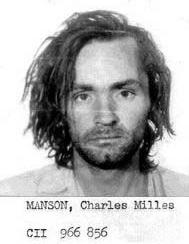
A number of 40-year commemorations of the Manson Family murders have brought these gruesome events of my childhood years back to memory. I was really too young to understand what all the fuss was about then, and now that I am old enough, I’m not sure I want to. Nevertheless, I have committed myself to exploring sects and violence in a religious setting, and the Manson murders have prongs of both phenomena. While recently refreshing my memory on these horrific events on a gray and rainy day, I noticed something I had not seen before.

Looks like someone's been on the yellow submarine a little too long

Looks like someone's been on the yellow submarine a little too long

Charles Manson was (probably still is) a believer in hidden codes. He allegedly cracked a code in the Beatles’ White Album that led him to the belief in an apocalyptic battle that he was determined to begin. I wondered why the Manson Family tends not to be listed among other apocalyptic groups such as the Branch Davidians or Heaven’s Gate. They all share several traits, and although Manson’s revelations came from the Fab Four rather than the Holy Trinity, a revelation from on high spurred him into actions that had a tragic outcome, just as David Koresh or Marshall Applewhite.

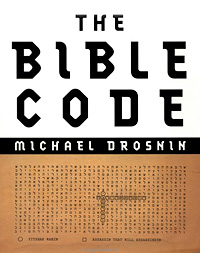
The whole Helter Skelter code also reminded me of another, equally bogus pawning of randomness as divine messages: Michael Drosnin’s The Bible Code. When I read this bestselling bit of intellectual dry rot a few years ago, I was amazed that anyone could possibly take it seriously. God writing hidden messages in a holy book like some hormone enraged high schooler? And figuring out that a singular genius would figure it out just before the apocalyptic end without realizing that it is possible to read messages back into any media after they occur? It seemed all too much for a rational mind to take. In one of my courses at the University of Wisconsin Oshkosh I gave students the option of reading it for a secondary project. To my chagrin, when I had the papers in one particularly tear-stained paper wailed (seriously) that the writer wished she had been warned sooner! This book changed her life! Everyone must know! Unfortunately I left Oshkosh without finding out what became of her.

God may not play dice, but apparently he likes crosswords!

God may not play dice, but apparently he likes crosswords!

I felt bad for introducing an undergrad to such “academic” sleight of hand; some college students just haven’t developed the critical facilities to see through the remarks of Balaam’s various sidekicks. Come to think of it, Manson’s followers accepted his revelations uncritically as well. Maybe the real lesson in all of this is that we must examine very closely those who claim special revelation, whether it be from Lenin, McCarthy, Starr, and Harrington, or just from God Almighty.


Ghosts of Nashotah House

A recent search for “Nashotah House” + ghost (not unsurprisingly) brought up my blog. Perhaps I was being bated, but I’ll bite anyway. Who can resist a good ghost story?

A wee history lesson will help to set the scene. Nashotah House is/was a seminary of the Episcopal Church nestled in the woods of what had been the frontier in Wisconsin. Established in 1842, it was originally conceived of as a monastery — an ethos it has tried to maintain ever since. It is a residential campus with both students and faculty required to live on the school grounds. I taught there from 1992 to 2005, long enough to see some strange things.

I admit up-front that I don’t know what to believe about ghosts. Very nearly ubiquitous as a cultural phenomenon (and firmly related to religion), ghosts permeate the human imagination. It is not at all unusual that ghost stories should thrive in a gothic setting like Nashotah; a simple web search will bring out the traditional hauntings of the place, especially those of the black monk. When I made my first visit to campus there were some distinctly creepy vibes that I wrote up as being non-priestly jitters amid the secretive life of the black-robed clergy. For my first two years I would be there for just part of the week, so instead of the usual faculty house to reside in, I was assigned to live in an apartment in Webb Hall. Known simply as “the Fort” for the solidity of its limestone block construction, Webb Hall had been built for a former dean, Rev. Dr. Azel Cole, as a grand three-story residence for the priest and his wife, Betsy. (Episcopal priests can marry, creating a steady siphoning of Roman Catholic priests who love both the liturgy and the ladies.) My apartment was on the third floor of the Fort, the highest point on campus. As the living dean showed me around, I had that oppressive, “something’s not right” feeling, despite the fact that the living room had been newly furnished and had a spectacular view across campus.

The dean pointed out the amenities of the spacious apartment, but when we reached the kitchen/dining area, we found something unusual. In the very center of the floor was a single dining plate, shattered. The dean muttered something about how the cleaning lady must have missed it on her rounds when she had prepared the apartment for my arrival. Otherwise the apartment was spotless. There was a door leading to a private chapel that Dean Cole had constructed. I was told it was no longer used since the only access was through the apartment, but the dean supposed I would be interested in seeing it. We stepped inside and it was coated with cobwebs and a thick layer of dead black-flies covered the floor, especially near the windows. The dean informed me that it was kept locked to prevent clandestine, unapproved Masses from being performed there by renegade priests on the faculty.

The creepiest room, however, was my bedroom. A spare room (for sleeping only, no doubt), furnished with only a new bed and side-table, it nevertheless felt crowded. When something finally did happen in that room it was after I had moved to a regular faculty residence.

[For the rest of the story please see the Full Essays page]


Assyrian Dreams

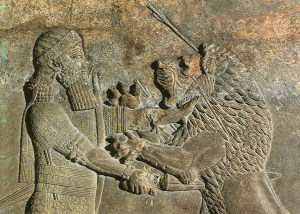
All through my formal education I had learned about the Assyrians. My first introduction to them was as the evil empire that destroyed the chosen nation of Israel, inspiring countless myths of the ten lost tribes. Upon further study they appeared in a more positive light — they were one of the great, formative Mesopotamian peoples who had gone through considerable trouble inventing much of our culture for us. They also had a penchant for over-running smaller and weaker nations, but then, everyone has their foibles. When I saw their striking bas-reliefs in the Boston Museum of Fine Arts, and later in the British Museum, I was deeply impressed by their ability to project hostility. Bulging biceps, braided beards, dreadlocks and attitude enough to be the envy of any gangsta, these guys could subdue you with just a solemn nod in your direction.

A good day for Assurbanipal, not so good for the lion.

A good day for Assurbanipal, not so good for the lion.

But the Assyrians over-extended themselves. Conquering further and further from the homeland, they couldn’t keep a stony eye from Egypt and Anatolia all the way to Persia. Media (not the paparazzi) eventually tumbled Nineveh and Babylonia stepped in to take on the burden of predominant empire. The United States hadn’t been invented yet, so somebody else had to dominate the Middle East. With the influx of Arameans and the machinations of the Persians, Mesopotamian culture became a cherubic mix of peoples. Assyria ceased to exist as a separate nation, and once the Arabian tribes launched into the region, all genetic bets were off. Racial purity was a dream of the past. So the Assyrians dissipated, joining their neighbors in a happy, amorphous Mesopotamian culture.

In Shamash we trust.

In Shamash we trust.

Then, after procuring a doctorate in Ancient Near Eastern studies, I took a job at Gorgias Press. Suddenly the Assyrians were back! That was one on the other end of the telephone! Visions of dreadlocks and skewered lions came to mind, and in my confusion I asked my colleagues if I’d slept through that lecture. No, it turns out, the Chaldo-Assyrians are a relatively new incarnation. Named Assyrians by nineteenth-century European missionaries, this predominantly Christian people has adopted and tried to assimilate the heritage of the ancient Assyrians. They still exist today, I’m told. Instead of swords and lion hunts, they wear camouflage and hunt with automatic rifles. But their flag hearkens back to their ancient, pre-Christian religion. That flag, their rallying point with high antiquity, bears the emblem of the eight-rayed Assyrian sun. Jesus, meet Shamash. Son versus sun. I guess it is time for me to go back to school again and see if I can get it straight this time.


Ortho-right or Ortho-wrong?

As a child reared in a seriously religious household far, far away from anything with even a whiff of orthodoxy about it, my first encounter with this traditional form of Christianity involved more curiosity than fear. What was this religion that claimed to go back to the very earliest apostles? Did Jesus wear one of those unusual hats? I never recalled seeing paintings of Peter, or Mark, or even Thomas wearing a medallion of the theotokos. Apparently I’d been routinely misinformed. The haunted, deeply spiritual grimaces on the faces of orthodox students my age were almost intoxicating. It was all new and exotic to me.

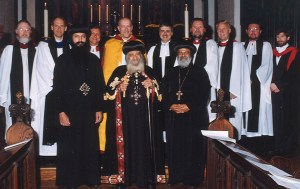
Several years later I find myself having been subjected to a variety of orthodoxies and the only thing they seem to have in common is the conviction that all the others are wrong. I once had a boss who was enamored of Greek Orthodoxy. (I later learned that this is the gateway orthodoxy, leading to more foreign strains.) Presently his interest shifted to the Russian variety and I eventually found myself cowering in the glare of the Coptic Pope Shenouda III’s eminence. How had a kid from humble beginnings come so far? A couple jobs and a few hundred miles later, my new boss turned out to be Syriac Orthodox. Phone calls to the office would come in languages I’d never even heard before. Being a northern European mutt, maybe I was simply jealous of the pride of ethnic purity. No fancy traditional dress to haul out for exotic dances at annual celebrations of mutthood (Lederhosen and stuffy tweed, anyone?)

Basking in the eminence of the Coptic Pope

Basking in the eminence of the Coptic Pope

All of this exposure to orthodoxy has led to heterodox thoughts in my heretical brain. It seems that the basic premise of orthodoxy is that the final truth was revealed just once, up front, and it left no room for growth. The expectation that Jesus would shortly be back didn’t leave much space to consider what complications would set in once people developed nuclear weapons, landed themselves on the moon, or devised genetic engineering. Complexities and complications that early Christianity could never have foreseen chaw like ravenous beavers on the stilts propping up this edifice. I am a firm believer in religious freedom and have never urged anyone to change her or his personal faith. But I do seriously wonder how any religious system, in the light of our limited brains, could ever expect anyone to believe that it had comprehended the whole of all truth for all time. It is all too wonderful for one condemned by a birth outside of ethnic Christianity.


Yes, Mammon

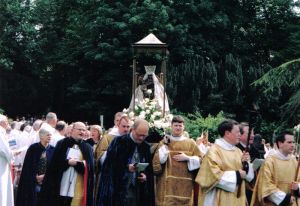
In the continuing coverage of the most recent New Jersey scandal the Star-Ledger, on Monday’s front page, posted a picture of San Giacomo Apostolo in Hoboken. San Giacomo is traditionally the brother of the equally mythical St. Ann. The statue, which stands outdoors in a public street, has monetary donations tacked to it. The image flashed me back to my Nashotah House days when students became visibly excited nearing the date for the procession of Our Lady of Walsingham at the proto-shrine in Fond du Lac, Wisconsin. Seminarians would beg for an opportunity to hoist the holy statue, or at least be a lowly acolyte. (These were grown men, mind you — many of them seeking the priesthood as a second career.) I never attended Walsingham, but it was my understanding that pilgrims and penitents at the festival also adorned their lady with money in hopes of some gift of grace. I grew up in a blue-collar household where paying ladies for favors was itself considered a sin.

Looks like Our Lady has put on some weight

Looks like Our Lady has put on some weight

While on a recent trip home, I saw a church for sale. As I started to break out my checkbook, I recalled how closely money and religion are tied together. The more I pondered this, the clearer their ancient, entangled roots became. The religiously observant bringing gifts to the temples of their gods was a standard act of piety and civic duty in the ancient world. Temples were expensive and the staff could only be supported by continuous donations. In the Ugaritic tale of Kirta, our protagonist seeks a son and makes a vow to Lady Asherah that if he successfully procures a wife he will make a statue of her in silver and gold. The favors of gods may be purchased. Today credit cards are accepted, but we are still caught in the web of those who claim God has asked them for your money.

For sale, God not included

For sale, God not included

When I was a teenager a friend invited me to attend a public presentation by some visiting Rev. Harrington, a popular evangelist. Several times during his high-energy sermon he sent the collection baskets around. The first time it was for your standard church offering. The second time was for any change you had in your pockets. The third time was for a special blessing. For those who had checkbooks ready, a thousand-dollar donation would get your name on a personalized plaque in his private jet. Years later I saw Harrington on television during an interview on his private estate. He puttered around it in a customized golf cart with wheels designed not to scuff up the gold-plated bricks that constituted the drive before his opulent mansion. “If we’re going to walk on streets of gold in heaven, I want to get used to it here,” he casually explained.

So, as an (unofficial) agent of Asherah, if you are seeking to make a divine investment, get out your checkbooks and I’ll tell you where to send the donations (checks made to “cash” please!).