Devils and Witches

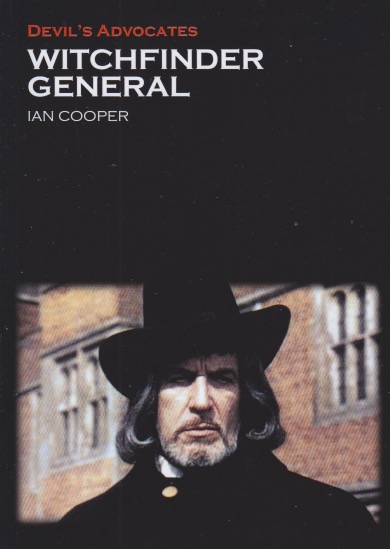
If you’re a regular reader (thank you!) you know that I’m currently under contract to write the Devil’s Advocates series volume on The Wicker Man.  As an editor myself I’m aware that academic series, often unlike fictional series books, tend to vary quite a bit from one another.  I want to try to get my submission close to the goal, however, so I’ve been reading volumes by other authors.  You may also know that The Wicker Man is part of an “unholy trinity” of early British folk-horror, with the other films being Witchfinder General and The Blood on Satan’s Claw.  Of the three my least favorite is Witchfinder General, so I’ve put off reading the particular volume on that film by Ian Cooper.  That has nothing to say about the author, but rather a lot to say about the base film.

The book is quite good.  Cooper is clearly aware of the controversy surrounding the movie and he points out some of the difficulties with it as well as what it does well.  His treatment is quite insightful.  The movie is violent and it’s an representation of the historical violence we thought we outgrew.  Matthew Hopkins was an historical “witch hunter” who was, in reality a serial killer,  mostly of women.  Fearing witches, while getting paid to find them, he was responsible for over 200 deaths.  As Cooper makes clear, the film lingers a bit too long on the abject nature of many of the tortures, not allowing us to look away.  For this reason many critics found the film distasteful.  I personally found it hard to watch.  Education isn’t always easy.

There’s quite a bit of film history in the book.  Cooper does a great job placing the movie in its cinematic context.  Like The Wicker Man, Witchfinder General is sometimes said not to be a horror film.  Indeed, there’s nothing supernatural about it.  Still, it fits the bill for many of those in-between movies that cross over into horror.  In this case it’s due to the violence.  For me, monsters are preferable to human monstrosity.  They’re easier to walk away from.  Although the witch hunts ended centuries ago, violence against women has remained.  Whether it’s legislative or physical or economic, women deserve better treatment than they’re offered by the male establishment.  Movies, and books about movies, like this one may be difficult to watch/read, but they carry important reminders that power continues to corrupt and it must be challenged and changed when it reverts to the mentality of Matthew Hopkins.  His spiritual kin, unfortunately, continue to thrive. 

Remarkable and Beautiful

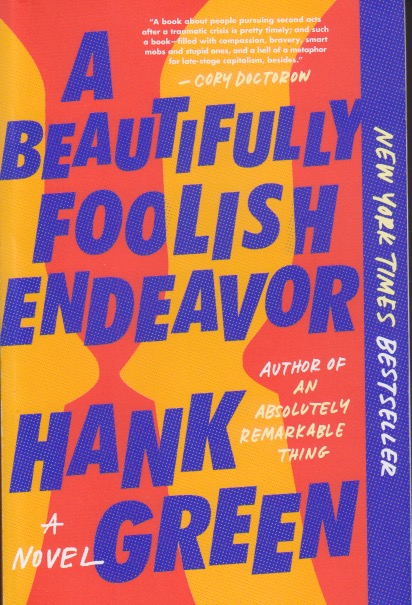
Last year I read and commented on Hank Green’s An Absolutely Remarkable Thing.  I knew there’d be a sequel, but it took some time for it to come out in paperback, and it took a day of flying to give me dedicated time to finishing it.  A Beautifully Foolish Endeavor picks up where the first novel left off, bringing April May back to life.  It’s a story about good and evil and how humans, as flawed as we are, are nevertheless worth saving.  This story takes a further sci-fi and dystopian turn than the first part, moving it more into the regular novel than the “new adult” that seems to better fit the initial book.  Really only six months have passed since the first story, but the still young protagonists have aged in the way experience doles out to people who think they understand the world better than they do.

The world of A Beautifully Foolish Endeavor is dystopian in the sense that corporations have too much power and can (and do) drive the direction of human development.  It’s clearly a novel written after a couple years of repressive Trump rule where autocrats will do anything to keep in the public eye, even destroy their own world.  It becomes Manichaean, or maybe even Zoroastrian in that the extraterrestrial entity Carl, who was the subject of the first novel, reveals that he has an evil “brother” that encourages the corporations in their efforts to rule the world.  The goal of this evil intelligence is to get humanity to destroy itself as a failed experiment.  There’s plenty of metaphor here since the way to get people to destroy themselves is through virtual reality.

As someone who finds quotidian reality difficult enough, I have no desire to see how well some technocrats can imitate what nature already does so well.  Stepping outside with a cold November wind blowing down my collar, threatening snow and driving me back indoors I know I’m in a world not custom built for our comfort.  I am one of billions of scurrying, resistant, persistent creatures doing my best to survive.  I’m sure that virtual reality is an amazing experience, but so is stepping out into that November wind.  Hank Green is gifted at writing compelling, conflicted characters.  From his own internet platform he’s become a significant influencer, gathering the interest of even the White House.  His two novels form a thoughtful set that, like the books of his brother John, make us stop and think what it is to be human.


Flight Path

It’s been some time since I was on a plane.  Or in a hotel.  These things seem strange and foreign to me now.  Covid-19 is now a fixture in life and we, as humans typically do, have adjusted.  Of course I was flying for Thanksgiving on the busiest travel day of the year.  Seeing all those people standing in line at 4:30 a.m. at the airport made my lifestyle seem a little less weird.  I’m used to being up at this time.  They did have to de-ice the plane at Lehigh Valley International Airport.  I’ve never been on a plane that was taking a shower before.  I also didn’t touch anything but my book.  And it seemed that those who “don’t believe in” masking weren’t making a fuss because you can’t win an argument with the FAA. I’m thankful for that.

I’d almost forgotten how to fly.  On the first leg of the journey I was the only one whose “hand-held device” was made of paper.  Connecting out of O’Hare, however, quite a few more books made an appearance.  I sit in front of a device all day at work, so on a rare day off I don’t really want to have to stare at a screen.  Although the total air time was under four hours I brought seven books in my personal item.  I finished one of them (the longest) on the trip.  I still have plenty of choices for the flight home on the weekend.  Thanksgiving, even more than Christmas, is the time for family gatherings.  We’re all vaccinated on this side, so it feels mostly safe.

This Thanksgiving I’m thankful that no turkeys were harmed on my account.  If you knew how “thanksgiving turkeys” are raised it’d put you off your feed, as the saying goes.  I’m also thankful that travel is possible, even if with added restrictions.  Frankly, I’m glad for them.  Anti-vaxxers don’t seem to realize that it’s not just themselves they’d be protecting, but others as well.  Vaccines and masks aren’t just about selfish desires.  Last year we couldn’t even consider traveling.  Covid-19 has changed the way we do things, perhaps permanently.  We can be thankful that we learn to adjust.  I’m no fan of crowds, but there was something a bit exhilarating about being among other goal-oriented individuals all focused on being with loved ones.  It gives me renewed faith in humanity, and that is something for which to be thankful.


Walking Bear

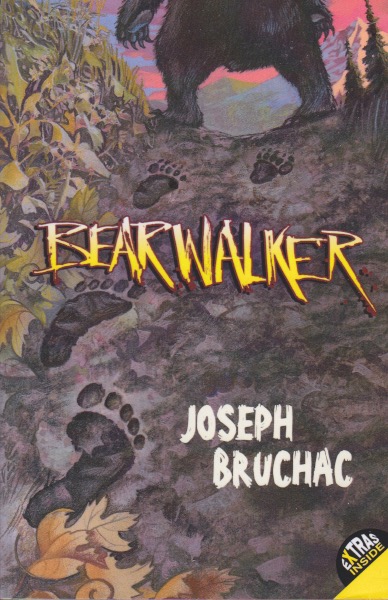
Indigenous peoples have been on my mind over the past several months.  Indeed, I read books by American Indian authors with awe.  In this darkening time of the year the Indian monsters join those of European descent in my imagination.  The wendigo has become somewhat popular in recent years but the bearwalk, or bearwalker, remains obscure.  Although a novel for young readers, Joseph Bruchac’s Bearwalker is a genuine horror story and the author is of American Indian descent.  It took someone giving it to me as a present (mainly because it was for young readers) to get me to pick it up.  I’m glad I did.

As might be expected for young readers there’s some blood but not gratuitous violence.  There are skillful twists in the novel and Bruchac knows how to put his protagonist on a cliff, as the old adage goes, then throw stones at him.  In this case, Baron, a thirteen-year-old Mohawk boy, is tormented by the bullies at his school.  Befriended by a respected teacher, he attends a three-day camping trip to the Adirondacks where a family dispute has led to a plan to terrorize the camp and force its sale.  The plan is to make it the scene of a mass murder with the school children present.  It’s here that Baron is able to demonstrate his worth to his classmates by escaping from the would-be killers and bringing help.

Throughout the story bears feature.  There’s some question as to whether there is a real bearwalker present, but the idea is there.  As with literature for young readers there’s some protective layering—no sex or strong language, for instance—but violence, at least in intent, is clearly there.  It is a very good story with suspense and excitement enough to keep even an adult horror fan going.  The main reason I’d had my eye on the book was to learn how the bearwalker might appear in it.  And also to see the story told from a First Nations’ point of view.  Like Baron in the story, American Indians I read aren’t aggressively angry about the way their people have been treated (which they certainly have a right to be).  There’s nevertheless a sadness and inevitability there.  Still, there’s also a pride in being part of an ancient and surviving culture.  There’s also quite a bit of symbolism in the story; Baron’s parents both proudly serve in the military, despite what the nation has done to their people.  And more subtle indications occur here and there that mainly adults would notice.  Although for young readers this is a real horror story, but one with a conscience.


What’s Poppin’?

“How are things in the world of finance?” Admiral Boom calls to a passing George Banks.  The bland answer of fine as everything is good with the pound sterling assures the seaman that everyone is doing their job properly.  This may be a throwaway scene from Mary Poppins, but it captures an anxiety I’ve been experiencing for some time now.  Admiral Boom doesn’t have to be an expert in finance—he knows that Banks and his ilk are taking care of that so that he can oversee his household, keeping it ship-shape.  With the shenanigans of the Republican Party, however, all of us—bankers, seafarers, editors, it doesn’t matter—have to become experts in politics.  Why?  Politicians can no longer be trusted to do their jobs.  Corruption is so rife that they saw no problem with Donald Trump (“How are things in the world of finance?”) being elected.

The internet has given people the idea that they know more than they do.  If you read enough you soon realize just how little you actually know, and that humility (note, Mr. Trump) is the only proper response.  Now we have people all jazzed on the idea that you can express your personal hatreds and be rude to others because, well, that’s what 45 did.  Now we all have to learn about what schemes (and they are schemes) the Republican Party is up to at all times to try actually to steal power.  Come on folks, gerrymandering is a blatant attempt to game the voting system, as is the retention of the electoral college.  And the filibuster.  

Sure, voters should be informed.  We are responsible for gathering facts, and not alternative facts, before we head to the polls.  Beyond that we used to be able to trust politicians to do their jobs.  Yes, there was always corruption—power inevitably leads to corruption—but there were checks and balances.  Those checks and balances are gone.  Now instead of keeping his house Bristol fashion, Admiral Boom must spend hours a day trying to sort out lies handed out like candy on Halloween, trying to figure out what is the truth and what is republicanism.  Don’t be listening for that boom on the dot anymore.  Mr. Binnacle is too busy trying to memorize the names of everyone running for the school board who are anti-masker, anti-vaxxers who stand for Trump and his original stolen election.  How are things in the world of finance?  How can we ever possibly know since we now all have to spend our time back in civics class?


Listening to History

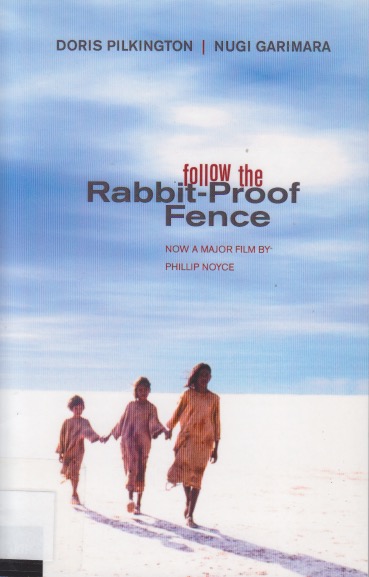
One thing fascists around the world are attempting to do is rewrite history.  Inevitably white, they want to paint themselves as good and superior.  Actual history, however, shows just how destructive and cruel “civilization” has been, particularly to original inhabitants of colonized nations.  Over the past several months I’ve been reading about indigenous peoples.  We’ve been led to believe they were unfortunately wiped out, that they no longer really exist, or that our governments treat them fairly to make up for past injustices.  Such myths must be dispelled and we need to hear from those who’ve lived their experiences.  Follow the Rabbit-Proof Fence by Nugi Garimara, or Doris Pilkington, is the record of one such remarkable experience.  Although made into a film in Australia, it’s a story with which I was unfamiliar.

Garimara is the daughter of an indigenous aboriginal woman who experienced life under the “civilizing” of West Australia.  Molly, the author’s mother, and two of her sisters—Daisy and Gracie—were separated from their family at the ages of 14, 11, and 8, respectively.  They were sent 1600 kilometers—very nearly 1000 miles—away to a school that was run as if the government believed Jane Eyre was an instruction manual.  Although they knew that runaways, who were always caught, were shaved, whipped, and put in an on-campus jail on bread and water, Molly decided to escape with her sisters.  Over nine weeks they managed to avoid the trackers and walk the 1000 miles home.  This all took place in 1931.  Follow the Rabbit-Proof Fence is an engrossing book that should be widely read.

Many questions remain.  Since the story is written from the memories of an aging Molly, there are gaps.  After making it home Gracie was “captured” and sent back to the school.  Molly was eventually tracked down and also returned, but she again escaped and followed the same route back home.  The authorities, implacable, believed that whites knew the best way to handle indigenous peoples, calling the department responsible “the Protector of Aborigines.”  We need to listen to the voices of those whose land was stolen.  We need to ask them how to make current circumstances more just and fair.  Yes, the indigenous lifestyle clashes with capitalism.  We’re becoming aware that their lifestyles tends to be healthier and more fulfilling, and yet we persist.  We are, it seems, living through the slow crumble of the capitalistic system.  When it all comes down we would be wise to learn from those who know alternative ways of being in the world and can find their way home in hopeless circumstances.


Steel Industry

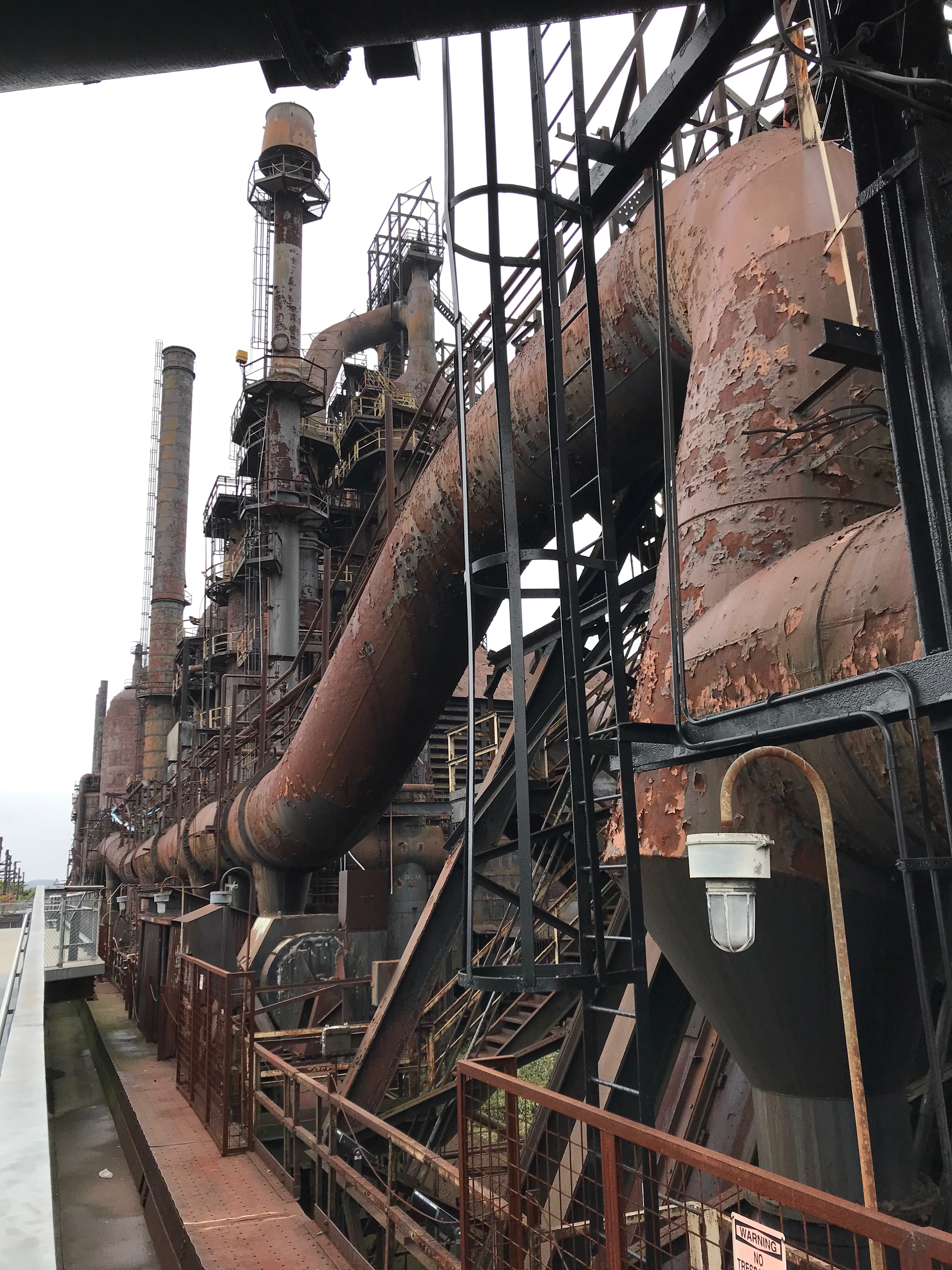
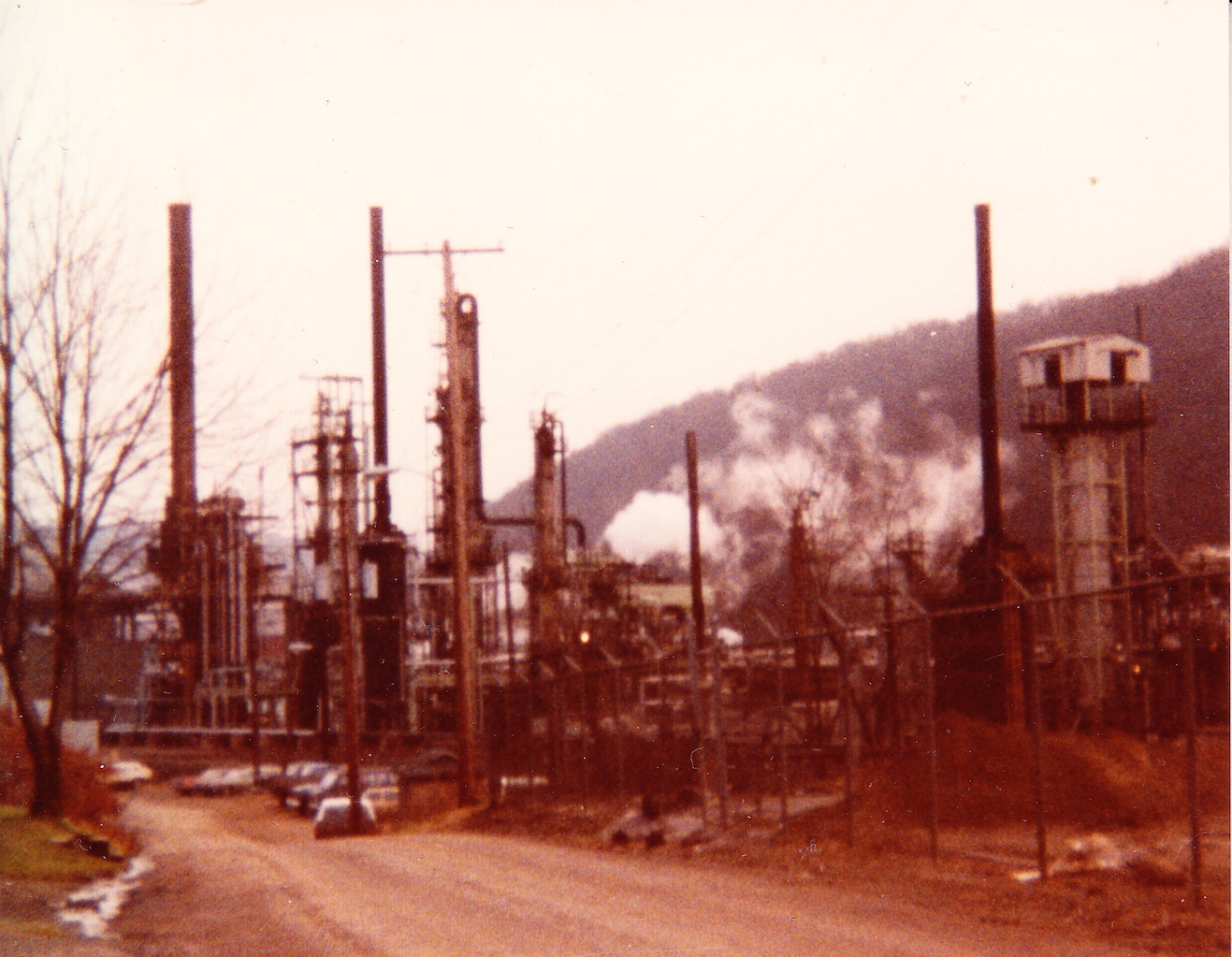
It was a building on Broadway, just south of Times Square.  I don’t know the name of the building or remember what business it may have housed, but I did notice on my quick walks through Manhattan on my way to the bus that it was being renovated.  The facing had been removed and an exposed I-beam bore the words Bethlehem Steel.  From coast to coast, and even to ships at sea, Bethlehem Steel was a major supplier.  Today the factory is still.  There’s a poignancy about such giants falling.  The world as we know it was largely constructed from the products of the still impressive, rusting reminder of days of glory.  No doubt the air is healthier to breathe and the noise level much more suited to humanity, but standing here next to this behemoth it’s easy to fall into a reverie.

I grew up near heavy industry.  Nobody in my family was directly involved, but my hometown had a steel mill just across the river and my next hometown housed an oil refinery.  Both are closed now and the area has been in an economic depression that has lasted for decades.  Industry on this kind of scale requires workers willing to sacrifice much in order just to survive in an industrial world.  Over 500 workers died over the years at the Bethlehem Steel plant.  Factory life involved dangerous jobs with machinery containing material at over 3,000 degrees, and single pieces of equipment that could easily crush a person beyond recognition.  Workers were in some sense expendable as the collective, the nation, grew.  The factory never shut down, running all through the night, seven days a week.  The profits were enormous.  So were the costs.

Global warming was well underway as the greenhouse gases belched into the sky.  Bethlehem Steel wasn’t the only polluter, of course.  Heavy industry, industrial farming, individual cars—we seem to be determined to poison the air we breathe in order to make money.  If the pandemic has taught us anything it’s that we’re all connected.  Rising prices and supply chain breakdowns have underscored that we all depend on each other worldwide.  Climate change has already assured that disruptions will continue and likely worsen.  There’s a kind of autumnal beauty in desolation.  These great steel stacks stand rusting and silent beneath a leaden but too warm sky.  Actions have consequences, and those that affect many create ripples that become waves.  We have created monsters but we can’t control them.


What’s Class Got to Do with It?

As an editor you get to read synopses of nascent books across a wide variety of disciplines.  A live topic in sociology and poli-sci is class.  As in “the hidden injuries of.”  So I’ve been grinding class in the machinery of my mind and the product always seems to be a question mark.  Neither of my parents finished high school.  My father worked, when he did, as a house painter.  With three children and no money for childcare (and not even a GED), my mother was of the stay-at-home variety.  I saw neither parent, and this would include my step-father, sit down to read a book for enjoyment.  My mother read the Bible for consolation, and read us children’s books before bed, but literature wasn’t really part of our lives.  I still think of myself as working class because that’s what I learned growing up.  Working class with books.

I recently posted about a contract for my fifth book.  The previous four have earned total royalties of well under four figures (combined).  I’ve been asked why I do it.  It’s not an expectation of my job.  It takes up most of my time outside an unrelenting nine-to-five.  Where does it get me?  None of my books (so far) have sold more than 300 copies.  I can see why—they’re either expensive or obscure (perhaps both).  But I love books and reading and I want to give back.  The truth is I don’t know why I do it.  Working class folk wind down from work in different ways.  Some of us do it by writing, I guess.

Learning, for me, works best if someone shows me how to do it.  I expect that’s why I did so well as a teacher.  Explaining things works for me.  I still run into this all the time—people come at you in media res and suppose you’ll know what they’re talking about.  At work, in extra-curricular organizations, just about everywhere.  My working class response is “whoa, back up!”  There’s no better place to start than the beginning.  It’s folk wisdom, I suppose.  In this world where everyone middle class is too busy, they don’t like to stop and tell you what you need to know to get started.  I don’t know how to be middle class.  One of my early jobs involved using a sledge-hammer.  I’d never done it before and I learned by watching others.  I’m not qualified to theorize about class, but I do know that by the end of the day that blisters will accompany any new task.


Rebranding

Established in 1583, Edinburgh University has been a world-class research institution for centuries.  It appears in pop culture as a place of great learning and innovation.  While the newest of Scotland’s four (in contrast to England’s two) ancient universities, it has risen to the point of greatest name recognition.  Even as a kid in rural western Pennsylvania, born into an uneducated family, I’d heard about it.  Little did I dream that I’d actually attend it one day, skulking its time-honored halls and walking the same streets as so many worthies that I couldn’t count them.  It was an inspirational place to live and learn.  While it may not get you a job, a doctorate from it will keep you curious for the rest of your life, and that’s a fantastic gift.

Just as I was preparing to graduate that venerable institution announced it had decided to rebrand.  Wait, what?  A four-centuries’ old university known world-wide felt it had to have a brand?  At great expense, they hired a consulting firm to make them more modern looking while retaining the trusted tradition stretching back to the late middle ages. It wanted to attract “modern” students (since this was in the early nineties those modern students are now adults).  I felt crushed under the commercialism of it all.  Branding?  If a kid from remote foothills of the Appalachians can know and dream of a place, why does it need to get the word out about itself?  Ah well, these wee bairn be wantin’ somethin’ flashy.

I’ve lived through other corporate rebrandings.  They seem to me a waste of good money, especially if you’ve been around for a long time.  Some people, I suppose, look at an old logo and say “looks outdated, not with it.”  Others of us fall down and worship.  You see, staying power is something rare these days.  Corporations come and go.  Even higher education institutions sometimes close down, but the old ones keep on.  You can pick up a book from 1600 and read about Edinburgh University.  It won’t have the new logo—in fact, it may not have a logo at all—but it will still be around four centuries later.  If you get something right at the beginning, why do you need to change it to impress those who think present-day branding (which will only have to be rebranded again at some point in the future) is superior?  Perhaps our ancient institutions need to learn that old lesson—trust yourself.


Thoughts on Job

The book of Job has been on my mind lately.  Leave aside the remarks of Eliphaz, Bildad, Zophar, and Elihu, it is one of the most honest books ever written.  Many people think Job is trying to answer the question of why the good suffer.  If so, it does a poor job.  No, Job is an exploration of suffering, and Job really isn’t looking for an answer why.  Instead, he simply wants his pain to be heard.  No fixers, no advice.  Simply to be heard and to know he’s been heard.  You see, in the world of the Bible words were significant.  Many prophetic utterances were simply that—utterances because it needed to be said.  Job ups the ante quite a bit, however, when he begins to wish that God would answer him.  God, after all, is responsible for his pain.

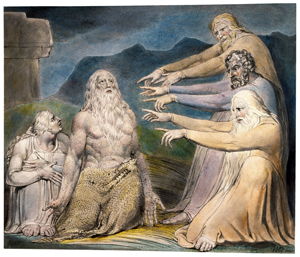
William Blake’s Job

The world is full of sadness.  Some people feel the sadness of others deeply.  We all strive for some kind of equilibrium, some balance.  There are, however, a lot of people out there that truly do suffer and for no particular reason.  Job is a polarizing book.  Many people dislike it intensely.  I suspect that some of them don’t like to think of the world in this way.  Those who do good should be rewarded.  (The book makes plain that Job is perfect.)  Those who do evil should be punished.  Job makes clear that that’s not the way the world actually works.  For reasons we can’t know (who’s privy to the divine council and its deliberations about our fates?) we may end up losing our hopes, dreams, health, and wealth.  Job is kind of a horror story.

There are those who read Job and argue from the point of view of his friends.  In the book itself God condemns the outlook of the friends, noting that Job—no matter how challenging his words were—spoke honestly.  Life is seldom fair.  We as human beings must strive for fairness as best we’re able since we sense that it’s morally good.  Indeed, much of the Bible upholds fairness.  The book of Job questions it.  Not it’s goodness or morality, but rather why the world doesn’t reflect it.  When someone is suffering one of the most helpful and difficult things we can do is listen to them.  We need not open our mouths to fix, suggest, or advise, like Eliphaz, Bildad, Zophar, and Elihu.  We simply must let the words be said.


Healing Time

Twenty years ago today I walked into the refectory at Nashotah House after morning mass and wondered why the television was on.  Normally people had their own theological issues to hash out over breakfast, so this was unusual.   When I saw what was happening, I skipped breakfast and went home to my family.  I remember the feeling of shock and terror of those days.  America, I knew, wasn’t the innocent nation it projects itself as being.  We had provoked, but none of that mattered as the isolationism of over two centuries on a mostly friendly continent crumbled.  We were vulnerable.  Living in the woods of Wisconsin there was no immediate danger, but the sense of confusion—and certainly the feeling that a less-than-bright president wasn’t up to handle this—made us all feel weak, even with the most powerful military in the world.

Yesterday the New York Times headlines ran a consideration on whether we’ve emerged better in the ensuing two decades.  Looking at where we are—a deeply divided nation because a narcissistic president that the majority of voters voted against put (and still puts) his ego ahead of the good of the country—the answer seems obvious.  It will take years, if not decades, to heal the damage that one man did.  His putative party (really his only party is himself), seeing his popularity as their means to power, refuse to distance themselves.  We simply cannot move forward.  Not in the midst of a pandemic where Trump followers won’t get vaccinated causing new waves of the virus to surface and thrive.  I’d like to think that on September 11 we might reflect—yes, I know it’s hard work—on how we all need each other.

Photo by Jesse Mills on Unsplash

Little could I have guessed in 2001 that a mere ten years later I would find myself working in Manhattan.  Somewhere in my mind on every day of that long commute I wondered if something might again go wrong.  On the bus I was thrown together with people of every description—well paid and just getting by, women and men, gay and straight, from all around the world—and we knew our fates were linked together.  Differences had to be put aside.  Selfishness has no room on a crowded bus.  That was my introduction to life in New York City.  Those who hear only the poison rhetoric of 2016 through 2020 should try commuting with an open mind.  If we all took the bus, life after 9-11 might’ve turned out very differently.


Moral Bankruptcy

Last Thursday, apart from being the day after the plumber came, Tropical Storm Ida dumped on us, and the first day of September, the New York Times headlines were disturbing.  I don’t have time to read many news stories in depth, but I glance at the headlines to inject just enough worry into my day.  After discussing the flooding, Afghanistan, and a few other stories a particular quote caught my eye and kicked my gut: “Kevin McCarthy, the House Republican leader, threatened to retaliate against technology companies that comply with the inquiry into the Capitol attack.”  This was a bit much after reading how much suffering is going on in the world.  Republicans threatening retaliation to keep the truth hidden in plain sight.  Is there any term for this but moral bankruptcy?

I simply can’t understand how any moral Republican can hold their head up proud.  I grew up Republican.  I was conservative most of my way through college.  I would never have stood up for a politician of either party that said “I’ll get you back if you tell the truth.”  Lies are the most insidious of acts.  How can you ever believe someone after they establish a reputation of being untruthful?  How can you believe he actually does support your cause?  How can you believe anything he says?  Not only that, but threatening his own fellow Americans for wanting to find out what his party supported on January 6.  There’s a reason the day is known as Epiphany—“the manifestation.”  When truth becomes clear.

A political party that has nothing to offer but lies and violence has become an organ of organized crime.  Perhaps our legislators should be given a dictionary open to the entry titled “perjury.”  We now have Republicans who lie under oath to become Supreme Court justices.  Who try to start rebellions with mobs ready to murder their colleagues and who then sit back and claim the rectitude of God Almighty when it’s over.  What have we come to here?  People were drowning in basement apartments and people were suffering loss of power and damaged homes.  Republicans meanwhile were working up threats of retaliation against people for simply trying to get at the truth.  The plumber did the job he said he would.  Those who projected and tracked Ida told the truth to try to save lives and property.  In the sewers of Washington, however, those loyal to the party vowed to keep their secrets safe. 


Friendly Food

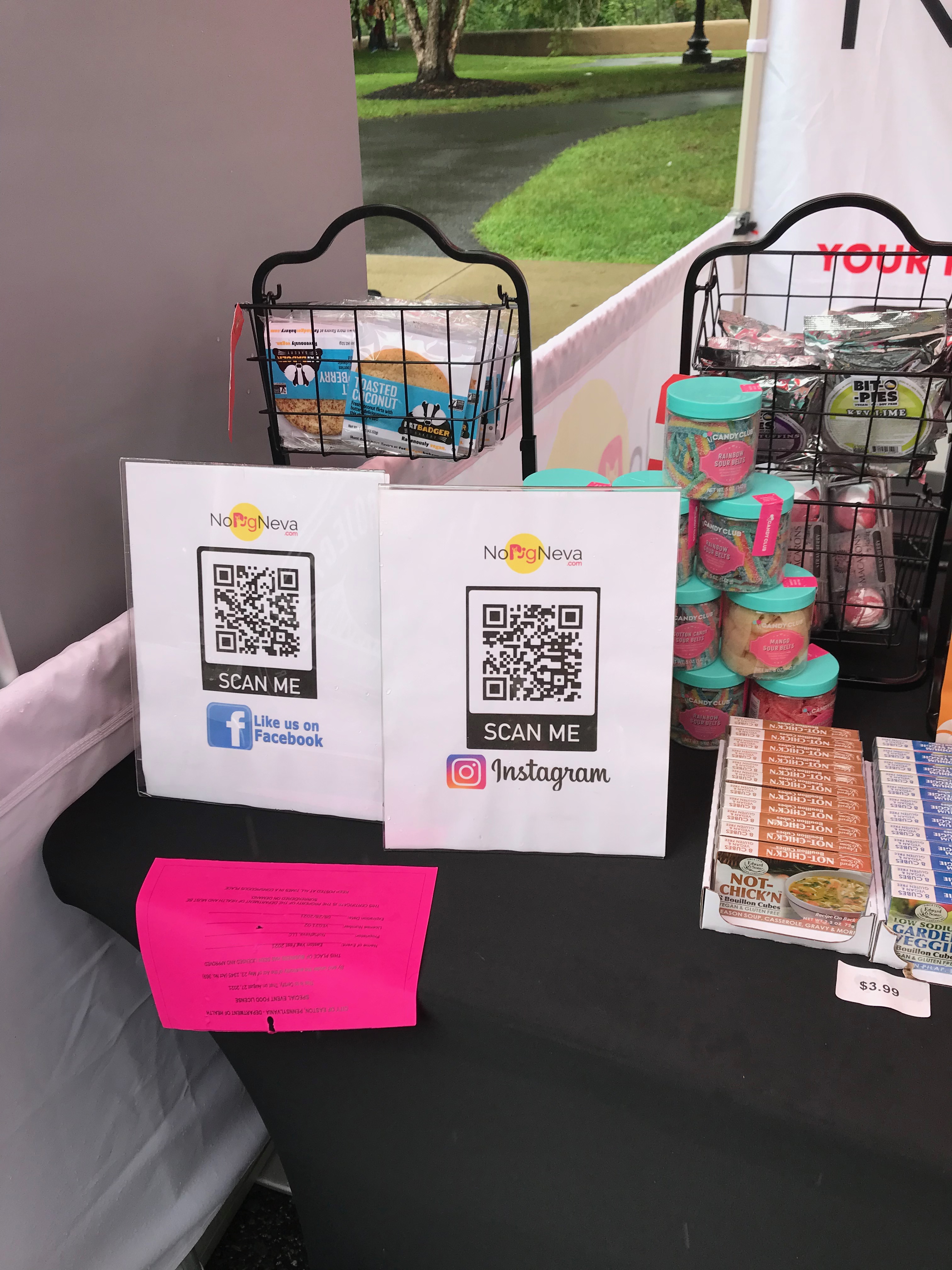
The rain felt like relief after the most recent heat wave.  We’d long planned to attend the Easton VegFest regardless.  Summer is the season for street festivals and it’s always a strange kind of affirmation to find one dedicated to vegans.  And to see so many people at it.  The cities of the Lehigh Valley have quite a few animal-friendly options for eating, and although the VegFest isn’t huge it’s a good place to find others who realize that our food choices matter.  So it was that we came upon the booth for NoPigNeva.  Now, if you’ve ever tried to shop for vegan food—I know there must be a few of you out there—you know how catch-as-catch-can it is.  Around here lots of grocery stores carry vegan items, but what you’re looking for may not be there.  Even WholeFoods in Allentown has a limited selection.

NoPigNeva is a supply company run by black women.  It supports worthy causes.  And it makes finding what you’re looking for essentially one-stop.  I’m no businessman, but I do wonder why, when they keep selling out of vegan stock, stores don’t get their orders refilled right away.  It’s almost as if we don’t want to believe people will buy it.  Vegan food has come a long way even in just the last five years.  I know that when I became a vegetarian almost two decades ago now I felt there was no way to get enough to eat as a vegan.  Options seemed so limited.  That’s no longer the case.  I’m guessing the success of the Impossible Whopper caught everyone (except consumers) by surprise.  Even now, if you order one (hold the mayo, please) you’re pretty much guaranteed it won’t have been sitting on the warming shelf.

There’s big money in the food industry.  I’m not a foodie, although it’s become fashionable to be one.  I do, however, think about whether my food is causing harm.  There is, I realize, no way not to impact the environment or other living creatures when eating.  Lessening that impact, however, and supporting historically oppressed groups feels good.  There is a morality to mastication.  Most animals, it seems, have evolved a fear of being eaten.  Perhaps we’re only starting to understand that breaking chains might have to begin with us.  Any industry (big agriculture) that tries to make it illegal to see where your food comes from is hardly to be trusted.  I trust more those willing to come to a street fair on a rainy Saturday afternoon to show that there is a better way.


Moral Compass

Where have all the morals gone?  Well, not exactly song-worthy, but it is a question I think about a lot.  You see, I work in publishing.  Publishing, above all, is a business.  People make their livelihood at it, and so they have to find a market that pays.  Money and morals don’t mix well.  A recent New York Times story pointed out that the political polarization that’s tearing America apart is reflected in bestsellers.  Political nonfiction bestsellers have topped the charts since Trump was unfortunately elected.  Books both pro and con have flooded the market.  What’s this got to do with morals?  Well, I believe publishing should be in the business of educating.  If you’re going to publish nonfiction, it should be material that doesn’t cause more problems than it helps solve.

When I look at a book, after checking the title and author, I next look at the publisher.  Some publishers are conservative, and that’s fine.  That’s what they do.  Most, however, consist of highly educated professionals who realize the severe, and continuing damage that Trump caused.  These publishers, however, will produce pro-Trump books if the numbers look good.  There’s gold in them thar hills!  I often have these scruples working for an academic press.  Some ideas are clearly distorted.  I’m no elitist—I’m still pretty much working-class all the way down to the bones—but education reveals when something very bad (fascism) is happening.  Others see it too.  Still, the temptation of all those dollars… it’s a real pressure, almost like being at the bottom of the ocean.  There’s money pressing on us and we want it.

The gray lady story bothered me.  Instead of publishers looking out their windows and seeing the political grand canyon of this nation, they see profits.  This is business, after all.  Just business.  Is there any such thing?  Morality informs the way you live, the choices you make.  Do I promote education, reflection, and sound reasoning or do I promote a very real 2024 threat of a man who leads by refusing to lead?  After elected Trump immediately began campaigning for his next term, loving the rallies, the cheers, the adulation.  Who doesn’t want to be worshiped?  But is that what we want to see three Novembers from now?  I remember the shock the morning after election day 2016 in New York City.  I see the damage four years of environmental degradation caused just when the effects of global warming were becoming obvious.  I see women demeaned.  I see voting rights quashed.  And now I look at the bestseller list and wonder where the morals have gone.


Still Too Close

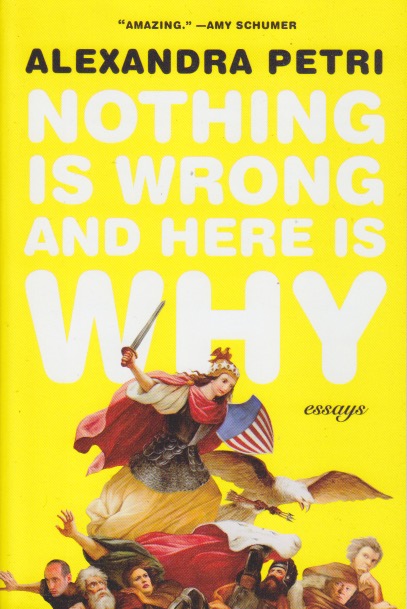
Parody is sometimes the best way to deal with a crisis situation.  As soon as I learned that Alexandra Petri had come out with a new book I was eager to read it.  Her last book, which I reviewed here some years ago, was such a delight—sharp and funny—that I fell in love with her writing.  Although she works for the Washington Post, I don’t regularly read newspapers (no time, if I want to read books) and therefore I don’t get regular doses.  Nothing is Wrong and Here Is Why is clearly a book written in a time of national crisis.  Yes, it’s funny, but the wound of the Trump years is still too raw to be able to laugh much about it.  Too many of his followers still don’t realize they were (are) being played and want him back.  It’s scary.

The first, and longest, section of the book are essays about the absolute ridiculousness of life under Trump.  It was a difficult and dangerous time for thinking people and although Petri excels as a satirical writer, the freshness of the terror—look at the Taliban and see if they are laughing—is just a little too intense.  Petri makes a great case for giving female leadership a try.  Any candidate, no matter which party, needs to know how the game is played.  And they must care about other people.  A pathological narcissist has no business being president of anything, let alone a democracy.  If you’re not familiar with satirical writing you’ll misunderstand just about everything Petri writes.

Once she gets beyond the section about Trump (shudder), the essays start to pick up some topics that it’s possible to laugh about.  Some of them are quite funny.  Although I enjoyed the book—when I started to put it down to get ready for work each morning I found myself saying, “I’ll read just one more.”  And three or four essays later I’d find myself rushing upstairs nearly late.  If it hadn’t been for the national tragedy called Trump, Petri’s second book might’ve been funny from the start.  Parody can be a defense mechanism.  At times things are just too painful to bear and those of us who write find ourselves doing our best to keep the mood light while society crumbles around us.  When things are ridiculous laughter is really what we need most.  We’re lucky to have Petri to provide it.  Here is why—she can bring a smile, or at least a smirk, even in a crisis.