I Saw Three Letters

For some reason I seem to have less time during lockdown than I had during whatever the opposite of lockdown may be.  Still, papers pile up and I have to sort and file them.  That’s when I saw three letters.  (You know, I like the Post Office.  I always enjoyed going to our local as a kid.  There was an air of expectancy, even before Amazon.  And stamps were a kind of passport to another reality.)  Once in a very great while I receive something interesting in the mail.  These three letters were examples.  Mostly they were examples of how little companies, and even the United States government, actually knows about me.  I keep going to the mailbox hoping the toilet paper I ordered from China has come.  Instead, strange letters.

One was written entirely in Spanish.  Now I’m no “English first” fan—I’ve spent far too much of my life learning other languages to suspect that one is superior to others—but my Spanish isn’t exactly pristine.  I wasn’t really even sure what the letter was about, and I wondered how my surname in any way suggested I needed a different language in which to do my business.  I don’t know why I saved the letter.  Maybe I figured I’d get around to translating it some day.  When there’s time.  A second letter was from a former employer of some seven years ago, informing me that I had been assigned a new password for the network.  Now this surprised me.  When said company asked me never to return, they intimated that I had to relinquish all proprietary information.  I wasn’t to try to get back into their systems.  In fact, it was their blocking of my account at work that was, in hindsight, the first hint that I was no longer an essential worker.  A couple weeks later another letter told me the previous missive had been a mistake.

The third of the letters came from our own government, if that’s what you can call it these days.  It explained to me that if I looked into my bank account I’d find some money they had magnanimously decided to return to me from the thousands and thousands I have given them unstintingly over the four decades I’ve been working.  This letter, like much from the government, really served no purpose.  Well, it was entertaining because it had a facsimile of 45’s signature on it.  And the toilet paper hasn’t arrived yet, so I think this particular letter may be very useful indeed.


Resurrectionists

“Resurrectionists” was the name given to those who supplied the black market for human bodies when medical science had scant access, back in the eighteenth and nineteenth centuries.  They’d rob graves, and sometimes kill their own victims, for the money medical schools paid for cadavers.  It’s just business, some would say, I suppose.  It was illegal, however, and carried its own death penalty at times, if a resurrectionist were caught.  I was surprised to learn that somehow the United States has learned to do large scale resurrection.  Clergy, hang up your stoles—the government’s got it covered!  I discovered this in the most unlikely of places, the World Health Organization’s daily situation reports.

Like many people I wonder when COVID the 19th’s reign of terror will end.  I don’t trust anything that comes out of the White House, so I look to WHO.  The daily situation reports give the recorded number of cases of the virus, which, despite progress, keep going up.  The US, as always, is the world leader.  In addition to giving the number of cases, the website also records the numbers of deaths.  This is a sad and sobering statistic.  Additionally, it informs reader of how many new cases and how many new deaths have been recorded in the last 24 hours.  Here’s where I learned of our godly ability.  On Tuesday the number of new deaths in the United States was -1696.  This represents a mass resurrection indeed.  If only we’d share the knowledge with the rest of the world.

Here’s the insidious nature of statistics and governments who abuse them.  Stalin famously noted that one death was a tragedy but a million deaths are a statistic.  The US isn’t the only nation to play with the numbers—we’re all just statistics after all—but it is a matter of record that the Trump administration wouldn’t let the Diamond Princess land, although in American waters, because it didn’t want those cases listed as part of our stats.  So it still stands.  They are listed, of all the nations of the world, as “Other.”  Lest there be any doubt, the Tuesday WHO situation report ended with a note that American authorities “retro-adjusted” the figures.  You’d think that we’d want to announce with trumpet blast that we’d figured a way of retro-adjusting 1696 deaths.  For those of us listed as non-essential employees this is perhaps meant as a ray of hope.  Our work may be just icing, and we may be a single digit in our uncaring government’s eyes, but we can be brought back from the dead by political fiat.


Bats and Bloodsuckers

In what looks (somewhat cynically) like at attempt to add newness to frightfully old news, the World Health Organization has renamed COVID-19 to the much scarier SARS-CoV-2.  The basics remain the same: the virus is transmitted the same way.  If it lands on a non-organic surface it soon dies without a host, rather like the elected officials of an old party once grand.  Like any parasite, it requires the life of another to prosper.  And so we find Mitch McConnell telling states to declare bankruptcy in a move taken from the Bible’s own playbook.  You see, during a famine in Egypt Pharaoh bailed out the food banks, and by buying all the land made peasants in essence slaves of the state.  The Good Book has all the answers.  A few generations later, however, and Pharaoh had to learn how to swim in the desert.  The divine economy is not without humor.

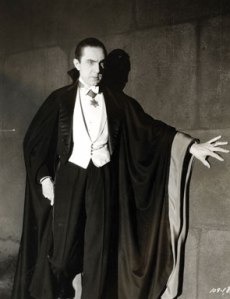
The WHO report also states that the vector has been traced to bats.  Bats make me think of vampires—I can’t help it, I’m a late monster boomer.  While WHO doesn’t make any connections with vampire bats, I researched them when I was younger.  Unlike elected members of the gOP, vampire bats aren’t selfish.  Nor are they greedy.  Finding a victim, the make a small incision with their sharp little teeth and lap up enough blood to survive.  If another bat goes a night or two without success, vampire bats will share their success, realizing in a way that politicians don’t, that helping one another is an assured way of establishing communal strength.  Or you could just be capitalist about it, let the unsuccessful starve, and go seeking another victim of your own.  Bloated bats don’t fly well.

If the Old Party learns from nature we’ll all benefit.  Greed is hardly the basis for sound government.  Nature would suggest that ingesting disinfectant isn’t the best advice to dole out to a nation about which you truly care.  The Old Party refuses to do anything, of course.  Having proven themselves unable to govern, they’re busy pulling together campaigns for November’s election.  With a leader who’s already said on national television that Republicans can’t win without gaming the election process itself, they don’t even blush.  I’m no expert, but it may be because they don’t have enough blood to rise to their cheeks.  If they’re short on blood it might be worth their while to learn a thing or two from vampire bats.


Peaceful Lessons

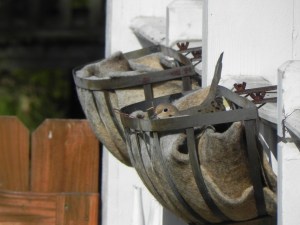
We are all, I think, looking for hope.  Probably due to the way I was raised, I often seek signs.  There’s no way to know if said signs are mere coincidences or the more intense variety known as synchronicities, yet we have a hopeful sign here at home.  On our front porch we have some plant hangers.  Spring crept up on us this year and we haven’t got around to putting any pansies in them yet.  The other day when I was stepping out to get the mail, I noticed feathers in one of them and feared there’d been a bird-related accident there.  As I took a step toward the planter, the head of a mourning dove popped up.  She blinked at me curiously, but didn’t fly away.  I knew then that she had built a nest in the as-yet unused planter and she was sitting on her eggs.

Monday was fiercely windy around here.  And rainy.  I wondered how any birds could fly in such weather.  A mourning dove flew up—perhaps one of the pair on our porch—and landed on the electric wire leading to our house.  The wire was swaying and bucking so furiously that the dove constantly had to shift and fluff and flutter just to stay in place.  The poor bird was in constant motion.  Then it showed a sign of animal intelligence.  There’s a much larger wire that runs down our street, from which other houses are supplied.  It’s more stable in the wind due to its girth.  The dove flew up to that wire instead.  There it was able to perch without having to constantly adjust itself to the gusts.  Peaceful and intelligent.  That’s what the world needs.  I have hope.

The dove has long been a sign of peace.  It’s understood that way in the Bible.  It was the dove that brought an olive twig to Noah, indicating that although all he could see was water there was, somewhere, dry land.  These days we need to be reminded that although it seems that the storm will last forever, even hurricanes eventually exhaust themselves.  The dove, clearly not happy about the horrendous wind buffeting it on that wire, nevertheless persisted in a kind of stoic optimism that things are as they should be.  There is great wisdom in the natural world.  If we can get to a window we can see it playing out before our very eyes.  Now when I step out the door, I glance at the dove, and she looks back at me.  We wink at each other.  She doesn’t fly away, for she understands.  She has a wisdom to which we all should aspire.


Prophetic Breakfast

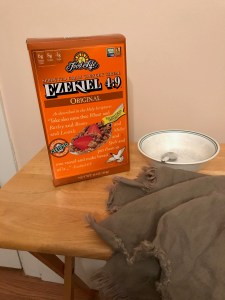
The irony doesn’t escape me—and why does irony always try to do that, anyway?—that Ezekiel 4:9 is about famine.  I’ve posted about the breakfast cereals from Food for Life (yet more irony, from Corona, California) before, but during this time of shortages at the local grocery stores, famine is an apt topic.  I don’t mean to underplay famine.  Death by starvation is something nobody should have to face, but looking ahead, who knows?  The reason I was eating Ezekiel 4:9 is that my usual cereal brand was sold out.  Empty shelves and the prophet seem symbolic, don’t you think?  The box quotes the verse as a kind of health-food recipe, but the point was, in context, that this was not something you’d normally want to eat.  This was food for hard times.

Ezekiel, you see, lived through the collapse of his own society.  In his case it wasn’t because of a virus, but imperial ambition.  The Babylonian Empire under Nebuchadnezzar was expanding and Judah was in the way.  The city was captured and Ezekiel, a priest, was exiled.  His symbolic action of eating poor food was to show people they ought to plan on this as “the new normal.”  Even now we hear people saying, “when things get back to normal…” but I also wonder if that will happen.  Collapse can occur slowly.  The thing about reading history is that we see centuries compressed into a few hundred pages.  Things take time.  Like restocking toilet paper.  Meanwhile empires crumble.

The Babylonian Empire didn’t last long.  Oh, it was long enough to mean some people knew nothing else, but looking back we can see that it held sway for decades rather than centuries.  In the middle of his book, Ezekiel changes his tune.  Once the temple is destroyed, when the worst has happened, he starts looking for a better future.  Many people have been under serious strain since November 2016.  Anxiety levels have been consistently high for damaging lengths of time.  I suspect the book of Revelation hasn’t been so well thumbed for decades.  The seventies were also apocalyptic times, as I recall.  Although we’re living through history, we each do it on the ground.  We experience it in our own little lives.  These seismic shifts can’t help but impact us.  It helps me to act like some things are normal.  I still get out of bed early.  I stumble into the kitchen and fumble on the light.  I settle down for breakfast with a prophet and wait.


Frankenstein’s Family

The story of Frankenstein has many unexpected twists and turns.  I’m currently reading a book about the writing of the novel—something I’ve done a number of times before.  There was an aspect of this story that hadn’t really caught my attention too much, but then, circumstances changed.  Suddenly old information became new.  It all started with a missed opportunity from childhood. 

It was a real puzzle.  Although my grandmother lived with us her last years, I never knew the name of her mother.  There had been hints.  My grandfather’s book with birthdays in it listed the first name, so I had a Christian moniker and birthdate only.  She’d died young, I knew, somewhere in the Washington, DC area.  This had been the state of my knowledge for many years.  My grandmother died before I was a teen, and before I took any interest in the family story.  I knew her heritage was Germanic, her father having been a first-generation American.

So young Mary Shelley (technically Godwin) was on a tour of Europe with her lover Percy.  Although they both came from distinguished backgrounds, they were cash poor.  Running out of money they made their way back to England as cheaply as they could.  They passed near Castle Frankenstein along the way, although there is no record that they actually visited it.  The name seems to have stuck, as does the story that they potentially learned about a mad scientist who’d lived in that castle.  This scientist was a theologian who dabbled in alchemy and experiments with dead bodies.  I know what you’re thinking—it’s like a puzzle piece we desperately want to go in this place but its fit’s ambiguous.  We’re not sure how much of this Mary Shelley knew.  The alchemist’s name was Johann Konrad Dippel.  I’d read about him before.

I’d spent nearly an entire summer some years back working on my grandmother’s family, finding little.  Just two years ago I did a casual search on “Find a Grave,” and to my surprise, I found my great-grandfather.  I knew it was him because his second wife’s name matched information from all the family records.  The cemetery record, in Maryland rather than DC, had his first wife’s name.  It was that easy.  After decades of searching, a few keystrokes revealed the mystery.  When it also listed her parents, the significance of her mother’s maiden name—Dippel—escaped me.  Now I have no way of knowing if this is the same Dippel family of Castle Frankenstein, but it put flesh on the bones of my long-standing interest in monsters.  Seeking them out may be the same as learning family secrets.  Perhaps it always is.


Die Besuch

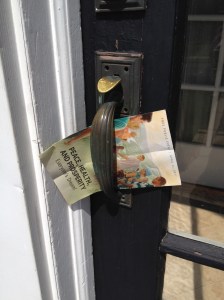
It was both sweet and perhaps misguided.  I’ve not written much about the coronavirus because I’ve really had nothing to say on the pandemic.  Also I’m squeamish.  Being a remote worker I spend most of my time alone anyway.  So when the knock came to my door, I wasn’t sure I should answer.  Afraid that some vital bit of information was to be conveyed, I gave in.  Two young ladies stood there and at first I thought they were selling Girl Scout cookies, but one of them had some copies of The Watchtower in a folder and I knew that the Jehovah’s Witnesses had come calling.  I didn’t invite them in.  I don’t mean to be inhospitable, but those who go around knocking on doors might have been exposed to who knows what.  They were here, the older one said, to give good news.

Although she didn’t mention the coronavirus directly, she said people were feeling anxious.  But God—our creator—had promised everything would work out.  She read me Revelation 21.4, about God wiping every tear from our eyes, from an iPad.  I’ve read that verse many times on my own, and, tainted with decades of specialist knowledge, knew a good deal about the context in which it was written.  The Witnesses didn’t stay long.  As they walked away I couldn’t help but think how this current scare has been affecting us all.  We are afraid.  I don’t need any advice when it comes to social distancing (I am an introvert, after all), but there’s a kind of hopelessness afoot.  I don’t read the papers but every headline is about the virus.  The world seems awfully quiet.

This will go down in history, I suspect, as a strange episode.  I feel guilty for conducting normal business, as if there is anything I could do to prevent the disease beyond isolating myself even further.  It’s perhaps the waiting.  Those of us in circumstances where joy is more fleeting than a visit from the Jehovah’s Witnesses often invest huge amounts of time waiting for things to get better.  The news, for example, that a piece has been accepted for publication.  Or that a long wished for promotion has come.  Or that somebody has actually read your book.  Such news is rare indeed and outside a disease rages out of control.  What else beyond missionary zeal would send you to strangers’ doors at such a time as this?  They didn’t even leave any tracts.


Icelandic Gods

There’s a lot to like about Iceland.  It has geothermal heat.  The people are literate and proud of it.  They don’t have an army.  Viking heritage and northern lights—what an interesting place!  A friend recently sent me a satirical piece on Patheos titled “Iceland Declares All Religions Are Mental Disorders,” by Andrew Hall.  I may not be as naive as I once was, but I have to admit I was nearly taken in on the fly.  Maybe because the idea seems so much better than what we have over here in our warmer, but less educated world.  Clearly, however, religion is extremely important to people, and if it is a mental disorder it’s an essential one.  Hall mades the astute point that Iceland didn’t want to become like the United States.  Who would, at this point?

Although this is a satirical piece, like most satire it works because it has chunks of truth in it.  Countries run by religions do seem to get into quite a lot of trouble.  I often think this is primarily a monotheistic problem.  If a nation accepts many gods, then adding those of other peoples is hardly an issue.  With a single deity, however, there is a single truth.  Anyone different is, by default, wrong.  When entire nations self-identify with a religion, it is only too easy to begin seeing those who believe differently just across the border as a threat.  Faith becomes fight.  As if a deity who always claims to value peace is only satisfied when we’re killing those who don’t share our same peaceful outlook.  Irony and satire have met together, it seems.

I’ve never been to Iceland.  It’s on my bucket list.  As a rockhound, the volcanic nature of the place calls to me.  I do wonder, however, how a vegan might fare on a far northern island.  My times in Orkney are among my mental treasures.  Those northern Scottish isles were places of wonder.  Not the most options regarding comestibles, however.  What they lacked in food they made up for in magic.  Iceland, despite the satire’s bite, has a considerable population that believes in the little people.  Anyone who’s too quick to dismiss such things ought to spend some time in the far north.  Driving to the ancient sites of Orkney certainly shifted my perspective a bit.  There’s great value in listening to the wisdom of those relatively isolated from the rest of the world.  You might, however, have to bring your own beans.


Vulnerability

Perhaps the most insidious thing 45 has been doing is undermining expertise.  If you’re like me you’ll be subject to that sudden, clenching fear that we live in a house of cards.  Everything is built on an extremely tenuous situation and we don’t understand the basis on which it’s built.  (That’s one reason I take such an interest in geology.)  So this morning I climbed out of bed around 3:30 a.m., my usual time.  There was no internet.  This has happened before, and I know enough to turn off power to the router and reboot.  This I did several times before finally calling RCN.  I pictured a tech sitting in a lonely basement at the wee hours, perhaps glad for a service call.  He was very nice.  Still, after having me do the basic checks again, he said he’d have to send a technician.  They, lazily, don’t start work until 8 a.m.

Now here’s where the expertise comes in.  Most of us use the internet pretty constantly.  We don’t know how it works, and when it’s broken we can’t fix it.  I can’t even figure out what some of these devices are.  In all likelihood the technician (my shining prince or princess) will not understand the underlying coding that makes the devices work.  They’ll be able (I hope, and if you’re reading this my hope is not misplaced) to figure out what’s wrong with the hardware.  I suspect even they, however, wouldn’t be able to lay the cable to my house, or repair it, if it were damaged.  We all rely on others farther down the line to know how to do their jobs.  Experts.  House of cards.  With a president claiming experts to be obsolete, I wonder how even the mighty could tweet without an internet connection.

All of this makes me feel quite vulnerable.  I work from home and I need a solid, reliable, steady internet connection.  The day we moved in, literally, two techs came.  It was a Sunday morning.  One of them fell asleep in the office chair while the younger one, who spoke no English, did all the work.  Every time I use the internet, I feel like I’m trying to add a new story to this house of cards.  I don’t know what to do if it goes wrong.  Since phone (and television, at least theoretically) is bundled in this, I can’t even call.  Well, I couldn’t if I didn’t have a cell phone.  My life is tied up with tech, and I can’t fix it if it’s broken.  I made it through a master’s degree without using a computer.  My frame of reference is ancient.  If a bird tweets and there’s no signal, does it make a sound?  Then, without explanation, the connection was reborn, just before 7 a.m.  Who says there’s no such thing as resurrection?


Human HU

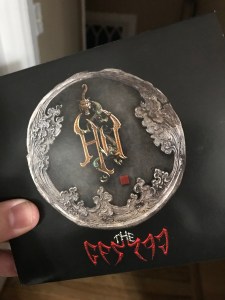
In these times of extreme xenophobia, we desperately need to understand those who are different.  When my brother recently shared his discovery of The HU’s album The Gereg, I was at first a little concerned.  That deep-seated childhood evangelicalism suggests anything that unfamiliar is bound to be satanic.  How unfamiliar?  Mongolian throat-singing unfamiliar.  Songs sung in Mongolian, unfamiliar.  Album art that could be heavy metal.  I’d never come across anything like it.  I suppose it’s a natural, knee-jerk reaction to say anything so unfamiliar is potentially demonic, and it shows just how paranoid a culture can be.  We think of 1950’s America as “the norm.”  I wasn’t alive then, but I’ve seen pictures.  Buzz cuts still give me the willies.  I trust Mongolians more.

I don’t know if The HU is a deliberate play on The Who or not, but the word roughly translates to “human.”  Like many ancient practices, nobody thought to write down the origins of throat singing.  Traditionally it was what Inuit women did when men were out on the hunt.  Like many aspects of hunter-gatherer society, it fascinates.  Some cultures reported that when Christian missionaries came, with their cultural imperialism in tow, they suppressed throat singing.  It looks like I wasn’t the only one raised to be suspicious of that which is different.  I learned, however, of my own cultural biases.  I learned that ones’ own assumptions must be interrogated.  If humanity is to survive, we must learn to try to understand one another.

Although the actual roots of throat singing are lost in unwritten times, I strongly suspect it has a religious, or if you prefer, spiritual, origin.  When women gather it isn’t the same as when men consolidate power and institutionalize violence.  I’ve read that when women rule there is a strong impulse to cooperate, to suppress aggression.  Men can learn this.  Indeed, as those white, male missionaries took up their positions in far-flung parts of the globe they spread the idea that men alone held the divine right of, if not kings, priests.  Conversion, you see, is seldom gentle.  Making the world in your own image, if you’re a man, runs into certain obvious problems right away.  HU means human.  When I feel the cold paranoia of my own government creeping up on me, I cue-up the soundtrack of my life.  I’m no longer a young man, and I don’t fear the different as much as I used to.  I need to hear something different, something human.


The Reading Bug

With the sunshine coming in my office can feel pleasantly warm in winter.  I chose this location not because of its southern exposure, but because it is a small room and it’s a good place for books.  Although it’s January, the sun brought a shield bug to life the other day.  At first I didn’t know what it was.  I’d hear a loud buzzing followed by a rather obvious crash, but I saw no insect.  Since we had a string of sunny days it kept reawakening in the mornings, warmed by sunlight on my windowsill and spent the days climbing on and sometimes attempting to fly through the glass.  I identified the beetle quickly once I saw it.  As I watched the poor creature’s progress (or lack thereof), I was sorry that I couldn’t release it outside.  It was still quite cold out, and I didn’t think it would survive.

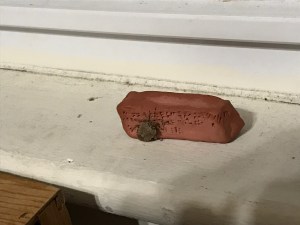
Spending long hours in the same room with my perplexed insect friend, I came to ponder what its experience of life was like.  I’m no Franz Kafka or Thomas Nagel, but I had to wonder when it chose to spend the night on a clay replica I had made of an Ugaritic abecedary.  I’d made this clay model when I was teaching, and I used it as one of several visual aids to help students understand how writing had developed.  (I had even ordered authentic papyrus to pass around, and the single sheet of vellum cost more than an entire book in those days.)  My doctoral work largely focused on Ugarit, and in the 1990s it looked like that sub-specialization might be on the ascendant.  We often live to have our mistakes rubbed in our faces.  But why had the shield bug picked this very spot to roost?  It looked as if it were trying to learn to read cuneiform.  It needn’t bother.

Although I habitually awake quite early, it isn’t easy getting out of bed.  Especially in a cold house during winter.  My entomological friend, of course, had to wait for the sun itself to come back to life.  Night on the windowsill can’t be comfortable, especially when the radiator is under the other window in the room.  No matter how much I try, I’ll never know if I’ve succeeded in understanding the experience of that bug.  How it is enslaved to the sun, and how it keeps on climbing, even after it falls, raising a tiny geyser of dust.  How it flies full speed into a barrier it cannot see, and then tries again.  I may not be able to understand this beetle sleeping on my Ugaritic alphabet, but I do think there’s something here to learn.


Space Farce

Okay, so “Space Force” sounds like a gimmick that you’d see in a 1950’s ad geared to dungaree-wearing boys.  These boys, who’d be named “Dick” would show the girls, named “Jane,” just how it was done.  So as I read about the furor of dedicating a King James Bible from the Bible Museum as the official Bible for military branches aimed at the stars, I had to think how very small we actually are.  So 45 thinks, like Reagan thought, that we need outer-space defenses.  These guys need to read more science fiction.  Actually, some plain old science would help.  If there are most advanced civilizations out there—and such seems increasingly likely, given that our understanding of science is subject to change—we are nothing more than cosmic mosquitoes buzzing close to our own planet where we can wail on each other in the name of lucre.  And we call it “Space Force.”

An article on NPR points out the hypocrisy of swearing in the military on a Bible.  One guy in there, I’ve heard tell, was called “the prince of peace.”  He’s somewhere near the back.  The public loves a good warmonger, though.  We can send our tentative rockets into orbit where bug-eyed aliens laugh with bemusement, and say “Just you try something.”  Or we can make business deals with Russia with one hand while pointing our missiles in their direction with the other.  Is that a missile or am I misreading something, Dick?  I can’t ask Jane, because she just follows along.  Maybe we’re inheriting the consequences of those who grew up reading Dick and Jane.  Boys with their rockets, girls with their dolls.

Bringing religion into the military is nothing new.  German soldiers marched out into a couple of World Wars with “Gott mit uns” inscribed on their waists.  Millions died.  No lessons were learned.  So now we want to take conflict so far over our heads that we can’t even see.  Ancient people knew the gods were fighting far above.  That’s how they made sense of the world.  Some, like Erich von Däniken took those stories literally and thought our alien observers were the reason.  Now that we’ve got drones we have no need of UFOs anymore.  All that sci-fi I watched as a kid wasn’t wasted after all.  Only I grew up reading that Bible instead of swearing on it.  I was pretty sure that war wasn’t a good thing, as he rode on a red horse with his sword pointing upward.  Time to dust off William S. Gray and get back to watching Space Force. 

From NASA’s photo library


Dancing

An artist is never really gone.  I have been listening to Leonard Cohen’s posthumous Thanks for the Dance.  Haunting in the way of Bowie’s Blackstar, there’s a poignancy to listening hard to the dead.  Especially when they saw it coming.  Artists are never really gone, and we can forgive them because they’re oh so very human.  Cohen was an exceptional poet and this album captures a man who knows the end is near.  Still he sings of girls and sins and God.  There’s an eternal soul there, and Cohen captures longing better than just about anyone.  The artist knows longing and understands not knowing for what.  The album struggles with religion and depression, a remarkably common combination.  Memories of glories that linger even as the body ages.

Listening to someone else’s music is taking a stroll through her or his head.  Someone once gave me a disc of songs built around a theme.  Although the theme came through I feared a little of what I heard here.  Some who know me primarily from my overly pious upbringing would be shocked to find Cohen on my favorites list.  For me he has no pretense.  Instead of ignoring religion, sexuality, or politics, he tried to make sense of them through song.  For me—and listening to music is a very personal thing—I think I understand when I’m drawn into his lyrics.  His experience of life was vastly different from what mine has been, yet he’d accurately mapped the direction my mind might wander, if given free rein.  Religion will hold your imagination captive, if left to its own devices.

Those who reduce Leonard Cohen to his over-used “Hallelujah” catch only glimpses of this complex man.  I once read an article about Bruce Springsteen in which a friend of his said that if he hadn’t succeeded in music he might’ve become a priest.  There’s an authenticity to these artists who write probing songs that have deep spirituality yet allow themselves to be human.  Cohen’s songs revealed he could see death with some ambivalence from afar.  Even in albums recorded thirty years ago the hints were there.  Instead of running and attempting to hide, Cohen’s lyrics, at least, indicated that he’d continue to try to live.  Maybe these are just the reflections of a middle-aged man who’s only glimpsed a fleeting connection between an artist in perpetual motion and a one-time scholar sitting up alone at 3:00 a.m., seemingly stuck in one place.  Whatever else they may be, such quiet moments will ones be haunted by Thanks for the Dance.


Smelling Winter

We’re experiencing the January thaw around here.  This isn’t a scientific thing, of course, and it doesn’t happen every year.  We had snow before Christmas, but it didn’t linger too long.  We’ve had cold days since, but none so bad that I couldn’t jog a couple miles over lunch.  The ground has started to freeze but much of the grass is still green.  The changing seasons are largely olfactory to me.  You can smell fall and spring coming.  I’m not talking about burning leaves in autumn or the first hint of magnolia in spring.  No, I mean the aroma of the earth.  Stuck indoors as we often are, we’ve been conditioned to think our sense of smell is under-developed and therefore unimportant.  Overall, however, humans don’t rate too shabbily in the nasal range.  We don’t experience the aromatic realm as much as dogs, vultures, bears, or mice, but our sense of smell is vitally important.

Not only does smell tether us to memory, it also influences moods.  Studies done on those deprived of scent by disease or accident indicate higher levels of depression.  All of us know how vital scent is to taste.  We don’t appreciate, I suspect, how the aroma of our earth can inspire us.  Yesterday as temperatures crept into the 60s, I stood outside breathing deeply. It was only in my back yard, and the clouds were low and gray.  Spring clearly came in the gusty air.  I know that the bulk of winter lies ahead.  January’s only just tuning up, and February has us in its sights.  The aroma of spring will once again be frozen to await release in more timely fashion.  I’ve been feeling chilly since October, layering up and reluctantly bidding goodbye to the scents of autumn.  Winter’s sterility has begun, but we’re being teased just now by a nature that likes to remind us who’s really in charge.

As I grow older, I’m hoping I’ll learn to smell winter.  My nose spends too much of it feeling cold, and when I wrap my face in a scarf, I have only my own breath to breathe.  What is the odor of winter?  The faint hint of smoke from a neighbor’s chimney?  The briny tang of a freshly salted roadway?  The pine of a newly cut Christmas tree?  Outdoors there’s life throbbing, pulsing slowly beneath the chill.  Even after the great ice ages, it was ready and eager to reemerge.  Today I smell spring in the air.  It’s not yet here, and won’t be for some time.  Scent is ever only temporary but today there’s yearning in the air.


All in This Together

The rain falling from the dark sky is barely liquid.  The thermometer reads 33 as we step out into the early evening—this is not the kind of night I’d want to be outside, but this is important.  When we arrive in Bethlehem there are already maybe a couple hundred people lining Rose Garden Park with signs.  We park and join them.   Many of the signs are clever and to the point: “I shouldn’t have to miss Nixon,” and “Vichy Republicans—shame on you!”  This winter of discontent, crumbling democracy, we are here as warm bodies on a cold night to protest what has gone on far too long.  The impeachment vote is scheduled for today and across the country people have come out—supper hastily eaten or yet to be started when they get home—to say enough is enough.

Now Pennsylvania isn’t the bluest of states.  I wasn’t sure of what our reception would be on the busy corner of 8th Avenue and Union.  I was amazed.  Large numbers of cars, and even some commercial trucks, honked their horns in support as they drove by.  Thumbs up out windows in the cold air.  Long blasts on horns.  For sure, many drivers remained silent, but only three that I counted bothered to roll down their windows and shout support for Trump.  They were treated respectfully and cordially by the protesters, many of whom were considerably older than my wife and me.  I listened to snatches of conversations as my fingers and toes grew numb.  Vietnam vets, and even one from the Second World War.  Retirees who should be spending December nights in their warm homes.  We all had something important to do.  We had to stand and be counted.

Because of a childhood incident, I suffered mild frostbite on my fingers and toes.  It is excessively painful for me to be out in the cold to this day.  We could only stay for about an hour and a half.  It was a work night after all.  There were many stalwarts still holding signs and chanting as we headed back to our car.  Around a sign for the park where other, more temporary signs stood, a protester said, “Someday maybe we won’t have to do this anymore.”  A younger man corrected him.  This happened because we failed to be vigilant.  Vichy Republicans are a real thing and although the elections are about eleven months away, we need to get ready.  We need to get everyone out to vote.  If the signs of support we saw last night reflect the feelings of Americans, it’s time for us to become a democracy again.