Whose Reality?

It was a groggy, foggy morning when I stepped off the bus in St Andrews. I’d been here before, but it had been over two decades ago, and with my wife, who is my navigator. I knew the International Society of Biblical Literature meeting was here, but I didn’t know where. Instinctively, I headed toward the medieval part of town. A religion conference, I reasoned, would best fit there. Seeing no signs of the inimitable professorate that I associate with the Society, I finally stopped into a university office where a dubious-looking receptionist peered at the conference letter and shook her head. The she spied a familiar address on the letterhead. “Ach, that’ll be doon this way, past the second roond-aboot.” Having lived in Scotland for over three years, I understood. I suppose if I’d just read the materials sent ahead more closely, I would’ve known that we were meeting in the newest part of Scotland’s oldest university.

A religion and science reunion came in the form of the physics and maths building where the meetings were being held. Science grad students, somewhat bewildered by so many biblical scholars, pushed open their lab doors with a sense of wonder—and perhaps disbelief. Could so many educated people seriously spend their time on the Bible? Science, after all, now has cornered the market on truth, hasn’t it? What hath Jerusalem to do with St Andrews? Ancient universities were generally founded to study theology. In 1413, when St Andrews opened its academic doors, God was the undisputed arbiter of truth. Now high-tech fighter jets scream overhead in nearby Leuchars, and we are secure in the ability of science to save us. And still biblical scholars, like the horseshoe crabs, come together in huge numbers on the beachhead of the human psyche every year.

To the student trained in the sciences, I have no doubt that we appear superfluous. Nevertheless, without religious belief, or the Bible, our society would not be where it is today. Although now it seems that science and religion bear deep hostility to one another, they actually grew from the same root and have a similar goal—to discover the truth. Science finds no evidence beyond the material, but religion declares the material as the perennial under-achiever. Scholars of the Bible from around the world, many of them not religious believers, expend their limited resources to come to one of the more inaccessible tourist destinations of Scotland and meet in a clean, modern, comfortable sciences building. Across town, in the heart of the old, medieval district, stand the remains of a once grand cathedral. Still majestic in its glorious decay, the church towers over a town once ruled by religion where now science and golf define the new reality.

DSCN3582


Burning Faith

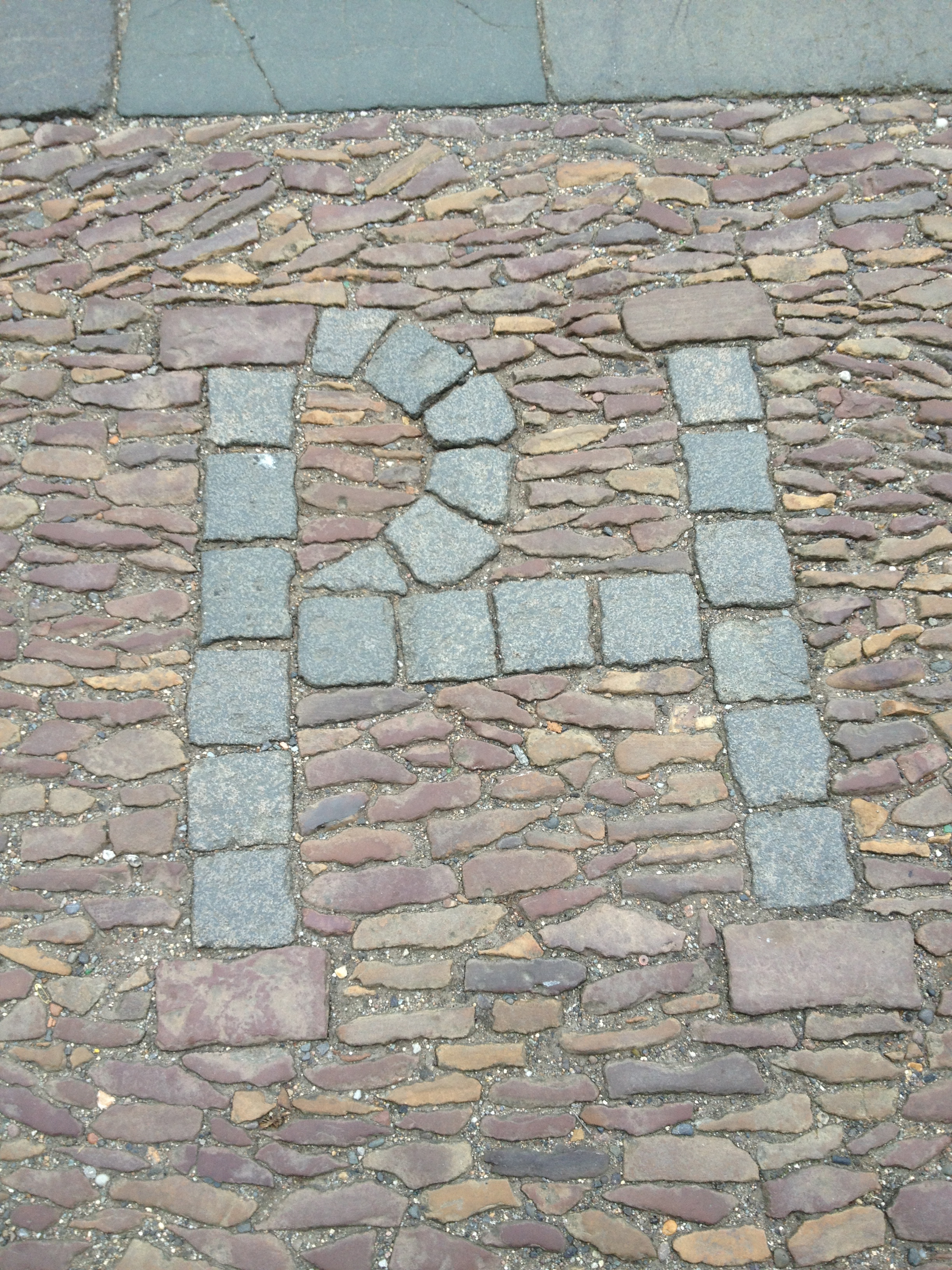
1528. February 29. St Andrews, Scotland. 24 year old Patrick Hamilton was burned to death for espousing the teachings of Martin Luther. St Andrews University is the oldest of Scotland’s four ancient centers of higher education. Heterodox religious teaching was considered a very dangerous thing in those days, especially in the halls of academe. Once infected with Lutheranism, like a zombie, you had to be burned so that the rest of the world could be safe, the virus contained. Only the problem in this case was an all too human one—difference of opinion regarding religion. The Thundering Scot, John Knox, would’ve been all of about 14 at the time, and reformation for the Catholic Scotland was still years in the future. Now, one of the largest European cathedrals, in St Andrews, lies in ruins because of that very reformation.

Religious bickering has a tendency to move beyond the ridiculous to the insane. Burning young men, after decades of burning hundreds of young and old women alike throughout Europe, was one of the most heinous symptoms of a horrid madness that had grown from religious fervor and fear. Religion itself is not to blame as much as the human tendency to use it as a weapon against those who are perceived as different. Some five centuries later and the physical stakes are gone but the fervor and fear are as strong as ever. As we hear politicians and televangelists lash out against those of whom God disapproves, the smoke still rises from the spot where Patrick Hamilton, late of the University of St Andrews, was sacrificed for his faith.

IMG_0729

Ironically, as I sat on the quiet morning train from Edinburgh to Leuchars, from the headphones on the young man behind me wafted AC/DC’s “Highway to Hell.” Was Patrick Hamilton aware that he was on a literal highway to hell as he returned home to Scotland? Did he have an inkling that his own people would torture him to death because he taught such dangerous ideas as salvation by faith alone and Scripture as the instruction for that salvation? Could anyone have guessed that the then teenaged John Knox would introduce what was to become an even less forgiving form of Christianity to Scotland by the time young Hamilton should’ve reached his dotage? Religion is funny that way. Even those who give their all to defend it easily become its victims. And a few yards down the road the Society of Biblical Literature meets in a university building dedicated to the sciences. History’s ironies never end.


The Importance of Being Honest

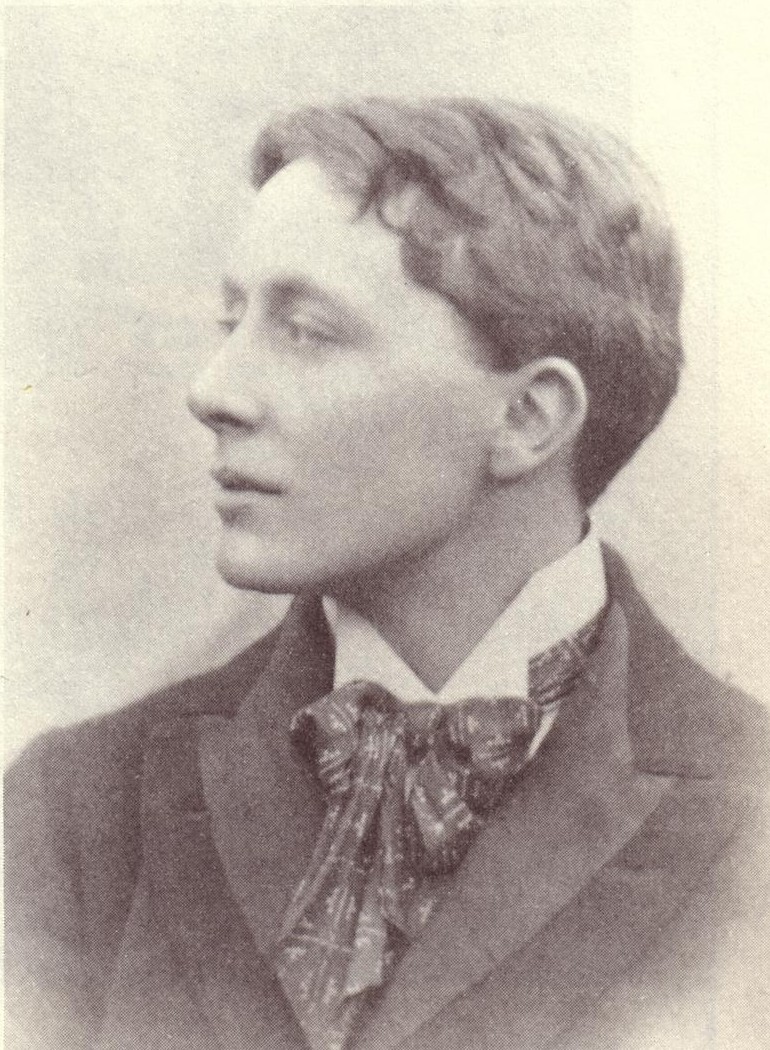
JohnGrayContinuing our quest to be a family out of sync with the modern world, we used part of our free day in Edinburgh to take the Book Lover’s Tour. Edinburgh has a long literary history that includes such writers as Sir Walter Scott, Robert Louis Stevenson, J. M. Barrie, and Sir Arthur Conan Doyle. A more recent star in that constellation is J. K. Rowling. The tour we took was led by the redoubtable Allan Foster, a geology student turned literary psychopomp. Although not associated personally with Edinburgh, Oscar Wilde had an unusual connection that made for an interesting tale. One of his male lovers, John Gray (a model for the eponymous Dorian) eventually became a Catholic priest, and lover of a wealthy Russian poet, Marc-André Raffalovich. When the Gray was assigned to St. Patrick’s in Edinburgh, Raffalovich was appalled at the state of the building and offered to finance a new church with the provision that his friend be appointed priest in charge. Thus the new building came to be and still stands on Cowgate.

Of course, nowhere is the priest or his lover, benefactor of the parish, mentioned in the church literature. Morality often parades as self-righteousness. Secret lives are not restricted to the clergy, of course. The fact is that people everywhere are human, and people are complex. So complex that we will sometimes carry on a charade to ensure religious respectability, to the point of having political candidates endorsed by clergy for issues that run counter to the very sources of their funding. Righteousness can be very costly, but self-righteousness comes cheap. Religious systems that demand standards that they can’t uphold either collapse or excel in duplicity.

When the tour was over, we walked by St. Patrick’s church. I wondered how many of the patrons knew the history of the lovely building they use for worship. Should they take a literary tour and learn the background of the church, would it make any difference? Ethics can be a matter of convenience, particularly when it is a matter of sexual propriety. Somebody else’s sexual propriety, that is. The real business of religion should be helping to improve authentic lives. Today it has often become the business of supporting the political system that bankrolls the special interests nearest to one’s heart. And reading, especially of unapproved materials, only gets in the way.


Persistence of Memory

I’ve posted before on sacred geography—the idea that a place is holy for some reason or other. That holiness is very personal, and although some locations seem to draw national, or even international, veneration, special places are intensely individualized. Edinburgh is one of those places for me. I haven’t been here for 21 years, after a stint as a post-graduate that lasted for three years and three months. Walking into Edinburgh from Waverley Station yesterday was overwhelming. Of course, it helped that the sun was shining (somewhat a rarity in these latitudes) and that my daughter was seeing it for the first time. Edinburgh is one of the truly beautiful cities of the world, but in my case, it is also invested with my personal history here. Once I called this city home.

DSCN3452

Wandering about, noticing the changes—Edinburgh has always drawn tourists during the summer—it was clear from the many languages and accents that people from all over the world were exploring the main touristed areas: the Royal Mile, Greyfriars Bobby, Princes Street Gardens-for me the experience seemed to run deeper. They will leave, I hope, with only positive memories of this mystical town, for a fair bit of medieval magic still hovers about it. For those of us who experience Edinburgh as sacred, however, there is good and bad mixed. I not only laughed here, but I cried, I worried, I was frustrated, sad, elated, depressed. I poured myself into a life here that I knew was ephemeral, temporary, destined to pass in the short hours that define one’s young adulthood. How could I have ever left? How can I ever leave again?

Away from the tourists, we wandered back to the places we used to live. How is it even possible, I wondered, staring up at the windows of our old flat, that I was ever bored there? Even the sacred, with constant exposure, becomes profane, I guess. And it requires an absence—perhaps two decades is far too long—to bring it back into focus. I am bursting open here. Some tourists are, I’m sure, busy falling in love with Edinburgh for the first time. For me, it is returning to an old friend. Twenty years of being heartlessly bounced about from job to job make the place I was born seem far less inviting than the streets and alleys that inspired Harry Potter and Waverley. This is the Nunc dimittis of my soul at this very moment. It comes to mind, Faust-like, whenever one enters paradise, knowing it will last for a few moments only.


Like Virgins

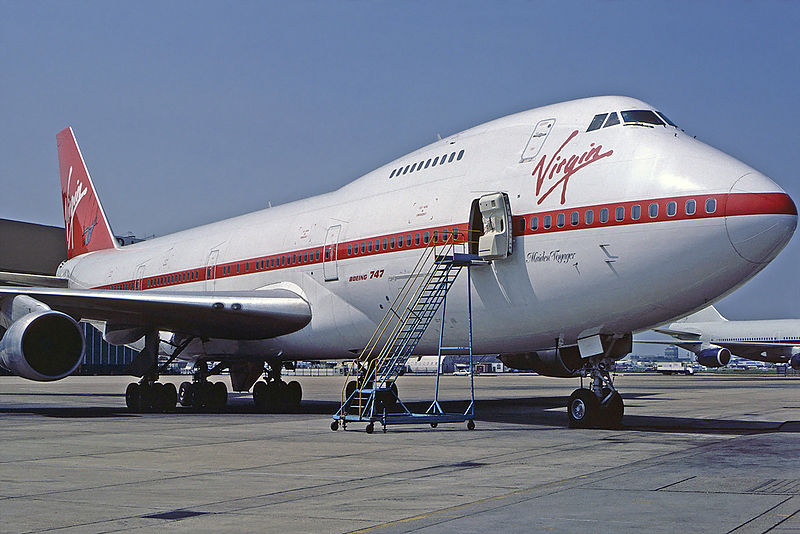
If you are reading this, I have safely arrived in the United Kingdom, courtesy of Virgin Atlantic. Given the lens through which I view everything, I somehow supposed that Virgin Atlantic was named after one of history’s two most famous Madonnas—the Blessed Virgin Mary, or just plain Madonna. It turns out that I was wrong on both counts. Virgin Atlantic, famously under the leadership of Richard Branson, borrowed its name from its older sister company, Virgin Records, also founded by Sir Branson. Virgin Records, I had supposed, was named after the only musical Madonna, but again, not so. The record company, new to an inexperienced Branson, was named by a colleague who noted that they were business neophytes, like virgins. The original logo showed an Eve-like virgin with a snake and everything.

Steve Fitzgerald's pic from WikiCommons

Steve Fitzgerald’s pic from WikiCommons

While in the UK I always call on Nick Wyatt, one of my doctoral advisors and now a good friend. As my mentor in Ugaritic, we always joke that I fly Virgin Atlantic because of the Virgin Anat, Baal’s famous warrior sister and sometimes lover. Anat was, of course, not the first perpetual virgin. The Mesopotamians had the idea that a goddess could be a perpetual virgin and still have kids, and what led up to said motherhood. Virginity is a status marker, still unfairly applied to women. I suspect a good part of it is biology (and if this seems weird, blame it on the jet lag), because the essential male reproductive function occurs whether or not a female is present, and even the most saintly men can not, from time-to-time, barring very extreme measures, avoid it. It is difficult to measure virginity in men, so why the double standard?

In this early morning haze (or is it really afternoon?), I suppose it comes down to not wanting to support somebody else’s child. Looks are at best a lackluster proof of paternity, and in the days before effective birth control, the only way you could be absolutely sure was to make sure your spouse was a virgin. Goddesses could get away with sex and still retain their purity. It was less sanguine for the human woman. Thus the Virgin Mary is accorded a special, but not unique status. But it turns out that none of this really matters because the Virgin I fly is merely a business virgin. And with a bit of experience, provides some of the best care in the air.


Bonnie the Brave

As a preemptive warning to my regular readers (am I’m sure you both know who you are), I am off today for a stint in my old haunt of Scotland. Before you get out your congratulations, be advised that this trip is for work. The Society of Biblical Literature, in addition to the big meeting about which I sometimes post, holds an international meeting every year. Since my employers frequently want me out of the office, I am being sent to the fair city of St Andrews in the kingdom of Fife for a week. Although I studied across the Firth of Forth in the wondrous town of Edinburgh, I ventured to St Andrews a time or two during my postgraduate days. By that time anyone in tune with popular culture had seen Chariots of Fire, and it was almost a requirement of credibility to visit the famous beach on the North Sea where the actors iconically ran as the movie began. And as in Chariots of Fire, I’m not sure that wifi access will be readily available. Should I find access, I shall gladly update my blog with my customary observations. If I fall silent, you’ll know why.

Scotland had a tremendous draw for me as I was contemplating where to complete my studies of religion (as if one ever can). Not that I was Presbyterian, and not that I have Scottish ancestry (although Celtic is represented in the Irish stowaway on my father’s side a few generations back)—it was the antiquity that drew me. One of the mysteries, to me, of new religious movements, is how people can believe in a religion that recently began. Should there be a supernatural, I’ve always supposed, and should that supernatural be concerned that humans have the truth, why wait so late in the story to start? It was such thinking that drew me from Methodism to its estranged parent, the Episcopal Church. Among the Episcopalians are many who argue for a continuity with the Catholic tradition, separated, literally, only by a matter of divorce. And Catholics go back to Jesus himself, a member of a religion so old that even the Romans grudgingly respected it (Judaism). I guess I’m guilty of old-school bias.

Kim Traynor's Edinburgh, from Wikicommons

Kim Traynor’s Edinburgh, from Wikicommons

So it was that I came to spend some years among the Presbyterians at Edinburgh University. The Ph.D. that I earned there translated to an unfortunately brief career doing what I’m best at—teaching. My tenure at Nashotah House never offered the opportunity to travel back to Scotland, or even England with its Anglicans. And as I prepare to board a plane across the Atlantic, although strictly for work, I can’t help but to reflect on those years of intensive learning, hoping to do my Scottish alma mater proud. And returning to the States to have my career shipwrecked on the rocks of unforgiving religious dogma. It may be that once I’m back among the heather and thistles, I may cast my laptop aside and try to claim religious asylum in a past that I can only see through rose-coloured glasses.


Heavy Metal

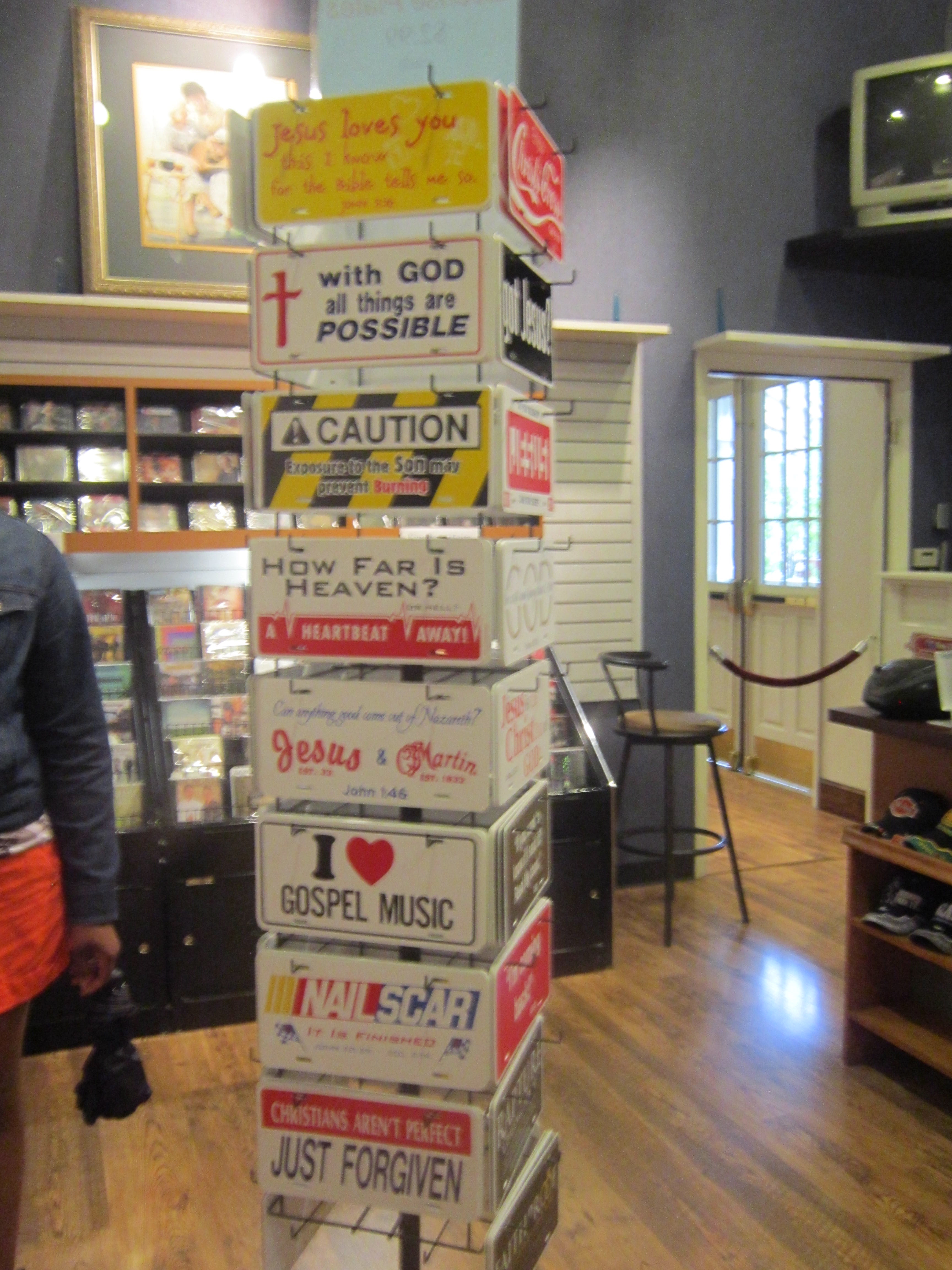
“I drive my car, it is a witness. My license plate, it states my business.” Only the hardcore may be able to place this quote from Daniel Amos’s impressive 1984 album Vox Humana. Even when I moved away from Christian rock after college, I kept Daniel Amos in my head—this is truly inspired artistry. Pop culture and religion courses have become a standard offering in religion departments over the past few years. We are, even as secular as we may be, a very religious society. When my daughter’s high school music program went off on its biannual concert tour, this year they headed south. On the itinerary: Dollywood. I came near to Gatlinburg, Tennessee on the trip I made to South Carolina to see my father for the final time, but I did not stop. I am told, however, that Dollywood is something to see. In one of the gift shops, my daughter snapped a couple of photos for my blog that draw all these disparate thoughts together.

IMG_1213

What we put on our cars is what we want the world to know about us without ever seeing us. This makes cars a perfect evangelistic tool for both the shy and the aggressive. The car becomes a tract. A statement that this vehicle is driven by an evangelical. I’m not sure it makes me feel any safer on the road. How many times have I been rudely cut off in traffic only to find a Jesus fish winking at me from the bumper of the offending car? Sometimes swallowing a Darwin amphibian. Religion speaks more loudly behind the wheel than it does from the pew. In the stress of traffic, what do we really believe?

IMG_1215

Cars are also the ultimate tools of self-assertion. Human beings, with little natural armor or predatory equipment, surround themselves with metal and accelerate themselves at velocities that nature never intended. We feel godlike behind the wheel. That metal box in front of us, driving too slowly, or having just pulled some stupid maneuver, is not a person. It is a thing. And those who choose to declare their faith on that object are under constant judgment. Well I know the evangelistic pressure to witness—fundamentalists are expert at manipulating guilt. Put these plates on your car and the world will know what you really are. But be careful. It’s not how you say, but how you play that will express what you truly believe.


Parochial Education

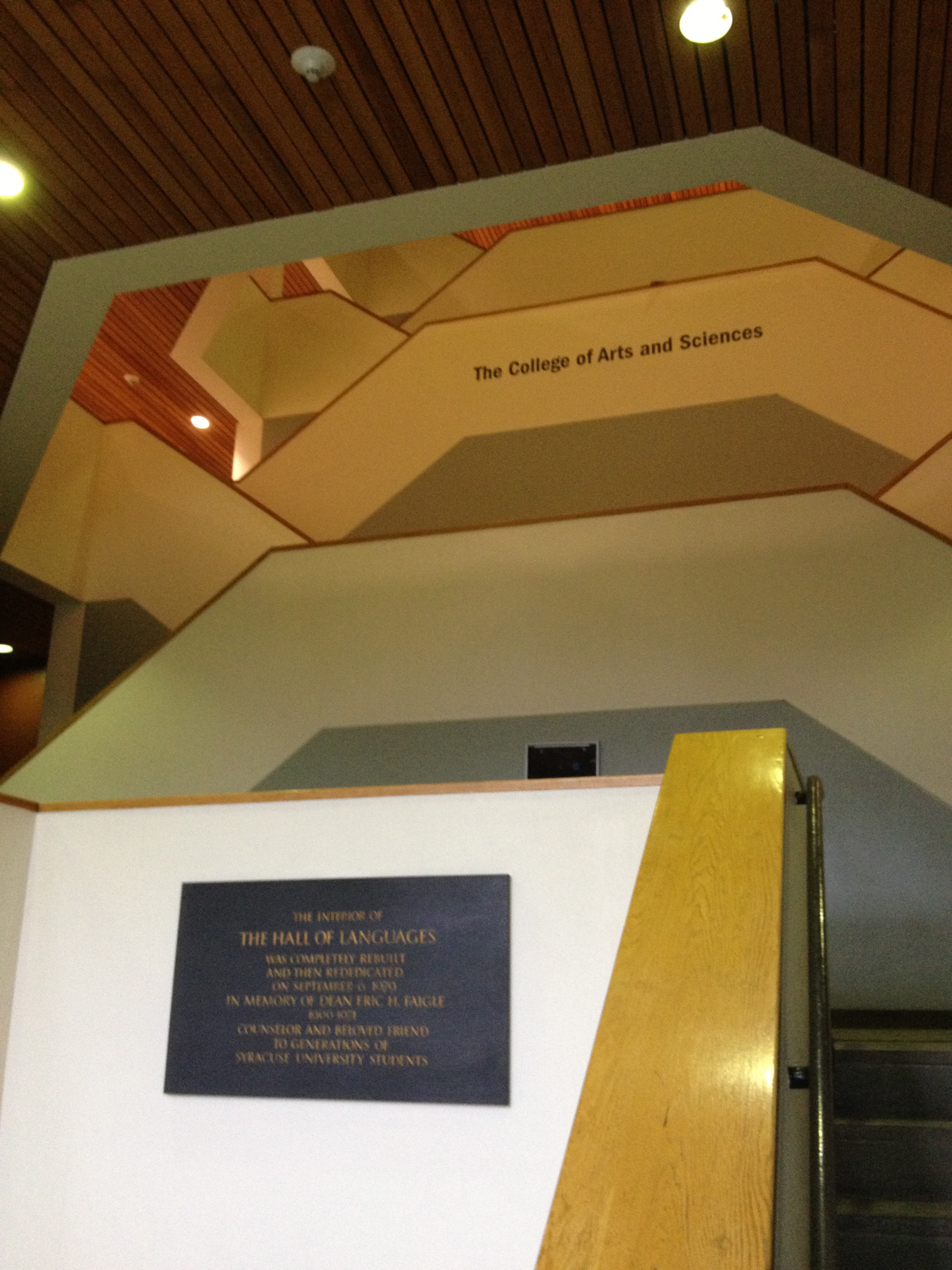
I’m sitting in King David’s Restaurant in Syracuse, New York. I’ve spent two days speaking with a wide diversity of religion scholars, and I’m realizing religion is not yet dead. A few days ago I wrote about the Burnt Over District and the Second Great Awakening. It occurs to me as I climbed the hill to the Religion Department in the rain, that I am on the trail of that Great Awakening. Syracuse University began as a Methodist school. Today, although affiliated with the United Methodist Church, it considers itself non-sectarian. Yet without those abstemious Methodists, they wouldn’t be here. The Methodists, now primarily represented by the United Methodist Church, owe their explosive growth to the Second Great Awakening. Out on the frontiers—for America was a rural nation—the revivals became showcases of the social, the supernatural, and the salacious. The Methodists and Baptists, in terms of numbers, benefited immensely.

With their enviable population base, the Methodists invested in higher education. Syracuse University, just up the hill, Adrian College, Boston, Central Methodist, Drew, Duke, Emory Universities, Florida Southern College—you could go nearly through the alphabet and not exhaust their schools—all owe their beginnings or present stature in part to those thrifty Methodists. Believers in an educated clergy, they reached out to embrace an educated laity as well. Although many of these institutions grew up and left their religion behind, the Methodists have impressed their stamp on American higher education unlike nearly any other denomination. Even when numbers in the pews decline, the Methodists will have left a legacy on the wider culture through their belief in education. About the only other Christian group invested so heavily in higher education has been the Catholic Church. Even so, the Methodist academic reputation climbs a bit higher.

I spent many happy years among the Methodists. Their way of looking at life, officially, anyway, isn’t extremist. Some aver that John Wesley was an extreme evangelist. Today he’d be snowboarding down the Alps to seek the unsaved, a Red Bull or two in his belly to stoke that restless fire. His followers, via media Methodists, eased into the mainstream—in some ways defined the mainstream. Methodism was good for a kid who needed to fit in. So as I sit in King David’s Restaurant, reflecting over my past that has landed me in this most unusual place, I am thinking about my Methodist roots. I’ve failed to impress those Methodist institutions where I was once courted for a circuit riding future. Now I watch as they educate other people’s kids. It is a safe guess that King David wouldn’t even be here if it hadn’t been for John Wesley and his personal need for assurance. If only more churches took education so seriously.

Climb that hill

Climb that hill


Sterling Serling

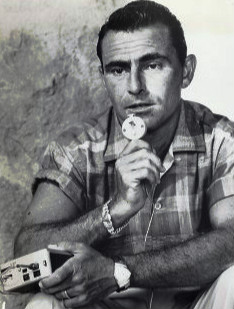
“There is a fifth dimension beyond that which is known to man. It is a dimension as vast as space and as timeless as infinity. It is the middle ground between light and shadow, between science and superstition, and it lies between the pit of man’s fears and the summit of his knowledge. This is the dimension of imagination. It is an area which we call the Twilight Zone.” The words are those of Rod Serling, native of Syracuse and Binghamton, and creator of The Twilight Zone. When I travel to a new place, I like to honor the writers and creators of the region. Yes, there always have been many creators. By my age, Rod Serling was dead, but he had, before that time, created a cultural phenomenon that would stay with the world forever after. It would be difficult to quantify the effect The Twilight Zone had upon me as a child. That opening took ahold of my young mind and convinced me that there was more to life than what appeared on the surface. It is the power of creation.

Rod_Serling_dictating_script_1959

Serling was a fighter. “The angry young man of Hollywood” who used his fiction to protest war and racism, Serling took on many issues in The Twilight Zone that would have been censored had they been presented as fact. Fiction is the vehicle in which truth rides. The bizarre world Serling envisioned captured the imagination to such a point that if I write, “do-do-DO-do, do-do-DO-do” many of you will be able to conjure the theme of The Twilight Zone in your heads. We all know that this is a sign that something strange is about to happen.

There is something about place. I’ve written about sacred geography before, and it is one of the more fascinating aspects of human subconscious life. Something about Syracuse-Binghamton still says “Rod Serling.” Maybe it’s in the low, glowering clouds or the ancient Native American names and traditions that can still be found in this region. Although I’ve never lived in New York, my ancestors did, in the region just east of here. A lifelong wanderer, I sometimes wonder what it is to belong to a place. I have often felt the persistent call of upstate New York, the salmon wisdom whispering me home, perhaps. I’ve never lived here, but maybe I belong here. New York is now proud to claim Rod Serling, and I drive from Syracuse to Binghamton delving deeply into the sacred geography of the region and ponder how such a mind came to be. Even creators, it turns out, have to be created.


Burnt Over

I find myself in Syracuse. Skirting the very edge of the Burnt Over District, Syracuse is only a short distant from Oneida, birthplace of one of the uniquely American religions to have been conceived in this area. Moving further west, several of the religions following the “Second Great Awakening” roared through the state, including the one that was to become the Mormon Church. Looking out over the rugged hills, I wonder what might be in this land that inspires such religiosity. Americans are known world-wide for their religious predilections, and back before the South took the privilege of doling out religious mandates, upstate New York was busy churning out new religions. Of course, this was in the days before the extreme urbanization of culture took hold. Individuals, often isolated from others and struggling to survive in a sometimes harsh climate (they are calling for snow this weekend, still), they turned to God in new and innovative ways.

There must be a point at which religion reaches satiety. How many religions does one nation need? Thus, revivalists found a tired population here in the Burnt Over District. How much energy does it take to build a new faith from scratch? Some flared brightly and burned out (like the Oneida Community), while others flourished to the point of putting forth presidential candidates (I need not say which new religion has offered us a candidate too wealthy to countenance). Something in the soil, perhaps. Something in the mountain air.

Scholars opine that the Second Great Awakening occurred in part, at least, in reaction to the skepticism that was surging through intellectual circles at the time. America has always been good for a backlash or two. While many thinkers were praising the accomplishments of intellect, Smiths and Noyeses were at home brewing up that new-time religion for which Americans thirst. We are great consumers of religion. In the early 1800s revival after revival spread through New York, as well as through the southern states. The south reacted by boosting the Methodist and Baptist populations. New York gave us new religions. Americans aren’t that choosey. In a pinch, just about any religion will do. I stand here in Syracuse, the mid-April snow drifting down about me and wonder what is about to awake in this skeptical age.

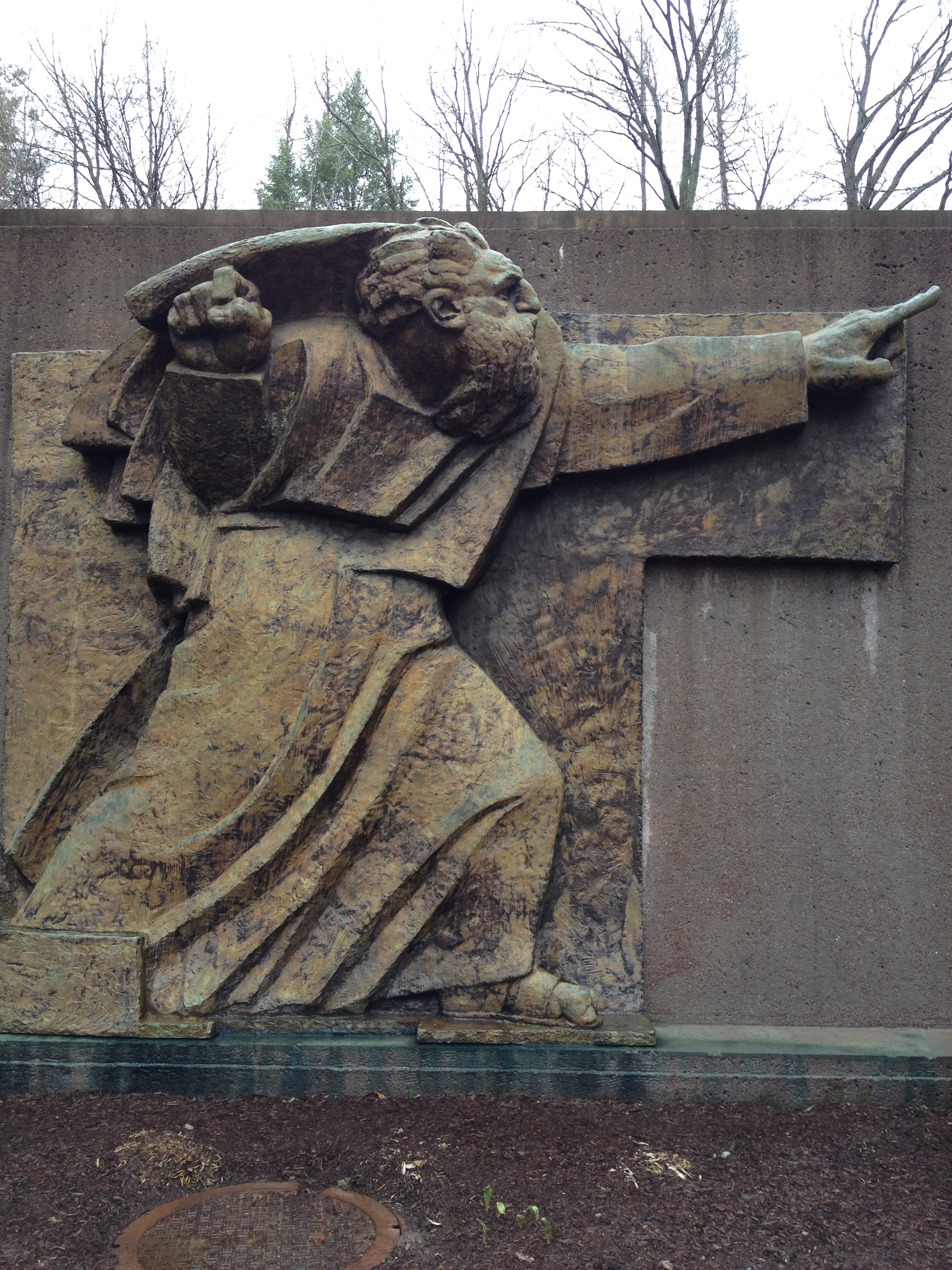
Moses starts a new religion

Moses starts a new religion


Good, Friday

Riding public transit sometimes turns into a religious experience. Various bus drivers will wish passengers a “blessed day” as they pull into the Port Authority Bus Terminal—not that I can blame them, after the traffic they face daily, for taking a spiritual breather. Lately, though, I have been wished a happy Easter by the driver. Ironically, I must note, because people of many faith traditions ride the bus. Not all are Easter riders. Just yesterday a Rastafari stood before me in line. I’m regularly joined by Hindus, Jews, and maybe even a Mormon or two (who can tell?). Holy Week in New York is a surreal experience. I chatted with some co-workers where the topic changed effortlessly from their experiences of Passover to others’ experiences of Easter. Religion is alive and well in the Big Apple, but it is mostly an afterthought to the real business of making money. That’s what we’re all here for, after all.

Money, according to the good book, is inimical to the lifestyle of faith. I must have a little too much faith, I guess, since I have so precious little money. Nothing throws that into such sharp relief as looming tuition bills. You see, I tried “to fight the good fight” only to learn that there’s no way to win it without playing by the entrepreneur’s rules. Filling out the FAFSA over the smoldering ruins of my “earning years” was a distinctly sobering experience. I went into higher education because I believed in it—there’s that pesky faith again. The things you believe in, however, have a way of turning on you. I suppose that’s an appropriate reflection for Good Friday.

It’s hard to be an idealist in a world where people say, “you just need someone to give you a chance,” and then turn their backs on you. So as I’m walking across town, thinking about my blessed day, I notice that we’re all in this together. Except some of us. In the idealist world, those who want it the most sometimes win it. Those who play by the rules. I had no Harvard aspirations, just a reasonable job in a little college would suit me fine. A place to think that doesn’t have wheels and aluminum sides and seat forty-nine other lost souls. But for those who have less, even the little they have will be taken from them. That’s biblical too. Higher education is one of the greatest gifts we can give our children, but it easily joins hands with Judas Iscariot. It is Good Friday, according to some. Others just call it a blessed day.

Mathis_Gothart_Grünewald_007


Flight of Fancy

I’m about fully recovered from my recent visit to Texas. Travel is perhaps the greatest form of education. After having my regular government pat-down, and hearing the airport loudspeakers warning me not even to joke with a TSA official, I was in a subdued mood as I awaited my flight. Airlines have learned to fine-tune human vanity. I know they are hurting for money, as many deregulated industries are, and there must be a marketing trick to get people to pay different prices for the arriving at the same destination at the same time. One of the most ridiculous is that of United Airlines’ Priority Access. Don’t get me wrong, I like United Airlines well enough. Their service has generally been on time, and they make being a human sardine as comfortable as possible. Some of the in-flight snacks, if you can afford them, are actually pretty tasty. But first you have to get onto the plane.

Of course, active duty military are free to board at any time. Tree-hugging pacifists, wait your turn. The part that really gets to me is that those held in special esteem by the Airline (i.e., those who can afford to pay more) are invited to board via the “Priority Access Lane.” This “lane” is created by laying a ratty carpet on the left side (or right side, for some gates) of an imaginary line composed of a couple of those retractable belt stanchions. To the left, sheep. To the right, goats. (Or vice-versa. We’re pretty hard to tell apart.) I’ve written about this before, but what caught my attention this time around was that a seeing-eye dog was boarded along with his human, via the “Priority Access Lane.” As I watched my canine brother sauntering towards the jetway, I was lost in thought. Not one sparrow falls to the ground. The privileged are boarding with a dog.

On my return trip home, at the ironically named George Bush International Airport, every few minutes a public announcement was broadcast about the interfaith chapel. Passengers were told that it was available 24 hours a day, and were given its precise location. Over the past couple of years I’ve had to fly a lot. I always notice the airport chapels, and I feel for those who are anxious about flying. I’ve never heard such a p-a announcement encouraging use of these chapels before. Perhaps I’m too fixated on how I never get to walk down the “Priority Access Lane.” I know my place; I was born among the working class, and when the plane goes down, I’ll be among my own kind. But I do feel sorry for the dog. He has no choice but to be classed with those who are, in the airline’s opinion, of higher priority than the common citizen. Next time I think I’ll just wait in the chapel, contemplating how god spelled backward is dog.

IMG_0558


Religion and Its Discontents

IMG_0575

Travel broadens the mind. I’ve always felt that travel, for those who pay attention when they do it, is one of the best forms of education available. When I do campus visits for work, my time is spent talking to faculty, but on my walks between appointments I keep an eye out for my own education. This past week at the University of Texas in Austin, I couldn’t help but notice how much religion still plays into the lives of many people—even undergraduates. One of the first things I noticed as I approached campus was the sign outside a Methodist Church announcing a sermon series entitled “When Christians Disagree.” Anyone with experience within, let alone between, denominations knows that disagreement is endemic. It would be difficult to find a single point of Christian teaching that is universally held among Christians without at least one group of dissenters. In my own experience, disagreements run deeply within Christian denominations, and the hatred experienced is often more fierce than that between Christians and “heathens.”

IMG_0574

Well, maybe not between some Christians and Islam. So on a campus kiosk I found posters for a seminar entitled “Muhammad: Messenger of Peace.” In a largely Christian context, Muslim students have a difficult time with their religion being castigated in the media and in popular thought. Almost all religions are capable of violence (I was going to write “All religions” but I couldn’t think of any instances where Jains have incited violence), but most highly value and promote peace as the ideal. Few religions are actually founded on violence. I’ve heard many Christians make the claim that Islam is about conquest, pointing to the rapid expansion of Islam following the time of Muhammad. They often overlook the Crusades, one of the most violent Christian reactions to another religion in history. Is Christianity all about violence? Who is “the prince of peace” anyway?

IMG_0579

On a bulletin board I saw a notice for Asatru, the Pagan Student Alliance. If any religious group is misunderstood, surely it is Pagans. Christian missionaries liberally used “pagan” to denigrate the old religions they encountered throughout the world. Often attempts were made to eradicate such beliefs completely. With some success. Many forms of paganism today are revivals of the old religions, and a few are actual survivals. The Pagans I know are moral, peace-loving people as well. Claims of human sacrifice (often fabricated) aside, paganism was, and is, an attempt to make peace with the planet upon which we find ourselves. Peace, it seems, is a desideratum of many religions. If we studied college campuses, where such beliefs are encouraged to coexist, we might find a model that would work for people in the “real world.” And perhaps peace really would have a chance.


Guidance

My relationship with Shiri is a love-hate relationship. Shiri is what I called my “Neverlost” GPS in my rental car in Texas. My iPhone has a female voice called Siri, so I figured my talking navigator must be her electronic kin of some sort. Finding my way around has been a lifetime vocation, but it is job most of us are never paid to do. I learned the trade using maps and the occasional compass. What a God-like feeling to look down at a map and visualize it from way up in the sky—it’s a kind of power-rush. Seeing the country, state, or city laid out below you, knowing that you want to travel particular roads based on traffic, tolls, or scenic beauty. Shiri and I had our first argument just after I disembarked in Houston. I’d never been to Houston before, and, being parked in a concrete bunker of a parking deck, Shiri was a little groggy and unclear about where she was when I spelled out that I wanted to go to Austin, avoiding major highways and tolls. Do I turn left or right out of the garage? She still hasn’t decided.

Shiri likes highways. Not a fan of urban driving, I’ll take a smaller road if possible. My first appointment wasn’t until the next day anyway. I can’t help attributing personality to Shiri. Was that a hint of disappointment in her cheerful voice as my driving made her recalculate the route yet again? Shiri has trouble determining if I’m on an interstate or a parallel access road. She sometimes sees roads that the naked human eye can’t discern. We fight, but she does eventually get me there. I have a feeling that she crawls into the back seat and weeps when I lock the doors and stagger to my hotel. It’s not that I don’t love Shiri, but she doesn’t respond quickly enough to real life conditions. A “slight left” across four lanes of rush hour traffic is purely academic to her. To me it is impressions of my fingers deeply embedded into the plastic of the steering wheel.

Shiri doesn’t understand that Houston’s many toll roads only accept EZ Tag and, being a visitor, I don’t have said tag. On the way to the airport—do I really have to see George Bush again?—she keeps trying to steer me onto roads that state “EZ Tag Only.” Texans are swearing at me as I suddenly change lanes and Shiri doesn’t help by repeating “At soonest opportunity, make a legal u-turn.” Shut up! Shut up! Where is the airport? I should be able to see it by now. Did I really leave the hotel two hours ago to travel this forty miles into… where? Is that a tumbleweed? When I see the Hertz rental return sign I break into spontaneous prayers of thanksgiving. I poke Shiri’s power button and leave without saying goodbye.

But now, a thousand miles away, secure in my own home, I miss her electronic voice.

IMG_0590


Persistent Idealism

Few spans of human life are so idealistic as our college years. There we meet many people from beyond our hometown, and we learn the treasures of diversity and different ways of doing things. Ideas mix and blend, and with professors who’ve learned so much telling us all the places we can go, the possibilities seem endless. I find the idealism of college kids refreshing. That’s one reason, I suppose, that I enjoyed teaching them so much. At work you’re far more often told why things won’t work and how they can’t be done. And I find myself thinking back to college and wondering when people lost their sense of vision. When did idealism die?

Yesterday I spent on the campus of the University of Texas at Austin. Between appointments I was crossing a quad area and noticed a bunch of blue and white balloons. We’re all still kids inside when we see balloons. I stopped to look. Then I noticed, across the street (in which sat a very obvious police car) a small group of students waving a Palestinian flag. Several police, frankly looking bored, stood between the two peaceful groups.

IMG_0581IMG_0580

Looking back to the balloons, there were a series of tents set up and a sign read “Israel Block Party.” Obviously this had been a carefully planned event, and we all know the heinous story of the constant persecution of the Jews throughout much of “civilized” history. The simple table across the street bore the sign “Free Palestine.” Less than ten students stood around, handing out literature, peaceful, yet literally flying their flag. Yes, the Palestinians have also been oppressed for much of their history. If only adults could live so peacefully as these students. My heart went out to them.

The issue of Israel and Palestine is one of the deepest scars in our collective human psyche. Indirectly, that conflict is responsible for many tragic terrorist acts, including the attacks of 9/11. And it is so frustrating because both sides (and there are actually more than two) are victims. We like our good guys in white and our bad guys in black. I’m still an idealist, after all. Yet in Israel/Palestine we have two historically oppressed groups vying for the very same land. And in the middle of this maelstrom, the Bible. The very book that can be read as an eternal promise by God that the people of Israel should own this land. By 1947, however, we’d stopped relying on God and began relying on guns. And atomic bombs. And life has never been the same since.

Images of the wall going up between Israelis and Palestinians just after the wall went down in Berlin reminded me of Bush’s proposed wall between Texas and Mexico. Here in Texas just about everyone in the lower paying jobs I’ve met is hispanic. And friendly. Grateful in a way that many of us wouldn’t emulate in such low stations. We are all people. We all experience the same feelings, needs, and desires. Why not tear down the walls and let us look at one another? Take a good, long look. And my idealistic self says, if we face another human being with love everything will be all right.