Fear of Religions

There’s a narrative of fear in Christianity that seems to have been absent at the beginning.  This is evident when driving the highways of America where you’ll see billboards (which are meant for selling things) advertising the truth of a kind of biblical Fundamentalism.  On my recent trip across Pennsylvania this fear stood out in some rather obvious ways.  And it doesn’t reflect the Christianity reflected in the Good Book.  Stop and think about it: although the persecution of early believers was probably never as widespread as the usual narrative says it was, the writings we have describe facing persecution with joy.  Believing that they would be delivered, the oppressed welcomed the opportunity to prove their faith.  The Chick tracts I read as a child, however, focused intently on how scary the future persecution would be.  Fear, not joy, was the motivation for belief.

As we stopped in a turnpike rest area, we noticed a kiosk of Christian books amid snacks both salty and sweet.  The only other reading material available had to do with tourist attractions and finding directions.  It was, upon retrospect, odd.  Pondering this I recalled the narrative I heard repeatedly in my youth—a time was coming when it would be illegal to be Christian.  There would be persecution and the only proper response was a faith borne of fear.  This was not a religion of love thy neighbor.  No, this was a religion of armed survival based not on turning the other cheek, but on asserting itself with a show of firepower.  This kind of weaponized evangelicalism has taken over the narrative of Christianity.  Paul of Tarsus, knowing he would likely be executed, wrote of his joy from prison.  In the land of plenty we tremble.

The more cynical side of my experience suggests that politicians—who have learned that fear gets them elected—found in this form of Christianity a convenient set of sheep without a shepherd.  There’s fear in these billboards.  Fear that another religion may take over.  Or that secularism may make cherished beliefs illegal.  This isn’t cause for celebration, as the sermon on the mount proclaims it should be, but rather a call to arms.  In this country we have more than enough.  Among those left out, however, this fear grows just as rapidly as among those who fear they may lose the abundance they have.  They try to convert the weary traveler whose eye is drawn to the billboard.  And even those who stop for a drink of cold water which, the Bible suggests, should be freely given.


Iron Ages

I find myself in Pittsburgh again.  We set out from the former steel city of Bethlehem and ended up in the former steel city on the other side of the state.  I’m not here for the metal, of course, but to visit family.  Making our way over the great eroded spine of the ancient Appalachians, I was thinking of how cities often take on the identity of their industries.  Pittsburgh and Bethlehem vied with each other for their facility with unyielding iron—one of the technologies so important to human history that we still use the Iron Age as a marker of advancing technology.  Pittsburgh’s now a tech city, much reduced in size from its heyday when only fifteen cities in the country were larger.  Bethlehem, it seems, is still trying to figure out exactly what it wants to be.

Back in college, I used to work in a church in the south hills.  I haven’t been to Windover Hills United Methodist Church since those days.  I was weighing my future then, deciding to attend Boston University School of Theology—the seminary the pastor had attended—and exposing myself to liberal thinking rather than more of the conservative milquetoast that was mistaken for milk and honey at Grove City College.  The memories that attended the drive were powerful and poignant.  I only lived in Pittsburgh two summers—the second working as a bagger at a grocery store (I should’ve known then where a college degree in religious studies might lead, even if summa cum laude).  As iron sharpens iron, so the Good Book says.

Recently I tried to recall all the addresses at which I’ve lived.  This seems particularly important because many of the buildings no longer stand and I greatly fear being erased.  Those of us who write often do.  I can recall the cities and even a few of the streets.  Numbers often escape me, for they seem to be mere place holders.  My days in Pittsburgh were decades ago, when life was really only just beginning.  Now I drive these hills with memories my only maps, wondering if I can find the place I’m seeking.  This place is part of me, even as Bethlehem is now becoming such a piece.  Cities change depending on the laws of supply and demand that can, as we know, even break iron.  And those of us who live in such places know that any industry is subject to memory, whether of God or of steel.


Relatively Unknown

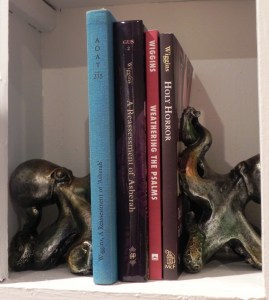
The Edinburgh Festival draws people from around the world to experience culture and fun in one of Europe’s most beautiful cities.  The festival also attracts the fringe—artists not associated directly with the festival, but who get included in what used to be a huge, thick catalogue that would keep us busy for hours, considering what a student and spouse could afford, and what you could not afford to miss.  One year a group called Outback was performing at an area church.  It featured Graham Wiggins on the didgeridoo—an Oceanic aboriginal instrument that is essentially a tree branch hollowed out by termites.  It’s so long ago now that I can’t recall if I knew ahead of time, but the leader of the group, the didgeridooist, was Graham Wiggins.  While not exactly a rare surname, Wiggins isn’t common either and when I saw him a strong family resemblance was immediately obvious.  So much so that after the concert we went to meet him only to find out his Wiggins side was from Oxfordshire.  Mine was from South Carolina.

Graham Wiggins, who was a month younger than me, was known as “Dr. Didg” because he held a D.Phil. in solid-state physics from Oxford University.  While an American, he had decided to stay in the UK to make a living from his music.  Some months later, on a Christmas break, we saw him busking in Bath on a chilly night.  We bought the band’s second CD from him that evening.  When my wife put on our Baka disc the other day, I grew curious whatever became of him.  I was surprised and saddened to learn that Graham Wiggins had died three years ago.  I knew we shared a surname and a family resemblance, as well as UK doctorates, but I learned he went to the British Isles from Boston University, which is where I had studied before attending Edinburgh.  He left the year I arrived.

Websites are reluctant to say of what Wiggins died.  I learned of this just days after finding out that a high school classmate had passed away, so mortality has been on my mind.  Wiggins, unlike this Wiggins, was a talented musician with a brilliant mind.  We saw him interviewed on television about the physics of didgeridoo playing.  I never did find out if we were distantly related.  The US Wiggins clan from South Carolina doesn’t have strong genealogical interests, although we know they started out in North Carolina many years ago.  It stands to reason they had come from England at some point, since it’s an English surname.  I only met Graham of the clan twice, but now I can’t get the fading didgeridoo sounds from my mind.


Thoughts While Flying

Uh-oh!  I seem to be airborne.  All that’s in front of me is concrete.  If I don’t do something, my exposed hands will hit first.  Tuck, and try not to hit your head.  Still, on impact the first thing I do is look around to see if anyone saw that.  It’s embarrassing to trip and fall, especially when you’re old enough to be avoiding that sort of thing.  I jog before it’s fully light out, however, and the sidewalks can be uneven.  Just in case anyone’s watching my Superman impression, I immediately climb to my feet and resume my pace.  I’ll be sore tomorrow.  As a jogger since high school you’d think I’d have this worked out by now, but you’re never too old to learn, I guess.

The amazing thing to me is just how much you can think in those fleet seconds that you’re actually in the air, about to hit the ground like a sack of old man.  That’s exactly what happened, though, from the split second I felt my toe catch in an unseen crack and felt my balance give way.  Taking additional steps while trying to straighten back up sometimes works, but my top-heavy head was too far out of sync and my feet were sure to follow.  Your memory of such things goes out of body and you watch yourself comically flying, without the grace of a bird, toward an unforgiving substrate.  Such is the fate of the early morning runner.  I don’t have time to do it during the day.  What if someone emails and I don’t answer?  They’ll think I’m slacking off.  Remote workers!

Despite the occasional spills, I’ve always enjoyed this form of exercise.  In the post-Nashotah House days while still in Wisconsin I’d sometimes do nine miles at a time.  Whenever I’ve moved to a new place I’ve gotten to know the neighborhood by jogging around.  Even if it’s not fully light you can see plenty.  (Although the cracks in the sidewalk aren’t always obvious.)  I tend to think about these things as life lessons.  Parables, if you will.  One of the deep-seated human dreams is that of flying.  Birds make it look so easy, and fun.  A human body feels so heavy when it impacts the ground.  I suspect that’s why we find gymnasts so fascinating to watch.  As for me, I’m just a middle-aged guy in sweats and wearing glasses.  And even as I head home I’m already thinking how remarkable the number of thoughts are in the few seconds while in flight, somewhere over the concrete.


Web Design

As those who read this blog on the actual site will have noticed, I’ve been playing around a bit with my “look.”  Neither famous nor influential, I’m just a regular guy with a doctorate who wants to make some use of it.  This blog is a way of doing that.  In any case, as I was changing templates and background images, I noticed my rather lengthy blogroll.  Apart from sounding like a particularly tasteless eastern appetizer, blogrolls are pretty much outdated these days.  Back when I started this, there was a community of like-minded bloggers who linked to each others’ pages and helped stir some stats.  In those days doing something like posting on the winner of the Super Bowl could garner you a thousand hits in a day.  The web’s become a bit more crowded since then, I suspect.

So I went to edit my blogroll.  As I did so I found no other blogs linked to mine—no offense taken!—and many that had become defunct.  Many, many.  And there were many blogs that hadn’t been updated in years.  Now, I understand that it is possible to make a living as a blogger these days.  According to my stats, this will be my 3,447th post.  When I consider the time it takes each day to write one of these things, I realize it’s a considerable piece of my life.  Seeing the blogs that have become inactive was like walking through a technological graveyard where many virtual comrades are buried.  For me, the exercise of writing (and I don’t mean the physical typing) is an essential part of each day.  I’d miss it if I stopped.

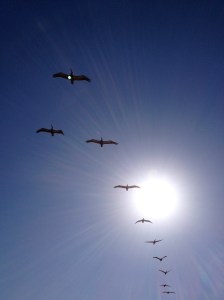
My redesign focuses on a couple of things: books and pelicans.  Since the books part should be obvious, the pelicans might need explaining.  The background image is one I took while visiting the University of California, Santa Barbara for Routledge.  On my lunch break I went down to the beach and this flock of pelicans flew right over my head.  The iPhone was new in those days, so I pulled it out and snapped a picture.  It won a company photo of the month prize (no monetary value).  There’s quite a bit of symbolism in this image of birds against the California sun.   This blog tends to be metaphorical and those who’ve complained on it over the years don’t really get that.  That’s because things are not what they seem.  There’s something valuable about having to dig for meaning, even if it means looking up.


Bookish Dreams

Driving into upstate New York via interstate 81 you’ll find a remarkable rest stop.  To put this into context, I should say that my wife and I have driven from Maine to Washington (not on a single trip) and from Wisconsin to Louisiana and South Carolina.  We’ve laid down considerable mileage together, and never have we encountered such a nice rest stop.  Clean, modern, and featuring local goods for sale, it’s a loving homage to the southern tier, the New York outside the city.  One of the features of this unusual facility is a terrazzo floor fresco highlighting the various points of interest within a couple hours’ drive.  Mostly when we stop here we look toward Binghamton and Ithaca, the cities we most frequently visit.  We stop to use the restroom and then drive on.

When we stopped over the holidays, however, we lingered a little bit.  There’s a display on Mark Twain—he lived in Elmira, New York for a time—and there’s an in-ground plaque outside to Rod Serling.  I spent some time looking over the points of interest in the floor map when my wife pointed out a site listed as Hobart Book Village of the Catskills.  I couldn’t believe that I’d been in this building dozens of times but had never bothered to look that far east.  Curious, I did a web search once we reached out destination.  There is, it turns out, a village in upstate known for its main street of book stores.  What perhaps impressed me even more was that it was considered significant enough to be given a kind of “Hollywood star” treatment in what is an often overlooked part of the state.

Now I can’t say what my impressions of Hobart are.  I’ve never been there, having just learned of it on a recent roadtrip.  What I can say is that my world suddenly began to feel just a bit more friendly knowing that such a place exists.  We live in a country that could indeed use a bit more positive influence.  Some of my happiest memories involve bookstores.  Back in my teaching days we made regular autumnal literary weekend trips, visiting sites haunted by writers.  Often we’d find an independent bookstore near such sacred places.  To many, I realize, this would smack of nonsense, but to those ensconced in literary dreams, it created pleasant memories.  You feel something in the air as you stand near the house or grave of an author.  Places are made sacred by what transpires within them.  The writing of books shapes the very space-time around them.  At least it does for those who even find inspiration in an interstate rest stop.


Holly Days

Thirty years ago today, my wife and I were penniless grad students.  Trying to be logical about when to marry—I’d been accepted at Edinburgh University shortly after we’d decided on a May wedding and the latest I could matriculate was April—we decided the holidays would be the best time.  Not Christmas, of course.  Or New Year’s Day.  As students we held to the illusion that others observed the natural caesura between the two.  We considered it from the feast of Stephen to New Year’s Eve, days when everyone is recovering from the intensity of Christmas or staying up late to welcome in 1989.  We settled on December 30.  The church was already decorated for Christmas, saving that expense.  Having moved up the date by some five months we did ask them to remove the banner that read “For unto us a child is born.”  Our reasons were purely academic.

I generally avoid writing too much about my personal life on this blog, but a thirty-year wedding anniversary is somewhat extraordinary.  Being a working-class kid I told my wife when I proposed that I couldn’t promise much but I could assure her our life together would be interesting.  That slippery qualifier has proven correct time and again.  Our first three years as a couple were spent in Edinburgh, and quite unexpectedly, the next fourteen at Nashotah House.  The first two of those years involved being apart from Sunday through Wednesday as I commuted from Champaign-Urbana to Delafield to teach my courses.  And, of course, to attend chapel.  Our daughter was born while we lived at the seminary and a Fundamentalist takeover led to the loss of my first (and to date only) full-time academic job.

The academic job market had been tough when I started and it had tanked in the meantime.  We had to uproot and move to New Jersey to find any work at all.  Publishing proved remarkably unstable and yet we stuck together.  This year we bought a house and moved to Pennsylvania.  It took three decades, but we’ve finally achieved what some would term normalcy.  The fact is, though, that long-term marriages are to be celebrated.  Many of the vicissitudes we’ve faced could easily have capsized our little boat.  Looking back over the years I can see that we never did prosper in any kind of financial or career situation.  Life has indeed been interesting.  I don’t blog much about my personal life, but today I can’t help but think of how incredibly fortunate I am to have found a soul-mate willing to stick with a guy who still thinks like a penniless grad student.  Thirty years of schooling and it’s not nearly enough.

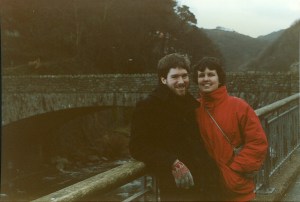
A young couple’s anniversary in Wales.


Righteous City

I’m a stomach sleeper, if that’s not TMI.  This began many years ago when I realized that upon awaking from nightmares I was always on my back.  I started doing what I knew was dangerous to infants, safe since I haven’t been part of that demographic for decades.  Terrazzo isn’t one of my favorite sleeping surfaces, however, and on my back on the floor of Newark’s Liberty Airport I realized I couldn’t roll over, for many reasons.  My glasses, for one thing, were in the internal pocket of my Harris Tweed.  For another, on one’s stomach one’s wallet is exposed in a way that’s maybe too inviting.  Before suggesting I could’ve placed my wallet and glasses elsewhere, let me write in my own defense that rationality isn’t my strong suit after midnight.

The night before

I found a spot next to a set of escalators where the constant thrumming alternately kept me awake and soothed me to nod.  I heard many languages spoken as I drifted in and out of consciousness for the few hours I had to wait for dawn.  And nobody disturbed me.  This is rather remarkable—a person asleep is a vulnerable being.  Doing it out in public with no private walls was a new experience for me.  I don’t sleep on planes, buses, or trains.  Or, until two days ago, airports.  It brought to mind the biblical world.  A town was considered a righteous place if a stranger could sleep unmolested in a public place.  The traveller—please take note, United—was in need of special consideration.  My situation revealed something unexpected about Newark Airport.

The morning after

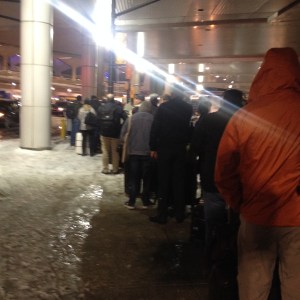
It was full of angry, frustrated people.  I opened my eyes at five a.m. to find a very long line snaking down the corridor behind me—a queue that had been there when I first drifted off.  These were people trying to reschedule flights since United couldn’t bump that day’s passengers because they’d decided not to fly out the night before.  Despite the weariness and intensity of emotions, there was very little bad behavior.  We were biblical strangers, mostly in the same circumstances.  No creature comforts, no privacy.  An east Asian woman said the next morning that in her country the airline would’ve brought food, and blankets at least.  In the United States fiscal concerns reign supreme, however; do you know how much it would cost to care for all these stranded people?  When I opened my eyes the situation was about the same as when I closed them.  I couldn’t help noticing I awoke on my back.


Eternal Return

For those of you who don’t live, eat, and breathe academic religious studies, it’s my duty to point out that the American Academy of Religion and Society of Biblical Literature (AAR/SBL) annual meeting begins this week.  For those of us in the biz it’s like the sun holding still at Makkedah as we try to prepare for our various roles.  This year the conference is in warm and sunny Denver, so be sure to dress in layers.  The meeting was held in Denver many years ago now, and I remember very little of it other than it being the year my final published paper from my Nashotah House days was read.  Or started to be.

I don’t know whether it was the altitude or the time of year, but I wasn’t feeling well the last time we met in Denver.  Although it may not show on this blog, I’m really into geology and the city has a great mineral collection in the Denver Museum of Nature and Science.  I went out to look at the collection the morning of my paper and had the great embarrassment of being sick while in the museum.  I went back to my hotel for a nap and when it was time to read my paper I had to excuse myself because running my eyes across the lines of text made me nauseous.  Concerned-looking philologists didn’t know what to do as I sat through the session with my head between my knees.  That’s how I remember Denver.

Perhaps this year will offer redemption.  You see, it’s very different attending the conference as the representative of a press instead of an institution.  Your time is completely booked.  People want to discuss their book ideas with you.  For a few short days of the year you’re one of the popular guys.  But for me, there are colleagues from every stage of my career on hand.  Not too many people from Nashotah House come, although there are more now than there were when I was about the only faculty member who went.  I see those I knew from Oshkosh and Rutgers, Gorgias and Routledge.  Those I knew as friends before we became professional colleagues.  They’re not after me to publish their books, and sometimes that’s all it takes to make three days of popularity really count.  Later today I’m off to Denver and I won’t have time to see the sparkling minerals this time around, but hopefully I’ll remember it more fondly when its over.


The Falls of Lucifer

The Devil is everywhere.  At least if we go by the many places named after the dark lord.  Over the weekend in Ithaca, we visited Lucifer Falls.  Like several of the cataracts in the area, this is an impressive waterfall that exposes the many layers of the gorge it has carved out over the eons.  Part of Robert H. Treman State Park, the falls were impressive after all the rain we’ve been having here in the east.  But why are they called “Lucifer Falls”?  The literature on the park begs ignorance as to the origins of the name, noting that it was likely taken from the original Iroquois name.  If that’s the case, it’s likely been distorted in transmission.  Many such satanic names are.

Apart from the fact that Native American names for geologic features weren’t based on the Christian trope of God v. Satan, early European settlers heard what they wanted to hear.  Devil’s Lake in Wisconsin, which we used to visit in my Nashotah House days, was more properly translated “Spirit Lake.”  Since the Christians who encountered the native name believed that indigenous religion was inspired by the evil one, they recast the spiritual lake into an infernal one, at least in name.  People will still vacation there, thank you very much, while retaining the baptismal moniker that an intolerant religion bestowed upon it.  There’s nothing evil about Lucifer Falls.  It is an astonishing testament to what nature can do when left alone.

Well, at least for a while.  Like its more famous cousin Niagara, Lucifer Falls, upriver, was harvested for its ability to turn a mill wheel.  The old mill still stands today in the park as a testament to how the river was exploited.  Mills aren’t naturally evil, of course.  They turn to produce the things people need—in this case flour.  They can also, however, be symbols of corporate greed.  Those who own them can exploit more than just the water, and mills became a name for many other places of industry that eventually stole the lives and livelihoods of those whose work in them was cheap.  William Blake’s “dark satanic mills” remains a memorable phrase testifying to what happens when the wealthy, when corporations—which are “persons” with no feelings—are allowed to make decisions.  Treman State Park’s old mill was the center of a community that apparently didn’t experience such exploitation.  It was just a mill.  It’s picturesque waterfall was just a waterfall.  The name, however, still speaks volumes.


Just Sagan

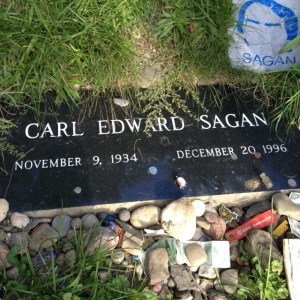
Perhaps the most famous resident of Ithaca, New York, during his career at Cornell was Carl Sagan.  The astrophysicist had had a noteworthy career, becoming a household name with his popularizing television programs and books.  When he died prematurely, there was a real sense of loss among many of us who appreciate those who dumb down science so the rest of us can understand.  Over the weekend in Ithaca, which still bears his physical legacy in a scale model of the solar system, we went to find his final resting place in Lakeview Cemetery.  There is something oddly peaceful about passing time among the dead.  It was late afternoon and we were the only ones in the graveyard.  We also had no idea where his plot might be, so we surveyed a good bit of the grounds, finding the Cornell family mausoleum along the way.

When my wife found his plot, with a simple tombstone laid into the ground, it was impossible not to notice the grave goods.  The leaving of mementos at the burial places of the famous is nothing new.  Douglas Adams’ grave in Highgate Cemetery in London had a profusion of pens pressed into the ground.  H. P. Lovecraft’s final resting place in Providence likewise had remembrances scattered about.  Among the items at Sagan’s grave were various bits of money, a teddy bear, and a somewhat lengthy letter written to the late scientist, expressing how much he had influenced the life of the writer.  After paying our respects, it struck me how even in a cemetery where death, the great leveler, has visited all, we still seek out the famous.

I couldn’t help pondering the implications of leaving behind something for the dead.  Money is of no use where goods and services can’t be traded.  Approaching the cemetery from the upper entrance, we first encountered a Jewish burial area where many of the tombs had rocks characteristically laid on top.  Sagan’s grave is on the border where stones on tombs begin to give way to crosses.  The custom of placing rocks on gravestones is ancient, but the reasons it’s done are disputed.  One of my favorite explanations is that flowers die but rocks do not.  There’s a simple elegance to it.  Many Christian graves appear neglected by comparison.  We don’t live in Ithaca, and it’s difficult to guess how often this somewhat hard-to-find cemetery is visited.  When it is, however, it is in the spirit of remembering a life that was ever focused outward, to an infinite yet expanding universe.


Just the Fax

Like most people I have a cell phone.  If I use it to take a picture, I can send that photo any number of places with a tap, swipe, and tap.  It works that way with scanned documents as well.  Using a hand-held phone, I can scan important papers, convert them to PDFs, and send them via email, text, “AirDrop” (whatever that is), Facebook, Twitter, Instagram—you name it.  Except fax.  That I cannot do.  The other day a company wanted me to send them a document by fax.  Within seconds I had scanned it with my phone and was ready to send it, but instead experienced electronic constipation.  The company had no email; it had to come by fax.

Now, like most reasonably modern people, we have no fax machine at home.  We still have some in the office in New York, but they are clunky, noisy, and seldom actually work.  The technology to receive documents has improved beyond the photostatic smear that facsimiles represent.  I worked for a company where the warehouse insisted on orders by fax.  You’d fax them the order and wait for the phone to ring.  They couldn’t read the fax and you had to tell them what it said.  Well, this particular company I was dealing with wanted a fax.  I downloaded two or three “free” fax apps.  They suspiciously wanted my credit card info.  Besides, if you send more than one page they wanted at least ten bucks for a “package” deal.  I had to send a three-page document.  I checked to see if my laptop could do it.  The manufacturer’s website said it could, but the menu option it told me about didn’t appear.  Who insists on faxes any more?

This is the dilemma of mixed technologies.  It’s like those movies where the streets of some exotic city are filled with rickshaws, cars, bicycles, and pedestrians.  The fax, in this analogy, is the pedestrian.  My mother doesn’t have email, let alone the capability to text (or fax).  Ours is a telephone relationship.  Yet in my hand I hold a device that can send this document anywhere in the world with a tap, swipe, and tap.  I recall my first trip to Jerusalem where hand-drawn carts, cars, and yes, camels, shared the streets.  This was in the days before the internet.  To contact home even by telephone was cumbersome and costly.  Yet somehow we survived.  I’d arranged the trip utilizing a travel agency and funded it by a letter-writing campaign.  The Ektachrome slides I took are now a pain to look at because technology has so improved our lives.  Unless, of course, you need to send a fax.  Delivery by camel can at least be arranged via the internet.


Museum Monsters

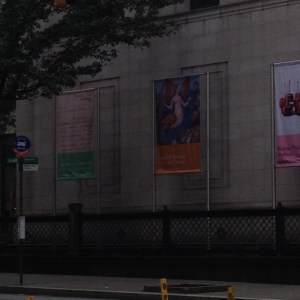
Timing has never been my strong suit.  As soon as I stopped my daily commute to New York City, the Morgan Library and Museum opened a display titled “Medieval Monsters: Terrors, Aliens, Wonders.”  To appreciate the irony of this fully, you need to realize my office was just across the street from the Morgan Library, and the daily visits would’ve provided a good opportunity for a lunch-time break with my beloved monsters.  Instead I was spending the time moving further west and unpacking.  Still, displays like this are a tacit form of validation.  Those of us who admit, as adults, that we like monsters huddle under a cloud of suspicion.  Monsters are a matter for kids—like dinosaurs and fairies—not something on which an upwardly mobile adult spends his time.  We’ll take whatever validation we can get.

Perhaps we’ve been too hasty to dismiss our monsters.  Even the Bible, after all, has them.  They help us cope in a chaotic and uncertain world.  A world of hurricanes and Trump.  A world lacking compassion and sense.  Monsters have always been symbols of the borderlands.  Creatures that cross boundaries and that shouldn’t exist but somehow do nevertheless.  Science has helped us understand our world, but in our desire to grow up enough to use Occam’s razor, we find that it shaves a little too close.  Besides, what can be more unnatural than shaving?  When we lose our ability to believe in monsters, we lose a piece of our ability to cope with an unpredictable world.  Monsters have their practical uses indeed.

If the world were more predictable, I would still be teaching instead of editing.  Or I’d still be living in an apartment rather than a house.  Moving is chaos embodied.  Like monsters, it’s best left to the young.  It’s just like this world for a monster display to open just across the street right when you’ve moved out of town.  I should expect no less in a cosmos marked by uncertainty.  Medieval Monsters isn’t the only museum display of the weird and wonderful.  Monsters have a way of showing up again once you think they’re safely gone.  Family and friends share with me their visits to other monster exhibits at other museums.  They may wonder at my fascination with them—an adult with a sober doctorate in the field of history of religions, biblical studies, ancient Near Eastern religions, whatever.  It’s kind of a monster in its own right, on display here daily.  If you happen to miss it, don’t worry.  It’ll remain lurking in its own corner of the internet.


Museum Haven

At various points of my career I’ve applied for museum curator positions.  Since those who actually land those jobs have degrees in museum studies, I’ve never gotten as far as an interview.  Still, I like to think I’d be good at it.  I spend time in museums and I’ve been told I have an okay eye for design.  And I recently read that museums are educational institutions.  That makes sense since people tend to be visual learners.  (This is something I took into account in my classes as well, illustrating lectures to make a point.  The traditional academic feels that pictures are somehow “soft” learning as opposed to the harsh realities of text and word-based instruction, but I beg to differ.)  We see things and they stick with us.

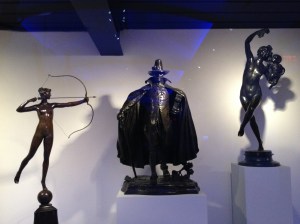
On a visit to the New York Historical Society museum I once looked at their somewhat abbreviated sculpture collection.  This isn’t the Met, after all.  One of the tricks I’ve learned about museum displays is that some curators place subtle humor in their framing of objects.  For example, my gaze was drawn to a figure of a pilgrim.  A stern-looking fellow, he’s captured in full stride, massive Bible tucked under his arm, determined frown on his face.  This is a man trying to create Heaven on earth, dour though it may be.  Taking a step back, my camera found a smile in this image.  On either side of this angry Christian were two naked women: one was apparently Artemis with her bow, the other perhaps a Muse.  The lines of the display draw attention to this juxtaposition.  There’s some humor here, intentional or not.

This also takes me back to yesterday’s post about Heaven.  Perceptions of what it is differ.  There’s a mindset like the pilgrim that sees a life of suffering being rewarded in the hereafter with endless bliss.  I do have to wonder whether too much hardship down here might not make one forget how to enjoy oneself.   It’s difficult to picture a Puritan in rapture.  It’s as if the journey—the hard road—is the real source of enjoyment here.  Each of us, I suppose, has her or his own view of Heaven.  Mine’s kind of like a library with all the time in the world without end to read.  Others, I suspect, would find paradise as a garden.  Yet others would see Heaven as a kind of museum, but it would be one where laughing out loud was okay, for the Curator definitely has a sense of humor.


Slow to Travel

A family friend recently died.  I was in New York City when I received the news, and I mused how recent a phenomenon this speed of information is.  The news wasn’t necessarily a shock—this friend had been experiencing failing health, he was a close friend of my grandfather—but for some reason Samuel F. B. Morse came to mind.  The story goes that Morse invented the telegraph because of his experience of being away from home when his wife died.  By the time he received the news and was able to get home by the conveyance of the day, she’s already been buried.  He set his inventive mind to improving the speed of communication over a distance.  In these days of receiving texts mere seconds after something momentous happens, it’s difficult to imagine that for the vast majority of human existence, personal news traveled slowly.

Feeling in a reflective mood I recalled how when I was in college I wrote letters home.  Yes, the telephone existed by then—don’t be so cynical!—but long distance bore a cost and college students find ways to save their money for girlfriends or spending a weekend in Pittsburgh.  News traveled more slowly.  Back before Morse, the swiftest option was the letter.  The death of a friend might take days or weeks to reach those close.  Distance in time, as well as space, may not have lessened the shock, but the immediacy of a text wasn’t there.  The death had occurred days or weeks ago.  There was nothing left to do but grieve and get on with life.  Like Samuel Morse—perhaps the only point of comparison between us—I was unable to get away immediately.  New York City isn’t easy to escape quickly.

We move swiftly and slowly at the same time.  I know news moments from the event, but this physical mass I inhabit is sluggish takes some time to get around.  Manhattan’s an island, and although it’s not Styx we’re crossing, the Hudson creates barriers enough.  Now my journey includes crossing the entire state of New Jersey before I can even reach home.  Were I to drive back to my original home, it would add another five hours at least in the car.  Sometimes I wonder if the immediacy of knowing is a blessing or a curse.  The shock is immediate and visceral.  But like an injection, the sharpness is quickly over and the dull ache sets in.  Our family friend had been suffering for some time.  Now he’s at peace.  I like to think he’s with my granddad, and that the two of them together won’t judge me too harshly for moving so slowly.