Righteous City

I’m a stomach sleeper, if that’s not TMI.  This began many years ago when I realized that upon awaking from nightmares I was always on my back.  I started doing what I knew was dangerous to infants, safe since I haven’t been part of that demographic for decades.  Terrazzo isn’t one of my favorite sleeping surfaces, however, and on my back on the floor of Newark’s Liberty Airport I realized I couldn’t roll over, for many reasons.  My glasses, for one thing, were in the internal pocket of my Harris Tweed.  For another, on one’s stomach one’s wallet is exposed in a way that’s maybe too inviting.  Before suggesting I could’ve placed my wallet and glasses elsewhere, let me write in my own defense that rationality isn’t my strong suit after midnight.
The night before

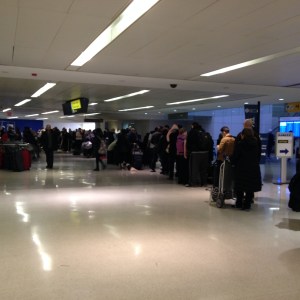
I found a spot next to a set of escalators where the constant thrumming alternately kept me awake and soothed me to nod.  I heard many languages spoken as I drifted in and out of consciousness for the few hours I had to wait for dawn.  And nobody disturbed me.  This is rather remarkable—a person asleep is a vulnerable being.  Doing it out in public with no private walls was a new experience for me.  I don’t sleep on planes, buses, or trains.  Or, until two days ago, airports.  It brought to mind the biblical world.  A town was considered a righteous place if a stranger could sleep unmolested in a public place.  The traveller—please take note, United—was in need of special consideration.  My situation revealed something unexpected about Newark Airport.
The morning after

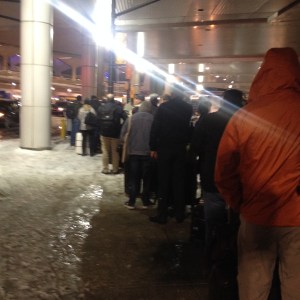
It was full of angry, frustrated people.  I opened my eyes at five a.m. to find a very long line snaking down the corridor behind me—a queue that had been there when I first drifted off.  These were people trying to reschedule flights since United couldn’t bump that day’s passengers because they’d decided not to fly out the night before.  Despite the weariness and intensity of emotions, there was very little bad behavior.  We were biblical strangers, mostly in the same circumstances.  No creature comforts, no privacy.  An east Asian woman said the next morning that in her country the airline would’ve brought food, and blankets at least.  In the United States fiscal concerns reign supreme, however; do you know how much it would cost to care for all these stranded people?  When I opened my eyes the situation was about the same as when I closed them.  I couldn’t help noticing I awoke on my back.


Eternal Return

For those of you who don’t live, eat, and breathe academic religious studies, it’s my duty to point out that the American Academy of Religion and Society of Biblical Literature (AAR/SBL) annual meeting begins this week.  For those of us in the biz it’s like the sun holding still at Makkedah as we try to prepare for our various roles.  This year the conference is in warm and sunny Denver, so be sure to dress in layers.  The meeting was held in Denver many years ago now, and I remember very little of it other than it being the year my final published paper from my Nashotah House days was read.  Or started to be.

I don’t know whether it was the altitude or the time of year, but I wasn’t feeling well the last time we met in Denver.  Although it may not show on this blog, I’m really into geology and the city has a great mineral collection in the Denver Museum of Nature and Science.  I went out to look at the collection the morning of my paper and had the great embarrassment of being sick while in the museum.  I went back to my hotel for a nap and when it was time to read my paper I had to excuse myself because running my eyes across the lines of text made me nauseous.  Concerned-looking philologists didn’t know what to do as I sat through the session with my head between my knees.  That’s how I remember Denver.

Perhaps this year will offer redemption.  You see, it’s very different attending the conference as the representative of a press instead of an institution.  Your time is completely booked.  People want to discuss their book ideas with you.  For a few short days of the year you’re one of the popular guys.  But for me, there are colleagues from every stage of my career on hand.  Not too many people from Nashotah House come, although there are more now than there were when I was about the only faculty member who went.  I see those I knew from Oshkosh and Rutgers, Gorgias and Routledge.  Those I knew as friends before we became professional colleagues.  They’re not after me to publish their books, and sometimes that’s all it takes to make three days of popularity really count.  Later today I’m off to Denver and I won’t have time to see the sparkling minerals this time around, but hopefully I’ll remember it more fondly when its over.


The Falls of Lucifer

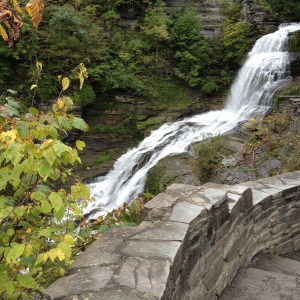
The Devil is everywhere.  At least if we go by the many places named after the dark lord.  Over the weekend in Ithaca, we visited Lucifer Falls.  Like several of the cataracts in the area, this is an impressive waterfall that exposes the many layers of the gorge it has carved out over the eons.  Part of Robert H. Treman State Park, the falls were impressive after all the rain we’ve been having here in the east.  But why are they called “Lucifer Falls”?  The literature on the park begs ignorance as to the origins of the name, noting that it was likely taken from the original Iroquois name.  If that’s the case, it’s likely been distorted in transmission.  Many such satanic names are.

Apart from the fact that Native American names for geologic features weren’t based on the Christian trope of God v. Satan, early European settlers heard what they wanted to hear.  Devil’s Lake in Wisconsin, which we used to visit in my Nashotah House days, was more properly translated “Spirit Lake.”  Since the Christians who encountered the native name believed that indigenous religion was inspired by the evil one, they recast the spiritual lake into an infernal one, at least in name.  People will still vacation there, thank you very much, while retaining the baptismal moniker that an intolerant religion bestowed upon it.  There’s nothing evil about Lucifer Falls.  It is an astonishing testament to what nature can do when left alone.

Well, at least for a while.  Like its more famous cousin Niagara, Lucifer Falls, upriver, was harvested for its ability to turn a mill wheel.  The old mill still stands today in the park as a testament to how the river was exploited.  Mills aren’t naturally evil, of course.  They turn to produce the things people need—in this case flour.  They can also, however, be symbols of corporate greed.  Those who own them can exploit more than just the water, and mills became a name for many other places of industry that eventually stole the lives and livelihoods of those whose work in them was cheap.  William Blake’s “dark satanic mills” remains a memorable phrase testifying to what happens when the wealthy, when corporations—which are “persons” with no feelings—are allowed to make decisions.  Treman State Park’s old mill was the center of a community that apparently didn’t experience such exploitation.  It was just a mill.  It’s picturesque waterfall was just a waterfall.  The name, however, still speaks volumes.


Just Sagan

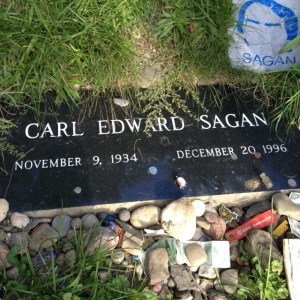
Perhaps the most famous resident of Ithaca, New York, during his career at Cornell was Carl Sagan.  The astrophysicist had had a noteworthy career, becoming a household name with his popularizing television programs and books.  When he died prematurely, there was a real sense of loss among many of us who appreciate those who dumb down science so the rest of us can understand.  Over the weekend in Ithaca, which still bears his physical legacy in a scale model of the solar system, we went to find his final resting place in Lakeview Cemetery.  There is something oddly peaceful about passing time among the dead.  It was late afternoon and we were the only ones in the graveyard.  We also had no idea where his plot might be, so we surveyed a good bit of the grounds, finding the Cornell family mausoleum along the way.

When my wife found his plot, with a simple tombstone laid into the ground, it was impossible not to notice the grave goods.  The leaving of mementos at the burial places of the famous is nothing new.  Douglas Adams’ grave in Highgate Cemetery in London had a profusion of pens pressed into the ground.  H. P. Lovecraft’s final resting place in Providence likewise had remembrances scattered about.  Among the items at Sagan’s grave were various bits of money, a teddy bear, and a somewhat lengthy letter written to the late scientist, expressing how much he had influenced the life of the writer.  After paying our respects, it struck me how even in a cemetery where death, the great leveler, has visited all, we still seek out the famous.

I couldn’t help pondering the implications of leaving behind something for the dead.  Money is of no use where goods and services can’t be traded.  Approaching the cemetery from the upper entrance, we first encountered a Jewish burial area where many of the tombs had rocks characteristically laid on top.  Sagan’s grave is on the border where stones on tombs begin to give way to crosses.  The custom of placing rocks on gravestones is ancient, but the reasons it’s done are disputed.  One of my favorite explanations is that flowers die but rocks do not.  There’s a simple elegance to it.  Many Christian graves appear neglected by comparison.  We don’t live in Ithaca, and it’s difficult to guess how often this somewhat hard-to-find cemetery is visited.  When it is, however, it is in the spirit of remembering a life that was ever focused outward, to an infinite yet expanding universe.


Just the Fax

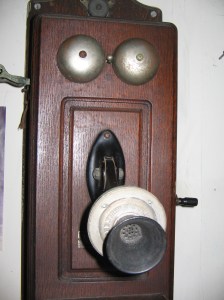
Like most people I have a cell phone.  If I use it to take a picture, I can send that photo any number of places with a tap, swipe, and tap.  It works that way with scanned documents as well.  Using a hand-held phone, I can scan important papers, convert them to PDFs, and send them via email, text, “AirDrop” (whatever that is), Facebook, Twitter, Instagram—you name it.  Except fax.  That I cannot do.  The other day a company wanted me to send them a document by fax.  Within seconds I had scanned it with my phone and was ready to send it, but instead experienced electronic constipation.  The company had no email; it had to come by fax.

Now, like most reasonably modern people, we have no fax machine at home.  We still have some in the office in New York, but they are clunky, noisy, and seldom actually work.  The technology to receive documents has improved beyond the photostatic smear that facsimiles represent.  I worked for a company where the warehouse insisted on orders by fax.  You’d fax them the order and wait for the phone to ring.  They couldn’t read the fax and you had to tell them what it said.  Well, this particular company I was dealing with wanted a fax.  I downloaded two or three “free” fax apps.  They suspiciously wanted my credit card info.  Besides, if you send more than one page they wanted at least ten bucks for a “package” deal.  I had to send a three-page document.  I checked to see if my laptop could do it.  The manufacturer’s website said it could, but the menu option it told me about didn’t appear.  Who insists on faxes any more?

This is the dilemma of mixed technologies.  It’s like those movies where the streets of some exotic city are filled with rickshaws, cars, bicycles, and pedestrians.  The fax, in this analogy, is the pedestrian.  My mother doesn’t have email, let alone the capability to text (or fax).  Ours is a telephone relationship.  Yet in my hand I hold a device that can send this document anywhere in the world with a tap, swipe, and tap.  I recall my first trip to Jerusalem where hand-drawn carts, cars, and yes, camels, shared the streets.  This was in the days before the internet.  To contact home even by telephone was cumbersome and costly.  Yet somehow we survived.  I’d arranged the trip utilizing a travel agency and funded it by a letter-writing campaign.  The Ektachrome slides I took are now a pain to look at because technology has so improved our lives.  Unless, of course, you need to send a fax.  Delivery by camel can at least be arranged via the internet.


Museum Monsters

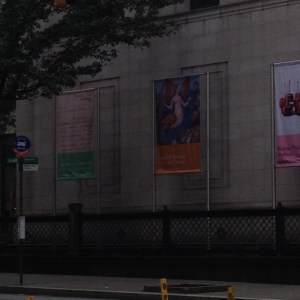
Timing has never been my strong suit.  As soon as I stopped my daily commute to New York City, the Morgan Library and Museum opened a display titled “Medieval Monsters: Terrors, Aliens, Wonders.”  To appreciate the irony of this fully, you need to realize my office was just across the street from the Morgan Library, and the daily visits would’ve provided a good opportunity for a lunch-time break with my beloved monsters.  Instead I was spending the time moving further west and unpacking.  Still, displays like this are a tacit form of validation.  Those of us who admit, as adults, that we like monsters huddle under a cloud of suspicion.  Monsters are a matter for kids—like dinosaurs and fairies—not something on which an upwardly mobile adult spends his time.  We’ll take whatever validation we can get.

Perhaps we’ve been too hasty to dismiss our monsters.  Even the Bible, after all, has them.  They help us cope in a chaotic and uncertain world.  A world of hurricanes and Trump.  A world lacking compassion and sense.  Monsters have always been symbols of the borderlands.  Creatures that cross boundaries and that shouldn’t exist but somehow do nevertheless.  Science has helped us understand our world, but in our desire to grow up enough to use Occam’s razor, we find that it shaves a little too close.  Besides, what can be more unnatural than shaving?  When we lose our ability to believe in monsters, we lose a piece of our ability to cope with an unpredictable world.  Monsters have their practical uses indeed.

If the world were more predictable, I would still be teaching instead of editing.  Or I’d still be living in an apartment rather than a house.  Moving is chaos embodied.  Like monsters, it’s best left to the young.  It’s just like this world for a monster display to open just across the street right when you’ve moved out of town.  I should expect no less in a cosmos marked by uncertainty.  Medieval Monsters isn’t the only museum display of the weird and wonderful.  Monsters have a way of showing up again once you think they’re safely gone.  Family and friends share with me their visits to other monster exhibits at other museums.  They may wonder at my fascination with them—an adult with a sober doctorate in the field of history of religions, biblical studies, ancient Near Eastern religions, whatever.  It’s kind of a monster in its own right, on display here daily.  If you happen to miss it, don’t worry.  It’ll remain lurking in its own corner of the internet.


Museum Haven

At various points of my career I’ve applied for museum curator positions.  Since those who actually land those jobs have degrees in museum studies, I’ve never gotten as far as an interview.  Still, I like to think I’d be good at it.  I spend time in museums and I’ve been told I have an okay eye for design.  And I recently read that museums are educational institutions.  That makes sense since people tend to be visual learners.  (This is something I took into account in my classes as well, illustrating lectures to make a point.  The traditional academic feels that pictures are somehow “soft” learning as opposed to the harsh realities of text and word-based instruction, but I beg to differ.)  We see things and they stick with us.

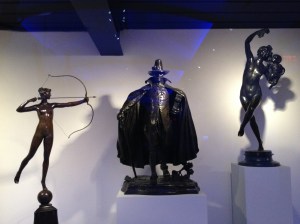
On a visit to the New York Historical Society museum I once looked at their somewhat abbreviated sculpture collection.  This isn’t the Met, after all.  One of the tricks I’ve learned about museum displays is that some curators place subtle humor in their framing of objects.  For example, my gaze was drawn to a figure of a pilgrim.  A stern-looking fellow, he’s captured in full stride, massive Bible tucked under his arm, determined frown on his face.  This is a man trying to create Heaven on earth, dour though it may be.  Taking a step back, my camera found a smile in this image.  On either side of this angry Christian were two naked women: one was apparently Artemis with her bow, the other perhaps a Muse.  The lines of the display draw attention to this juxtaposition.  There’s some humor here, intentional or not.

This also takes me back to yesterday’s post about Heaven.  Perceptions of what it is differ.  There’s a mindset like the pilgrim that sees a life of suffering being rewarded in the hereafter with endless bliss.  I do have to wonder whether too much hardship down here might not make one forget how to enjoy oneself.   It’s difficult to picture a Puritan in rapture.  It’s as if the journey—the hard road—is the real source of enjoyment here.  Each of us, I suppose, has her or his own view of Heaven.  Mine’s kind of like a library with all the time in the world without end to read.  Others, I suspect, would find paradise as a garden.  Yet others would see Heaven as a kind of museum, but it would be one where laughing out loud was okay, for the Curator definitely has a sense of humor.


Slow to Travel

A family friend recently died.  I was in New York City when I received the news, and I mused how recent a phenomenon this speed of information is.  The news wasn’t necessarily a shock—this friend had been experiencing failing health, he was a close friend of my grandfather—but for some reason Samuel F. B. Morse came to mind.  The story goes that Morse invented the telegraph because of his experience of being away from home when his wife died.  By the time he received the news and was able to get home by the conveyance of the day, she’s already been buried.  He set his inventive mind to improving the speed of communication over a distance.  In these days of receiving texts mere seconds after something momentous happens, it’s difficult to imagine that for the vast majority of human existence, personal news traveled slowly.

Feeling in a reflective mood I recalled how when I was in college I wrote letters home.  Yes, the telephone existed by then—don’t be so cynical!—but long distance bore a cost and college students find ways to save their money for girlfriends or spending a weekend in Pittsburgh.  News traveled more slowly.  Back before Morse, the swiftest option was the letter.  The death of a friend might take days or weeks to reach those close.  Distance in time, as well as space, may not have lessened the shock, but the immediacy of a text wasn’t there.  The death had occurred days or weeks ago.  There was nothing left to do but grieve and get on with life.  Like Samuel Morse—perhaps the only point of comparison between us—I was unable to get away immediately.  New York City isn’t easy to escape quickly.

We move swiftly and slowly at the same time.  I know news moments from the event, but this physical mass I inhabit is sluggish takes some time to get around.  Manhattan’s an island, and although it’s not Styx we’re crossing, the Hudson creates barriers enough.  Now my journey includes crossing the entire state of New Jersey before I can even reach home.  Were I to drive back to my original home, it would add another five hours at least in the car.  Sometimes I wonder if the immediacy of knowing is a blessing or a curse.  The shock is immediate and visceral.  But like an injection, the sharpness is quickly over and the dull ache sets in.  Our family friend had been suffering for some time.  Now he’s at peace.  I like to think he’s with my granddad, and that the two of them together won’t judge me too harshly for moving so slowly.


Galilean Blues

Call me nostalgic, but growing up Fundie, “Capernaum” tripped easily off my lips.  In fact, it was a word I heard very frequently at church, always pronounced “kap-er-NEE-um” (please pardon my amateur phonetics).  Even though no one I knew had ever been to Israel, we all knew it was in Galilee and that it figured large in the early life of Jesus of Nazareth (although we assumed he was surnamed “Christ”).  When I attended seminary I was surprised to hear the geonym pronounced “ka-per-NUM.”  It sounded so sophisticated—aristocratic, even.  Still, everyone at Boston University School of Theology knew what, and roughly where, it was.  It was a household name, no matter how you pronounced it.

Spellcheck disagrees.  It doesn’t recognize one of the most famous places in the New Testament.  Now, I’m aware that my view of things is idiosyncratic.  This blog should be proof of that.  Those who grow up from Fundamentalism often know this experience—something that everyone knew when you were young and informed is arcane knowledge to the rest of the world where Kardashians and Sedarises are household names.  The Bible, irrelevant at best, is a foreign country.  Then the religious right comes to power and everyone’s confused.  They don’t speak the same language as the rest of the world.  They say kap-er-NEE-um.  Others scratch their heads and glance at their knee caps.

When I visited ancient Capernaum it required some imagination to reconstruct what it had been, back in the day.  Since the ruins were relatively recent—only a millennium or two—some of the buildings were still above ground, including the famous synagogue.  Even among the unchurched archaeologists, everyone knew the connection of the city to Jesus of Nazareth.  That doesn’t mean, however, that the programmers responsible for spellcheck recognize the name.  Kardashian doesn’t get a red underline on my word processor.  Even in the first century, however, Galilee was a backwater (with real water!).  Important people came from big cities and had family connections.

Some things don’t change much over the millennia.  The famous often find their spotlight because of connections.  If the deity decided to incarnate today, s/he’d know to get a website put together first.  And it would help to have some product endorsements.  Even salvation at a click isn’t enough to draw most people in.  Of course, the matter of name—excuse me, “brand”—is important.  More than anything, you want something people can pronounce.  And just to be safe, anchor it to either New York or the city named The Angels.


Stand-in Line

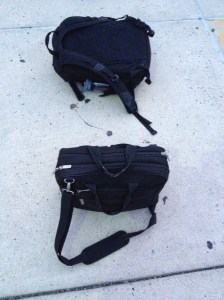
Pop culture borrows from religion without knowing it.  Or maybe it’s just that religion has become so irrelevant that people no longer care.  Whichever may be the case, those who contribute to pop culture have a rich treasury from which to take withdrawals.  This occurred to me while waiting for a bus into New York.  Many people don’t want to stand in line (who does, really?).  In the Park-n-Ride subculture, you may leave an avatar in your place.  It’s probably not called an avatar, but since there’s nobody here to ask, I’m going to use the pop culture name.  You put your bag on the pavement, marking your place and then go sit in your car.  Since I’m going to be sitting in a big car for the next two hours, I prefer to stand outside.

The idea of an avatar is mediated to most people through either computer language or the movie.  I first encountered the term in the former sense in Neal Stephenson’s Snow Crash.  I was an internet neophyte and had trouble conceiving a virtual world in those days.  Some time later came the latter.  James Cameron’s film embodied the idea—linked through software, the tired hardware of physical bodies could be given new life.  In some senses it was an even better life.  Now everyone knows what an avatar is.  Perhaps except that the idea is native to Hinduism.

Hinduism was never an organized, intentional religion such as Christianity.  It is rather a wide array of traditional beliefs that, in the light of missionary activity, had to be given a name.  There are many gods in Hinduism, and when a deity descends to earth s/he appears in a form recognizable to humans—an avatar.  Not being an Indologist, my understanding of the concept is very basic, but it’s enough to know that this religious idea found a role in pop culture first through computer representations of human beings.  We had flattered ourselves with being gods, since we had created a virtual world.  A world we couldn’t physically enter.  Avatars were, therefore, how we wanted others to experience us.  Snow Crash is peopled with all kinds of representations.  The internet today, nearly 30 years on, has many more.  After all, there are many gods.

I glance at my watch.  The bus should be here any minute now.  When it enters the lot I’ll see the deities behind these canvas and leather avatars.  They’ll be less impressive than I’ve imagined them, I’m sure.  And although we’ve created virtual reality, I still have to get on a physical bus to go to virtual work.


Book Naked

Alogotransiphobia doesn’t just strike me when I’m on the bus.  Whenever I travel anywhere I try to take a book along.  To the DMV.  To movie theaters.  To take the paper to the shredding truck.  Anywhere there might be a line.  There comes a time when you realize every second is a gift, and time runs swiftly through the glass.  Life’s too short not to read.  So it is that I find myself in a hotel for a night.  Feeling somewhat like taking a risk, I’ve only brought three books.  Will I read them all tonight?  Most likely not.  But just in case…

Alogotransiphobia is real.  In my long-distance commuting days—in a past still very recent—I tried to calculate carefully.  Would I finish this book in the three hours I knew I’d have on New Jersey Transit?  If even a chance seemed to exist that I would, I would add another book to my bag.  But then that occasional Monday morning would arrive when somehow Sunday night seemed to slip away unbidden, leaving me bleary eyed and foggy brained to face pre-dawn alone on a deserted street corner.  And I neglected to calculate the chances.  Once in a great while, on such a day I would finish a book only to face a very long ride home without another.  Alogotransiphobia would kick in.  I would squirm in my seat as well as in my mind, anxious to get off that bus, as if I needed to shower to wash the feeling of wasted time off me.  A commute without a book was remaindered, unrecoverable time.  Lost time.  Squandered.

For two months now I’ve been delivered from the daily commuting life.  Now I find the opposite phobia.  That which entails staying at home and having so much to do that time to read is stolen back by that cosmic trickster we call fate.  I try to carve out time for reading, but the funny thing about work is that when you do it from home you feel you have to prove yourself.  I suspect employers know that.  A certain type of worker—perhaps one who’s lost a job or two in recent years—will always reach for supererogation.  And such a one will even sacrifice literacy on the altar of an assured paycheck.  Until recent days I was like a hermit on the bus.  Those around me may have been going in the same direction but we were in completely separate places.  I was, during the commute, lost in a book.  Alogotransiphobia was in the seat right beside me.


A Star in the East

The times they are a, well, you know—nobody wants to violate copyright.  In any case, nothing stays the same for long.  New York, for example, is a city in a constant state of transformation.  Fully grown buildings now stand where there were literally holes in the ground when I began working there.  One building near Times Square recently had a facelift that revealed the steel girders beneath.  On the I-beam were the words “Bethlehem Steel.”  And it’s not just New York.  Our cultural transformation has been taking place over the last few centuries as populations have moved to urban areas, abandoning farming to the few who remember how.  Being from western Pennsylvania, I pretty much thought the eastern part of the state was Philadelphia.  I’d heard of other urban regions, of course, such as Scranton and Allentown, but they were well outside my experience.  We didn’t get out much.

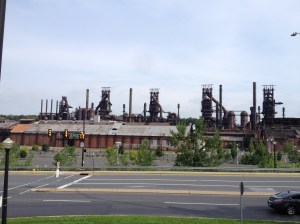
Now that I’m here in the eastern part of the state, I’m begun to explore the ever-changing micropolitan area of Allentown-Bethlehem-Easton.  The three cities blend at the edges, and this region is the third largest population zone in the state, after Philly and Pittsburgh.  It’s also the fastest growing region in the commonwealth.  I suppose we might’ve helped with that statistic.  The other day I had to run an errand in Bethlehem.  I pulled over to marvel at the hulk of what had once been Bethlehem Steel.  Now, I grew up in a town with an active steel mill, and Pittsburgh grew to fame for the same metal, but this was a behemoth of a plant.  Subdivided and open to development, it now houses a casino, in part, and an arts center.  And still there’s more space.

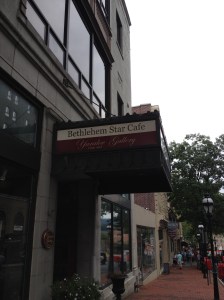
Bethlehem was founded on Christmas Eve by the Moravians.  Perhaps appropriate for a town trying to resurrect itself, Bethlehem calls itself the Christmas City.  Star imagery abounds, and many businesses name themselves with this Christian symbol.  The image is quite different from that of a steel city with hard-working men on the shift.  The grime and din of industry.  Bethlehem, like many places in the state, was named for its biblical forebear.  On my visit to the original Bethlehem many years ago I was, like many tourists, disappointed that it isn’t “O little town of” anymore.  There were people everywhere and it was difficult to imagine a quiet stable inside a noisy stone church thronging with the faithful.  Clearly things don’t remain unchanged for long, even in towns famous for their remoteness.  Although far from New York, they share a common heritage of people everywhere, and that heritage could bring us peace if only we would allow it.  The answer, it seems, is blowin’ in the, well, you know.


Away and a Stranger

“And Joseph also went up from Galilee, out of the city of Nazareth, into Judaea, unto the city of David, which is called Bethlehem.”  Strangely enough, the great physician (although we know nothing of his medical practice) Luke was writing about a place an ocean and a sea away from here.  The place names of eastern Pennsylvania demonstrate the religious awareness of the early colonial Europeans who brought their Bibles and diseases to this nation.  Bethlehem, Pennsylvania was known more for being a house of steel than being a house of bread.  It’s just down the road from the little town of Nazareth, made famous by The Band’s classic hit, “The Weight.”  The road to Emmaus is nearby.  And the major medical facility is, you guessed it, St. Luke’s.

The Band had an influence somewhat surprising for those who may have trouble recalling their nondescript name.  “The Weight” is a story of a traveler coming to, of all places, Nazareth, Pennsylvania.  So taken by the song was a Scottish band that they adopted the name Nazareth before informing us that “Love Hurts.”  This is something the evangelist and purported doctor Luke presumably knew.  If you go down from Nazareth even unto Bethlehem, you’ll find the steel city recast as the Christmas city.  For those of us who grew up in the western part of the state, Pittsburgh was the real steel city anyway.  When I was growing up, Pittsburgh was the 16th largest city in the country.  It now sits at 65th, because, like Bethlehem it had trouble drawing people without the natural hardness that is Pennsylvania.  There’s a parable in a city transforming from a heavy metal to a holiday.  There’s no Pittsburgh in the Bible.

When Luke begins his Christmas narrative (think of this as one of those “Christmas in July,” or August things), quoted above, he ironically leaves Mary until the next verse.  Joseph, whom later tradition will say had nothing to do with the conception anyway, still gets first billing.  One wonders what might’ve been different had Mary led the way.  It was much later, after the gruesome crucifixion account, that Emmaus came into the picture.  Two unnamed disciples were walking along that road and didn’t recognize who Jesus was.  Had they kept walking, I wonder if they might’ve ended up in Pittsburgh, for the biblical names soon give way to places like Kutztown and Fleetwood, the latter of which, I have to admit, I never got into.  Had Mary taken a load off in Nazareth, this story would’ve been completely different.  Thus saith The Band.


The Distortion of Absence

I’m sure it’s happened to you, too.  After some time away, you return to somewhere familiar.  For some reason this doesn’t seem to apply to places you spend only a little time—for example, the cabin where I tend to go on vacation every year.  Rather, it impacts quotidian spaces, the places you see nearly every day.  Returning after an absence, the place looks strange, as if you’d forgotten what it was really like.  A fairly common example is a college dorm room.  When you return to it after, say, the winter holiday, it looks not quite how you remembered it.  It’s a little smaller or larger than you recalled, or you didn’t remember that the floor tiles were that color.  Within a day or so the feeling disappears and you accept the “new normal.”

The strange, or unfamiliar, is the source of many monsters.  Freud famously phrased the uncanny as “unheimlich,” un-home-like.  It is close to what you expected, but not exactly.  The uncanny valley is that place where things are about right, but slightly off.  It generates a creepy feeling, as if reality is being distorted.  On a business trip to Boston a few years back I visited Boston University School of Theology, a place where I spent over two years in my twenties.  745 Commonwealth Avenue hadn’t been renovated, but I stepped inside and was stunned by how wide the hall was.  In my mind it had become far narrower.  It was downright disturbing, as if I’d walked into somebody else’s past.  It made me wonder—is any of this really real?  Or more frighteningly—is my memory that fragile?

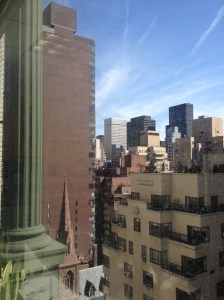
I recently spent a day working in the New York office.  While the office itself seemed the same, the city did not.  Emerging from the Port Authority Bus Terminal I knew exactly where I was.  Or did I?  I’d walked roughly the same route daily for almost five years, and two years before that a similar track.  It was as if the bus had exited the Lincoln Tunnel into an alternate Manhattan.  Unheimlich.  I’ve returned to many places after being away for awhile and this distortion of absence always creeps me out.  Can my memory be that faulty or is all of this an illusion?  The gap between present reality and remembered reality provides crevices into which monsters crawl, waiting.  By the time I reached the block of my office the feeling had gone away.  But somehow, the monsters remained. 


Childhood’s End?

Writers are agents against chaos.  Those of you who read this blog frequently know that chaos has been one of my themes lately.  Moving, which is a process that takes months and months of time, is pure chaos.  Whenever I settle down to write, yet another moving-related task comes to me—this box needs to be unpacked, that gap in the fence must be mended, where did I put the toolbox?  Mundane things.  Writers like to think the world conforms, somehow, to their inner lives.  In reality, things are far more complex than that and don’t seem to be getting any easier.  Starting to learn about house ownership is something best left for the young, I suspect.  Every question (where should we put the television?) leads to a daisy-chain of other issues (but first we need to move that hutch, but it’s too heavy for either of us to lift, etc.).

In ancient times water symbolized chaos.  Before we left on vacation, the main issue was to get all boxes off the floor in the garage.  We haven’t had time to move them safely inside yet, what with planning for vacation and all, so plastic became the order of the day.  We do need, however, to get things inside eventually.  A slow process for two middle-aged people with full-time jobs, even without jet lag.  Writing feels like a luxury item, for what is most required is time—time to move things to their proper places.  Time to figure out what those proper places are.  Time to go to work again.

Had we thought this through, we might’ve used vacation this year to unpack.  We bought our plane tickets, however, before we bought the house.  This latter transaction is one of chaos embodied.  Who knew, for example, that the grass had to be cut so often?  That all roofs leak?  That chaos is constant, and not intermittent?  In biblical times, one of the signs of God’s greatness was the ability of the Almighty to hold chaos in constant check.  The waters were always lurking, looking for any opening—except when you need rain and it just won’t come.  Sitting here writing feels like the giddy irresponsibility of childhood where there’s so much to get done and so little time in which to do it.  And neighbors don’t appreciate the lawn being mowed before the sun is properly out of bed.  The renter pays a price for living with, for at least some stretches of time, chaos-free maintenance.  The home-owner quickly learns that any time left over for writing feels like being irresponsible, and a little bit divine.