Quiet Night

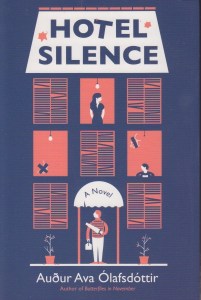
Reading challenges are a good way to expose yourself to books you might not otherwise find.  This is my fifth time through the Modern Mrs. Darcy’s annual challenge and she tends to favor books in translation.  That’s fine by me, because we could all use a bit more cross-cultural understanding.  My latest book in this challenge was my third novel by Auður Ava Ólafsdóttir, Hotel Silence.  Ólafsdóttir, although a professor of art history, is quite a gifted novelist and her stories probe what it is to be human, and also reflect life on a somewhat small island.  Icelanders are known for their love of reading as well as for their geothermal power.  This novel deals with darker subjects that some of Ólafsdóttir’s previous work, but one thing becomes clear—the Bible is an influence.

With a writing style that is poetic and descriptive, she acknowledges that the Good Book plays a role in forming her story here.  I don’t want to give too much away, but it swirls around the difficult topics of suicide and war, and, ultimately, a kind of redemption.  As I’ve come to expect from her writing, the characters are quirky and have foibles.  There’s a matter-of-factness to them.  They go about following singular ideas and all of her work that I’ve read is based on the concept of a journey.  Maybe that’s something of a given for those who live on an island.  Taking her characters to far lands is a way of reaching understanding, not xenophobia.  That’s one of the reasons for reading the literature of other people.

In academia I was taught that exoticizing other cultures was a kind of evil.  I can see the point in that, although, like most academic things it takes the fun out of imagining far-away places.  Human beings need sources of wonder, and I don’t know if I’ll ever be able to afford a trip to Iceland, so reading stories written by a native feels, well, exotic.  Academics have a point, though.  For people of an exotic locale, their life is pretty much a daily struggle just like our lives are.  The backdrop is different and the specific circumstances are unfamiliar, but at the end, people are people.  That’s why I like Ólafsdóttir’s novels.  At the end we find them facing the same kinds of problems the rest of us face.  And we come to realize that our world is an isolated place in space.  And if there are aliens out there watching us, they must think we’re fairly exotic.  Let’s hope they’ll read us in translation.  We can all use a good challenge.

Geocheating

So, we geocache.  Not as much as we used to, but over 15 years ago my family and I began the sport and really got into it for a while.  Geocaching involves using a GPS to find a hidden object (“cache”) so that you can log the find.  It’s all in good fun.  The organization that hosts the website also offers the chance to log “trackables”—these are objects with a unique identifier that you sometimes find in caches and you get credit for logging your find.  There are no prizes involved.  We started several of these “travel bugs” ourselves, years ago.  If you started one you got an email when someone logged it, and you could see how far around the world your little bug had gone.  For many years we’ve not heard much about any of ours and assumed them to be MIA.

Recently I started getting several email notices about a resurrected travel bug.  It was as if someone had finally found a cache somewhere deep in the Sahara where it’d been hidden for a decade.  Then I had an email from a fellow cacher, in German.  I figured it must be serious.  The message was that a Facebook page was publishing trackable numbers so that anyone could claim to have found them.  One of ours was on that list.  I went to the page to look.  It said, “Let’s face it, it’s all about the numbers.”  And they proceeded to list hundreds of numbers so that you could claim to have “found” the pieces with your posterior solidly sunk in your favorite chair.  This is annoying not only because we had to pay for the trackable dogtags, but also because it was cheating.  I said as much on the page only to have my comment blocked.

How sad is it when people cheat at a game when there’s no gain?  All they do is claim to have done something they haven’t, for no prize or recognition.  A fun family pastime falls victim to the internet.  Ironically, geocaching was really only possible because of the internet.  It required a place where players could log their finds in a common database.  Facebook, continuing its potential for misuse, allows someone to spoil it.  I, along with my unknown German counterpart, reported the page to the powers that be.  But since we live in a world where the powers that be don’t recognize any rules beyond inflating their own numbers, I shouldn’t be too optimistic of any results.  I guess this is how Republicans play games.


Back to Normal

The western philosophical tradition is built on the idea that permanence is reality.  From the Greek philosophers on, the idea has been to identify the basic, unchanging building blocks of reality to get at what’s really real.  The eastern philosophical system posits that change is reality.  Permanence is illusion, and that which we think of as unchanging is a deceptive projection of our own minds.  This dichotomy keeps coming back to me when things change and I keep waiting for them to go back to “the old way” or “the usual way.”  Most recently, for example, the shift to or from (I can never remember which) Daylight Saving Time.  This was followed closely by a mandated trip to San Diego, three time zones away, that lasted five days.  While there I met with potential authors later into the evening than I generally stay up on eastern time.  Now that I’m back home I keep waiting for things to go back to the way they were.

My response to all of this is to wonder if maybe I have the wrong philosophical disposition.  Problem is, the entire western world is built on the proposition that permanence is reality.  The things that worry us are, in eastern thinking, part of the constantly changing flux of reality.  While away from the usual constant connectivity of life at home, bills still come electronically.  Websites ask you for passwords that, like eastern thought, are constantly changing.  I play along, even to the point of “buying” property so that it will always be mine.  Right now lots of things are up in the air in the western world—the future of democracy itself is uncertain—and I keep waiting for things to get back to normal.

Part of the problem is that I keep too busy.  It is easier for me to maintain this illusion if I slow down and have time to think it through.  Things change too quickly for that, however.  Using time as a pole star to navigate this constantly heaving sea, I’ve become a little confused about my longitude.  I’m settling back into eastern time at the new hour they tell me that it is, but I feel as though I’ve left lots of things behind.  I’ve had a little time off work over the holiday and there’s a tremendous amount of change awaiting me once I fire the laptop up again.  I want to go back to where I was before I boarded that plane, back before I “gained” an hour.  Back before I had to learn everything you need to know to “buy” a house.  I look to the east and nod.


Post Facto

“Yea, though I walk through the valley of the shadow of death,” Psalm 23 asserts, “I will fear no evil.”  Nor should one fear evil when flying over Death Valley, as I did coming out of San Diego, but I did.  There are perhaps not too many national monuments that can be appreciated from 30,000 feet, but the only way I’ve seen both the Grand Canyon and Death Valley is by plane.  My flight home from AAR/SBL had me sitting over a wing, so a photograph of the famed graben would simply show mostly wing and a bit of Death beyond.  This valley holds the record for the hottest ambient temperature recorded on the surface of the earth (134 degrees) and is famed as one of the filming locations for Star Wars.  Still, from the air the juxtaposition of mountains and salty, flat dearth was impressive.  I had no one with whom to share my excitement; the kid next to me was watching a movie on his phone and I had no idea who he was or if he’d be interested.

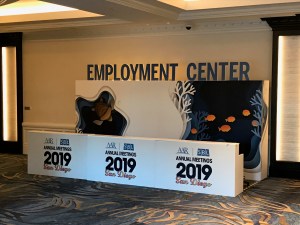
Disneyland, they say, is the “happiest place on earth.”  While I have my doubts about than endorphin-laced claim, I do know one of the opposite locales.  The hotel in which I stayed, the Grand Hyatt, San Diego, hosted the AAR/SBL Employment Center.  The hotel is not to be blamed for holding the most unhappy place on the planet, but as I looked at the booth I wondered if this was truth in advertising.  Should it not read “Unemployment Center”?  That two-letter prefix would make this at least honest, if not cheery.  I have spent some of the most miserable hours of my life in the employee hopefuls’ lounges at past conferences.  Hours and hours wasted, waiting to see if anyone, anyone at all was willing to grant you an interview.  I saw more than a few tears shed in that horrid place.  Some of them mine.

Now I’m high over Death Valley.  It feels far too sanitary to experience it in this way.  The professorate, which seeks to improve the world, is generally a powerless lot.  Signs scattered throughout the Convention Center and hotels asked such things as Does your school have over 50% contingency faculty?  And statements like Tenure track is not the norm.  The psalmist, it seems to me, got it right.  If you want to face the valley of the shadow of death and not fear, you have to walk through it.  The more people who do, the better the hope that we’ll land this plane with some kind of resolve to do be open to visions and to act upon them.


J L Seagull

Perhaps it has happened to you as well.  At some undisclosed period life became so busy that you felt as if—in a good southern California metaphor—you were riding on a huge wave and you couldn’t get off.  Back in my teaching days I had time to plan my trips to AAR/SBL and fit in some human activities as well as maybe even getting around to see the outside once in a while.  It’s great to run into so many people from every stage of my academic life—toddlerhood at Grove City College through my current doddering editorship—but I can’t help having the feeling that I’m popular now because I’m thought to have something others want.  The keys to the kingdom.  A possibility of getting published.

Those of you who read my daily reflections know that I’m glad to share publishing knowledge.  I encourage academic authors to learn a bit about the publishing industry.  It’s rapidly changing and when you have an inside track (here is the real added value) you need to look beyond your current book project to see what goes on behind the veil.  Widen the focus.  There’s a whole world out there!  My glimpses out the hotel window inform me that there’s an entire bay to be explored.  I watched seals or sea lions (it’s hard to tell from this distance) playing in the water as the sun rose.  Then a seagull flew up and landed inches from my face on the windowsill of my room.  It stayed for nearly a minute, looking me over as I looked it over.  Noticing the tiny white feathers that formed a W on the edges of its beak.  Its Silly Putty pink feet with small black nails.  The emerging red patch on the underside of its bill.  It took a step off the ledge, spread its wings and looked elsewhere for a snack.  I soon learned why.  A second later a larger gull landed in its place.  We too regarded one another curiously.  Had the glass not been there, we could’ve easily touched.  It also lept off to be replaced by an even larger, more mature gull.  None of the three were in any hurry to get away, but when they realized I couldn’t give them what they wanted, they left.

I’m a great fan of metaphor.  Academic writing, unfortunately, doesn’t encourage the craft of utilizing it (neither does it often encourage being coherent).  Later this morning—it will be early afternoon back home—I have to rush to the airport to catch a hopeful tailwind back east.  Someone else will check into my room.  If, perchance they sit by the window with the curtain drawn before dawn, the gulls will visit.  And maybe a lesson will be taken away.


Armed Forces

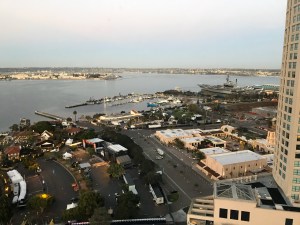
You ought to feel safe with the U.S. Navy so close by.  The naval base at San Diego is the second largest surface base in this particular branch of our sprawling military system.  From my hotel room I can watch the ships chugging through the harbor and from the Convention Center you can see quite a spread of naval real estate.  Still, all this hardware doesn’t make me feel safe.  Perhaps because I’m a child of the sixties, I can imagine a world at peace where military budgets don’t literally take food from the mouths of hungry citizens.  The last time I was in San Diego for AAR/SBL I toured the USS Midway aircraft carrier.  It’s clearly visible from my room.  I was amazed at both the technology and the obvious expenditure for such a craft.  It can’t be easy to set a city afloat.

Whenever I experience things like this I can’t help but wonder what we might accomplish if we loved each other as a species and put our heads together to try to solve our problems.  Lack of water—perhaps ironically in this naval city—is a serious global issue.  Poverty is the ghost of civilization.  The grasping of power by the driven but inept is clear worldwide.  We build great, complicated war machines.  The noise generated by the helicopters charging overhead bespeaks their weight and weaponry.  Down here in the southwest there are places civilians just can’t go because our military is busy keeping us too safe to allow us to wonder what they’re up to.  Black budgets must be nice.  I stand here among religion scholars and dream.

Ironically religion often leads to the fear that leads, in turn, to militarization.  We want to protect our “way of life.”  We’ll follow the prince of peace into war any day.  Just give the signal and release the missiles.  It doesn’t make me feel safe at all.  One time on a family visit, we drove through Norfolk, Virginia.  We stayed at a cheap hotel, because, well, we’re cheap.  The metal door was heavily reinforced with a stolid steel lock.  Navy men, we were informed, didn’t always behave well while ashore.  The locks were to keep us safe from those protecting us.  We stayed only one night and left early the next morning.  So I while the annual meeting away under the watchful eye of our largest line item on the budget.  They’re keeping our bodies safe, but who’s keeping track of our souls?


Wisdom of Trees

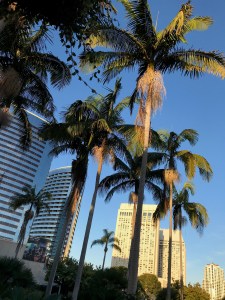
Stepping out of the airport the first thing I noticed was the palm trees.  I’ve traveled to this area enough times that I shouldn’t be surprised, but I always am.  And since we are creatures of the culture in which we’re raised, palm trees inevitably make me think of Gilligan’s Island.  We grasp for culture to help us make sense of this odd world of negotiating other people and, like many children born in the sixties, I was raised on television.  Gilligan’s Island (somehow appropriate training ground for attending AAR/SBL—it actually featured a professor) was as close to seeing a palm tree as I ever got, being raised in a very humble household.  To me, palm trees were as much creatures of fantasy as the monsters that populated the movies I watched on Saturday afternoon.

My first experience of a real palm tree was in Israel, 1987.  I’d signed on as a volunteer at Tel Dor, an archaeological dig near Haifa.  Then, as yesterday, I encountered palm trees—so alien and yet so natural—at the airport.  Welcome to Tel Aviv!  And so we think of palm trees as being part of paradise, a place where it’s always pleasantly warm and although well-watered it doesn’t rain too much.  Trees symbolize our culture.  Although back home in the northeast most of the leaves are down from the hardwoods, the region is also defined by its large plants.  Trees do that for us.  Spreading high over our heads, with dense cellular structure that makes them heavy, trees have always been attractive to our species.  And they can help us define, at a glance, where we are.  “Paradise” derives from a Persian word for “garden.”  Even in arid zones they value their trees.

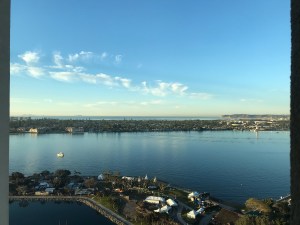
Looking out my hotel window I see the bay.  In the bay stands a marina.  Back home most boats are shrink-wrapped by now and I’ve already seen smaller bodies of water start to freeze over.  Paradise has no ice.  For the castaways, being on the island was always a challenge, but never a terribly serious one.  Thurston Howell III used his money (useless where there’s nothing to buy) to try to assert his influence.  Everyone treated him with respect, always calling him “Mr. Howell.”  In that paradise, however, one of the two characters (who had names) referred to always by title, the professor—the skipper, of course, was the other one—was the person looked to for guidance.  If anyone would figure out a way to be rescued, it would be the academic.  I’ll be spending the next few days on an island with mostly professors.  And when it gets too intense I’ll look at the palm trees and remind myself that this is paradise.


Speedy Delivery (SD)

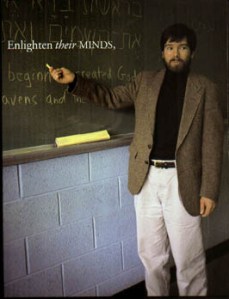
Ritual, no matter what scientists say, is deeply woven into the fabric of human psyches.  It may be either the warp or the weft, but it’s downright basic.  I was reminded of this on my hurried and slow trip to San Diego yesterday.  I always wear the same shirt when I fly to this conference.  This isn’t superstition, but rather it’s a case of sticking with something that works.  I don’t often wear turtlenecks, and one reason is that they seldom fit well.  More years ago than I care to admit (I’m wearing the shirt in the photo below, which was taken at Nashotah House nearly two decades in the past) I found a navy blue turtleneck from Land’s End (this is not a sponsored post, although it probably should be) that works perfectly.  Even today it fits snugly around the neck after hours of wear.  Maybe ten years back I bought a black turtleneck from the same company and after pulling it over my head, it gaps something awful.  I tend only to wear it around the house.  The original still does the job.

I was ready to drive myself to the airport yesterday and I grabbed a quick lunch at home.  Part of said lunch involved opening a ketchup bottle probably nearly as old as the shirt I was wearing.  (I’m sure you can see where this is going.)  I ended up looking like a murderer, which is not something you want to try to explain to a TSA agent.  I quick threw said ritual shirt into the washer and the drier buzzed at the same time as my phone did for when I had to leave for my two-hour-ahead check-in.  This remarkable shirt was dry and ready to serve.  Maybe you can see now why I’m so ritualistic about clothes.  I also opt-out of those Star Trek scanners at the airport.  This means I get lots of governmental pat-downs.  It feels more authentic when you have actual hands running down your body—at least it’s honest.

The TSA agent commented that you don’t see many turtlenecks these days.  I explained that it’s good for flying because I’m always cold on planes.  As this stranger’s hands were rubbing down my chest, I was wondering how many times this shirt has been felt up by the US government.  It has no pockets to pick, and besides, at airport screenings everything is stowed in my carry-on, including wallet.  At midnight San Diego time, I checked into my hotel.  East coast time said I’d been awake 24 hours because who can really sleep on a plane?  Once my patted-down body reaches 3 a.m., Eastern Time, it wakes up.  In these circumstances it’s good to know I can rely on that shirt in my drawer.  That’s what rituals are all about.


Daylight Saving Time Zone

One or two of you out there—you know who you are—put yourselves through reading my musings on a daily basis.  I haven’t missed a post in nearly a decade, but travel always complicates things.  Yes, it’s that time of year again—I’m on my way to AAR/SBL.  The American Academy of Religion and Society of Biblical Literature Annual Meeting is the trade show of the guild.  This year we’re meeting in San Diego, California.  The hope of many of us is that it’ll be sunny and warm.  Last year, of course, I missed the conference for the first time, exchanging the Denver Hilton for a night on the floor of Newark’s Liberty Airport.  This year I’m flying out of a different venue—one where egress is possible in the case of snow.

I always like to post a reminder to the faithful few that normal service on this blog may be interrupted.  One never knows what might happen when away from the regular routine.  And three time zones will surely wreak havoc with circadian rhythms that haven’t yet caught up with the end of Daylight Saving Time.  Or is it the beginning of Daylight Saving Time?  It makes no difference, because it lead to lack of normal sleep, no matter what we call it.  In any case, San Diego may make usual posting unusual.  At the very least it’ll be a few hours off.  I’ve become a creature of habit, posting my thoughts between six and seven on weekdays.  On weekends I’m up just as early, but I give the web a chance to sleep in.

These annual meetings are exhausting when you go on behalf of a publisher.  Unlike the leisurely experience of a paying customer, you don’t get to go back to your room for a nap, or even to sleep in.  Every year colleagues ask me to receptions but I decline because every day is a school day.  And I have appointments from 8:30 until 6:30 daily.  Sometimes even later.  You, my gentle reader, have been given advance notice.  I’ll try to continue my daily chronicle of life inside this particular head as thousands of scholars of religion mill about, wondering about the answers to the big questions.  Right now the big question is whether I’ve packed everything I’ll need.  I’ll gain three hours on the way out, but I have to leave them at the desk when I get back.  Along the way I’ll scatter posts like breadcrumbs to help me find my way home.


Geography Lesson

As someone who eschews easy labels, I’m always conflicted when someone asks what my doctorate is “in.”  Universities have departments, of course, and different academic fields have differing standards of what qualifies you as an expert.  My Ph.D. was mainly in the field of history of religions, but focused (all such project must be narrow) on what is best called ancient West Asian cultures.  Recently someone showed me a website with free geography quizzes on it.  (I post the link here with the caveat that this can be very addictive.)  This friend asked me how good my Asian geography was.  I knew that once I got east of Iran I was going to be in trouble.  Some countries, such as Russia, India, China, and Japan are hard to miss, but the others I was properly humbled over.

I tried the quiz again and again until I could point to any of the official Asian nations with a fair degree of accuracy.  Eurasia is a very large landmass, and when you consider that it is, apart from human-made canals, attached to Africa this is a lot of space to label.  Considering that many isolationist politicians can’t correctly find smaller countries on a map without an app, I started to realize just how lopsided the world is.  Many more people live in Asia than populate the “New World.”  They actually have more space than we do here, but much of it is too cold or too dry for comfortable living.  Still, I considered that if I’d had this quiz as a kid I might’ve known my geography much better than I do.

As I’m preparing to attend the American Academy of Religion and Society of Biblical Literature Annual Meeting in a few days, I recall priding myself at knowing all fifty states of my native country.  I’ve been to all but five of the lower 48—Alabama, Kansas, Oklahoma, New Mexico, and Nevada have eluded me (the conference never meets in them and I don’t have friends who’ll put me up for free in them).  But at least I know where I haven’t been.  

After trying my hand at Asia on the app, I attempted Africa.  Let’s just say I still have a lot left to learn.  And unlike when I was a kid, I look forward to taking quizzes.  Work interferes with web time, though, and learning modern countries isn’t the same as knowing where Hatti or Elam used to be.  Religion, after all, forms borders just as impermeable as mountains, oceans, or deserts.


Frozen Streams

I was walking in Ithaca, with my feet not far from Sagan.  Winter had settled in prematurely, as it often does in upstate.  I was wearing a hoodie and old fleece combo and I suppose I looked a bit tatty.  My wife and daughter had gone to see Harriet, but movies about how badly people have mistreated others, strangely for a guy who watches horror, really depress me.  Ithaca, until recently, supported three independent bookstores, so I figured I could pass the time easily enough.  It was growing dark and breezy, and I visit bookstores only with a list, otherwise it’s too dangerous.  Autumn Leaves, a used vendor, I’ve visited many times.  Their religion section is disappointingly small, but I tend to find offerings in other areas when I blow in.

Buffalo Street Books is the last remaining indie that handles new books, but I stopped by The Bookery, now closing, on my way.  This was saddening.  Ithaca houses both the ivy league Cornell and the highly regarded Ithaca College.  I suspect many of the street sweepers hold doctorates.  Has book culture entirely bent the knee to Amazon?  At the end of the last millennium, Ithaca housed 25 independent bookstores.  Today it’s evident that Buffalo Street (formerly The Bookery II) struggles to keep its hold.  I feel ethically obligated to buy something there, to take one for the team.  I had a short list and the shelves in The Bookery had been nearly bare.  It was just too depressing to stay there.  I found an inside bench and sat to read until the movie was over.

Or so I thought.  I ventured back outside and now it was fully dark, being six p.m., and I wandered back to the familiar Ithaca Commons.  I went into a couple of shops, but they looked at me as if I were homeless.  (I suppose I was, in a sense.)  I haven’t had a haircut in a while, and my beard is scruffy and white.  My hoodie and fleece don’t speak to affluence.  I had unconcealed books—I routinely refuse bags—and I suppose I could come across as a touch eccentric.  (I don’t have enough money to be authentically eccentric.)  I wondered how street people do it.  Outside the east wind was decidedly sharp and windbreaks on the pedestrian zone are few.  I came to the monument to Martin Luther King Junior.  I was walking in Ithaca but I really felt that books could make that dream come true.


Old Grains

Back when I was somebody—a professor is somebody, even if only a seminary professor—I was invited to meet with a group of Seattle writers and intellectuals.  I was in Seattle already because driving all the way out here was possible when you live in the Midwest and your summers are basically open and free.  (Professor’s privilege.)  One of the group members, the one who invited me, asked me about grain.  When the club met they ate.  With a bent toward history, one of them brought period-appropriate bread.  What kind would be fashionable for a night of ancient Near East talk?  (I was still researching and writing on Ugarit at the time, before Ugaritology passed away.)  Without stopping to think I replied “Einkorn.”  I didn’t know if einkorn was still around or not.  All I knew is that it was the earliest (at least as understood at that time) domesticated grain.  The loaf that arrived that night was a more accessible grain variety.

All of this came back to me as I stood in the local health-food store.  We don’t shop here for regular groceries—it’s expensive to eat healthily—but we’d been invited to someone’s house and said we’d bring appetizers.  The health-food store had vegan cheeses, so we needed crackers to go with.  Then I spied the word “einkorn.”  The Seattle discussion had to be well onto two decades old by now.  I was finally able to answer my question, einkorn was still alive.  The craze for ancient grains did not exist in my professorate days.  Some companies, according to occasional news stories, were trying to brew the beer of ancient Egypt or Sumer, but the health conscious hadn’t gone so far as to trying to replicate the diet of the earliest agriculturalists.

Ancient grains cost more because the yields are smaller.  Although the grain heads look disturbingly like those house centipedes that scamper in the basement when you flip on the light, they aren’t nearly the size of a current wheat head.  It stands to reason that it takes more of them to make up the same amount of flour, and appetites have grown over the millennia.  Like most vegans, I read boxes.  Another ancient grain cracker, apart from brown rice, included amaranth, flaxseed, millet, quinoa, sesame, and sorghum.  Never mixed this way in antiquity (for amaranth and quinoa were part of the “new world” and the others “old”), modern mixologists have devised new ways of using ancient grains.  Einkorn nearly went extinct with the development of wheat, rye, and barley.  But it hung on, and now, as a dozen millennia ago, it has a way of sustaining both dreams and fantasies.


Trailing Art

One of the many trails that wend their way through Ithaca is the Art Trail.  (The town finds waypoints on the wine and beer trails of the southern tier as well, but we were looking for visual art.)  In early October several artists open their studios—these are personal places—to the tourists passing through.  Those of us on the trail are seeking inspiration in human expression.  I’ve neglected my own art for many years.  While other guys my age are retiring and expressing their boredom, I struggle to find enough time to write, dreaming of the day when I can again take up my pencils and brushes.  Being in so many studios over the weekend jump-started something in me.  Humans are at their most god-like when they create.

Seeing artists in context is revealing.  They don’t worry too much about convention.  I found myself hanging toward the back of our little group.  There was so much of others’ souls on display here.  While some were young, a fair number were older than me.  Perhaps retired from a novocaine job that dulled many days until enough years had passed and the need to let the art out escaped.  If felt like visiting a small farm where the true independent, liberal spirit of this country once resided.  These were farmers with paint brushes rather than shotguns and Trump bumperstickers.  Free thinkers, not Fox thinkers.  Under a sky October blue after two days of rain and gray, this was a mosaic of autumn.  Art is a muse.  I think of my neglected brushes and dried out paints, tucked away in the attic.

Modern art sometimes feels like someone slapped a frame around something random, but in talking with the creator something different emerges.  Something that doesn’t feel like plastic.  Something that defies words.  Like poems sometimes break conventional lines, art refuses to be confined.  Some of these studios used to be living rooms.  Houses converted and dedicated to creativity.  Why is this so difficult to accomplish in my own life?  How has the time come to be consumed with work, even when the commute has been effaced?  I suppose I’ve been using words to express myself—this blog is certainly an example of that.  It is, however, a mere fraction of visual ideas awaiting release.  I don’t know if I could ever open my studio to strangers.  Art trails are labyrinths, and once you’ve entered that maze, it will take some time to reemerge.  And when I do I know I will have been transformed.


Book Magic

Something happens to you on a long bus ride, reading a mind-blowing book.  Part of the transport—literally—is that you’re captive for an hour or two and your book is your boon companion among snoring strangers.  Another aspect is the earliness of the hour.  Days like yesterday, when I have to commute to New York, involve awaking at 2:30 a.m.  The day is cast very differently when your timing shifts back by a few hours.  It’s almost mystical.  The largest portion of the transformative experience, however, is the book itself.  I’ve begun commutes with a book that I quickly realize is a mistake, but since I’m not a quitter, I soldier through it to the end anyway.  On yesterday’s commute the book was one of those that caught my imagination and flew it like a kite from the rear of the bus.  Arriving in Manhattan before six a.m. added to the feeling.  The city’s a very different place that time of day.

Not everyone enjoys reading, I realize.  My late stepfather once had a job as an elevator man.  Not the kind dressed in livery at a big-city hotel, but as an operator in an antiquated building in Oil City, Pennsylvania, where you had to pull the metal gateway  physically across the door and wait until the floor leveled before opening it again.  I didn’t get along with my stepfather, but one day I went to visit him in the elevator.  It wasn’t a busy building.  He sat on a stool, staring straight ahead.  For hours at a time.  Not a man prone to meditation, I knew he had to be bored.  I asked if I could bring him something to read, at least.  He declined for fear of missing someone’s call signal.  It was one of the most frightening scenarios I could imagine.

The clock in the Port Authority read 5:49 when we pulled in.  The day seemed full of possibilities.  I caught the 4:30 home, but the magic was gone.  The book had moved on to more technical things.  Traffic was bad, and there’s a world of difference between reading while the bus moves and trying to do so when it’s caught in traffic.  The commute out of New York City is normally a nightmare, and yesterday traffic didn’t flow freely until we were nearly through New Jersey.  My book was still my companion, but rather more like when a conversation ebbs after an intense discussion.  There was the worry of getting home, taking out the garbage, and trying to stay awake until a reasonable hour.  The book would still be there tomorrow, but I wouldn’t be the same.


Upstate Reading

In terms of cash flow I don’t fall into the wealthy bracket.  My assets are largely in pre-printed paper form, and when I visit the local Little Free Library it’s generally to donate books rather than to take them.  Over Labor Day weekend I was in Ithaca.  One of the more famous features of the town is its weekend Farmers’ Market.  Indeed, the north-south corridor through town is a continuous traffic jam during Market hours.  Not only are there farm stands in the permanent open-sided structure, but there are a few craft booths and several places to buy al fresco fair from local restaurants.  In the summer parking can be hard to find, but the place has a carnival-like atmosphere nevertheless.  It also has a Little Free Library.  I’ve been to the Market many times but I’d never noticed it before.

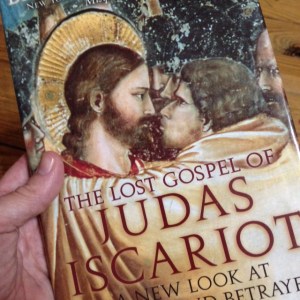
Upstate New York is beautiful but it tends toward the conservative end of the political spectrum.  Ithaca is a pixel of blue in a screen of red, and that strangely showed in the Little Free Library.  Many of the books were either Bibles or popular kinds of devotional titles.  Given that Cornell isn’t known for its religion department (Ithaca College has a respectably sized philosophy and religion department, however) these books aren’t the kind you’d expect to find in an institution of higher education.  That’s why I was surprised to see a near mint copy of Bart Ehrman’s The Lost Gospel of Judas Iscariot on the shelves.  The Gospel of Judas hasn’t been big news for a few years now, but this was a book that suggests a different demographic than your average evangelical readership.

Like Ehrman, I once made a living as an adjunct at Rutgers University.  Indeed, it was this commonality that helped me to get to know him a bit.  He’s gone on to a kind of fame rare for biblical scholars.  Indeed, to have a sufficient number of copies of your book printed to end up in a Little Free Library—in other words, you have to have more cachet than your garden variety Ph.D.  In my local community LFL I like to leave books for others to take.  Just last week I stopped by and noticed that the summer had depleted the stock.  Ironically, I had noticed one of Neal Stephenson’s novels in the same circumstances as Ehrman’s.  I’m glad to see intelligent works on offer for the reading public.  And trading books with no money involved suggests to me that there’s a better form of economy than material greed.  All it takes is a Little Free Library and a little good will.