Really Celebrate

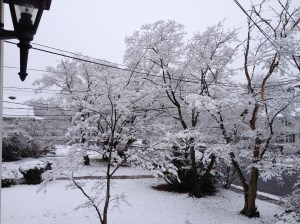
It’s a dilemma.  How do we celebrate Mother’s Day during a lockdown?  The COVID-19 pandemic has changed a lot of things.  Given that it was snowing around here yesterday (not to be blamed on the virus), even May doesn’t seem very cooperative this year.  On Friday night I made an emergency trip to Target for essentials.  One of my ulterior motives was to purchase a Mother’s Day card for my wife.  Given the lack of social distancing at the card rack, I wasn’t the only one who had this in mind.  The remainder of the store had shelves of daily necessities picked clean.  How to celebrate moms during a pandemic?  I guess by trying to stay alive.

Those of us far from childhood homes can’t visit our mothers.  Even if we could we couldn’t take them out for dinner.  If we send flowers we can’t send gloves to protect their fingers—the stores are out of those.  If we send flowers to plant we have to send plastic to cover them too, having had four nights with freeze warnings in a row.  Talking to my Mom yesterday she recollected the year that it snowed on Memorial Day.  I shouldn’t complain.  Mom would rather I didn’t.

Perhaps the best we can do for Mother’s Day is to start treating all women better.  One commemorative day a year doesn’t make up for a lifetime of second-class citizenship.  Our mothers are the reason all of us are here.  Isn’t that reason enough to see we’re all part of a single family?  Women put up with a lot to take care of us.  Even so we deny them an amendment granting them equal rights.  Politicians are saying “Happy Mother’s Day” even as they continue to withhold basic human rights from women.  We could celebrate Mother’s Day by putting our sentiments into action, transforming daily life into equal pay and equal protections.

There’s a pandemic outside.  There’s some snow out there too.  But there’s a warmth inside and for that we have our mothers to thank.  If we really mean it when we send our mothers cards and flowers, if we really mean it when we call, if we really mean it when we give her a hug, we’ll show it by our actions every other day of the year.  We need to be sincere when we say it, or don’t say it at all.  Happy Mother’s Day!


Peaceful Lessons

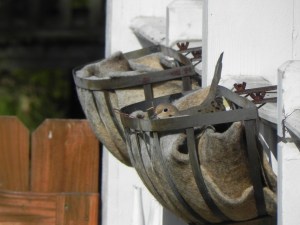
We are all, I think, looking for hope.  Probably due to the way I was raised, I often seek signs.  There’s no way to know if said signs are mere coincidences or the more intense variety known as synchronicities, yet we have a hopeful sign here at home.  On our front porch we have some plant hangers.  Spring crept up on us this year and we haven’t got around to putting any pansies in them yet.  The other day when I was stepping out to get the mail, I noticed feathers in one of them and feared there’d been a bird-related accident there.  As I took a step toward the planter, the head of a mourning dove popped up.  She blinked at me curiously, but didn’t fly away.  I knew then that she had built a nest in the as-yet unused planter and she was sitting on her eggs.

Monday was fiercely windy around here.  And rainy.  I wondered how any birds could fly in such weather.  A mourning dove flew up—perhaps one of the pair on our porch—and landed on the electric wire leading to our house.  The wire was swaying and bucking so furiously that the dove constantly had to shift and fluff and flutter just to stay in place.  The poor bird was in constant motion.  Then it showed a sign of animal intelligence.  There’s a much larger wire that runs down our street, from which other houses are supplied.  It’s more stable in the wind due to its girth.  The dove flew up to that wire instead.  There it was able to perch without having to constantly adjust itself to the gusts.  Peaceful and intelligent.  That’s what the world needs.  I have hope.

The dove has long been a sign of peace.  It’s understood that way in the Bible.  It was the dove that brought an olive twig to Noah, indicating that although all he could see was water there was, somewhere, dry land.  These days we need to be reminded that although it seems that the storm will last forever, even hurricanes eventually exhaust themselves.  The dove, clearly not happy about the horrendous wind buffeting it on that wire, nevertheless persisted in a kind of stoic optimism that things are as they should be.  There is great wisdom in the natural world.  If we can get to a window we can see it playing out before our very eyes.  Now when I step out the door, I glance at the dove, and she looks back at me.  We wink at each other.  She doesn’t fly away, for she understands.  She has a wisdom to which we all should aspire.


Cancelled Easter

The year they cancelled Easter.  Well, not exactly.  Perhaps I’m merely a product of the commercialization of my time, but my thoughts go back to the Grinch.  “It came without boxes,” he said, “it came without bags” (and any more might be copyright infringement).  You get the point—holidays aren’t reliant upon their trappings.  Can Easter come without colorful eggs?  Without baskets and bonnets?  Without Peeps and chocolates?  Yes, it can.  We’ve taken another holiday with religious origins and associated it with what you can buy.  I know it’s more than that for some people.  It’s singing stirring hymns (all of which can be found on YouTube), and dressing nice (which can still be  done at home), but mainly I think it’s the sense of togetherness that’s missing.  The freedom of bursting from our personal tombs in which we’ve been stuck for three weeks.

Around here snow was falling on Good Friday.  A friend told me her company decided since everyone was working remotely they would give them an extra holiday that day.  Others of us slogged on as usual, for unlike Christmas, the Easter/Passover complex is not about getting days off work.  These are, I guess, working class holidays.  Our capitalistic outlook wants us to spend money, though, on holidays.  Halloween (on which I foresee a plethora of plague doctor costumes) has become almost as lucrative as Christmas.  The spring holidays—St. Valentine’s, St. Patrick’s, and Easter—encourage spending as well.  Can we not get to the heart of a holiday without pulling out our wallets?  Spring holidays are all about the return of life after winter.  It was snowing, but I could hear lawnmowers in the distance.

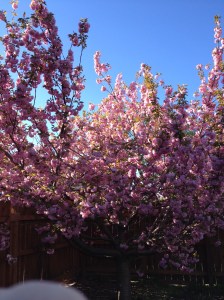
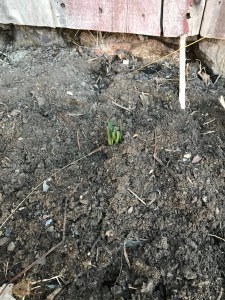
With capitalism growing old and sluggish, the next spending holiday isn’t until Mother’s Day, yet another spring celebration associated with flowers and life.  My wife has been saying that what she misses is being out to see things coming back to life in spring.  Some of the trees are putting on quite a show already.  Magnolias and dogwoods have started to scatter their petals with the snowflakes.  Our daffodils have been blooming since March.  The forsythias are already going green.  Life is returning.  That’s what Easter, and in its own way Passover, is all about.  Life after imprisonment—freedom.  Liberation.  We have to put them off this year, but they’re all movable feasts.  We keep quietly apart in the hopes that life really will return after disease and death.  And it will come regardless.  It always does.


The Wind and Trees

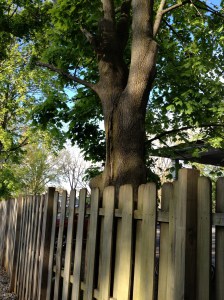
Being invisible, the wind is easily forgotten.  Until it begins to really blow.  I don’t know about where you are, but this past week was a very windy one around here.  Thursday especially.  My office has a couple of windows and each view shows different kinds of trees.  The south window reveals only a stolid oak or maple in a neighboring back yard a few doors down.  I don’t know this neighbor and I’ve never been close enough to get a good look at his deciduous tree.  Its leaves are down, of course, and although its branches moved in Thursday’s gusts there was never really a question of it coming down.  Trunk stout and sturdy, it has stood through many windstorms and will likely see many more.

My west window opens to some lofty pines across the street.  At least sixty feet tall, their trunks, like many coniferous species, stand fairly straight.  The way these trees bent in the wind worried me as a home owner.  And as a human being.  You see, I have done some woodwork.  A guy with as many books as we have either runs himself broke on buying bookshelves or learns to make his own.  I’ve spent plenty of my money on one-inch pine boards—the standard shelving material.  The 1 x 10, which is really 3/4 of an inch by 9 and 3/4, is the usual bookshelf board.  Not even an inch thick, it isn’t easily bent.  Incorporated into the trunk of a tree, it’s absolutely immobile if I press against it.  I’ve tried to move a mature tree trunk.  Even a good-size branch.  Mere humans can’t.  And yet I see these very same trunks swaying like they’re waltzing with the wind.

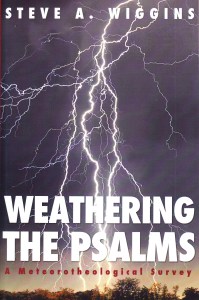
No wonder the weather has always been associated with the gods.  I mean, on Thursday last I saw these giants in the earth bending in arborescent obeisance.  The wind is easily forgotten.  As I worked on Weathering the Psalms, I easily sketched out the chapters on rain, lightning, and even snow.  But wind.  If you exegete a storm often the most damaging aspect is the wind.  Hurricanes and tornadoes damage due to their great wind velocity (the former also from impressive rain dumps).  What we call EF5 (or F5) tornadoes are so violent that any instrument directly in their path can’t survive its onslaught.  Winds swirling over 300 miles per hour are pretty much incomprehensible.  And yet when they dissipate, those violent winds are once again invisible.  Isn’t that just like the gods?


Future Warming

It’s a good thing global warming is a myth, but somebody forgot to tell the hyacinths and lilies in my backyard.  February in Pennsylvania is not when you expect to see spring flowers.  Now I’m fully aware that unseasonal warm snaps and cold spells aren’t an indication of the global climate; they’re far too localized.  One thing I’ve learned in my several decades of life is that heat takes time to transfer.  If you’ve ever had to wait for a pan of water to boil when you’re hungry, you know that to be true.  On cold morning’s my coffee’s ice coffee before I finish the mug, but it does take time for that transition to happen as the cup empties.  With something so inconceivably large as the atmosphere, it takes time.  As our hemispheres take turns pointing at the sun and warming up, the air tries to reach equilibrium and so the weather goes.

Scientists are now talking about, once we get the deniers out of the White House, what long-term remediation plans we have to make.  We’ve already set in motion extreme weather events.  We’ve had decades of warning, but those who control the money just can’t bear to let any of it go.  It’s a safer bet to wreck the planet.  You can just cash in your insurance money and buy a new one.  That’s the way it works, isn’t it?  So I’m standing outside in my shirtsleeves in February staring at April flowers who think winter’s over already.  I don’t know what to say to them.

You can’t drive a car without a license, nor can you practice law or medicine.  To be a world leader you don’t even have to be literate.  I often imagine what the future survivors will say.  They’ll likely be there, since people have a way of getting by.  They may wonder if we knew this was coming.  Of course, the internet won’t be up and running then, and who knows what’ll happen to electronic information when there’s no power left to keep the servers going.  In any case, my perhaps futile answer to their imagined question is yes.  We did see this coming.  Some of tried every legitimate tool in the box called “democracy” (you’ll need a dictionary for that one) to introduce sanity into the discussion, but bluster wins over hard thinking every time.  I cup my hands around the tender, if resilient leaves.  They’re only doing as nature directs.  If only our species could pay such attention to what the planet is saying.


Smelling Winter

We’re experiencing the January thaw around here.  This isn’t a scientific thing, of course, and it doesn’t happen every year.  We had snow before Christmas, but it didn’t linger too long.  We’ve had cold days since, but none so bad that I couldn’t jog a couple miles over lunch.  The ground has started to freeze but much of the grass is still green.  The changing seasons are largely olfactory to me.  You can smell fall and spring coming.  I’m not talking about burning leaves in autumn or the first hint of magnolia in spring.  No, I mean the aroma of the earth.  Stuck indoors as we often are, we’ve been conditioned to think our sense of smell is under-developed and therefore unimportant.  Overall, however, humans don’t rate too shabbily in the nasal range.  We don’t experience the aromatic realm as much as dogs, vultures, bears, or mice, but our sense of smell is vitally important.

Not only does smell tether us to memory, it also influences moods.  Studies done on those deprived of scent by disease or accident indicate higher levels of depression.  All of us know how vital scent is to taste.  We don’t appreciate, I suspect, how the aroma of our earth can inspire us.  Yesterday as temperatures crept into the 60s, I stood outside breathing deeply. It was only in my back yard, and the clouds were low and gray.  Spring clearly came in the gusty air.  I know that the bulk of winter lies ahead.  January’s only just tuning up, and February has us in its sights.  The aroma of spring will once again be frozen to await release in more timely fashion.  I’ve been feeling chilly since October, layering up and reluctantly bidding goodbye to the scents of autumn.  Winter’s sterility has begun, but we’re being teased just now by a nature that likes to remind us who’s really in charge.

As I grow older, I’m hoping I’ll learn to smell winter.  My nose spends too much of it feeling cold, and when I wrap my face in a scarf, I have only my own breath to breathe.  What is the odor of winter?  The faint hint of smoke from a neighbor’s chimney?  The briny tang of a freshly salted roadway?  The pine of a newly cut Christmas tree?  Outdoors there’s life throbbing, pulsing slowly beneath the chill.  Even after the great ice ages, it was ready and eager to reemerge.  Today I smell spring in the air.  It’s not yet here, and won’t be for some time.  Scent is ever only temporary but today there’s yearning in the air.


Prophets and Precipitation

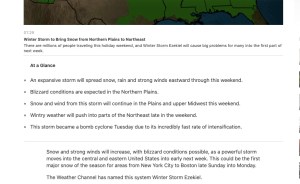
I have no idea how they name winter storms, or even if they should.  Weather-hype is yet another instance of click-bait, or watch-bait that requires constant upgrading to draw in increasingly jaded readers/watchers.  Winter storms are a fact of life, particularly in northern states.  If you name them, then you think you own them, as the saying goes.  In any case, beyond the fact that they go through the alphabet to draw their inspiration, I have no clue what criteria are used for giving names.  The storm that many of us were out in for much of the day yesterday was “Ezekiel.”  There are plenty of “E” names available, and I wondered at this biblical choice.  Ezekiel is often treated as a name for eccentrics, and I wondered if something about this storm was proto-apocalyptic or what.  Beyond the standard “snowpocalypse,” I mean.

The storm may have been considered of “biblical” proportions since it affected/is affecting much of the nation (as it is me, even as I write).  We tend to use the Bible for things that are of large scale, and, frequently, beyond our control.  Prophets often called for events on national level, and Ezekiel’s message had to do with a kind of ultimate redemption.  I suppose it’s the kind of message our nation could use right now, snow or not.  We could use good times sent from above, following the decidedly unbiblical evangelical administration we’ve put up with for three years now.  What would Ezekiel say?

Back in my teaching days, I had to cover Ezekiel in less time than the prophet deserved.  He pantomimed the coming destruction of Jerusalem, and, among the exiles, proclaimed their return to a better future.  Now I can’t say if winter storm Ezekiel will lead to a better future or not.  It will lead to some sidewalk shoveling, some travel headaches (as we experience firsthand yesterday), and the usual array of winter wonders.  I do know that claiming insanity to label a prophet is a cheap shot when it comes to explanations.  Ancient people recognized madness when they saw it, and prophecy, they knew deep down, was different.  None of this suggests this storm has been in any way predictable.  Yesterday with its accumulation of sleet and freezing rain, and today with its projected snow are all part of a typical December around these parts.  As people addicted to media stimulation, I guess we have to give it a name so that we can feel properly awed.


Dayglow

Yellow and orange leaves on a damp pavement.  A sky claustrophobically occluded with gray clouds.  A decided chill in the air.  All you have to do is add a few pumpkins and the feeling of October is complete.  I don’t know why this particular image of the change of seasons grips me the way it does.  As a homeowner I don’t want to turn the heat on too soon because the gas bills will jet up and will stay that way for seven or eight months.  I get depressed when skys are cloudy for days at a time.  Around here the leaves have only just begun to change.  In other words, there’s a decided difference between the way I imagine October and the way that it feels on the ground.  In my imagination there are Ray Bradbury titles, The October Country, The Autumn People, but here in the physical world I shiver and add another layer.

Over the past several weeks I’ve been struggling to figure out why horror appeals to me.  It seems to be the Poe-esque mood rather than any startles or gore.  The sense of mystery that hangs in the air when you simply don’t know what to expect.  Will it be a warm, summer-like day or will it be rainy and raw, a day when you wouldn’t venture outside without the necessity to do so?  October is like that.  It is changeable.  Beginning in late September it is dark longer than it is light and for much of the rest of the year I will go to bed when it’s dark outside.  It’s always still dark when I awake.  Is it any wonder that October has its hooks in me?

Short stories, of which I’ve had about twenty published, seem to be the best way to capture this mood.  You see, it isn’t a sustained feeling.  It’s piecemeal like that extra quilt you throw on your bed at night.  The urge to hibernate creeps in, but capitalism doesn’t allow for that.  October is an artist, and I’m just the guy wandering the galley, pausing before each painting.  This feeling only comes after summer, and it is fleeting.  In November the leaves will be down and the cold will settle in quite earnestly.  The candles we lit for Halloween will be our guide-lights to those we hold out to Christmas when the dayglow will begin to return at an hour that reminds us change is the only thing that’s permanent.  And in this there’s a profound hope.


Snow in September

One of the trendy things when I worked in United Methodist youth camp was “Christmas in July.”  Although not quite six months out, the idea was to inject some fun when it was starting to feel too hot out and, as evangelizing efforts go, to talk about Jesus.  The origins of this tradition predate me, actually.  Even secular camps were using the idea in the mid 1930s.  By introducing the mystery of the unexpected, I suppose it might’ve helped to deal with camper homesickness, a perennial problem.  It worked, in my experience, because nobody was really thinking about Christmas in July.  It was a ploy.  Just after the summer solstice, Christmas would have to wait until after the winter solstice to materialize.  Now this past week we observed the autumnal equinox.  I usually write a post about that, but I’ve been kind of distracted lately.

Over the weekend I had to head to a big box home goods store.  I prefer to visit our local independent hardware store, but they don’t carry lumber and I needed some.  I walked in to find the store decked out for Christmas in September.  This was just a bit disturbing.  It’s not even Halloween yet.  In fact, it’s not even October!  For many people in temperate regions autumn is their favorite season.  Harvest themes, apple and pumpkins, turning leaves, falling leaves, and Halloween.  Putting on the occasional sweater for the first time after a long and hot summer.  Big boxes are leaping past all that to get to your Christmas bucks, even while you still have to mow the lawn when you get home.

Okay, so I’m not the only one to grouch about the premature appearance of Santa Claus and the extreme commercialization of Christmas.   I know that Bethlehem is called “Christmas City,” but as we wandered to the Celtic Festival underway downtown, people were sweating in the eighty-degree heat.  The leaves have begun to turn around here, reminding us all that Halloween and Thanksgiving are coming.  The holiday season.  I enjoy it as much as anybody else, but I don’t want to rush it.  I suspect the internet has accustomed us to instant gratification.  You want it?  If you can type it and click on it, it can be at your doorstep in two days.  You don’t need to wait for Christmas to catch up any more.  Meanwhile our landfills overflow with the stuff we throw away from Christmases past.  Christmas in July I think I get.  Christmas in September is just a little too much.


Book Signing

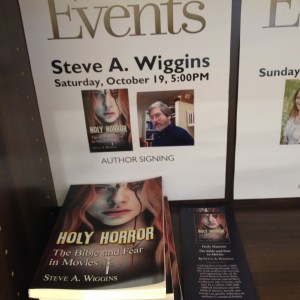
Okay, so I’ve got a book signing for Holy Horror coming up at the Moravian Book Shop in Bethlehem.  And they’ve advertised it in the local paper.  I’m humbled and honored by this, especially since I have no local following.  When I go to the website of the newspaper, The Morning Call, ads pop up on the top, bottom, and center of the page, obscuring the event.  I take this as kind of symbolic.  Life is crowded.  We seem to have turned the corner to autumn around here with nights being distinctly chilly.   After the languorous heat of summer when even thinking about winterizing seemed to add another layer of insulation over already too warm body, now we suddenly have to try to fit it in among an already crowded schedule.  At least I don’t have to commute too much any more.

I’m trying to get ready for the book signing, but I don’t really know what to do.  Perhaps I should try to get some business cards printed up.  Maybe I should think of some catch-phrase to use if anyone actually buys a high-priced book.  What should I wear?  Working at home can make you feel like a recluse sometimes.  I don’t have enough money to be considered eccentric, but I don’t get out among hoi polloi much either.  If most people have as much trouble as I do clicking off the ads to get to the event underneath, those who swing by the table are likely to be few.  Still, I’m looking forward to meeting local horror film fans.  They are, in general, a surprisingly cordial bunch.

After Nightmares with the Bible I’m going to focus on trying to find more mainstream publishers.  The reason is simple: academic publishers tend to be overpriced.  I’ve worked in publishing long enough to be able to decode pricing schemes.  There is a logic to them, even if at times it feels like you’re being overshadowed by pop-up windows.  To get a wide readership you need a pretty big platform, and getting a following on any form of social media takes the one thing I don’t have enough of.  Time.  You see, just the other day it was summer and we felt like we were baking.  Now the equinox has plunged us into the days of getting the furnace cleaned and operational and looking at the prices of insulation and shaking our heads.  Somewhere under all of these pop-ups are ideas waiting to be written down.


Whether or Weather

It was a self-inflicted double feature.  I’d been pondering movies about the weather.  Tons of movies have the weather in them, sometimes even as a significant plot element.  Few films, however, take the weather as their central thesis.  These movies verge on horror as the weather is something much larger than we are and which is deadly.  Let’s face it, a film about sunny skies and light breezes doesn’t have much of a hook.  I began by watching The Perfect Storm.  I’d seen it before, of course.  Not much like its book, which is nonfiction, it follows the loss of the sword boat Andrea Gail in the eponymous storm of 1991.  Not all members of the crew get a backstory, and since nobody knows what really happened, it was a chance for special effects to drive the story just as massive waves drive the boat.  The weather, while central, is seldom commented upon.  The characters are motivated by trying to make a living but there’s not enough time to give all six of them adequate stories.  Add to that another boat with no backstory and the movie become disjointed and smoky.

The next feature was The Day after Tomorrow.  Again, I’d seen it before, but you know how one thing leads to another.  Like The Perfect Storm, The Day after Tomorrow introduces more subplots than the movie can handle, even bringing a Russian freighter up Fifth Avenue in order to have a wolf-chase scene that is simply dropped after it’s discovered that wolves can’t climb ladders.  Still, the latter story has an environmental message.  Aware that human activity does lead to global warming, it tries to picture what would happen if it were speeded up into a matter of weeks rather than years.  No  matter how long it takes, the weather will get you.

As I’ve contended before, the sheer scope of the weather practically makes it divine.  Although we live in different climatic zones we’re all tied together under a single, volatile, powerful atmosphere.  Early humans realized that their survival depended on the weather.  Drought kills as readily as sudden ice ages.  The key, it seems, is balance.  Nature isn’t kind to species who assert too much dominance.  One of the means of nature’s control is the weather.  Until the development of meteorology, and even after its first tentative steps, the weather was considered a divine bailiwick.  We may proclaim it entirely natural, but it still commands its share of awe and majesty.  And it can easily claim a few weekend hours searching the skies for some kind of meaning.


A Decade

Please pardon my being sentimental, but today marks one decade of blogging on Sects and Violence in the Ancient World.  I realized, thinking this over, that I used to make some interesting, perhaps even quotable statements back then.  Why not, I thought, farm those older posts to celebrate what I was thinking when I was a tenth-of-a-century younger?  So for today’s post, I’m presenting some quotable quotes from July 2009, starting with one of the zingers from my very first post.  For convenience, I’ve even provided the links to the posts so you can see them in context, if your July has somehow not filled itself up already.

Sects and Violence in the Ancient World, by the way, was the name given when one of my nieces thrust a recorder in my face and asked me what I would call a blog, if I had one.  She subsequently set this site up for me.  One aspect of the title may not have been evident: it’s a quasi-anagram for my initials.  It has been, from the beginning, mostly metaphorical.  Without further ado, then, a few of my favorite lines from a decade long gone:

“He had a sidekick called Cypher (sold separately), and arch-enemies with such names as Primordious Drool and Wacky Protestor. I marveled at the missed opportunity here — they could have called them Text Critic and Doctor Mentary Hypothesis!” First post: Bible Guy, July 12, 2009. <https://steveawiggins.com/2009/07/12/bible-guy/>

“Technology has outstripped reality.” Asherah Begins, July 13, 2009 <https://steveawiggins.com/2009/07/13/asherah-begins/>

“Black and white are not in the palette of serious religious studies.”  God is Great (not)?, July 14, 2009 <https://steveawiggins.com/2009/07/14/god-is-great-not/>

“When he [Aqhat] refuses to release it to the goddess he is unfortunately pecked to death in a hitchcockian demise by a swarm of buzzards with attitudes.” Sects and Violence, July 15, 2009 <https://steveawiggins.com/2009/07/15/sects-and-violence/>

“Indeed, one may think of them [religion and monsters] as fellow ventricles in the anatomy of fear.” Vampires, Mummies and the Holy Ghost, July 16, 2009 <https://steveawiggins.com/2009/07/16/vampires-mummies-and-the-holy-ghost/>

“Better to consider it [weather] human than to face unfeeling nature.” Changing Faces of the Divine, July 18, 2009 <https://steveawiggins.com/2009/07/18/changing-faces-of-the-divine/>

“As the gods are drinking themselves senseless (how else can the latest Bush administration be explained?)…” Drunken Moonshine, July 20, 2009 <https://steveawiggins.com/2009/07/20/drunken-moonshine/>

“As usual, we kill off what we don’t comprehend.” Not Lion, July 22, 2009 <https://steveawiggins.com/2009/07/22/not-lion/>

“A bonobo was recently documented as uttering the word ‘yes’ to a keeper’s question, officially making her more articulate than some clergy I’ve known. Even today there are churches that still call their leaders Primates!” Religious Origins, July 23, 2009 <https://steveawiggins.com/2009/07/23/religious-origins/>

“I never used a computer regularly until I began my Ph.D., and then it was only a glorified typewriter, qwerty on steroids.” Who We Were, July 27, 2009 <https://steveawiggins.com/2009/07/27/who-we-were/>

“I grew up in a blue-collar household where paying ladies for favors was itself considered a sin.” Yes, Mammon, July 28, 2009 <https://steveawiggins.com/2009/07/28/yes-mammon/>

Where do you suppose we’ll be a decade from now?


Why July?

The weather in July can be exhausting.  I’ve always pretty much associated the Fourth of July with hot, sticky weather and this year’s holiday weekend has lived up to that.  Combine it with the incessant rain in the eastern half of the country and you’ve got a mix that won’t permit you to open your windows, but makes you simmer if you stay inside.  We often handle this by seeking out air conditioned facilities where you don’t have to spend a ton of money in order to find some relief.  It also happens that today is the anniversary of our moving into our new house when, as I recall, the current rainy cycle began.  Restless, stormy nights may be Gothic, but they don’t fit the staid, steady nine-to-five lifestyle very well.

Despite it all, I still value summer.  The sense of carefree days, as my friend over on Verbomania says, give estival days a shimmer like none other.  So much so that it’s difficult to keep track of what day it actually is.  For me this particular date will always remind me of buying a house for the first time and spending a literally sleepless hot night learning the hard lessons of homeownership.  Still, since I mentioned Independence Day, I continue to find myself relieved at the lack of land lordliness when it comes to the list of those who hold something over my head.  If only I could catch up on some sleep over a long weekend it might all seem more real.  July can be like that.

As I saw this weekend approaching from a distance, I made plans at how much I would accomplish.  I would get so much writing done that I’d be well ahead on my next project.  I might figure out what it was most important to say, and maybe finally find the meaning to life.  (Summer makes me feel optimistic, it seems.)  I would post new videos on my YouTube channel.  The weather, however, as the Psalms indicate, can change your plans.  Twilight lengthens to the point of making night and day difficult to distinguish.  Sleep doesn’t refresh the way it usually does and morning—my writing time—is hazy and lazy.  My next book sits untouched on my hard disc while I look over boxes that remain unpacked from a year ago.  Childhood summers set the pattern of dropping all and experiencing the mini-anarchy that lack of structure brings.  Despite all that I’d hoped to accomplish, I find myself welcoming this hot and humid anniversary.  That’s what July is like.


Weathering the Sun

I may have given up on Weathering the Psalms a bit prematurely.  Those who know me know that the weather impacts my mood.  Now that I have a yard to mow that feeling has grown exponentially since perpetually wet grass is happy grass and is impossible to cut with a reel mower.  Today, while those of pagan inclinations celebrate the sun, there’s more rain in the forecast.  As there has been since Sunday.  If Yahweh’s the God of the sun, then Baal’s had the upper hand for some time now.  As an article on Gizmodo has pointed out, this has been the rainiest twelve months on record for the United States.  And we’re largely to blame.  We’ve known we’ve been warming the globe since the 1980s, at least.  Yet we do nothing about it.  You can’t stop the rain. 

Our species occupies that odd role of predator and prey.  Most predators, actually, are prey to somebody else.  Not being nocturnal by nature, we fear the dark when we feel more like prey.  Since we’re visually oriented, we crave the light.  Today, when the conditions are right, we have it abundantly.  Ironically, of the seasonal celebrations, the summer solstice is the only one with no notable holidays.  Easter and a host of May Day-like holidays welcome spring and Halloween and Thanksgiving settle us into fall.  December holidays around the other solstice are the most intense, but summer, with its abundant light and warmth, is perhaps celebration enough.  Or maybe we know that marking the longest day is a transition point, since now we’ve reached a natural turning point.

So, it’s the solstice.  From here on out the days start getting shorter and we slowly move toward the time of year when horror becomes fashionable again.  The light that we crave now ebbs slowly to the dark we fear.  There should be a holiday around here somewhere, for those of us outside academia continuing working right on through.  The problem is western religions, especially Christianity, place no especially memorable events here.  Resurrection’s a hard act to follow.  Calendars, apart from telling us when to plant and harvest, are primarily religious tools in origin.  When things are their darkest, six months from now, the church moved the likely spring birthday of Jesus to counteract pagan festivals encouraging the return of the light.  I, for one, would like to see a day to commemorate it, even if it’s raining again.


Refuge in Diversity

The Easton Saturday morning farmer’s market is a happening place.  Daring to spend a non-raining Saturday away from mowing, my wife and I decided to check it out.  If you’re not familiar with Easton, Pennsylvania, it has more than the Crayola factory that smells like childhood itself.  The downtown is marked by a traffic circle with an island in the middle large enough to fit, well, a thriving farmer’s market.  As usual, large gatherings attract those selling spiritual rather than material goods.  A very well dressed gentleman handed me a flier and when I got home I had to look up Refuge Church of Christ to find out what it it’s all about.  A New York City-based denomination of predominantly African-American membership, the church has over 500,000 members.  That I hadn’t heard of it before is no surprise.  There are well over 40,000 denominations of Christianity alone and it’s difficult to keep track of them all.

There comes a time in the life of anyone who takes religion seriously enough to study it professionally when s/he’s inclined to ask which is the original.  Think about it: you’re bartering with your eternal soul on the barrelhead here and don’t want to make the wrong choice.  When someone invites me to convert (I don’t know the secret handshake to show I’m already a member) I’m curious about them.  The unfortunate thing about all of this is that each tradition believes it has the truth and most, if not all, others have got it wrong.  Few are the faiths that declare, “Believe whatever, just believe.”

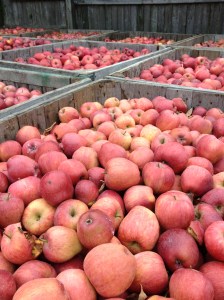
I once tried to make a denominational genealogy chart.  Part of the problem is that tracing things back to Catholicism isn’t quite right.  The Roman Catholic Church as it exists today is quite different than anything Paul, or Peter, or James would’ve recognized.  To say nothing of Jesus.  And that’s inevitable.  Religions don’t stay the same.  They evolve as soon as they pass from person to person.  Those who belong to denominations often do not know what the official teachings of the body are, and getting back to the original they’d find that their denomination started out believing things quite different than its own current theology.  If you’ve got only one soul with which to make that eternal decision and literally thousands of choices, well, let’s just say that you don’t want to think about it too much.  Besides, we’re here for fresh fruits and vegetables.  And it’s a rare gift of a Saturday without rain, no matter who’s responsible.