Yellow Jacket Redux

Back before what year it was really mattered, I stepped on a yellow jacket nest.  (I know I wrote about this last summer, but there’s a point being made here.)  So traumatic was the ensuing horror scene that I literally did not wear shorts (other than those obligatory for gym class) for at least a decade.  I’m still reluctant to do so.  The south side of our house is the best real estate in town.  For bugs.  After last year’s unfortunate yellow jacket massacre, I went out and patched every hole I could find and reach.  I missed one.  (Actually, it is where previous owners didn’t bother to reattach a porch light after installing a new porch.  The gap was too big to use filler and I was trying to figure out how to do the repair when it got cold out last fall.)  So the jackets are back.  Ironically, not two feet from where they settled last year.

I really don’t want to kill the little buggers.  I have respect for all of life, and if they didn’t regularly get into the house I’d leave them be.  They’re only doing what they evolved to do.  At times it seems like all of life is an experiment presided over by some alien race, curious about what would happen if a few select species were given an intellectual boost.  You see, these yellow jackets are smart.  They’re problem solvers.  When I realized what they were doing—it was already too late—I started going outside at 3 a.m. (I’m awake anyway) and duct-taping the gaps shut.  I did this three days in a row before I realized what would happen if the police drove by.  A guy in a hoodie in the dark, standing next to a window on someone’s back porch with a roll of duct tape in his hand?  How do you explain your way out of that one?

Nature couldn’t have given these yellow jackets a real analog for duct tape wrapping the entry to their home, but each day they came back and buzzed around it contemplatively.  I figured the stickiness of the tape (I could barely get it off my fingers) would dissuade them.  They began digging under it.  Not only that, they began building an exterior entrance tunnel.  Soon they had an even better fortified nest with an easily guarded means of ingress.  Their brains may be small, but working together they can accomplish truly remarkable things.  More so, in many ways, than this human who watches them with fear and reverence.

Reading Wicker

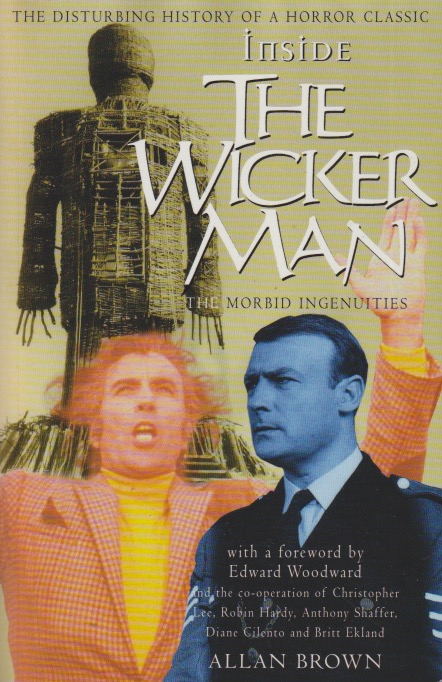
Have you ever read a book where factual errors make you question the larger picture?  I suppose being trained in research makes me more bothered by small inaccuracies.  Don’t get me wrong, I’ve made mistakes myself.  Even in publications.  But when they come near the beginning it’s rather unfortunate.  That’s not to say I didn’t enjoy Allan Brown’s Inside The Wicker Man.  I actually enjoyed it quite a lot.  There’s a real treasure trove here for fans of this cult classic.  I suspect it’s the definitive treatment of the misfortunes the film faced after it was shot, and even during the shooting process itself.  It’s somewhat surprising that so many of us have even heard of it.  When the film’s production company turns against the project it must present special difficulties. Errors are human. Most of the mistakes in the book were about religion.

For Wicker Man fans this book is a great resource.  Not only does it tell the story, but it serves as a useful reference. It includes information on locations, script excerpts, and behind-the-scenes stories.  You get to feel that you know the people involved beyond simply seeing them as characters in a play.  One of the points that Brown makes, while obvious in retrospect, is crucial:  The Wicker Man works as horror not in spite of religion, but because of religion.  I struggle to articulate what the two share in common, but it is useful to be reminded that a prime example comes in this unusual movie.  I wrote about it in Holy Horror, but there’s much even there that I left unsaid.

Brown had the distinct privilege of interviewing many of the people involved in the making of the film.  Most of the cast and crew have since died—the movie was, after all, nearly half-a-century ago.  Even so, when attempting to get at what a novel, movie, song, or piece of visual art means, the realization soon dawns that it’s often in the mind of the observer.  Some songs, for example, speak intensely to some people while being ignored by many others.  The Wicker Man never swam into the mainstream.  I discovered it during an intense period of watching as much quality horror as I could get my hands on.  Immediately I was struck by its intelligence and its strong message.  I’ve watched it several times since, making me, I suppose, a fan.  Enough of one to read this book and enjoy it, in any case.  And to recommend it to others who may be interested in the fascinating film it explores, along with its religion.


Peak Complexity

I remember being a kid.  Things probably weren’t as simple as some adults seem to remember—society, even as a child, is complex.  You soon learned the important lessons: who the bullies were and how to avoid them.  Cars are dangerous, particularly if they’re moving.  God is always watching you.  Then you start school and you begin to learn things you simply didn’t understand before.  You study math and although addition and subtraction seem pretty easy, division and multiplication require some concentration.  By the time you get to high school the math has become so complex that hours of homework are required to figure it out.  I don’t know about you, but nobody explained to me what jobs you needed this for.  I just hoped it wouldn’t be mine.

I’ve managed to get through so far with only the obligatory mathematical complexity of trying to explain certain problems to my daughter when she was in a similar situation.  Fortunately she understood how things worked better than I ever did.  The complexities, however, also come in other species.  I learned that being an adult meant constantly negotiating complexities.  That’s tricky for a guy like me because I tend to understand things by tracing them to their origins.  (There’s a reason history appeals to me.)  Social complexities often don’t allow such tracing—you need to figure out relationships and their implications and how you fit into the picture.  The same is true of jobs.  I’m sure many of you’ve had a job where the requirements change as circumstances alter.  You may have been hired to do one thing, but now you do another.

Then big life events come in with all their own complexity.  The other day I was wondering if there’s such a thing as peak complexity.  If there is, what happens when we reach it?  Do things in life simply become so intricate that society (I’m thinking here simply in human terms) implodes?  Or do we start to make things simpler again? Is there any going back?  I used to tell my students that my own grandmother was born before heavier-than-air flight.  By the time she died we’d been to the moon more than once.  Yes, rural life had its complexities, but since the industrial revolution the pace has been—what’s more than breakneck?  I know computer engineers and they tell me code is so complex that it’s actually a job to sort it out.  Just because you can fly a helicopter doesn’t mean you can put one together.  If we ever do reach peak complexity I have a suspicion that we won’t be able to tell, until in retrospect.  Childhood’s beginning.


April Really Fools

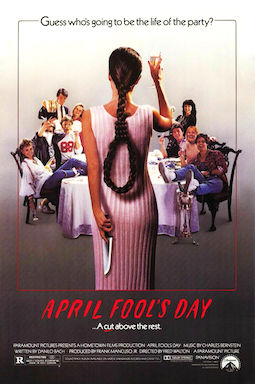
What’s the best kind of April Fools’ Day prank?  What about one that occurs nowhere near April first?  Actually, I’m no fan of practical jokes.  They usually come at the expense of someone and really aren’t that funny.  And where does that apostrophe really go anyway?  Still, because of a project I’m working on, and because it was available on a streaming service I use, I watched April Fool’s Day in July.  An example of holiday horror from the 1980s.  Although moderately successful at the box office, the movie never took off to become a cultural icon like, say, Halloween did.  In fact, I only recently heard of it.  Part of the reason, I suppose, is the ensemble cast is pretty large (nine friends together for a weekend) and none of them played by big names.  In case you don’t like pranks, there will be spoilers below.

The trope of a number of young people—often college students—isolated in some inaccessible location is common enough in horror.  The optimal number seems to be five, otherwise an hour and a half isn’t really time to get to know everyone’s character well enough.  Of course, one by one they get killed off.  Since it’s set on April Fools’ Day you’re led to think some kind of serial killer is loose on the island, but in the end the entire thing turns out to have been an elaborate prank.  Nobody has really been killed and the audience is on the receiving end of an extended practical joke.

As I try to catch up on horror movies I missed I quite often have to rely on those that come with one of the few streaming services I use.  When I was myself a college student I couldn’t afford to go to the movies often.  Home video hadn’t really become affordable yet to people of my economic bracket, and besides, I spent a lot of time studying.  As the only one in my family that watches horror, finding the time to do so remains a challenge.  And there is quite a backlog.  I’ve been trying to watch horror set on specific holidays as a way of keeping myself honest.  Even that can prove a challenge, however.  I can justify the time, however, and the somewhat modest cost, as research. Hey, somebody has to do it.  And that’s as good an excuse as any for watching April Fool’s Day in July.


To Write in Black and White

It can be seen as a black and white issue: either you’ve written a book or you haven’t.  Many people do write books.  Many more want to.  In a survey I saw sometime in the past few months—I can’t recall exactly where—a survey indicated a high percentage of Americans wanted to write a book.  What exactly does that mean?  There are many different kinds of books and several motivations for writing them.  And, depending, your work may or may not be taken seriously, even if you publish.  As someone who’s published four nonfiction books, all of them obscure, I often think about this.  Working in publishing I have some privileged access to the ins and outs of how this works, but that doesn’t necessarily help in writing success.  So what are the motivations?  Is there any way to tell the difference?

Obviously, I can’t speak for others’ motivations but I can see the results.  Most of the writers with whom I work are academic writers.  Their books are generally written for fellow academics and they’re the result of years of research in specialized libraries often off-limits to non-academics.  Those are pretty easy to tell at a glance.  Another class of nonfiction writer is the journalist.  It’s assumed by the industry that someone who majored in journalism is a talented writer.  If, after reporting on a topic for a few years, a journalist wants to write a book based on experience, that frequently gets a publisher’s interest.  The results may not be academically reliable.  I recall that as a grad student it was assumed there were even certain established publishers not to trust—mainly those that weren’t university presses, but not exclusively.

The self-published book has a more difficult trajectory to trace.  Some authors, no matter how good or insightful, just can’t get a standard publisher’s attention.  Others are convinced of their own wisdom and now have an easy route to become a published author.  Yet others realize some money can be made from writing (although making a living at it is very hard work).  I’ve been reading a book by a journalist that has lots of factual errors in it.  I try not to judge, but I do wonder when I know it’s shelved as nonfiction.  Now, these aren’t the kinds of errors that will cost a life if dosed incorrectly or will set off a war between dominant personalities that are heads of state.  I also know that most books do contain inadvertent errors—books are written by humans and we don’t have all the answers yet.  Still, I think of the readers and how we define nonfiction.  What counts as a book anyway?  Things are seldom black or white.

Writing my first book

Weathering the Sleep

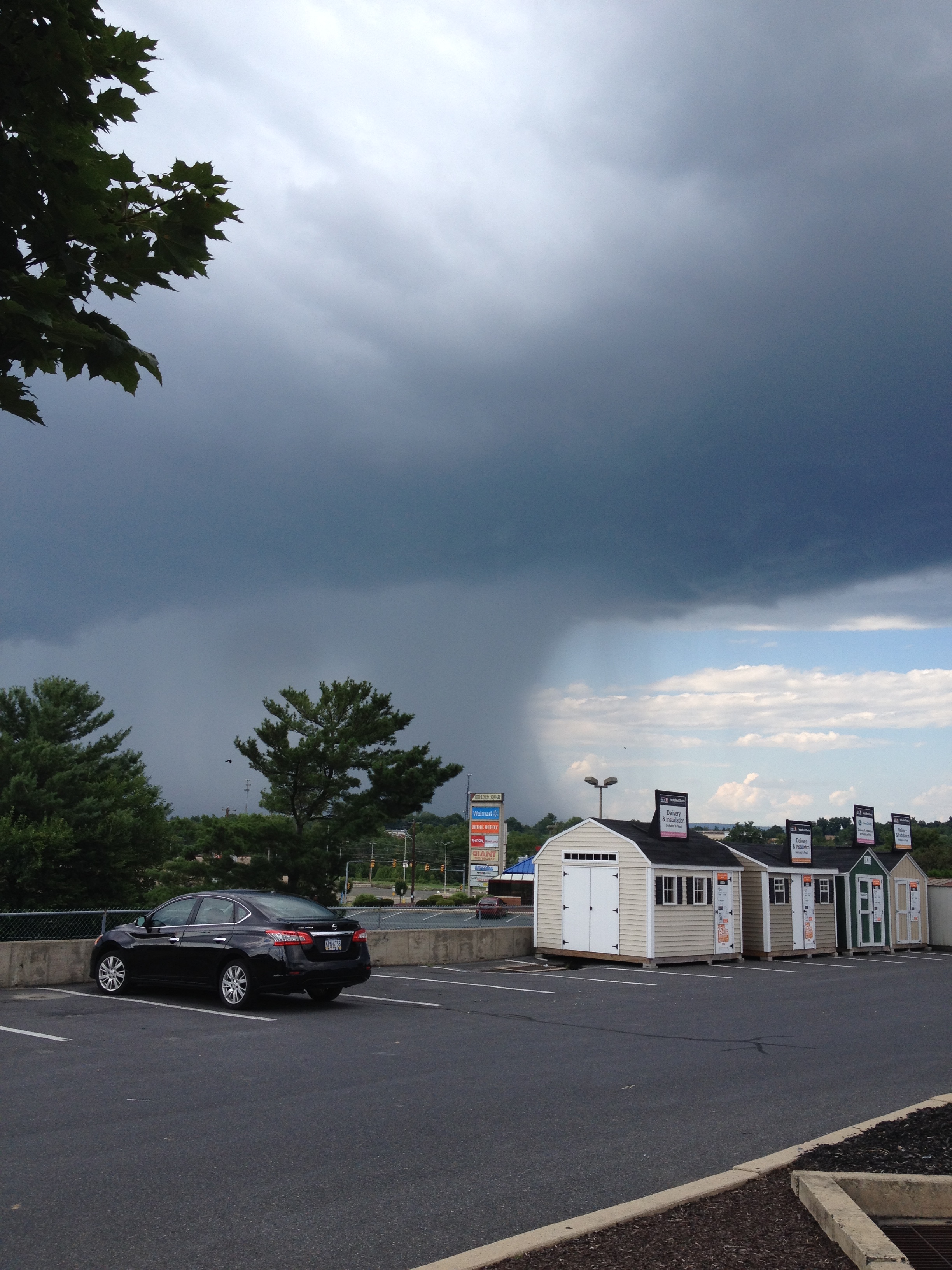
Weather still has a tremendous, if incremental, effect on life.  Patterns where a repeating weather cycle seems stuck in place are a good example.  While not exactly uncommon in summer around here, thunderstorms develop during the hot and humid days.  Our current pattern is that thunderstorms arrive in the middle of the night.  For days in a row.  We had a few days in our current series.  Some of us can’t sleep through thunderstorms, not least because we have to get up and close the windows, pulling fans out, so that the water doesn’t invade.  This means several nights of interrupted sleep and rather unforgiving work schedules the next day.  Companies don’t often take this fact of the weather into consideration.  I’m not the only one yawning all day.

Of course, other things interrupt sleep as well.  Any parent of a newborn has those perpetually baggy eyes that we’ve come to associate with trying to get an infant to sleep through the night.  Work doesn’t smile on that kindly either.  Both of these (and many others) are very real human concerns regarding slumber.  HR, on the other hand, looks at the clock with a frown.  This sort of work ethic is particularly bad in America where work is a kind of sacred obligation (unless you’re a minor, rich, or retired).  You owe that time, no matter how sleepy you are or sloppily you may work because of it.  In my case it’s the weather that’s been causing my drowsy days.  I guess I shouldn’t have given up caffeine a few years back.

Weather, although it’s treated as a “neutral” subject, affects everything.  There are deniers, but climate change is real.  It’s measured across centuries and millennia, however, and our point of view spans only the few decades of our own lifetimes.  We come again and again to the myth that this planet was created for us rather than the more factual realization that we grew organically out of it.  Our civilization is complex and grows more so all the time, requiring less and less time in nature.  Nature isn’t predisposed to be nice to us, or to any species.  It’s a matter of balance.  So it is with the weather.  This massive atmosphere above us seeks to balance itself out but we’re making it hotter than it should be.  Many suppose that God will sort it all out, if, indeed, forcing a crisis won’t compel divine intervention.  I just hope the “man upstairs” has been getting enough sleep.


Magic Color

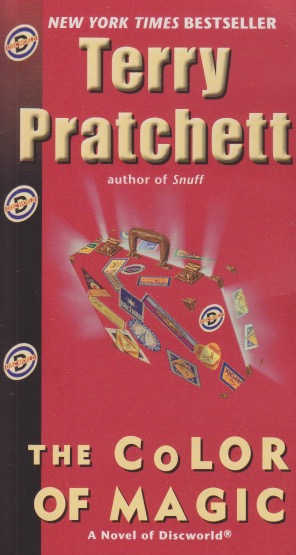
Terry Pratchett was known for his quirky, funny writing.  I’ve only ever read his collaboration with Neil Gaiman before, Good Omens.  I’d heard of Pratchett’s Discworld series and I decided to give his first novel in the series, The Color of Magic, a try.  There can be little doubt that Pratchett was a clever writer with great turns of phrase and imaginative plots.  Something I’m discovering about myself, however, is that fantasy as a genre isn’t working well.  I suppose a case could be made for calling Discworld science fiction, but the world-building seems definitively fantasy—warriors, dragons, supernatural beings—the whole lot.  The story is well told and the writing’s great.  It just didn’t grab me as I hoped it might.

Having said that, one thing I noticed was that Pratchett realized something I’ve written about many times before—if you’re going to do world-building incorporating religion makes it believable.  There are gods here, often distant and mainly unconcerned with human beings (and various other beings), but clearly part of the diegesis.  And, of course, magic.  Maybe that’s the part of fantasy that I find disconcerting.  I read through the Harry Potter series, and although it was funny in parts, it was mostly played straight.  Was it fantasy?  I’ve been writing quite a lot about genre lately, and I’m beginning to run up against its limitations.  Discworld is clearly a fantasy environment. Rincewind and Twoflower are great characters, and so is the luggage (if you haven’t read it yet, let that be an enticement).

I ran into the same sense of disbelief recently with Ursula K. Le Guin’s Left Hand of Darkness, and there’s little doubt that it’s science fiction.  Maybe as I’m aging I’m getting more and more mired in this familiar, if not tired, world in which I find myself. Horror, however, retains its fascination.  The Color of Magic follows the hapless wizard Rincewind and how his life changed forever after he met the tourist (a rarity on Discworld), Twoflower.  Together they face and overcome (with sometimes a little deus ex machina) obstacles of others with agendas that simply don’t accept misfits.  The literally cliff-hanging ending does encourage the reader on to book two and the characters won’t soon be leaving my mind.  It’s just with fantasy too much seems possible.  Anything can happen and it’s almost a matching of wits with the writer.  Not that that’s bad, but maybe it just isn’t the escapism I tend to think fantasy is intended to be.


How You Feel

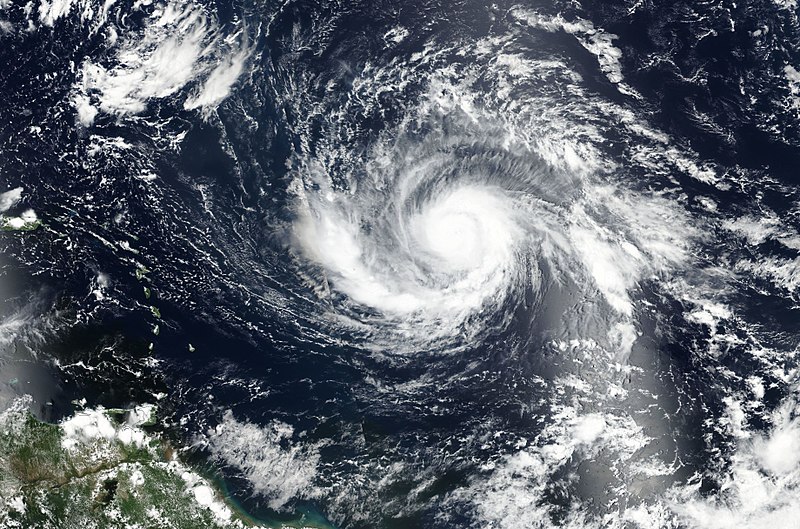
Image credit: NASA, public domain via Wikimedia Commons

Have you ever had someone tell you how you should feel?  This always feels like an odd thing on the receiving end.  Each of us is born, learns from our experiences, and confronts emotions.  Many people believe that they might improve others’ lives if only others would feel the way they think they should.  Interestingly, and simultaneously, at work and in social settings we’re being told to honor diversity.  We are to respect the feelings of others, no matter how uncomfortable they make us feel.  Who is the guardian of others’ feelings?  Emotions are tricky to figure out.  We can clearly see them at work in animals—the age-old flight or fight response, for example, is based on fear.  Still, based on their own experience and temperament, one animal will run while another in the same circumstances will attack.

Emotions don’t come with an instruction manual.  For a not insignificant outlay of resources you may hire a professional to help you work through them.  Or you might learn to trust your emotions.  They evolved for a reason.  Telling someone else how to feel invalidates their experience.  If they feel frustrated, or lonely, or angry, aren’t those legitimate human responses when neither fight or flight works?  Human societies create great complexities.  Some of us like things the way they were.  Many of us currently alive are only a generation away from people who grew up with horses clopping down the street and now all of life is virtually virtual.  How does that make you feel?  How do you even assess what the right feeling might be?

Advice givers mean well.  Perhaps your emotional state causes them discomfort.  If only you would cope the way that they cope then we could all go home happy.  The lament, however, is a time-honored means of expressing frustration when things just aren’t going your way.  We like to believe that good people prosper and that things work out for them in the end.  We like to believe lots of things.  We also have plenty of feelings about them.  Invalidating others’ experience may make us feel better about ourselves.  After all, we have just given valuable advice to someone who hasn’t experienced the situation like we have.  Being a parent may be the best way of learning to empathize and help another human being deal with the always tricky realm of emotion.  The important thing is to let others know that, no matter what somebody else says, only they know how they are feeling.


Used or New?

A recent post on a used book got me to thinking.  Back when I was acting like a trained researcher my reading was very specialized and focused.  Even so, my personal reading was eclectic.  I think that’s the result of having been raised poor.  With no bookstore in our town, and no Amazon (or Bookshop.org), book purchasing was catch as catch can.  Since my fortunes haven’t dramatically increased in life (long story), my purchasing habits have remained pretty much the same.  I’ll buy used books or movies if I can.  Since these are about the only things I buy, they loom large in my mind.  And the thing about buying used is that it’s often opportunistic.  I can pretend it’s intentional and say I’m trying to be well-rounded, but the fact is I try to save money where I can.

This really struck me as I was reading something written by a film maker.  Now, I’ve penned two books about horror films, and I tend to watch them quite a lot.  What struck me about what I was reading was just how many films the writer knew.  Academics can be that way—knowing everything about a subject.  When researching my first book, A Reassessment of Asherah, I read everything I could find in pre-internet days about the goddess.  That is a thoroughly researched book.  When you’re a graduate student your job is to become as familiar as possible with your subject, no matter the language of the research (within reason).  As just an editor my movies and my books are a matter of what I find in my eclectic life.

I often imagine what my life would be like if I could’ve remained a professor.  In those days I read fewer full books—research is often a matter of reading only the parts relevant to your project—and certainly less fiction.  I was never a well-paid academic, teaching at a small school that considered on-campus housing a large part of the compensation package.  I didn’t buy many books then, either.  Some of the most important ones were, you guessed it, used.  I wonder if I would’ve ever have shifted my interest back to horror.  During those days I didn’t need horror (it was a gothic campus and I was beginning family life).  Since then I’ve become an even more eclectic person.  My fascination with geology began then and still comes back when the stars are just right.  And even they, I suspect, might be remnants of even older, used stars.

Photo credit: NASA

Irony

It’s a funny old world, as the saying goes.  I don’t deal, as an editor, with many agents.  In fact, having been in publishing for nearly a dozen years it’s only happened three times.  The most recent agent is one to whom I sent a pitch for Holy Horror and from whom I never heard back.  The book he sent me isn’t too different from what I was doing in said volume.  That’s the way it goes, you say.  Indeed, I don’t disagree.  But who doesn’t like a dose of irony in an otherwise stainless steel world?  As I’m reading through the proposal I see that it cites the interest in the subject because of the great popularity of the Religion and Monsters sessions at the American Academy of Religion.  I was responsible for getting those sessions started.

Since irony loves company, none of the people I recruited to get that session rolling read my blog.  I’d been meeting with various scholars over the years and started to notice a common interest in religion and monsters, which I personally share.  I suggested to one of these gainfully employed scholars that we should apply for such a session.  She agreed and we invited another gainfully employed academic to join us.  I wrote the initial proposal.  The session was approved (the proposal being helpfully revised by my colleagues) for three years running.  Now it was being cited as objective proof of an idea that this very agent had dismissed when I presented Holy Horror to him.  Our society very much thinks having a university post means you have something to contribute.  No post?  No interest.

I’ve been working on religion and monsters for (conservatively) a dozen years.  I’ve written two high-priced books on the subject and I’ve received almost no traction in the field because I can’t put a university, or college, or seminary, behind my name.  I was formerly an associate professor, but who you are speaks louder than who you were.  Institutions speak even louder—much louder—than individuals.  The thing about privilege is that it works.  So in this funny old world I’m bemused to be watching my own idea helping propel a colleague’s case for an agent.  I’m working on my fifth book, and I sincerely hope this one will retail for less than thirty dollars.  That’s difficult to do without an agent’s intervention.  I know agents are swamped with proposals.  I know they’re very selective.  And I also know that the irony of being a biblical scholar interested in monsters will catch their attention.  Only, however, if you have an institution behind your name.  Funny, isn’t it?

Even the monster smiles

Online Research

Given my current lack of a university library, and my continued rapaciousness for research I’ve had to sample internet offerings.  There’s a reason academics are skeptical of the internet’s research reliability.  Just about anything you want to verify brings you up against a paywall where you can sometime buy an article you could read for free if you were a professor, for about $15 or $20.  The privileging of academic information.  (Hey folks, I give it away here!)  In any case, I often run into websites on the topic on researching that give “facts” with a breezy assurance that isn’t followed up with footnotes, making me wonder where they got their information.  Who was the publisher?  Who says they know what they’re talking about?  No wonder alternative facts rule the day.

One of the things I learned in the course of my doctoral work is that those three insignificant letters, if applied correctly, indicate that you know how to do research.  Earning a doctorate is often considered (and sometimes is) a matter of becoming a specialist.  Those willing to peel back the top layer realize that underneath what’s going on is a transformation of your way of thinking.  You can find facts, but you can also weigh them in the balances.  You take no one’s word for it.  Unless, of course, they’re published by a prestige press.  And even then, if the lesson really sunk in, you’ll have your doubts.  The internet is a frustrating place to try to find reliable information.  Oh, it’s great for looking up phone numbers, and even for getting directions.  Just don’t trust it with history.

Currently at work on my fifth book, I’m finding research somewhat of a hurdle.  I’ve reached out to local universities and they seem only to want to let you in if you’re an adjunct (which is considered a conflict of interest in my current post).  You’re therefore locked out of knowledge.  I recently learned that JSTOR may be offering a fixed number of free articles to independent scholars.  If so, that is a great and farsighted boon.  You see, the problem is you need to look at the footnotes to know which articles are actually based on solid research.  There’s a move afoot that makes academic presses shudder.  The move for free information.  It’s the business of academic presses to sell it, of course—that’s where the money comes from.  So I sit here facing another paywall and I wonder is wisdom can ever truly be free.

Photo by Sharon McCutcheon on Unsplash

Shifting the Narrative

Wide ranging.  That’s a phrase that comes to mind to describe Vine Deloria Jr.’s book God Is Red: A Native View of Religion.  Another phrase is very important.  I know this book has been available for several years and it’s been on my reading list for many of those.  What is it about?  Some books are just difficult to summarize, but the basic answer is that it’s an American Indian view of how Christianity has distorted the world.  An accomplished academic, student of law, and activist, Deloria knew of what he wrote.  His book explains articulately the view of Christianity from the outside and what a religion that reverences the earth really looks like.  What makes the book so fascinating is that Deloria had theological training and could engage with the Christian worldview over a considerable range of topics.

Controlling the narrative is of primary importance and the fact is white men have controlled the narrative and normalized one view of history, science, and our place in the universe.  First nations peoples had, and some still have, a radically different outlook.  Deloria makes the crucial point that even our science developed out of our religion.  That science, in turn, supports the worldview that created it.  It is possible to look at things differently.  In fact, for much of human history those alternate views were predominant.  The triumphalist view of Christianity claims it’s successful because it’s right.  A native view takes a longer view, saying “we’ll see.”

Very concerned about the state of the planet brought on by the Christian/capitalist partnership, Deloria advocated for not only Indian rights, but environmental protection s well.  Not only is the environment central to Indian spirituality, the concept of sacred spaces is very real.  Many of us not raised with indigenous points of view have experienced this as well.  Some places are special to us.  We hesitate, because of that very science created by the Christian worldview and its view of God, to call such spaces objectively sacred.  Even the “objectively” part is determined by a Christian perspective.  Deloria ends up by asking whether this form of religion has improved the state of the world.  There’s no doubt that some of Christianity’s achievements have lessened human suffering.  It is also true that science has achieved great things.  If I understand correctly, Deloria isn’t disputing this.  His point of view is much more essential.  Is this the only way to live on this planet?  From the indigenous point of view, which is far more important that we want to admit, the question is—is this the only way to see it?


Scary Folk

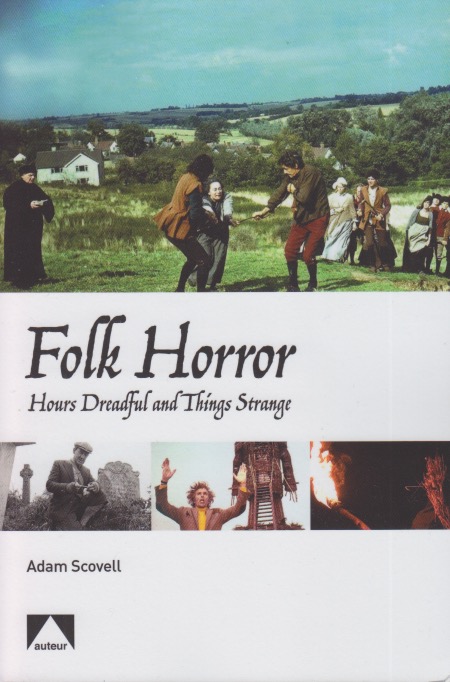
Genre is a useful category.  It can be misused, however.  Straightjacketing a piece of literature, music, or film can lead not only to confusion, but to constraining creativity itself.  Nevertheless, the category of Folk Horror is certainly expansive enough for a book-length treatment, such as Adam Scovell has given it.  Unless you’ve read quite a bit about the subject you might wonder what folk horror is.  A good part of Scovell’s work is definitional—providing the reader to an answer to that very question.   Although it has earlier roots, folk horror was initially a British genre that became particularly noticeable in the late sixties and early seventies.  It comprised movies and television programs that dwell on specific aspects of the landscape—particularly the rural—and isolation within it.

What I find particularly compelling about folk horror is that it is often based on religion.  In the countryside you encounter people who think differently about things.  Believe differently.  Their convictions are enforced upon the stranger who may be there by design or by accident.  Ironically the genre largely emerged in a nation that prides itself for its role in civilized behavior.  It speaks volumes about belief.  Civilization has produced more refined strains of religion, but on its own religion will tend to grow wild, even as the weeds in your yard are distantly related to the cereal grains we cultivate.  Examples of this are everywhere.  Fans of horror can name them off, but even those who don’t care for the genre know the kinds of belief this indicates.

Not all folk horror is about religion, of course.  It can be rural ways in general.  No matter how you classify it, most people can identify Deliverance and the danger it implies about being far from civilization where those who live in the woods can do as they please.  Scovell delves into the urban settings of folk horror as well—most of his examples are British—because it is possible to hide in the city also.  Although the genre reached a high point in the 1970s, it didn’t die out.  The book ends with consideration of some more modern examples, such as Robert Eggers’ The Witch.  The problem, as those of us who write about film know, is that just because you’ve written a book it doesn’t mean future examples won’t change the picture.  The Lighthouse and Midsommar were both released in 2019, after the book was published.  And they demonstrate that the scary folk haven’t gone away.


Altared States

Religion Dispatches is a great website.  I used to write for them from time to time, and according to Google they were probably the most read of my internet publications.  I’m not sure what happened, but a few years back time simply evaporated.  These days literally the only time I have to get things done is on the weekend.  A simple thing like taking the car in for inspection takes advance planning and can throw off my entire schedule for the week.  I have difficulty finding time to write for Horror Homeroom these days.  That’s a long preamble to saying I saw an interesting article by Hollis Phelps on Religion Dispatches titled “Hulu’s ‘Hamilton’s  Pharmacopeia’ Shows that We Can No Longer Ignore Connections between Religion and Drugs.”  There have been a number of suggestions that drugs and religion are related over the years, but our “Christian” culture has declared the former taboo.  (Except wine, of course, and even that’s suspect.)

Photo by Alex Kondratiev on Unsplash

This article has me thinking about chemistry.  Not that I ever did very well in it.  Still, I recall hearing one high school teacher or another saying life is organic chemistry.  I’ve come do doubt the standard definition of life as I’ve aged, but there’s no doubt chemical reactions are a large part of the somatic existence we all experience.  Eating leads to chemical reactions to break down the chemicals in food.  Some of them are good for us, others are not.  Some (but not all) of the really dangerous ones we outlaw.  Drugs are a good example.  I don’t use drugs, but I’m aware that many religions do.  I don’t doubt the altered states of consciousness that reportedly arise from the responsible use of such drugs.

I haven’t watched “Hamilton’s Pharmacopeia” (I have no time).  Still, I have to wonder why Christianity, in particular, came to declare its own war on drugs.  A large part of it, I expect, was the belief in the imminent return of Jesus.  You didn’t want to be caught unawares.  Then there was also the sad fact of abuse of controlled substances.  Alcoholism and the opioid crisis are reminders that these unfortunate aspects can still cause serious problems.  At the same time, research is demonstrating that religious experience and the use of some drugs are related.  American Indians, at least some of the tribes, found religious significance in peyote.  There are present-day religions devoted to cannabis.  Does it all just come down to chemistry?  I don’t know, but if there’s a drug to increase the number of hours in a day that might be a real revelation.


Laugh Out

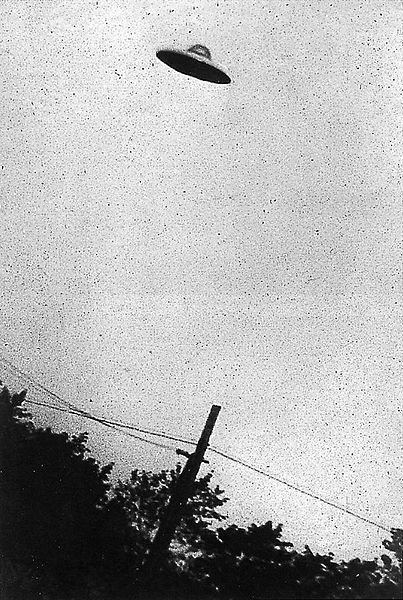
Is it safe to discuss this now, or are people going to laugh at me?  That’s the feeling that has attended any talk of UFOs until recent days.  Ironically, if the Ancient Astronaut people are right, we may’ve been visited from elsewhere ever since we’ve called this planet home.  In any case, now that UAPs are out of the bag, some are beginning to discuss how they might impact religion.  (Yes, “impact” can be a verb.)  Thus I came across a story titled “If UFOs are real, how would they impact our faith?” on Times NewsKingsport Times News, based in Tennessee, ran this as an opinion piece.  While not deeply probing, it did raise the question of how all the recent UFO news affects people’s religious outlooks.

Image credit: George Stock, via Wikimedia Commons

As a country we’re both deeply religious and in denial about the fact that we’re deeply religious.  I’m convinced that this is behind the political woes we face: the educated have become more secular and religious literalism is considered laughable.  Yet it’s clearly there.  Ironically, UFOs were considered laughable until the US Navy admitted that they were real and had no idea what was going on.  Laughing at something we don’t understand is hardly ever a step towards enlightenment.  So the article concludes that even if aliens are here, things will be fine if we continue to go to church as normal.  Any extra-terrestrial visitors change nothing.  Strangely, one of my earliest memories is of attending a rural church service one evening where the program was on flying saucers and Christianity.  This was entirely in earnest, and nobody in the congregation was laughing.

Others interested in the topic have discussed religion and UFOs over the years, but perhaps the answer is yet another of those unknowns.  Religion is a remarkably adaptive phenomenon.  Scientists suggest it’s hardwired into our brains, even as those same brains give us evidence that some of those beliefs are misplaced.  What we can’t do is stop thinking about it.  As I watch politics continue to tear this country apart, I realize it’s not really politics we’re talking about after all.  It’s religion.  Meanwhile people are learning that the government has been keeping secrets about what’s up there in the heavens.  There are elected and appointed officials who’ve gone on the record saying they believe UFOs are demonic.  While that hardly seems like a scientific approach to something truly unknown, it is a religious one.  Only those who laugh rather than listen will find this news at all.