Fishy Business

There’s bound to be a logical explanation for how it got there. After all, this is private property and people have been here all day long. Somebody would have noticed if fishermen had stomped up this boardwalk, dropping their catch along the way. There’s no place to dock a boat. And yet here it is in all its Fortean glory. A fish out of water. Literally. It’s a perch, I think. About eight inches long. Forty yards from the nearest water. Other than the flies all over it, it looks in good shape. As if it were out for a swim in the dry air and lost its way back to the nearby lake. I’m sure there’s a logical explanation, but I can’t help but think of Charles Fort and his witty takedown of conventional reasoning.
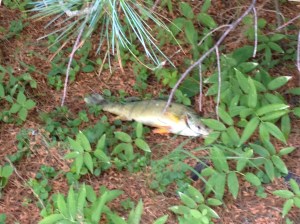
In addition to fish, this lake also hosts ospreys and bald eagles. Just yesterday morning I saw one flapping above the water looking for breakfast. And one of my relatives saw an eagle struggling with a fish the other day—an issue of maintaining air-speed velocity when fully laden, I think—only to have to catch and release. Could that have happened twice? Raptor drops the slippery, heavy fish and can’t fit under the pine trees with that wingspan to pick the thing up. Possibly. It’s not the most fun explanation, but it will do when logic’s non-negotiable.

Charles Fort, the great anomalist, is perhaps most famous for his irrepressible insistence that rains of fish had a more exotic explanation than a tornado sucking them up only to drop them far from water. In his puckish way, he wrote how such “damned facts” were explained away by convention. Fort liked to hold the door open for the wider possibilities. Meanwhile we’re stuck here with the unarguable reality that there’s a dead fish by the boardwalk, far from water and a logic that makes me ask, if it fell from a bird’s talons why does it look so perfect? No twigs or pine needles picked up from its heavenly plummet. No obvious injuries to its piscine flesh. Even had some disgruntled fisherman rowed up unobserved and flung a perch as far as he could, the thing would’ve had to’ve had quite a spiral on it to’ve made it this far from the lakeshore. Science works by sweeping the facts outside the norm off the table. I’m not saying there’s anything paranormal about this fish, I’m just wondering what Fort would’ve made of it, beyond a free lunch.


No Place to Hyde

“I was driven to reflect deeply and inveterately on that hard law of life, which lies at the root of religion and is one of the most plentiful springs of distress.” These words occur near the beginning of Dr. Henry Jekyll’s confession, the very manuscript that closes Robert Louis Stevenson’s The Strange Case of Dr. Jekyll and Mr. Hyde. Upon reading the book, along with the preface and afterword clearly meant to pad out the thin volume, I realized that I was not alone in having known the story all my life but never having read it. Western culture is steeped in the idea like so much strong English tea. The story of the divided self. The eternal question of who I really am. Like Frankenstein’s creature, Jekyll and Hyde found immediate resonance in the pantheon of monsters. Here was something with which we could all identify, but which we all would deny. Or would we?

Jekyll notes that the root of religion—proper behavior, moral living—is a source of distress. And this before the era of Nones and non-believers. Religion has that reputation. “Be good or else!” Or fire insurance, as some call it. Religion, in the popular imagination, isn’t so much about sublimity any more. Or transcendence. Somewhere along the way it got fixated at about the level of our genitals and what we should never, ever do with them. Hyde’s sins, as commentators frequently note, are anything but explicit. He tramples a young girl and kills an old man. Beyond that we know nothing of his monstrosity. Is it so hard to believe the restraint concerns his sexuality? After all, his friend Utterson—well, Jekyll’s friend Utterson—enjoys his wine. Both respectable men seem to have hearty appetites. Apart from violence, what other dissipation is there?

Like many first-time readers I can’t recall how I first learned of the mad scientist and even madder thug that make up the namesake of this story. For some reason I never made—even remotely—a religious connection with it. It was a monster story, after all. Innocent fun for a Saturday afternoon. The experience of reading the book was a bit more jarring than that. Jekyll’s confession isn’t exactly easy to read. It is like going to the confessional with the curtain drawn and all the lights on. And yes, the implications are religious after all. It is a little book with a big point to make.


Berrying Perspective

Two people looking at the same thing see something different. Since we’re living with a government of distorted perspective this truth appears refreshed daily. I was reminded of this while picking huckleberries. Huckleberries, according to the local edible berry guide, are called many different things. In this part of the country you know them when you see them. And if you see them you pick them. They appeal to the frustrated hunter-gatherer left in us city-dwellers. As I was trying my best to fill my bucket, I kept thinking of those who only see nature’s bounty as a means of turning a profit. In my mind they’re meanies—those who take all the fun out of the few freedoms we have left—although I realize that it’s a matter of perspective. Consider the huckleberry.

I’m a mere seasonal visitor to these parts. Since not too many of my own species make this location their permanent domicile, that’s perfectly natural. Many of the berry pickers I’ve encountered have been seasonal guests as well. There are the more “industrial” pickers, though. In a good year huckleberries can command fifty dollars a gallon on the local market. Unless you know an unfrequented secret site, a gallon can take several hours to pick even in a promising location. Overall, you need to arrive before anyone else and get the most productive bushes so that you don’t have to wander around the mountainside in search of a more lucrative locale. Not to mention that, like most berries, they have a limited shelf life. Nature prefers sharers to hoarders.

While I’m picking I generally think of bears. Unlike my species they don’t have the grocery store option. These berries are their survival, I suppose. Nature does provide. That’s how evolution works—we form symbiotic relationships with our environment. The meanies, however, can’t see beyond the self. What nature provides must be accumulated for my own benefit and not that of others. There are never enough huckleberries to go around, the industrial mind thinks, and so I’d better control the availability and set my price. You don’t even have to like huckleberries to do it. Ironically we call this having a gift. Standing here on this isolated mountainside, bent over a bush offering nature’s abundance, I believe that I’ve found a gift. I have to remind myself, however, that this too is a matter of perspective. It is a perspective that tastes right to me.


The Unliving

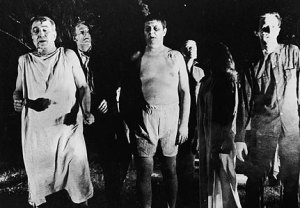
Western Pennsylvania, from which I hail, has few claims to fame. One, still largely forgotten, is that it was the birthplace of the petroleum industry. Remains of the early exploitation of the fossil fuel still lie scattered carelessly in the woods. Another claim to fame is that the region was the adopted home of George Romero and served as the setting for his groundbreaking film, Night of the Living Dead. Unintentionally, Romero created what continues to shamble on in the form of the modern zombie. Although the movie doesn’t call the living dead “zombies,” it established the trope of their endless hunger for human flesh and their rabid bite. So it was with sadness that I read of Romero’s death a couple of days ago. Although he wasn’t from Pittsburgh, he established the city as zombie central. It’s nice that he gave something back.

Zombies have, due to their protean nature, become a fixture among the monster constellations. They represent the worst of what people can be—selfish and brainless, without empathy, their own cravings being the only matters of importance to them. Sounds kind of like the Republican Party. The rest of the world calls them monsters. Night of the Living Dead shocked audiences of the late 1960s with its graphic portrayal of cannibalism and thoughtless destruction. Interestingly, the choice of a strong African American lead for the movie was, according to interviews with Romero, simply a matter of his being the best actor, not an intentional racial statement. (That too reminded me of western Pennsylvania; there were racial tensions where I grew up, but many of us befriended those who were “different” without any clue that it should matter at all.) Duane Jones carried off the role of Ben with conviction and energy. He died young but he never became a zombie.

To make an impact intention need not be present. While Romero denied for the rest of his life that the movie was “about” the Vietnam War, and that his choice of a black lead was a racial statement, both of these factors became facts about the film. Concepts, in other words, like zombies, may rise from the dead. Beyond the shock and gore, the movie made a powerful, if unintentional, statement. It helped to define Romero’s future career. A success in a difficult industry may indeed decide one’s fate. George Romero would go on to make many other monster movies. Western Pennsylvania would become a zombie haven. You never know what you might find scattered about in those forgotten woods of your childhood home.


Nature Watching

Whenever I travel in the northwest, I keep an eye open for what one colleague calls “charismatic megafauna.” You know, the big animals that are so rare to see that they develop a charming, if imaginary, persona. Not that I’ve ever seen much of it here. It’s rarity is part of the charm. My usual hope is to see a moose—something that happens every three or four years. Black bears are even rarer. Grizzly bears, which still inhabit this area, and mountain lions I’ve never seen. I know they’re there, but their agenda is not to be seen. My first full day here I was sitting outside working on an academic paper. My time off work is rare, and when I get a moment, even in the wilderness, I try hard not to waste it. I had the feeling of being watched. Not the creepy kind of feeling, but the kind where you think an animal might be keeping a wary eye on you.

I looked over the top of my book. Several yards distant I could see a head bobbing up and down. Then I noticed a black patch on a nearby lodgepole pine. It took a few seconds for the red head to register. A mated pair of pileated woodpeckers. Not exactly huge, but they are large birds. And since they are the personality behind Woody Woodpecker, well, I guess you can call that charismatic. Charismatic enough for me to put down my Ugaritic mythology and go inside to fetch a camera. Of course they were gone by the time I’d returned. I decided to take a walk down the track in a vain hope of finding them again. Once in a while charismatic megafauna cooperate. There they were, one going after ants on the ground, the other perched above pecking wood.

Most of our large fauna we’ve driven to near extinction. Humans can’t stand not to be the biggest thing around. The megafauna remain, however, hidden though they may be. An online site for this area posted a photo of a cougar snapped last summer. I’m not sure when the last time a grizzly might’ve wandered down from Canada, but since last November I’m not sure why they’d even bother. Even the moose seem coy. Animals don’t do what we want them to do. Those that we can’t domesticate follow their own agendas and calendars we can’t hope to comprehend. As they flap away I can swear these woodpeckers are laughing at me.


Photographic Evidence

All photographs are lies. That moment preserved, formerly on celluloid but now with electrons, is gone for good as soon as the shutter is snapped. The camera doesn’t see as the eye sees. I was reminded of this during a mountain thunderstorm. I awoke early, coated with jet lag and the residue of my regular early morning schedule. It was still dark, but the reddish sunlight soon wrestled through a valley fed by a creek across the lake. The color was impressive, but my camera washed it out to a diluted Creamsicle orange. In reality the clouds were roiling overhead and lightning was streaking through a thunderhead like synapses firing violently in a massive brain. Thunder in the mountains can’t be photographed. Nor can it be forgot.

My work used to require quite a bit of travel. Before I would visit a campus I would spend some time on faculty pages, trying to put faces together with names. Impressed with how young these professors were, I’d knock on doors armed with foreknowledge of who might greet me. I wondered who these older people were when the door actually opened. It’s disconcerting to see someone age before your eyes. I would think back to the photographs online that had assured me this person would be much younger. The picture was a fossil. A moment frozen in time. The very next second after the photo capture that smiling face had changed. The best that we can hope for is a gross approximation.

Perceptions of reality, as all religions teach us, contain a healthy dose of illusion. While it contains ethereal beauty, this vision I’ve captured in my lens is only part of the picture. There is something deeper, more meaningful behind it. Photographs enhance memory. In the days before Photoshop they could be submitted as proof of an occurrence. They are a form of art. Whatever else they may be, they are also lies. Lies need not be of evil intent. Religions try to explain what some privileged individual realized was the truth. These who found a way of looking behind the photograph. The streaking lightning outside evades the slowness of my finger on the button. The thunder rolling and re-echoing through these valleys will remain in my head long after the sound waves cease to reverberate. Reality is more than it seems. Even my experience of this mountain thunderstorm is that of a single individual seeking enlightenment. Elsewhere others are up early, observing it too. What they experience may be something very different from me indeed. I have a photograph to prove it.


Devonian Dreams

Toothbrush and dental pick in hand, I go at it. Not that I’m a professional, mind you, but curiosity drives me to this. You see, this crinoid before me is at least 358 million years old and anything that can make me feel young deserves all the attention I can give it. Crinoids are also know as “sea lilies,” but they aren’t plants. They’re actually echinoderms, and the fossils I’ve found in the past have only been cross-sections of their “stems,” a stone circle, as it were. This one has tendrils visible, and I can’t believe that it was a chance find on one of my recent walks through Ithaca’s gorges. I’m dreaming Devonian dreams, and I want to brush away the plaque of the eons and see what I’ve actually found.

Fossils are a kind of eternal life. The creature that died to leave this impression lives on as a monument in stone. It reminds me of my unfortunately brief stint as an archaeological volunteer. Scraping away dirt to reveal a piece of pottery that hadn’t been touched by human hands for 3,000 years. Of course, that’s merely a second ago when you’re talking about something pre-Carboniferous. The dinosaurs won’t even show up for another 100-million years. And I think I have to wait too long for the bus. Time, as they say, is relative. Did this medusaized creature before me realize just how terribly long it would take for enlightenment to arrive? And how so very swiftly it could fall one foolish November night? Careful, this fossil’s fragile.

I grew up among the Devonian substrate in western Pennsylvania. The Bible on my shelf told me to disregard the evidence before my eyes. Some clever true believer had declared Noah’s flood the culprit, never bothering to explain how freshwater fish showed up after the deluge. Those we tried to keep in our aquarium never seemed to handle the slightest disturbance of their salinity. The ages of the literalist are by definition short-sighted. 6,000 years seems hardly enough time to account for any sedimentary stone, let alone that riddled with fossils. I’m hunched over my bit of slate, dental pick hovering nervously over what will never come again. The Bible behind me says it’s an illusion. You may be right, Mr. Scofield. You may never have evolved. But as my fingers glance a creature dead before even the crocodile’s grin I have to declare that I have.


Big Shoes

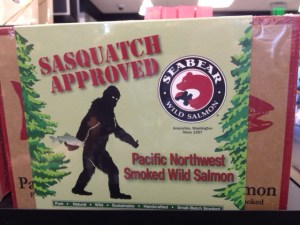
Belief in the supernatural seems to be alive here in the northwest. At least if the culture at Sea-Tac Airport is anything to go by. I’d noticed, last year, that a sasquatch graces a restaurant in the N terminal, where jets from Newark tend to land. This year we had a bit of a layover, so we strolled through the C concourse. There I found sasquatch approved salmon in the somewhat anomalous Hudson News. Then, as I sat in one of the stylish, Seattle seats, a young woman came up next to us and sat down wearing a Sasquatch Volleyball shirt. I’m past the age when I can get away with innocently asking young ladies if I can take a photo of their shirts, so you’ll just have to use your imagination for the latter. The point is, bigfoot has been mainstreamed.

When I was growing up you got pretty mercilessly teased if you expressed any interest in such things. Now that I’ve got a respectable career others can get away with what captured my imagination as a young man. I’ve never thought of myself as being ahead of the curve. Or really ahead of anything, for that matter. Still, I trust my instincts. Maybe religion will come back into vogue some day. Or maybe it will simply be called something else. A tainted name is difficult to live down. The supernatural—or paranormal—often shares conceptual territory with religion, and although the pews aren’t getting any fuller, the number of those looking for some kind of meaning in the unusual seems to be holding steady. Physics can take us only so far in understanding what it is to be human.

Times change. Yesterday’s jokes are today’s orthodoxies. Those who spend a great deal of time peering back into history won’t be surprised by this. What is true today is true for today. New facts will be discovered and if we lived long enough we’d find that the future world will believe quite differently than we do. Not that the truth is relative. It is, however, temporary. Massive religious wars have been fought over trying to keep truths timeless. The sad irony is that the truths had already changed by the time such wars had been waged. The more rational we become, it seems, the more we open the door for the supernatural. I won’t presume to be one declaring such truth. That would take more weight than I have to offer. And anyone making such a claim would have some awfully big shoes to fill.


Of Fancy

Later today—at this time of morning the use of the word “day” feels ironic—I’ll be on a plane heading out of civilization. Well, to be more precise I’ll be flying to a place from which I can drive out of civilization. Airports only serve cities, after all. Until we get individual drone service to remote locations I guess we’re stuck with jets and their inconveniences. I have to admit I’m more nervous than usual about this. I’ve been reading the stories about airline thugs who, like terrorists, beat and drag passengers off the plane. I try to take extra care to choose an undesirable location on the jet—next to the restroom, for example, or really near an engine—so that an airline employee would rather wait for the next flight than to sit here. I remember when flying used to be fun.

One year I’d lingered a little too long with my girlfriend and I had to rush to Logan Airport to catch my flight to Pittsburgh for the holidays. Arriving maybe half an hour before my scheduled flight, like a pre-murderous O. J. Simpson I ran through the concourse with nary a TSA agent in sight. To the what I am now sure was annoyance of the other passengers, I arrived at the gate just as the door was closing. With a sigh they let me board. I tried to ignore the angry stares of those already seated and belted. We all made it to Pittsburgh, however, in time to celebrate with our families. Now flying means adding at least two hours to your travel time so that you can get through security that makes you feel no more secure. I’m frisked and prodded and made to feel guilty for doing nothing more than wanting to get away from civilization for a while. We call it civilization anyway.

The wait in the airport is the hard thing. They’ll offer wifi, but you’ll have to pay for it. I’ve trained myself to read on the bus, but when you’re awaiting the announcement of your flight when you’ll have to line up just like at the Port Authority, it’s difficult to concentrate on your book. You don’t want to be lost in another world when they call your zone. There are, after all, airline employees hovering, seeking empty seats. I remind myself at the end of this ordeal a lack of civilization awaits. This is why we do it, and there’s a reason we call it getting away. Time to end this flight of fancy and head toward an actual flight that will be anything but fancy.


Pagan Values

“Pagan” used to be a pejorative term. If we’re honest we’ll have to admit that it is still used that way by many people. All the term really denotes, however, is a believer in “non-Christian” traditions. The classical pagan was someone who’d “never heard of Jesus,” and therefore hadn’t bowed to the obvious truth. In the current religious landscape a pagan is someone who makes a conscious choice to follow different gods. Looking over history, there are plenty to choose from. If you don’t limit yourself to monotheism, there’s no compunction to stop at just one. Paganism is a flourishing religious choice today. Getting over the stigma will require effort for a long time to come, as a video a friend sent me from Heat Street shows.

This video show pagans in the US Army at Fort Jackson. It’s worth the three minutes of your life that it’ll take you to watch it. Pay special attention to what the chaplain says. We’ve been acculturated, through monotheistic lenses, to ridicule those who believe in many gods. We’ve also evolved beyond the stage where E. B. Tylor could inform us that the most natural form of religion is animism and we have to be taught to unlearn it. We’ve also had the natural human tendency to believe in magic laughed out of us. We can’t accept that anything could exist that doesn’t conform to the laws of physics as we currently understand them. One size fits all. And many think even one god is one too many. As the chaplain says, religion takes on a whole new meaning when your job is asking you perhaps to sacrifice your life for others. You need to allow belief to thrive. The military is coming to grips with paganism.

Belief systems aren’t necessarily rational. I’m reminded of this whenever someone comments that, Mormons, say, believe strange things. I think of what Christianity asks of us and realize it’s only a matter of distancing. All religions ask their adherents to accept the unbelievable. To the great frustration of materialistic reductionists, it is human nature to accept a spiritual world. We are conscious beings and we see intention in the world. Apart from the Whitehouse, the universe seems to be filled with intelligence. We may call it different things. The labels may come in foreign languages. Deep down, however, we all know the feeling. We can teach ourselves to ignore or deny it, but believing is as natural as breathing. If the Army allows pagans—and there’s more than just a few—we should open up both our eyes and our minds. Entire worlds await those willing to do so.


Average Reality

One of the stranger dynamics of higher education is its unquestioning acceptance of a one-size-fits-all methodology. Don’t get me wrong—the empirical method works. The only real problem with it is that not all phenomena in the universe cooperate with human observation. It’s something I call the problem of occasional phenomena. Perhaps because of the rancid taste left in scientific mouths by lingering creationism, anything that isn’t slow and regular enough to be directly or theoretically observed simply can’t fit in this old world. The weird, the anomalous, the strange—these open the door to possible spirits and spirits have no way of being measured. At least not yet. The most convenient way to deal with them is to call them superstition and end the discussion right there.

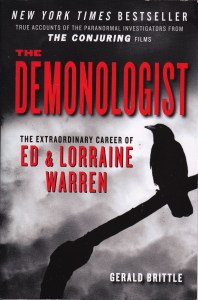
The larger problem is that people see things. Unless said people are scientists, they are considered amateur observers, liable to mistake what they see. The classic example of this is ghosts. From the beginning of recorded history people have claimed to see them, or hear things go bump in the night. Some of the first modern people to make a profession out of exploring such things were Ed and Lorraine Warren. Unfortunately, they didn’t write books about their experiences. Largely because of movies made about some of their high profile cases, there has been a resurgence of interest in the couple and the books originally published by other presses, such as Prentice Hall and St. Martin’s, have been reissued by Graymalkin Media. These are co-written tomes of uneven quality. They’re also like candy—once you start on them it’s hard to stop. Gerald Brittle’s The Demonologist is one such book. More than others in the collection that I’ve read, it concentrates on a single phenomenon that overlaps with the world of religion—demons. Unlike trained religion scholars, however, the Warrens aren’t shy about declaring what demons are (fallen angels) and how they differ from devils (it’s all about rank).

What makes these books so interesting is the dispassionate description of the cases the Warrens investigated. Unless they are pathological in their connection to telling untruths, there’s some very odd stuff that goes on out there. Although they declare once in a while that other religions and their practitioners can also deal with demons, there’s a simple kind of black-and-white view of morality that fits what you might have learned in Sunday School. One of the reasons for this, I suspect, is that most academics don’t take an academic interest in demons. Once they’re filed in the mythology folder there’s no reason to try to figure out what they might “really be.” The Warrens’ outlook, therefore, has become canonical among ghost hunters. They certainly have more credibility in that crowd than most Harvard Ph.D.s. It’s funny what can happen when you refuse to explore what the average person considers to be just as real as the physical world we all think we know so well.


Clean Sweep

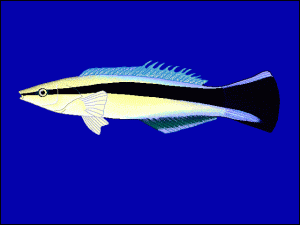
The other day I was reading about cleaner wrasses. These are the fish, usually in coral reef community, that establish a place of business, and other fishes who want to be rid of parasites come onto location to be cleaned. They allow the wrasses to nip them all over to get the pests taken care of, even allowing the smaller fish to swim into their mouths to work their specialization there. Kind of a mix between a visit to the dentist and the car wash. Documentary makers have filmed the process multiple times, and, being humans, we project onto the piscine scene a kind of business template—an exchange of goods for services. Then we turn back to our own lives and forget the underwater world.

Image credit: Robbie N. Cada, courtesy FishBase, courtesy Wikimedia Commons

Still, I have to wonder about what’s going on here in the realm of consciousness. We do not yet know what consciousness is, but we all recognize it in ourselves. We know we’re alive and conscious—except when we’re dreaming when we don’t seem to realize what’s going on in our brains isn’t really happening. Most of the time, however, we set our goals, have our intentions, and go about our business accordingly. What is the motive force that drives a fish to the cleaner wrasse’s studio? Isn’t there a level of consciousness involved to know that this fish’s house is where you need to be for this kind of treatment? Don’t the larger, predator fish know that if they eat the wrasse in their mouth they’ll have to find a new service provider? Are they aware of this or are they, as some scientists like to tell us, simply biological machines following their programming?

I’m not a scientist, but I see consciousness all around me. I watch the interactions of land animals—I generally don’t take trips under the sea, no matter what Sebastian says—and they are anything but simple. The birds on the wire and in the chokecherry trees have complex interactions. All you have to do is watch a single individual for a few minutes. They make decisions—the sky is a vast, open template with no obstacles, surely they have to decide why they want to go this direction and not that! And bowerbirds build nests as elaborate as Victorian mansions. Not that there are bowerbirds at my bus stop, or even in New Jersey. There are limits to how far even nature will go. As I stand here, waiting for my bus, I can’t help but think how like a cleaner wrasse I am. And I’m sure they must be conscious of what they’re doing since life’s all about the exchanges of goods and services.


Any Means Necessary

As one of his first acts as governor of New Jersey, Chris Christie cut the Access to the Region’s Core tunnel project. This was before he closed the state-run beaches so that he and his family to have one for themselves without Independence Day crowds bothering him. Liberty means something new these days, I guess. The ARC tunnel project was meant to ease some of the burden on those hapless zombies known as commuters. As a member of this undead class myself, I often think of the relief that never was as we sit, unmoving, just meters away from the Lincoln Tunnel, looking nervously at our watches wondering just how late we’ll be to work this time. Our elected “representative” leaders have no idea about the life of the average person. Having lived sequestered away among the rich and axle-greasers for so long they have forgotten that real wheels need to roll. Their bottom line is at risk.

Trump, apparently aware that torture and public transit go together, has nominated Steven Bradbury, the Bush-era policy architect, as his general counsel of the Department of Transportation. Known for his “torture memos” Bradbury has none of the charm of the sometimes macabre other Bradbury who had the courtesy of keeping his frights restricted to fiction. The most disturbing part of all of this is just how little our elected officials care about the people who keep this country going. Populism, still poorly understood, is what happens when people get fed up with business as usual. Easily duped, the average citizen can’t tell an “entertainer” from a genuine leader. The era of “I’m not a doctor but I play one on TV” has grown up and become truth. Doogie Howser where are you when we need you? It might be helpful to have Rex Morgan on hand after a session in the torture chamber.

Government has become a joke. Comic strip presidents gather the assorted nuts and dolts required build up a representative democracy, it seems. I used to tell my wife, back in January when things were bleaker than Poe’s December, that we could expect no less than outrage after outrage from a man whose sole motivation is to get people to look at him. We all knew jerks motivated by that in high school. The difference is that now they’re easily voted into office. Selfish men who will close down public parks so they can take the whole thing for themselves. They have no idea what governing is because they can’t understand that other people have wants and needs as well. Other people are for torturing when you’re bored. Sounds like a visit to October Country may be in order yet.


Literary License

Whenever I orient myself to a new place, I tend to do so by the writers who’ve lived there. As a family we used to take “literary trips” to visit locations associated with famous writers. While in the Midwest it was often Laura Ingalls Wilder, and once, Mark Twain. Here in the east there has been considerable diversity. Several locations associated with Edgar Allan Poe have informed our travel plans. H. P. Lovecraft (although, to be honest, we always had other reasons to be in Providence) naturally followed on from Poe. We visited the property of Edna St Vincent Millay in Austerlitz, New York, and later in the same trip Sleepy Hollow, to find the haunts of Washington Irving. Famous writers can be found in just about any major city and many small towns. Now that Ithaca is in our regular orbit, I’ve begun to consider the implications.

Carl Sagan is probably the most well-known of the city’s past celebrities. His premature death added an almost Gothic element to his fame. Certainly among the sphere of his fellow academics known for fiction is Vladimir Nabokov. An entomologist by trade, Nabokov turned to writing and teaching. His lasting renown in this field was for the novel he tried to burn before it was published, Lolita. Before I knew Ithaca would be in my future, and indeed, before I knew that Nabokov was either a former resident or an entomologist, I read the novel. It’s a challenging book. Humbert Humbert is as flawed a protagonist as one might find, and any character guilty of child molestation is difficult to read even in the protection of fiction. Perhaps that’s why the novel won such acclaim. The experience of men and women who read it, I suspect, is very different. It’s a novel of moral urgency.

In perhaps a more innocent time, E. B. White attended Cornell. Apart from The Elements of Style, his book-length oeuvre was mostly in the realm of literature for children. This brings the the focus back to youth. Our childhoods—whether we acquiesce to what fate seems to demand or challenge our lot hoping to improve it—make us who we are. As the years increase in number the memories become more fiction and less fact, they nevertheless remain the touchstone for anchoring our understanding of self. Some of us constantly measure ourselves against the future we clawed for as a child, like those pencil marks on the doorpost showing our physical progress. Having been unable to afford the luxuries of travel when I was young, I add a notch to my literary belt every time I travel to Ithaca, knowing full well that only the slimmest of minorities could find my very obscure hometown on a map. If I remember correctly.


The Consequences of Being Smart

A few years ago my wife bought me a smart phone. Being lifelong Mac users, the iPhone was the model of choice. I don’t have the intense connectivity issues of the young, I guess, so I don’t use it for texting or surfing the net. It’s great for holding bus tickets, though, and navigating in unfamiliar places. I’ve grown quite used to the convenience of having the internet in my pocket. Such a smart device. Naturally, one smart device in a family will breed others. We all have iPhones now. Like most Apple products they’re hermetically sealed and have few moving parts. The user need not know what goes on inside. It’s the very definition of a black box.

Then my wife’s phone went rogue. Suddenly it stopped picking up 3G signals (these are older models, after all). Now, you can’t just open up a black box and look inside. Even if you could I’d have no idea what I would be looking at. So I called tech support. My wife keeps music and photos on her phone, so we didn’t want to lose anything. Little did I realize that I’d just committed two-and-a-half hours of my life to phone repair. Before I was done, I would come to know six discrete people at differing levels of intimacy as we worked together to figure out what might make a black box tick. I spoke to Apple support and our service carrier. They put us back through to Apple support, and they had to call us back because the process was a lengthy one. In the end, it worked. The phone was restored to its former glory, but I had lost one of the very brief evenings I have.

One of the typical sci-fi, or apocalyptic, scenarios is the person or civilization that builds something s/he it can’t control. Like a biblical plague, we’ve unleashed a technology that makes our lives oh so much easier but ever so much more complicated. In addition to our professional expertise, we all need to understand, to some degree, technology. Technology and deity have begun to share blurred lines. It’s as if many believe it will save us. At the end of the day, however, we have to assert that it is here to serve us. We are the gods and technology represents the lowly beings we’ve created to do our bidding. Then again, those who read ancient stories know what happens when the gods create a servant race. I’m lucky that all it cost me was two-and-a-half hours, and not some even greater sacrifice.