GF or TGIF?

For some today is Good Friday. Others are saying “TGIF!” There’s a basic disconnect that has grown between days of remembrance (okay, let’s just call them “holidays”) and the days required of capitalism. Easter is not generally considered a work holiday. As I’ve mentioned elsewhere, coming on a Sunday, it is safely out of the reach of much commercialism. Although, vis-à-vis Christianity, it’s a stronger holiday than Christmas, it isn’t a federal holiday. In a world of religious pluralism, that’s no doubt correct. Still, for those who ponder deeply the tradition that wrought them, shouldn’t we be allowed to contemplate our loss without spending a vacation day?

It will come as no surprise to my regular readers that I often think about the ministry as a vocation. After all, I paid my good money and attended seminary. When I was teaching at a seminary and there was some pressure to move that direction, however, I felt that I was adequately served by daily masses and the opportunity to minister in the classroom. Before those days, however, I trudged into work in Ritz Camera in Brookline, Massachusetts, on Good Friday wearing black and feeling depressed. From long habit I wished to be in church. From financial necessity I stood behind the counter and smiled. Good Friday is that way. It’s hardly a holiday when loss lies all around. It’s a bleak day, one might say. Few bosses who don’t feel the depth of symbolism can quite understand. Work week interruptus.

No doubt it’s vain of me to try to encapsulate this into words. As a culture we prefer the bright, sunny colors of Easter—a holiday with considerable spending but without loss of work efficiency. We should be smiles all around. “Smiles, everyone! Welcome to Fantasy Island!” But we can’t get there without going through Good Friday. Meanwhile, those who don’t observe the day are glad that it’s Friday. Not exactly a holiday weekend, but a weekend nonetheless. Have we outgrown Good Friday? I should think not. For although we bring our cheery flowers and bonnets out for all to see, we all know that Monday is just another day at work.

Elihu_Vedder_-_Soul_in_Bondage_-_Google_Art_Project


Durable Goods

CharingCrossThose who love books share a soul. A weekend never feels complete to me without at least an hour spent in a bookstore. On one such weekend a clerk in our local indie recommended Helene Hanff’s 84, Charing Cross Road. The recommendation was actually for my wife, but knowing me, she said I’d like it. What’s not to like about a set of revealing letters between a struggling, New York-based writer and a London used bookstore clerk? Books tell the story of a person’s life. If I’m invited to someone’s house, I look at their books. I would expect the same if they ever came to see me. Kind of like dogs sniffing each other out. Books reveal the inner person. They also give me ideas of more things to read.

I can’t help but think we’ve lost something intangible in the world of ordering books online. Don’t get me wrong, I appreciate Amazon maybe more than is proper, but how many treasures have I found simply by browsing? The days are well past when a single person could claim to have read every book (and really, who would want to?) so there’s always something undiscovered lurking at the bookstore. And these days used bookstores have the most character. In Milwaukee I used to frequent a used bookstore that could have passed the building inspectors’ visit only by bribery. I spent happy hours there. You see, books are durable goods that can outlast their owners. Can anyone really ever own a book?

84, Charing Cross Road was an unexpected delight. A quick web search reveals that Marks & Co. Is no longer with us. It is now a McDonald’s. Helene Hanff is gone too. And she thought she was born a century too late! Yet here we are in the twenty-first century and books are still with us, despite our losses. They have something of eternity to teach us. The ebook has not yet managed to kill off print. Our local used bookstore closed some years back. I confess to visiting a Barnes and Noble in a state of desperation. There a guy, older than me, was talking to a clerk. I couldn’t help but overhear when they mentioned the used bookstore, now long gone. Even the clerk sighed that they were the only show left in town. Although they were strangers I knew that we somehow share a soul. So it is with those who love books.


Modern Vampires

VampiresTodaySometimes I feel guilty. A grown man reading about vampires? Then I think of such puerile things as television and the stock market over which other adults waste their time and my pituitary gland releases endorphins and I carry on. I must say, however, after reading Joseph Laycock’s Vampires Today: The Truth about Modern Vampirism, that I’m not a vampire. Nor have I ever wanted to be. I am fascinated by the idea, however. The more I read—as is the case with most good academic books—the more I questioned definitions. Laycock does a good deal of that questioning himself in this book, and I came away wondering what indeed defines a vampire? As a child it seemed pretty clear. The vampire was a blood-sucker who came out at night. Fangs, a thirst for blood, and a faded aristocracy seemed to be the essential characteristics. But I was only a child.

Before you get the wrong idea about Laycock’s book, I need to say that his is a serious study of modern day vampires. Yes, they exist. No, they’re not easy to define. As an academically trained scholar of religion, Laycock is keenly aware that self-definition is crucial to categorization. Religious believers self-identify. We have no way of categorizing an adult (and some would say no way at all of children) without their own affirmation of what they believe. Vampires Today, however, raises the pointy question of whether those who self-identify as vampires constitute a religion. Or if vampire communities may be considered religious groups. In case you’re confused: many people identify themselves as vampires—sanguinarian and/or psychic. They believe they require the life energy of others to live and prevent illness. They sometimes drink blood—with permission—or siphon the life force of other people. Like all adults, they should be treated as self-identified. Probably not, as Laycock carefully spells out, a religion.

As in his other books, Laycock takes seriously groups that would, based on numbers alone, be considered fringe. Nevertheless, these groups are a part—sometimes an influential part—of larger society. We live in a world where we’re authoritatively told there is nothing but matter and energy, and as biological beings our purpose is reproductive success and then death. Is it any wonder that vampires and others are seeking something more? I’m no vampire. I read the occasional, thoroughly pulp, Dark Shadows novel to recapture a little of that after-school wonder I felt watching the waves pounding on the Maine cliffs while Barnabas Collins lurked inside. And he bore a strange truth that was perhaps instilled in those young years. Age is only partially a biological matter. Defining it any other way is, I have to believe, immature. So I read about vampires and wonder.


But Loses (His) Soul

Although a couple steps from the real thing, a book review can be an art form of its own.  A short piece in a recent Wired magazine focused on an ironic bestseller that I keep seeing on the standard lists: The Life-Changing Magic of Tidying Up, by Marie Kondo.  Apart from something we’ve probably all heard from our moms, I wonder why so many people buy a book telling them to get rid of things.  Clive Thompson notes in his review (“Clutter Clash: How Tidying up Can Hamper Creativity”) that one of Kondo’s pieces of advice is that books should be on the list of things to discard.  Disagreeing in principle with this assessment, it is an even larger argument that I would like to challenge: “studies” apparently show (I’m not sure which studies) that clutter can be “soul crushing.”  Given that we have no empirical way to assess souls, I’m uncertain how to measure the number of angels crushed under my stacks of books.  Who has the right to assign clutter to the ranks of venial sins—or mortal, for that matter?
 
The book’s subtitle, The Japanese Art of Decluttering and Organizing, may provide some vague spirituality to the topic, and I agree that entropy can get the upper hand from time to time, but soul-crushing?  Some of us keep books and papers precisely because of their value in lifting the non-verifiable soul.  In fact, I was just reading (ahem) about how religions (the traditional home of wisdom about souls) revolve around their books.  Perhaps we should leave at least a showy Bible for the coffee table to display along with our copy of Feng Shui for Dummies.  My soul feels lighter already!

IMG_2727
 
When did advice for improving our souls shift from those who spend their ruminative lives asking the weighty questions to those who suggest picking up after yourself might just work as well as a life of self-denial and putting others first?  And why would you buy a book that recommends you don’t keep books?  My existential crisis deepens, and I haven’t even read it.  I can’t shake the feeling that  I spent thousands of dollars over multiple years getting an education in what turned out to be merely housekeeping.  I marvel at the clutter-free environment as much as the next person.  That’s one of the reasons I love art museums so much.  Yes, my soul does get a boost there.  If I go to the gift shop on the way out, however, I’ll likely want a book to help recapture those sublime moments.  Then I will go home, where my clutter awaits, and will truly feel peace in a place where books abide in profusion.


Spring Forward

I have to admit that spring snuck up on me this year. Weather is, of course, no reliable predictor of the Vernal Equinox, and since I depend on the lightness of the sky while waiting for the bus as an indicator of seasons, turning our clocks ahead last weekend blindsided me to the nearness of the light. Holy Week in Christianity is just one of a cluster of holy days long associated with the point of equilibrium: the day when light and darkness balance perfectly, only to tip from then on in the favor of light. The crocuses have been up for weeks and the robins are ubiquitous, so I really have no excuse. Spending too much of one’s days indoors, I suspect, will inure any soul to the wonder of changing seasons. Climate control, no windows, and constant business separate a person from what nature has evolved us to be.

Easter, understandably, can’t be a national holiday in a land of religious freedom. Not everyone recognizes Easter and even those who do don’t agree on the date. Having a moveable feast is a great inconvenience to employers who want to know everyone’s going to be at their desks. Besides, even though the date changes, it’s always on a Sunday. Many people already have that sop and so, we glide past the vernal equinox with nary a thought. Business as usual. Looking at the great monuments of the past, when ancients put great effort into marking the seasonal change days, I can’t help but think that we’ve lost touch with a basic element of our humanity when we let the equinoxes pass without notice. I hadn’t even realized it was spring until it had begun.

Stopping to recognize the significant days in the passing of the year may be inherently religious. We can be as secular as we like about the equality of light and darkness, but somewhere deep inside we’ll still be thankful that the days will be growing longer until there is more light than dark. We just don’t have to say so at the office. Holidays, it seems to me, offer us hope. We don’t have to buy stuff or give presents. Just having a day to stop and reflect makes us more human. The vernal equinox came silently on a Sunday this year. I awoke early to try to catch sunrise on a cloudy morning. I look to the east, and I dare to hope.

IMG_2725


Palms and Psalms

At Nashotah House, where I spent many years of my career, it was often felt that the weather during Holy Week was, in the best of circumstances, appropriate. With spring just around the corner, however—the date of Easter is based on the Vernal Equinox, after all—a number of surprises came. Particularly in Wisconsin. The ideal scenario would look something like this: sunny then partly cloudy on Palm Sunday; it was a a joyful day for a parade, but clouds make for nice foreshadowing. Nobody really commented on the weather for Monday through Wednesday, and Thursday—Maundy Thursday—was largely spent inside the chapel. Good Friday, however, should be rainy. Saturday gloomy. And, of course, Easter Sunday should be a perfect, sunny spring day. It seldom, if ever, worked out that way. The weather is not beholden to liturgical celebrations. The same holds true for New Jersey. At least the snow has been removed from the forecast today, only to come in the night.

It was at Nashotah House that I wrote Weathering the Psalms. Being a lexically driven book, it was never intended to be a commentary on global warming. It should have been, in retrospect. Already by then we were nearing the point at which, even if greenhouse gas emissions were stopped, runaway melting of the polar ice would continue apace and the weather would grow more and more unpredictable because of human action. Human action of everyone except the industrialists, of course, since they don’t believe in global warming. We cling to our palms and shout “Hallelujah” while the sea level’s rising and our weather grows increasingly erratic. We have a theology with which the weather disagrees.

IMG_2721

The liturgical year is, like its Jewish predecessor, cyclical. Some have suggested that holidays were invented to remind the laity of when it was safe to plant again. Of course, the climate in the “Middle East” is quite different than that of northern Europe and the United States where the Bible seems to have its proper setting. As I was walking yesterday, I enjoyed the daffodils that I always associate with Easter. When I returned home I saw snow in the forecast. Leap year, Daylight Saving Time, and my general level of sleepiness conspired to cause me to overlook that today is the Vernal Equinox. I look for the snow, grasp my palm, and think of spring.


Bible Use

In the current presidential race, it seems, the Bible hasn’t been as large an issue as it has been in the past. Bluff, bravado, and bullying seem more the order of the day. Goliath rather than David. This makes me think of the varied uses that the Bible has had in American life. It has been used as a spiritual guide, a textbook, a set of moral principals, a grimoire, and a science primer, as well as a political playbook. It is versatile, the Good Book. It has been prominent in American society from the very beginning, but clearly its prominence is starting to fade. Not likely to disappear any time soon, the interesting question is how people use the Bible, often without reading it. This is what scholars call the “iconic book” aspect of the Bible. It is performative—it acts in a way that has an outcome, no matter what the intent of the user. As I’ve argued in academic venues, it has become a magical book.

An iconic book (photo by David Ball)

An iconic book (photo by David Ball)

Wondering whether this is a new situation or not (I deeply suspect it’s not) I’ve been reading about the Bible in early America. Almost all the reference material points to the “official” uses of the Bible—that by statesmen and clergymen (both classes of “men” in the early days) with almost nothing of how it was used in private. This question involves some exercise of the imagination since there are few data. Would not a family, struggling to survive, see in the Bible a powerful book? And would not a powerful book be capable of subverting the laws of nature? Reading about the witch trials in Salem, we see that thunderstorms and other “prodigies” were considered magical. Surely one could use the Bible for unorthodox purposes? There’s little to be said in the absence of evidence. The use of magic in the colonial period, apart from the trails of witches, was not unusual.

How do we measure the ways the Bible was used when nobody beyond interested parties, such as clergy, wrote about it? Mr. Trump even tries to quote it from time to time, but since his citation that sounds like a joke opener, “Two Corinthians [go into a bar],” he seems to have let that hot potatoe drop. The Bible, seldom read, remains a powerful book. The source of its power, I suspect, is in its use by the common people. Many people are familiar with it, and believe in it. Some have even read it. It remains, however, one of the great mysteries among the early European settlers. We know they had their Bibles with them. How exactly they read them, when not under the eye of the preacher, we apparently have no way of knowing.


Ethology Theology

MindingAnimalsProminent public intellectuals, we’re used to hearing, often lament the survival of religion into a rationalist age. As an obscure private intellectual—if I may be so bold—I am always pleased to see when a credentialed scientist asks if we are being too hasty. No, but actually says we’re misguided to dismiss the evidence of our own observations. Marc Bekoff’s Minding Animals: Awareness, Emotions, and Heart is an encouraging study by a balanced individual. Bekoff, unlike many scientists, realizes that emotion does play into observation and reasoning. More than that, materialistic reductionism does not account for human or other animals’ experience of life. Historically motivated by religions to separate ourselves from animals, we have only come to know slowly—painfully slowly—that the distinctive markers of humanity are shared in degree by other animals. Bekoff is bold enough to give the lie to the belief that animals have no emotional life. Traditionally science has said that we cannot know what goes on in animal brains so it is best to take animal emotions off the table. Then scientists go home and love their dogs, who love them in return. When’s the last time I read a scientist writing about love?

Minding Animals is a manifesto. We have, in our arrogance, made unwarranted assumptions about both animals and our unique status on the earth. We drive other species of animals to extinction at a rate that required an asteroid collision or some other catastrophic event in the past. And we use animals as if they had no interests of their own, even such basic interests as avoiding pain and suffering. “They’re just animals,” we’re told. Bekoff is an ethologist—someone who studies non-human animal behavior. As common sense, both the sine qua non and bête noire of science, reveals, animals experience and express happiness, anger, and love. They can be depressed. They can be overjoyed. And we treat them as if they were objects to do with as we please.

Bekoff admits some of his fellow scientists treat him as if he’s gone soft. Like Diogenes, however, I search for an honest man and I think I have found him. Instead of castigating religion, Bekoff ends his book with a chapter on theology. Not to make fun of it, but to show that even scientists must integrate different kinds of knowledge. Not only is the science that Bekoff describes appealing to the emotions, it also makes sense. No scientist is completely objective. Even Mr. Spock breaks down once in a while. We all have perspectives. And that includes our fellow earthling animals. We evolved from the same ancestors and yet treat them as if we own them. Minding Animals will—or at least should—make us feel guilty about that. Being human and being humane, after all, are only a silent e apart.


St. Pat Tricks

What does it say about a saint when the celebration of his day is excessive drinking? Virtue and vice, while not nearly as Manichean as sometimes made out to be, nevertheless conflict in such a setting. Like many American mutts, I have some Irish heritage. I wear green on St. Patrick’s Day, as it’s the done thing. I avoid any celebrations, however. When my job calls for travel to college campuses, I know to avoid the time around St. Patrick’s. Indeed, I’ve taught on campuses where Spring Break was always scheduled around St. Pat’s so as to minimize property damage on campus. Send them off to Florida, where they can be some other electorate’s problem.

IMG_2681

This is an interesting dichotomy. We live in a fairly permissive culture, at least when it comes to things like sex and violence. We nevertheless have built a Prohibition-Era-like mystique around alcohol consumption that makes our college-aged kids a little too curious. Binge drinking and its predictable aftermath have become far too common. Put them together with an Irish saint and all bets are off.

Historically, the Irish have been maligned in what is an acceptable way. Few complain when a nationality is non-ethnic on the surface but non-welcome nevertheless. The Irish have been historically oppressed, but today we forget all that. We hold parades with bagpipes to bolster solidarity, but only if the taps are freely flowing. Drinking with holidays is nothing new. Even Judaism has its Purim and other religions may, from time to time, relax strict rules on the evils of alcohol. But what does it say about a saint that there is apparently no other way to celebrate his day? Wearing green, yes, but that may be entirely accidental. It is, after all, a Dionysian rite of spring, our apparel matching the verdure we soon anticipate as winter wends its weary way out. Even so, I’m glad not to have to be on the streets of a major city when the parade marches by. Even with my Irish ancestry, I prefer to celebrate in my own quiet way, just by wearing green.


Measuring Religion

How do you measure the religiosity of a people? While the boundaries of the United States are somewhat porous, internally, we nevertheless still consist of somewhat self-governing states. One measure of religious belief is to take your metrics by state. Of course, some people—perhaps many—owe their state of residence to their work and not their natural choice. You’re judged by the company you keep, regardless. So when the New Jersey Star-Ledger ran a front page piece about religion in the Garden State last week, I was intrigued. I do spend quite a few of my waking hours in the neighboring New York, but for statistical purposes (and taxes and tuition) I’m considered a New Jerseyan. So what’s the damage?

IMG_2702

The story is actually about a Pew survey undertaken last year. New Jersey, it seems, ranks 19th from the top when it comes to religious states. Ranging from Alabama as the most religious to New Hampshire as the least, the measures of devotion are four: do you attend worship, do you pray frequently, do you believe in God, and do you profess yourself religious? Each of these questions provides its own set of problems when it comes to being an actual measure of someone’s commitment to religion. I maintain, as I often declare on this blog, that religion is one of those non-quantifiable aspects of life. It cannot be measured accurately because the tangibles are immeasurable. Deep commitment may be found among those who don’t frequently attend worship. What if your religion is a very private affair? And besides, doesn’t all of this measuring sound like a locker room contest?

As a nation, we spend a lot of time worrying about how religious we are or aren’t. Since such events as presidential elections have hinged on candidates’ piety since I’ve been old enough to vote, that’s understandable, I suppose. Nevertheless, such surveys are about surface belief. I recall in college being told that if your living space didn’t have enough evidence to convict you, you weren’t really religious at all. I know I’ve got quite a few Bibles laying around, and although we rent, we do have some religious artwork on our walls and mantle. I blog about religion daily. Still, I wonder where I might fall on some survey designed to tell me how religious I am. Such things can’t be measured with surveys, but in situations where the stakes are so high, we will do what we can to understand the imponderable.


Apes’ Asherah?

As a part of my class on Ancient Near Eastern Religions, since we were dealing with the earliest textually recorded religions, I explored origins. Specifically, the origins of religion. For years I told my students that biologists had observed behavior among chimpanzees that was proto-religious. Imagine my delight in seeing an article on New Scientist headlined “What do chimp ‘temples’ tell us about the evolution of religion?” The article, by Rowan Hooper, describes chimpanzees banging rocks before a “sacred tree” and storing the rocks in the tree in a ritualized fashion. That’s a long way from Episcopalians putting on their Sunday finery, but it is a fascinating piece of a larger puzzle. As the article points out, other symbolic action among chimps has been observed—some of it the basis for what I discussed with my students. The impulse to acknowledge the power of the Other runs deeply within animals, particularly mammals and birds.

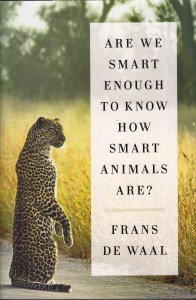
This may seem an odd thing to suggest. We do know, however, that among the earliest attested behavior or Homo sapiens, along with hunting and seeking shelter, is religious behavior. It is part of who we are. Primatologists, such as Frans de Waal, have noted that the great apes engage in altruistic behavior. It is only when they become billionaires, apparently, that the urge dies. Again, other mammal species and some birds also show altruistic behavior. We are part of the natural world. Our religion, rather than being a collective insanity, is part of a continuity with that natural world. It is much a part of who we are as is seeking food or putting on clothing.

DSCN6152

The more rakish side of my imagination goes to the fact that this article begins with a sacred tree. Tree worship is part of early religions. Some scholars suggest it is part of Asherah’s cult in the ancient world. (I discussed this in technical terms in an article some years back; take a look at my Academia page if you can’t sleep without reading it.) Goddess or not, trees are essential for our survival—call them a godsend. Would it not make sense for religion to include reverence for trees? It seems that some great apes, at least, agree. Are these primates religious? We can’t say. One thing, however, is certain. Our fellow animals show more moderation in their use of the environment than our species does, and that in itself is both logical and religious.


Lovecraft Legacy

CarterLovecraftHistory can be a funny thing. Take the way it treats some people. H. P. Lovecraft wasn’t famous in his lifetime. In fact, his isn’t exactly a household name even now. His creation Cthulhu lurks grandly in the internet, and even Lovecraft himself is finding mention in some literature courses, despite his lack of literary finesse. Yet, fiction is being written about him. I just finished Jonathan L. Howard’s new novel, Carter and Lovecraft. While H. P. doesn’t appear as an acting character in the novel, he is related to one of the protagonists in a way that is essential to the story’s plot. I won’t give away any spoilers here, but the novel takes over where Lovecraft, the non-fictional character, left off.

Lovecraft, famously, was an atheist. Nevertheless he spun a mythic world of Old Gods that has become canonical in its own right. His stories veritably teem with religious themes as well as monsters. In fact, in Howard’s treatment of the mythos, the religious elements still show up. As I’ve noted before, one need not be a theist to be a capable theologian. Fiction like that of Lovecraft, or that of Howard, inherently holds a kind of numinous quality. In fact, fiction frequently does. In reading, we allow ourselves to be drawn into another world. What could be more religious than that? The beliefs of the writer, it seems, may not ultimately matter.

At one point, at least, in Carter and Lovecraft the sentiment becomes explicit. One of the characters contemplates starting his own religion, only to realize that he’d have to write a holy book. That, he decides, would be a lot of work. As one who dabbles in various forms of literary art, I can take his point. There is something wondrously exhausting about giving birth to words. And those words make worlds. When you stop to think about it, that’s kind of a religious thing to do. I’d recommend Carter and Lovecraft to H. P. L. fans. It’s not a Cthulhu-fest, but it is an enjoyable, compelling tale that raises questions which, if not handled carefully, will quickly turn theological.


Retrograde Motion

How wondrous it feels, after a winter of dark skies, to see dawn beginning to break even before I crawl onto the bus in the morning. Almost pagan in my desire for the longer days, I anticipate this every year after standing in the dark since October. Then everything changes. Darkness falls again. I’m inexplicably weary, despite the sleep of a weekend. It’s Daylight Saving Time. Every year I wonder at this inane wartime madness that we keep going, despite its lack of applicability in an electronic age. Employers, I should think, with an eye toward efficiency, would lead the charge to end changing clocks twice a year to yawning employees and the inevitable depression of taking a step back into darkness. It will be another month before the sun again appears at my bus stop. Meanwhile, it will be light when I’m getting ready for bed in the evening. Perhaps I’m the only one who thinks about this. Religion, however, has always held time sacred.

IMG_2439

Quite apart from “sacred time”—holidays and festivals—religions have always been about the appropriate use of time. Counterintuitively, they suggest the rushing about we do to make money, to ensure our material well-being, might be misplaced. There might be a better use of the allotment that we’re given on this earth. Time to ponder. Call it prayer or meditation, studies show that it is good for us to spare some of our time for quiet reflection. Every second counts. And time sets the very patterns of our lives. Bodies know when to awake and when to eat. Until we go and shift the entire calendar on them.

Daylight Saving Time was a wartime measure to ensure the most efficient production of arms. Now, in days with lights blazing constantly, telecommuting, and farming being done largely by automation, we still religiously keep to this barbaric ritual. Eyes heavy with sleep, I stand in the utter darkness again, wondering when I might see some glimmer of light. It will only come when I’m ensconced in my windowless cubicle. It is so dispiriting. I, for one, would gladly forfeit a mere extra hour’s sleep in the autumn, just to keep progress going in the spring. Instead, I follow the crowd as we waste an hour that becomes five, six, ten, or twenty as we try to readjust our bodies to rising an hour earlier. For those of us up before four a.m., it is a sacrifice indeed. All I really crave is to allow the light continue to grow.


Can of Worms

A great variety of food comes in cans. My mind naturally turns to vegetables and beans, but “tinned meat” was a staple of my childhood, including the now derided Spam. When I see octopus and squid in cans I’m glad I’m now a vegetarian. Once—it may have been in Canada—I even saw bread in a can. My wife and I used to can vegetables at home when we had a garden and commuting didn’t eat up every spare second of the day. For the store-bought can, however, a can opener is essential. The idea is to seal the outside world out, to avoid contamination. To get to the goodies inside you need a tool. A can opener. In these days of emergency preparedness, a can opener can be a matter of life and death, or so we’re led to believe. Dry goods can survive without special preservation, but most require cooking and if the power’s out, well, cans can be much easier. I’m writing about cans because our can opener doesn’t work. We don’t have one of the electric machines that takes up counter space and would be useless in an emergency, but the basic hand-held device that’s designed to remove the lid from a can. I hope there are no hurricanes before we can get another.

A little context is in order here; after all, this blog is about profound things. We’ve gone through four can openers in the past six months or so. (Similar statistics apply to rotary cheese graters and garlic presses, but they are less crucial in an emergency.) The underlying issue is ethics: when you buy something durable, you expect it to last. Now you’re probably thinking, “don’t buy cheap merchandise, then.” We tried getting all of these devices from kitchen stores (not outlets!) and for a price that edged us beyond the comfort zone for a basic tool. These were the ones that went defunct the quickest. Our economy is built on the premise that people have to spend. When I was a kid, we had a can opener that remained the same through my childhood and college years. And we were poor. Now that we’re warned of terror on every side, you’d better have access to a store when that emergency comes because your can opener can fail you.

I know how to use a pocket-knife can opener. In fact, over the holidays I had to resort to one since stores weren’t open and our most recent addition to the can opener family had died. I made sure to show my daughter how to use the pocket knife device. When we lived in Wisconsin we learned how to make our own candles too. During Hurricane Sandy, a decade after they were dipped, these candles proved their worth. With no electricity for three days, we did rely on a can opener. Since then we have not found one that lasts. It seems that our economic plan as a nation is at odds with our national emergency preparedness. Even in the event of a war, we’re told, companies won’t produce weaponry unless they can make a profit. In days like these it seems that a pocket knife might be the wisest investment of all.

Why would anyone need two?  Now I get it!

Why would anyone need two? Now I get it!


Moral Money

Yesterday I spent at the Mid-Atlantic Regional American Academy of Religion and Society of Biblical Literature meeting. Not a registered guest, I was there in mufti. Those who know me stopped by to greet me, even without a name tag, but I noticed, as I increasingly do, the youth of the attendees. Apart from the business discussed, the issue of these younger colleagues kept arising. It’s as if the tap was left on but the glass is already full. Presidential aspirants aside, we live in a world where people are increasingly realizing that you can’t squander resources. We have compulsory education to try to make the next generation smarter, more fortunate than our own. And those who have the inclination and ability to go on for advanced study, we throw into menial jobs and poverty because, despite the myth, a doctorate doesn’t help your financial prospects. Universities have become businesses and one of their top-end products is the doctorate. The doctorate with no future.

Sitting in the lobby between appointments, I can’t help but thinking back to a younger me. I am part of what older colleagues are calling “the lost generation” of humanities scholars. Those who have the credentials but no opportunities. A wasted resource of a nation that loves reality TV and blustering windbags, as long as the windbags are billionaires. It makes me sad to think that instead of making a place for those driven to high achievement, that we’ll offer them poverty-level adjunct positions with Obamacare, food stamps, and excessive hours. When they burn out, like a high wattage bulb, we’ll go to the closet and screw in another to replace them. Just don’t turn off the tap. Graduate students bring in money.

This is a moral issue. Since it involves what are scare-quoted as “the elite” we seem not to care. Isn’t it fun to knock down those who think they know too much? I sit in the lobby and watch the bearded young men, the young ladies with heavy backpacks thrown over their shoulders, and I want to warn them all. And it’s not just me. My colleagues, lost generation or not, all agree. We’re sending our best students to oblivion. In the most prosperous nation in the world. You can tell we’re prosperous because all it takes to gain the confidence of a political party is lots of money. Lots and lots of money. I won’t mention the obvious that such loose lucre could be put to good ends, making jobs for those who’ve poured their lives into bettering their minds. Or maybe I will. It is a moral issue, after all.

IMG_0213