Out There…

Spring is a time of hope. As crocuses poke their heads through the slowly yielding soil, we’re reminded that the long months of darkness are only temporary after all. It was only appropriate, then, that my wife should point out to me the returning of the X-Files. Only a limited season of six episodes, but after hearing rumors for years that the third movie was in the works, we’ll gladly take six episodes to remind us that the truth is out there. I’ve not always been a fan or the X-Files, but there are reasons for that which have to do with living in the middle of the woods in Wisconsin in a seminary where the paranormal was, at times, just a little bit too readily at hand. And also because the very topics addressed are those of taboo. The anomalous is fodder for ridicule. Nobody could be so naive. Meanwhile the show was winning awards and creating enduring cultural memes.

Thexfiles

As I’ve suggested many times on this blog, the paranormal and religion are closely related categories. While not many X-Files episodes directly dealt with religion, the second movie made the connections explicit, blending Bible and spooky effects at a distance with abandon. The X-Files and religion share a fascination with wonder. It is all right not to know. Sometimes wanting to believe is enough. We can find information on nearly any topic instantaneously by pulling out our phones and tapping into the local wifi network. We access any bit of random information with ease. And we wonder at our lack of wonder. Where has it gone?

Thirteen years ago the haunting music died. We’ve been left with a reality that feels dull and devoid of possibility. We need some sign of hope. Ironically, it is Fox that offered a world of possibilities far beyond a Republican purview. This was a realm where humanity was no longer in control. Forces outside of and more powerful than us swept into our mundane setting to remind us that even government control is only an illusion. Human pride requires timely mementos that we are simply the dinosaurs of our age. The incomprehensible overshadows us as we spin away our time on a planet nowhere near the center of our galaxy, let alone our universe. And yet we tell ourselves we are capable of discovering the laws that lie behind it all without stepping foot on even the nearest of other planets. Welcome back, X-Files. Remind us where the truth may be found.


The Film’s the Thing

BibleFilmIn the context of teaching, I often described how movies portrayed the Bible. There is an aspect of this that may go overlooked since the Bible is, in the nicest possible way, inert. That is, the Bible frequently functions as a character in movies. In a minor, or supporting role perhaps, but clearly it has an impact on what the other characters do or say. The story wouldn’t be the same without it. So it was that I finally got around to reading The Bible in Film—The Bible and Film, edited by J. Cheryl Exum. This is a collection of 11 academic essays about the Bible in various cinematic guises. A number of the essays focused on Jesus, being the most obvious biblical character to star in movies; he had another one this past summer. The collection, however, is wide-ranging in its biblical characters.

More interesting to me, and this is just a personal preference, is the way that the Bible shows up in movies. Those who decry the study of sacred writ seem to be in denial concerning just how deeply embedded in our national psyche the Good Book is. As the various contributors to this volume show, the Bible appears in ways both subtle and overt in many films. Like it or not, the stories represented in the Bible are classics, and many film-makers find a rich source of material here (when they’re not busy making sequels). The Bible is, to a large extent, who we are.

That’s not to deny a religious pluralism to the United States. We are diverse and that is one of our strongest assets. Still, even though our founders were primarily deists, and not evangelical Christians, their culture was pervaded by the Bible. A large difference between then and now is that, although they weren’t “Bible believers” our founders knew their Bible. In a sense that is almost incomprehensible today, they realized that you don’t have to believe it to see its value. The Bible does have some good things to say. Even now when I get overwhelmed, I can still find some balancing sanity in parts of Sacred Writ. It’s not all about killing your enemies or keeping women silent in the churches. It is a very human document. That’s why, in my humble opinion, we keep coming back, as a society, to the Bible. Anything that is so momentous is bound to find its way into our movies and our other art forms. How we take that is, of course, a matter of personal taste.


Ice Church

Eternity is a concept closely associated with religious thought. It bears a freight that phrases such as “steady-state universe” and “Big Bang” lack. Indeed, the foundations of Christianity and Islam involve the belief that eternal life can be had for those who play by the rules. Great cathedrals and mosques were erected to last forever, or at least until the end of the physical world. Perhaps that is the reason I find the idea of a church constructed out of ice so engaging. Annually for the past several years, a church has been built of ice in the Romanian Alps. Accessible only by cable car, the church is a temporary structure in a land where varieties of Christianity (let alone other faiths) are openly hostile to one another. As the globe slowly wobbles back to a northern inclination, the church will melt and disappear. Still, in its brief time in the world, baptisms and marriages will be performed there. Eternal vows in a temporary structure.

A theological message is inherent in such an institution. We are trained from our earliest days to be consumers. We are to acquire goods and desire more. Were we ever to be satisfied, capitalism would crash to the ground like an ice church left out in the heat. The secular world in unrelenting in its message that we are born to eat, buy, and use. The more expensive, the better. And the more quickly obsolete, the more profitable it will be. The towers of our cities are constructed of concrete and steel, and yet, I have watched new buildings grow and supplant those that have seemingly stood forever but which, in reality, have existed for less than a century. Indeed, all of our towers ought to be made of ice.

IMG_1252

Ice is cold and hard, but it is still water. An article in The Guardian notes that some pastors see this as a kind of baptism frozen in time. Shape given to that which follows the contours of its container. The water, however, will ultimately follow its natural order and rejoin the oceans of the world. While humans are naturally disposed to collect, to save up against lean times, we have to be taught to be consumers. Some of us are content with relatively little, knowing that elsewhere our fellow human beings have nothing at all. Their churches are made of ice, and our corporations are eager to reach even them, to teach them to covet what the more “affluent” have. And the world slowly warms, turning all into liquidity.


Final Final Frontier?

Over the past several months my wife and I have been making our way through the Stars. Not really Trekkies or Jediists, we both came of age during the early days of Star Trek and the dawning of the original Star Wars. Both franchises have continued to grow and have become cultural markers in their own rights. We have survived all the episodes of Star Wars I through III, and have made it, so far through Star Trek V: The Final Frontier. As we switched off the DVD player, we mused that we hadn’t seen this particular installment (with good reason) since we had originally watched it together shortly after it came out. It has its moments, but it just doesn’t measure up to what Kirk and Spock can usually muster. Watching it as a somewhat jaded critic of space movies, however, its religious elements simply couldn’t be ignored. After all, this is the episode where they find God, then shoot him in the face.

Opening with Sybok, the emotional Vulcan messiah, with a tacked-on identity as Spock’s brother, healing his first convert, the movie follows a typical kind of progression of a boy and his god. The town on Nimbus III (every Trinity watcher surely caught that reference) is named Paradise. Some wag painted the Miltonesque “Lost” after the town name on the gate through which Sybok rides like Jesus entering Jerusalem. Hijacking the Enterprise turns out to be remarkably easy, even with Spock, Bones, Uhura, Sulu, and Kirk in the shuttlecraft. And soon we’re off to the Great Barrier, which, as it turns out, is just a bunch of colored lights.

When God appears, he takes the shape of a typical Terran, white beard and everything. When Sybok questions him he briefly turns Vulcan, but we get the sense that God is whoever you want him to be. He is definitely masculine, and he has anger issues. His Eden is a barren rock, and he feels trapped and requires a starship to get about. We are forced to conclude that this is no deity after all and life is but a dream.

Despite its many disappointments, Star Trek V is a theologically aware movie. Its conclusion of science trumping the need for the divine leaves us with three old men around a campfire waiting to die. A trinity in its own right, but one where the only hymn to be mustered is “Row, Row, Row Your Boat.” And God lies dead at the center of the galaxy.

Star_Trek_V_The_Final_Frontier


Unconventional Resurrection

GospelLivingDeadWith talk of resurrection in the air, it seems natural to turn to zombies. In this internet age the monster of choice seems to change from day to day, but since the turn of the millennium zombies have been a contender for popular favorites. In a world where many of us feel zombified by our work, this is no surprise. Late capitalist power structures drain the life, leaving only the shell. In a situation where zombies appear so frequently, it is difficult to keep current. I bought Kim Paffenroth’s Gospel of the Living Dead shortly after it was published. Subtitled George Romero’s Visions of Hell on Earth, it saves itself from too my obsolescence by taking the narrative from Romero’s movies, and one remake, thus leaving room for the many other zombie movies to come and go. While it does make reference to 28 Days Later and Shaun of the Dead, most of the discussion stays pretty close to Romero, taking the reader through his quaternity of movies in the genre.

Roughly paralleling Romero’s oeuvre with Dante’s Inferno, Paffenroth treats the movies theologically. Not surprisingly, sin and ethics play a large part in his analysis. The undead, after all, are not un-spiritual. As I read along, however, I often thought how a western Pennsylvania connection gives some insight into what Romero is trying to do. Perhaps we are in danger of over-reading without the context (what biblical scholars call isogesis, but which post-modernists call simply reading). For example, some of the place names are given a theological significance in Gospel of the Living Dead that some of us who grew up in the area recognize as just another town. This always comes home to me when watching Night of the Living Dead. The posse out to hunt zombies always reminds me of people I knew in high school. After all, the first day of buck season was a local holiday.

Still, I have trouble seeing Romero agreeing with the dialogue revolving around sin. Yes, his first two movies were as much social criticism as they were horror. The Vietnam War and consumerism were true evils to be cast in parables and shown to the public. Zombies were prophets. Paffenroth suggests that zombies will never become mainstream commodities, but time has shown that even zombies can be bought out. World War Z was a Hollywood extravaganza. The Walking Dead is hardly the domain of outcasts and pariahs. Romero’s monsters were, alas, not more powerful than capitalism. Even zombies can be purchased. Zombies and vampires can indeed earn money, and resurrection itself comes with a price.


Middle Eastern Idol

As the Passover-Easter complex of holidays approaches, our stern, scientific face turns toward the more human sensibilities of religion and its impact on our lives. PBS recently aired the Nova special The Bible’s Buried Secrets (originally aired in 2008) and when a colleague began asking me about it I figured I’d better watch it. As an erstwhile biblical scholar there wasn’t much here that was new to me, but one aspect of the program bothered me. Well, to be honest several things bothered me, but I’ll focus on one. When referring to the gods of the Canaanites, among whom the program readily admitted the Israelites should be counted, they were invariably referred to as “idols.” The problem with this terminology goes back to an issue I frequently addressed with my students—the term “idol” is a way of demeaning the gods of a different religion. Implicit in the word is the assumption of the monotheistic worldview and its attendant problems.

The Bible’s Buried Secrets seemed to adopt an overly optimistic view of the monotheistic religions sharing the same god while everyone else worshipped idols. The view is as fraught as it is simplistic. Historically Judaism, Christianity, and Islam are certainly connected. Each recognizes in the others a glimmer of its own theology and outlook, but the concept of deity has shifted somewhat at each development. Judaism and Islam are rather aniconic, especially compared to many varieties of Christianity where images are allowed, or even encouraged. It is difficult to grab the attention of the magazine-reading public with an image of invisibility on the cover. It should come as no surprise that some Jews and Muslims believe Christian images to be, well, idols.

An idol moment?

An idol moment?

The word “idol” is by nature pejorative. Ancient people were sophisticated polytheists. That statue that represented a deity was not thought to be that deity in any absolute sense. Rituals assured the ancients that they were instilling some aspect of divinity into the statues they used, making them sacred in the same way a Christian consecrates a church building. What’s more, it is natural for people to seek a visual focus for its devotion. It is difficult to conceptualize the Almighty as a person without giving it (often him) a body. Islam, especially, has been adamant that this can’t be done, and looking back at Christian practice it is sure to see idols abounding. As the holy days begin for our vernal celebrations, we should perhaps use the opportunity to rethink such religious vocabulary since every orthodoxy is someone else’s paganism.


To See the Sky

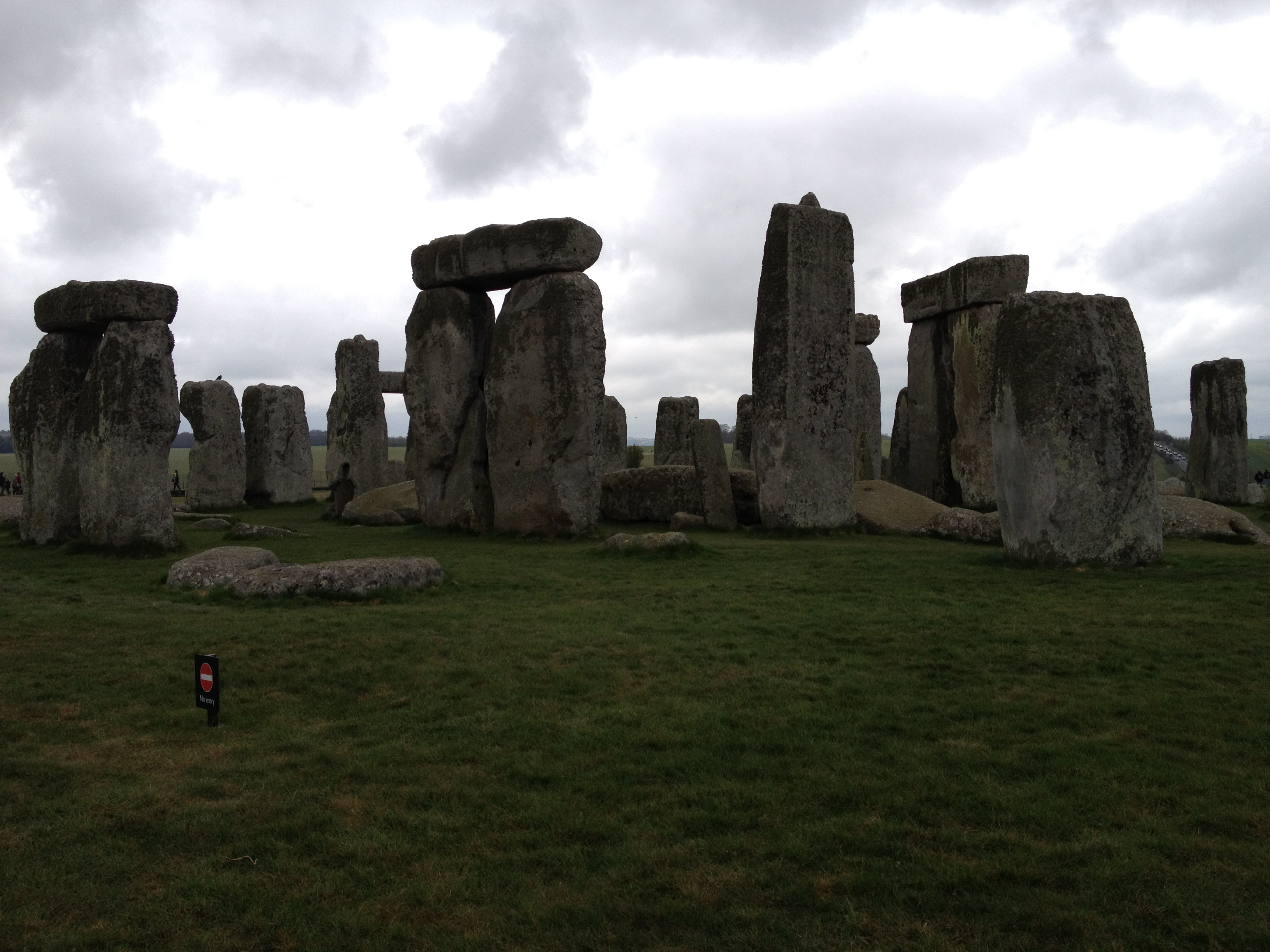
Stonehenge. The very name evokes mystery and myth. Although archaeology has revealed more about the monument than any mere visual survey, we are still very much in the dark about its origin and purpose. With one exception: we know it was something religious. When we discover artifacts that required a tremendous outlay of human effort in pre-industrial periods, the motivation, according to our current understanding, is almost always religious. Modernity has come to us with a cost. In any case, a recent story in The Guardian highlights the view of Julian Spalding, erstwhile museum director, that Stonehenge might have housed a platform on top of which the real action took place. As might be expected, experts disagree. With its precise solar alignment, one wonders if a roof might have been superfluous, but then again, there is the sky.

IMG_0129

When I begin to feel depressed working in the belly of a concrete bunker with no windows, indeed, no view of the sky at all, I find my way to a room with a view of the outside. I’ve always had a celestial orientation, and looking at the sky—especially on a day with some blue showing—can cure my sadness in a way almost supernatural. I suppose that was part of the reason I wrote Weathering the Psalms; there is just something about the sky. In that book I couldn’t really verify what it was. I still can’t. I know it when I feel it, however, and this perhaps the feeling the Julian Spalding is asking us to explore at Stonehenge. Ancient people directed their worship upward, not toward the ground.

Like all universal statements, however, there are exceptions. Some ancient religions recognized our place as children of the earth. The celestial sphere, however, is part of the package. Our atmosphere makes our world habitable. While the moon is beautiful and Mars inspires wonder, their lack of air spells their hostility toward those who need to breathe deeply and look up into the blue once in a while. Almost Frazerian in its archetypal view, Spalding’s idea has a beauty of its own, whether or not the evidence bears it out. People of ancient times had a talent we lose in our cubicle-infested, results-obsessed world. We all exist because of the atmosphere above us. And when modern views become too much for me, I head outdoors where, sun or not, I find my solace in the sky.


Rorrim

It was an object of wonder. Handed to me as a child, the Bible inspired a kind of awe reserved for the big events of a young life. Here were the very words of God, in King James English, for me to read, mark, and inwardly digest. Well, at least read. And read I did, as only the fear of Hell is able to motivate an impressionable psyche. When a parish minister saw the trajectory of my life, he suggested exploring the ministry. More Bible reading ensued. With only Halley’s Bible Handbook as a guide, interpretation was largely a matter of what the minister said, and the kind of primitive reason that resides in a teenager’s head. I made it through college as a religion major without ever hearing about Mesopotamia’s influence on the Bible. Once I did hear, in seminary, it was clear to me that to get to the truth, you had to go back beyond the first page. Mesopotamia was only part of the story. The Bible was a book compiled in a region where other religions shared concepts, deities, and stories with the Israelites. While unique in some respects, it turns out the Bible wasn’t as unique as I’d been led to believe.

Mesopotamia, vying with Egypt, was the true cradle of the civilization that gave rise to who we are in the western world. Perhaps in the eastern hemisphere as well. The great cities of Sumer, and later Babylonia and Assyria, yielded cuneiform tablets and other artifacts that insisted we widen our view of antiquity. The heirs of this tradition developed Judaism, Christianity, and Islam. All three monotheistic religions have bred sects that despise this ancient past with its uncomfortable truths, and thus we hear of IS destroying the evidence with abandon. The years of my life spent studying these cultures disappears so quickly under the bulldozer’s blade. For all this, it is IS that is the passing fancy. You can’t destroy the truth. You can damage it, however, to the detriment of everyone.

IMG_0188

Political regimes, and not just in the Middle East, operate with an unbecoming arrogance when they believe in their own self-righteousness. Were it not for those who wondered what these wedges on clay meant, we might still have to reckon (more seriously than we already have to do) with those who insist that it’s the Bible way or the highway. Unfortunately, it often takes disasters such as this wanton destruction of the past to wake the media from its lethargy concerning the cultures that gave our religions birth. There’s so much more to distract. The world can’t make up its mind about the color of a dress, and meanwhile those backed with a justification of true belief destroy that which can never be replaced. Given the rhetoric of political leaders even here, I suspect that our past is no longer safe, no matter where we house the artifacts bearing witness to the truth.


The Art of Religion

RastaIf you take a train along the Raritan Valley Line en route to New York City, you will see many of the less highly regarded sights of New Jersey. The properties along the rails are often industrial and neglected. Graffiti abounds. On one particular concrete underpass is a truly monumental graffito reading “Paint the Revolution.” Since I can’t afford to take the train on a regular basis, seeing that prophetic line is a rare occasion for me, and it always casts me in a reflective mood. No doubt injustice has become deeply entrenched in our society where politicians are synonymous with distrust and wealth is carefully corralled by a passing insignificant number of individuals. These thoughts recurred as I was reading about Rasta, the religion that developed in 1930s Jamaica, and is now found throughout the world.

Perhaps the most rewarding aspect of being an editor is exposure to new ideas. Of course, anyone can achieve this by reading, but as a person whose job is to find new books, an editor often has to go beyond passive, to active reading. So it was that, while at Routledge, I came to Darren N. J. Middleton’s Rastafari and the Arts. I immediately fell for it. I’d read about Rasta before, but Middleton’s use of art as a means of exploring the religion was captivating. Now that his book is out, I reacquainted myself with what drew me to the project in the first place. Admittedly, a large part of the draw is the fascination with Rasta itself. While some, perhaps many, would claim that it’s not a religion, Middleton demonstrates pretty clearly that it is, or that it at least has all the hallmarks of one. Moreover, it is a religion profoundly based on the concept of social justice, something that many religions possess in diminishing quantities.

The African diaspora led to the development of several new religions as African thought was forced into a mode of accepting Christianity. Among those many new religions, Rasta stands out for its association with a particular musical style, reggae. Of course reggae can be secular, but one of the many insightful observations of Rastafari and the Arts is that the global spread of Rasta often begins as music travels. While reggae is generally identified by its musical style, it is also noted for having a heavy dose of social consciousness. People who’ve been oppressed, no matter what their race, often express their victimhood in their arts. Not particularly numerous, and certainly not politically powerful, Rasta has been painting its own revolution. That revolution is associated with peace and love, and, in a way almost unique among belief systems, its music.


Music Alone

Thinking back to our days in Edinburgh, I had a song come to mind. I could remember only a word or two, but the tune and the cadence were still there. Not a singer, nor even a hummer, the best I could do was ask my wife if she remembered the song based on the two words I could recall. Amazingly, she did. When I went to download it on iTunes, I learned that it isn’t available in the US. Probably copyright laws—these can be quite bizarre. Music has a way of staying with you and one of the songs unforgettable to those of us growing up in the ‘60s is Don McLean’s “American Pie.” In a recent Bloomberg View piece, Stephen L. Carter, a professor at Yale, laments the fact that McLean’s original notes for the song are going up for bids and, after five decades of guessing, we may finally learn what the cryptic lyrics mean. Or will we?

AmericanPie

A colleague of mine used to say, “words don’t have meanings, they have usages.” In the literary technique known as reader-response criticism, it is the reader who has the final say in what a passage “means.” An author may intend one thing, but who is the author to control the meme once it’s out? (You can see why some biblical students get upset by such things since the same thing applies, even if the author is God.) While I’m not po-mo enough to accept this completely, it has introduced an edge of caution to my reading. After all, if an author is dead (ahem) we can’t question him or her to find out what they meant. Even if they remember. “American Pie” is notable for its lyrics with religious imagery which, fairly clearly, are not really religious. Or are they?

Carter laments the coming unveiling. The mystery will be gone. Don McLean, the ultimate one-hit wonder, will walk away with the goods yet again. I have no doubt that there will be analyses and hermeneutical disquisitions. The learned will claim that we finally have the answers. I’m not so sure. What if the “Father, Son, and Holy Ghost” turn out to be Buddy Holly, Big Bopper, and Richie Valens? What does that mean? Perhaps Don McLean, like any old prophet, was merely a vehicle for a message received from elsewhere. The questions go back in an endless regression, and no answer will ever be final. We all know the song is about “the day the music died.” As the old camp song says, “music alone shall live, never to die.” And as I sit here trying to remember how a song I last heard two decades ago goes, I’m pretty sure that the camp song is right, whatever it means.


Three Thoughts

If it weren’t for friends sending me little nuggets they find on the internet, I might be uninformed about much of the weird and wonderful world unfolding around me. With hours not spent at work being laid out on spartan public transit, I don’t have much time for surfing. So it was that I watched this video of St. Patrick trying to explain the Trinity to a couple of normal Irish blokes. Of course it’s funny, but as I watched it, a thought occurred to me. I used to think what a waste it was for learned minds to sit around arguing the fine points of theology. The Trinity is a prime example—three is one but not really one. Form, substance, essence, accidents or effects? What is it that makes them distinct yet not? It is, of course, a logical impossibility. Yet hearing words like modalism and arianism made me realize that these were highly sophisticated concepts. They were developed in Late Antiquity in a world with quite a different frame than our own. Atheism probably existed then, but it was very rare. What we might call naturalism did not exist. Some kind of deity or force was obvious behind the natural world.

To be sure, some thinkers had already suggested that the earth was round and that laws of mathematical precision governed aspects of nature. The frame of the human mind, at the point when engineers can construct pyramids and ziggurats, had already reached the point of science. What do you do with science when gods can’t be dismissed from the picture? Naturally, you turn your science on the gods. Although many today would argue that if God exists, the deity is a being (or concept) outside the realm of science. Science deals with the material world, not with supernatural possibilities. Dividing a single deity into three persons without making yourself a polytheist is a real mental puzzle. The concept of the Trinity isn’t biblical, although the basic ideas are derived from the Bible. It is a purely theological construction to explain how Jesus could be God and yet die. Well, it’s more complicated than that.

One of the great joys of the angry atheists is to point out the obvious frippery of theological discourse. How many angels can dance on the head of a pin? Why would anyone waste their time on such nonsense? Yet, the thinking behind early theology was exquisitely rational and highly developed. One might almost say “scientific.” The people of antiquity were not stupid. Our mental picture of the Middle Ages is often of unwashed louts chasing witches and hiding from dragons. Their society, however, was advanced by the standards of hunter-gatherers. The technology of the day may not have reached down to the level of the everyday worker, but human thought, ever restless, was working its way toward a scientific revolution. And God tagged along. Even Sir Isaac Newton gave a nod in that direction. While theological arguments may have outlived their usefulness in a society such as ours, they did represent, in their day, the best of rational thought. And in their own way, likely contributed to the birth of what we know as science.

The fate of heretics

The fate of heretics


Animal Form

Mort(e)The fear of insects is fairly common among people. It is difficult, however, not to appreciate the “hive mind” and how insects in colonies work for the betterment of all, often at the expense of the individual. Now imagine that the hive mind resents what humans have done to insects over the millennia. And suppose that their massive mind allows them to develop a hormone that transforms animals into partial humans with consciousness and, for the most part, workable hands. Then you’ve got the premise of Mort(e) by Robert Repino. A debut novel about a cat (Mort(e)) and his desire to find a friend in the fog of war that follows the transformation of animals into people, the story is as compelling as it is creative. Add in a strong dose of religious concepts (Mort(e) is considered a messiah among the battered human population, and he has a prophet) and you’ve got a captivating story perfect for comment on this blog.

While not all novels I read have a religious element, a surprising number do. And this isn’t because I pick stories with religious themes. It is because religion pervades the human outlook on life. Repino’s novel, however, does go beyond a casual mention of religion. It turns out to be central to the plot in a way that, were I to describe it here, would constitute a spoiler, and since I want to encourage reading of Mort(e), I don’t want to reveal too much. Suffice it to say, without religion a large part of the story would be missing. No matter whether you believe religion is good or bad, you’ll find plenty to think about here.

These days I read novels liberally mixed in with non-fiction reading. Sometimes I’m disappointed after I spent a few hours on a book and find it to lack substance. (Sure, I do read as a guilty pleasure from time to time, but here I mean the kinds of books you invest in.) Mort(e) is a substantial story. The world in which the protagonist operates can be described as apocalyptic, and end-of-the-world scenarios have a way of raising questions about what we believe. The time spent reading Mort(e) is a good return on investment. And once it has been out there long enough, I’ll want to return to that plot spoiler to investigate it further. It’s that kind of book.


A Kind of Lunacy

I can never keep track of the vernal equinox. Actually, I have the same problem with the autumnal equinox and both solstices. I think it’s because when I was growing up I thought they always came on the 21st of the month. That’s a nice, regular interval. Our months, however, are not natural. Were they to follow the moon (whence we get the word “month”) they would be about February length. The moon’s phases, however, do not keep to human time. In actuality, a month is approximately 29.53 days. Various emperors throughout history added days to their months, making our jumble of 365.25 days a mix of mostly 31-day periods, with some being 30, and February alone holding out at 28. Or 29, depending. All of which is to say, I didn’t realize spring was here until the day was mostly over. Here in the northeast it was snowing, and the celestial dome was occluded. That was a shame since it was also the day of a solar eclipse. I consoled myself by realizing that even if it had been sunny I was in the wrong location to see the eclipse, so I wasn’t missing much.

DSCN3762

So spring subtly appeared this year. Not only was the day an eclipse day, for some, it was also a “supermoon” day. That is to say, the moon was at its closest point to earth at the time, making the eclipse a truly spectacular one, if you could see it. All of these astronomical machinations on the event that sets the date for Easter has developed a new kind of mythology. According to The Guardian, some minority of clergy have seen this event as initiating the apocalypse. Of course, eclipses are by their nature local events. The vernal equinox occurs every year, and the first Sunday following the first full moon of the equinox will be Easter. We get a supermoon (or perigee-syzygy of the Earth-Moon-Sun system) about every 14 months, so this is hardly rare. But then, the moon has always been the locus of mythology.

Ancient peoples knew the phases of the moon intimately. As the main source of non-artificial light at night, it was a boon to those without electricity, or even gaslight. Without physics to provide a mechanism, stories developed to explain the ever-changing status of our nearest neighbor. Some of those tales took on religious elements, and many religious calendars remain lunar. The vernal equinox, however, is a solar event. From now on the days will get longer until the summer solstice, a day of celebration and mourning, as we move back into the days of declining light. Each of these celestial events comes with its own religious freight, and it seems, dissenting clergy notwithstanding, that so it shall carry on for many moons to come.


No Beef

IMG_1932

Burger franchises aren’t always the best option for vegetarians. When you’re traveling, however, choices can be slim. My wife and I recently pulled into a Burger King. They do have a veggie burger, although it is clear that those who prepare them seldom eat them. They must be frozen because they inevitably have that tough edge that comes from microwaving them just a little too long. Anyway, we were sitting down to have a bite, or chew, when a group of three gentlemen in the corner booth caught our attention. They were arguing, in a friendly way, over Christianity. Among the topics of conversation was the age of the earth. (Ten thousand years, at the outside.) Overhearing the conversation, I started to get nervous. I noticed the guy at the table next to them glancing curiously their way.

I glanced around. Other people having conversations about mundane things. Perhaps this is what we’re taught to do. Speak of things that have little depth. We are in a public place. We don’t discuss religion or politics here. But then I reconsidered the situation. If I were to join their discussion I’m sure we would have found little in the way of common ground, but I realized that conversations around religion do have depth. These guys, despite the media’s incessant message that religion is for non-intellectuals, were thinking deeply about topics of ultimate concern. When’s the last time I talked with a colleague about what really matters over lunch?

A blurb in a recent Christian Century mentioned Bob Dylan. It suggested that in a recent interview that he’d intimated that if he hadn’t gone into music, he would likely have studied theology. Likewise, I recalled an interview many years ago with Bruce Springsteen that suggested he might have made a good priest. Listening to the lyrics of many of the songs of these two icons will reveal that depth and public religious discourse many not be so rare as this incident in Burger King seemed to suggest. Maybe the words aren’t always direct. Maybe we speak in metaphors and with guarded asides. Maybe we speak with our actions instead of our words. Many of the most profound conversations we have, when viewed in that light, are like those of three men in a Burger King.


Losing My Religion (Excuse)

I’ve always appreciated New Jersey inventiveness. This is a state where lottery winners register with the social security numbers of dead people to avoid taxes. Politicians and honest folk both seem to resort to inventive means of getting around the system. A recent article in the New Jersey Star-Ledger brought this home. An uproar has developed, it seems, over a more stringent regulation concerning religious exemptions for vaccines. If the bill passes, parents and guardians opting out of vaccines for their children will have to state their religion and the cause for the objection. Many have been suggesting this is government of the worst kind, because, well, it wasn’t really a religious reason that they used the religion waiver. Have you met my dead relative? He recently won the lottery.

A timeless problem that arises from a situation such as this is the issue of defining religion. We’re not really sure what it is, other than a reason for not preventing disease. Experts disagree about the essential components of religion. Since the concept of God is up for grabs, doing what pleases said deity (or not, depending on whether a religion has a deity) would seem to be part of it. Most religions, whatever they are, suggest honesty is a virtue. And honestly, most religions have no trouble with vaccines. The paper even had a helpful chart of religions, even indicating that Christian Scientists and Jehovah’s Witnesses have no issues, really, with vaccines. Clearly some churches do. One suspects other may have had such regulations, but they eventually died off.

Since we can’t bother to define religion, it becomes a most convenient excuse for just about any kind of deviant behavior. Many religions exist; more than most people even suspect. Sects of Christianity alone number around 40,000, and that’s leaving aside all other religious traditions and their many splinter groups. Truly held religion, as the media often underscores, can lead to extreme behaviors. The only way to come to grips with this is to try to understand what religion actually is. The most logical locus for such study would be universities. Many of them are run by states. States that are afraid of breeching that wall of separation. Even in the cause of public health. In my opinion, funding the study of religion could be a real shot in the arm. But then, so could winning the lottery.

800px-Typhoid_inoculation2