
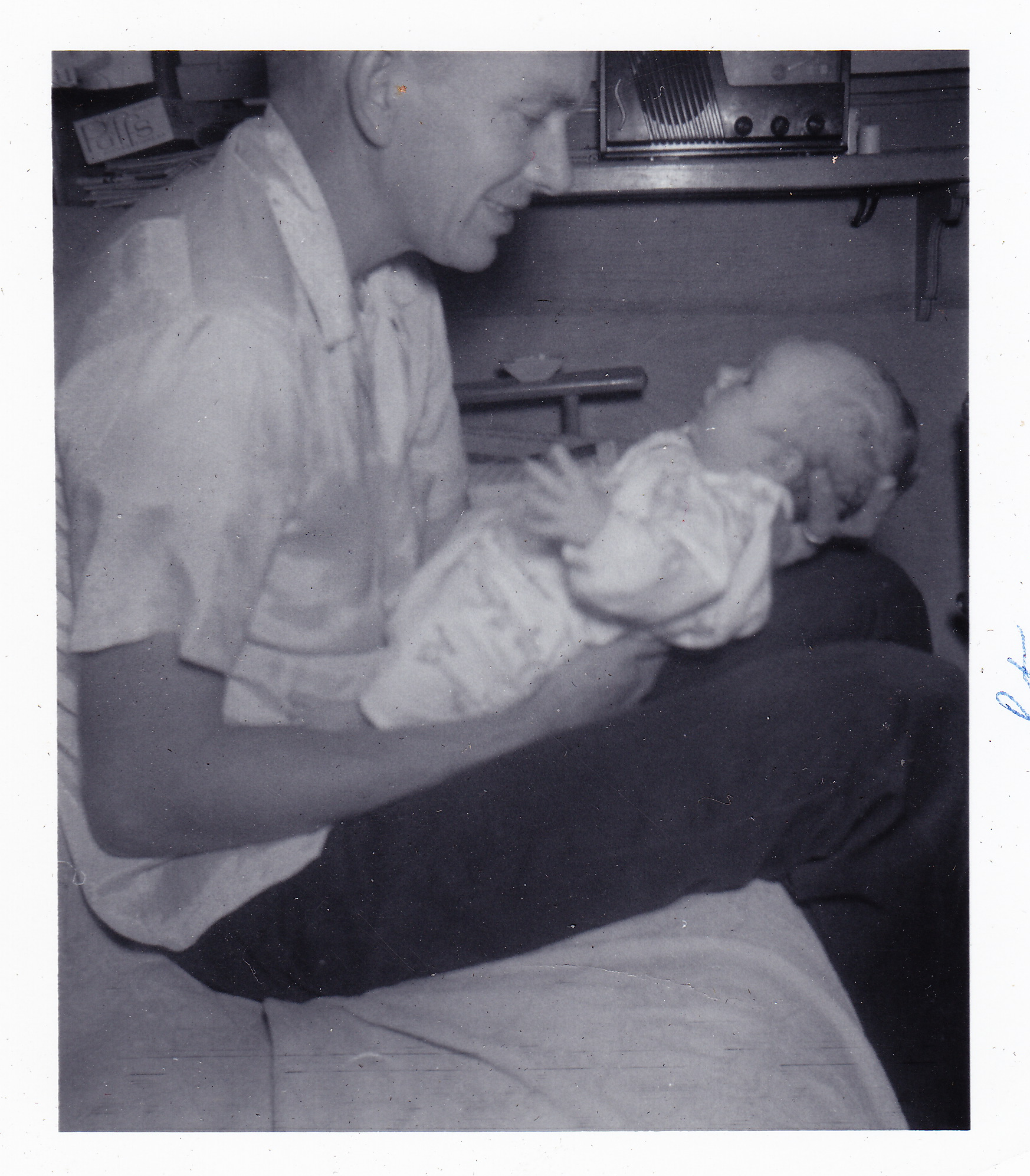
 I’m not completely stupid. I know that the Father’s Day ads with which I’ve been peppered all month are nothing personal. They’re intended to tug at the sentimental heartstrings and get me to spend some money on dear old Dad. As one of the generation for whom computers were a new household commodity well after college was over, I know that I’m part of a fairly large demographic of middle-age users. I do wonder, when I see these ads, how many other readers ponder the fact that their fathers have died and that Father’s Day is an occasion as much of mourning as it is of celebrating. While I know, dear reader, that you’re not my therapist, my father died many years ago after a lifetime of separation from my brothers and me. I can’t claim to have known him, except in unguarded moments looking into the mirror at the blue eyes he contributed to my genetic code, along with other aspects I can only imagine.
Father’s Day can, of course, be a day to honor the memory of, as well as buy things for, dad. Holidays, however, aren’t really holidays without the changing of hands of lucre. Although I never tried to think much about it, I never spent a Father’s Day with my father. I know I’m not alone in this, but many are the days when I believe I would have benefited from a bit more instruction than I received on that front. “Majoring in religion is not the best career choice,” might have been one of those nuggets I could’ve done with hearing. The women in my family seemed to think it was okay. Even one of my dad’s ancestors was a clergyman. I like to think that fathers might be able, in some cases, to see farther than their sons. Call it male bonding. Call it being a man in a post-patriarchal world. Call it confusion.
I’m all for honoring parents. I also tend to think people are basically good and that by far the majority of people try to do what they think is right. They may not have much with which to work, but they try. I can also think of better ways of honoring them than spending money. Maybe we could try restructuring society so that those who start out with little might have resources available to move ahead. If some father’s child has obvious gifts, might we not offer a way for that child to use them and thrive? As a father myself, I can think of nothing that would make me happier than to see my child have better prospects than I’ve had. Instead I see a society of one-percenters encouraging us to spend a bit more since, after all, fathers measure their worth in stuff. The stuff that really matters, at least for this father, include those no longer here as well as those who are yet to inherit.
Shepherds and Sheep

Photo credit: Spencer Means, Wikimedia Commons
The murders in Charleston this week are part of an epidemic. The members of Emanuel African Methodist Episcopal Church join, unfortunately, a growing list of victims of hate. Not only hate, but that subspecies of hatred that calls the unstable to attack in a church, or synagogue, or mosque, as if to defy the very gods with their misanthropy. Growing up we used to be taught that any place of worship is sacred. Then we believed it was because God had made it so, but now it is clear that sacred space is made so by the intent of those who worship. We find places where we believe we’re safe from the trials of the everyday world. A place where God will look over us. A place, dare we call it, of sanctuary. Sanctuary is a concept that has gone extinct. As children we all knew of the concept of “home” in chasing games—the place where you were free and need not worry about someone coming after you. Amnesty was granted at the cry of “olly olly oxen free.”
In the biblical world, we’re told, those in danger could flee to the temple and grasp the horns of the altar and be safe. It wasn’t that someone couldn’t be pulled off, but it was that an inherent respect attended sacred places. No place is sacred any more. Hatred has a way of overriding what we all recognize as civilization. Well-armed youth and a culture of hatred have never led to peace. Xenophobia may be natural, but it can be disarmed through education. Unfortunately, in this country at least, education is not valued. In fact, in the culture wars, those who have the most sympathy for those who commit hate crimes will be among the first to cut education spending. It’s a luxury we can’t live without. We need to teach the meaning of sanctuary again. We need to teach the meaning of love.
Human beings shouldn’t have to rely on sanctuary to be safe. No matter what our racial heritage or gender or orientation, we are all simply people trying to make our way in the world. As a child I knew “olly olly oxen free” meant that nobody would try to tag me if I came out from hiding. I was also taught that the word “hate” was as bad as any swear and that it should not be said. While my mother was teaching me the virtue of love, we were sending young men to kill foreigners in Vietnam. I grew up with no doubts as to which was the superior way. One way leads to life and peace, the other to constant fear and death. The people of Emanuel African Methodist Episcopal Church have told Dylann Roof that they have forgiven him. They are offering sanctuary to one who has done nothing to earn or claim it. They, like children, lead us.
Pope of Deliverance
As I was out jogging just now, a large gasoline truck pulled across the road, stalling my attempt at healthy living. As I waited for the driver to move, I thought of Laudato Si’. In Laudato Si’, Pope Francis’s encyclical letter, the future seems, for the first time in a long time, an optimistic place. I’m not Roman Catholic, but knowing that the head of the largest Christian body in the world has made an ecclesiastical pronouncement about our responsibilities as citizens of the planet is nevertheless authoritative. A world run by blind greed cannot see the signs in plain sight. We have taken what does not belong to us and have left a wasteland behind. I look back over a lifetime of advocating, in the small way my small voice can reach, for responsible tenancy on the Earth, and feel comforted by such a powerful ally. Perhaps it’s because I’ve never been a property “owner,” buying into the myth that the planet may be purchased, but it has never made sense to me that one species has the right to claim it all for itself, leaving it in a state our mothers would’ve never allowed our bedrooms to have been left, and supposing it is somebody else’s problem. If not ours, whose? We’re the ones paying the rent.
Those responsible for industrial level pollution baulk at the idea of economic fairness. Capitalism rewards the greedy and the only thing to trickle down is tears. Those with money can always count on lackeys to follow, thus when the man in white says this is important, those in red, and purple, and black have no choice but to follow. There’s no escaping the planet. We shouldn’t have to feel we need to escape. We need to take—dare I say it—corporate action. Those of us on an individual level sometimes think we can’t make a difference. Habits can be powerful things. A visit to a landfill can be a mystical experience. The visions you have there won’t be beatific, however. You might begin to understand the Inferno, in any case. We consume, and pollute, as if it is our right to do so. As if our brains have misfired into suicidal sociopaths.
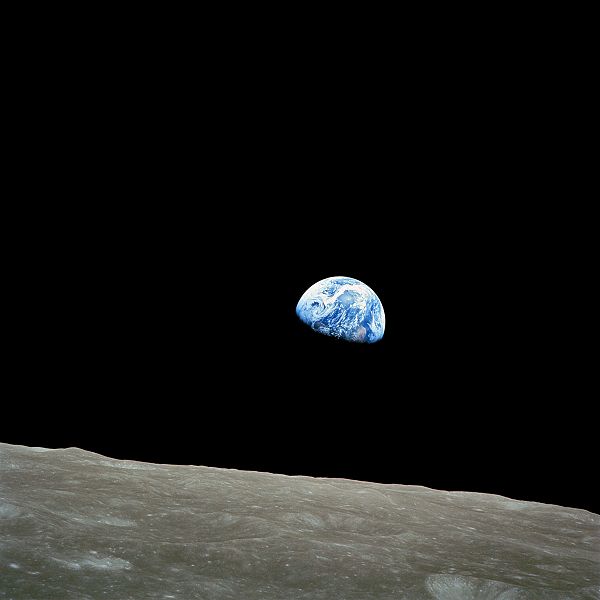
Son, behold thy mother.
Where, I have often wondered, is the voice of the church in all this? By far the vast majority of the world’s inhabitants are religious. Religious leaders, embroiled in politics that lead to solvency and power, have frequently neglected to turn out the lights when they’ve left the board room. While it may seem to be an abuse that the Catholic Church is extremely wealthy and highly influential, it may be that the humble leader of such an organization is the only person truly capable of getting attention. The Pope’s voice carries farther than that of any other single individual in the Christian tradition. And the media are already buzzing about the long anticipated Laudato Si’. The Pope begins on a positive note, and if those who make any claim to be faithful pay attention to the truly important message—far more important than fighting condoms or ensuring that half the human race is kept out of the club house—there may be a slight glimmer of hope yet. Maybe religion really can deal with ultimate concerns after all.
Doubt No Alleles
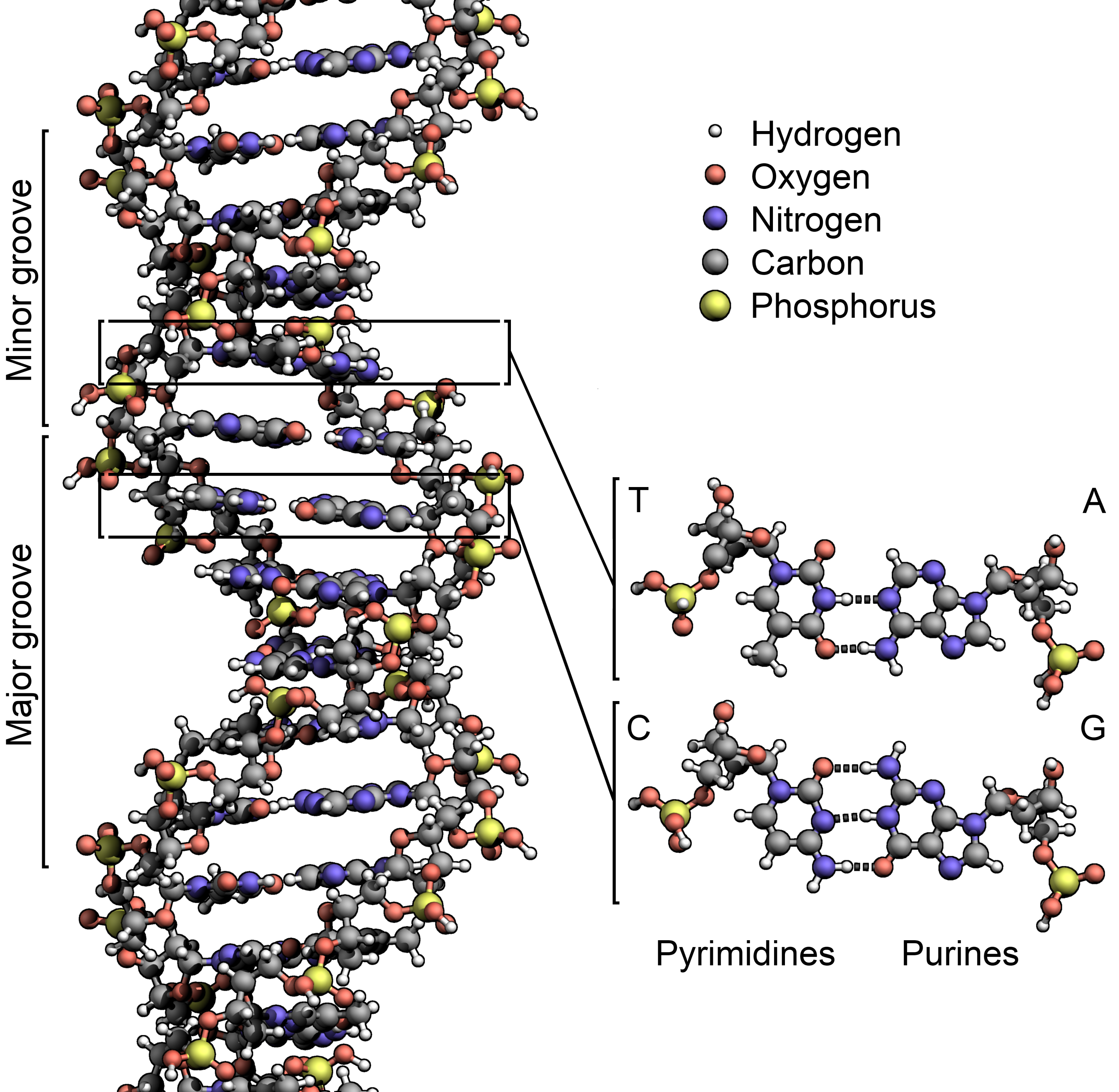
Image credit: Zephyris, Wikimedia Commons
DNA. Is there anything it can’t do? For many decades anthropologists have built painstaking methods to trace developments in human culture. Those of us who’ve studied linguistics in any fashion remember well the many times instructors corrected our false cognates and pointed out family trees of languages that showed who came from whom, based on subtle shifts of orthography or some other aspect of philology. Entire careers could be made in ancient Near Eastern studies by shuffling around the way words were formed and speculating about how they influenced one another. Then DNA. A recent story in the New York Times demonstrates that DNA studies now tell us whence came the Europeans. Among the three groups that eventually settled in Europe were agriculturalists from the Near East, coming along at just about the same time as the Sumerians show up in southern Iraq. They joined the hunter-gatherers already in situ. Their languages, however, did not dominate as a third group, from western Russia showed up and gave (according to DNA) many of the groups their base languages. And here I thought Latin and Greek and Anglo-Saxon had something to do with it.
No doubt we’ve benefitted much from learning about DNA. We can fight diseases that were mysterious, if not divine, in previous centuries. We can learn how closely we’re related to other animal species, or even the neighbor next door. Sneaky fathers can be determined with a precision that sometimes puzzles, such as the recent story of twins who had different biological fathers. Without DNA such a thing could only have been a myth. I wonder, however, what we’re losing in terms of humanity. I suppose we’ll still need a few archaeologists to dig up the remains for scientists to date. And many traditional cultures will still insist that the human remains uncovered be reinterred and not probed and prodded, even after death. We’ll call them backward and superstitious. We’ll consult the genome and decide who to marry.
Meanwhile some hopeless romantic will insist on sitting off in a corner and composing sonnets to the woman he irrationally loves. Looking at the nighttime sky, he may compare her to the beauty of the moon. We know it is a lifeless rock trapped in our own gravity, mechanically reflecting the light of a burning ball of hydrogen and helium 93 million miles away. And if she’ll run this cotton swab across the inside of her cheek we might well be able to tell if she’s a good choice for mating purposes. We’ll also be able to determine the origins of her ancestors and remove a great deal of the mystery about her—there! Won’t that be better than having to woo her and find all that out for yourself? And when your children grow up you’ll point them to the STEM disciplines, since that is the only direction in which there is any human future. And the anthropologists can join scholars of religion as we wait for someone to put the soup in our bowls.
American Bible
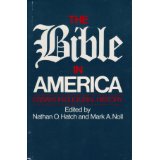 Any book that sets itself the task of addressing American culture has, it seems, a built-in obsolescence. Culture shifts are radical and swift, and it would seem that distance is necessary for any serious analysis. I am reminded of historian Barbara Tuchman’s opinion that history cannot be written without the passage of at least a half-century. We’re simply too close to the subject matter otherwise. The Bible in America, edited by Nathan G. Hatch and Mark A. Noll, does not claim to be an analysis of the current situation, but it stands as a representative of how much has changed since the 1980’s. The era in which the book was written is stamped all over it like the Preppy look or Doc Martens. American culture was very different then. Some of the contributors noted that the Bible, as we’ve often been told, is on its way out. Elections of the new millennium would give the lie to that observation, and we might now argue the same, but I wonder if our view is long enough.
The source of my wonder is a basic observation. The Bible was foundational for the idea of the United States. Those who have joined the “melting pot” (willingly or unwillingly) have been brought into a soup whose stock is Bible flavored. I’m not naive enough to think that it is undiluted or even anywhere near its original form, but as a former biblical scholar I’m sensitive to the motifs and themes of the Bible and I see them daily in undiminished numbers. Transmutation is not the same as exodus. I make no judgment whether this is a good or bad thing. It simply is. Those who think it is an exaggeration to put such prominence on the Bible in American culture should read the first couple of essays in this book. It may have been that without the Bible the will to cross the dangerous water to an uncertain (and to many, catastrophic) future would not have been so pressing.
Like most collections of essays, this little volume has a grab bag of wisdom. Reading it is like taking a stroll through the ’80’s again. We seemed to know things with a certainty then that has all but vanished these three decades hence. The Fundamentalist movement provided a Tea Party appropriate to Mad Hatters and White Rabbits alike. Presidents declared that we were on Crusades again. Megachurches have the budgets of small developing nations. I’m not about to make any predictions for the future of the Bible here. An observation, simple, but fairly obvious, will have to suffice. Since colonial times, Americans have always had their Bible. It hasn’t always been the same book, and it hasn’t always been interpreted in the same way, but it hasn’t ever gone away. I can’t say about the future, but right now I’m about ready to put on my Ray-Bans listen to some Madonna.
Vox Humana
You know how it is when you get a song stuck in your head? This is one of the few scenarios that will actually lead me to buy music. I have very specific (some would say “odd”) tastes in music. I love the originals. Long ago I ceased listening to “Christian Rock.” It was a thing when I was attending a Christian college, of course. Many who feared the terrors of the drugs and sex part felt they could be slightly rebellious with the rock-n-roll side of things by listening to various groups that pounded out evangelistic messages with electric guitars and overheated amps. There were, however, amid those groups pretending they were a saved Metallica, some real artists. Somehow some of the songs of Daniel Amos came to my mind. I had all four albums of the ¡Alarma! Chronicles—still do up in the attic somewhere—but we left most of our sound system in Wisconsin. I hadn’t bothered to buy a new needle for my turntable, and I’m not sure I still have the patch cables to connect it if I did. It’s been at least a decade since I heard Vox Humana. The internet made it too easy.
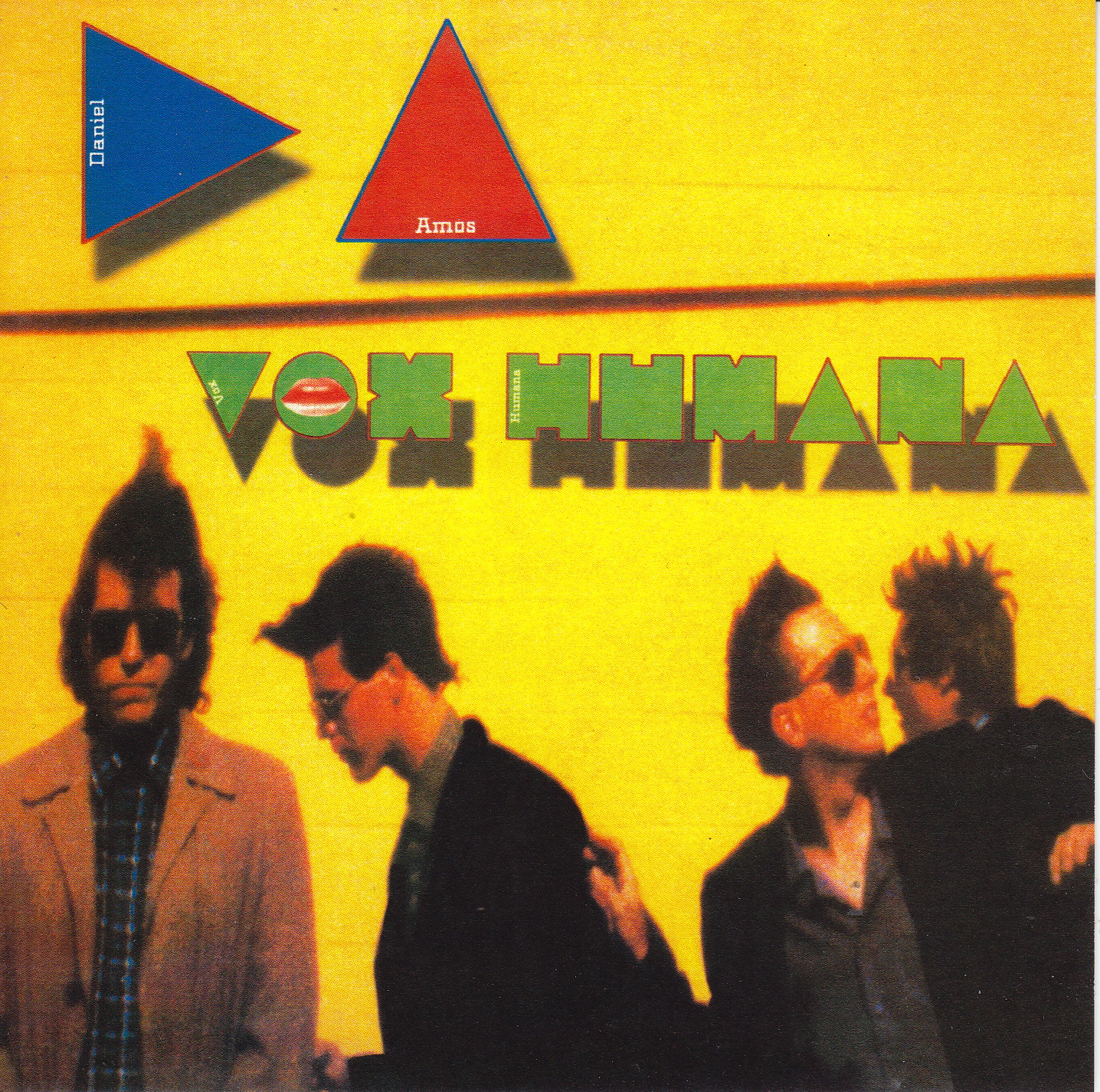
To understand my quest, you have to imagine the context. It was 1984. I was a rising senior in college and I hadn’t seen much of the world. Having grown up in humble circumstances, I didn’t have money for travel or many material things. When my roommate took me to visit his house and he introduced me to a friend who had a room dedicated to sound equipment and albums, I felt as though I was on another planet. Daniel Amos’s Vox Humana had just been released. Our host slipped it from its yellow cover and played it with all the blinking green and red equalizer lights flashing and I was completely blown away. It was Christian music unlike I’d ever heard. In fact, it was ahead of much of the pop music of the time. As soon as I got back to campus I ordered it from the Christian bookstore. The songs still come back to me when I least expect them to.
Call it a guilty pleasure. My theological outlook is lightyears away from what it was when I was an undergraduate. I still haven’t seen much of the world, but what I have seen of it has changed me in ways that there’s no means of reversing. Although I really can’t afford to be buying music—we’re only paying for electrons any more—I just couldn’t help myself this one time. It’s no longer the ‘80s, and the 1950s sci fi movies DA references in the lyrics are closer in time to the album’s initial release than that release is to me now, but still large swaths of the lyrics are imprinted in my mind, taking me back over the decades. It’s the music of my youth. And it was edgy then. It sounds more conventional, perhaps even old fashioned now. Still, when you get a song stuck in your head, pagan or Christian, there’s really only one thing you can do about it.
Human Race
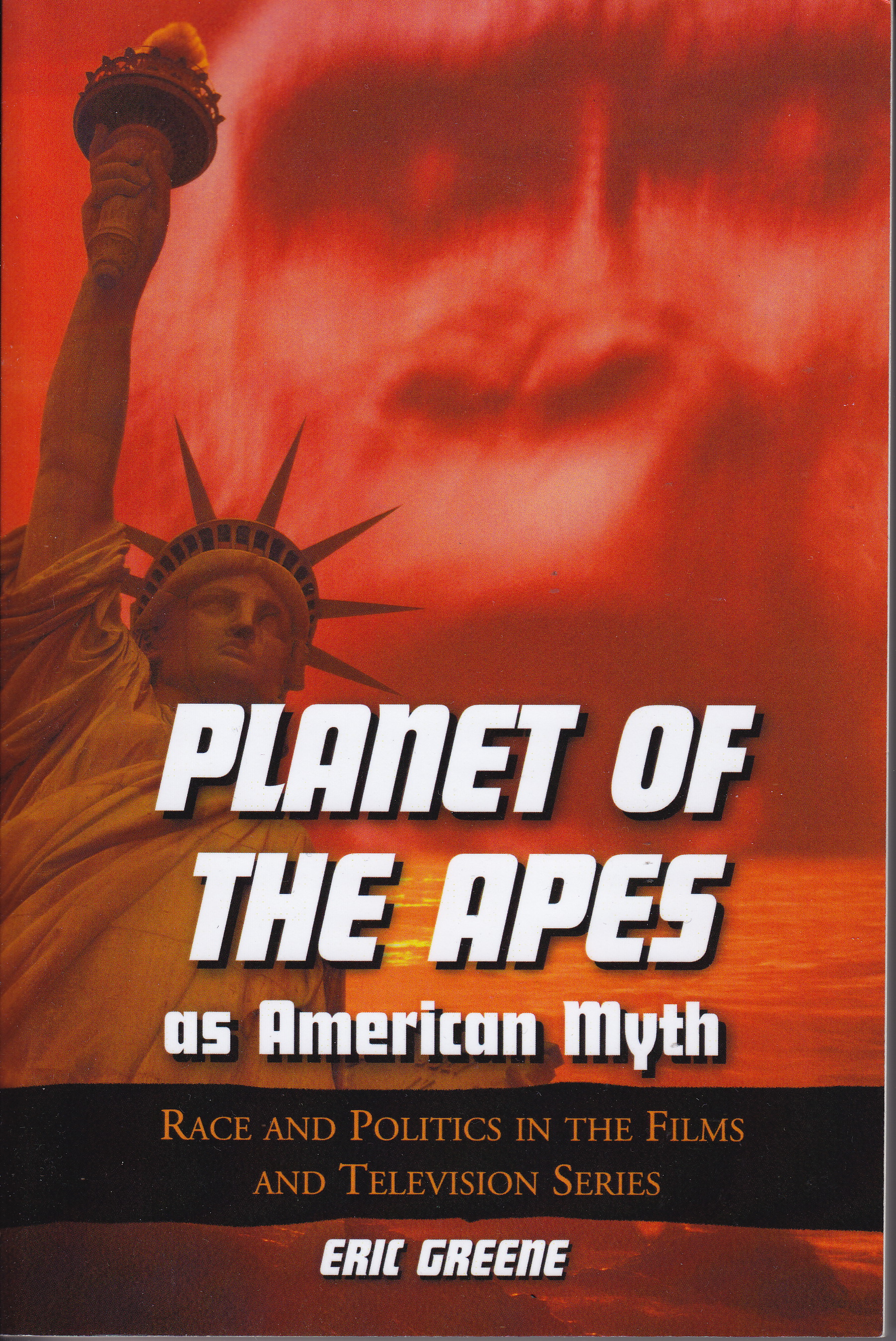 For reasons no one fully understands, Planet of the Apes touched a deep level of responsiveness in American society. I have to admit to having fallen behind a bit; I need to see Dawn of the Planet of the Apes to be back up to speed, but nevertheless, I remember the television releases and airings of the originals, and even have gone through the entire series in the form of home theater offerings. One Saturday long ago on a visit home, I sat through a marathon of the entire five-movies sequence all in a day. It should be no surprise, then, that as soon as I saw Eric Greene’s Planet of the Apes as American Myth it went on my reading list. Race and Politics in the Films and Television Series, the subtitle read. I admit that I grew up in a conservative, but sheltered environment. Having friends who were African-American, although, admittedly, they were a small fraction of the demographic in my small town, I never realized that there was a problem. Not until I took history and social science classes in school. You have to learn things such as racial distrust.
Struck by Planet of the Apes when I first saw it, I had no idea that it was a racial tale. It makes sense now, in the light of Greene’s analysis. To a child fearing evolution as much as Hell itself, the movie was a kind of forbidden fruit, and by making it science fiction, there was no reason to suppose there was a message here. It was a powerful kind of captivity. I have watched the movie, and current adaptations, many times over. Greene does an excellent job of demonstrating that the movies came at a time of great racial distress. Civil rights, the Vietnam War, the fear of the Communist—xenophobia was perhaps at an all-time high when the apes invaded our planet. As the series goes on, the identifications become clearer and clearer.
But more than that, Greene pointed out some very obvious—in retrospect—religious symbolism in the movies. Some of it was so intentional that it was written into the script. Among the scenes from the life of Jesus, the movies borrow most heavily from Exodus. Moses figures abound. Even Charlton Heston, in his role as Taylor, was following up on the Ten Commandments. Holy families and sacrificial victims mark just about every stage of this dystopia, a world where trust is always far from any relationship with someone physically different. It’s about time that I watched Dawn of the Planet of the Apes. And after that, I need to go back to the beginning, and watch them all with renewed eyes. In the light of current events, also with the hope of a more just future.
Work Weekend
It’s a Saturday and my wife’s at work. She’s worked five days already and will still be at work tomorrow. I’m lazing in bed until 5 a.m. when I hear the neighbor’s alarm clock from upstairs. An hour later I see him headed to his car, dressed for work. I think about the concept of weekend and how it apparently means nothing any more. Well, I’m not at work, so it must mean something, but it’s not what it used to be. Don’t get me wrong—when I was a professor I gladly worked through weekends. Indeed, I was working pretty much all the time. I was paid to be a thinker, and I can’t shut this thing in my head off. My current job, however, is a 9-to-5 with expectations of more, but not entailing any extra compensation. Overtime? You lucky one, you’re “exempt!” And don’t forget to take your laptop home, in case something comes up in the middle of the night. (I do read the timestamps on my emails.)
The weekend is a religious idea. Ideal, even. We have the biblical concept of the Sabbath to thank for our free Saturdays, when they come. Christian beliefs about resurrection to account for Sundays. Days originally set aside for worship. Time off work is worship now. When else will we get the laundry done? Groceries bought? Floors swept? I leave before six each day and arrive home near seven at night. To keep up my Manhattan lifestyle I have to awake before four and head to bed at eight. If I had an extra minute to access my memories I might think this a little odd. I used to have time to write books. Where did that go? Vacation time? You have to be at the airport two hours early so you can be frisked for a plane that’s inevitably late. You get five days off, and two will be spent traveling. Work waits for no one.

I guess it’s no surprise that those who argue that we should abolish religion have jobs that either they love or that don’t require weekend hours. They have time to examine this gift horse minutely in the mouth. You know, we don’t have to have days off. In olden times, or even today on farms, the concept of a weekend is only academic. Those whose jobs are just work to keep an imprisoned soul in its weary body are, after all, expendable. Perhaps I’m just too weak. The occasional three-day weekend rejuvenates me to a degree that’s almost frightening. I wonder why we can’t add holy Fridays to our list of days to worship. There is a price to be paid for neglecting time to reflect. I can’t imagine Pharaohs and kings wanting to grant any more time off, however. We all know who we’re really working for, and it’s not the one who gave us our weekends in the first place.
Christian Horrorshow
Books & Culture is the review organ of Christianity Today. Christianity Today is the evangelical answer to the more liberal Christian Century. Working in publishing, particularly in the field of religion, it is important to keep an eye on what the popular magazines are saying about our books. Well, neither is as popular as it used to be, but still. I’ll grown used to Books & Culture taking a rather wholesome reaction to books that challenge worldviews. In fact, it’s not unusual to find a fairly mild tome castigated as somewhat insidious. Negative reviews tend to sell books as well as positive reviews. Sometimes better.
I was a bit surprised to see a two-page spread in a recent edition of Books & Culture focusing on horror stories. Horror and evangelical generally don’t play well together. Well, maybe I should temper that a little bit. The first article was actually on Shirley Jackson, best known for her excellently moody The Haunting of Hill House. That particular book has spawned or inspired at least five scary movies, two of them versions of the book itself. I have to confess that this is the only Shirley Jackson novel I’ve read. The article, somewhat strangely for an evangelical magazine, had made me want to explore some of her other offerings. Horror doesn’t have to be splatter to be effective.
The second review in this issue was for an Oxford anthology called Horror Stories. The reviewer, Victor LeValle, also comes out with a positive review of the collection. All of this makes me wonder if I missed something growing up as a conservative Christian who felt distinctively unsavory because his love of monsters and the macabre. I can’t remember ever not liking mild horror stories. They manage to evoke parts of my psyche that most other literature bypasses. I discovered Poe at an early age. That’s not to say that I like being afraid. Fear is not what I’m seeking here. It is a kind of strange redemption. In college many of my evangelical friends couldn’t understand my fascination. “Why don’t you watch something more uplifting?” I’d be asked. I was as surprised as anyone when one of my very few Grove City dates agreed to see Nightmare on Elm Street with me. Not even Shirley Jackson could’ve seen that one coming. I wonder how she’d respond to being written up as an evangelical inspiration?
Becoming an Icon
A kid among the Monster Boomers can’t let the death of Christopher Lee go by without comment. How many hours of my childhood were spent watching movies on Saturday afternoon TV with his many personae arresting my attention? And, of course, his prolific output just kept on coming. The Wicker Man, for instance, would never have been among my childhood fare, but his performance as Lord Summerisle is still captivating and sends shivers down my spine. Of course, he wasn’t always a horror movie star. His voice nevertheless conditioned us to be on our guard, for we knew something untoward was about to happen.

Photo credit: Avda, Wikimedia Commons
I often ponder the lure of monster movies. As a young boy, I couldn’t get enough of them. I tried to grow out of this stage, and managed pretty well through my doctoral work, but then when I found myself in a Gothic seminary where my life would be shredded and discarded, I suddenly found myself sitting up late to watch movies my family would not care to see. There was a catharsis happening here. Some would claim that it is puerile and immature—they would be the same people who’ve not been forced from careers and faced with unemployment and been dealt a failing hand by an institution that received full commitment during the formative years of an aborted career. No, those who’ve faced monsters cannot easily leave them alone.
Of course, Christopher Lee was only playing monsters. Now many people around the world can instantly recognize his name, face, or voice. We all face monsters. Our society teaches us to deny that they exist, much to our own peril. Little children, bewildered by this insanely complex world that adults have constructed, may be the ones to see most clearly. We watch the monsters on the screen so that we might figure out how to deal with them on the playground or in the boardroom. Christopher Lee was more than an actor. He was a teacher. And his best students learned something of human nature from him.
Once and Future Bible
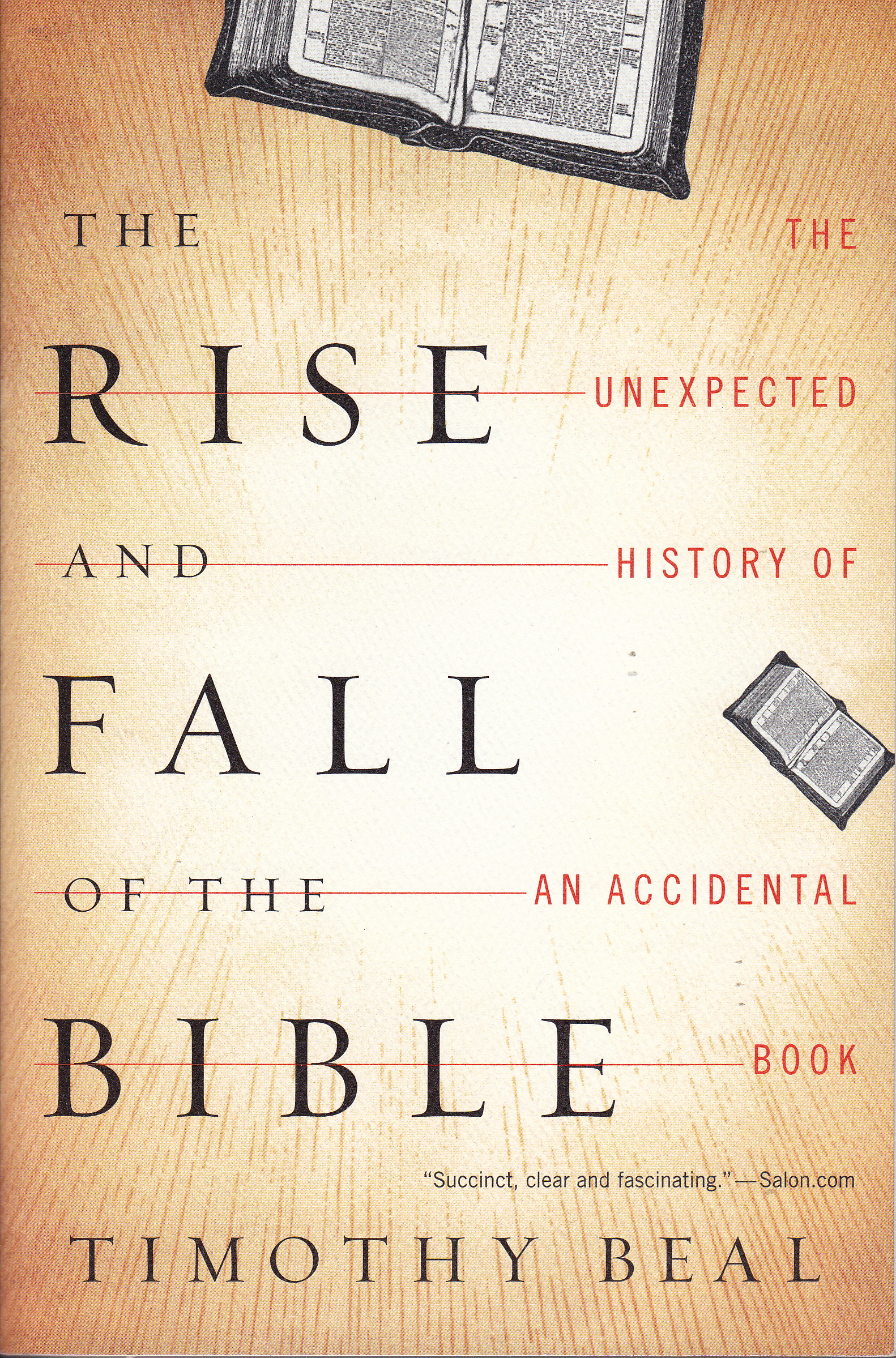 While I may not share Timothy Beal’s view that print culture is on its way out (I harbor hopes every time I see vinyl records making appearances in stores), he is certainly correct most of the time in The Rise and Fall of the Bible. Written for non-specialists, this book nevertheless gives his fellow biblical scholars pause to stop and think. Beginning with an eerily similar childhood experience (although mine was considerably more dysfunctional and appears to be veering back in that direction by career exigencies), Beal recounts how he came to study the Bible with a critical eye and to observe a number of important things. One of the scholars associated with the Iconic Book movement, he shows how our biblically illiterate society still values the symbolic nature of the book in various ways. We still buy, for example, lots of Bibles. We still want elected officials at least willing to swear on one. We still think it has some special kind of power.
Beal gives a brief history of “the Bible” as an idea. It is essential, as he notes, to realize that as a “thing” the concept of Bible is fairly recent. Certainly nobody in Jesus’ day thought of it as we do. What’s more, and more to the iconic element, Bible sellers have been looking for “added value” to boost the sales. Biblezines (of which I’d not heard) and Manga Bibles are only two examples of the many “extras” Bible vendors add to their texts. In essence they are making new Bibles. Beal wonders how much buyers read the actual biblical text as opposed to the other, more eye-catching material in these books. Bibles are made trendy and hip, decorated, dissected, and dolled up. And we feel virtuous for purchasing them. We play right into Big Dan’s hand, if you get my meaning.
A fascinating collection of interesting bits about the way the Bible has been re-presented to the same public for over two centuries, The Unexpected History of an Accidental Book is an appropriate subtitle here. Those who fueled the Bible craze—those that we now routinely call Fundamentalists—are among those most distressed by the indignities perpetrated upon what was once considered a sacred text. What can be more fundamental than making money off people’s beliefs? Still, for Beal and his colleagues who have managed to land the rare positions teaching Bible, there is an urgency about this whole enterprise. “These jobs,” in Bruce Springsteen’s words and my own experience, “are going boys, and they ain’t comin’ back.” Meanwhile our culture will continue to make love to its holy book, even though they may not recognize who they wake up next to in the morning.
Forest of the Subconscious
The mind is not the brain. This isn’t mystical mumbo-jumbo (although there’s nothing wrong with mystical mumbo-jumbo either). We’ve been bombarded with the message that we are meat machines for many years now. Those who have studied physics and plumbed its depths often tell us that if we had all the bits of information involved, we could figure out anything. Our minds are our brains and it is merely electro-chemical signals that form a kind of operating system for this biological computer. The idea that we have a separate mind, we are told, is an illusion. Interestingly, studies of the subconscious mind raise significant questions regarding this interpretation. The subconscious, it is generally acknowledged, was discovered by Sigmund Freud. Prior to Freud many people did things and didn’t know why. Now we know, despite debates about the details, that we have to consider the subconscious mind as well as the more familiar conscious one.
I’ve been on a Through the Wormhole kick lately. Since we don’t have television, I have to watch the episodes after they air, but at least I have the option of doing this when I have some time. I recently watched the subconscious episode. The truly amazing takeaway from this was that our minds often, daily, in fact, operate on a level that we know nothing about. There are ways of tapping into the subconscious mind—meditating, as I mentioned earlier this week, is one way. Others are more scientific. Stimulating areas of the brain with small amounts of electricity can enhance abilities that we never knew we had. In fact, we might even be able to enact a Matrix-like download of information. I think I may have swallowed the blue pill after all.
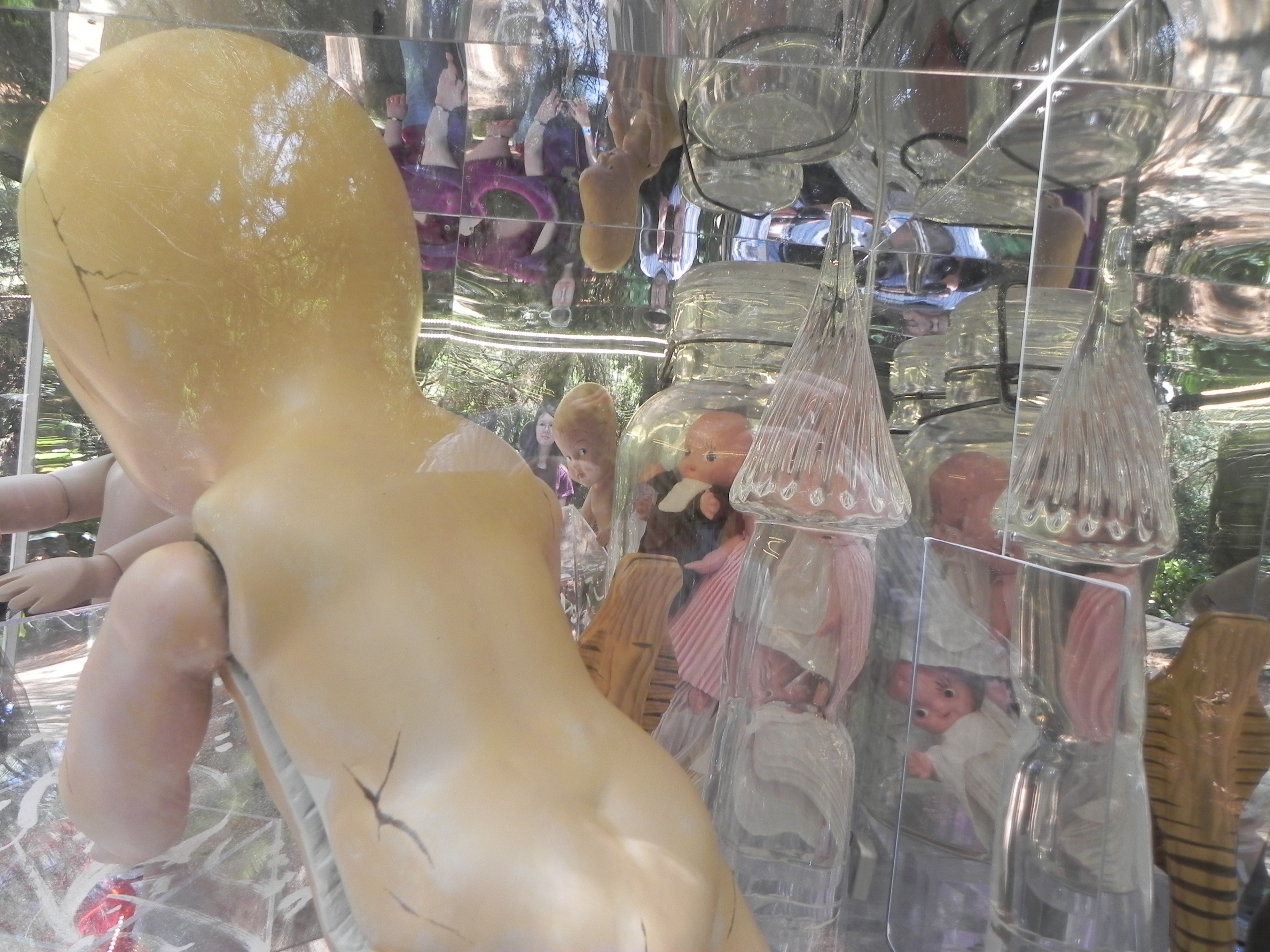
Call it a gut-level reaction, but I have always had a strong resistance to the idea that we are mere automatons. Consciousness, which, increasingly we’re discovering, involves a dose of subconsciousness, doesn’t feel at all like a we’re programmed. Theologically, I always objected to the strange notion of predestination. It made no sense, theologically, or experientially. One very wise professor once told our class, “If you want to test this, tell your spouse that you’ve got her or him completely figured out. They will do something you don’t expect.” Our minds are perhaps the most miraculous parts of human beings. The concept that we are merely following the pre-determined laws of physics makes no sense unless we believe in a literal Hell that we’ve made of this world. Are we programmed to self-destruct? I believe not. Whether in my conscious mind or in the true mind that lies underneath it.
God on the Brain
 Those of us with scientifically oriented minds, but with affinity for the less quantifiable aspects of life, tend toward academic study of the humanities. It is not unusual for someone with a background in the hard sciences to dismiss such “softer” fields as less rigorous at best, or, at worst, a sheer waste of time. Many people in the humanities cower under this cloud of being considered somehow inferior for not being able to put numbers to everything. I suspect that’s why I find neuroscience so fascinating. While still teaching at Nashotah House, I would prompt students to think that whatever decisions they made about ancient texts, those decisions were mediated, in a very real way, by their brains. We don’t understand brains completely, but I’m amazed at what we have discovered so far. Years ago I read the book, Why God Won’t Go Away. It was an eye-opening study of what brain mapping reveals during states of religious inspiration, or at least, intense meditation or prayer. We can, to an extent, see inside someone’s head while they are communing with the other.
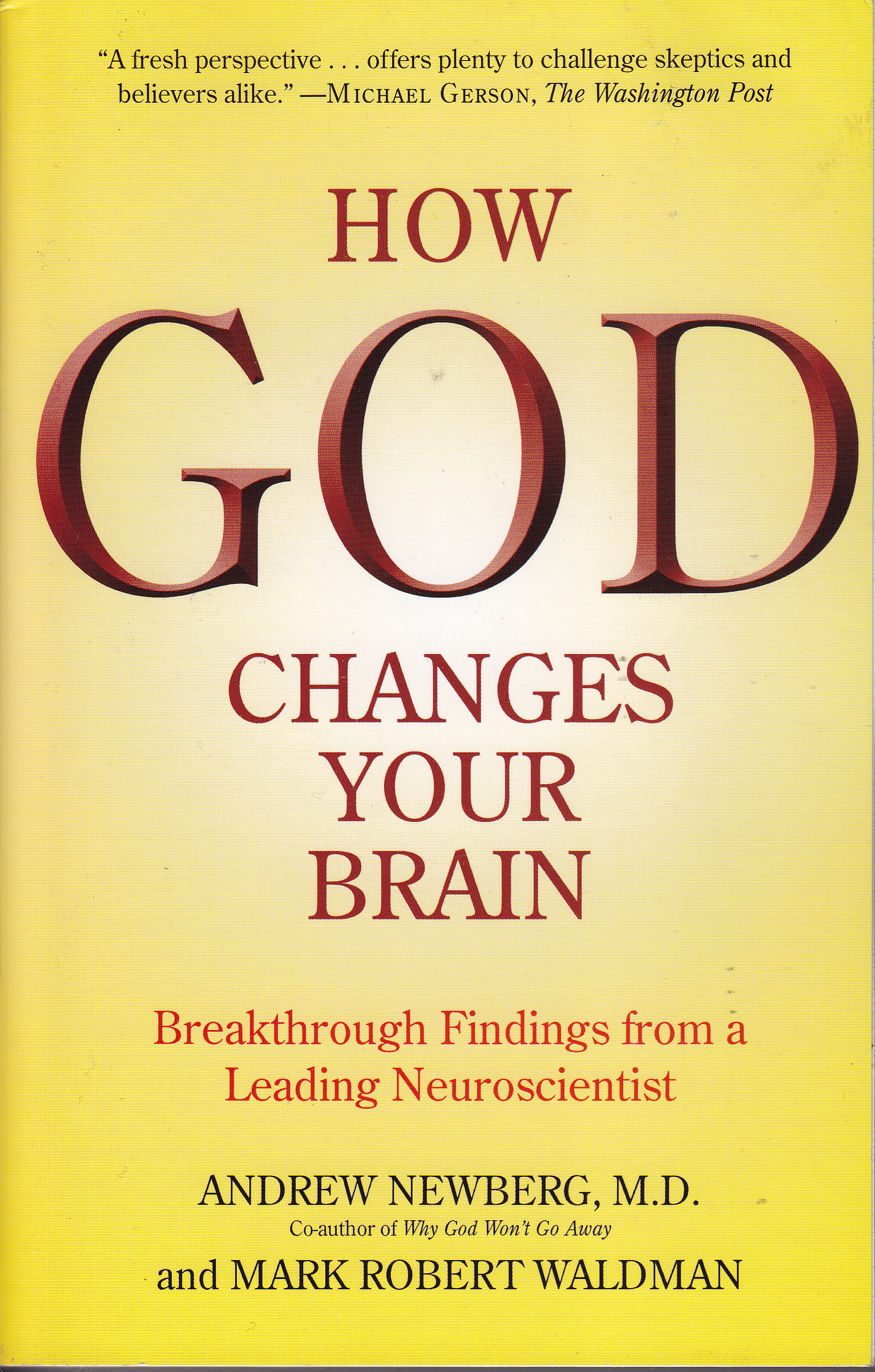
I recently became aware of the new book by Andrew Newberg (lead author on Why God Won’t Go Away) and Mark Robert Waldman, How God Changes Your Brain: Breakthrough Findings from a Leading Neuroscientist. I was a bit nervous at first, since I couldn’t recall how reductionistic Newberg was in his initial book on the subject. Neuroscientists sometimes perceive the world as being, in a sense, as all in our heads. I was pleased to see that Newberg and Waldman recognize that the “God question” is an open one. They address it right up front. I was drawn to the book because of one of their conclusions that had leaked into the footnote of something else I’d been reading: the brain changes as soon as it is introduced to the concept of God. Brain wiring is continually changing, but the takeaway here is that as soon as we introduce our children to the God concept, their brains will not unlearn it. It stays with us for life. Changing concepts about God is therefore quite difficult. Few even try.
This book, however, doesn’t see this as necessarily negative. In fact, the authors challenge the horsemen of atheism in that all studies seem to indicate that religion is actually good for you. Particularly meditation. In a world that is increasingly run on stress (just ask any business-person) this is an important reminder that prayer, or meditation, can actually heal some of the brain damage caused by life in a stressful environment. The nice thing about this is that the empirical evidence seems to be pretty strong. Our brains seem to be telling us to relax, step back, and not take all of this so seriously. Those are layman’s terms, of course, filtered through my brain. Even reading this book made me feel much more relaxed. It reminded me why, for much of my life, monastic living has seemed so very appealing. Instead, I live in the secular world with its many rewards and stresses. If I learned anything from this wonderful little book, I will be spending a bit more quiet time each day, and won’t be feeling guilty about it at all.
Molly Picture
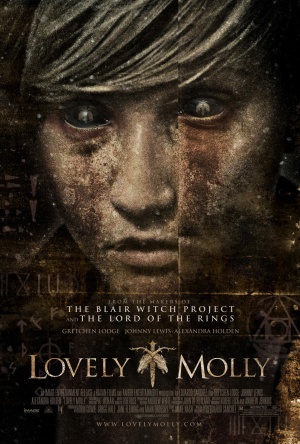 Maybe I’m getting out of practice with my horror movies—I don’t have time to watch them like I used to—but Lovely Molly left me a little confused. I suppose I’m more susceptible to big advertising than I’d like to admit, but I knew about Lovely Molly from the massive Times Square ads back when I was still with Routledge. I’m ambivalent about demonic possession movies, but I put it in my mental bucket list until I had a weekend evening alone to fire it up on Amazon Prime. As I’ve noted, it left me more confused than scared. Yes, watching it kept me tense, not knowing what was going to happen next (I knew nothing of the story beyond that it was a possession story) but as gruesome as a couple scenes were, the question of what’s going on never really got resolved. It’s pretty clear that Molly was abused as a child, turned to drugs to cope, and is having a breakdown after moving into her creepy childhood home. If her newlywed husband didn’t hear some of the sounds, it would seem to be a conventional breakdown story. Eduardo Sánchez doesn’t show us the monster until the very end, and even then, not clearly. I had to turn to online discussion groups to understand what I’d just watched.
While in this post-modern age no one is qualified to say what anything really means, if fans are to be believed, the DVD extra implicate the demon Orobas. I’m no expert on demons, and I couldn’t recall having heard the name before. In the “found footage” scenes where Molly eerily hums to herself while visiting the sites of childhood memory in the house, she does uncover what seems to be the symbol of Orobas. This is a horse-headed, horse-footed demon with the body of a man. Indeed, when she is being stalked by what she believes to be the ghost of her father, Molly hears horse hooves on the floor. In the final scene, she leaves a photo album for her sister to find with her father’s head covered with pictures of horse heads that she’d cut from his wall of framed pictures, apparently of prized beasts.
The real horror here, however, is in what seems to be a misogynistic implication, no matter how justified, that Molly (and her sister) are the murderers. Molly reveals that her sister killed their father, and Molly herself dispatches, it seems, the preacher, her husband, and the girl of the neighbor next door. She, however, is the one who had been victimized. If this is a case of possession, at least by implication, then the male demon is to blame, but it looks like Molly pays the price. The evidence is circumstantial and Molly disappears at the end, leaving open the room for a sequel. While I felt no need to sleep with the lights on after watching it, the movie has enough provocative material to make me think about it, trying to figure out what was supposed to have transpired. I suppose that many horror movies are more straightforward, but the more easily forgotten for being so.
UCB
The Flying Spaghetti Monster came onto my radar while teaching at the University of Wisconsin, Oshkosh. I was teaching a course entitled The Bible and Current Events and the controversy over teaching Intelligent Design had been gaining steam. As I addressed the evolution section of the course, I became aware of the Flying Spaghetti Monster and his noodly appendages. The Jesus fish had recently evolved to a Darwin fish, and the Darwin fish was being eaten by a Jesus shark, then I finally saw the Flying Spaghetti Monster on somebody’s bumper. I looked it up online and discovered a whole mythology had been developed to go with this parody of a religion. It was lighthearted and funny and had an obvious purpose—to challenge the equally bogus claims that creationism is science. Now, I don’t try to change anyone’s religion. If someone finds creationism comforting, well, the United States is based on freedom of religion and who am I to dictate what someone else believes? The problem is creationists often don’t share that courtesy and try to get their religion taught in public schools as science, which it isn’t. The Flying Spaghetti Monster was their nemesis.
Over the weekend, when I actually have time to do a little surfing, I came across the United Church of Bacon. Noticing the similar food-based theme as the Flying Spaghetti Monster, I decided to check it out. It seems to have become a cottage (cheese?) industry to start your own anti-religion. A look at the United Church of Bacon’s website reveals it to be the brainchild of Penn Jillette of Penn and Teller, and friends. As usual, the voice of Teller is not heard. This is a legal church which performs many of the services of traditional religions, but without the belief. Bacon, it seems, is the ultimate reality here—to quote the church on a billboard: “Because bacon is real.” They have nine bacon commandments and an impressive list of charitable works.
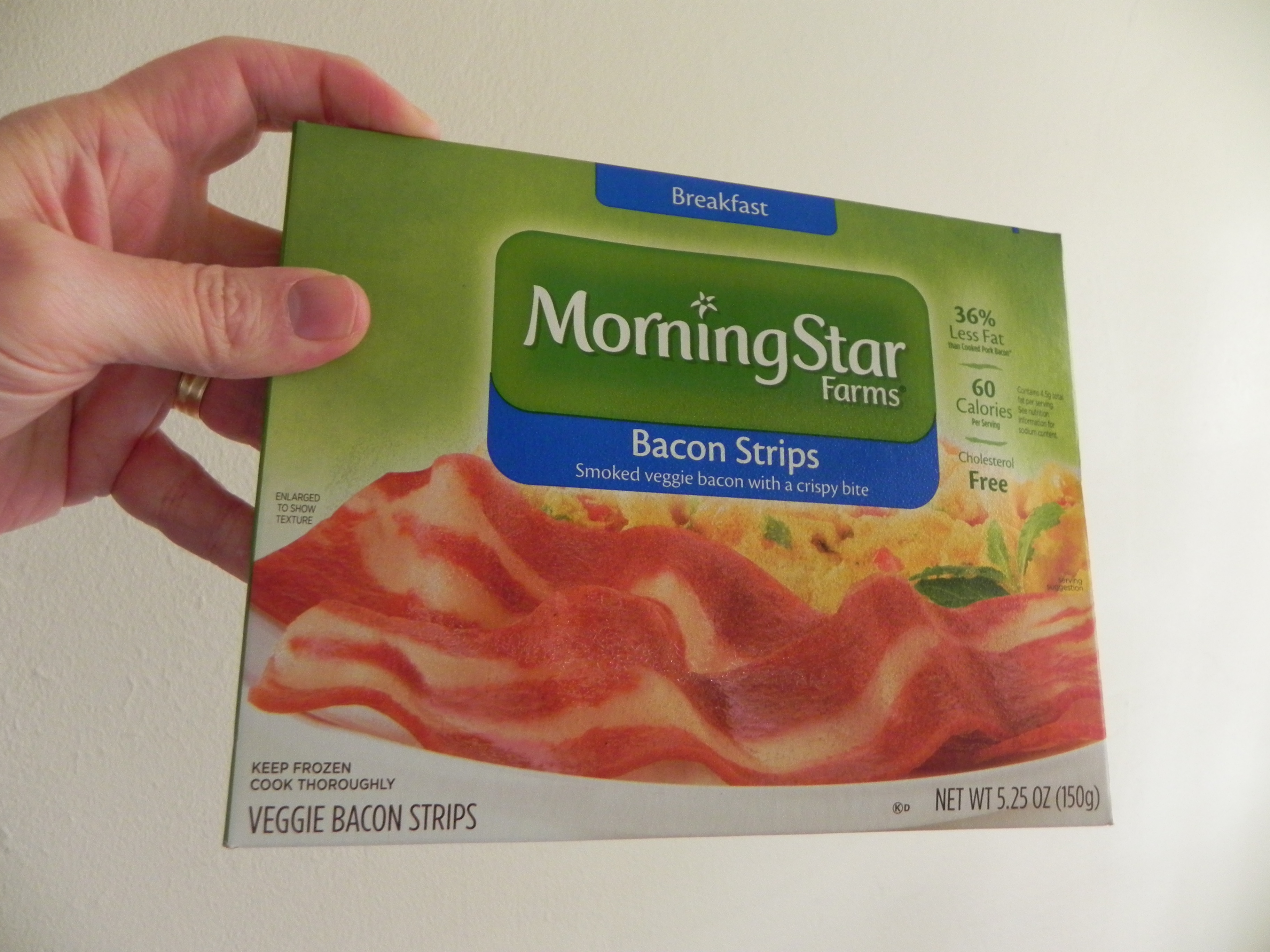
Looking over all of this material, I wonder what the mainstream churches might take away from all of it. For one thing, the obsession that Christian denominations have had for centuries with correct belief has become a kind of albatross. Petty differences in theology tend to lead to hatred in the name of the prince of peace. Another is the repeated emphasis on giving has taken its toll. The United Church of Bacon openly advertises that they give money, they don’t take it. While few clergy become fantastically wealthy, it is no surprise that most bishops or those of equal rank never seem to go hungry or drive cheap cars. If entertainers are rich, it is because they offer something worth paying for. And for those of us who are vegetarians, the UCB offers the alternative of praising vegetarian bacon. You are, after all, what you believe.
Heretic?

