Down the Garden Trail

According to NBC, a new “Christian” alternative to Boy Scouts USA is being launched in (over)reaction to the vote to allow gay teens to “join” the organization. Calling themselves “Trail Life USA,” this redeemed-only organization is supposed to be “safer” than other scouting options. This issue, of course, is all about perception. There have been gay Boy Scouts from the beginning and there will be gay Trail Life members. People are people, and just by saying that a sexual orientation is excluded does not mean that it will be, or ever can be (nor should be). “This is not another church program,” John Stemberger, one of the founders, is quoted as saying. “This is going to be a masculine outdoor program to raise young men.” The subtext is sluggish with irony. I am reminded of the scene in Disney’s Mulan where Yao, Ling, and Chien-Po are about to climb the pillars to the emperor’s palace in drag and the song “Be a man,” starts its reprise. Masculine outdoor program indeed.
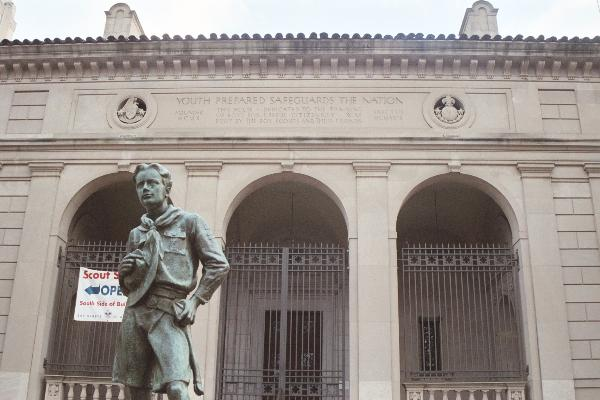
Photo by Bruce Anderson, Wikipedia Commons

Photo by Bruce Anderson, Wikipedia Commons

The idea of separating youth from the realities of the world to keep them safe is like taking them into the woods without telling them there may be bears. Those of us who’ve spent nights in the woods know that hating bears is a ridiculous posture to take. Bears, even when gnawing on your arm, don’t hate you. They simply exist. It is the balance of nature. Studies of nature have time and again revealed that homosexuality is far from unnatural. Several species practice various homosexual behaviors and I am certain that the more we observe nature the more we will find ourselves mirrored in it. Nature can be quite encompassing in that way.

Christianity also has a long history of being at a kind of equilibrium with homosexuality. The all-male priesthood of the Middle Ages could hardly be classified as all self-denying heterosexuals. Even some televangelists of the most Protestant stripe have confessed to gay encounters and episodes. New uniforms and solemn promises will not change the way a person is born. Of course, if the child is Jewish or Hindu or Muslim, he will need to abide by a statement of Christian belief. What of Mormons or Seventh Day Adventists? Thankfully lines drawn in the sand are easily washed away. Exclusion may have been the trope of the Christian past, but as Boy Scouts boldly go where every man should’ve gone before, Trail Life, it seems, may have been appropriately named. It’s life John, but not as we know it.

Instant Education

Among the “non-essentials” upon which I spend my earnings, books hold the top spot, if not in value, certainly in quantity. Reading is more than a pass-time—it is perhaps the most basic aspect of who I am. I love books. While reading a New Jersey Star-Ledger piece by Allan Hoffman entitled “Learning by the book,” however, an uncomfortable truth dawned on me. Hoffman gently laments that the search for information has gone almost wholly electronic. As a person who currently works in the book industry, I know he’s right. More than that, I know it from my own life. I can’t remember the last time I opened a phone book, other than to retrieve a pressed leaf I’d inserted between its pages for pressing. If some bit of information about a religion or a biblical passage escapes my distracted brain, a few keystrokes work better than shuffling to the shelf, pulling off the reference books, and thumbing through until I find the datum. No, we are all addicted to speed.

Despite the best effort of Google books, much material necessary for research in many subjects remains sequestered in actual books. The problem is, for contemporary knowledge, book production is slow. In my editorial work, and as an erstwhile author, I know that the five years I spend researching and writing a book, the submission time to a publisher, the eventual decision, and then the year or longer production time, all equate to immediate obsolescence. Any non-fiction book is outdated by the internet even before it is shipped from the warehouse. New truths are born at the speed of light while books take years to make. I agree, Mr. Hoffman, we’ve lost something in our idolatry of the instant knowledge. If you need urgent info (What do I do about a snake bite? Where is the nearest Starbucks?) the internet is your up-to-date databank.

I have long known that the study of religions is often the study of texts (most of which are online now). Believing some ancients knew more about the ultimate realities of life than we do, either by dint of divinity or enlightenment, we search the texts about them or by them in hopes of joining them in a knowledge beyond knowing. Now in the age of the internet, new messiahs arise almost daily, proclaiming their truths across the world-wide web of wisdom. I have a feeling there is a dissertation or two in there. Of course, it will take a few years before you’ll see them in print.

IMG_0966


To the Flag

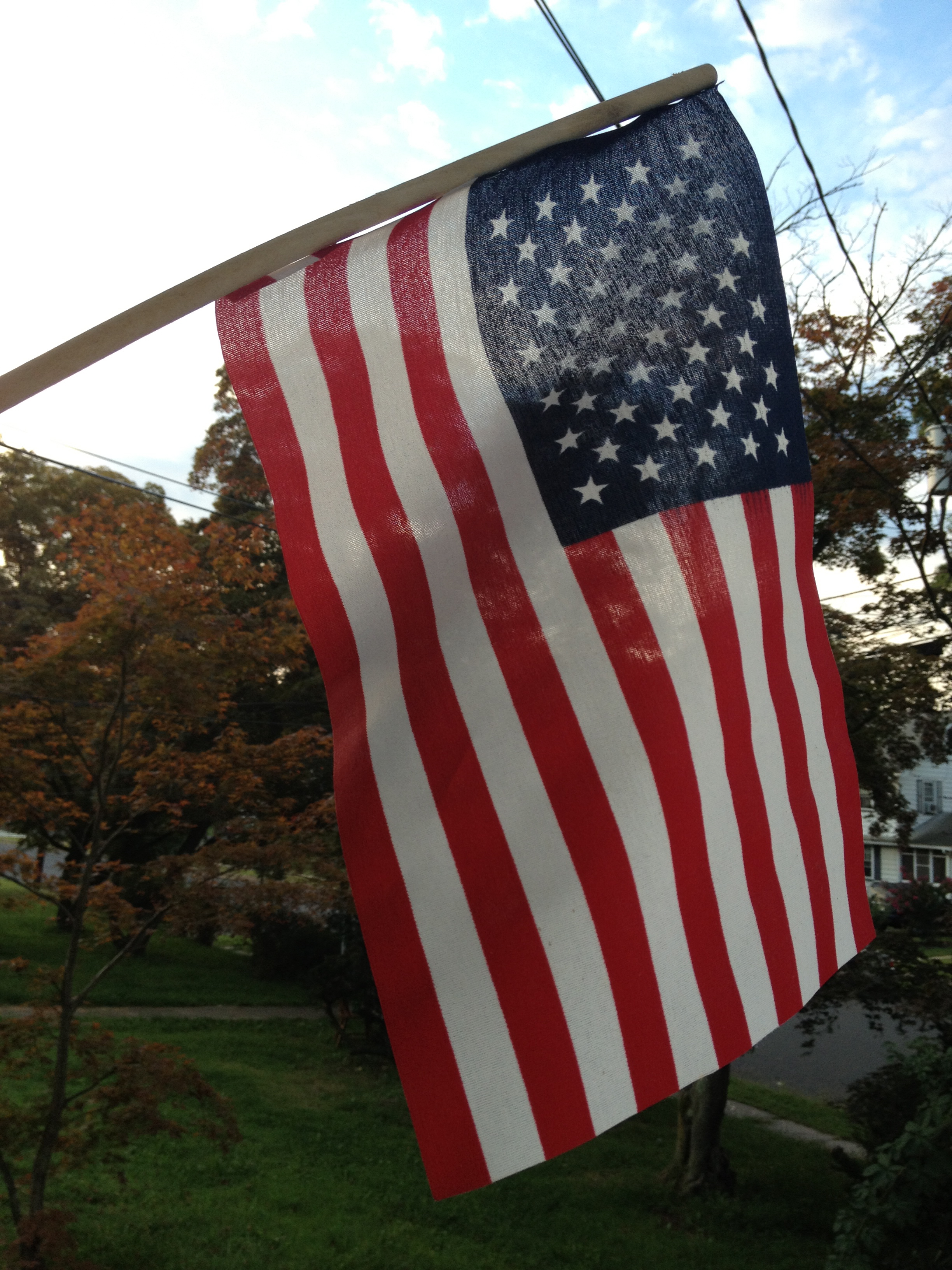
In the great witch hunt that began (or perhaps simply continued) with the Neo-con upsurge in which big business climbed into bed with theological conservatives, the pledge of allegiance became the acid test of true Americans. The Communists were now fading as a threat, and to be patriotic requires a clear and present enemy, so the un-Americans could be found among those who refused to pledge allegiance to a flag. In a recent CNN story, a case is going to court in Massachusetts to remove the words “under God” from the pledge. The dilemma is as simple as it is complex—children who do not believe in God may either recite what they don’t believe, or be ostracized for opting out. (Those of us who make a habit of opting out of things know the feeling well.) The argument goes that children are pledging loyalty to their country, not to a religion. Why should they be forced to say what they don’t believe?

The pledge has an interesting history. The original oath, a celebration of the now much-suspect Columbus Day, was intended as a quick credo of loyalty. No deity of any sort was invoked. Over time, additions started to creep into the pledge (the original version read “I pledge allegiance to my Flag and the Republic for which it stands, one nation indivisible, with liberty and justice for all”). It was not until after the tremendous horrors of World War II, when society was over-reacting to all kinds of threats, real and imaginary, that the words “under God” were added, in 1954. Godless Communists beware! Like the original pledge, this emended pledge celebrated a civil holiday—Flag Day.

IMG_0962

Nationalism could well be considered a form of religion. Customs differ in various parts of the world, and highlighting the differences allows for the conferring of unique advantages among the members. True capitalism cannot work in a culture of complete fair play or equality. Nations must be able to declare ownership and control of resources, including those known to every “human resources” officer in the universe as the most troublesome kind. To be useful to a nation, loyalty must be pledged. And children, who don’t have the experience or psychological development to make an informed choice about the Almighty, must say that they believe in “one nation, under God,” where “one nation indivisible” has itself been divided by God. Don’t get me wrong, I am glad to be an American—I can’t imagine being anything else. But I especially like the part about “liberty and justice for all.”


Proselytization and Cheese

One of the universals of many childhood lives is Kraft Macaroni and Cheese. If I were the financial sort, I would consider investing in it. As my daughter was moving into college, I noticed other worried-looking parents sitting by their unpacked cars, some with corporate-size boxes of Mac and Cheese shrink-wrapped and ready to tide a son or daughter through difficult times. It is a comfort food, a warm and welcoming friend. Some would say heavenly. Eventually, as adults, we learn to view processed foods with some introspection, moving toward the harsher, but healthier fresh varieties. Secretly, most of us would welcome the opportunity to eat like we did as kids when the consequences were unclear and the guilt was still a plucked apple away.

IMG_0960So at a college organizational fair, my daughter sent me a picture of savvy marketing. Christ the King Lutheran Church giving away boxes of childhood. When that warm, gooey, comforting sensation of childhood hits those whom society is suddenly telling they’re adults, they might have their thoughts turn to the Lutherans. Or the many other faith-based organizations eager to recruit among the young and newly independent. This, of course, is nothing new. Religions have long displayed their benefits to convince those with more earthy things on their minds. The evolution of religion is a fascinating study from the days of enforced loyalty despite belief up to the buyer’s market that religion represents today. How do you convince those who legitimately have a choice? What brand of religion is better than the others? Which is the tastiest variety?

The irony of appealing to the body to gain the commitment of the soul is one religions have had to adopt. There was a time when the way to heaven came through self-denial and spiritual discipline. Earning salvation was hard work. Now if we can get you into the pews on Sunday morning, preferably with your wallet, all is good. It is well with your soul, it is well. I feel for the modern, institutional religions. They were once a powerful force in society and by default people believed that they had a special line to God. Up to the 1950’s, even, this perception was especially strong. People learned, as people will, what they could get away with. Turns out, religion is optional. But eating is not. Not if you’re going to survive in this harsh world. And even if you don’t believe in heaven, we will always believe that in the kitchens of paradise they will be serving Kraft Macaroni and Cheese.


The Goddess

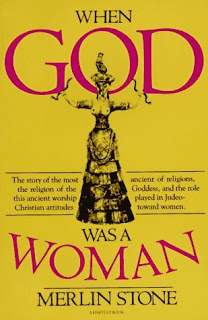
WhenGodWasAWomanMerlin Stone was a sculptor and an artist. I met her only once, a few years back when I was still recognized as an “authority” on ancient goddesses. At one of the many Society of Biblical Literature annual meetings I attended, she came and introduced herself to me, thanking me for my work. Of course I knew who she was—the author of When God Was a Woman, one of the books that was most influential in the revived goddess movement of the 1980s. I have always appreciated those women who have dared to take on the often amorphous patriarchal power structures of society to raise the necessary questions of fairness and justice. Stone was one of those women. Her book, while based on sometimes questionable historiography, nevertheless highlights some of the issues that many male scholars have chosen simply to ignore.

One of the biggest problems faced by authors like Merlin Stone and Marija Gimbutas has been the shifting sands of history. I recently had a deep conversation with a couple of feminist friends of mine where the issue of truth emerged. Truth, as I came to realize, may be a temporary phenomenon. What is true today (the earth is the center of the universe) may not be true tomorrow. It is always contingent. Historians reconstruct a past to which they do not have direct access, and further discoveries will often detail the errors made along the way. When God Was a Woman was originally published in 1978. Some of the historical constructs that Stone uses have since crumbled, but the main point of the book remains firm—women have as real a claim on the divine as do men. (I can’t help but wonder if there is some connection between this and the recent trend towards prominent male thinkers declaring themselves atheists.)

Although I can’t agree with everything Stone wrote, one of her ideas dropped a hook in my brain. In describing the sexuality that apparently attended worship of “the goddess,” she notes how male scholars came to refer, always derisively, to the such religions as “fertility cults.” Turning this phrase about, Stone wonders whether far distant future analysts will look at monotheistic religions that decry sexuality as “sterility cults.” Not that the goddess is all about sex. Religions, however, always weigh in when such spiritually significant activities as sex take place. Men, who are often eager participants, are the ones to construct religions condemning what should be a most obviously sacred human activity.

Merlin Stone may have died just over two years ago, but her book will stand as a yad vashem to half of the human race who have been religiously subjected to the other half. And perhaps there is a goddess out there yet who will bring about liberty and justice for all.


Chronic Religion

The Chronicle of Higher Education publishes a surprisingly large number of articles that touch on religion. I write “surprisingly” somewhat ironically here, since religion and higher education have been inextricably tangled from the very beginning of post-secondary education (and even before). A recent article by Donald L. Drakeman caught my attention because of the tag-line: “A venture capitalist with a doctorate in religion sees the value of a bear market in the disciplines.” In all honesty I have no idea what a venture capitalist is, but I do understand “doctorate in religion.” Dr. Drakeman’s article is entitled “The Highly Useful Crisis in the Humanities.” Drakeman points out that during times of economic hardship the number of students studying the humanities declines. During times of economic prosperity they rise. And he also points out that this can be interpreted in more than one way. Since I’m afraid of venture capitalists, I feared that religion, along with the rest of the humanities, was about to take another trip to the woodshed where it would come back again but might chose to stand rather than sit for a few days.

I was pleasantly surprised to find that Dr. Drakeman suggest that this disparity actually demonstrates the inherent value in the humanities. Tough times lead us to pare down those things that we value so that we might survive. Once a kind of stasis is reached, we try to climb once again. Humanities, in other words (speaking for myself and not Drakeman), represent the pinnacle towards which we strive. When money gets in the way, as it often does, we lose our focus and down comes baby, cradle and all. The humanities are what we live for; money represents pure survival. It is no surprise that those who lose their sense of human fellowship sometimes become survivalists—the individuals who can thrive with no other people around. But what about when the post-apocalyptic stock market recovers? Where will they be without the humanities?

Education, apart from simple survival skills, began as a means of ensuring that the religion that sustained our ancestors through hard times was passed on to the next generation. At times the more literal-minded suppose that means that the religion itself should never change—as if the religion were the point of it all. Although they may not have articulated it so, the ancestors, I believe, had a different goal in mind. Those who are parents already know what it is. We want our children to have it better than we do. If religion helped us, it should help them. It only becomes a problem when the religion itself is mistaken as the goal of the process. Everything evolves. A religion that changes with the needs of society is among the most vital aspects of the humanities, whether or not our forebears would even recognize it as religion at all.

IMG_0316


Divine Sex Change

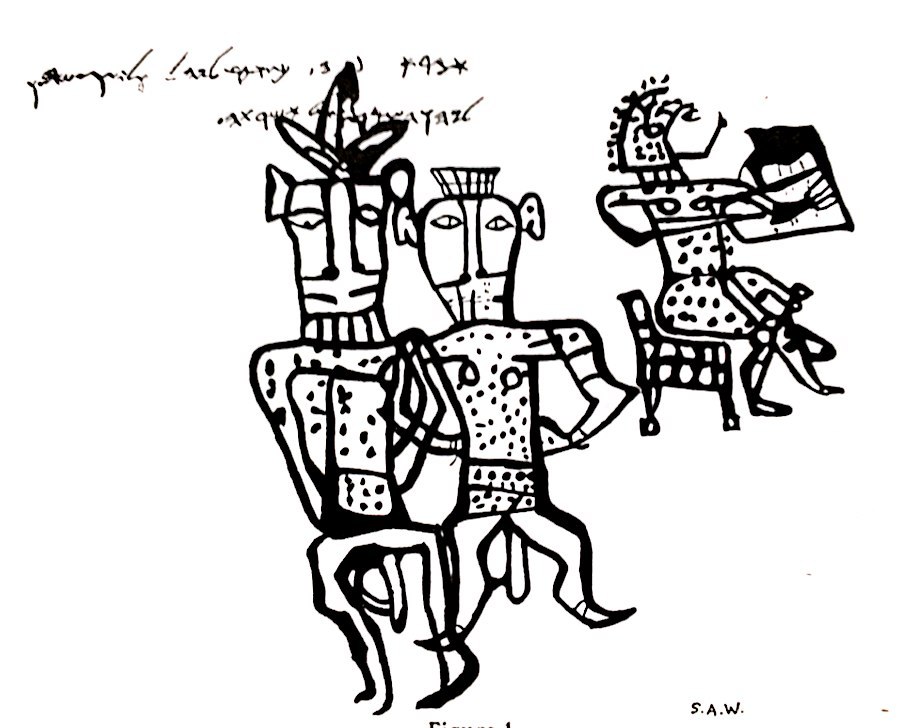
One of the greatest problems in reconstructing ancient religions is the ambiguity of the evidence.  Most ancient artifacts are not labeled (they probably didn’t need to be for the original viewers) and few have textual materials explaining them.  This became clear to me when studying the famed inscription found at Kuntillet Ajrud in the mid-1970s.  The most (in)famous aspect of this artifact was that an inscription overlapped a doodle, and due to the urgent desire to interpret the inscription a particular way, the line drawing was supposed to be an illustration of the inscription.  The inscription is commonly translated as something along the lines of “I bless you by Yahweh of Teman and his asherah.”  Many scholars took asherah to mean Asherah, the goddess, despite no evidence for pronominal suffixes on personal names in classical Hebrew.  The doodle shows three figures, perhaps related, of which two were said to be Yahweh and Asherah.  Despite the very clear resemblance to the Egyptian dwarf-god Bes (Kuntillet Ajrud is between Israel and Egypt), it was argued that the figures in the “foreground” should be considered Yahweh and his main squeeze, Asherah.

KuntilletAjrud

The artistic analysis of these doodles has always been torturous. Tiny, perhaps insignificant, details were ascribed great importance—particularly those indicating the gender of the figures.  For the Yahweh-Asherah connection to work, one had to be male and the other female (with the male preferably in front).  The problem was that both figures seemed to have penises (in keeping with Bes’s typical representation).  In order to make it clear that the right-hand figure was female it was claimed that she was wearing a lion skin and the “penis” was literally a tail, the leopard’s tail, seen between “her” legs. The problem seemed to be a possible scrotum appeared to be present.  The left-hand figure, larger (therefore, in front) had a clear scrotum, and that sealed the case, in a manner of speaking.  Little chestal circles were said to be breasts on the right-hand figure, but male nipples on the left-hand figure were lacking.  Oh, and they were dancing, as shown by the woman playing the harp in the “background.”  Believe it or not, seriously scholarly debate raged over this—nothing short of the discovery of Yahweh’s wife seemed to be at stake!  A colleague recently emailed me to tell me the final report of the archaeologists concludes that the “scrotum” on the right-hand figure was a mere dust smudge and so, aha!, she is a female after all!


I argued years ago that this drawing was clearly a representation of Bes. The connection with the inscription is accidental (the jug on which the inscription occurs is full of doodles); if someone wanted to illustrate an inscription, they would not draw figures that actually obliterate part of the caption. Assumption is built on assumption here, however, making for a very shaky foundation indeed. Don’t get me wrong: I would like to see Yahweh as happily married as the next deity. It is not good for the god to be alone. Still, it is going to take more than a divine sex-change operation to transform Bes into Asherah. If nothing else this divine gender-bender ought to serve as a cautionary tale for scholars, yet somehow I doubt that it will. We see what we want to see.


Have a Blessed Day

“Last stop: New York Port Authority. Have a blessed day.” This secular blessing is sometimes appreciated after the harrowing commute to Manhattan, but I often wonder about its origins. Bus drivers are among the most under-appreciated of employees, I reflected on Labor Day. They are routinely blamed for matters beyond their control: accidents that snarl traffic for hours, mechanical problems, highway construction. Often I only reach the Port Authority Bus Terminal on time two days a week. I always say “thank you” to the driver while exiting, however. I’m very glad it’s not me behind the wheel.

Photo credit: Hudconja

Photo credit: Hudconja

A few months back, however, I noticed that a few of the drivers, while announcing the terminal stop, will add “Have a blessed day.” Last week I sat back further than usual, and heard an interesting exchange as I awaited my turn to exit. The driver had wished us a blessed day (whether we wanted one or not), and several of the passengers, upon disembarking, said back, “Have a blessed day.” I’m sure the driver appreciates it. As a lifelong student of religion, however, I found it fascinating. New York City is a great place to observe religious developments. “Have a blessed day” is innocuous in its lack of specificity. Who is doing the blessing here? At the behest of what intermediary? The driver has literal street cred by making it to the Port Authority unscathed. S/he has the power to bless and to curse. Those of us helpless as passengers are at their mercy. If the driver doesn’t drive, we can’t serve the god Mammon.

I always thought “Have a blessed day” was like an after-sneeze blessing. It is unusual for the sneezer to panegyrize their blesser by wishing good fortune back. Most often they are too busy blowing their noses. Here on the bus the driver might be Muslim (it is clear that some are), Christian, or Hindu. Some are likely among the most deserving of atheists. A blessing laid is a blessing played, however, and many are the passengers who are now returning the favor. We don’t know which deity is being invoked; it may be that it is simply the force that is with us. As we climb off that bus into a city that crushes a human soul as easily as a cockroach, we all could benefit from a blessed day. And I wonder on my way to work whether I’ve just witnessed a new religion being conceived.


Disorganized Religion

In an Advice column in last week’s Chronicle of Higher Education, subtly pseudonymed Madalyn Dawkins contributed a piece entitled “Dodging the God Squad.” Dawkins, the wife of a senior college administrator, is an atheist and she shares anecdotally the woes of non-believing administrators everywhere. Even in state universities administrators must not reveal their lack of belief because powerful donors may withdraw their support or other administrators may bring them down. This leads Dawkins to posit a “God Squad” that silently polices university administrators, ensuring a kind of conventional belief structure. Of course, with any covert operation speculation must be involved. Dawkins notes that instructors may declare themselves non-believers with few consequences, but for administrators the game is much more political.

Doubtlessly covert religious groups exist; we discover them all the time. In this case, however, I wonder if Dawkins has wandered into that territory some of have written about for years but to which most academics are blind: the world is actually a very religious place. I sympathize with Dawkins. Those who are educated cannot unlearn what they’ve discovered on their academic journeys. What they often do, however, is suppose that others have kept apace. I see this all the time in the public posturing of the other Dawkins, Sir Richard, that is. Railing against belief as if it is a disease, he doesn’t seem to understand why the unwashed masses don’t get some kind of flu shot of the mind and destroy this pesky infection. What academics sometimes—often—forget is that religion serves many valuable functions in people’s lives. In a world where the privileges of an academic lifestyle are rare and becoming rarer, the disparity is only going to increase. There is no “God Squad.” There is society and there is academia.

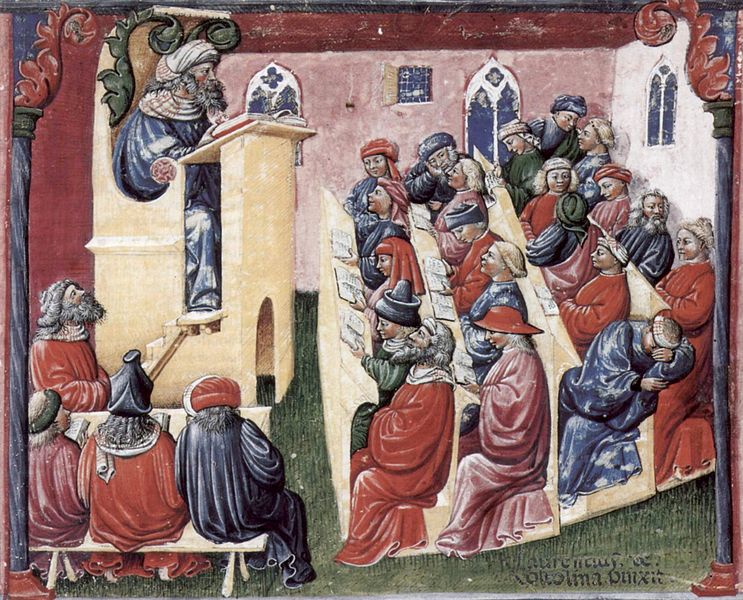
I’ve been around the quad a time or two. I know that academic administrators often see no reason to study religion. Many of them are non-religious, as I’m sure many people know. Supposing that all others share their views, however, they cancel funds for the study of religion (one of the departments hardest hit by the “it doesn’t lead to a job squad”), as if silencing the rational voices in this discussion will make the phenomenon go away. Higher education exists for the sake of society. Those who are educated can help to educate others and slowly, slowly progress will ensue. Some of us have tried patiently to do just that over our years in the classroom. I never belittled a student’s religious belief. I did try to raise questions, and I tried to teach students to raise their own questions. My positions, however, were repeatedly cut out from under me by eager administrators. There is no God Squad. For the sake of us all, however, it would be best if administrators acted like this mythology is really true.

An early view of higher education.  Literally.

An early view of higher education. Literally.


Which Way to Eden?

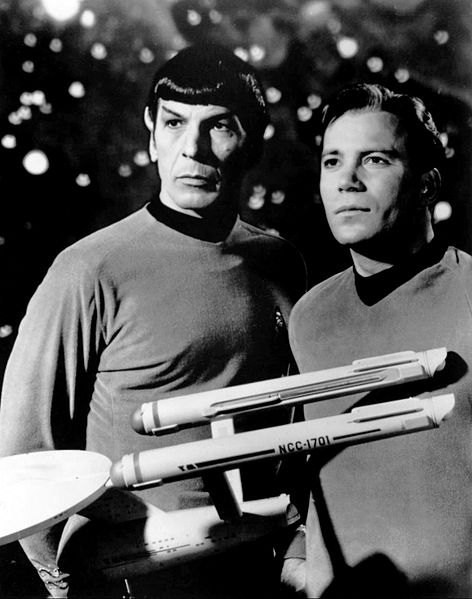
We don’t have television service, and I haven’t watched TV regularly for about two decades. Over the years, however, we’ve collected the DVDs of the shows we miss, or which we wish we’d seen so that we missed them, and use those in lean times. Feeling a bit lonesome over the weekend I downed a few Twilight Zones followed by a Star Trek chaser. On a three year mission to explore strange new worlds, my wife and I have been working our way through Star Trek, the original series. We’ve finally reached the final chapters of the final frontier. I’ve noticed as we’ve gone through the episodes just how biblically literate the series is. Even Spock quotes the Bible from time to time. Over the weekend, to keep my mind off present reality, we ended up watching “The Way to Eden.” As much as I enjoyed Star Trek as a kid, when it was still new, the overtly ’60’s-themed episodes bother me as an adult. I’m very much still a hippie at heart, but I don’t like lingo, and the alien cool cats in their weird shorts and funky hairdos chanting “Herbert! Herbert!” still really bother me. Somewhat predictably the aliens hijack the Enterprise to reach their fabled paradise.

Leonard_Nimoy_William_Shatner_Star_Trek_1968

Spoiler alert! For those of you who’ve been asleep since 1969, or have had no curiosity about the inspiration behind all those geniuses who’ve ushered in the technological revolution, I’m about to reveal some details. Eden is deadly. The landing party finds the short-pants wearing, funky guitar-strumming crooner dead under a fruit tree. “His name was Adam,” Spock laconically notes. The scene of Dr. Sevrin’s burned foot has stayed with me since childhood, and I still cringe when he leaps out of the shuttlecraft to take a bite of the poisoned fruit. It was only as an adult that I realized his name was reminiscent of Eve, indeed, a kind of blending of the words “sin” and “Eve.” In a kind of homoerotic death scene, the two male leaders end up under the tree together. Probably my overactive imagination.

Sometimes I ponder how much a biblically illiterate society misses. I frequently told my students that the Bible is foundational for our culture. Whether or not you’re aware of it, it is reinforced regularly in ways both ortho- and heterodox. Despite our very secular self-awareness, entire movies, such as The Book of Eli, can be based on the premise of biblical literacy. It is entirely possible to watch movies and television shows, and to read novels (graphic and literary) with enjoyment and not notice the allusions. The reasons they are there, however, is that despite the abuses of literalism, the Bible does have some profound things to say. It’s up there with Shakespeare and Chaucer. And even with Roddenberry and his host of staff writers. And I suspect that it still will be, in some form, in the twenty-third century.


Playing Civil

In a piece written for the Los Angeles Times, Joseph Margulies warns of the potential dangers of civil religion. I first learned about civil religion in college in the early 1980s, when the concept was still relatively young. The idea is as deceptively simple as it is accurate: when nationalism reaches its natural limits, the divine is invoked. Civic ceremonies become religious ceremonies—presidents lay hands on Bibles, whether or not they believe. Civil religion dictates that all presidents be portrayed as believers, but that is something we have to take on faith. Civil religion leads to sculptures of the Ten Commandments on courthouse lawns and the flying of United States flags in churches. The danger with this innocent-looking triumphalism is that some people take it too seriously. It is not limited to Christianity, either. Civil religion is a disguised, albeit thinly, form of nationalism.

The vast majority of people in the world hold religious beliefs without deep reflection. That is not to suggest that they don’t believe deeply, but simply that they don’t lift the edges to peer under the surface much. We are taught what to believe by religious specialists. To question them is to question the deity they represent. Since fear is easily ingrained in the human psyche, the angry god is among the most effective of weapons ever devised. We fear for our eternal peril, and it is easier to believe the clergy have the answers than to divine the truth for ourselves. Those who think profoundly about religion, outside the confines of the professional clergy, are always a suspect lot. What business do we have, poking around the beliefs of others?

Civil religion shocked me when I first learned of it. Like the majority of my peers, I had assumed that public displays of piety were to be taken literally. As I began to hang out with clergy and to see how they often transformed outside the church with a fellow “insider” beside them, I started to understand. The cynical asides whispered outside the hearing of the faithful, the double lifestyles, the on-stage personae. This may not have been civil religion, but it was not always what it seemed. Teaching in an Anglo-Catholic seminary, I saw high mass as carefully choreographed as an off-Broadway production of A Chorus Line. Civil religion relies on its partnership with the unquestioned belief of the Saturday-night and Sunday-morning crowd. It all fits easily together and runs as smoothly as a pink Cadillac. Just don’t look under the hood.

IMG_0088


Ivory Doghouse

inthebasementoftheivorytowerSome months ago I wrote a post about a book I had not yet read. In the Basement of the Ivory Tower: The Truth about College, by Professor X both entertains and informs. And depresses. Written by an anonymous adjunct English instructor, the book presents much of adjunct life in gritty realism. No one sane can possibly dispute that there are problems with higher education, however, X’s experience and mine of the same phenomenon, while eerily similar, are strikingly different. X became a Professor because of the need for extra income to help pay a mortgage. Good for him—I am glad for him. Having been an adjunct myself, however, in much more trying circumstances (fear of being turned out of a rented apartment for insolvency) makes me wonder if X delved deeply enough. X was not a Ph.D. turned away from full-time teaching after having proven himself to have “the right stuff” in the collegiate classroom. He could afford, albeit barely, house payments. He had a full-time day job.

It could be the differences in our specializations that paints the contrast so starkly. I studied religion from my undergraduate days and demonstrated competence at each step of the way. Even now colleagues encourage me that a full-time teaching job might come up. Some even lament the loss of my contribution to scholarship (not many, mind you! Far more have forgotten they ever knew me). Unlike Professor X I was fired for religiously motivated reasons. Once thrown off that lifeboat, there’s no getting back on. The religious are persnickety in that way. Being fired from a seminary is a sure sign of faulty merchandise. I spent six years, in some fashion, as an adjunct instructor with the constant specter of very real loss of everything a daily threat. Everything, of course, in my case meant mostly books. That made the threatened loss even worse.

Although my experience differed considerably, Professor X is absolutely right in his portrayal of how tenured, regular faculty often treat adjuncts dismissively. At times with disdain. As if we somehow didn’t graduate from world class universities. As if we didn’t have nearly two decades of stellar teaching evaluations. As if we’d stepped in something on the way to class. If I ran the world (and heave a sigh of relief that I never will) full-time faculty would be required to recite a prayer of thanksgiving every day that they were favored with a genuine taste of the promise that crumbles into sawdust in the mouths of the adjuncts. I was a full-time associate professor with a future. Since then I’ve become, no matter how full-time my workaday job, an adjunct with an uncertain future. And if you are lucky enough to have a full-time professorship, close your eyes, bow your head, and thank whatever it is you believe in. Ivory towers, it seems, come in many colors.


Personal Dogma

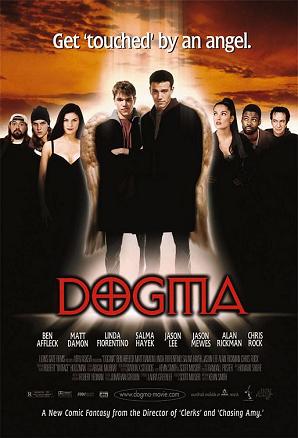
Dogma is a movie that many seminarians discover at some point in their theological education. Smart, funny, and irreverently reverent, the film follows the exploits of a couple of misled angels trying to get back into Heaven and thereby negating all of existence. It is no surprise, given Kevin Smith’s origin myth, that the film opens and closes in New Jersey, but I often ponder the strange coincidence of places in the movie to places I’ve lived since my own seminary career began (and ended, rather like the massacre scene in Red Bank before God cleaned it all up). Nashotah House, where I discovered Dogma, is in Wisconsin. Wisconsin is the state to which Bartleby and Loki, the two angels, have been banished. The means of their escape from this upper-Midwest purgatory is a church in New Jersey. Along their way the angels pass through Illinois and Pittsburgh, before crossing into the very state where God is located throughout the movie (the Garden State, of course!). After having been summarily dismissed from my seminary post in Wisconsin (not for watching Dogma, I’m assured), I too headed for New Jersey. Before that I had lived for a while in Illinois (home of Bethany) and Pittsburgh (home of Moobie). Watching Dogma is in many ways a reflection of a journey that I’ve accidentally undertaken.

YEE.tif

Another kind of dogma seems to be at work in the Eagle Mountain International Church in Newark, Texas. The Associated Press announced that 21 cases of childhood measles had broken out in the church, particularly among the homeschooled and unvaccinated. Fears of inoculating against a pre-medieval faith have led many of those who trust their own knowledge above that of the collective specializations of educators, to put their children at risk for the sake of belief. The belief, perhaps unsurprisingly, is poorly informed. One of the pastors of EMIC (!) has been encouraging vaccination as biblically sanctioned. If not for the sake of your children, for the sake of the scriptures…

Vaccination, in various forms, was developed in both Christian and pagan contexts. The earliest examples come from Asia where the plagues sent by the devil were resisted with human ingenuity. It takes a paranoid twenty-first century, first-world faith to suppose saving our children is some kind of conspiracy. “Let the one without germs,” we can almost hear them say, “throw their tissues away first.” In my Pittsburgh days, I was very much a literalist. How surprised I was to see Lady Aberlin from Mister Roger’s Neighborhood playing an angst-ridden nun, derailed by an exegesis of “The Walrus and the Carpenter” in Dogma. Although the Neighborhood is “anytown” those of us locals knew that Fred Rogers was from Pittsburgh. Lady Betty Aberlin was the niece of King Friday XIII, and only those with no conspiratorial imagination would suggest it is merely coincidence that her cousin is named Kevin. With or without dogma.


Dangers de la nuit

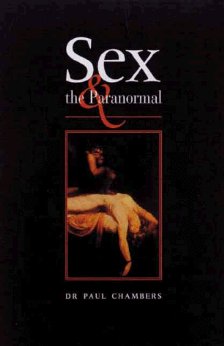
Sex&Paranormal Some books require extra clothing on the bus. When I saw the title of Paul Chambers’ Sex and the Paranormal, I noted the juxtaposition of two aspects I’ve frequently argued are intimately related to religion. There can be no question that religions in some way attempt to regulate sexuality. Those forbidden topics loosely collected under the sobriquet of “the paranormal” tend to be only a baby-step or two away from religious beliefs. Often those who are open to religious acceptance also allow for the possibility of the paranormal. So what did these two quasi-religious phenomena have to do with one another? How was I going to read a book with a title like this on public transit? How would I plumb the depths of its wisdom without feeling like a pervert? I found an unused book sock, a kind of colored condom for textbooks, and wrapped in around my questionable interests and read as discretely as possible.

Chambers, a member of the Society of Psychical Research, as well as a scientist, starts the reader off with what he is surely correct in identifying as a combination of sleep paralysis and hypnopompic hallucinations—the feeling of being violated by demons or ghosts in the night. While the reasons are poorly understood (beyond our latent sense of vulnerability while asleep), the fact of sleep paralysis is well documented. As Chambers points out, our over-active, often religiously fueled, imagination fills in the blanks for those who wake up unable to move, feeling a presence in their darkened rooms. This leads Chambers into a discussion of Lilith and succubi and incubi, the molesting demons of ancient lore. Witch-hunts and amorous aliens are strange bedfellows in this volume as well.

Studies like this daringly bring together subjects that have been parsed apart by conventional society. They are also deeply relevant. Many of us remember the (largely mythic) Satanic worship scares that plagued pockets of America, and then Europe, in the 1990s—latter day witch-scares, as Chambers points out—the tremors of discontent that rumble through societies struggling for an overly rational explanation for human behavior. They are present-day reminders that no amount of fiscal solvency and empirical data will ever banish the deep fears from the human mind. Our emotions have often served us very well, and have sometimes abused us, for the entirety of our evolved existence. And although we can hold them at bay in the clear light of day, at night we are surprised to discover that we really believe in monsters after all.


Back to the Future

When I leave work, I’m in a rush. It would seem that Third Avenue and Eighth Avenue shouldn’t be that far apart, but you can’t see from one to the other. I’m a pretty fast walker, and I’ve negotiated city crowds since my graduate student days. If you get caught at a light on one of Midtown’s avenues, you get into a cascading series of minute-long delays and you could miss your bus. Since I do this nearly every day, I know the lights are on timers, and getting through one light may make all the difference in having to wait another half-hour in the Port Authority Terminal for a missed bus. So when the woman held out her hand in front of me, I was ready to pull a dodge, but then I saw the tarot card printed on the slip of paper she held toward me. I took it at nearly a run with an acknowledging nod of thanks. New York has any number of psychic readers, and I’ve noticed that different ones advertise in different street corners in town. Unlike the competition, this psychic doesn’t announce who s/he is (I always assume “she” but the chit doesn’t say). “Clairvoyant Consultant” is the only identity, along with a street address. “Gifted European Spiritual Psychic” also occurs. I will get a five dollar discount if I go in. Tempting.

Clairvoyant

On the bus I noticed something about the colorful print of the tarot card. I’ve never in my life touched a real tarot card. I’m not really superstitious, but why take chances? The Bible can be pretty harsh about such things. This card says, “Wheel of Fortune.” The wheel, with its runic (and Hebraic) symbols, is surrounded by clouds. On each of the clouds in the four corners is—and this caught me off guard—an iconic symbol of each of the evangelists. Matthew’s winged man is in the upper left, and Luke’s winged ox in the lower left. Mark’s winged lion is in the lower right and John’s eagle claims the upper right. On the wheel itself rest a sphinx, a la Oedipus, a serpent (a la Eden?), and what appears to be a recumbent devil. Clearly clairvoyants see some value in traditional religious symbols.

New York is quite a religious city, for all its secular trappings. Not all of the religions are traditional—many, in fact, would start a literalist’s blood on its way to a low simmer. It is a city of seekers. The wheel of fortune may be a more apt symbol than I realized. The earlier bus gets caught in traffic today, and at one of the common stops I see the later bus whizzing by, and I know that it will arrive at my home stop long before I will. Of course, I had no way of foreseeing that. Each day as a commuter is another spin of that wheel of fortune. It is not a surprise New York is such a religious city. Your fate is never really in your own hands. But this flyer is, and it entitles me to five dollars off a peek into the great unknown. I think maybe I got this card about two decades too late.