Sleepy Jean

Last week in the Chronicle of Higher Education, an article by Cristina Richie entitled “The Scandal of the (Female) Evangelical Mind” appeared. Richie points out that despite great strides being made in employing women in religious studies positions, Evangelical institutions still fall behind. This dynamic is not unexpected, however. Those of us who grew up evangelical know that no matter how much it may talk the talk of equality, evangelicalism walks the masculine walk of deeply seated patriarchalism. For those who literally “believe the Bible” there is simply no way around a male Jesus. Even if you go that dangerously risqué step and suggest that the Holy Spirit is somehow feminine, when the divine couple gets together (and Father is always in charge), the offspring must be either male or female. In any literal reading, women cannot possibly claim equality. For their very salvation they are dependent on a male. A god with testosterone. As in heaven, so on earth.

Evangelical institutions have a difficult time with women leading men. They’re not alone. As early as the first century of the Common Era, Paul had the same issues. Literal religion in a biologically dimorphic world will always be problematic. Either there is one god, or there are three. In either scenario the males outnumber the females. Should we posit a divine couple (as some in ancient Israel appear to have done—please wave “hi” to Asherah for me) we still have a culture that is dominated by men. The divine couple will always have the goddess deferring to the will of the god. And you can be sure that he will never pull over and ask for directions. We already know which way this chariot is going.

Every once in a while, the Chronicle likes to sit back and take stock of the religious landscape. Religious studies is, despite the bad press, a thriving area of academic interest. Surely to those in more quantifiable fields, our little squabbles over whether god is a man or a woman must seem pedantic and a little pathetic. And yet, the evangelical institution has an instruction book. That book, if followed word-for-word, leads to eternal rewards for those who are willing to foot the hardships. And for at least half of those (and likely much more than half) that will mean living on an earth that mirrors that realm beyond the sky. Although you can’t see it with any telescope, if you believe hard enough, it is there. And in that ideal place, the god in charge is a man’s god.

540px-Paradiso_Canto_31


The Weather in Kansas

In a move that threatens intellectual whiplash, the Kansas State Board of Education has backed the Next Generation Science Standards. For a state historically at war with evolution, adopting a curriculum that (rightly) presents evolution and global warming as facts, there is cause for hope. As an average citizen sometimes just struggling to get by, I watch in stunned horror as our elected officials try to repeal Obamacare without touching their own health plans paid for by yours truly (and mine truly). I see them vote themselves pay raises while pension plans and salaries of ordinary citizens are frozen. I know where the buck actually does stop. So it is strangely encouraging to see a state that has declared war on science beginning to realize that yes, the truth does have consequences.

Science does not necessarily have all the answers, but it is the best that we know. The empirical method works, and our healthcare, transportation, and communication have all benefited enormously by it. Our way of life has grown easier because of our application of evolution and its ways to our understanding of microbes and the ways to hold off their attacks. Science has been warning us since I was a high schooler, over three decades ago, that our industrialization has been causing grave changes to our ecosystem. Unfortunately, those with money to make from it can simply afford to move to higher ground. Kansas is among the Great Plains states. It is wise to recognize that global warming threatens those who live close to the earth most of all.

The intolerance to science is not simply a religious reaction, as some would characterize it. Religion may be used in the interest of business. And any savvy entrepreneur knows, and exploits that fact. It matters not a jot or tittle if you evolved from a common ancestor with the apes, as long as you can climb, like King Kong, to the highest towers and look down on all the rest of humanity. The water from melting ice caps may be rising below, but the Great Ape need not worry. Until it becomes clear that without the little guys down below, even the top monkey is nobody.

NotInKansas


Supergod

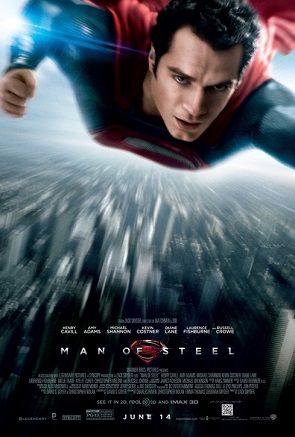
ManofSteelThis weekend the most-seen UFO in the skies was the Man of Steel. I didn’t see the new Superman movie, partly because, I suppose, of my own inadequacy issues. Also partly because I’ve always had trouble warming up to Superman. He’s just got too much going for him. Don’t get me wrong—I love heroes. But heroes are vulnerable. In fact, their vulnerability is the key to their strength. Superman, truly threatened only by kryptonite, is maybe just a little too perfect. A little too… messianic? So it would seem, according to CNN’s Belief Blog. According to a post by Eric Marrapodi, Warner Brothers is pushing hard on the Christian imagery of Man of Steel, encouraging church discussion groups, and even providing a study packet of Jesusesque tropes to discuss with the faithful. All this for a hero dreamed up by a couple of Jewish kids in the 1930s.

A telling observation appears somewhere in the middle of the article, where Ted Baehr is quoted as saying “I think it’s a very good thing that Hollywood is paying attention to the Christian marketplace.” Did you catch it? Christian marketplace? No surprises here, really. Christianity has “been good” to many who advocate the prosperity gospel—god wants the good to be rich. And since I haven’t been able to walk through Times Square for two weeks without seeing the Man of Steel, larger than life, flying off of massive billboards into the crowds of tourists and locals, I have no doubt the movie did very well over the weekend. Some may have even had their faith restored. Others will have had their pockets lined.

A few years back I was asked to present a program for adult education for a church in Princeton. They wanted someone to talk about religion and movies, and this is something I’d often addressed in my classes. I selected movies to discuss that were not “religious”—no films premised on religious characters or situations—and had no difficulty filling an hour with example after example. Movie makers have long known the benefits of movies based on Christian concepts. Self-sacrifice, redemption, and resurrection permeate the movie industry. This is a Christian culture. The parallels between Superman and Jesus have long been noted by critics of religious imagery in both films and comic books. And those who make films have also realized that Christianity is more than just a belief system. Indeed, it is a marketplace. And with enough money, even a regular mortal can bend steel.


Lower Education

Many people have asked me, as a former professor, why universities are so expensive. Ironically, many of these people are in flourishing businesses where the story ought to be as tired as the excuse that’s usually trotted out: faculty are paid too much, mismanagement, etc., etc. The truth is much more insidious and it begins with governments and corporate executives who can’t handle the sharp sting of criticism. I have experienced this firsthand, and unlike many academics, I have an authentic blue-collar background so that my perspective is unclouded by generations of privilege. I recently found this post on The Homeless Adjunct, and I was glad that someone is actually willing to write the truth. The high cost of higher education is because a subtle series of changes—often deliberate—that have been instituted since the 1970s to change colleges and universities into engines to power capitalistic ventures rather than to educate potential critics. Those who have a hard time accepting conspiracy theories may be disturbed by how well documented this development is.

I realize that I am a mere proverbial voice crying out in an even more proverbial wilderness. The fact is, this change in higher education, implemented since the era of protest that was the 1960s, goes on without the knowledge of by far the majority of university faculty. They still tell their promising students to continue on to graduate school, that the bottleneck that has been holding up new, or even replacement, jobs is bound to burst. Things will get better. Not. As the Homeless Adjunct points out, corporate interests now run the universities, sucking up their prestige like bloated vampires, while endorsing their own manipulative interests. How can “educated” people believe global warming is a myth? Get corporations who “oppose” global warming to fund science programs and see what happens. The truth becomes quite malleable when lucre is involved.

Even more chilling, as our brave adjunct reveals, this model has begun to filter into high school, and down to Kindergarten. The way that educational decisions are made is based only, always, and ever on the bottom line. Not for our children, but for corporations that decide what our children can, and more importantly, can’t do. Their future is being undermined.

catalog

As a former adjunct who went blindly through the system, ending up with a doctorate from a major European research institution only to fall afoul of a thickly entrepreneurial administration, the clouds were wiped clean out of my eyes. I believe in higher education. And I believe that those of us with any moral sense are obligated to take it back. We will likely be destroyed in the process, since money is the only value our society recognizes, but if we want a world where our children can thrive, education must be true education.


Whatever Happened to Whimsy?

American Gothic is one of my favorite paintings. I’ve never seen the original, and I know of no other paintings that Grant Wood produced, although I’m sure there are some. The mood in what has been called “the most famous American painting” is unsettled. There’s something not quite right here. When one of my authors wanted to use the image on a book cover, it led to quite a bit of serious discussion. I was a bit surprised by the negative impressions—not of the painting, but of its use on a serious academic book. The discussion seemed to turn on money rather than on wit and whimsy. I confess to being a dreamer, and I admit that the aspects of life that truly inspire me are never financial. When I crave wealth it is so that I might free up some time for creativity. That’s not the way business works.

Sometimes I feel a stranger in my own country. The unquestioned triumph of unbridled capitalism means that you can go from city to city to city and not really be able to tell much of a difference. If you want to buy a bit of tubing or a piece of wood, it’s Home Depot or Lowe’s for you. Office supplies—Office Max or Staples are your only choices. If you want to buy intelligent books, well, you’re just plumb out of luck unless you go to Amazon. The big financial corporations have won. Just admit it. Every time I visit my hometown I come away depressed at all the vacant stores and lost hopes of the small businesses that offered something just a little different. Something to tickle my fancy. Something to tempt me to wonder. Something with a tinge of American Gothic.

AmGoth

The messages we receive from every angle echo Madonna’s hit song, “Material Girl.” Only this includes all genders. Reductionistic materialism tells us that we’re just proteins walking. Mind is an illusion. Soul is a myth. I work a job where the money I’m paid is transferred electronically and if I want to see some of it in paper form I face a robotic ATM rather than a human face. I went to the mall last night and wept. Call it a mid-life crisis if you will. Say nostalgia has no place in a forward-looking society. I just want a few more options besides the plastic, the smart-chipped, and the sterile. The world needs more whimsy. Maybe that’s why I insisted on American Gothic on the cover of the first book I put under contract.


Sweet Morality

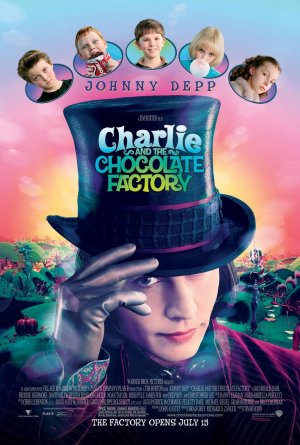
CharlieandtheChocolateFactory When I saw Willy Wonka and the Chocolate Factory as a child, I had never heard of Roald Dahl. Although I enjoyed the movie, it was never a favorite. Like any kid I liked candy, but I’ve seldom been motivated by sweets. I discovered Roald Dahl when my daughter was young, and read for the first time his somewhat more disturbing original version of the story. Tim Burton has a reputation for going back to the roots of beloved childhood characters and revealing their darker sides. When his Charlie and the Chocolate Factory came out in 2005, the appeal went beyond sweets, for this was a modern, if sinister, morality play. While rewatching the movie recently a number of what should’ve been obvious religious motifs suggested themselves. The first came when Charlie Bucket is shown in the main chocolate processing room reaching for a candy apple. Violet Beauregarde steps in and snatches the apple from the tree in a defiantly Evesque move. She later receives her punishment by being transformed into a fruit.

Augustus Gloop receives a strange, chocolatey baptism is what might otherwise be the waters of life. After all, the Oompa-Loompas are shown bowing down in worship to a cocoa bean in a flashback. When Veruca Salt attempts to catch one of Willy Wonka’s nut-sorting squirrels, in a rather disturbing scene reminiscent of Ben, the squirrels pin her down and carry her to the garbage chute. She is carried in classic cruciform style, emphasizing the martyrdom she receives at the hands of her indulgent father. Even Mike Teavee undergoes a kind of resurrection after being atomized and projected into a television.

A friend once told me that the characters in the film represent various deadly sins. Augustus Gloop easily falls into gluttony, and Violet Beauregarde is an emblem of pride. Veruca Salt clearly represents greed, and Mike Teavee is full of wrath. Willy Wonka is part devil and part god in the film, doling out just punishment in a seemingly unfeeling way, while rewarding the few instances of virtue. Deprivation forges virtue in Charlie Bucket demonstrating how clearly the movie is in the realm of a morality play. With its horror film tropes and forays into the truly strange, Charlie and the Chocolate Factory is an example of how morality persists even in the vision of those often considered completely secular. Without it the movie becomes just another excuse to overindulge in sweets.


Sacred Gaze

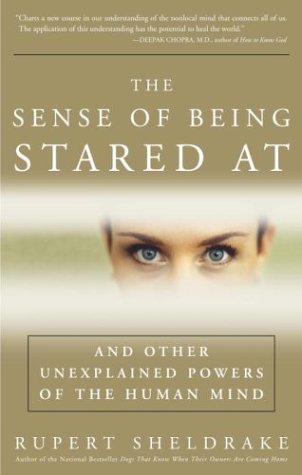
SenseofBeingStaredAt Rupert Sheldrake raises the ire of some of his fellow scientists. Science has increasingly allied itself with a strict kind of materialism, although, as Sheldrake repeatedly points out, evidence for such absolute materialism is lacking. This is not to challenge science, but simply to note that we may not yet have all of the data. The Sense of Being Stared At considers possible scientific explanations for unconventional situations we all experience from time to time. Who hasn’t felt eyes on them and turned around to find somebody looking? A number of other “impossible” scenarios also find their way into this intriguing book. Sheldrake suggests that such phenomena can start to be explained scientifically if we allow that the mind is not the same thing as the brain. Sure beats a Christmas party with B. F. Skinner, where every present is inevitable.

Materialism feels threatened when spooky action at a distance occurs. As Sheldrake points out, however, we are willing enough to accept it if an invisible “field,” one that we can’t even feel, is posited. Take magnetism, for example. Few people doubt that magnetism is a real force. We’ve never actually seen it, but its effects are clearly visible. Taking this as a starting point, Sheldrake suggests that various psi phenomena involve such fields. The scientific studies that have been undertaken on many of these “spooky” scenarios show statistically that chance may be safely ruled out. And, if the experience of many ordinary people counts for anything, even our pets and other animals may possess minds.

Ironically, the mind (with its taint of being associated with religious concepts such as the soul) is one of the most contentious phenomena in science. Many materialists deny its existence, suggesting it is merely some epiphenomenon of our brains’ electro-chemical processes. Yet these scientists still, one presumes, insist on being treated with respect and being paid for their work, although these mere trifles are just odds and sods clinging to the edges of a materialistic abyss. To me, work like that of Rupert Sheldrake is crucial for an honest assessment of the evidence. Maybe not everyone accepts that dogs know when their “owners” are coming home, and maybe Sheldrake’s morphic fields have yet to be confirmed, be it is clear, when all the evidence is considered, these phenomena do actually happen on occasion. Instead of simply dismissing something because it shouldn’t be, or can’t be, according to materialism, why do we find accepting the evidence so frightening? Is it perhaps the fear of being watched?


First World Religion

H. P. Lovecraft’s contemporary, and sometimes inspiration, Algernon Blackwood has recently come to my attention. Like Lovecraft, Blackwood was an early twentieth-century writer of supernatural tales. Raised with a father of “appallingly narrow religious ideas” Blackwood came to write stories involving strange religious characters and occult themes. I recently read his famous story, “The Willows,” for the first time. The entire premise is built around a sacrifice required by strange gods on an isolated island in the Danube River. Much of Lovecraft’s literature, as is readily apparent, builds on the Old Gods. Lovecraft was an unflinching atheist, but he knew that the divine had the ability to frighten in a way that the purely material often does not.

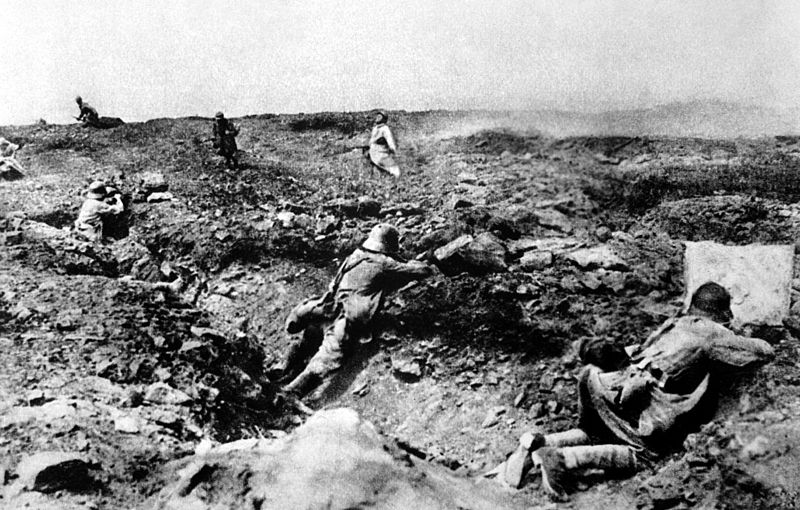
The early twentieth century exerted an enormous influence on the religious landscape of the modern world. Although my historical specialization is much earlier, it is clear that the events of the First World War forever changed the way that religion was viewed. Historically, those not involved in the fighting of wars had often been insulated from them. With the advent of technology that allowed military devastations to be photographed and swiftly disseminated, people around the world realized what an atrocity war actually is. Not glorious. Not triumphant. And despite the abundance of piety in foxholes, no deities evident anywhere. It is well known that horror of war at least partly led William Jennings Bryan to advocate a more fundamental brand of Christianity to counterbalance the “evils” of evolution that led to such nasty ideas as eugenics and social Darwinism. It is no accident that the Fundamentalist movement began to take hold with the revelations of the First World War.

GermanInfantry1914

Ironically, today many use creationism as the excuse to challenge all religion as a misguided set of antiquated principles that have no place in an enlightened world. The sad truth is that those who immediately dismiss religion out of hand don’t realize that the creationist concern arose precisely for the same reason: the horrors that science was unleashing upon regular, simple religious believers. The two viewpoints, however, can live together. Although many of the writers of the early twentieth century had no room for faith in their accounting of reality, they did believe in its effectiveness in creating fiction that had to be taken seriously. Atheists, perhaps, but not angry ones. Perhaps the angry ought to spend some time amid the willows to evaluate more fairly the ambiguous role that religion play has played and continues to play in an uncertain world.


Religion, Generally

Attempting to keep this blog focused on religion, has, of course, relegated it to the hopelessly outmoded pile for many people. I run into this all the time, professional, sophisticated individuals who have moved beyond the need for religion don’t see why we should waste our time with it. It’s about as useful as a room full of year-old newspapers. Like most people who end up studying religion, for me it began as an outgrowth of a religious upbringing. When you get to college they ask what you’re interested in. When your response is “Not going to Hell,” they’re likely to send you over to the Religion Department (if there happens to be one). One of the early lessons you learn as a religion major is (or at least should be) tolerance. Sure, the beliefs of other religions, when encountered for the first time, may seem weird. If you step outside your own tradition, however, chances are a great deal of what you believe could be considered odd as well. In such circumstances tolerance is perhaps the only way to avoid violence.

The few readers who leave comments on my posts give me pause to think. I largely study religion in isolation now, without the give-and-take of academic colleagues. It is not unusual for someone to point out the bizarre, or even unethical behavior of someone else’s religion (New Atheists do this all the time). When trying to understand religion, however, we have to be honest about the fact that all religions, and non-religions share instances of bad behavior. As my grade-school teachers said, “one bad one ruins it for everyone.” Religions are just as subject to human perversions as any other activity. People do bad things occasionally. Sometimes in the name of religion (or non-religion). Rationally it is obvious that we shouldn’t blame the religion for the poor behavior of some adherents. Yet we often do.

Religion-bashing is a popular sport. Those who engage in it, however, frequently fail to take into account just how widespread religion is. By far the vast majority of people in the world, educated or not, believe in a religion. This is complicated by the fact that an agreed definition of religion is still lacking. We don’t know what religion is, but we know it when we see it. Our universities and public intellectuals often ridicule it as unsophisticated and naive. As someone who has spent a lifetime thinking about religion, I suppose I’m obligated to say it, but there is a deep truth here: religions do motivate for good as well as for evil. Both non-religious and very religious people can be bad or good. What we require to get along in such a world is tolerance. And a willingness to listen to others. Otherwise both religion and non may not survive to criticize each other.

Jacob-angel


Monsters Incorporated

Monsters

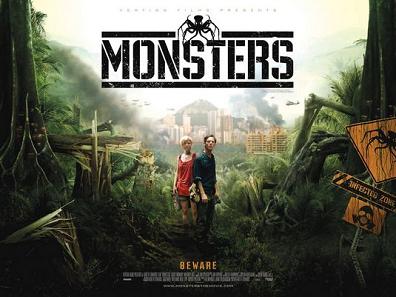
Monsters. What’s not to like? With a title so innocuous and limited US marketing, this 2010 British indie film only just came to my attention. I hadn’t even heard anything about it as I sat down to view it. The premise of invading aliens is as old as H. G. Wells, if not earlier, but this is a film without over-the-top CGI and a very human story. Showing far more tension than bloodshed, Andrew and Samantha, their Anglo names very prominent, are caught in alien-infested northern Mexico. Somewhat predictably, Samantha has a rich daddy who happens to be Andrew’s boss, but the couple has to find their way back to the United States as giant insectoid-octopi rampage through the night, destroying just about anything they can get their tentacles on. So far it sounds like standard Saturday-afternoon fare. As Andrew and Samantha reached the Rio Grande, however, overlooking the huge wall the US government built to keep out the aliens, I realized what the film is really about.

During the Bush years, shortly after the Berlin Wall had come down, a new wall was snaking its way along the Mexican border. America had become weary of “Give me your tired, your poor.” This was the land of opportunity, instead, for the chosen few. Never mind that we know that many of the jobs most of us don’t want are gratefully accepted by those who may not be technically legal in this country. Never mind that we deny social justice, in many ways, to those who make our lifestyle possible. Andrew and Samantha face the massive wall that says, “keep out.”

Of course, they make it back to Texas. They discover, however, that the aliens have breeched the walls as well. And they really pose no threat beyond wanting to draw strength from the abundant light-sources of a power-hungry world. The film’s ending is a bit ambiguous, but then again, the plight of the alien generally is. I watched the film with no expectation beyond a bit of sci-fi action to help give me the energy to make it through another week of work. Instead I saw a brash American coming to a deeper sense of humanity while standing in a church where hundreds were mourning their dead. The death of one small girl was as much a tragedy of as the breeching of the borders. Until humanity prevails over artificial borders, there will indeed be monsters. Were that they were only giant insectoid-octopi.


Continental Religion

In the course of my duties as an editor of religious studies, I was pondering the origins of the world’s major religions. Now, agreeing on what the major religions are is an exercise fraught with political incorrectness. What does “major” mean, after all? In any case, when we count in terms of numbers, there are more Christians, at the moment, than any other single religion. They are followed by Muslims and Hindus. So far there is little upon which to disagree, at least according to self-professed affiliations. Buddhists are usually counted as the next largest group, followed by Sikhs. When religionists mention “the big five,” however, they usually mean Judaism, Christianity, Islam, Hinduism and Buddhism. There are likely far more followers of traditional Chinese folk religion, perhaps mixed with Confucianism and Taoism, than most accountings record—such beliefs aren’t neatly categorized. Jains make up a sizable population, and Shinto is often classed in with all those religions of the far east. Many of the more modern religions, such as Mormonism and Jehovah’s Witnesses, sprang from Christianity, and so can safely be classed as a form of that faith.

What occurred to me that day was that all the major religions of the present world began in Asia. Judaism and Christianity, with all their numerous progeny, started in Israel or Palestine. Islam, as we all know, began in Arabia. Hinduism, Buddhism, Sikhism, and Jainism all have their origins in India, the big winner for the seed-bed of religions. Traditional Chinese religions and Shinto trace themselves to the far east. Yes, there are indigenous religions throughout the world. Native American and African religions are not to be discounted, yet they never quite attain the level of public awareness to be qualified as “major” religions. In this spiritual accounting, “major” has nothing to do with importance. For the religions with the largest followings we must turn our eyes to the one-stop continent, Asia.

Where major religions begin

Where major religions begin

Considering this, the obvious question is why. Why Asia? Civilization itself began in Asia, and one of the marks of a civilized society, at least until the day of the New Atheists, has been religion. Religion may be abused, as might any human innovation, but it has also been a harbinger of a more civil world. Not only fear of the divine, but also a sense of gratitude toward whatever forces might be greater than humanity, allowing us to survive for another season, or through another storm. Even in the world of science, religion has been a motivator. Gregor Mendel, the scientist who gave us genetics, was a monk experimenting in a monastery. Sir Isaac Newton was an occultist. Francis Collins is an evangelical Christian. Religion is at least as old as civilization. Its forms may be morphing, but, I suspect something our Asian forebears knew: religion will never truly go away.


California Weeping

Once again, we as a nation are left to mourn. Gun violence against the young seems, according to the posturing of the NRA, to be a legitimate diversion. I remember watching Gilligan’s Island growing up. The episode “The Hunter”—where if Gilligan survives being stalked by big game hunter Jonathan Kincaid, the castaways will be rescued—now seems strangely prescient. The location changes every few months, however. Yesterday it was in Santa Monica, California. College kids studying for finals being shot at by a man with a semi-automatic rifle. And even after Sandy Hook, and Columbine, and Virginia Tech, we still do not have the will, as a nation, to safeguard our young. Such a perversion of evolution the natural world has never seen.

The logic of allowing widespread ownership of firearms doesn’t make me feel any safer. Judging from the number of young victims of various gunmen—most of whom end up dead so no questions may be asked—we are willing to allow our children to be collateral damage in the war to keep personal weapons. As city after city after city is scarred by the anonymous guy who’s got anger issues taking it out on the helpless, we still insist that guns are our friends. I’d rather be friendless.

My fingers grow fatigued scrolling through the increasing list of multiple shootings. It takes one of sterner constitution than this writer even to make it through the Wikipedia page listing school shootings. Those who die give us ample cause for tears. Those who survive will spend lives dealing with horrible memories. Schools are where we place our hopes for the future. The lessons learned there should give our young the knowledge they require for a lifetime in this complex society we’ve created. Unfortunately that society also includes facile access to deadly weapons that kill with ease. Our hearts raced as Gilligan outsmarted Mr. Kincaid, although we knew he would have to survive. The star always does. But television is a poor guide to reality, unless it’s the NRA telling us why the only reasonable response is to increase the number of guns and let civilization do its work.

IMG_0149


Mr. Hubbard’s Legacy

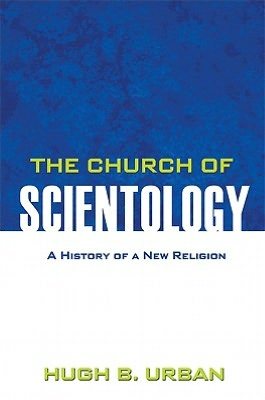
churchofscientology As a child just discovering the joys of reading in the early 1970s, I found science fiction captivating. We were poor, and our town had no library, so I’d buy my books on Saturday trips to Goodwill. In other words, you take what you can get. I recall buying a book by a guy named L. Ron Hubbard. I don’t remember the title or the story, but I recall my surprise when, as a religion major some years later, I learned that this same sci-fi author had started a new religion. Scientology was not something you’d likely encounter in a poverty-stricken, sub-Appalachian town in rural Pennsylvania, and with no Internet it wasn’t so easy to learn about such things even if you had. We did have TV, though, and we watched Welcome Back Kotter (Risky Business was a little too risky). When I discovered that John Travolta (“Vinnie” as we thought of him) was a Scientologist, I was curious. But only to a degree. When I first taught World Religions and spent a few years researching the Scopes Trial for a book I never had the chance to write, I became very interested in American religions. They don’t come much more American than Scientology (and Latter-Day Saints).

As soon as Hugh B. Urban’s book The Church of Scientology: A History of a New Religion appeared, it immediately went onto my reading list. Like most interested laity, I’d found it difficult to trust much of what I’d read on the Church of Scientology from media sources. Now I had a reliable guide! Even better, Urban frames his study around a question that pervades this blog: who gets to decide what is a religion? As Urban deftly points out, it is odd that government agencies are often those tasked with a job more fitting for those of us who’ve studied religion with the rigor that a physicist devotes to quarks and neutrinos. Some of us have parsed religious texts to bare bones and then dug up the skeletons beneath and examined their ossified remains as well. The world doesn’t take religion studies too seriously, however.

Urban’s book, well written and solidly researched, maintains that rarest of academic feats: objectivity. When approaching a religion, particularly a controversial one, emotions are easily engaged and objectivity is challenged. While confessing that he isn’t a Scientologist, Urban lets the historical facts speak for themselves. He doesn’t try to belittle those he studies, but he doesn’t coddle either. Reading his fascinating account, many questions are raised about the rights of religions and the role that secrecy plays. And we know that Urban is only skating across the surface of a deep and mysterious pond here. Sitting in my room with a yellowed, used copy of some L. Ron Hubbard pulp fiction story in my hands, I would’ve never guessed, as a child, what I was really holding.


Horseshoes and Hand-grenades

When possible, I like to follow up on events I mention on this blog. A few weeks back I mentioned the plight of the horseshoe crab and red knot, the bird species that feeds upon the crab eggs. Hurricane Sandy put the world’s largest nesting area for horseshoe crabs, compromised by human development, in serious danger. Ecological scientists, concerned for the fate of these intertwined species, frantically tried to rebuild eroded beaches so that the Christian crabs could sacrifice their children to the ravenous red knots. (Nature’s ebb and flow, it turns out, doesn’t always favor the unborn.) The good news is, that thanks-at least partially-to the efforts of the environmental engineers, crabs turned out en masse this year, and the red knots, on their transglobal migration, had plenty to eat. It is encouraging to hear that once in a while people impact their environment for good.

Perhaps unwittingly, a member of the American Littoral Society (which I am glad to learn does actually exist) was quoted in the New Jersey Star-Ledger as saying, “There was the potential for a catastrophe after Sandy.” I’m taking his words, intentionally, out of context because of their wisdom. Many people had, on the basis of human losses alone, already declared Hurricane Sandy a catastrophe. This simple quote is perhaps the most honest assessment of the universe it which we find ourselves. From the viewpoint of the not-human, Sandy was a catastrophe averted. The crabs, perhaps unconsciously, did what their biology programmed them to do. The birds feasted, and nature resumed its usual course. Humans weren’t in the center of this picture. We were supporting characters behind the scenes. There had been potential for catastrophe. Nature survived. Thrived, even.

Photo credit Carbon NYC, from WikiMedia

Photo credit Carbon NYC, from WikiMedia

I do not in any way demean the material losses that many people suffered, and continue to suffer, because of the hurricane. Unlike us, however, horseshoe crabs have very limited options. They can’t fly to Las Vegas to propagate, legally or not. They can’t fell timber and build cabins in the woods. They can’t put up an igloo and survive Arctic winters. We the people have endless choices about where to settle. Every environment on the planet, except under water, we have explored, exploited, and populated. We are bound by the very statistics that we are told run this universe, to be in harm’s way once in a while. Human loss of life due to Sandy was not massive. We can rebuild. We do rebuild. The loss of horseshoe crab habitat could have spelled the end of two species of fellow inhabitants on this globe. Catastrophe was avoided. At least from the multiple eyes of the humble horseshoe crab.


Going In, Coming Out

Being primates, perhaps it is no surprise that we are fascinated by who is doing whom. We, literally, by nature, find sexual alliances fascinating. Despite the fact that close observation of nature has indicated that homosexuality is indeed natural—it has been observed in many species, and isn’t even limited to mammals—we can’t help but make it a deciding factor in what an individual is. Two unrelated news stories over the past week have focused on homosexuality as the overwhelmingly defining trait of a person. In the first story, the Evangelical Lutheran Church of America (ELCA) has elected its first openly gay bishop. (Gay bishops, even in the pre-Reformation church, have not been exactly an endangered species.) The Rev. Dr. Guy Erwin, however, is so much more than a partnered gay man. He is a highly educated person who had held that most rare of positions—a bona fide academic position in higher education. He is also a member of the Osage Nation. His election as a Native American or as an academic would not be newsworthy. His orientation, well, that’s a whole different story.

Meanwhile, across the planet, the Southern Baptist Convention (SBC) is cutting its ties with the Boys Scouts of America because the BSA has decided to make honest men of its boys. BSA has recently voted to allow gay boys to remain in the Scouts, something that the Mormons had no problem accepting. Quite apart from the misguided SBC move, I was saddened to see CNN’s inaccurate headline, “Baptists plan exodus from Boy Scouts.” The story does not indicate that the Baptist brand of Christianity has withdrawn, so to speak, from BSA, but the Southern Baptist Convention. Baptists are much more broad-minded than the SBC brotherhood (I use the phallocentric collective intentionally) would indicate. All Baptists, it seems, are guilty by association.

SBC in the White House

SBC in the White House

People are complex. Putting them into neat categories is unfair to who a person really is. The category “gay” is notorious for subverting all other qualifiers for decent human beings. As the National Socialist Party recognized, the easiest way to build a case against a people is to put them together in a class that “deserves” our fear, mistrust, and hatred. Don’t look at the individual beneath the label. You might be forced to change your mind. Did that individual overcome the difficulties of being a “minority” in his or her own native land? Did that individual work hard to climb through the educational system to attain an advanced degree? Did that individual commit his or her life to another person, no matter what the social stigma? None of that matters, as long as we can talk about his or her “orientation.” It is society itself that requires reorientation.