Happy Labors

Labor Day Parade

Just as Memorial Day has become the unofficial start of summer, Labor Day has become its unofficial end. Unlike holidays that commemorate an event, Labor Day was a planned holiday dating from the 1880s. To get a sense for this, think about the past. Just try to imagine yourself as a worker in the 1880s. There were long hours, a workday did not go from 9 to 5, there were no regular vacations, no protection from injury on the job, often hard labor. This was daily life for many people since the Industrial Revolution began. Labor Unions were the result of exploited (overworked and underpaid) workers banding together. If one guy quits, work goes on. If everyone quits, somebody’s got to listen! So groups of workers formed unions to get organized and to begin to bargain for more appropriate working conditions.

Credit for Labor Day goes to either Peter McGuire or Matthew Maquire. Both men were laborers associated with unions: McGuire with the American Federation of Labor (AFL) and Maquire with the Central Labor Union (CLU). Whoever actually first suggested it, Maguire’s CLU was behind the first Labor Day in 1882.

It may seem hard to imagine now, what with all the free time people have to sit in front of the computer or television, that there was a time when a day off work could become a national holiday. But on September 5, 1882, the Central Labor Union held its holiday in New York City – the home of many unions. Less than 10 years later, in 1894, President Grover Cleveland signed in the first Monday in September as a legal holiday. Public support ran high for Labor Day, but some favored a May 1 celebration.

As an observance, Labor Day was simply for the enjoyment of a day off. The holiday has a special poignancy given the persistence of unemployment over the past several years. Although Labor Day has no religious basis, the fact is that many of us have been taught that our self-worth lies in our work, our contribution to the good of the whole. For those of us who have been forced into stints of unemployment, Labor Day seems less a holiday than a reminder of what we lack. Have we evolved a society that has outlived the need for a Labor Day?


Delicate Matters of Faith

Friday’s New Jersey Star-Ledger ran an op-ed piece by Phyllis Zagano entitled “Teaching how, not what, to think.” The essay concerns a tale of two professors, one at the University of Illinois and one at Seton Hall. Both have come under fire for teaching on the issue of gay marriage, one from, one against, a Catholic viewpoint. Zagano’s point of view, evident from her title, is that professors should teach students how to think, but not what to think.

This is one of the most difficult aspects of teaching religious studies. I am in my eighteenth year of teaching in the field. In that time I have taught at both religious and secular schools and, in both settings, presented the material objectively. There are those in both settings who complain. Students at Nashotah House frequently wanted me to bend the Bible to fit conservative Anglo-Catholic teaching. Under immense logical pressure to accept what reason told them of the world, they wanted an authoritative book to back them up in a pre-decided outlook. A theological ace of spades to trump the uncomfortable conclusions of rationality. At the University of Wisconsin Oshkosh and at Rutgers University students frequently want to know my religious outlook so that they might know how to categorize what they are learning: is it sanctioned or is it anathematized? We need to know who you are so we can evaluate your authority in such delicate matters as faith.

I frequently ponder the issues raised by Zagano. I know of no other field of study where the stakes are so high, with the possible exception of political science. Religion is an all-encompassing phenomenon. All of life must conform to religious teaching, often with eternal consequences. It therefore makes an enormous difference what you are being taught. Like Zagano, I try to teach students to think for themselves. Both at the seminary and university I refused to reveal my personal outlook on the issues; I try to kick-start the thinking process. I have paid the price for this in the past, but it is a non-negotiable component of education. If the truth is uncomfortable, it is always possible to let someone else do the thinking for you.


Talking Past Each Other

My first two sections of Mythology class met yesterday, and my post on Stephen Hawking was still fresh in my mind. As predictable as clockwork, religious leaders have begun to respond the Hawking’s new book, not yet released. Theodicy in overdrive.

I am not qualified to assess Hawking’s scientific findings. As much as I daydream about having followed my childhood ambition to be a scientist, I find myself in religionist garb teaching university courses among the humanities. What is ironic is that theologians feel that they have to answer Hawking’s conclusions. An article on CNN has the rebuffs of a number of British clerics, including the Archbishop of Canterbury. The main thrust of their comments is that the God Hawking dismisses had already left the theological classroom (the God-of-the-gaps) while the God the major monotheistic religions serve is less of an explanation of the universe and more of a method of determining what it means. So, I guess, this God of meaning may or may not have created the universe, but let God be God and mathematics and physics be damned.

Unless the theologians are better trained than most, the intricacies of M-theory are far too complex to be understood by workaday religious practitioners. The theory is backed by mathematical formulas that are far more frightening than Tiamat, Ahriman, and Azazel bunched up in a cosmic tag-team match against the nice world theologians have created. For my part, I am happy to let the physicists deal with the numbers and symbol systems while I sit by trying to explain what mythology really is to my undergraduate audiences.

Who's looking down today? Uncle Earl?


God of the Gaps = Poof!

In Stephen Hawking’s new book, The Grand Design, according to MSNBC, he declares that God is not necessary, physically speaking, to get the universe going. The only people who should be surprised here are those who took Hawking’s final lines from A Brief History of Time too literally: “However, if we do discover a complete theory, it should in time be understandable in broad principle by everyone, not just a few scientists. Then we shall all, philosophers, scientists, and just ordinary people, be able to take part in the discussion of the question of why it is that we and the universe exist. If we find the answer to that, it would be the ultimate triumph of human reason – for then we would know the mind of God.” I remember being a bit surprised when I read that the first time.

Whose eyes are watching you?

At some level, it seems, many people took comfort in knowing that one of the greatest scientific minds alive had left a door open for God. The great cosmologist looking through a theoretical telescope and seeing God on the other end looking back. There was a symmetry here, a sense of rightness. Some, to gauge by the reactions reported, feel that Dr. Hawking has betrayed us in stating the obvious. God was never to be found in the petri dish or under the electron microscope. According to the theorists of a theological stripe, God has no quantifiable qualities that might be measured. As the article states, the only God to disappear here was the God-of-the-gaps.

As a young, undergraduate religion major, when I first heard that God-of-the-gaps was bad philosophy/theology, I was a bit surprised. (I spend a lot of time being surprised.) If God has no explanatory value in the real world, whence deity at all? If religious folks behaved better, there might well be cause to suggest that the evidence for God comes in human kindness and charity. Unfortunately, religious folk quite often instigate the hatred and suffering that scars much of human society. No, Stephen Hawking has not killed God, just as Friedrich Nietzsche did not commit deicide in the nineteenth century. If the God-of-the-gaps is gone, nothing of value has been lost. The minds of theological thinkers will only have to be stretched just a bit farther.


Bible, Bible, Who’s Got the Bible?

Rutgers University boasts a truly diverse population. In my fourth year as an adjunct in the Religion Department at the New Brunswick campus, I am continually reminded of the religious and cultural mix of the human race. As I began my twelfth section of Introduction to the Hebrew Bible last night, it occurred to me just how tight a grip Christian-based publishers have on the Bible. I generally spend my first class session on defining the Bible since many students enter such a course (and it is always full) with notions of what the Bible is. In fact, “the Bible” is a difficult document to define.

Binding a book together indicates that what is between the covers belongs together. This is almost a subconscious fact that we pretty much take for granted. If a publisher put all of this in the same place, it must belong together. For the general consumer market, that translates into Bibles that contain the Hebrew Scriptures and the Christian Scriptures. This mix of 66 books satisfies most customers in the United States and Canada, but the Catholic reader expects some 13 additional or expanded books in her or his Bible. Jewish customers expect somewhat less, with 27 books normally in “the Bible” being specifically placed there by a later, revisionist sect. Orthodox Christian Bibles may add or leave out a book or two, depending on the tradition.

The irony of this situation strikes me as we have Bible-thumpers constantly appearing in the news. Their well worn, black leather King James Versions are “the Bible.” For them. Their message to the American public: we must get our lives back in line according to (my interpretation of) this book. What of those in this country who have fewer or more books in their Bibles, or, Yahweh forbid, completely different scriptures? Is there no room in a nation of religious liberty for them? I have a modest proposal. For the politicians who want their Bible to drive our society, stop by my class at Rutgers sometime. I am always glad to see the diversity. And it shouldn’t be too hard to find a section to fit in your schedule – I teach four sections of the class throughout the year, including summer and winter terms.


Natufia to Say

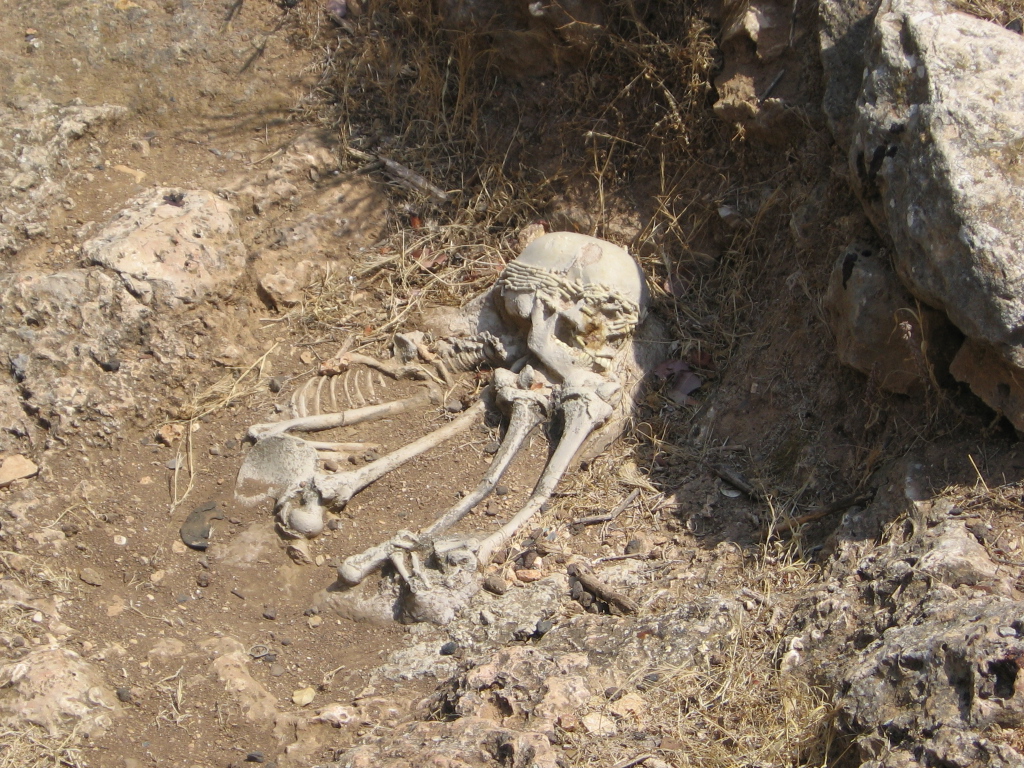
The Natufian culture predated the Israelites by millennia. They were gone by at least 7000 years by the time Israel appeared. The Natufians seem to have been the first permanent residents of a hotly disputed piece of real estate: Israel/Palestine. On Monday MSNBC reported on the archaeological find of a feasting hall among the Natufians. The story reminded my wife of similar stone-age sites that we visited in the Orkney Islands several years ago. What the story reminded me of, however, was the marzeah. The Natufian site features two activities: feasting and burial. The article notes the coincidence of 28 human burials, including one shaman, and the unmistakable signs of feasting. Bring them together and its sounds like marzeah time to me!

Natufian burial, from Wikipedia Commons

The marzeah is an imperfectly understood social institution from the ancient Levant. It is mentioned in the Bible as well as in the Ugaritic texts. Although plausibly reconstructed by modern theorists, we simply do not have a complete record of what the marzeah entailed. Two of the key elements seem to have been feasting and a funerary nature. Monotheistic religions tend to downplay the role of the dead as influential entities since they interfere with a monistic view of the divine. The two Hebrew Bible references (Amos 6.7 and Jeremiah 16.5) do not speak highly of the practice. The Ugaritic material suggests drinking may have been involved as well, further problematizing the ritual.

Now here is where the ambiguity of archaeology is thrown into sharp relief. The fact is we do not know what the Natufians were doing when they buried or feasted at this site. The Hilazon Tachtit Cave does not seem to have been a regular occupation site, and we do not have any reason to connect the burials with the feasting. Beyond a hunch. The hunch is the incredible urge to bring like things together. People excel at pattern-recognition. When I read of funerals and feasting my mind leapt to the marzeah. There seems to be no organic connection between the Natufians and Israelites (or Ugaritians), but the continuity of cultural concepts seems to strong to dismiss. Were ancient people toasting their dead with feasts that were remembered down into the Late Bronze and Iron Ages?


Can You Handle the Truth?

Time magazine’s Religion feature this week announces Claremont School of Theology’s decision to go interfaith. In response to declining enrollment, the United Methodist seminary has decided to offer training to Jewish, Christian, and Islamic leaders. Naturally, this will have to be done with the approval and support of training facilities for rabbis and imams, but it will be a way forward for the beleaguered Christian seminary. Seminaries have been in a state of crisis over the past few decades (otherwise it is hard to explain how I might have been hired by one, and a particularly conservative one at that!). And it is not difficult to see why.

Religion is, by nature, conservative. If truth is unchanging, there is no improving upon it. Religions claim to espouse the truth, so stability, orthodoxy – stagnancy – are required. Yet theological seminaries compete with graduate schools for students and faculty. Seminaries crave academic respectability – this is the entire reason for academic accreditation (my old-time colleague Daniel Aleshire of the Association of Theological Schools is quoted in the article). The basic operating premise of institutions of higher education, however, is that we are still learning the truth. We are not there yet. No God reveals the laws of physics in whole cloth (or vellum). Humans must theorize, discover, criticize, and theorize further. Meanwhile, seminaries wave their muted flags and shout, “Over here! We already have the truth!” To be accredited, they have to hire Ph.D.s who have been critically trained. Critical training does not accept simple truth claims. The result: seminaries hire critical faculty while religious authorities insist that the party line be toed. Something has to give.

Offering to bring different religious traditions together is a wonderful idea. Established religions need exposure to each other if the human race is going to survive. Exposure, no doubt, however, will reveal the amorphous nature of truth. The fact is that we are still looking for answers. Everything we have learned about religion points in that direction. What I find particularly telling about this situation is the motivation. Claremont is trying this route for financial reasons. The great god of all higher education, Cash, has finally gotten his talons into religious institutions as well. If there is any unchanging truth out there, it has a dollar sign in front of it.

In gold we trust...


Restoring Horror

Few television families are as true to life as the Simpsons. At least on a metaphorical or symbolic level. Last night as I watched the episode entitled “She of Little Faith,” I was reminded of just how large a role religion plays in this sit-com. While the majority of Springfield’s inhabitants don’t ever question the correctness of the local church, Lisa Simpson remains the avowed skeptic. Conflicted over her own sense of what is right and family expectations, she becomes a Buddhist yet continues to attend church with her family. This image of religious compromise strikes many as precisely what is wrong with organized religion today – it lacks the coercive power it once had.

In a free-market economy religious belief is a commodity to be selected and purchased. Most people are far too busy trying to get ahead to spend much time thinking about religion; it is far simpler to allow the clergy to do that. They come back to us, telling us what to believe, like some congressional report from heaven’s house of representatives. We pay them a salary and their service is to make sure we believe what keeps God happy. Religion, potentially the most powerful motivator in the world, is up for grabs like former Soviet nukes. Anyone is free to declare him or herself a religious leader, qualified or not.

So over the weekend thousands flocked to Washington to hear 2012 presidential hopefuls Beck and Palin tell them how to restore “honor” to our nation. Beck commented that his rally marks the point at which America starts to “turn back to God.” Most Americans at the rally (or those at home) seldom think about the amorphous God to which he refers, for themselves. Americans are consumers. We purchase what we like. If the God that is touted will make things better for me, then I’ll buy it. This is the price we pay for refusing to take religion seriously at an academic level. It is not about to go away. I side with Lisa Simpson as the honest individual who has an examined life. Facing opposite me on the Mall are tens of thousands who would rather be led. I am afraid. I am very afraid.


Faker or Fakir?

An article posted on CNN on Friday, “More teens becoming ‘fake’ Christians,” suggests that many American teenagers aren’t really Christian. Whether that is a bad thing or not I’ll leave up to the reader to determine (Kenda Creasy Dean of Princeton Theological Seminary, cited in the article, has no doubt that it is bad). My concern with the premise and the presentation of Dean’s data is much larger: who has the right to determine what is “authentic” religion? In a world daily faced with the clash of religious views, particularly among passionate believers, most scholars of religion seem to agree that one’s religion is what an adherent claims it to be. There is no way to test the authenticity of a religion empirically. Whose Christianity does Dean mean? That of Jesus? Or of Paul? Or of the Pope? It seems to me that what she suggests is that “true” religion is “passionate” religion.

Religion, however, may extend well beyond belief structures. Religionists recognize many forms of religion that are primarily activity-oriented rather than belief-oriented. Does that mean the adherents of such religions are only half-hearted members of their tradition? Do only passionate believers qualify? Who is it that has the authority to decide what any religion is? If it is seminary instructors, I’d rather face the apocalypse right now. I’ve known far too many of those to trust their judgment on defining authentic religion.

Christianity is perhaps the most fragmented religion in the world, with tens of thousands of different denominations, each declaring itself correct and authentic. What person ever purposefully believes in an incorrect religion? “I know my religion’s wrong, but I think I’ll stick with it…” Who gets to determine which is the real real religion? Passion may not be an adequate measuring stick. The clashes of religious views that leave the highest body counts are between groups equally passionate about their beliefs. In such a world where people need to learn to control their religious passion, it is my hope that mere theological assent might be more than enough in most cases. And only for religions that are belief based.

The only true religion?


Gort to Flood

There seems to be a society-wide fascination with the end of the world as we know it. Or maybe it is the just the perspective I bring to it. The past two decades with their breathless run up to Y2K and grappling to forge some sense out of 9/11 before 2012 rolls over us, have been awash in popular representations of how it might all come to an end. A society begging somebody to apply the brakes. We’ve got many senior citizens still around who’ve never used a computer attempting to coexist with a generation that has never been without one. From Kitty Hawk to the moon in just 66 years. I remember watching the latter on (black-and-white) television. Now I watch students walk into class with devices about whose function I can only ask Mr. Spock to speculate.

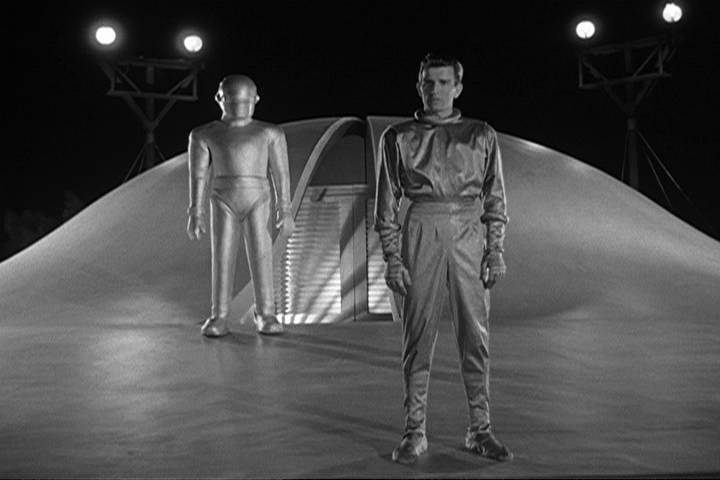
So it was that I finally got around to watching The Day the Earth Stood Still last night. The 2008 remake. Having long been a fan of the original, I can understand the insistent draw to bring it up-to-date. Even by the time Star Trek (original series) aired, it was hard to see what had terrified 1950s audiences about Gort or the idea of aliens. Thus I had great expectations when I first saw the trailers for the remake, but the reviews took the edge off my shine and I’ve only now experienced it. Naturally, I was looking for the religious angle.

Like Justin Cronin’s The Passage, the religious metaphor came in the guise of an ark. Klaatu is here to save all species except us, prompting Regina Jackson to state that after the ark is filled, the flood will come. The apocalyptic end of the world – being eaten by bugs (perhaps prescient of New York’s bed-bug infestation) – brings nanotech and the Bible together in an unhappy marriage. As soon as the authorities learn that Klaatu’s sphere is an ark they try to blow it to kingdom come. And yet Helen Benson is here to tell the tale.

We are vulnerable. For all our achievements, we fear the kids down the block that are bigger than us. Whether they be cold, emotionally flat aliens or ragingly wrathful gods, we are constantly watching the skies waiting for the next great flood.


Gnot What It Seems

Mythology has a funny way of dying. It just keeps resurrecting itself. It is the eternal return. One of the shocking truths about religions is that their cohesiveness is exaggerated for effect. The usual desired effect is power or influence over others, as in most human enterprises. Nowhere is this clearer than at the birth of religions. Since each human brain processes information in a unique way, the two people in a room with the religious founder will hear his/her teachings in their own way and neither will be identical with each other or the founder. This phenomenon has been long recognized by religionists. It is customary to speak of “Christianities” or “Judaisms” rather than suggest a fictional singularity.

Manuscript finds and serious study of early Christian texts make a strong case for two major brands of Christianity as early as the first century of the common era: “Orthodox” and “Gnostic.” The former likely arose in opposition to the latter. Gnosticism congealed out of a heady brew of Zoroastrian dualism, Judeo-Christian nascent apocalypticism, and good old “Canaanite” mythology. The teachings of Jesus could readily fit into a worldview that rejected materialism for a pure spiritual plane untainted by physical limitations and pollution. It is only a small step from here to the belief that the physical world is an illusion. Problem is, that would mean the physical resurrection was apparent only, and what does that mean for all future prospects of bliss? Better to bring down the hammer of Orthodoxy than to live with doubt.

Yet Gnosticism lives on. One of the few direct lines of descent can be found among the Mandaeans, an endangered monotheistic sect that has maintained a Gnostic dualism for centuries. Indeed, they trace their origins all the way to Adam. Gnosticism, whether recognized or not, has left its influence on concepts from The Matrix to Philip K. Dick’s novels to Rich Terrile’s theories of God. Certainly there is a draw to believing this world is an illusion and that reality lies elsewhere. Maybe in that real world there is no need for religion since everyone already knows the truth.

sursum codex


Freiheit

This week’s Time magazine has a rhetorical question on the cover: Is America Islamophobic? Not a word need be said. The real issue at stake, the one many Muslims feel the brunt of, is religious freedom. This founding concept of America has been eroding for decades. How many Americans have tried to imagine what it would be like if they were Muslims living in “the land of the free”? For that matter, how many have tried to imagine what it would be like to be Catholic, Protestant, or Unitarian? Certainly, it would seem, Jews know the value of religious freedom. Do we ever really try to feel their experience? It is much more cozy to be part of the religious majority and tell others to step in line.

With great roaring newts and Alaskan beauty queens telling them what to think, Americans are easily stoked to injustice. No, they have no right to worship here, they tell us. The truly frightening part is how easily manipulated the masses are. America a Christian nation? Who can adequately define “Christian”? Those who make such claims tend to be Neo-Cons who assume some fundamental form of Christianity is the default version. The only version. Their goals are not religious, but rather intensely selfish – the antithesis of Christianity. By their fruits you shall know them, a wise man once said. It is easy to forget who.

We live in a nation that since the Reagan years has attempted to privatize industries that had ensured fairer treatment because of government standards, no matter how faulty. Now private companies could run with the basic necessities of civilized existence and grow wealthy on them while those who were poor could be forced to pay more. This was done with the public image of a “Christian nation.” RR, the poster-child of the Religious Right. Laissez faire has come to mean “leggo my Eggo” – let me claim the one true religion and capitalize upon it. One size does fit all as long as the wealthy are left free to grow wealthier. Let’s call it religious freedom, but let’s prevent others from pursuing their religion freely. To me it feels like 1984. And that was decades earlier than 9/11.


Two Roads Diverged

Back in my Gorgias Press days one of my co-laborers (BU) suggested that I might enjoy reading Cormac McCarthy’s The Road. Since then it has come out as a movie, and further apocalyptic events have occurred – the Deepwater Horizon disaster and the election of Chris Christie come to mind – so I finally got around to reading it. It is a harrowing book for any parent to read and I doubt I have the heart to see the movie. Already the book is spawning internet quotes and quips, but I was particularly interested in seeing how this post-apocalyptic novel handled God.

Since the Bible, via Zoroastrian influence, gave us the religious concept of the apocalypse, it is fitting to see how religion fares in its unhallowed progeny. Mostly God is absent. When the man and his son mention God, the language is spare and laced with betrayal. “There is no God and we are his prophets,” the old man declares after the man and his son leave the bunker. A few paragraphs later he states, “Where men cant live gods fare no better.” The value of the apocalyptic metaphor is that it forces us to face life as we find it: raw and uncompromising. In the fictional apocalypse it is permissible to utter aloud implications of life’s callous lessons.

My career has had its share of jagged edges. The lacerations I’ve personally received have been at the machinations of Christians eager for self-justification. Self-congratulatory individuals and collectives that suppose God has specially favored them. “There is no God and we are his prophets.” It is like reading Camus in slow motion. One of the lessons both Nashotah House and Gorgias Press taught me was that it can always get worse. Reading McCarthy’s sad yet true tale of the woe we bring upon ourselves, the lesson for those eager for the apocalypse is that they have only to open their eyes.


Catskill Waiting

Catskills epiphany

We’re back from the Catskills and all they imply. One of the more obvious implications was a lack of internet access – one of the many reasons I like to frequent remote locations. I had planned this little get-away with some vague hopes of enlightenment of some kind. The quote from Melville in my last post is more than just nice prose; it is the essence of spiritual striving. I know those aren’t scientific words, but they embody the spirit of several nineteenth century American novelists I’ve read and reread. I did see a Catskill eagle while there, but I returned home still seeking an epiphany.

While briefly away from the constant demands of teaching, the bigger picture starts to come into focus. We visited Ellenville on the day of their Wild Blueberry and Huckleberry Festival – we’d just picked huckleberries ourselves in the mountains outside town – and religious groups were represented aplenty. I had noticed the many churches in this rural region, and one of the feters handed me a tract that informed me “If you have said ‘Yes’ to these three questions [have you ever sinned, lied, or stolen] (by your own admission), you are a lying, thieving, adulterer at heart; and we’ve only looked at three of the Ten Commandments.” And also, John Lennon is dead. Nothing like a little self-righteous judgment with your blueberry pie. Sirens began to blare and a fair-goer collapsed and had to be airlifted to a regional hospital. It was very dramatic.

This is where the big picture came in. When there is an accident, we take astounding measures to save the injured, suffering, or wounded. A fair-goer flown by life-flight to the hospital. At the same time, our society condones, encourages even, an unemployment scenario where even highly trained individuals are cut off from health care and self-esteem as well as income. Left to die a quiet death of desperation. As long as we don’t have to see it, death by redundancy is sanitary and sanctioned. Has this great society ever sinned, lied, or stolen? I have seen that Catskill eagle and I am still awaiting an epiphany.


Woeful Wisdom

“There is a wisdom that is woe; but there is a woe that is madness. And there is a Catskill eagle in some souls that can alike dive down into the blackest gorges, and soar out of them again and become invisible in the sunny spaces. And even if he for ever flies within the gorge, that gorge is in the mountains; so that even in his lowest swoop the mountain eagle is still higher than other birds upon the plain, even though they soar.” Herman Melville takes the credit for this passage. It is one of the many pericopes that make Moby Dick the greatest book ever written. Those who know me only as a biblical scholar may be surprised to read that, but I invite anyone who has ever instantly fallen in love with 1 Chronicles 1-9 to reply and argue the point.

Although Moby Dick has fallen into the provenance of books that are kept alive only by required high school and undergraduate required reading lists, this novel still comes back to me at many points in my life and fractured career as both a solace and a warning. Melville was clearly a man tormented by his search for meaning. He drew heavily on the Bible for Moby Dick, likening Ishmael to Ecclesiastes at one point, and the whaling haunts of New Bedford to tophets. To appreciate Moby Dick deeply, one must be familiar with the Bible.

Is this the Bible, or what?

Considering the great changes that are taking place in society, I often wonder if we have reached a breaking point. In my university life, I see students absolutely frantic to achieve an A in an easy class, one that would not have broken a sweat in my undergraduate days. Their anxiety is real; grade inflation has forged the B into the new D, or F. Yet these same students know nothing of life apart from the internet. In times like these, I betake myself to the Catskills, and with Melville, turn my eyes upward, seeking madness.