Bibles and Dolls

To celebrate my wife’s birthday, yesterday we drove to the historic Bucks County Playhouse in New Hope, Pennsylvania to see a show. The Playhouse has an illustrious history, having hosted performances including such players as Kitty Carlisle, Lillian Gish, Bert Lahr, and Robert Redford. We went to see a production of Guys and Dolls, the musical based on characters and situations penned by Damon Runyon. (My first introduction to Runyon, I must admit, was in the Alice Cooper anthem, Department of Youth.) Although we attended a performance of the musical back in the Edinburgh Fringe Festival a couple of decades ago, I’d forgotten how much the Bible moves the plot along.

Naturally, any love story that involves a Salvation Army cadet will have its religious conflicts, but it is Sky Masterson’s knowledge of the Bible that drives Sarah Brown to first give him serious attention. Without the arresting power of the Holy Bible, the love interest would never have sparked. As I frequently tell my students, without some knowledge of the Bible, American society just can’t be understood. Even Sky Masterson’s real name is Obadiah (“servant of Yahweh”).

Damon Runyon was anything but a saint. His lifestyle was diametrically apposed to that envisioned by his fictionally pure Sarah Brown – a heavy drinker, smoker, and perhaps womanizer, he was a friend of crime bosses and a noted gambler. But Runyon, like most Jazz Age Americans, knew his Bible. One of his famous phrases derives from the book of Ecclesiastes: “The race is not always to the swift, nor the battle to the strong, but that’s how the smart money bets.” From the quiet streets of an artsy hamlet in Pennsylvania to the glitzy lights of Broadway, the Bible still makes itself known. The smart money is on the one who learns to spot it.

An unorthodox sort of prophet


The Cross in my Pocket

A local woman, whom I can only assume carries a prosperity cross, has won a 211 million dollar New Jersey lottery jackpot. As I had written some months back, when I received my prosperity cross, I tried my hand at the lottery with no rewards. Having had a dream of riches a few weeks back, I again attempted the lotto, with the added ethical motivation of assisting our state’s beleaguered educational system. Still no prosperity. It seems that the divine attention was focused a few miles north and a few days late. The happy winner has gone on record (in the New Jersey Star-Ledger) as saying, “I give God all the glory for this blessing that he has given me… He has seen and knows the highs and lows of my life, and knows the good I have done, and the good I can accomplish in his name.”

This innocent statement, no doubt whipped to a froth by prosperity gospelers, reveals all the difficulty of the weekend warrior prayers for good weather. Tweaking the world in one corner, as chaos theory demonstrates, leads to disaster in another. Not that our thankful lottery winner will unleash untold evil on the world, but it is time that people of all religions stop to consider the implications of the divine bursting in upon the mundane. In my experience, when such people are asked why God chose them and not someone else, they wax mysterious and intimate that only God knows. It is part of a great cosmic secret, only cryptically hinted at in the Holy Bible.

Call it sour grapes, or the grapes of wrath, or any other viticultural metaphor, but God does not direct the lottery. Too many truly good people suffer far too much for such easy answers. Those who promote the prosperity gospel are not among the paragons of human achievement or selfless nobility. Rather they are the idols of the self-important and acquisitive entrepreneurs. I wish our New Jersey lotto winner well – I hope she will steer clear of the prosperity gospel and actually put her money to good use.


Great Balls of Fire

Gnu from WikiCommons

“I looked, and there came a great earthquake; the sun became black as sackcloth, the full moon became like blood, and the stars of the sky fell to the earth…” (Revelation 6.12-13a). With all the apocalyptic events of the past few days, some religious pundits are eagerly awaiting a rider on an extraterrestrial white horse with a light-saber jutting from his mouth. As the smoke from Eyjafjallajokull rises like a funeral pyre, a great green bolide streaks across Midwestern skies (landing, no doubt, near Nashotah House, among Wisconsin’s most paranormal locations), and this all follows an earthquake in China. More impressive than the snowpocalypse of this past winter, but less worrisome than the abrupt ending of the Mayan calendar.

All of this fuss reminded me of the way 1987 began. Having grown up in humble circumstances, one of my favorite pastimes was jigsaw puzzles. As my brother and I sat piecing one together on New Year’s Day while home on break, suddenly a loud boom shook our ramshackle house. Now I grew up in a small town built around a large refinery, and stories of the cataclysmic explosion that was sure to come raced through my head as my brother and I went outside to see the great pall of greasy black smoke that was certain to accompany such a disaster. We were met by clear skies and neighbors standing in a confused huddle in the streets. The news that evening reported that a fireball had been seen racing across the daytime skies of Ohio and Pennsylvania before it exploded some distance north of us. I’d just experienced my first bolide. It wasn’t the end of the world, but it was an event I’ve never forgotten.

The message I take from these many natural occurrences is that humanity is small. We imagine ourselves to be gods of our domain, controlling our environment and making it more to our liking. But we are not in control. Revelation was not predicting the end of the world, but was attempting to reassert a sense of control for people suffering from a perceived godless enemy. Today we still think of such events as a sign of God’s anger. I’m not sure what God is supposed to be angry about, unless he has happened to drop in on a Tea Party and heard how his name is being taken in vain.


Hate, in the Name of Love

I knew I was in trouble when I looked up the concept “codependency” on Wikipedia this morning and read, “This article has multiple issues.”

I was reminded of an article my wife pointed out to me on MSNBC earlier this week concerning Fred Phelps and his Westboro Baptist Church. My thoughts about religious freedom clash with my outrage over what may be legally classified as a religion. I’ve mentioned Phelps before, but the deeper issue here is whether freedom of religion can truly be free. Westboro is being sued (rightfully, imho) in a case that is going to the Supreme Court. His codependent hatred is causing excessive grief to the father of a soldier killed in Iraq. Phelps claims it is God’s will that he spread his Gospel of Hate.

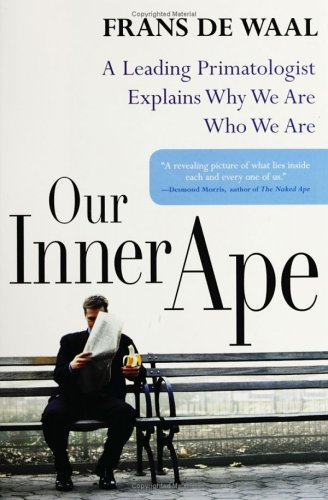
Reading Frans de Waal’s Our Inner Ape, it quickly becomes apparent that empathy is what makes human society possible. Without our ability to feel for another, nature would lead us on a selfish rampage that would not be satiated until everyone but the alpha male was ruthlessly butchered. This seems to be Phelps’ idea of Heaven. It should be a stark warning sign when apes have better bred manners than a pastor.

Hatred and religion may form a codependent bond. Each feeds off the fear and distrust of the other, striking blindly at anything that is different, challenging, or unclear. Religion does have its noble children – those who in the name of their faith try to make life better for others. If the world were run according to Phelps’ religion, however, I would opt for life on the planet of the apes.


Ape Versus Primate


I have just finished reading one of the most important books I’ve found in quite some time: Frans de Waal’s Our Inner Ape. My attention was first drawn to the author when Rutgers University sponsored a talk he gave in the fall that I was unfortunately unable to attend. Simultaneously I saw his book footnoted in a text I was reading and decided to follow up on it. In addition to containing fascinating, documented anecdotes concerning ape behavior (he tells of a bonobo that attempted to help an injured bird fly!) de Waal holds a mirror up to the great apes and sees humanity reflected back. His discussion of the origins of morality makes far more sense to me than any theory I’ve seen a professional ethicist concoct. Our sense of empathy, de Waal notes with considerable evidence, derives from our common ancestor with the apes.

After discussing the understudied trait of kindness in the apes, de Waal writes: “With morality firmly rooted in sentiment it’s easy to agree with Darwin and Westermarck on its evolution and to disagree with those who think culture and religion contain the answer. Modern religions are only a few thousand years old. It’s hard to imagine that human psychology was radically different before religions arose. It’s not that religion and culture don’t have a role to play, but the building blocks of morality clearly predate humanity. We recognize them in our primate relatives, with empathy being most conspicuous in the bonobo and reciprocity in the chimpanzee. Moral rules tell us when and how to apply these tendencies, but the tendencies themselves have been in the works since time immemorial” (225).

These might just be platitudes if ample evidence did not demonstrate their veracity. Apes plan ahead, recognize fairness, and can even see issues from the point of view of others (something Gorgias Press might benefit from learning). They are clearly inheritors of the moral sense that evolution has crafted among all cooperative animals over the eons. Religions like to lay claim to the origins of morality: we behave this way because our god told us to. In a sense that may be true, but only if the “god” is nature itself and the instruction it gives is the way for a species to thrive. Caring for one another, all religions aside, is the formula that evolution presents as the most successful choice of natural selection.


Not My Cup of Tea

The cutesy and puckish title of “Tea Party” is intended to sound whimsical among a group of political activists who lack imagination and creativity. They wear biblical-sized blinders that block out all enlightenment, trying to appear trendy and radical when what they really want is a return to the Dark Ages. Trying to make turning the clock back on progress chic and sexy, they stand for old-fashioned selfishness and the preservation of privilege for those who deserve preferential treatment – others just like them.

They grab headlines and limelight. So diametrically opposed to the progress that the real Tea Party (in Boston, 1773) strove for – progress against the privileged and mighty holding down those at disadvantage, the Tea Party movement seems to have convinced the media that it is worthy of their absconded moniker. Once again the Bible finds itself slave to an outlook. Ironically, Christians who look to the Bible as an unchanging anchor in modern society have no desire to return to the dietary restrictions and apparel requirements of yesteryear. They do not comprehend the vast gulf in morality outlooks that separate flat-earthers from space-age technocrats. A disconnect that would short-circuit the most robust processor drives their fantasy-world desire for a yesterday than never really existed.

What can a concerned biblical scholar do? Is it possible to force a conscientiously willful party that disregards facts and history to face reality? Perhaps the response should be that of the eighteenth-century Bostonians: board their ships of privilege and jettison their valued cargo utilized to create and uphold a system of abuse. Should that happen, we would soon see front-page pictures of Boston Harbor bobbing with saturated Bibles.

Mutiny on the Bountiful?


Dinosaur Ark

Over the weekend I had a detailed comment left on my post about the discovery of Aardonyx celestae, found here. Since the comment is a lengthy rebuttal, my answer begged to become a post of its own, so I present it here. The first remark I have to make is that my commenter wrongly suggested two problematic assumptions: I “don’t care” about correctly representing Creationist viewpoints and that I “ridicule Christians.” For those many students who have taken my classes over the past 17 years, it is always clear that I respect all religious viewpoints; in fact, empathy is generally cited as one of my main characteristics. I vehemently defend the rights of individuals to believe the religion they believe to be right – e.g., I do care. As for the ridiculing Christians concern, I ridicule no person. I will, however, point out viewpoints that are ridiculous, “Creation Science” being one of the most obvious. As is clear to anyone who takes the time to survey Christianity, the large majority of Christians in the world have no problems with evolution. A small but vocal sub-sect of the religion, mainly based in America, is the main Christian group that supports Creationism.

My theological assailant tells me that the Hebrew word for “kind” in the Noachian account is “min” (the root, marked as “dubious” in the standard lexicon, is myn) and that it is “much broader” than the word translated “species.” The problem here is that the ancient Semitic viewpoint has been left unaddressed. For the ancient Israelite dog was dog and wolf was wolf, and ne’er would the twain meet. Arguing that a limited evolution has taken place in order to make room on the ark is a fatal flaw to the position. Once it has been admitted that the Noah story is not literally each and every species known, it is the equivalent to the ark springing a leak mid-deluge. The commenter’s examples of animals breeding only “within their kinds” is also problematic. Such “kinds” are not recognized by “nature” and numerous examples of viable offspring crossing species have been recorded. Nature simply doesn’t abide by the neat and tidy categories that the ancient Israelites recognized. Suggesting that two sauropods were all that was needed on the ark to produce everything from Titanosaurus to Anchisaurus is a stretch for even “day-age” theorists since the genetic differences between them are as immense as their body size differentials. This slippery use of the word “kind” has all the imprecision of a god-of-the-gaps.

Did God say to take seven pair of each clean animal? My Bible reads “two of each kind” in Genesis 6.19. But wait, the story changes in Genesis 7.3. Could it be that we have two separate sources (or “kinds”) here? My commenter does not inform me where the fresh-water fish came from; after God blew the water out of the cosmic dome (Genesis 8.1) they must have had time to evolve while the salt leeched out of the low-lying basins left behind by the flood and its marvelous geography-forming power. Good thing Noah had plenty of fresh water on the ark!

“Take time to consider what scientists have already said on the issue,” my debate partner adjures me. That’s just the problem, however. I do read what the scientists say. And all of them who write without a Genesis bias tell me that the ark story is not scientifically feasible. More than that, being a life-long Bible reader, I came to that conclusion as well, based on the genre of the story (myth). I never claim to be the first to find contradictions that prove problematic for the Bible – I simply try to make my readers consider the implications of the fact that such contradictions indeed exist.

What I find so interesting about such criticism is that the author of the comment has not tested his/her hypothesis about what I actually believe. On principle I do not share my personal religious beliefs on my blog, just as I do not share them in the classroom. What I believe is immaterial to the issue of Creationism; in this issue the facts speak for themselves. The fact is “Creation Science” is science fiction.



The Danger of Books

Yesterday the Hunterdon County Library booksale began. I did not grow up as a reader. As a child, television was my primary source of information. For reasons unclear to me, I took to books when I started junior high school. Suddenly I couldn’t get enough of them. I lived in a town with no bookstores, so I usually depended on what I could find on our periodic trips to Goodwill to look for clothes. While my mother was looking for apparel for my brothers and me, I hovered over the quarter-a-piece book bin, buying up to a dollar’s worth of used books at a time. I kept my books in a ratty old suitcase under the bed. There were no bookshelves at home, nor any room for them. Besides, I liked to keep my books separate from other aspects of my life. Perhaps it is an illness, but from that day on, I have not been able to resist the draw of books. It is perhaps natural that I would go into higher education (although my field might have been chosen a bit more wisely). In any case, yesterday I drove to Flemington, New Jersey, with, at least to judge by the traffic, three-quarters of the population of the county.

One of the books I purchased had a slip of paper tucked between the leaves. When I got home I read on it, “The naked witches have been regarded either as a jokey press gimmick or as a complete non-event. The truth of the matter is that the witches played a very important role in a whole series of monster invocations.” Intrigued, I wondered what the source of this unusual quote might be. Then I was struck by the religious imagery implicit in the piece: witches, no matter how defined, are a religious subject. Monsters, as I have frequently noted, share intense neural territory with religion. And invocation? It is a liturgical term! I can only wonder what the original context of this quote might have been, but the book in which it was stuck was in no sense religious. I am a very eclectic reader (so it is perhaps unusual that I would go into higher education) and no books I purchased had anything to do with religion. It seems that religion never fails to find me.

My devotion to books often reminds me of the day when Amazon used to include bookmarks when you purchased from them. My favorite bore a quote from Erasmus: “When I get a little money I buy books; and if any is left I buy food and clothes.” It sometimes drives my wife to frustration that I still wear clothes I purchased before we were married some twenty-two years ago. My informal student evaluations on Rate My Professor sometimes comment on my out-of-date fashion sense. The reason is, however, that I buy books before clothes, and yes, even food. And when you buy used books at a library book sale, you may learn that naked witches invoke monsters, and that may be valuable information. And my clothes are never in a condition Goodwill would consider accepting when I’m finally forced to relinquish them for lack of functionality.


Older than Stonehenge

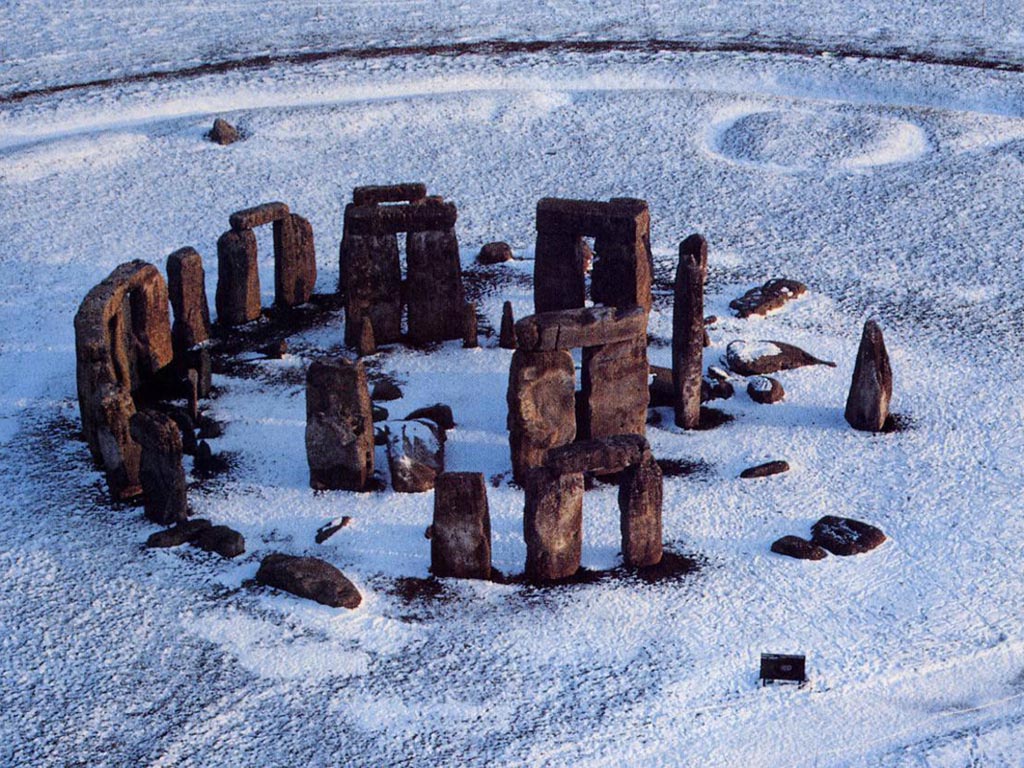
MSNBC ran a story yesterday concerning a little-known henge in Dartmoor, England. Images of these remote Dartmoor megaliths transported me back to my years in the British Isles when my wife and I spent every available tuppence traveling around to see antiquities so old that the Roman fortifications along Hadrian’s Wall seemed like throwbacks to the 1950s. With some English friends we met in Edinburgh we drove through the bleak moors of Dartmoor and Exeter, down into the forgotten curiosities of Cornwall, and back to Salisbury Plain to see Stonehenge. One year for my birthday we flew to the Orkneys (on a plane designed like a shoebox with wings) to explore the islands with the highest concentration of preserved prehistoric sites in Europe. Suffering from a killer head-cold, I accompanied my wife on hands and knees into tombs constructed thousands of years before William turned his conquering eye onto the British mainland. Colossal stone rings larger than Stonehenge, but less bulky and lacking capstones, stood out in the middle of a field where the locals barely threw a glance; such monuments had become part of the daily backdrop.

Archaeologists constantly attempt to discern the function of these silent remains. The MSNBC story suggests, based on the remains of porcine bones, that the Dartmoor site may have been associated with funerary rites. Carbon dated to 3500 BCE, they predate Noah’s putative ark (dated precisely to 1657, thank you Bishop Ussher) by more than a millennium. That they may have been associated with death is no surprise – the great feats and structures of humankind seem to be exactly that, efforts to cheat death. To leave reminders that we were here and we had something to say. What exactly they had to say, however, is muffled by the eons of lost communication.

A phenomenon I have noticed for many decades now is that when an unexplained structure or artifact is recovered, first recourse among many archaeologists is to attribute religious significance to it. Religion is the default fall-back when we can’t explain why people were expending tremendous resources to articulate a primal, deep concern in stone or clay. In many respects, the same is true today. Religious leaders still raise funds like no other class of professionals, simply by suggesting that death itself may be cheated of its due. All that money, however, can’t stop the inevitable. Instead of running away, I side with the archaeologists as I poke my head into some dank, dark space no other person has explored for many a month or year. Sitting quietly in an empty tomb left by an ancient society rendered completely mute by high antiquity, you are nevertheless in touch with what it means to be truly human.


I Have a Daydream

I don’t often comment directly on politics because I don’t like to get beaten up. I’m not a poly-sci major who has statistically verified evidence to present, and many of the issues are simply too complex for a guy like me. I’m left scratching my head like a confused ape. Nevertheless, I’ve just finished covering Micah in my Prophets class, and the eighth century prophets have a way of firing up even the most passive of souls on the issue of social justice. Also, newspaper stories continue to demonstrate that most elected officials, living in their world of privilege and power, have lost touch with the average citizen. After reading the prophets and dreaming of a better world, I have a proposal to end oligarchy and institute democracy.

No person who earns more than $100,000 a year should be eligible to run for public office. Now I live in New Jersey where the cost of living is high. I have survived here for over three years with an income far less than half of that figure, so I know it can be done. Observing the abusive tactics of bishops first-hand, I had suggested a similar measure for the church some years ago. To become a bishop an individual should be forced to take a pay-cut, bringing their income below that of those they serve. Politicians are “public servants” who’ve grown fat on the generous salaries they devise for themselves alongside their perks, kick-backs, and expense accounts. The same also applies to politicians in higher education. You want a really excellent university president? Reduce the funding for the post. Only those truly committed to the ideals of education would be willing to take on the job. Posers and playboys would have to step down.

Corporate-style greed has a strangle-hold on democracy. Most people are content to let the wealthy rule as long as they are left alone – freedom in exchange for accepting the demands of the self-indulgent. My daydream is of a world where people can free themselves from the never-ending greed of the corporate climber. And my system would not exclude anyone for seeking office. All the wealthy would have to do is be willing to live on a middle-class or lower salary for a few years. Politicians have forgotten (if they ever even knew) what is like to struggle, worry, and fear that any month, week, or day you might not be able to meet your obligations. They don’t personally watch the prices increasing at the pump or at the grocery store or on the electric bill. Their Olympian existence is beyond human suffering. It is once more time to ask, “what would Micah do?”


Sects in the City

Newsweek ran a story a few days back asking an obvious question: with all the scandal surrounding an exclusively male Catholic priesthood, why not invite women into the leadership mix? The story, by Lisa Miller, makes the point that sexual scandals have continued to deepen and widen only to be treated lightly by a hierarchy that insists sex is only for procreation. Sex between men and women, that is. If an exchange is made between males, particularly if one is under-aged, well, no souls are going to be derived from that! Although Miller’s plea easily wins on the basis of reason, when power is so deeply entrenched reason is likely to be tied to the stake and set ablaze. No, the church has made up its mind, and well, darn the torpedoes!

The church seldom embraces scientific advance without an approval period. The sexual scandal is no different. Everything that has been learned about sexuality over the last couple of centuries suggests that it’s not just for reproduction any more. Nor has it ever been. At least not in primates (both religious and mammalian). Religious organizations often test their strength by seeing just how far into the lives of subscribers they can reach. What they can control they will. The problem with sex is that it is very hard to control. It can be hidden, castigated, descried, and shamed, but it will not go away. Sexuality is hardwired into all creatures that reproduce that way. No, this is actually about power and privilege. Unchecked power and privilege inexorably lead to abuse. We expect that for the corporate world, excuse it even. Yet we hold the church to a higher standard.

Thine is the power and the glory

It is difficult for an institution raised from infancy with the assurance that God loves it best to outgrow this fantasy. Most people never examine their religion too closely — the edifice is built upon the premise that the leaders know more than the laity. Simply believe what you are told to believe. Yet no religion can lay claim to authenticity without subjecting itself to critical examination. This is the nightmare the Catholic Church now faces: two millennia of posturing and assuring believers that everything is fine are coming unraveled. And ironically the instigator is sex; that common denominator for any species with a backbone, and even some without.


Soulless Robots?

Robots have taken over my life. At least in the short term. As my friend Burke commented on Easter: “Alleluia! The robots have risen… up against us?!” Actually, the robots I encounter are benign and all follow Asimov’s rules. I have mentioned before the phenomenal First Robotics program, a venue to encourage high school students to consider careers in engineering. Team 102, Somerville High School’s robotics team, recently won a regional competition in Hartford, Connecticut. My role has mostly been to watch other people design and construct the robot while occasionally correcting the grammar on written documents. The joke my friend made, however, has at its roots a deep-seated human concern: how do people deal with soulless machines?

Stephen Asma, in his book On Monsters, has a chapter concerning the human fear of a robotic future. Electronic gadgets with uncompromising metal bodies and no consciousness that we recognize present a frightening combination. The question that concerns me more, however, is the concept of the soul itself. The Hebrew Bible has no concept of the soul as it would later be adopted by the Judeo-Christian tradition. In the Hebrew Bible a body is a soul; when the soul dies the body dies – people are a monistic unit, not a dualistic entity with a part that hangs around the spirosphere after the biological part rots away. Of course, in Christianity the soul has become an essential aspect of church doctrine and we fear other creatures that lack them. Souls have never been observed in a laboratory and we have yet to prove their existence.

Reading the news and seeing how biological, soul-fueled humans treat each other is a sobering task. Each day I lay the newspaper down with a new kind of dread. Perhaps souls are only mythical beings concocted to shore up a theology that can’t survive without them. Or maybe all living beings have souls. Perhaps even mechanical ones. As Team 102 heads to the national competition in Atlanta in the days ahead, I know that I’ll be rooting for a soulless machine that may be a bold step towards humanity’s continuing evolution.

Sorry for the blur, the robot just wouldn't stop shaking me!


Alaska’s Temblors

There are rumblings under Alaska. Some people are just a bit nervous after last week’s earthquakes in Mexico – could it be our turn next? Mount Redoubt, remote from human population zones, has been sputtering and steaming and making itself look large. It is preparing for something big.

In apocalyptic literature we see a similar image: the small horn that boasts and makes itself out to be the greatest of the ten that speckle the head of the great beast from the sea. The little horn called Antiochus, so enamored of his own abilities that he surnamed himself Epiphanes, “the manifestation.” And uncritical people, taken in by his bravado, followed him until he started torturing and killing those who didn’t agree with his religion. Those who would not bow to his own personal Zeus would be martyred in nasty ways.

Now an active volcano is sputtering in Alaska. Could it be the sign of the end times? I doubt it. The end does not come ushered in by mere movements in the earth’s crust. According to Revelation there has to be a harlot on the back of a hideous beast. And that’s only if you believe Revelation is predicting something that hasn’t already happened. No, I believe Mount Redoubt is just doing what volcanoes always do – threatening, making noise, and occasionally erupting. They may blanket their surroundings with ash and magma, but these are often only temporary postures on the part of nature. Those who have ears to hear, let them hear.

More than just a redoubtable mountain?


Clash of the Titans

Over the weekend I joined the thousands flocking to theaters to see Clash of the Titans. I first met Perseus in fifth grade and have been intrigued by classical mythology ever since. I tried not to believe that it was nearly three decades ago that I sat in the single screen theater back in Oil City, Pennsylvania watching a film with the same title and Ray Harryhausen’s famous stop-motion animated creatures. I was anticipating great things. While the new Clash is visually stunning at several points, the post-modern story line primarily demanded my attention. While there are gods galore in the film, the message is maybe not atheistic, but, to coin a word, anolatric – denying worship to the gods. Time and again Perseus refuses the help of the gods and when he finally meets Zeus, his absentee father, he shows him anything but respect.

Who let the trogs out?

The Greeks, like all ancient peoples, primarily feared the gods. Not offending deities was a societal expectation since an infraction on the part of any citizen might lead to divine repercussions. Dictys, Perseus’ adopted father, rails against the gods for allowing the degeneration of society, a trait that Perseus takes to extremes in the movie. In battling the monsters, Perseus is storming Olympus itself. In a nod to the Easter weekend crowds, Perseus defeats death himself by banishing Hades to an incongruously fiery underworld. I left the theater slightly stunned; here had been a hero standing before the very gods but refusing to worship. Clash of the Titans indeed.

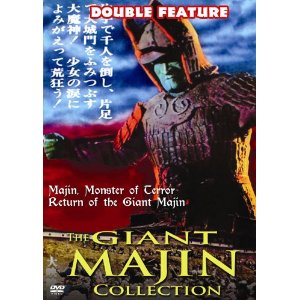
While my family was off winning the Connecticut Regional First Robotics competition in Hartford (go Team 102!), I had consoled myself the night before seeing Clash by watching the cheesy 1968 Japanese giant monster classic, Wrath of Daimajin (also known as Return of the Giant Majin). I had seen the original Giant Majin some time ago, but here was a “monster” movie where the destructive colossus was himself a god. The Giant Majin is a protective mountain deity who, when injustice grows unchecked, breaks free of his rocky home and destroys the wicked. The Wrath of Daimajin included startling biblical imagery: as the Majin stomps through the sea the waters part as if Moses were on the god’s shoulder. The faithful female protagonist is being executed on a cross (burned at the stake, but tied to a cross), and the Majin breaks the gibbet and holds her aloft, the very tableau of the evil-banishing crucifix. As always, the Giant Majin vanishes at the end, leaving the oppressed to build their own, better future.

I dream of Majin with a dark green face

Such movies are benchmarks of public theology. Made by laypersons trying to express their ideas about the divine world, I find them a crucial measure for any teacher of religion to watch, mark and inwardly digest. In just 24 hours I saw a Shinto god go Christian and a Greek polytheist lose his faith. The world just can’t figure out if the gods are for us or against us.


The Passover-Easter Complex

Some years back I completed an unpublished book for young readers on the holidays. This project was undertaken because most holidays have a religious origin and because I could find no comparable source for kids to learn this information from a reliable source. Unfortunately publishers have showed little interest. Rather than waste the effort it took to write the book, I have been installing segments here, on the Full Essays page of my blog. Since it is Easter for many Christians today, I have added the next installment: the Passover-Easter Complex. It begins like this:

No doubt the most complicated set of holidays are those that surround the changing of the seasons – the solstices and equinoxes. Among even those holidays, the Passover (Jewish) and Easter (Christian) complexes are especially complex. Like most major holidays these celebrations have very interesting roots. Problem is, it is hard to know where to begin! We’ve already started with Mardi Gras, but that is kind of a festival on its own. To really get started, we have to turn back to the calendar (again?).

Easter, like Passover, is a “moveable feast.” That doesn’t mean playing musical chairs while you eat! It means that the dates change depending on the moon, so to figure out the date you have to (you guessed it) look at the sky. (Actually, these days you can look on the web or in many books used by churches to figure it out. But work with me here, let’s pretend it is, gasp, before these things were invented!) Two days of the year have an equal amount of day and night all around the world, when the earth stands up straight on its axis. Marking the beginning of spring and fall they are called the vernal and autumnal equinoxes. (“Equinox” means “equal-night,” “vernal” means “green” or spring, and “autumnal,” duh, “in autumn.”) Back when people had no TV, this was a big thing! Not only was it cool to have equal day and night, in the spring it meant days were finally getting longer and warmer. For ancient people it meant that light was winning the struggle with darkness.

Read more…