The Passover-Easter Complex

Some years back I completed an unpublished book for young readers on the holidays. This project was undertaken because most holidays have a religious origin and because I could find no comparable source for kids to learn this information from a reliable source. Unfortunately publishers have showed little interest. Rather than waste the effort it took to write the book, I have been installing segments here, on the Full Essays page of my blog. Since it is Easter for many Christians today, I have added the next installment: the Passover-Easter Complex. It begins like this:

No doubt the most complicated set of holidays are those that surround the changing of the seasons – the solstices and equinoxes. Among even those holidays, the Passover (Jewish) and Easter (Christian) complexes are especially complex. Like most major holidays these celebrations have very interesting roots. Problem is, it is hard to know where to begin! We’ve already started with Mardi Gras, but that is kind of a festival on its own. To really get started, we have to turn back to the calendar (again?).

Easter, like Passover, is a “moveable feast.” That doesn’t mean playing musical chairs while you eat! It means that the dates change depending on the moon, so to figure out the date you have to (you guessed it) look at the sky. (Actually, these days you can look on the web or in many books used by churches to figure it out. But work with me here, let’s pretend it is, gasp, before these things were invented!) Two days of the year have an equal amount of day and night all around the world, when the earth stands up straight on its axis. Marking the beginning of spring and fall they are called the vernal and autumnal equinoxes. (“Equinox” means “equal-night,” “vernal” means “green” or spring, and “autumnal,” duh, “in autumn.”) Back when people had no TV, this was a big thing! Not only was it cool to have equal day and night, in the spring it meant days were finally getting longer and warmer. For ancient people it meant that light was winning the struggle with darkness.


Read more…


True Metaphors

I have a bad habit of taking road signs metaphorically. Not that I ignore the instructions, it is just that I consider their wider implications. While I was a tormented layman at Nashotah House I was pleased to see a road sign go up along the county lane that led directly to the main campus entrance. “Detour Ahead” it read in its reflective orange glory. I knew immediately that it was a metaphor for my life.

Yesterday as I drove to New Brunswick (New Jersey) for a student’s thesis defense, a large traffic sign that allows its message to be programmed and changed easily sat beside the road. “Expect Delays” one screen read. The next tersely stated, “Church Services.” Yesterday was, naturally, Good Friday, but I couldn’t help reading a bit more into this curt nugget of truth. My mind wandered to Galileo, Bruno, and Darwin. And to thinkers who nudge conventions outside the sciences. In fact, to societal progress itself. I thought of how often human good has been blocked by the agency of religious believers. When something new and beneficial is discovered it has to go through an approval process longer than that of the FDA – by the Church. Is this new information dangerous to doctrine, to preconceived notion? Will it damage our power structure? Can it be permitted?

Back to Joseph Campbell. Raised in the context of a Christian culture, Campbell did not believe any one mythology – he believed all mythologies. He keenly felt the loss that society incurred when it forfeited its mythic heritage and jettisoned its gods. Are we better off without them or not? The answer is still unknown. Perhaps the most appropriate traffic sign of all is “New Traffic Pattern Ahead,” and the most damning is “One Way.”

The ultimate heresy


Smile, You’re Condemned

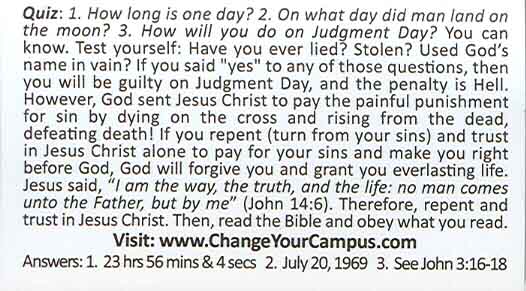
Yesterday at Montclair State University, I was sitting in the hallway (my office) prior to class. (Office hours are required, but space is limited for adjuncts such as myself.) While I was reading my book a student walked up and handed me a business card. “For you, sir,” she said politely. The card had a smiley face on it, and was designed to bring cheer.

Then I flipped the card over and found out I was going to Hell. A bit of a downer when you’re about to start class!

It isn’t the first time people have attempted to convert me without bothering to find out what I believe. It seems that if you already hold the zealot’s view you’ll appreciate the gesture of being condemned just to make sure your soul is saved. It is the thought that counts, after all.

The book I was reading was Joseph Campbell’s The Hero with a Thousand Faces – a book I’ve known since college but from which I have only taken a tipple until this year. Many scholars of mythology fault Campbell on being too much of a generalist and looking too much for connections where they are not obvious. His language can be florid and mystical, verging on “believer,” for those uncomfortable with any kind of faith. I find Campbell to be a welcome guide, although, as for any guide, I do not believe all he says! One nugget in particular stuck out at me: “Wherever the poetry of myth is interpreted as biography, history, or science, it is killed.” As we find ourselves on Good Friday, only those with eyes firmly shut will disregard Campbell’s wisdom.

I still remember my shock when I first learned that gods, centuries before Jesus, had been dying and rising. What had always been presented to me as a unique historical event actually had a long and venerable prehistory. It suddenly seemed as if the ministers I’d known hadn’t done their homework. Or perhaps they lacked the cognitive finesse to understand Orpheus, Adonis, Baal, Osiris, and even Ishtar, as types of either blatant or obscure resurrection. It is the Campbellian, or nearly universal hope: life prevails over death. As the young lady walked away, I sincerely wished her happiness in the quest she’s only beginning.


Bible vs. Bible

Back in December I wrote a post about a mother (Estelle Walker) who was put on trial for starving her children (who survived). The reason the poverty-stricken mother did this was that, as she read the Bible, God would provide for her. She prayed mightily, but the children still went without food. She was found guilty of child endangerment, and at her sentencing this week the judge, interestingly enough, cited the Bible. Noting that the Bible presents a nurturing image of mothers, the judge, Peter Conforti, said, “The court has read the Bible too. Mothers are told to love their children.” Walker’s attorney cited a “‘delusional disorder’ that caused her to have an overreliance on God,” according to Joe Moszczynski, of the New Jersey Star-Ledger. An overreliance on God, or on the Bible?

This entire sad scenario highlights the danger of viewing the Bible as a magical book of answers. In a scene that is reminiscent of the Scopes Trial, both sides of the case cite the Bible for their actions. Which is correct? Is it not both? Does this not show the problems that arise when considering a lengthy book written over a period of at least a millennium by perhaps a hundred different authors as a uniform source of legal code or ethical conduct? Yet, when swearing to tell the truth, people lay their hand on the self-same Bible while thinking it means something highly idiosyncratic.

As a teacher of Bible I have a great admiration and respect for this problematic book. One of my recurrent concerns is that a storehouse of human experience and wisdom is treated as if it were a font of magic. As if finding a statement in the Bible somehow assures us that our viewpoint is correct. The Bible is used to justify crimes and noble actions. If clergy could have a more enlightened view on just what the Bible is, perhaps believers would not be led to destructive behavior because of simple misunderstandings. Perhaps children would be fed and judges could spend their time judging cases where the Bible simply doesn’t apply.


Eternal Dampnation

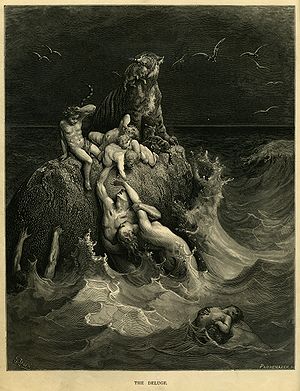
Does anybody have Noah’s telephone number? New Jersey has just experienced the wettest winter on record. Since the day records began, we’ve never had this much rain. That fact came home to me yesterday while driving the fifty miles to Montclair in a tremendous downpour. I had just purchased new windshield wipers, but the cap had fallen off the driver’s side blade. Driving on a truck-infested interstate where traffic continued to fly by at above posted speed limits, I realized with horror that at each passing swipe the rubber insert that actually swipes away the moisture was creeping out of the top of the wiper fixture. There it was, just at the top of my field of view, thrashing about like a demon-possessed snake, while my field of view grew smaller and smaller. I was in lane three of an eight-lane highway and couldn’t get over to make adjustments. In a nightmare I envisioned the slippery snake making a terminal bit for freedom and flying over my head as metal scraped glass and I drove blind into whatever lay ahead.

Well, the wiper stayed intact long enough to get me to the university. The rain did not abate, however. Even with battered umbrella and longsuffering raincoat, I was soaked below the knees by the time I squished into class. Unfortunately we studied the flood myth a few weeks ago. A few years back William Ryan and Walter Pitman, a couple of geologists, uncovered the fact that the Black Sea had been flooded by the Mediterranean some 7500 years ago. They posited that this sudden increase in sea-level around the Euxine Sea led to the dispersion of a world-wide flood myth. Their book became a best-seller and even Robert Ballard got in on the search for Noah’s homeland.

Hearing people talk about New Jersey’s incessant rain, I have no doubt that a major sea change was not necessary for flood stories to begin. As water levels rise, perhaps to the delight of whales and other blubber-laden beasts, the rest of us fear being perpetually covered by overwhelming waves. That is enough to start the story of a flood. Especially when your windshield wipers aren’t working on the Garden State Parkway.

Is it damnation or just New Jersey?


The Call of the Apocalypse

In discussing various polemics against religion, such as those by Christopher Hitchens and Bill Maher, I have frequently stated that they have a point, but they have ignored the good that religion hath wrought. It is like an Anti-Julius Caesar – the good is oft interred with the bones. Then the news goes and validates their polemic. The arrests yesterday of the leadership of the Christian militia calling themselves the Hutaree (I’m sorry, but it sounds like a happy Boy Scout gathering) highlights once more the danger that religion poses to an already unstable society. I’d not heard of the Hutaree before, and chances are I would never have heard of them had they not plotted an apocalyptic war against the United States’ government that landed them on the front page.

Few people are willing to admit just how dangerous apocalyptic thought is, or how deeply rooted it is in American politics. Tracing the roots of this form of belief is not difficult – apocalyptic first appears in the Bible when revelation through prophecy met and mated with Zoroastrianism’s dualism. The offspring of this union was the belief that a new, and better (!), age was about to dawn. God would usher in an era of peace, but it had to be precipitated by an era of war. Presidents drawn from the Religious Right have held this belief. Some have even eagerly begun wars in hopes that this ancient Afghanistanian religion would lead to the Christian apocalypse. At least the Hutaree were up-front about it: they believed that armed conflict with the government would flush out the Antichrist and usher in the end.

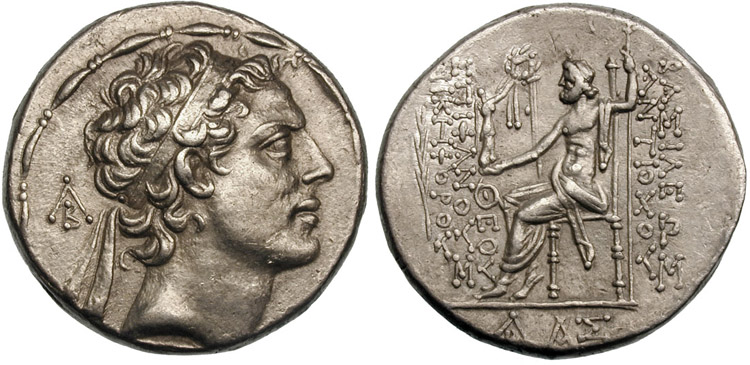
Last night in my Prophets class student questions indicated just how much interest there is in apocalyptic. We live in an era when information is all-too-easy to find, and yet many otherwise intelligent people believe that a hidden knowledge about the future is available in the Bible. It is not. For those who have ears to hear, Daniel was written about Antiochus IV Epiphanes. Revelation was written about a Roman emperor (perhaps Nero or Domitian) who threatened nascent Christianity. The apocalyptic battle was already underway. The future they longed for was peace. Modern apocalypticists see all of this as future prediction and believe that they must start the war. All of this makes me feel strangely vindicated. The FBI and other government officials are starting to demonstrate an awareness that to prevent religious extremism you must understand it. Now if only universities would catch on and realize that the study of religion is vital to national security I might end up with a full-time teaching post after all.

The original Antichrist


Civil Rights and Science Fiction

I remember reading L. Ron Hubbard’s science fiction before the Church of Scientology was widely known. Not surprisingly, the religious movement began in New Jersey – a state where anything seems possible (except finding a job or having a stable government). Over the weekend, however, a New Jersey Star-Ledger story noted that some former members of the Church of Scientology are trying to sue their religion for violation of labor laws and unreasonable pay. Lawyers predict such a case cannot win in court, and I personally wonder how such cases of enforced labor differ from other brands of organized religion that require that extra push from their members. Doesn’t the church reserve the right to demand, voluntarily of course, that citizens forfeit their legal rights?

When I was young and naïve (instead of being old and naïve, as I am now), I took my first teaching job at Nashotah House. I was not yet thirty. It was, of course, a conflicted situation: a bunch of men living in the Wisconsin woods trying to maintain a monastic presence nestled between the sinful cities of Madison and Milwaukee. (And a few women, always the minority of the student body collective.) One of only two non-clergy on the faculty, I was surprised when, in response to what was an unreasonable administrative demand I was told, “When you signed your contract, you gave up your civil rights!” I’m not a lawyer, but I learned an important legal lesson – never mess with the saintly sorts that make up the church administration. Religion is big business. And religious bodies can afford big lawyers.

I feel sorry for the plaintiffs in this legal dispute, but they are in a wide and vast company. Organized religions are human constructs, and human constructs will always favor climbers. Climbers who reach the top will always build fortresses to protect their personal interests. In the church they’ll call it ecclesiastical authority and trace it right back to Jesus handing Peter some metaphorical keys. No, the church is not above the felonies and misdemeanors that secular courts just can’t judge. Potential members should read the contract, including the fine print. And don’t be taken in by the bits that sound like science fiction.

Inventor of new worlds


Heavenly Visitors

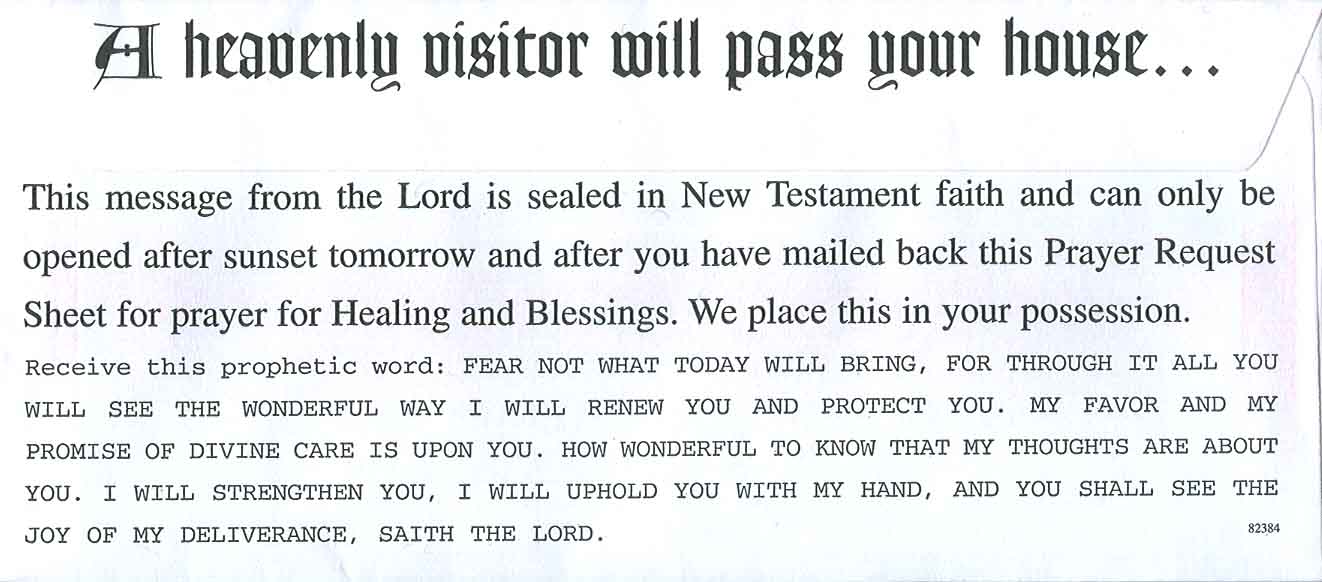
With Passover hard upon us, I was a little disturbed to receive a letter on Friday that read, “A heavenly visitor will pass your house…” Having been raised on the sturdy fare of Exodus, I knew that heavenly visitors more often take the form of marauding angels than of jocular Santa Clauses. It seemed an ominous warning. Of course, it came from the Saint Matthew’s Churches that sent me such good wishes of divine promises of prosperity some months back, so I had to assume it was a purely coincidental biblical reference. The folks at Saint Matthew’s Churches are, after all, Bible believers.

Perhaps because of that fateful letter, I dreamed, in good Genesis style, a dream two nights ago. I dreamed that I found a dollar coin on the ground at a family outing. A few feet away lay another. And another. Wherever we went in that Morpheus-bewitched town there were silver dollars unclaimed on the ground. My trousers were being dragged down with the weight of the lucre in my pockets. I couldn’t believe my good fortune! Then I awoke, still employed only part-time, still worrying every minute about whether we can meet all the bills. Perhaps the dream was a message? Should the Saint Matthew’s’ folks be right, prosperity was headed my way. Saturday’s powerball jackpot was in the double-digit millions. I very rarely play the lottery, but since state education in New Jersey needs all the help it can get, I offered up a dollar to see if Saint Matthew’s’ prosperity was at hand.

No. Not even one number came close. Perhaps there is a secret clause in the prosperity gospel contract. Perhaps those who prosper must hold certain conservative views on social issues. The views, say, my mother holds. Yet she lives in a trailer on a severely circumscribed income. That doesn’t seem to be it either. Last night I awaited another dream. Instead, the next-door neighbors were holding a loud party until 3 a.m. Perhaps celebrating Palm Sunday? Or perhaps that was the heavenly visitor passing over for Passover a couple of days early? Either way, I didn’t sleep well last night knowing that something was just outside my window.


Lying Literalists

“I hate, I despise your festivals, and I do not delight in your solemn assemblies!” The words of some godless communist? A disaffected liberal? An angry atheist? No. These stark words come from Amos, the prophet. Each year when I teach my course on the Hebrew Prophets I am struck by how strident their words are. For Fundamentalists and others who take the Bible literally the words belong to none other than the Big Guy. The Primal Y. G-d. God hates the worship conducted in a land where injustice reigns.

Although the basic principles sound correct, it is clear that America cannot really be considered a just society. There are a few too many families without enough to eat, a few too many homeless on the street-corners of our cities, a few too many unemployed. And a few too few filthy rich. There is plenty to go around, and one might naively think prosperity might trickle down. It doesn’t. I’ve always been amazed to see the girth of many prosperity gospelers who inveigh against the unrighteous. A sturdy measuring tape might tell us all we really need to know about righteousness.

Bible believers do not believe in the Bible. They accept the message they wish to hear, that God loves those who are rewarded with wealth, but the message of Amos they have little time for. They miss the part where the prophet calls them cows of Bashan that are fat for sacrifice. Yet when they flip out their iconic Bibles the theologically illiterate follow them to the polls. The more they pound their Bibles the more they are beating innocent victims. Be careful before becoming a Bible believer – it is not always a comfortable place to be!


Two Mites for the Truth

“Abuse scandal puts heat on Vatican for more transparency,” runs a headline on the front page of today’s New Jersey Star-Ledger. The reference, of course, is to the recent divulging of alleged abuse that implicates the brother of the Pope. The wording of this particular headline, however, contains the kernel of a very important religious preserve. Like the X-Files, religious structures thrive on secrecy. If the mystery were removed from religion, what would be the motivation to believe? Science provides facts and theories that do not require as much belief as they do acquiescence. Religion, on the other hand, deals with intangibles shrouded in murky darkness.

Religions cannot be transparent. “Naked business” models simply do not work when the wealth of the ages is at stake. Few religious believers ever question how or why the leaders of their traditions hoard wealth and valuable objects and real estate. The great medieval European cathedrals, as magnificent as they are, represent loss, pain, and toil on the part of a great many faithful. Those with severe consciences will always drop an offering in the plate, basket, or tray when divine pressure is laid upon them. Even if they really cannot afford it. Two mites for the salvation of an eternal soul is a real bargain!

No one can truly claim to have comprehended the whole of a religion. After all, many religions have centuries of accumulated lore and tradition that must be passed along in ways opaque to the general issue believer. If glass walls were erected around every seminary and religious training institution, those who have not had the experience of being involved in clergy instruction would find the sight blinding. No, religion will never be transparent. Nor will it ever be extinct. It is simply far too easy to believe what one is told.

Two mites, and then some


Jesus Lets Himself Go

Leonardo da Vinci's Last Supper


Carpentry is hard work, as Jesus must have known. The occasions when I head to the basement and chew through wood with an electric saw and nail boards together through pre-drilled pilot holes always leave me feeling like I’ve burned a few calories. Not to mention walking everywhere. No Hondas, Volkswagens, or Smart Cars in those days. A guy could sure build up an appetite. My wife pointed me to Newsweek’s blog this week, where a story about the portion sizes portrayed in paintings of the last supper over the past millennium is posted. The conclusion drawn: the food servings have continued to escalate in size as food production and acquisition have become easier.

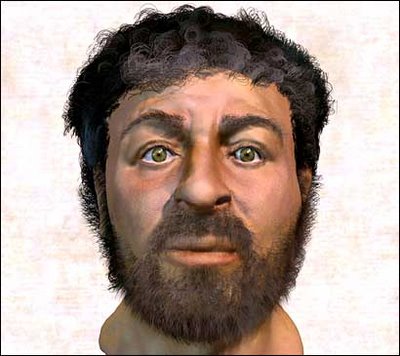
This is not so surprising, given that what people value is what they portray in art. As I’ve mentioned before, Stephen Prothero, in his book American Jesus, demonstrates that portraits of Jesus reflect the self-perception of the society in which they are produced. Few attempt to make a life-like representation, largely because no one knows what Jesus might have looked like.

Jesus as an ordinary guy

A few years back, Richard Neave, a retired medical artist from the University of Manchester reconstructed, based on forensic research, what he believes Jesus likely looked like. The portrait is not handsome, and to be fair, not based on the actual skull of Jesus which has been missing for a couple of millennia. I used to ask my students in Intro to Christianity what difference it would make if Jesus was not good-looking. They tended to react strongly – particularly those of Christian disposition – there was an inherent blasphemy in suggesting that Jesus might not have been drop-dead handsome.

Now, if we gently push his chair back into that fateful table one more time, we might wonder how an overweight Jesus might appeal to those who struggle with weight issues. More of him to go around, as the saying goes. I’ve viewed much religious art in my time, but I’ve never seen a love-handled Jesus, let alone a chunky savior. And perhaps that is the biggest miracle of all, given that he eats more each passing year.


Mournful Metaphor

Sometimes the concept is great but the results disappoint. Those who have followed this blog know that a unifying concept over the past half-year has been the often hidden relationship between religion and monsters. Certainly this fascination has its roots in my refusal to admit that I’ve grown up, but with the popular media pushing the undead into our collective consciousness on a daily basis I feel a happy vindication. I posted last week about Seth Grahame-Smith’s new book, Abraham Lincoln: Vampire Hunter. Well, now that I’ve finished the book I would say that the jarring concept of our most honored president leading a secret life was fun to wrestle with, but the book failed to win me.

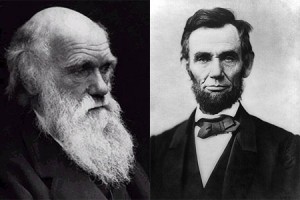
Lincoln’s great contribution to our nation is still echoing through a society slow to admit the equality of all. Perhaps that fact alone would render any book trying to throw some comic relief on a deadly serious issue mute before it even begins to spin its yarn. That, and I didn’t like the portrayal of the vampires. I’m no undead purist, and I’m aware that vampires have changed form and character over the centuries, but having masses of them in one place felt like being the proverbial cat-shepherd. Giving them political ambitions, with a nod to Francis Ford Coppola’s Bram Stoker’s Dracula, was too much. The issue of slavery, clearly the metaphor being utilized by Grahame-Smith, is hard to smile about. Lincoln’s personal suffering is difficult to lighten with his career as a vampire hunter. The story just didn’t work.

I’ve had enough bumps in my own life to eschew easy categorization. Even my current career must be listed in the TBD category. Nevertheless, I wasn’t sure if what I was reading was a serious attempt at a novel or a humorous exploration of a funny idea. I found the book catalogued in humor, but its narrative seems to have the earnestness of a determined novelist. When the story ended I felt as if I’d read a dime-store novel I’d purchased at Comedy Central. And with the headlines the way they are these days, I’d been hoping for a good laugh. Instead it seems that I have been bitten by a vampire wearing shades.

Two heroes, no smiles


Naughty Religion is Bad Science

In the continual struggle of Fundamentalist Christianity against the rest of the world, new Creationist grounds have been made in Connecticut. Connecticut is not exactly the first state to spring to mind when it comes to extremist conservative religion, but Fundamentalism knows no bounds. Perhaps the largest disappointment, from the point of view of a student of religion who knows the Fundamentalists a little too well, is that otherwise intelligent people simply accept what their clergy tell them. Having been a seminary student and professor, however, I know the kinds of training clergy receive and if the whole wide world knew things would be different.

Clergy of all stripes of all denominations of all religions are just as human as the rest of us. They do not have special physiognomic features in their brains or hearts or cellular structures that allow them to receive private messages from God/the gods. Many are trained in special schools where people like myself teach them, often against the blustering of their clergy supporters back home, what we factually know about the Bible and other aspects of religion. Many successfully block out what they are forced to hear and emerge just as ossified, if not more so, as when they entered. In other words, their “education” has been an exercise in learning to ignore the truth. They are then made into clergy who continue the deception. Even worse are the clergy who receive no training at all, frequently fresh from an overly-heavy-dinner-induced religious experience, who claim that the biological responses to overtaxed gastric juices is some message from beyond.

The average citizen naively accepts the religious credentials of their clergy, supposing that this “holy” person has had some special word from on high. That word is often factually wrong, especially concerning evolution and the origins of life, but it is accepted as gospel truth and disseminated among unsuspecting children. Religion is a matter of belief, not of fact. As America lags farther and farther behind even developing nations in science education, Fundamentalist clergy give a self-satisfied smile. They have become the gods of a nation that was once able to land some of its citizens on the silvery moon in that great literal dome that surrounds our flat earth.


Grounds for Sculpture

Few people would deny that religion and art share a common heritage. Some of the earliest human art was religiously motivated (I would contend that cave paintings and Paleolithic figurines were religious objects), and much of the contemporary art scene derives its inspiration from religious motifs and constructs. Not all art is religious, however, and not all religions are friendly toward art. Nevertheless, there is a tangible connection.

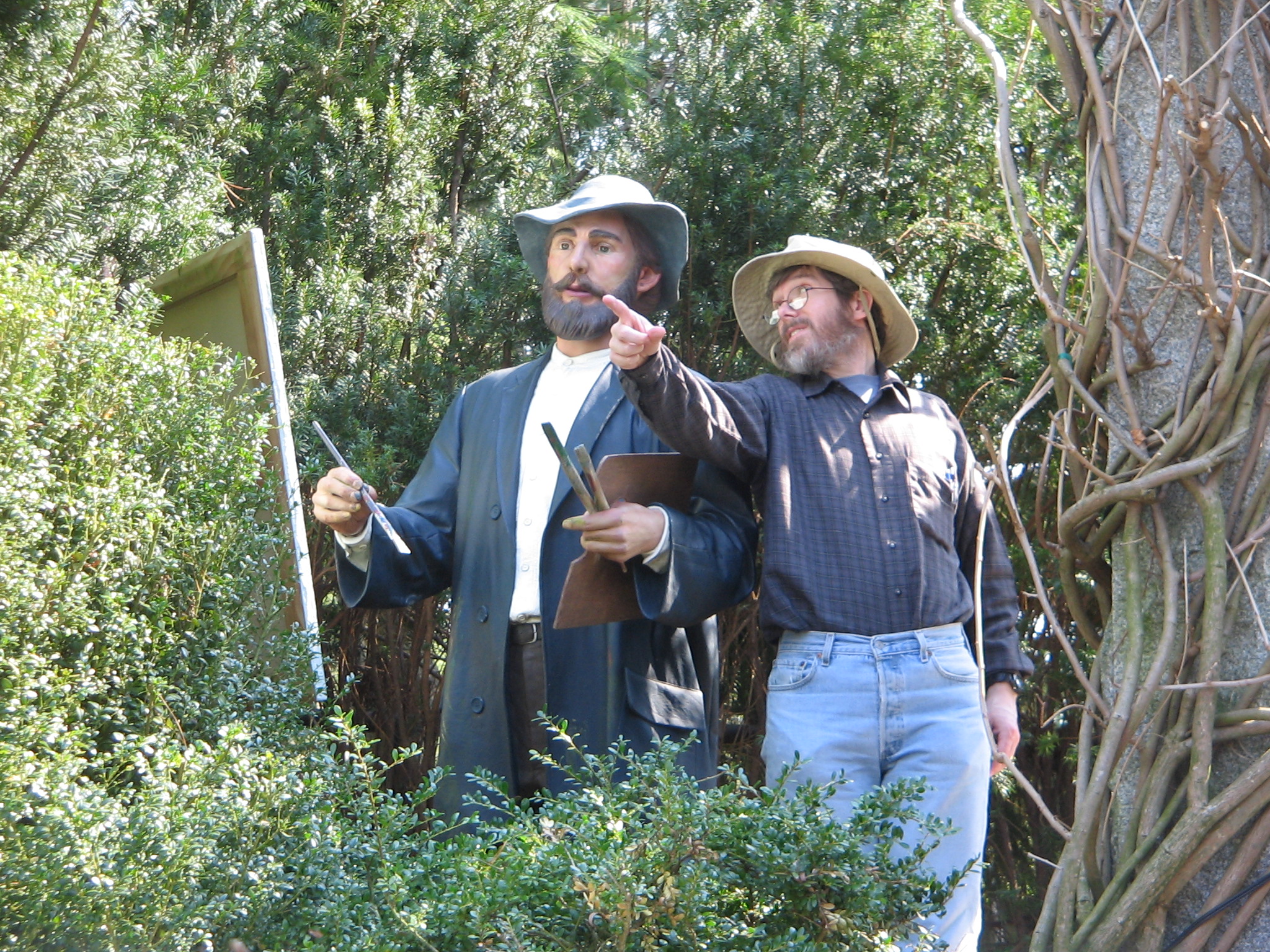
This weekend was uncharacteristically warm and sunny for a New Jersey March. This led us to take our visiting family to Grounds for Sculpture, one of New Jersey’s often overlooked treasures. Built on the remains of the old State Fair grounds in Hamilton, this park houses an impressive array of outdoor sculpture that is contemplative, innovative, puckishly funny, and even a little weird. It reflects the human experience. My family and I have been there multiple times, appreciating the sculpture from new angles, discovering new pieces, and seeing it all through the eyes of others.

Taste in art is highly personal and individualistic. Just like religious sensibilities. Both art and religion seek to make the human soul accessible to others through profound expression. Several of the sculptures in this unique garden bear biblical titles or suggestions, but they may be enjoyed as secular pieces of expression as well. Here is where art is superior to religion: it does not insist on any single way of expressing the truth. Sometimes, it seems, art may actually attain what religion only aspires toward.

Monet listens attentively to a dilettante


Evil Echinoderms

Ever since I can remember, I have longed for the ocean. Not a good swimmer, and not one to eat the myriad creatures that fill its immense waters, I find myself nonetheless drawn to its endless pounding surf and salt spray. Even before I’d read Rachel Carson’s The Sea Around Us, discovered the eternal fascination of Herman Melville’s Moby Dick, or had even heard of H. P. Lovecraft, I knew that I belonged to the ocean. It need not compete for my affection. It had already won. With family visiting this weekend and with an unseasonably warm March weather-system, we went down to the Jersey Shore yesterday to visit my old friend. Sandy Hook is a peninsula that juts up from New Jersey toward New York City, a sandbar of undeveloped free ocean access administered by the National Park Service. During the summer it can be intensely lined with fishermen and sun-worshipers, but in March it was a reasonable place to be. Sea creatures are abundant when left alone, and we saw our first harbor seal of the season, along with a galaxy of sea stars. These echinoderms had eluded me thus far; we’ve been to the shore several times during our Jersey days and had never discovered any. One large sea star had been stranded in an evaporated tide pool. Compassion overcame me and I carried it down to the surf to offer it a chance for continued survival.

Miserable sinner?

Recently I reread Jonathan Edwards’ horrific yet classic sermonic masterpiece, “Sinners in the Hands of an Angry God.” Vividly depicting a furious deity barely capable of restraining his repressed wrath directed toward wicked human beings, but for an uncommon dose of misplaced compassion, Edwards suggests we all deserve ghastly destruction. Edwards underscores one of my recurrent observations about religion – it is a means of control. The great Puritan divinity only accepts penitent Puritans, all others go directly to Hell, not passing Go, not collecting their two-hundred dollars.

As I held that helpless sea star, destined for the cruel, drying rays of an unclouded sun, I did not think of its multiple transgressions. Murderous predators, sea stars consume other sea creatures, including their own kind, in the constant struggle for survival. This one had obviously had a successful run and had grown to an impressive size. I felt no rage, no desire to destroy this killer. Instead, I saw a radiant example of a being evolved to live in an environment that I can not even comprehend, just doing what it needs to get along in its undersea world. And I recognized the wrath of God for what it really is – one man’s unfulfilled plan to decide the destiny of his fellow creatures.