
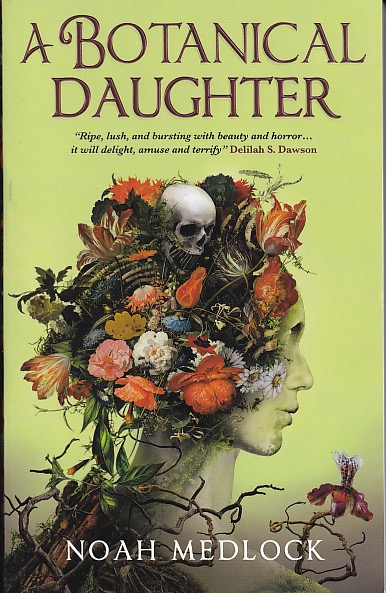
A friend recommends weird fiction for me to read, and I have said friend to thank for Noah Medlock’s A Botanical Daughter. A species of Frankenstein story, with a kind of botanical Dr. Moreau, this horror novel always keeps some fun in place as the story unfurls. Gregor, the eponymous botanist, and Simon, his lover, the taxidermist, work together to fuse a recently murdered young woman with an exotic fungus species from Asia in their greenhouse home in Victorian England. This fungus is sentient, and fusing it to a corpse is meant to give it, or better, her, mobility. Their local housekeeper, not aware that the corpse belongs to her best friend, falls in love with the fungus woman, who also hosts and blooms flowers, ferns, ivy, and occasionally thorns. Since Gregor and Simon have a relationship technically illegal in the Britain of the time, they remain in their greenhouse as they try to contain, but also know, their botanical daughter.
When other people visit, which is not often, the plant woman is quite capable of reading their evil and taking justice into her own tendrils. The resulting plot is strange and compelling. The next step is never very obvious, and Gregor makes himself quite unlikeable fairly often in the story, going from loving his created daughter to insisting that she’s an evil fungus that shouldn’t be given any credence for having personality. He, however, supplies the wealth that makes the experiment possible, and does have the curiosity of a scientist who has crossed a boundary best left well out of reach. The daughter is the most captivating character in this blended household. And there is a body count along the way. People hate what they can’t understand and this leads to considerable tension in the village.
I’m glad to have read this tale, and I’m sure it will provide me with quite a bit to ponder for a few days. The real monsters, as is usual in scenarios such as this, are those who can’t accept someone who is different. Gregor, othered himself, is sometimes the monster, but at the end is not clearly cast as such. There’s never a question as the the daughter, or the housekeeper’s motives, which are pure. Religion plays a role in the tale as well, as befits a book that was recommended to me last year at the AAR/SBL Annual Meeting. It was appropriate reading at this year’s meeting, to prepare facing long days hearing about other people’s book ideas.

