LOL Cat Bible Commentary, Part 1

It was bound to happen. Here is the first installment of the LOL Cat Bible Commentary.

Genesis 1.1 Oh hai! In teh beginning Ceiling Cat maded teh skys an teh Urfs, but he no eated them.

In teh beginnin
In teh beginnin ub teh dai — Ceiling Cat nawt wurk at nite, cuz datz wen
Basement Cat come owt to do ebil stuffz.
Ceiling Cat
Ceiling Cat writed da Bible. He’z the mos smartess an strongess kitteh ever. An him reely good — he no eat other kittehs fud, an he nebber jumpz on another kitteh in da middul ub teh nite (but for hoomuns dis ok).
maded teh skys
But first him taked a nap. Den Ceiling Cat maded teh skiez so him had place to liv. An den him putted a hole in da ceilin so him kood peep down on teh Urfs. Wait, him nawt maek teh Urfs yet! Ai sowwy, plz to furgive? Kthx.
an teh Urfs
K, nao Ceiling Cat maek teh Urfs. Urfs is where the hoomuns howse iz.
Ceiling Cat no maek teh udder Urfs, jus da wun wif da howse.
but he no eated them
Ceiling Cat can has a hunger after awl taht wurk, Aifinkso! But him no eated teh skiez, cuz den him fall owt, an den dere no moar kittehz to wurk on da Urfs. An him no eated teh Urfs howse, either. Him wanted to maek teh birdiez an teh moal an teh fishiez. An him also want to maek teh hoomuns for to maek his fud.

1.2 Teh Urfs has no shayps an has darwk fase, an Ceiling Cat roed invisible bike ovah teh wawters

Teh Urfs has no shayps
Cuz Ceiling Cat nawt evur maded a Urfs befoar. Him not no wut Urfs shayp iz!
an has darwk fase
Ceiling Cat can to seez in teh darwk, but dere nawt eny shayps to seez. The Urfs has dawrk fase liek teh howse wif no elec…elek…elekt…wif no lytes.
roed invisible bike
Liek him wuz dreemin. Invisible bike is hawrd to be finded in teh dawrk, but Ceiling Cat maded it an him finded it.
ovah teh wawters
Ceiling Cat nawt liek to get him feetz wet, so him no rided teh bike thru taht wawter. Wawters has see monsturs an stuffs.

1.3 At furst, has no lyte. An Ceiling Cat sez, “I can has lite?” An lite was.

At furst, has no lyte
Ceiling Cat nawt need lyte, but him noes taht hoomuns will to need lyte for to maek noms.
An Ceiling Cat sez
Ceiling Cat has to tawk to himself cuz of monokittehism. No udder kittehs arownd yet, not ebben Basement Cat.
I can has lite?
Ceiling Cat reely wanted a cheezburger. But him needed a hoomun for to maek cheezburger. So him has to maek teh lyte for to get noms.
An lite was.
Nao him can to see howse an da Urfs he maded. Den him maded lolz an udder stuffz, but first him taek moar napz.

(Translated into LOL Speek by the world’s greatest CATS! Fan Kthx)


Thoughts Off de Waal

Although Frans de Waal’s Our Inner Ape was published half a decade ago, the monograph remains terribly relevant. I gave some primary impressions of the book last week, but one section has remained firmly in my head and has mingled with all the harsh rhetoric in the news about health care reform in the United States. Asking the question of whether Homo sapiens are still evolving biologically, de Waal withholds his final opinion on the matter, but he points out that statistics indicate Americans are falling behind much of the rest of the developed world in terms of general health. This he ascribes to the competition inherent in a free market economy that favors the best health care only to the wealthy while the average citizen is offered substandard options. The numbers bear him out on this – he notes that on the standards utilized to measure general health, the United States is not even in the top 25 industrial nations.

With the conviction of a true prophet, de Waal notes that privatization of health care has led to a precarious imbalance in medical care in the United States, where the top 1 percent of citizens has more income to spend than the bottom 40 percent combined. This, he believes, is because we have lost sight of the altruism inherent in apedom. Although the great apes are endangered (ironically, by their overly greedy genetic cousins) their societies show no such disparity. An ape family will assist a weakened or feeble member and give it extra care to ensure that it is offered a life as comfortable as possible. They do not discard the fragile and “expendable” members. Republicans, however, wave placards trying to shout down basic health coverage for the poor.

Does biological evolution continue among the human species? Have we stopped natural selection’s eternally ticking clock? Only time will tell. It does seem, however, that the very Bible pounded by the Religious Right (health care reform’s greatest opponent) would argue that the apes got it right. We should care for the poor, disadvantaged, and underrepresented. While the Tea Party belles are busy trying to rewrite history with America founded as a Christian nation they daintily wipe their mouths on the pages of the very book they treasure so deeply and claim as their authentic heritage.


Bibles and Dolls

To celebrate my wife’s birthday, yesterday we drove to the historic Bucks County Playhouse in New Hope, Pennsylvania to see a show. The Playhouse has an illustrious history, having hosted performances including such players as Kitty Carlisle, Lillian Gish, Bert Lahr, and Robert Redford. We went to see a production of Guys and Dolls, the musical based on characters and situations penned by Damon Runyon. (My first introduction to Runyon, I must admit, was in the Alice Cooper anthem, Department of Youth.) Although we attended a performance of the musical back in the Edinburgh Fringe Festival a couple of decades ago, I’d forgotten how much the Bible moves the plot along.

Naturally, any love story that involves a Salvation Army cadet will have its religious conflicts, but it is Sky Masterson’s knowledge of the Bible that drives Sarah Brown to first give him serious attention. Without the arresting power of the Holy Bible, the love interest would never have sparked. As I frequently tell my students, without some knowledge of the Bible, American society just can’t be understood. Even Sky Masterson’s real name is Obadiah (“servant of Yahweh”).

Damon Runyon was anything but a saint. His lifestyle was diametrically apposed to that envisioned by his fictionally pure Sarah Brown – a heavy drinker, smoker, and perhaps womanizer, he was a friend of crime bosses and a noted gambler. But Runyon, like most Jazz Age Americans, knew his Bible. One of his famous phrases derives from the book of Ecclesiastes: “The race is not always to the swift, nor the battle to the strong, but that’s how the smart money bets.” From the quiet streets of an artsy hamlet in Pennsylvania to the glitzy lights of Broadway, the Bible still makes itself known. The smart money is on the one who learns to spot it.

An unorthodox sort of prophet


Not My Cup of Tea

The cutesy and puckish title of “Tea Party” is intended to sound whimsical among a group of political activists who lack imagination and creativity. They wear biblical-sized blinders that block out all enlightenment, trying to appear trendy and radical when what they really want is a return to the Dark Ages. Trying to make turning the clock back on progress chic and sexy, they stand for old-fashioned selfishness and the preservation of privilege for those who deserve preferential treatment – others just like them.

They grab headlines and limelight. So diametrically opposed to the progress that the real Tea Party (in Boston, 1773) strove for – progress against the privileged and mighty holding down those at disadvantage, the Tea Party movement seems to have convinced the media that it is worthy of their absconded moniker. Once again the Bible finds itself slave to an outlook. Ironically, Christians who look to the Bible as an unchanging anchor in modern society have no desire to return to the dietary restrictions and apparel requirements of yesteryear. They do not comprehend the vast gulf in morality outlooks that separate flat-earthers from space-age technocrats. A disconnect that would short-circuit the most robust processor drives their fantasy-world desire for a yesterday than never really existed.

What can a concerned biblical scholar do? Is it possible to force a conscientiously willful party that disregards facts and history to face reality? Perhaps the response should be that of the eighteenth-century Bostonians: board their ships of privilege and jettison their valued cargo utilized to create and uphold a system of abuse. Should that happen, we would soon see front-page pictures of Boston Harbor bobbing with saturated Bibles.

Mutiny on the Bountiful?


Bible vs. Bible

Back in December I wrote a post about a mother (Estelle Walker) who was put on trial for starving her children (who survived). The reason the poverty-stricken mother did this was that, as she read the Bible, God would provide for her. She prayed mightily, but the children still went without food. She was found guilty of child endangerment, and at her sentencing this week the judge, interestingly enough, cited the Bible. Noting that the Bible presents a nurturing image of mothers, the judge, Peter Conforti, said, “The court has read the Bible too. Mothers are told to love their children.” Walker’s attorney cited a “‘delusional disorder’ that caused her to have an overreliance on God,” according to Joe Moszczynski, of the New Jersey Star-Ledger. An overreliance on God, or on the Bible?

This entire sad scenario highlights the danger of viewing the Bible as a magical book of answers. In a scene that is reminiscent of the Scopes Trial, both sides of the case cite the Bible for their actions. Which is correct? Is it not both? Does this not show the problems that arise when considering a lengthy book written over a period of at least a millennium by perhaps a hundred different authors as a uniform source of legal code or ethical conduct? Yet, when swearing to tell the truth, people lay their hand on the self-same Bible while thinking it means something highly idiosyncratic.

As a teacher of Bible I have a great admiration and respect for this problematic book. One of my recurrent concerns is that a storehouse of human experience and wisdom is treated as if it were a font of magic. As if finding a statement in the Bible somehow assures us that our viewpoint is correct. The Bible is used to justify crimes and noble actions. If clergy could have a more enlightened view on just what the Bible is, perhaps believers would not be led to destructive behavior because of simple misunderstandings. Perhaps children would be fed and judges could spend their time judging cases where the Bible simply doesn’t apply.


WWJWF?

On the way to work yesterday, my wife spotted an old billboard ad that read, “My birthday wish: Protect life from conception until natural death. Jesus.” Now, I realize that this is a belated birthday response (or perhaps premature – scholars of the Christian Scriptures tell me Jesus was likely born in April), but I felt compelled to exegete this wish. In the biblical world, which, by definition, includes Jesus, there was no such thing as conception as we know it. Ancient folk did not know about sperm and ova, and so “conception” was simply the act of carrying a child. When it began they did not know. The Bible is pretty clear that breath indicates life, so life begins at the moment of the first breath. Everyone in the first century knew that.

As a good Jewish believer, Jesus also knew that the Bible dictates scores of reasons that life would not end naturally. Many acts considered normal and healthy today were singled out in the Torah as offenses against the almighty, and many were worthy of the death penalty. If natural death is the divine will, well, father and son ought to have a heart-to-heart talk. I will go on the record as opposed to capital punishment. Heck, I’ll go on the record as a pacifist and a vegetarian too. I do so, however, fully aware that the Bible has a different view.

My concern with billboards like this is that they co-opt a figure who cannot correct the human errors of misreading emotion for righteousness. Anyone with money can make up a birthday wish for Jesus and, with a willing vendor, splay it out for all passing motorists to see. I respect the sanctity of life, but I don’t force my wishes into Jesus’ mouth. We have the Bible, we have brains. For those who want to know what Jesus really wished for, it is a simple a matter as reading a book.


Archaeology in the Service of Politics

People are political creatures. Unfortunately. Politics, as most honest observers of society admit, serve the interest of the ruling party over the good of the whole. This is a nearly universal human flaw; a glance at any newspaper will demonstrate its prevalence. Those who practice politics can hardly be blamed for using the system they’ve inherited, but the system leads to many instances of unfortunate posturing and suffering. Clearly seen in Middle Eastern current events, it is nonetheless no less so in the “western world.” Often in both political arenas the Bible is invoked.

An article in this morning’s New Jersey Star-Ledger bears the headline “Archaeologist links ancient wall to Bible and King Solomon.” The story goes on to describe how excavations in Jerusalem outside the Temple Mount have unearthed a stone wall that might have been part of the legendary temple of Solomon. Of course, putting biblical names to mute structures amounts to voicing ownership claims. Solomon is not a historically attested individual yet – the only source referencing him is the Bible – and claims to have found his temple are premature. As the story states, “Palestinian archaeologists have criticized their Israeli counterparts’ rush to link finds to the Bible.” Amen. So they have; the structure itself is used as a form of dominance. Eilat Mazar, the archaeologist named in the article, is quoted as having said that this wall, “testifies to a ruling presence.”

The Haram es-Sharif, or Temple Mount, is one of the most hotly contested pieces of real estate on the planet. Embedded within these claims are acclamations of ownership. This brief post does not offer the space to unfold the complex issues in any substantial way, but it is an opportunity to note how archaeology is often used to establish tenuous holds on a past that is too foggy to penetrate. Like the classic dystopias of the twentieth century, politically oriented individuals use the evidence to write their own versions of the past. Pasting the name of an uncertain Solomon on a building that the Bible states was built by Phoenicians is an ironic historical twist indeed.

Gnu Jerusalem from WikiCommons


Prosperity Fail

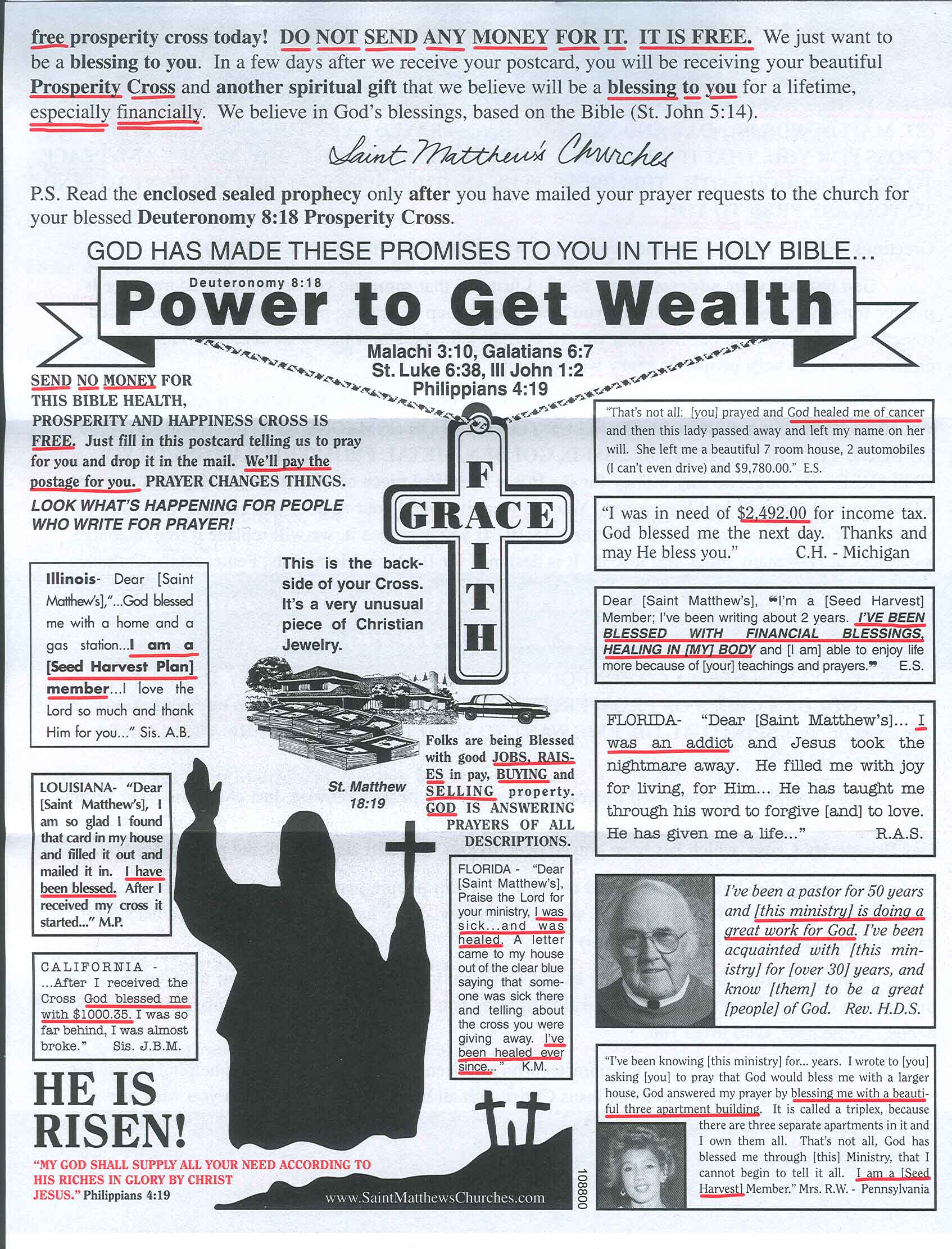
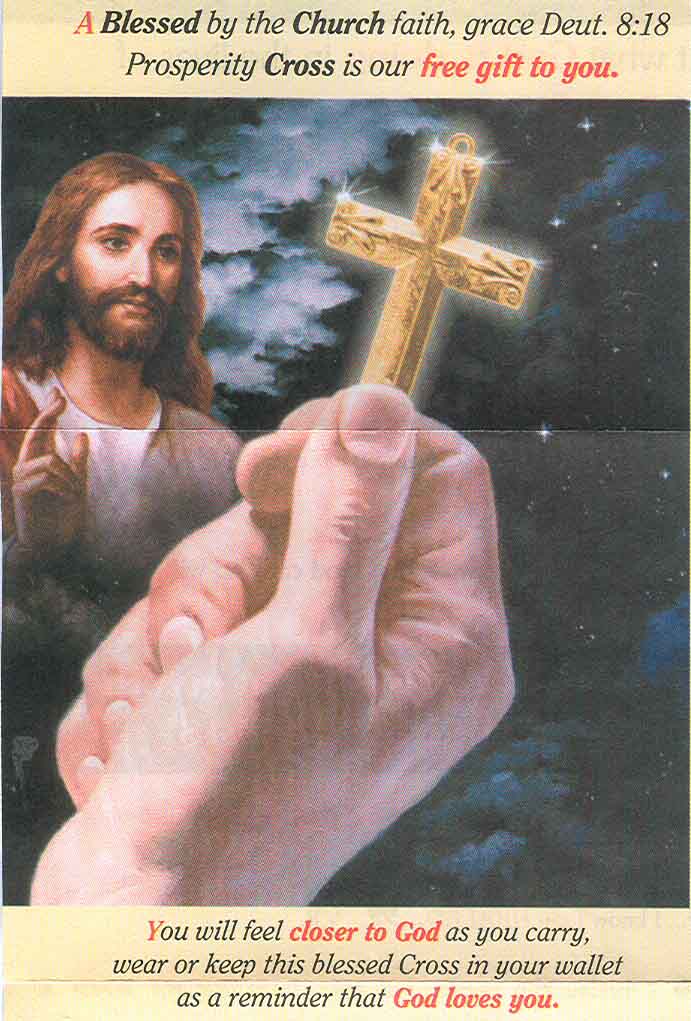
Every so often I receive unsolicited mailings from impersonal churches intimately addressed to “Resident.” Invariably these churches tell me that God wants me to prosper (although he has a funny way of showing it sometimes), offer to send me some totem to make it possible, and assure me of their general goodwill. Yesterday’s mail brought me a packet from Saint Matthew’s Churches offering to help me become wealthy by receiving a free golden cross just for responding — post paid! — to their offer. Clearly such mailings are intended to target readers down on their luck. Since I’ve been without a full-time job since July, I meet their demographic rather well. My response, however, may not be what they hoped for: I plan to send no money.

I wonder how deeply these prosperity clergy consider the impact of an unemployed individual receiving their vain promises. Sometimes when the under-employed receive such hollow promises it feels like a god-slap. Oh! If only I had been wearing this free cross I wouldn’t have had to suffer such bouts of depression and self-doubt! It was just that simple! And the Holy Bible says so too!

Those of us who’ve tried to make a living of studying the Bible don’t just read the cheery bits. The Bible is full of suffering, despair, and difficulty endured by those who tried to do the right thing. So, in fairness to the spirit of empirical inquiry, I’ve decided to respond to this offer. The control will be the last seventeen years of my professional life, during which prosperity has eluded me. It may take another seventeen years, but if I carry my free cross around, things are sure to turn my way. The accompanying literature says so. I’ll set myself a task in Outlook for 2026 to see if, A. the world hasn’t ended in 2012, and B. the magic golden cross really works.


Turn a Priestly Eye

In the local newspaper today there are two stories involving priests and money. One focuses on a British priest, the other on an American priest. The story on page 6 states that a priest in England is receiving harsh criticism for having stated in sermon that the desperately poor are morally justified in shoplifting to survive. He added that this should only apply to large chain stores and not small, family-run businesses. On page 11 is the story of an American priest who won $100,000 in a televised poker tournament. Since the money is being given to the parish it is a light-hearted human-interest story.

What I find disturbing in all of this is the larger message. Yes, priests need to be involved in the financial affairs of the world — we’ve created a culture so focused on money that it is impossible to avoid it. Yet the distinct tone of the news stories is telling. The priest advocating shoplifting to save the poor is suspect since he challenges modern mores of property ownership. The Bible advocates landowners leaving some of their hard-earned crops for the destitute to glean. The priest who won an enormous pot playing a game is simply a creative individual raising church funds in new ways. The Bible states nothing about gambling for money. Somehow I can’t reconcile the two stories.

Everyone feels the economic pinch in hard times, but few in our society really know what it means to experience true deprivation. Would it not be better if the church could devise a system that ensured fair allocations of resources without having to advise petty theft or playing one’s cards close to the clerical collar?


Lost in Translations

Furor is up like storm waves concerning a revision of the New International Version of the Bible according to the Associated Press. Evangelical groups, fearful lest the word of God be misrepresented (!), claim nothing is wrong with the Old New International Version. The story of biblical translation is long and colorful and peppered with more than a few deaths. People, originally especially Europeans and Americans, but spreading like swine flu around the world with the missionary movement, are very concerned about being certain they have they exact words from the Author himself.

Concern with having the correct answer is natural enough, but the goal of a perfect translation is unattainable. The basic reason is that translation, like Bible-writing, is a human endeavor. And people just don’t achieve perfection. Also, words often betray us. I used to ask students what the word “die” means. Some would say to cease living, while others would say it was the singular form of dice. Some even recognized it as the nominative, feminine singular definite article in German. The truth is, however, that words do not have meanings. Words are symbols that have usages, but the letters “d-i-e” in that order mean only what we intend for them to indicate in any given circumstance. Certainty is a mirage; it can never be reached.

A few years back Today’s New International Version was published and it has been called “an emblem of division in the evangelical Christian world,” by Moe Girkins, president of Zondervan (owned by Rupert Murdoch). Even among self-identified evangelicals unanimity is illusory. Each person’s religious beliefs start to differ from everyone else’s in the privacy of his or her own head. That is because everyone is unique. The Bible can be made to “mean” whatever an individual wants it to mean. Until we became merged into some Borg-esque entity new translations will be loved by some and hated by most.


This Fair’s for the Goats

“County fair, county fair, Everybody in town’ll be there, So come on, hey we’re goin’ down there …” Thus begins the chorus of Bruce Springsteen’s little-known song “County Fair.” (It is one of the bonus tracks on The Essential Bruce Springsteen.) The haunting melody of what might otherwise be a carefree summer song is enhanced by the fact that my wife has been staffing a couple of 4-H County Fair booths over the past weeks and I don’t get to see much of her with the long hours. While at a recent fair she pointed something out to me that, not having much experience on a farm, I had never known. Abattoirs employ goats in a specialized animal herding role. The animals in a stockyard, usually sheep or cattle, get familiar with the goat and learn to follow it. The goat is trained to lead them to their deaths while it is spared. The industry term for this animal is a Judas Goat.

It's a goat's life

Slaughter House Rock

Although the origin of the name is obvious, the practice strikes me as insidious, if justifiably biblical. Training an ignorant animal to lead more gullible animals to their premature demise — it sounds a little too much like Pat Robertson to me! Is this sending in a goat to do a man’s job? Then to saddle the poor creature with the title of Judas, as if the poor thing planned it! Yet another reason to be glad I’m a vegetarian!

The Bible is pervasive in and paradigmatic for our culture. I might even term it endemic. As many children grow up without the biblical force-feeding that many of those in my generation had, these images and metaphors may eventually go extinct. Or perhaps there will always be a goat to lead them back to a Bibliophile culture. The county fair itself might be instructive. Originally instituted in Roman times as periods of relaxation from labor (rather pointless for those of us not gainfully employed), fairs evolved into opportunities for individuals and companies to display their wares and goods. From a practical point of view there is little you can see at the fair that you can’t find quicker or cleaner on the internet. But the internet lacks that human element. Perhaps we are really all just glad to go with the crowd sometimes without even asking where the goat is leading us.


Thy Will Bee Done

Today I had to do battle against the bees. That’s the way I must steel myself for the task of mass specieocide. Watching those little tiny creatures struggling, kicking their six legs and antennae into the air, trying to get the poison off is heartrending to me. They are, after all, only trying to do whatever it is that yellow-jackets do. But it is a heat wave right now, and without central air we need to open windows as much as possible, and today they tried to invade people air space. I had to do something. So standing over the carnage of an Ezekielian valley of damp exoskeletons, I recalled the bees of the Bible. (May their entomological souls rest in peace.)

Bees are one of the more innovative weapons in the divine arsenal. They are used to chase people away, like God’s little army of armored stinger missiles. And as in any arms race, it is numbers that count. Hundreds of them to the one human being holding a putrid can of chemicals trying to defend home against their incursions. In the book of Judges, the one prominent female judge is Deborah. Her name translates to “bee.” She is the bane of the Canaanites. So much so that general Barak (“lightning”) refuses to go to war without her. Bees were a potent curse in ancient times as well, strong enough to drive a family from their home.

Bee careful around this one, because love hurts!

Bee careful around this one, because love hurts!

A Sumerian cylinder seal depicts what appears to be a divine scene with a killer bee goddess (not an Africanized killer bee, but a slang killer bee). One wonders what the worshippers must be thinking. Perhaps they too had watched Phase IV when they were kids! Bees could also be benevolent. Honeybees provided a rare treat before sugarcane had been discovered, and even Israel’s “promised land” flowed with milk and honey. So like most of life, bees were ambiguous. They bore all the markings of the divine: a wonderful sweet residue, nice trendy color scheme, but a painful sting that could even be fatal. Gifts of the gods are like that. So no matter how humane my temporary solution may be, I still feel like I’m taking on the gods.


Bible Guy

Strange bedfellows?

Strange bedfellows?

In my Nashotah House teaching days, standing sentinel in my office was the 8″ action figure of Bibleman. I first discovered Bibleman while surreptitiously skulking through a Christian bookstore seeking Veggie Tales paraphernalia (don’t ask). I quickly rounded the corner in the kids’ section and there he was, encased in purple-and-yellow body armor, packing a Bible and laser sword and a packet sealed forever from the curious eyes of Biblegirl. I knew then and there that I had to have him. I sent my wife back to buy him later.

Naturally curious, I found a website and learned that an entire culture and money-making industry had grown around this ultimate good guy. He had a sidekick called Cypher (sold separately), and arch-enemies with such names as Primordious Drool and Wacky Protestor. I marveled at the missed opportunity here — they could have called them Text Critic and Doctor Mentary Hypothesis! Fascinated, I watched video clips of Bibleman’s deft swordplay in a scene that brought back the poignant death scene in Robocop. This was certainly not the old-fashioned fundamentalism I’d grown up with. But even with a Schwarzenegger build and phallic light sword, this guy was KJV and GOP all the way.

Shortly after taking another surreal job, this time at Gorgias Press, my wife showed me a related article in the newspaper. Wal-Mart announced that it was planning to carry Bible action figures, manufactured by One2believe. The line includes Noah, Moses, Daniel, Goliath, and of course, Jesus. I must admit that I was let down that David and Bathsheba figures did not seem to be available. Jesus does have a pull-string, however, for quoting his favorite Bible verses. Even as I throw the paper aside in vexation, I know that come fall, when I find my way back into a classroom at Rutgers, Bibleman will likely have a new companion on my office shelf, and it may be the son of the Big Guy himself.