Village People

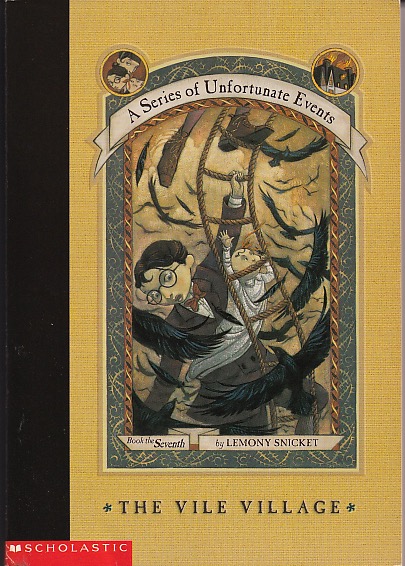
Even when reading A Series of Unfortunate Events years ago, many of the Poe references stood out.  Having just re-finished The Vile Village, a noted a few more nods to the master.  This particular number in the series also advances the story, letting the Baudelaire orphans know that the V of V.F.D. is “volunteer.”  They meet, briefly, Jacques Snicket.  He is murdered by Count Olaf.  Meanwhile the orphans have to try to find the Quagmire Triplets while being held in the Village of Fowl Devotees, which has a mania for burning people at the stake.  This one does get pretty dark.  Their actual guardian in the village, Hector, is kindhearted but timid.  He tries to rescue them but in the end, the orphans realize they need to take care of themselves.  Klaus turns thirteen and Sunny learns to walk.  But what of Poe?

From the beginning the guardian of the Baudelaire fortune is Mr. Poe.  A singularly ineffectual individual, he’s dismissive of what the children know, but he’s not a bad person.  The Poe connections begin, however, with the orphans’ surname.  Charles-Pierre Baudelaire was a French writer who was famous as a translator of Poe into French.  Naming the protagonists after him was surely another nod to Poe.  As is the series of unfortunate events themselves.  One of the reasons Edgar Allan Poe is such an intriguing writer is that his life was, from a distant view, a series of unfortunate events.  Losing his mother, being taken in by a hard father, failing to attain fame through his writing, the death of his brother, the death of his wife at a young age, his own struggles with alcohol.  His was a storied, but not fortunate set of circumstances.

The Vile Village is populated by a huge murder of crows—ravens tend to be solitary.  The crows roost each night at Nevermore Tree.  This, of course, is a nod to Poe’s most well-remembered poem, “The Raven.”  The people of the village are extremely protective of the crows, even as they live by a massive set of rules that are enforced with the punishment of being burnt at the stake.  Olaf shows up late in the story by pretending to be Detective Dupin, the name taken from Poe’s famous investigator.  The story naturally ends with the orphans being separated from the Quagmire Triplets and left to find their own way forward.  The author also enters the story as the brother of the murdered Jacques and lover of Beatrice, and the mystery continues into book eight.


The Shaft

For those following my musings on Lemony Snicket’s A Series of Unfortunate Events, I’m up to book six of the Baudelaire orphans’ adventures, The Ersatz Elevator.  There’s much to appeal to adults in these stories, as ridiculous as some parts are.  In this installment the Baudelaires are adopted by Esmé and Jerome Squalor, wealthy benefactors who live on Dark Avenue.  Mrs. Squalor, who’s very wealthy, follows whatever’s in at the moment, setting the theme for this part of the saga.  Of course, many “in” things are quite silly and they keep the situation light.  Although they live on the 66th floor (at 667), the Squalors have the elevators decommissioned because elevators aren’t in.  Count Olaf uses an abandoned elevator shaft to help work out his scheme to control the orphans, all the while trapping the Quagmire triplets.  The V.F.D. theme is further emphasized, but not yet explained.

The world-building of this series is impressive.  I remember reading through the first time and being increasingly drawn into the question of what V.F.D. could mean.  Although the 2004 movie picks up on Olaf’s arson activities, it doesn’t include this particular aspect.  The rest of the world Handler devised is also intriguing.  The time-frame is unclear.  The place, although it goes to outer-lying areas, centers on a city unnamed but which clearly has relevance for the overall plot.  People of this world are singularly clueless, including the orphans at times.  The world with its desultory, or even sinister, place names reflects that constant theme of misfortune that somehow isn’t depressing.  And an educational element, particularly in introducing children to new terms, phrases, and concepts, is generally present.

I learned the word “Ersatz” in German class.  A noun denoting “substitute,” it became an English adjective only in the last century.  Once the concept is defined in the way the children devise to climb down the elevator shaft, it’s used in reinforcing ways throughout the rest of the story.  Often in humorous contexts.  Also, the character of Lemony Snicket starts to grow more prominent as Beatrice is brought more explicitly into the plot.  The first mentions here are subtle, but her role takes on some shading as the series moves on.  This use of narrator as character had some influence on me as a writer.  While I’d written a not very good novel before beginning my doctorate, I started on my fiction again, on and off, during the period when I was reading these books to my child.  Coming back to them continues to inspire an adult who loves their gothic flavor, even if as ersatz adult literature.


Outgrowing Fear

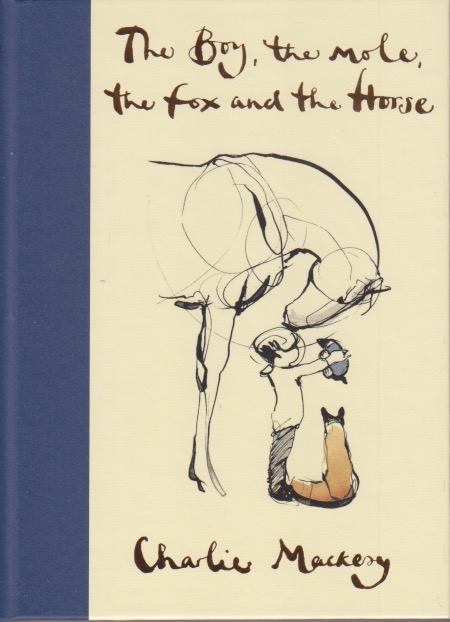
A friend, during a time of trouble, quoted from Charlie Mackesy’s The Boy, the Mole, the Fox and the Horse.  I immediately ordered a copy.  The word “magic” gets thrown around a lot, but this book holds real magic.  It is perhaps the wisest book I’ve ever read.  Do yourself a favor—if you haven’t read it, find it in a library, or order it from Bookshop.org or Amazon.  Visit a local bookstore, and if they don’t have it, ask them to order it.  If people read books like this we’d never need to worry about things.  And if everyone read it and took it to heart, we’d never need to worry about anything again.  There’s much to be said about believing in yourself and believing in the power of love.  At the end of the day they speak for themselves.

The book is for any age reader.  Handwritten and illustrated, it’s written at the level of a children’s book that takes less than an hour to read.  Its message feels almost radical, however.  That having been said, the young adult generation, I’m given to believe, grew up with the kind of outlook Mackesy offers.  The book struck me particularly relevant and necessary, something for those of us in the over forty crowd.  I understand the tendency to grow more conservative as we age and I believe it’s because we’re afraid.  Ironically, the book addresses the issue of fear, pondering how life might improve if we could get beyond being afraid of things.

The artwork is beautiful and the words are inspired.  This is an eminently quotable book.  Mackesy has been an artist by trade.  We can learn so much from such humble artists, if we’re willing to listen to them.  Kindness, love, and simplicity are gifts we often wish not to accept.  It’s very easy to hate and selfishness comes naturally to people.  And when we get together we tend to complicate things.  Once in a while we should set aside the complexities of life and make time for a simple story that reminds us of what’s really important.  Of course, those of us who read are prone to thinking of ways the world could be a better place.  Being open to love instead of hate, trust instead of fear, and hope instead of dread doesn’t come naturally.  That’s why it’s so helpful to have books to remind us of this.  Especially when such a book won’t even require an hour of your time.  I’ll be coming back to it time and again.


Kids’ Stuff?

Do you want to be popular with the kids this Christmas?  Do you want to hear the squeals of pure delight that every mom, dad, aunt, or uncle wants when that special present is unwrapped?  Might I suggest a book of theology?  Yes, one of the publishers here at AAR/SBL has a table of Theology for Kids.  Staring at that sign during the long hours on the conference floor, my mind kept wandering back to Richard Dawkins’ comparison of teaching children religion to child abuse.  Indeed, my wife had sent me an article in Rolling Stone a few weeks back that declared an Evangelical childhood was a, to put it politely, a total mind-fornication.  It is something from which those of us raised religious spend all our lives recovering.  Some never escape, while others try to make sense of the world without it.

Publishers of religious bodies make up a substantial part of those present at the annual meeting.  The ones with the biggest, flashiest displays are often buoyed up by evangelical dollars.  Teaching kids to think this way is a core part of keeping the meme alive and those of us who dared question it with our God-given brains are the modern heretics and heathens.  Some years here, various publishers are piously closed on Sunday morning (this is only a three-and-a-half day conference) with signs telling the rest of us that they’re observing the Lord’s day.  America is a strange mix of evangelical and secular, the kind of place where you can purchase theology for kids.  I know I grew up with such things, even though we really couldn’t afford the other children’s classics that I only learned about from having a child of my own.

The canon is important to this self image.  For me, I’ve come to expand mine a bit over the years.  That expanded canon includes unconventional sources of spiritual inspiration, or so my conversations with others leads me to believe.  Theology can, and often does, lead to death sentences for adults.  And sadly, occasionally for children.  It’s difficult to blame adults for trying to ensure their children’s eternal salvation, especially when religion is so terribly difficult to escape even as an adult.  I suppose that’s why I still advocate for learning about religion although it has damaged me personally as well as determined what would pass for my career.  So I stand here awaiting my next appointment and find myself again taken into my past which was full of theology for children.