Loaded Symbolism

Perhaps it’s all the politics in the news, or perhaps it’s the very long nights of January, but death comes to mind during the winter. One of the enduring preoccupations of religion is the issue of death. Christianities teach of wonderful rewards or horrendous punishments after the sloughing off of this mortal coil. Many eastern religions suggest the even scarier idea of reincarnation—we are doomed to repeat this sideshow over and over until we get it right. Since the universe has billions of years to go, that’s plenty of time for errors. When we finally depart, however, we leave our loved ones with the dilemma of how to handle our remains. Burial goes back to the Paleolithic Era—simple, effective, little fuss. Nature reclaims what we have borrowed for a century or less. This is the preferred Christian end, for, believing in the resurrection of the body, a body must remain. In some form. Other religions, noting the cleansing power of fire, prefer cremation. Those original Zoroastrians still prefer exposure of the dead to carnivores. It is, however, generally our religion that dictates our final disposal.

Enter the entrepreneur. The corpse becomes a commodity. You’ve got a problem and you’ll pay well for a satisfying solution. Some years back I saw ads for a company with the scientific, yet romantic concept that, as carbon, our corpses could be pressurized into diamonds. It is a costly procedure, but you could wear your beloved around your neck or on your finger as a chunk of the hardest substance on earth. A few weeks ago I found a more affordable solution on the website of Holy Smoke. Once you have made the decision to go with cremation, what do you want to do with that urn of ashes? Holy Smoke offers a solution: you can have your loved one’s remains loaded into ammunition shells. Taking care to handle the ash with profound respect, Holy Smoke will place the remains into either rifle or shotgun shells (one pound of human ash fills about 250 shotgun shells). You can then be shot toward eternity by loving relatives at their convenience. Gunpowder-propelled toward Heaven itself. Holy Smoke is located in Alabama.

Welcome to eternity

The problem of human remains is perhaps the most religious one of all. Our faiths give us the hermeneutic we need to face that great portal. As we consider the number of useless deaths brought on by Bush’s personal war in the Middle East, a kind of macabre closure can be seen through the smoke. After all, the NRA endorses the Republican Party. So does the Religious Right (unless, of course, they nominate a Mormon). Perhaps if we loaded our guns with our dead instead of live ammunition, the symbolism might finally hit its target. Holy Smoke could be offering a valuable service here to be shared between religious enemies. Instead of the kiss of peace, well, use your imagination. Perhaps it’s the very long nights of January, or perhaps it’s all the politics in the news.


Political Games

The Lord is in a changeable mood these days. So many GOP wannabes and so many disappointing results in Iowa. The fact that politicians now routinely rely on religion to get elected is bad enough, but the very mockery they make of the faith of their followers is criminal. This is the surreal paradox of a nation based on religious freedom—we are free to believe, well, whatever. It never fails that as the weekend rolls around newspapers trot out the religious stories. Men and women who live otherwise secular lives wash into churches like a spiritual tsunami, and by the time the rinse cycle comes, they’ve already got their sights set on the post-game show. In everyday life religion seldom enters, but when it comes to the polls, it counts for everything. Maybe if god didn’t have so many golden boys (the one golden girl dropped out of the race) all of this would be a little easier to bear.

The problem, speaking from the point-of-view of someone experiencing a little too much Christianity at the moment, is that the early form of the faith was a bandaid solution. You see, Jesus’ early followers thought the world was about to end at any minute. This was before the Republican Party even formed, and long before Joseph Smith made up a story about rose-colored glasses and an Italian angel named Moroni. The religion had no longevity plans. All the faithful were supposed to be gone by the end of that first century, and now, some twenty centuries later, they’re running for office in a nation equipped to bully the world. The logic of the situation dictates that if any one candidate is telling the truth of god’s sanction the rest are all pathetic liars.

When politicians began courting religious conservatives in an unconscionably cynical act of sympathy, they were taking out a promissory note they never intended to pay. The nature of religion, however, is to accept even what is improbable—even better—what is impossible. This faith, even after eight years of Bush failing to keep his promises to deliver on the issues they so crave, remains intact. The substance of things hoped for, the evidence of things not seen. Now, less than four years later, they are ready to believe all over again. And as long as we are looking for the impossible, is it too much to ask that religion be left out of politics so that the business of running the nation might be done with at least a modicum of rationality? Now that deserves to be called faith!

GOP's favorite game?


Unorthodox Accreditation

While going about my editorial duties, I found myself directed to the webpage of the Antioch School of Church Planting in Ames, Iowa. Okay, I’ll admit that the fact that I spent the holidays in Ames may have been what actually motivated me to look. Over the past twenty-some years I’ve spent many holidays in Ames, but I never knew of this particular institution. I had been checking up on somebody’s status when I found the Distance Education and Training Council. The DETC is an accrediting body. In a world where we can’t take anyone’s word for it—especially not a bunch of academics’ many words for anything—we have invented accrediting bodies. These watchdog groups maintain the high academic standards that we like to mix well with our beer and football to make the American college experience. The DETC, however, scopes out remote education programs. Often these schools have no campus. The ASCP is accredited by the DETC.

So I poked around Antioch for a while. The name is taken from the ancient Syrian city where the early Christians first earned their title. It became clear in a fraction of a second that this accredited program is an ultra-conservative answer to seminary education. How to get what looks like a regular degree to improve your indoctrination. Instead of being bemused (one seemingly appropriate response), I was actually a little bit disturbed. Education occurs every day in non-structured ways. I can get a whole life lesson just walking across Times Square. When we want standards of comparison, however, we rely on tried and tested schools to offer us degrees. When a program that supports opinions that run counter to the educational system’s standards gets accreditation, we all need to watch out. Somebody call the Bureau of Weights and Measures!

The distrust of academia often does not apply to such self-promoting schools. Americans tend to love self-made doyens who bring education down-home. As far as I could tell from the website, the Antioch School is an extension of a local Bible Church that is intended to provide future clergy with home-baked degrees. That in itself isn’t a problem, of course, but when the wider public doesn’t know the inner workings of higher education, and generally distrusts it, who’s to say whether any degree is valid or not? Aren’t all bachelors created equal? Not really. Accrediting doesn’t prevent abuses from slipping through the system—I’ve seen it happen firsthand, right under accrediting teams’ noses. It is a game we play. You can earn a master’s degree or a doctorate in planting churches. And if you ask me, that’s the same thing as getting a degree in planting corn, only much less scientific.

No way through this maze.


Silent Might

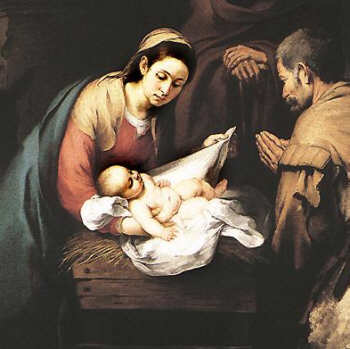
Iowa is a state for reflection. For many years Christmas in Iowa was a family tradition, but living on the east coast makes such pilgrimages rare. On Christmas Eve in Ames, we drove past a Nazarene Church decked out for the holiday with a sign reading, “Jesus Came for You.” Perhaps I watch too many movies, but the images that came to mind were of Rambo and The Terminator—menacing figures who’ve sought out their victims for revenge. Coming for you was a threat rather than a promise. Who can forget Arnold’s “I’ll be back”? Was the child who came sent with a mission of punishment or of peace? To hear presidential candidates and other evangelicals tell the Christmas story, it is clearly the former—the Rambo of God who blows away the sins of the world—that we should expect. The Prince of Pieces.

That version of Christianity that likes to present itself as the default, the natural form of what the church has taught all these years, has a strong current of threat running through it. God never shows up unless there is a problem—an absentee father only too swift to remove his ample belt to begin a sound thrashing. Religion often thrives in the context of menace. Teaching that people are evil by nature and only good when under promise of Hell, such believers understand the coming of Jesus to be cause for fear and alarm. According to Luke, the angels began their message with “Fear not.”

How Christmas is understood reflects on the view of Christianity that believers choose. For the advent and arrival of an emissary can be cause for celebration or of fear. In some mangers the infant conceals a cudgel and woe to those who suggest equal treatment of all or a non-literal reading of favorite prooftexts. This time of year stands as an excellent test of what this child will grow up to be in the minds of his latter-day cohort. What arrival should we anticipate? If it is the Jesus of the politicians and evangelicals, we only have to look at the headlines to discover the answer.

What child is this?


England’s Christian Gift

As much a part of the holiday season as Santa Claus and baby Jesus, the Salvation Army bell-ringers are out in full force. As I drop a quarter in the bucket, I ponder the strange lineage of this denomination. When the cheerful holiday shopper convivially donates spare change, few, I suspect, know that they are supporting a church. The Salvation Army is one of the bewildering number of denominations to spring from English Christianity. The Church of England, small in the United States, but imperial in much of the world, grew amid a religious unrest that spun off countless dissenters. We all know the story of Henry VIII and his not-so-merry wives. His political move to focus the official religion of England on the crown led to the Puritan resistance. Puritans left England for the Netherlands, and then on to America where they flocked to New England to develop into Calvinistic Congregationalists.

Meanwhile back in Amsterdam, some of the English Separatists evolved into Baptists. Baptists were also congregational in polity and also found the religious freedom of America to be appealing. (Now they select our elected officials.) The Puritans had helped develop the Presbyterian movement as well, with dissenters in Switzerland. Still at home in Britain, the Church of England waffled between Catholicism and Protestantism for some time. The evangelical fervor that emerged with the Wesley family led to the Methodist Church, which remained attached to the Church of England until its founder’s death. In America the Methodist Church grew rapidly. During the era of religious revivals the Adventist movement grew out of Methodism, as did the Church of the Nazarene, the Holiness movement, and Pentecostalism. All of them today are major denominations. Even the Anabaptists tip their wide-brimmed hats in the direction of the English dissenters. The Plymouth Brethren, inventors of the Rapture, were another English-derived denomination, as were the Wesleyan Churches.

What does all of this have to do with the Salvation Army? The Salvation Army was founded in London by a Methodist minister, William Booth, and his wife Catherine. The movement adopted quasi-military mythology and ranks, and soon grew into a church of its own that supported what would later become the Social Gospel cause. Known primarily for their charitable works, they are yet one more splinter from the tree of English Christianity. Perhaps the Christmas tree is an appropriate analogy for the Christianities to spring from Henry VIII’s loins. Like the pine’s many branches, each with its ornaments, Christianity in England sent its twigs in all directions. Counted together, the descendants of English Christianity far outnumber any other Protestant grouping. Just a thought to share while waiting for the quarter to drop.


R-e-s-p-e-c-t A-l-l

Every great once in a while a politician makes a statement consonant with the principles of the nation. Over the weekend Robert Menendez, one of New Jersey’s U.S. senators, make a public announcement of his support for the Respect for Marriage Act. Admitting that 15 years ago he voted for the Defense of Marriage Act, which would not recognize homosexual unions, Menendez has searched his conscience (a rare commodity among elected officials) and has come to realize this “Defense” Act for what it is: legislated immorality. It is immoral for a government to deny rights to committed couples based on the gender of either party. Gender is a social construct that may or may not align with sex—even the concept of two completely distinct sexes is now seriously questioned by biologists. The old measuring rod of ability to procreate together just does not match reality: infertile couples are granted the same rights as other married couples, so why not same “gender” couples? As Americans we often like to vote without thinking too deeply about the topic.

The value of procreation is obvious. Birds do it. Bees do it. Even educated fleas do it. (Cole Porter knew what he was writing about.) When did we become so fixated on this one aspect of sexuality that we let it become the sole purpose of sexual behavior? Many religions recognize sexuality for what it is, a form of human interaction. The end result may be a new child, but it is not so as the result of the vast majority of couplings. Christianity (in some quarters) early on took a dim view of sex, and soon began to relegate it to procreational necessity only. Even then you were supposed to try hard not to enjoy it. The Catholic Church even relegates the biblical siblings of Jesus to the role of step-siblings; children of Joseph from a prior marriage, despite what the Bible says. Such distortion of nature could only come at the interference of religion. And as long as we’re busy regulating sex, let’s add a few statements about the only appropriate outlets for that committed relationship. Never mind who gets hurt. It’s all gonna burn.

I, for one, salute Senator Menendez for his willingness to open his mind. Too often the “government for the people” is excised from Lincoln’s Gettysburg address. When did we the people pass to the government the right to decide whom we might love? The agenda set by the Religious Right is religious wrong, and too many tax-paying citizens are the heirs of its paranoia. It is time the government began serving the entire electorate rather than just the Southern Baptists and their friends. Nobody is attempting to regulate their sex lives, as Ted Haggard, Jimmy Swaggart, and Newt Gingrich will gladly attest. Keeping the zipper firmly up is not the strong suit of televangelists or politicians. If we’re going to have double standards here, let’s at least open the game to same-sex marriages. Those who feel threatened by the fair treatment of others need to gaze long in the mirror and ask why.


Tolerance, Princeton Style

Princeton is an idealistic kind of town. A seat of great wealth, the town is dominated by the university and yet it manages to retain a sense of genteel quaintness that so often accompanies the aura of financial security. Even with my distrust of money, I love to wander its streets and imagine what the world could be like. My ideal world has bookstores, and so I always stop at the Labyrinth, the current incarnation of the university bookstore in town. Last time I was there I found an overstock sale copy of Ian Buruma’s Taming the Gods: Religion and Democracy on Three Continents. Well, both the price and the topic were right, so I read it this week. Buruma is actually a scholar of democracy, human rights, and journalism, not religion. One of the key identifiers of religion is that there is no central, unifying topic that ties all religions together, and therefore scholars of many disciplines have much to say about it. Buruma offers three chapters illustrating the way that religions interact with society, often violently. He then tenders suggestions for how this violence might be curbed.

Commenting on tensions of Islamic growth in a nominally Christian Europe, Buruma notes that one of the Enlightenment core values is a belief in universals. If truth is truth it is universal. This, he notes, often conflicts with religions since most religions also tend to make universal, often exclusive, claims. Here is precisely where human culture is brought to its knees by religion. Due to their revealed nature, western religions cannot be challenged on any rational grounds. This is as true of Mormonism as it is of Judaism. If God said it, and there is no empirical proof, people have no choice but to obey. Problem is, God can’t make up “his” mind about the final word on the subject. New religions sprout constantly, growing into inevitable conflict with their neighbors. Not to mention those who have reasoned their way out of religion.

What is the limit of religious tolerance? As Buruma notes, tolerance necessarily includes tolerating intolerance. Some religions are constrained to be intolerant of others, and how do we allow them to be part of our little tea party? (The metaphor is intentional. Think about it.) Buruma suggests, as many have, that the rule of law should settle the situation. People must learn to separate civil law from religion. But can it be done? I have serious doubts. I’ve heard this suggested before, by minds far greater than mine. Having grown up as a religious kid, however, I know that rule of law has its limits. It stops once God opens the door to direct revelation, whether to people today or thousands of years ago. Religion is not bound by the rule of law. It is its own highest authority. Many, many people throughout the world believe that. Moses, Jesus, Mohammad, all are noted to have had clashes with civil authorities of one sort or another during their lifetimes. The pattern is set. So even here in Princeton, with an engaging, thoughtful book in my greedy little hands, surrounded by great wealth, I realize just how idealistic all of it can be.


Jew Want Some Jesus with That?

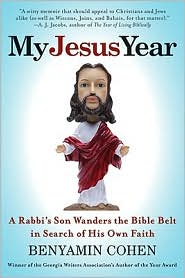
There’s been a trend in the last few years of journalists following a religious lifestyle not their own to learn something of another faith. This often leads to whimsical—occasionally funny—books that generally sell well. I appreciate the effort of those who try to open their minds to other belief systems, but the truly funny thing about religions is that they are very difficult to study objectively. There is a universe of difference between studying the papacy and being a Pope (I am only guessing here). This aspect of the religious explorer came through quite clearly in Benyamin Cohen’s My Jesus Year. Cohen, an Orthodox Jew, without compromising his faith, spent a year of Sundays attending various churches with two goals in mind: to learn more about Christianity and to appreciate his own Judaism more. The result is, for someone raised in the Christian tradition, a little disorienting.

We seldom tell children about other religions since such information would imply that religion is a choice, a marketplace. We prefer to tell our children that our brand is the right one—the only right one—because that is what we believe. By the time most children encounter those of other faiths, the indoctrination of their childhood has congealed. Many Christians will send their children to Christian daycare, often followed by parochial schools. Where would they expect to meet their first Muslim? Unfortunately, it is often on the battlefield. By protecting our children from the dangers of foreign faiths, we endanger everyone involved. So, reading a book written by a Jew, I felt a little strange—as if maybe Christianity wasn’t the majority faith after all. Given the wide diversity of Christianities Cohen cites, this is not so strange after all. Am I more like the evangelical Ultimate Christian Wrestling crowd or the Roman Catholic doing crossword puzzles during mass? Or none of the above?

Cohen notes that evangelical pastors (or laypersons, Christian or not) will sometimes share their secrets of success with those of other religions. Tellingly, he quotes Bernie Marcus, co-founder of Home Depot, explaining to rabbis how they might drum up more excitement: “You’re in the marketing business; you’re selling a product. You’re selling religion. It happens to be something that’s good for people. But you can’t get to them to sell them the religion because you’re in the marketing business and you don’t realize you’re in the marketing business.” Is that what it really comes down to? Religion is frequently described as a marketplace; it is the only paradigm available for the true capitalist. We’ve seen it take over higher education, and now those who give advice to religious leaders are the captains of industry. We have become victims of our own success. There was a time when religion stood outside the ordinary, but now it can be packaged and marketed and sold. An excellent exercise on your way to the store, however, is to stand back and listen to the other customers. If you are lucky, one of them will be Benyamin Cohen.


Zombie Jesus

It must still be October. Despite a snowstorm before Halloween (one of nature’s trick-or-treats), all the signs are still there. My daughter showed me a Venn diagram yesterday, during a whole-day marathon of putting plastic around our drafty old windows, showing the intersection of three “monster” traits: resurrected from the dead, local townspeople fear and revere him, and convert as many mindless followers as possible. The creatures that inhabit this eerie universe are Dracula, Frankenstein, Zombie, and, where all three intersect, Jesus Christ. Obviously this was just for a laugh, but interestingly, one of the traits of Penn Jillette’s book, God, No!, is his rather frequent reference to Jesus as a zombie. Then I clicked over to Religion Dispatches, and the lead story is headlined, “Praying to the Zombie Jesus.” Ours is a world of mindless, quick connections where the compelling idea of resurrection has lost its appeal. Despite our religious culture—or perhaps because of it—we have come to see Christianity as just one more peddler of a wonderful, disturbing idea.

As regular readers of this blog know, I find the abuse of religious ideals inexcusable. Using one’s faith to beat another down is just plain wrong. Nevertheless, to focus on the folkloristic aspect of resurrection (or perhaps it is a metaphor) is to miss what drew the very earliest followers to Jesus. Before the idea of rising from the dead came a message that people should love each other and treat one another with respect and dignity. By the end of the first century of the common era, or perhaps as early as Paul, that idea grew to be a quasi-magical resurrection from the dead. No longer were women counted as equals among the followers of Jesus, and no longer were wealthy compelled to give it all up. Paul’s faith looked to a future world, beyond death, and was willing to consider this world, well, to be polite, crap. The reasons for this transformation are legion: the persecution that Christianity was undergoing, the failure of an apocalypse to take place, the disenfranchisement of the believers. They needed something to look forward to.

Zombies are likely a passing fad. When we start seeing books of zombie Christmas carols, zombie haikus, and zombie apocalypse survivors’ guides, we seem to be reaching the peak of the plateau. The zombie is mindless, rapacious, and entirely selfish. It will not go away. It is the perfect denizen of October. When I stare into those uncomprehending eyes, and see the disturbing lack of compassion and the desire to consume human brains, I start to make connections of my own. Analysts often describe zombies as the ghoul of the common folk. But all these characteristics taken together suggest that perhaps the month in which to expect zombies is November. Surviving another snowpocalypse, earthquake, and hurricane, the human spirit is difficult to dominate. And yet, when the polls open up in the darker season of the year, zombies will rise. The plastic on my windows does nothing to stop these chills.

Borrowed from a friend's site


Anglo-Wicca

Although it may seem the right season for witches, the revival of serious witchcraft in the religion of Wicca is a much misunderstood and maligned phenomenon. One of the persistant myths that many religions continue to perpetuate is that they go back to the very beginning. If any religion might rightly make that claim, it would be something close to Wicca, or nature religion. The fact is, however, all religions have histories and beginnings, and radical reshaping is not at all unusual along the way. In the western hemisphere, many like to claim a privileged position for Christianity. Certianly in the political world, such a claim is justified. Christianity shaped Europe, and therefore, by extention, all previous colonies of the European powers. The Christianity that shaped Europe, however, was the political powerhouse of Roman Catholicism, and later, reformed versions of the faith. The Catholicism of the Middle Ages, as may be discerned at a mere glance, shares little in common with the ideals given in the mouth of Jesus by the Gospels.

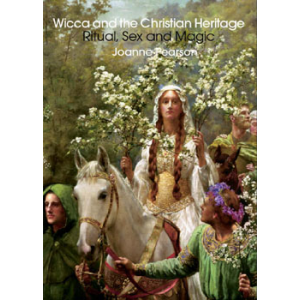
I just finished reading the provocative Routledge title, Wicca and the Christian Heritage: Ritual, Sex and Magic, by Joanne Pearson (2007). I learned a considerable bit about the modern origins of what is recognized as a tax-free (the sign of any true religion) belief system of Wicca. As Pearson points out, this Wicca dates back to the 1950s. What really caught my attention, however, was the tortured religious history of the movement’s founders. Enamored of Anglo-Catholicism (a form of ceremonial I had been force-fed for over a decade at Nashotah House), the founders of the religion (both intentional and unintentional) craved the seal of antiquity. Many of the players invented denomination after denomination of Christianity, sometimes acquiring ordinations and consecrations by hapless Eastern Orthodox bishops who misunderstood where they were spewing their blessings, in the attempt to show it was real Christianity. You need a roadmap to keep all the blind alleys straight. In the end, Wicca derived from an unorthodox combination of orthodoxy, Masonry, and Spiritualism. It is a wonder that modern Wicca appears as sane as it does.

Pearson’s book is not a full-fledged history, but more of a background to such a history. Many Nashotah House affilates, I’m sure, would rage to see time-honored names from Anglo-Catholic history alongside those often considered charlatans and posers. But when it comes to religion, even the most orthodox are very creative. Perhaps each gesture, vestment and accessory has a pedigree. None of them go back to a dirt-poor peasant who told his followers to give all material goods away. We may be willing to accept many things in the name of religion, but let’s not go overboard here. Not even the literalists do that.


Lead us not into Dominion

Christian dominionists emulate the Roman Empire, it seems. The Viewpoint in last week’s Time magazine, entitled “In God We Trust,” points out several of the objectives of the dominionist camp. Taking their cue from a decidedly modern and western understanding of Genesis 1, this sect believes the human control over nature to be a divine mandate in which our species dominates the world, with divine approval. As Jon Meacham points out, that dominion does not end at other animal species, but includes control of the “non-Christian” as defined by their own standard. This non-negotiable “Christianity” is a religion guided by utter selfishness and self-absorption. So thorough is this directive that those indoctrinated in it cannot recognize Christians that do not share its perspective as part of the same dogmatic species. It is a frightening religious perspective for a nation founded on the principle of religious freedom.

Rehearsing the rhetoric from Rick Perry’s “the Response” rally, Meacham rightly points out that when dominionists quote the Bible it is most important to note what the Bible does not say. Herein lies the very soul of the movement—filling in the void where God does not talk with human desires and ambitions. As any good marketer knows, however, packaging can sell the product. Introduce a rhetoric that claims to be biblical to a nation where most people have never read the Bible and smell the recipe for success. People want to believe, even if what they think they believe is not what it claims to be. Christianity is claimed by so many vastly differing factions as to have been drained of its meaning. This is the danger in the game of injecting religion into politics. Surely the Perrys and Palins and Bachmanns know what they believe, but they do not say it aloud, for their Christianity does not coincide with the various forms of the religion advocated by the churches historically bearing the torch of Christ’s teachings, insofar as they might be determined.

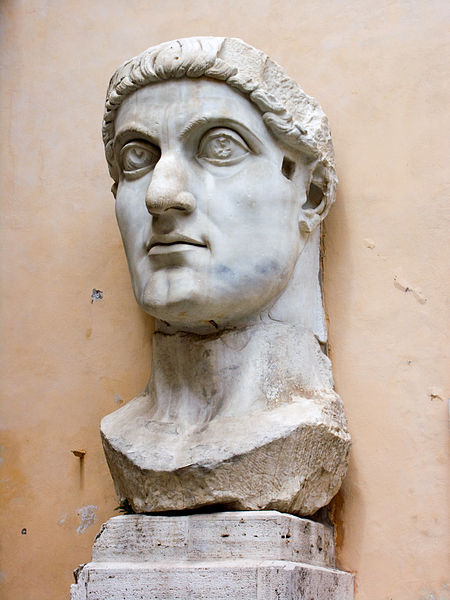
Dominionism is nothing new. Even the most pristine believer must see that Constantine had more than a warm fuzzy feeling in his heart when he adopted a foreign religion and fed it to his empire. No, Christianity was an effective, non-violent means of control as well as a way of achieving life after death. Rome was nothing without dominion. The parallels with the United States have been noted by analysts time and again. As we watch the posturing of political candidates wearing some form of their faith on their sleeves, the unsuspecting never question what might be up those sleeves. It is fairly certain that when the parties sit down at the table and the cards are dealt, it won’t be Bibles that we find scattered there. This is not a kingdom of God’s making. When dominionists take over all others must scan the horizon for the advent of the Visigoths who will not be dominated.


Remembrance Day

September 11, 2001 is on America’s collective consciousness. A decade ago thousands lost their lives in a religiously motivated and misguided attack on what some see as a wicked culture. Those who hate America have never come to know it. What a sad commentary it is that religious belief lends its strength of conviction to those whom it has convinced that evil is righteousness and that terror is divine. It is somber to experience this tenth anniversary so close to New York City. When I ride in to work now every day I see the new World Trade Center rising, literally, from the ashes. It is a monument to what America tries to embody.

Twin towers, 13 years old.

Our nation is not perfect. None is. Too easily we accept the casual relegation of various minority groups to poverty. Too easily we allow the obscenely wealthy to escape all sense of social obligation. Too easily we focus on our selves rather than our community. No, we cannot claim to be perfect. Nevertheless, we strive for an ideal that will not die.

Some have boldly claimed twentieth century notables as “the greatest generation.” I believe that praise, although deserved in a sense, to be misplaced. The greatest generation was that rag-tag group of colonial citizens who’d fled from cesspools of oppression to find freedom in a new world. They were not perfect. They oppressed and displaced Native Americans who still suffer under repressive policies that ensure the great embarrassment of their treatment will remain out of sight. The greatest generation I envision is those who, at the risk of their own lives, decreed that the world should, must contain a haven for those who cannot live without a free conscience. A place where religion, or even the very words you say or write, cannot be dictated by the government. A place where people could go on to become the putative “greatest generation”s of the future.

When I first heard about the attacks on 9/11 I was at Nashotah House. Those first moments of confusion were terrifying—our daughter had just started school and was not close enough to hold. My wife and I watched the television in sheer unbelief, tears on our faces, our lives being forever wrenched and twisted in new directions. In was a day that sobered up an entire country.

(Please read the remainder at Full Essays.)


Glass Act

One of the main cultural Meccas of central New York state is the world-renowned Corning Museum of Glass. I recall visiting the museum three decades ago, as a child. Since then the museum has continued to expand and diversify its programs and displays. The Corning Museum of Glass is perhaps the greatest collection of art glass in the world. The history of glass is laid out chronologically, and along about the Middle Ages, religious glasswork comes into fashion. Some of the pieces were manufactured as intentionally religious artifacts. Others acquire a religious significance through less orthodox means.

Traditional religious glass

Near the end of the display is a piece by Gianni Toso, done around 1981. Entitled “Chess Set,” the glass sculpture features Roman Catholic pieces facing off against Jewish rabbinic pieces. The sculpture is intended to be comic as the expressions and the postures of the figures clearly indicate. Each piece bears some symbol of their faith: thuribles, lulavs, crosiers and Torah scrolls face off against one another, each side wearing unmistakable looks of superiority on their faces. Countless hours obviously went into the fabrication of such an intricate piece, and as with most art, it contains a serious message.

Toso's Chess Set

The figures here may be Jewish and Christian, but they could really be any religious traditions. The concept of putting them into a chess match is an inspired commentary on the constant struggle for superiority among religious traditions. In a world of differing religious outlooks, and where such outlooks are taken with deadly seriousness, no one is willing to relinquish religious superiority. The aggressors are difficult to discern since, as in life, any true believer must be a kind of missionary.

Toso's face-off

The medium of an artwork also makes a statement about its subject. Glass is a difficult medium to manipulate. Since it often must be very hot, the artist is familiar with the burns that accompany such intense heat. Glass produces a superior shine as an artistic medium, but it is also very fragile. Like the conflict presented on this chessboard, the religions behind it bear the limitations of the medium: they shine at times, yet they can also cause severe burns. And above all, they are fragile.


Girl Meets God…

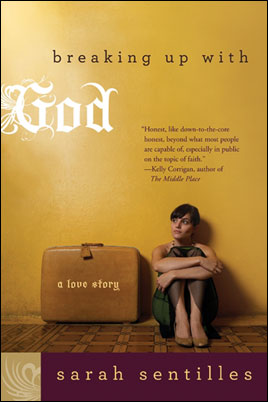
Once in a very great while I find a book that I simply can’t put down. It is a rare windfall when that book feels like it was written especially for me. I was instantly engrossed in Sarah Sentilles’ Breaking Up With God. Like Susan Campbell’s Dating Jesus, this book reinforced the fact that women experience a side of God’s character generally closed to men—the idea that God might be a lover. In our distorted, still patriarchal culture we have yet to grow beyond the idea that God is male. This simple, persistent teaching ensures that a gender-divide will always remain in effect when it comes to monotheistic religions. What truly spoke to me from Sentilles’ book, however, was not the theology, but the heart. Although the gender view from which I approach concepts of divinity must necessarily be different, here I found someone with a journey in many ways similar to mine. The honesty with which the author lays open her experience is beautiful and terrifying.

One of the recurring questions on this blog is whence the concept of God arose. Anthropologists, psychologists, and theologians come up with varying answers but the fact is the real impact is felt in very human minds. We have, perhaps unwittingly, devised a punishing image of the creator of the universe. A God who causes, allows, or at least condones arbitrary human suffering. A God who permits atrocities daily to be committed in his name (for this is a masculine god). A God who has left a burning ruin in his wake. Those of us who’ve attended seminary, as Sentilles makes vividly clear, are taught perceptions of the divine that can never be translated into the pulpit. Those of us who go on to graduate school are permitted a rare glimpse behind the veil to see something that it frightens us to contemplate, let alone write or speak about. It is a burden best worn like a hairshirt—beneath other clothes so that people don’t know it’s there. Many of us are then cast into the career outer darkness with nothing but our highly educated, disturbing thoughts for comfort.

Sarah Sentilles has given the world a gift with her revealing, sensible, and very human story. Having grown up with the image of God as a father, it was a shock when a seminary professor once revealed to me that God could never really fill that role. Nor, he added, could the church. While it cannot be the same as breaking up with God, the realization that what you were taught as a child was merely a metaphor forces a grand reevaluation of perceptions. My professor was, of course, correct. Carrying around a faulty image of God will lead only to intractable complications further down the road. Although Sentilles started down the path some years later than I did, it seems we have wound up in the same neighborhood. Her book deserves to be read widely, thought over carefully, and pondered for a time. We need to consider: what hath man wrought?


Just Druid Again

It would be difficult to suggest an ancient class of people with greater New Age credibility than the druids. Although I spent three years among the Celts, I claim to have no special knowledge of the druids, and when I saw Peter Berresford Ellis’ book on the subject, I decided to learn more. Not really a straightforward history—not enough of the druidic culture survived in any material form for the writing of such a history—Ellis instead summarizes a complex gallimaufry of evidence and speculations into a reasonable facsimile of who the druids might have been. Ellis suggests that the druids were more a caste of society, rather like the Brahmin caste among Vedic culture. Should that seem far-fetched, it would be difficult to read A Brief History of the Druids without noticing the obvious connections between the cultures. The Celts, of which the druids are a subset, have their origins in eastern Europe rather than the usual supposition of a homeland over the sea in Ireland, Scotland, or Wales. Connected to India via a common ancestral language, Indians and Celts both derive from the same Indo-European linguistic family tree.

Ellis’ book is so full of information that it is unwieldy at times, especially for those of us who find the formidable Gaelic names intimidating. Nevertheless, it is an excellent source for learning about the religion of the druids, insofar as it may be reconstructed. One of the most striking aspects of Celtic culture that emerges from the book is how it differed from the Roman culture that would come to dominate the western world. An obvious example is that Celtic society offered a much more enlightened place for female rights and leadership than would emerge along the Tiber. Another important difference was the Celtic antipathy to abuses of private property ownership. Gaelic bishops earned the ire of Rome by declaring that egalitarianism is the will of God. In the words of a fifth century Celtic bishop:

“Do you think yourself Christian if you oppress the poor?… if you enrich yourself by making others poor? If you wring your food from others’ tears? A Christian is [one] who… never allows a poor man to be oppressed when he is by… whose doors are open to all, whose table every poor man knows, whose food is offered to all.” Words a Perry or Bachmann might do well to read.

So noble were the druids in the eyes of eighteenth-century antiquarians that many suggested Abraham was the original druid and that the great figures of the Bible were part of the druidic heritage. The world, alas, has gone after Rome instead. Rather than druids we have CEOs and politicians worth a mint before they ever “swear” an oath of office. If the current Celtic revival brings back some powerful druids, perhaps the world might just become a more tolerable place.