Building Horror

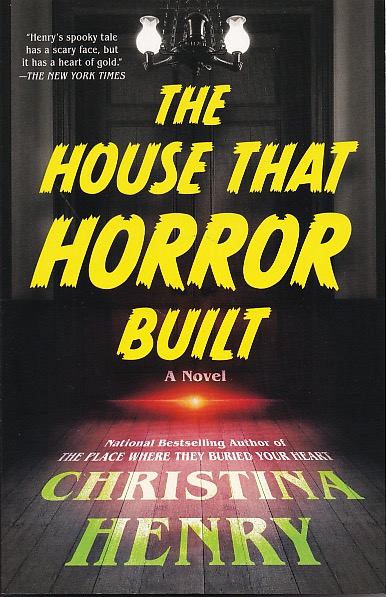
Christina Henry grew a reputation rewriting fairy tales.  At least that’s how I found her.  I read The Girl in Red and then Horseman (which was after I’d begun work on Sleepy Hollow as American Myth).  I thought she’d found her niche as a writer.  Lately, when browsing bookstore shelves in the horror section, I’ve discovered she has a reputation there as well.  The House that Horror Built caught my eye, and I trust certain writers, based on past performance.  (Which is, I suspect, how most agents assess their clients.)   In any case, I wanted to give it a try.  Speaking of trying, I’ll attempt to avoid spoilers here because there’s a twist ending.  The story begins innocently enough.  Harry, a woman down on her luck, has a job cleaning the house of a famous horror director, Javier Castillo.  Barely making ends meet in Chicago, she cleans his horror props three days a week.

Castillo is in Chicago because of the disappearance of his wife and son after the latter was accused of a murder he probably committed.  His family gone, Castillo moves away from Hollywood while trying to work on his next project.  Meanwhile, Harry’s landlord is evicting her and her son Gabriel.  Upon learning that Harry likes horror movies, Castillo invites her and her son to dinner one night.  Things get a bit chummy for Harry’s tastes, but they return once more when a couple of actors are staying with the director.  One of the actors has a tragic accident, falling to her death.  Meanwhile the eviction date is moved up and Harry has no choice but to accept Castillo’s offer of hospitality.  She’s known for some time that his house is haunted.  I think I’ll leave things there.  Hopefully it’ll peak some interest.

I don’t know much about Henry, but she does seem to understand the plight of the poor.  It isn’t easy to survive when you can’t earn enough beyond what covers the necessary expenses.  And when you have a child, the anxiety increases exponentially.  For the most part, this is a slow burn horror tale.  The suspected ghost is introduced not too far into the proceedings, but the explanation is more than the reader expects—at least this reader.  The last couple of chapters are page-turners with some full-on horror.  I don’t mind waiting for some payoff.  To me, however, the darkness in the threat of homelessness is its own form of horror.  And it’s not too difficult to imagine for the majority of us.  I’d say Henry has bridged successfully into the genre.

The Horseman

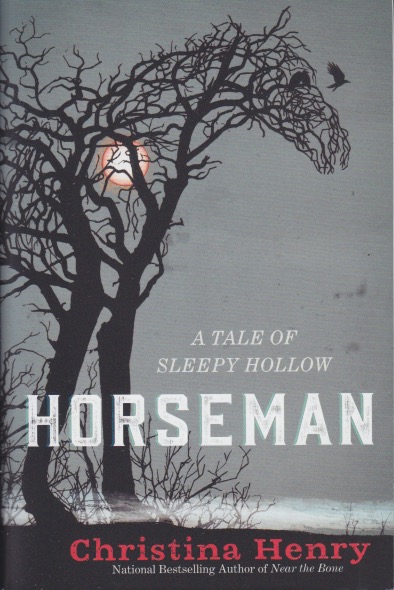
Washington Irving’s tale, “The Legend of Sleepy Hollow,” perhaps due to its being the earliest literary American ghost story, has been retold time and again.  When I saw that Christina Henry had a take on it that came out last autumn, I knew I’d be reading it.  I’d read her The Girl in Red late last year, but I couldn’t wait until fall to read this one.  Henry has a way of taking traditional stories and making them relevant.  Horseman is set two generations after Ichabod Crane and Brom Bones and Katrina Van Tassel, but they all appear in it.  According to Irving’s story—and this is often changed in cinematographic treatments—Brom and Katrina wed.  The narrator of this tale is Ben, who in today’s terms would be considered transgender.  He (his preferred pronoun) is the grandchild of Brom and Katrina.

Henry is a master of magic realism.  There really is something in the woods of Sleepy Hollow and it’s taking children’s heads.  Some influence from Tim Burton’s film version is found here, but the story has its own trajectory and inner logic.  Ben actually sees the monster, but nobody will believe him.  Not until it’s too late.  The one person who does believe is Katrina, Ben’s grandmother.  She, however, wants Ben to act like a girl because he was born female.  She wants him to stay home and learn sewing and cooking.  Ben’s hero, however, is Brom.  He’s a good man, if rowdy.  He married Katrina for love, not wealth.  Ichabod Crane does appear, later in the story, but since how he appears is a spoiler I’ll need to let you read for yourself.

Americans are often raised with the wrong-headed notion of canon as the one way a story goes.  Retelling is as ancient as writing itself.  Homer, Apollodorus, and Ovid were retelling stories.  So were many Bible writers.  People tell one another tall tales.  Washington Irving didn’t invent the Headless Horseman out of whole cloth.  Neither did the people of Tarrytown.  How the story goes is a matter for discussion.  Bet yet, it’s also a matter for retelling.  Henry’s version could be made to fit with Irving’s, but with a bit of prior assumption, some posthumous collaboration.  Hers, however, is a tale for our times.  Just like in Red, the protagonist isn’t conventional, according to conservative sexual standards.  Both are, however, authentic.  And although both may be flawed in various ways, there’s no denying that they’re heroes.


Read Red

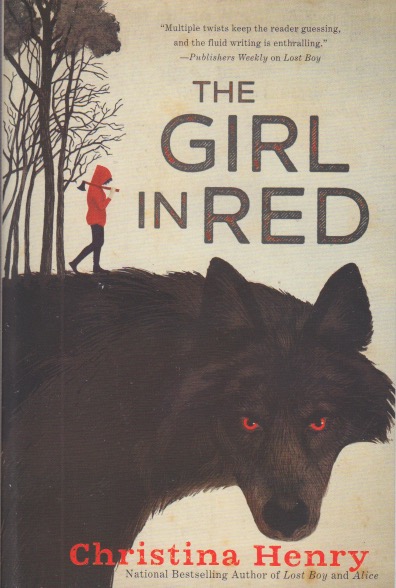
Fairy tales can be pretty gnarly.  I recently picked up a new translation of Grimm but I haven’t read it yet.  For some time I’d been aware of Christina Henry’s The Girl in Red.  As soon as I discovered it I wanted to read it.  The BISAC code says it’s science fiction but I’d call it horror.  More than that, I’d say it is the most tense book I’ve read in years.  Henry knows how to keep readers on edge.  Yes, it’s a take off from Little Red Riding Hood, but in a way that I wasn’t anticipating.  Red is a strong, believable protagonist who finds herself in a pandemic-ravaged world (imagined before Covid-19) where she has to get to her isolated grandmother’s house.  Everything between will surprise, scare, and stun.

The writing carries you along.  A government with secrets, the ever-present threat of roving groups of bandits and militias who are always on the lookout for girls, and the uncertainty of how this will all end make for a powerful tale of what people are capable of.  And not necessarily for good.  Making Red “disabled,” and black, Henry has given us a protagonist we need.  And it’s always a delight when a character finds that watching horror movies has been good training for a world where order has broken down into a Trumpian anarchy.  Scary and witty, the story has so much to like it’s difficult to know where to start beyond the recommendation to read it.

Those who analyze literature sometimes say that the great story-lines have already been taken and that the best modern writers can do is to adapt them.  There may be an element of truth to that, but even if there isn’t the clever retelling of old tales can be quite enjoyable.  This isn’t so much a retelling as a reimagining.  It’s also a poignant reminder that when things start to break down—or even in the status quo—women are put at risk.  Men too quickly resort to guns and violence.  As the story unfolds it becomes clear that Red is capable of surviving in this world, even when at a disadvantage.  There’s also no overcoming of the military.  It’s too well established and too heavily armed.  Red’s run-ins with them allow her to impress those who assume white male superiority.  In that way this is a parable within a fairy tale in a modern guise.  I’ll be reading more of Christina Henry’s books.