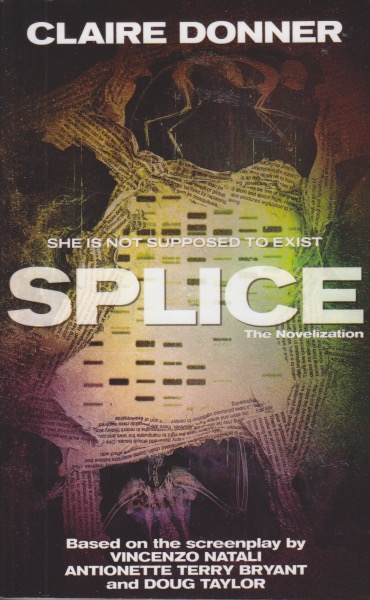
Novelization

I watched the sci-fi horror film Splice a few years ago.  Long enough that I don’t recall many details.  When Claire Donner, a friend of mine from Miskatonic Institute of Horror Studies, told me she’d written a novelization of Splice, I knew I had to read it.  If you’ve seen the movie then you know the story.  If you haven’t, you can read it in her book.  I don’t often read novelizations—I read the one for Tim Burton’s Sleepy Hollow, and as a young person read the original three Star Wars novelizations.  Such books really only apply to movies not already based on a novel, of course.  They give the reader a path into the inner lives of the characters.  Naturally, now I have to watch Splice again to see it through Donner’s lens.  The basic idea, if you want some encouragement, is that a couple of scientists add some human DNA into a gene-spliced animal being lab grown for enzymes to fight disease.

In the rawest sense, this is the story of Frankenstein for a more technological crowd.  Like Frankenstein, it is a sad story.  And like said sad story, it involves reproduction without two human parents.  The real builder this time, however, is Elsa and Donner gives considerable development to her motivations and thought process.  (I’m very curious to know if I can see that in the movie or not.)  Clive, her partner, isn’t aware of the source of the human DNA.  The spliced creature grows into the passably human Dren, who finds herself asking the questions Frankenstein’s creature asked about his own existence.  Like said creature, Dren has to be hidden away, and controlled.  At the same time, she is evolutionarily superior to her maker.  There’s a lot to see here, folks!

Having written a fair bit of fiction in my time, I do wonder what it might be like to do a novelization.  I suspect most of us, if a movie is well made, decide on the motivations of characters but how often do we delve into their inner lives?  I’m not sure that I do that most of the time.  When I write fiction I do it all the time.  I want to know my characters and why they are the way they are.  Sometimes they remain mysteries to me, but that doesn’t prevent me from trying.  This novelization is deftly done, and approved by the screenwriter/director.  And the deep motivations make the scenario plausible.  If you haven’t seen Splice you might enjoy doing so.  And then read the novel.  Or the other way around.
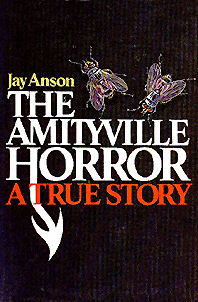

Truth and Belief

I met Claire Donner the way I meet most people these days.  Online.  I’m not sure how she found me in this dusty little corner of the internet, but she has one of the coolest jobs of all time: the New York City Director of Miskatonic.  If you don’t know Miskatonic, and if the title doesn’t at least give you a hint, you need to go back to your Lovecraft.  Its full title is Miskatonic Institute for Horror Studies.  They also have offices in London and Los Angeles.  Miskatonic offers a variety of one-session courses on horror and Claire had emailed me about the vexed idea of the nature of belief as it relates to horror movies.  Her course on the Amityville Horror—“‘Based on a True Story’: The Importance of Audience Faith in The Amityville Horror”—was excellent.  It left me in a thoughtful mood.

The way that I write books is that I have several projects going simultaneously.  Eventually one reaches critical mass and starts a chain reaction until it gets finished.  One of those projects that hasn’t yet attained critical mass is on Ed and Lorraine Warren.  It’s such an avocation that on a visit to Jim Thorpe on a family trip, I stopped into a shop where the owner proudly displayed articles about the Warrens in his window.  I asked him about the Warrens—whom he knew—but I wasn’t prepared for an interview (and I’m sure, neither was he).  Meanwhile, relatives waited patiently outside.  One thing I’m pretty certain about is that the Warrens sincerely believed in most of what they were doing.  There are nagging loose threads, however, that suggest they kept the financial angle firmly in mind.

To bring this back to Amityville, the course raises the question of the Warrens’ involvement.  They were among the earliest of “investigators” to take what was largely a hoax seriously.  They, however, didn’t get a cut in the profits.  I suspect this is what launched them into their promotional activities.  That book and movie combo brought in, and still brings in, the cash.  Who wouldn’t feel cheated?  But still, there’s belief.  For many of us belief requires some evidence, some tangible trace of truth.  These are the kinds of things explored in this fascinating course.  Horror and religion have been bedfellows for a very long time.  They often converge on this concept of belief.  There’s so much more to the Amityville Horror than meets the eye, even if we all know it was largely a hoax.