As a movie fan, you eventually come to trust certain filmmakers. The Coen Brothers produce consistently good work. I’d missed No Country for Old Men and was somewhat reluctant to see it. Films about sociopathic killers bother me, and I knew that the Cormac McCarthy novel was about a drug deal gone bad (and made him a household name). Drugs are another of my triggers, having grown up in an alcoholic household. But still, the film won the Academy Award for best picture, and it was a rather glaring hole in my viewing of Coen Brother major movies. While the film isn’t horror, it is one of the scariest movies I’ve seen in some time. The ending is devastating, and sad, and reflective. It’s easy to see why it appealed to the critics. Nothing is neatly tied up at the end. I haven’t read the novel, but I hear the film follows it closely.
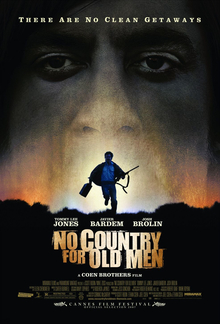
Llewelyn Moss comes across a drug deal gone bad. He finds a couple million in cash and takes it to the trailer park so he and his wife can retire. A hit man, Anton Chigurh, pursues him and eventually Moss realizes that a transponder has been hidden among the cash, giving away his location. Meanwhile, the local sheriff, Ed Tom Bell, does what he can to protect Moss’ wife and tries to save him from what he realizes is an unstoppable foe. Chigurh proves as tenacious as his reputation suggests, and viewers learn that Moss is as equally tenacious, but has both a conscience and morality, both of which Chigurh lacks. The scenes where Chigurh appears to be fair-minded are the scariest in the film.
The log line “There are no clean getaways” about sums up the outcome. Often classified as a western, the feel is more of a thriller. “Coen Brothers movie” might be a genre all its own. The relative lack of humor puts it much closer to Fargo than to O Brother, Where Art Thou? or Raising Arizona on the Coen Brothers scale. The unrelenting violence also brought Pulp Fiction (different director, different feel) to mind. The bleakness of the outlook of Sheriff Bell, as well as the look in his eyes, is haunting. His conversation with Ellis near the end stirs thoughts of Ecclesiastes and the reflection on just how violent people can be toward each other is profoundly disturbing. I’ve seen many horror films that didn’t scare me half as much.