Long Winter

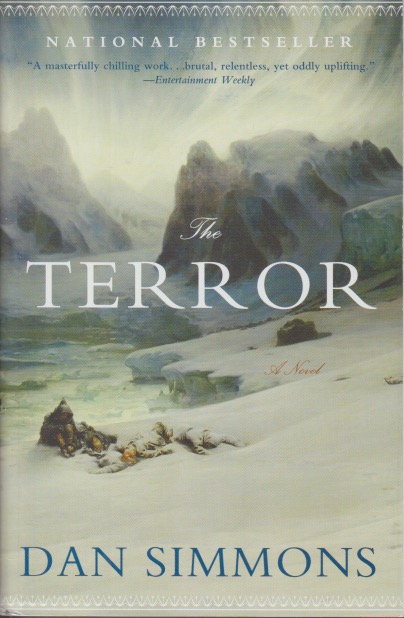
I have to confess that I often feel uncharitable towards very long books.  Mainly, I think, that is because one of my main blogging topics is books and when it takes a long time to read one I have to come up with other things to write about.  Still Dan Simmons’ The Terror had been strongly recommended.  I found it in an indy bookshop on independent bookstore day and began reading it sometime back in May.  It started out strong, but about three-hundred pages in began to feel a bit tedious and self-indulgent.  (I’ve done that myself with my fiction, so this criticism is also aimed at the one writing this reflection.)  In case you haven’t read it, the Terror of the title is HMS Terror, the ship captained by Francis Crozier under the command of Sir John Franklin, captain of HMS Erebus.  Both ships, seeking the northwest passage, froze in the Arctic ice in 1846 and their combined crews of 129 died without ever being found.

That’s a strong basis for a horror novel.  Your mind can’t help but wonder what it’d be like to be stuck in the dark, sunless winter, temperatures well below what most of us could survive, and realizing that you were never going to get out.  Simmons traces the story arcs of several of the crew that historically populated the ships.  Since there were no survivors, just about anything is fair game.  Including creating a monster to attack them.  Even as I began to warm to the book in the last hundred or so pages, it seems that some of this could’ve been trimmed and the same sprawling majesty been preserved.  Maybe I’m just jealous because none of my novels have been published and I keep being told you have to keep things short to get any traction.

In any case, by the end of the book I was really drawn in.  This was after the villain got his own, and Crozier starts to recognize the indigenous Arctic people for their truly remarkable survival skills.  (Not vegan friendly, of course, since vegetation doesn’t thrive in ice-bound conditions.)  It comes to a remarkable conclusion and I gradually found myself letting go of my petulance for having to invest so much time in one book.  I’m a slow reader with a very large pile of books yet to read.  In any case, Simmons won me back.  I quite enjoyed his Night of Summer and A Winter Haunting many years ago.  If you’re not afraid of big books, and you’d like to read about what can go wrong with a group of men trapped in the Arctic, then The Terror may be for you.
A Certain Man Went Down

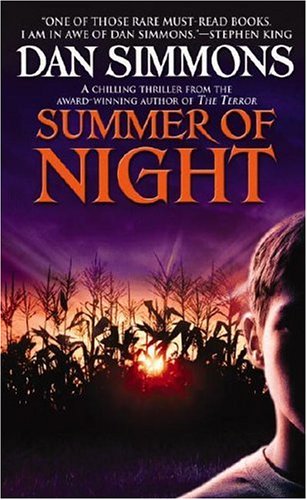
Among the progeny claimed by Wabash College is Dan Simmons. I’ve read a couple of Simmons’ ghost novels, although in reverse order. I read A Winter Haunting, which I quite liked, and followed it up with Summer of Night. Having lived in the Midwest many years, it was easy to visualize the scenes. Then came the time for my trip to Crawfordsville, Indiana. I started the day in South Bend, finishing up my meetings at Notre Dame. I’d noted on the map that, as is often the case, the places I need to get to just aren’t connected by anything resembling a direct route. Although the forecast said “30 percent chance of rain,” I’d awoken at 4 a.m. to a thunderstorm and it had been pouring all morning long. I could swear they were making plans to convert the great Notre Dame stadium into an ark. Perhaps I’d forgotten just how persistent Midwestern storms can be. Soaked, I crawled into my rental car to tool down to Crawfordsville. At least the rain had finally stopped.

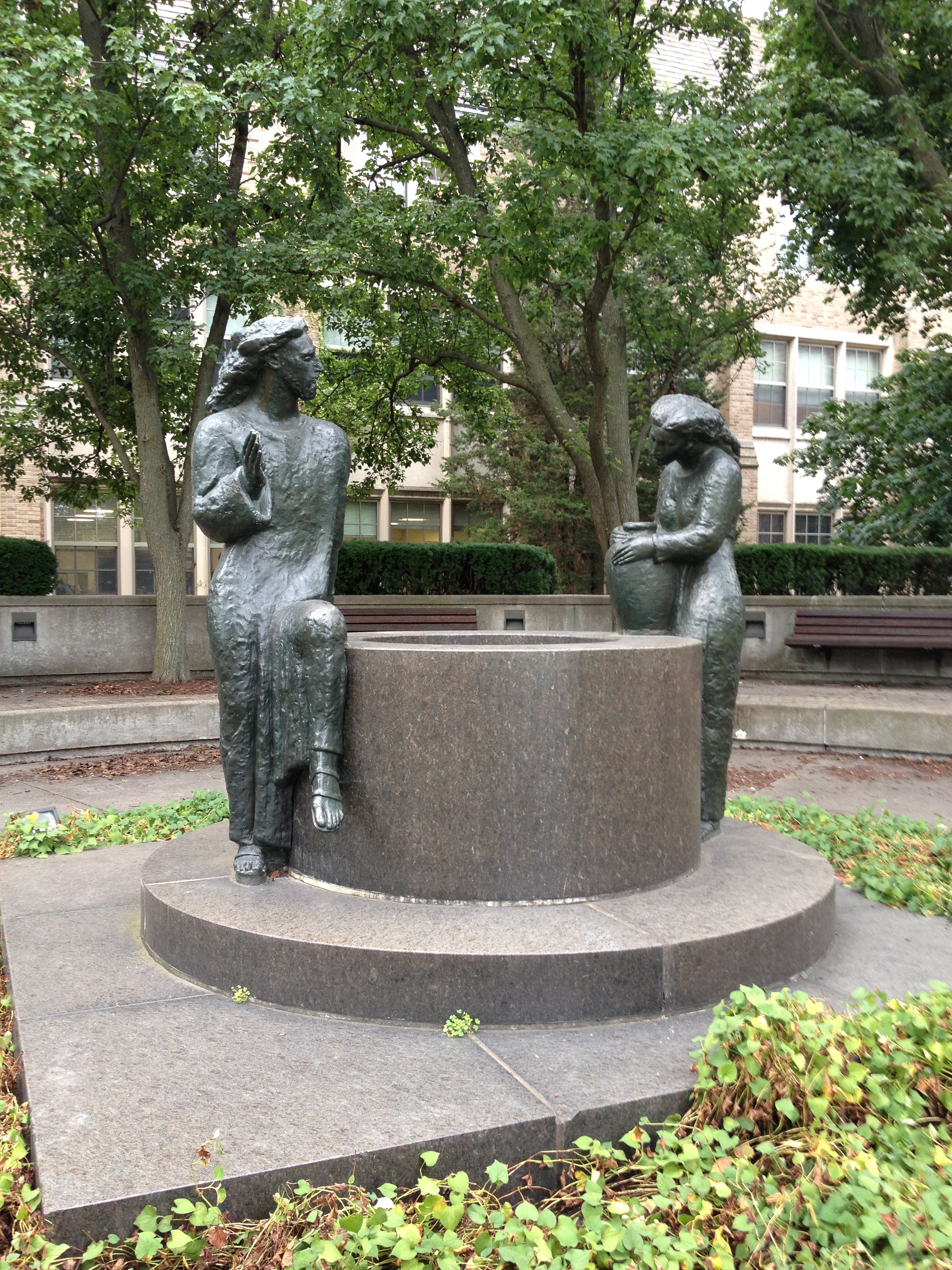
On one of those highways in the middle of corn fields as far as the driver’s eye dares look, the low tire pressure light came on. I dutifully pulled over and called Hertz. The suggestion was to find a gas station and put some air in the offending tire. Someone could be there in three hours. Looking about me at the amber waves, I thought of the spirits of Dan Simmons’ stories. A car breaking down in the heartland. No one around to offer assistance. The illusion allusion was shattered when a stranger pulled over and asked me if I needed help. I recall a priest friend once tearfully confessing to me that he had, on a rainy night, refused to stop to help someone with a flat because of fear for his safety. I understood completely—it can be a scary world out there. “And likewise a Levite, when he was at the place, came and looked on him, and passed by on the other side.”

With multiple stops to put air into my slowly leaking tire, I limped my way from town to town, reaching my destination after dark. Along the way a fierce rainbow appeared to the east as the sun began to set. Once you’ve abandoned the interstate in Indiana, there’s no going back. I began to notice just how many churches dotted each little village through which I drove. Samaritans, I thought. As I write this in Crawfordsville, I think of the corn, sorghum, and soybean fields that inspired Dan Simmon’s ghosts. I think of a stranger, a woman of minority demographics, stopping to see if I needed help along a lonely highway. She was among those our society would deem vulnerable, and yet she was the only one who stopped. And I think of parables. “But he, willing to justify himself, said unto Jesus, And who is my neighbour?”

IMG_0988


A Summer Fright

Although primarily known for his science fiction, Dan Simmons has also strayed down the dark path of horror fiction as well. During the depths of winter I found Simmons’s A Winter Haunting a moody and appropriate concomitant to the season. Not realizing that it was a sequel, when I saw his Night of Summer while at a Borders going out of business sale, I wondered if the same effect might work in warmer times. Both books rely on Egyptian funerary cult to move the story along, although in Night of Summer it is difficult to determine if the real menace is Osiris or the Judeo-Christian devil. Simmons has characters refer to Osiris as the power behind a haunted bell, but the climax of the story bears little resemblance to Egypt and quite a bit to standard monster flick tropes. “The master” of the reanimated dead is not explicitly identified. The use of Anubis in A Winter Haunting is quite effective, but the infernal characters were intermixed a little too much for my liking in Night of Summer. Better the devil that you know…

Perhaps it is simply that summer represents a time of relative ease and recovery from the frenetic pace of the remaining three quarters of the year. Although the heat and high humidity often make the season feel unbearable, the blush of abundance is all around. It is not easy to be afraid. When the air begins to chill and nature seems prepared to shut down production in the autumn, we naturally turn towards the desolate and constant struggle that will see us through the winter. Ancient people needed reassurance that warmth and relative ease would return. New Year’s rituals frequently marked autumn or spring, sometimes both. The death or life of the crops symbolized things to come.

Osiris, the god of the dead, also served as a god overseeing the renewal of crops for the ancient Egyptians. Death and life were knotted so tightly together that to unravel them was to fray the essence of the divine world itself. Among the cultures of the ancient world the Egyptians boasted the most developed concept of an afterlife. Even Paleolithic human burials contain grave-goods, demonstrating a belief in some kind of continuity beyond death. Simmons plays on that primal fear by resurrecting the dead in his novel. Beliefs about death and what might come thereafter have been one of the constant identifiers of religion from antiquity to the present. When evil pollutes the process the genre shifts to horror: witness the current fascination with vampires, zombies, and other undead entities. Religion and death are inextricably bound. Although Night of Summer may not live up to its sequel, the correlation between religion and fear meets the expectations of the genre, even during the long days of relative ease.


Anubis Rising

As if reality weren’t haunting enough, I’ve been continuing my quest to find the scariest fiction book written. I’ve borrowed suggestions from others, but it seems that the fear factor is a decidedly personal thing. Nevertheless, the suggestions are often enlightening as well as provocative. I recently finished Dan Simmons’s A Winter Haunting. Simmons’s work had previously been unexplored by me, so this was a foray into the unknown. Of course, I read horror with an eye toward the sacred and I’m seldom disappointed. In A Winter Haunting the sacred appears in the form of Egyptian religion. Simmons makes very effective use of hellhounds, tracing them back to Anubis.

Now Anubis lays me down to sleep

The religion of ancient Egypt had a morbid preoccupation with death – or maybe it was just a healthy recognition that it is inevitably coming. Many of their gods eventually ended up patronizing the dead in some way. Andjety, Ptah, Min, Osiris, Isis, Nephthys, Maat, and Thoth, as well as Anubis, regularly appear in the cult of the dead. And, of course, pyramids represented the stairway to heaven long before Page and Plant. Death and its psychological angst have been crucial to the development of religion from the beginning. The Egyptians honed it to a fine art.

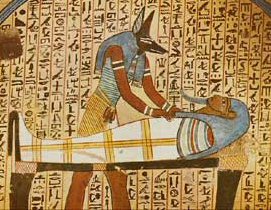
Anubis was likely associated with the dead because of the scavenging of wild canines at shallow graves. Magic, a phenomenon anthropologists have difficulty distinguishing from religion, dictates that the source of the problem should be appropriated as its cure. To protect the dead, the scavenger of the dead transformed into Anubis. Simmons did his homework, for this transformation is well represented in A Winter Haunting. Without knowing this particular plot device, I had been reading about Egyptian funerary cult independently of the novel and this coincidence proved entertaining as well as informative. I won’t be sleeping with the lights on, though. The search continues.