American Possession

the_exorcism_of_emily_rose

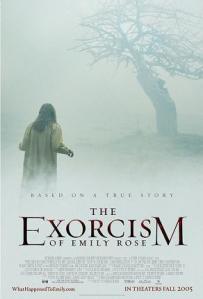
Exorcism seems an especially appropriate trope these days. Embedded evil has to be faced squarely and forced out before it kills its host. I recently rewatched The Exorcism of Emily Rose. This is a most unusual horror film in that the story is born by a courtroom drama over whether the priest overseeing the ritual was responsible for the death of Emily Rose. Famously based on a true story, the movie raises a more basic question than whether it “really happened”—what is the viewpoint through which we view the world? We see from the very beginning that the case is actually a contest between two powerful law firms. Each wants a lawyer that can shred the case of the other. The prosecutors engage Ethan Thomas, a very religious Methodist, against the defense’s Erin Bruner, an agnostic. Believing Emily’s case to be purely medical, Thomas asserts that had she stayed on her medication Emily would’ve remained alive with the prospects of a healthy life. Fearing a complete loss, Bruner takes a risky counter-approach: what is Emily really was possessed?

The obligatory scary scenes are shown, of course. They are flashbacks inserted into the course of the trial, but nevertheless disturbing for all their calm, rational framing. The real question, as the story plays out, is can a supernatural worldview be allowed in a court of law. Ironically, such a worldview is already present when a witness swears on the Bible. This particular movie doesn’t show those scenes, but it would’ve been a fair point for Ms. Bruner to make. Clearly the court can’t decide if demons are real, but it can allow that possibility. It’s a classic case of science versus religion. Nevertheless, both sides make use of science. The anthropologist on the stand is dismissed by the religious Mr. Thomas. He has no time for Catholic, or any other religions’, superstition.

Many strange choices were made for this particular cinematic piece, but the story works nevertheless. Those who believe in spiritual realities are allowed to live them out only to a point. The legal system decides if a religion has gone too far. I couldn’t help but wonder if, in a post-truth world, any clear standard of rationality can possibly hold. But questioning universally accepted truths and subverting them to personal preferences its almost if we’ve actually reached the stage of “all those in favor of general relativity say ‘aye.’” As I say, the film was more timely than anticipated. Demons, after all, often appear in the guise of an angel of light. Especially for those motivated by fear.


December Demons

Conversations with friends, inevitably, turn to the fiasco this country faces with Donald Trump. My response, apart from attempting a measure of optimism and combativeness, often involves escapism. Regular readers know that I watch horror movies. They may not know that I watch such films to help me cope with the very real fears of living in what has all the signs of being an out-of-control autocracy. With this in mind, I’ve been reading about horror films to try to understand myself a bit more. Perhaps a roundabout way to psychological insight, but it is cheaper than seeing a therapist. Over the weekend I again watched The Exorcist. A classic of the horror genre, it is rare in having been nominated for Best Picture at the Academy Awards and having received mainstream critical acclaim. What made it particularly interesting at this particular viewing is the fact that demons are such poorly understood monsters.

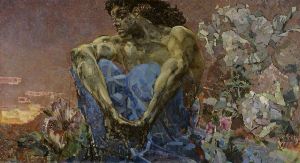
Mikhail Vrubel's demon, Wikimedia Commons

Mikhail Vrubel’s demon, Wikimedia Commons

One of the reasons for this is that no single entity known as “demon” fits all the ancient ideas about such spiritual beings. The earliest demons we know about, from ancient Mesopotamia, aren’t necessarily evil. They seem to be in control of natural forces that harm people, but that isn’t always intentional. From the human perspective this is bad, but from the point of view of the divine world, it’s neutral. Sumerians and those of the Babylonian and Assyrian empires did not believe in Hell. There was no Satan and therefore “fallen angels” intent on harming people weren’t part of their worldview. The Greeks, who gave us the word, referred to as “daimons” nature spirits that were generally benign. In the biblical world, influenced by Zoroastrianism, a dualistic understanding of the universe emerged and eventually demons came to be understood as angels that followed the Devil in revolt against God.

Complicating the picture, possession, in world religions, is not always a negative thing. In some cases it is a way of having a deity inhabit one’s body—something of a blessing. In the New Testament demons may have been an explanation for epilepsy. They were, however, understood in that day as possessing spirits of evil intent, in league with Satan. Thoroughly evil, they could evoke paranormal phenomena and could completely control a person unless expelled. In modern media, where reality television dictates the terms, demons are responsible for some hauntings. They are disembodied entities “that were never human” and they are always malevolent. One of the reasons they are so scary is that no one really knows what they are. And in cases where one has no idea what to expect, fear is a natural result.


The Grammar of Evil

I stepped into a devil of a situation. Elevators are strange spaces. Given the choice, I’ll take the stairs any time. At work, however, as one of the many quirks of Manhattan, our elevators only stop on certain floors and we’re not able to use the stairs unless it’s an emergency. After a meeting on a floor where the only option was to elevate out, I stepped into a crowded elevator where a conversation was going. “You always capitalize Satan,” someone was saying. The usual questions among non-religion editorial staff ensued. Why is that? What about “devil”? “It’s never capitalized,” came the reply. My profile at work is about the same as it is on the streets of New York. Not many people know who I am or what I do. Although I’ve struggled with this very issue before, on a professional level, I kept silence and waited for my floor.

So, was the elevator authority right? “Satan” has become a name, rather along the lines of “Christ.” Both started out as titles. In the Hebrew Bible “satan” is “the satan.” The accuser, or the prosecuting attorney—something like that. As one of the council of gods, the satan’s job was to make sure the guilty were charged of their crimes. Diabolical work, but not evil. By the time of early Christianity, however, Satan had evolved into a name. It is therefore capitalized. It was specifically the name of another title, “the Devil.” Or is it “the devil?” Do we capitalize titles?

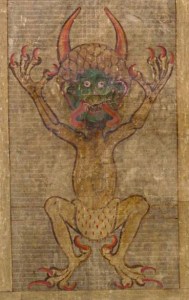
The Devil wears underpants.

The Devil wears underpants.

In seminary and college the received wisdom among those of my specialization was that there is only one Devil and the title should be capitalized. My elevator colleagues were discussing the number of devils when I stepped out. Traditional theology says there’s only one. Not that the Bible has much to say about the Devil—he’s surprisingly spare in sacred writ. Demons, however, are plentiful. Some people call demons devils, just as many believe that when good people die they become angels. The mythology behind demons seems to be pretty well developed in the biblical world, but again the Bible says little. Demons can be fallen angels or they can be malign spirits who cause illness. Either way they’re on the Devil’s side. But should we capitalize his title? The Oxford English Dictionary doesn’t help, giving examples of both minuscule and uncial. I suppose that’s the thing about the Devil; you never really know where you stand.


Foiled Again

Few things travel as well as curses. Or so it seems in a news report from Serbia. Archaeologists in Kostolac, according to The Guardian, have excavated skeletons nearly two millennia old. That’s not news, since people have been dying as long as there have been people. What makes the find extraordinary are the gold and silver metal foils that have been found at the gravesite. Inscribed in Aramaic with Greek letters, these tiny missives were rolled and placed in lead tubes to be buried with the dead. Although translations of the inscriptions aren’t given, the fact that they contain the names of demons would suggest these might be curses against anyone seeking to disturb the tombs. Such devices go all the way back to the Pharaohs, and perhaps earlier. Nobody likes to have their sleep disturbed.

Serbia, for those unfamiliar with geography, isn’t exactly next door to ancient Aram. The burials and inscriptions seem to fall into the Roman Period, however, a time of cultural diversity. When cultures come into contact—in the case of Rome and prior empires, through conquest—new ideas spread rapidly. And sometimes old ideas. The Romans, in general, didn’t like competing religions. Then again, their idea of religion was somewhat different than ours. Ancient belief systems were more or less run by the state. They served to support political ends—at least they were upfront about it. Your offerings and prayers were to be given in support of the king, or emperor, and beyond that nobody really cared. Unless, of course, you were making curses.

Curses, it was believed, really worked. Even today in cultures where belief in curses persists people tend to be physically susceptible to them. We don’t want others to wish us ill. Perhaps that’s the most surprising thing about politics today. Our society has taken a decided turn towards the more secular. Candidates for political office, even if they personally believe nothing, can still cast curses on those who are different. They can claim support of their “faith” to do so as well. Words, in ancient times, were performative. They meant something. Curses were taken seriously because if someone were serious enough to say it, they probably meant it. They could be written down and preserved beyond death. Today, however, words are a cheap commodity. You can use them to attain your personal ends and discard them once they’ve outlasted their usefulness. Perhaps we do have something to learn from the past after all.

Copper scroll from Qumran, replica. Not a curse, just an illustration.

Copper scroll from Qumran, replica. Not a curse, just an illustration.


Minding Souls

The mind, despite nay-sayers, is real. It isn’t an illusion. Emergent phenomena are often larger than the sum of their parts. One of the problems with the non-physical is that we can’t parse it precisely. “Mind” may be called “soul” may be called “personality” may be called “spirit.” You get the picture. Many scientists would answer “none of the above” to the question of which of these exist. Other scientists, not on the fringe, are beginning to see that the answers aren’t quite so simple. A recent piece in the mainstream Washington Post, dares to say what we all feel. Or at least many of us feel. There are realities that religions have recognized for millennia, that demonstrate the existence of the non-corporeal. “As a psychiatrist, I diagnose mental illness. Also, I help spot demonic possession,” an article by Richard Gallagher, is worth reading. Gallagher, with a hat-trick of Ivy League-awarded degrees, believes in demons. They’re rare, of course, he says, but real.

The standard story—in large part correct—is that ancients misdiagnosed epilepsy and some forms of mental illness as demons. Undoubtedly their standard threshold was too low. Occasionally, however, they may have been right. Unlike what we’re sometimes told, the ancients recognized at least some mental illness when they saw it. There were non-functional people then, and while some may have blamed demons, others saw them as people who don’t think like the rest of society. Then there were the possessed. As Gallagher notes, humans with superhuman strength, speaking languages they never learned, and yes, even levitating, have been witnessed by credible viewers. Very rare, yes. But also very real.

Despite the need that many feel for freedom, we are, as a species, fond of laws. We want to know the rules and we’re quick to call out those we catch cheating. We’re so fond of laws that we apply them to nature and claim that natural laws can never be broken. Well, at least not above the quantum level. A friend shared that this concept of applying legal language to nature is a fairly recent development in human thought. The idea of a law, however, requires someone to oversee and enforce it. One of the subtleties here is that any enforcement that takes place requires a measure of value, and value, as much as we all treasure it, simply can’t be quantified. Is gold more valuable than silver? It depends. The value comes in assessing its usefulness. Laws separate good behavior from bad behavior. And, if many credible people are to be believed, the behavior of mind sometimes defies the laws of nature.

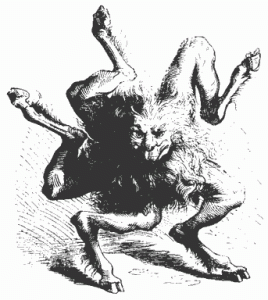
Buer


Devil’s Workshop

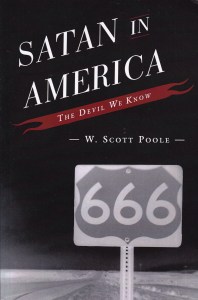
SatanInAmerSome of us prefer taking our monsters neat. With Old Scratch, however, we have a slippery, protean beast. This is amply demonstrated in W. Scott Poole’s Satan in America: The Devil We Know. Not only the Devil, but vampires, demons, and the human minions known as Satanists and witches populate this study of American culture. The Dark Lord is difficult to pin down. This is true even concerning his obscure biblical origins. As I’ve noted before, there is no Devil in the Hebrew Bible. By the time of the Gospels he’s alive and well and on planet earth. Or at least what passed for planet earth in those days. Tempter, father of lies, prince of the power of the air—he was a pretty ambitious fellow, seeking like a lion those he might devour. Those were early days, however, and Poole focuses specifically on his development in American culture. It is, as he shows, a rich culture indeed.

Beginning with the colonial era, with the Matherses, Jonathan Edwards, and their ilk, and bringing the figure up through fairly contemporary times, Poole shows us how the Devil defines America, in many ways. Please don’t misunderstand; Poole does not say America is evil or Satanic, only that our culture has had an undying fascination with Satan. Not everyone agrees, of course, with who he is or how to interpret him. Although theologians have largely left the Devil in the dust, polls tend to show about half of the American population believes in the Beast (yet another character in the mixed martini of evil Poole serves up), or more properly, Satan. It really might help to have a diabolical score card here: is the Antichrist the Devil? Is he the same as the Beast? What about demons? As a child I was taught there is only one Devil, but lots and lots of demons. Legions of them, in fact. There can be only one morning star, one Lucifer.

One thing we can say for certain about Satan, at least in the context of Poole’s study, is that he is evil. Not that some haven’t had sympathy for him. Popular culture has helped to keep the character alive. Sometimes comically, sometimes with dead seriousness, novelists, cartoonists, film-makers, and playwrights come time and time again to the font of the inexplicable evil we all seem to sense, in some sense, exists. The evidence is all around us. Whether conceived as an external agent of supernatural origin, or as some inborn tendency for—at least some—committing atrocity, we do have to explain evil. Satan has been a convenient way of doing so for centuries. But, as Poole intimates, it might be a defense mechanism. Perhaps we need to take a closer look at ourselves. Perhaps trumping our exceptionalism in the face of a world in need is a symptom that requires a serious exorcism.


Taking God to Bed

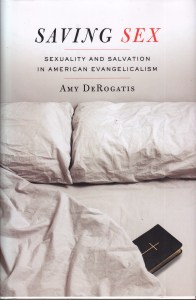
SavingSexThere are varieties of evangelical experience. It is so convenient to put people into neatly labeled boxes that we tend to forget religious experience can be very different, even to conservatives. This point is made very clearly in Amy DeRogatis’ Saving Sex: Sexuality and Salvation in American Evangelicalism. The title of the book requires some further disclosure. DeRogatis is offering an academic study of evangelical sex manuals and teachings about sexuality. If you’re anything like me, the very concept sounds strange. I grew up in an evangelical household and we would’ve been scandalized to learn that such things as godly sex manuals existed. In fact they did, but we didn’t know about them. Although evangelicals share a common idea that there are appropriate and inappropriate varieties of sexual experience, they disagree, according to the evidence, over what some of those boundaries are.

DeRogatis’ book offers some fascinating insights even within this circumscribed field of study. For example, some writers of such manuals give rather permissive instructions as to what might happen in a heterosexual, Christian boudoir, while others keep to the basics. Some suggest that the very practice of sexuality opens its participants to demonic infestation, so much so that they consider STD to be Sexually Transmitted Demons. This is an intriguing and frightening world to enter. Many of the writers of such books suggest that women should indeed be under the authority of their husbands in all things. No room for Lilith there! Others, however, are surprisingly broad minded. More so than some Episcopalians I’ve known.

This brings me, as a former evangelical, to my concern about academic studies of such groups. It seems to me that to truly understand what are undoubtedly irrational beliefs, you must have had the experience of truly believing. If I might be excused of the pun, are you experienced? As much as we wish it were, evangelicalism isn’t a neat packet of propositions that people simply accept. It is a complex, emotional, and, in its own universe, logical response to the belief that the Bible is the owners manual. Sola scriptura gone wild. How individuals deal with this impossible truth is widely divergent. We’re taught not to discuss sex in polite company, but we just can’t help ourselves. For some that’s good news indeed. For others it is the very definition of wickedness. As Saving Sex shows, there is more than one position to be taken.


Not Your Father’s Demon

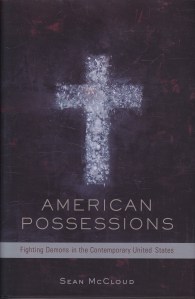
AmericanPossRegan MacNeil is a name that can still send shudders up and down stout spines. Despite advances in CGI and special effects, The Exorcist is consistently rated among the scariest movies of all time. Demon possession, clearly, is a very troubling thing. American Possessions, by Sean McCloud, is not a place to go to find Catholic priests expelling the forces of darkness. Subtitled Fighting Demons in the Contemporary United States, the book, one might suspect, is saying more than it seems to be letting on. This is a book about Third Wave evangelicalism and its demon-fighting manuals. Although the term “Third Wave” may be unfamiliar, the next time you go to a Tea Party you’ll know you’re among them. These born again uber-capitalists believe in a literal demonic world. In fact, demons are so common that Jesus would’ve had a hard time keeping up with their exponential economic growth. These demons are more frightening than those that possessed Regan. The are more akin to a different Reagan.

Especially popular among Pentecostals (the fastest growing form of Christianity) this modern day belief in demons sees them in places Jesus didn’t think to look. Family curses (at places ruled out in the Bible, but still, apparently, possible), addiction, depression, sexual urges—these are all demonic. And once these modern demons are cast out, unlike that of Regan, they can come back. And if they don’t possess you they will oppress you. And they can live in your material goods, your house, and even the land it is built upon. They are everywhere, and they have to be fought against constantly. They also, apparently, vote Republican.

This view of the world, strange as it is to many people with a basic education in science, motivates a large sector of the United States population. Expelling these demons requires a specific view of Christianity—a view that absolutely excludes Catholics. And it is a view that promotes free market economics, blaming the victims of poverty for allowing themselves to be oppressed by demons. Many aspects to this belief system will strike the reader as completely unbelievable, all the more for being so seriously believed. At the same time, we are told, we should pay no attention to religion, at least as educated people. The problem with this is that these true believers vote. And the kingdom they would have come on earth is, in a way they would certainly deny, possessed.


To Nature, and Beyond

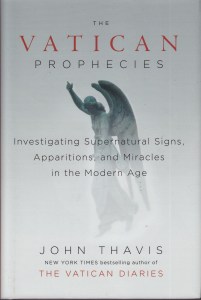
VaticanProphIt might seem odd to differentiate the supernatural from an established world religion like Roman Catholicism. After all, be premise of traditional Christianity is based on a miracle or two. Church officials, however, are not naive. It has been known from the early centuries of the church that although miracles are still from time-to-time proclaimed, they are a relative rarity. Few are claimed, like Jesus of Nazareth, to have the ability to summon the supernatural at will. When my wife gave me a copy of John Thavis’s The Vatican Prophecies, I wondered if this might be a sensationalist exploration of “the hidden Vatican” and its penchant for keeping things hushed. After all, the subtitle is Investigating Supernatural Signs, Apparitions, and Miracles in the Modern Age. Thavis, however, is one of the most even-handed writers on the topic I might imagine. Clearly respectful of the Catholic faith, he doesn’t go after any pet theories or conspiracies. He lets those in the church answer with their own words. And those words paint a fascinating picture.

Beginning with the concept of holiness, Thavis shows that the point of the spiritual life is not to seek signs. Nevertheless, signs are reported. Apparitions of Mary have a long history, as does the shroud of Turin. Those who write about such things often have a clear bias, but Thavis gives the facts, interviews those who know, and offers a narrative full of possibilities. The supernatural can take a darker turn, however, as his chapter on demons and angels demonstrates. Although demons have been cast into the outer darkness by science, it doesn’t prevent people from apparently being possessed. And of course miracles come under scrutiny, particularly in the context of making saints. Prophecy, in the sense of knowing the future, is the last major topic up for discussion.

The Vatican Prophecies is a curious book that seems neither credulous or overly skeptical. It’s more like reporting than it is declaring what is or isn’t possible. Yes, the Roman Catholic Church does still profess miracles, but a vast number of them that come up for testing fail. Scientists serve as expert witnesses and personal claims are not sufficient to win the day. Although there are a few characters in this account, the majority of those mentioned in the book are understated, thoughtful individuals who happen to know they can’t decide what really happens or not. Instead, they simply deal with it. For those of use who live in a world of uncertainty, this book is a most apt introduction to topics taken seriously by some very intelligent people.


Imagining Things

Having a child in college is one way for me to stay attuned to popular culture. You can absorb quite a lot by simply paying attention while on campus. For example, on the last several visits I’ve heard the song “Demons,” by Imagine Dragons, being piped into various venues. Given the biblical language of the song, I wondered about its origins, but, like many a distracted parent, had too much on my mind to pursue it. Well, on a recent visit, the song got stuck in my head. Partially this was because during an a cappella concert the Christian group did a cover of the song. This sent me to the internet—the only place where information on contemporary culture is instantly at your fingertips—to do a bit of poking around. Secular groups, after all, frequently use biblical references unnoticed.

When I learned that two members of Imagine Dragons were from Brigham Young University, I just had to know if they were Mormons. From what I’d seen of concert photos, white shirts and ties were rather conspicuous by their absence. Indeed, it turns out, according to the web, that the group does have some LDS in its bloodstream. I’m not so naive as to think that being of a particular religious background makes rockers religious. The debates raged in college over whether U2 was a Christian group because some of them were Catholics. I don’t recall seeing any crucifixes on the album art. This is all especially intriguing because Christianity and rock-n-roll are considered by many to be natural enemies. The origins of rock in the sexually suggestive blues had many 1950’s parents quite worried.

Religion changes, however, once you get away from the parents. I’ve known Mormons that I couldn’t identify as such until they told me. I’ve known Catholics about which I still harbor doubts. Religious affiliation is sometimes purely cultural. That won’t prevent you from being excluded from consideration for a teaching position at any of their schools, however. Scholars of religion can be the greatest believers of fiction to be found. Still, I have to admit to myself that the song “Demons” does keep me coming back. I wonder if the Christian group performing the song was aware of its Mormon tinge, or if they even cared. Sometimes theology can be had for a song.

ImagineDragons


The State Demon

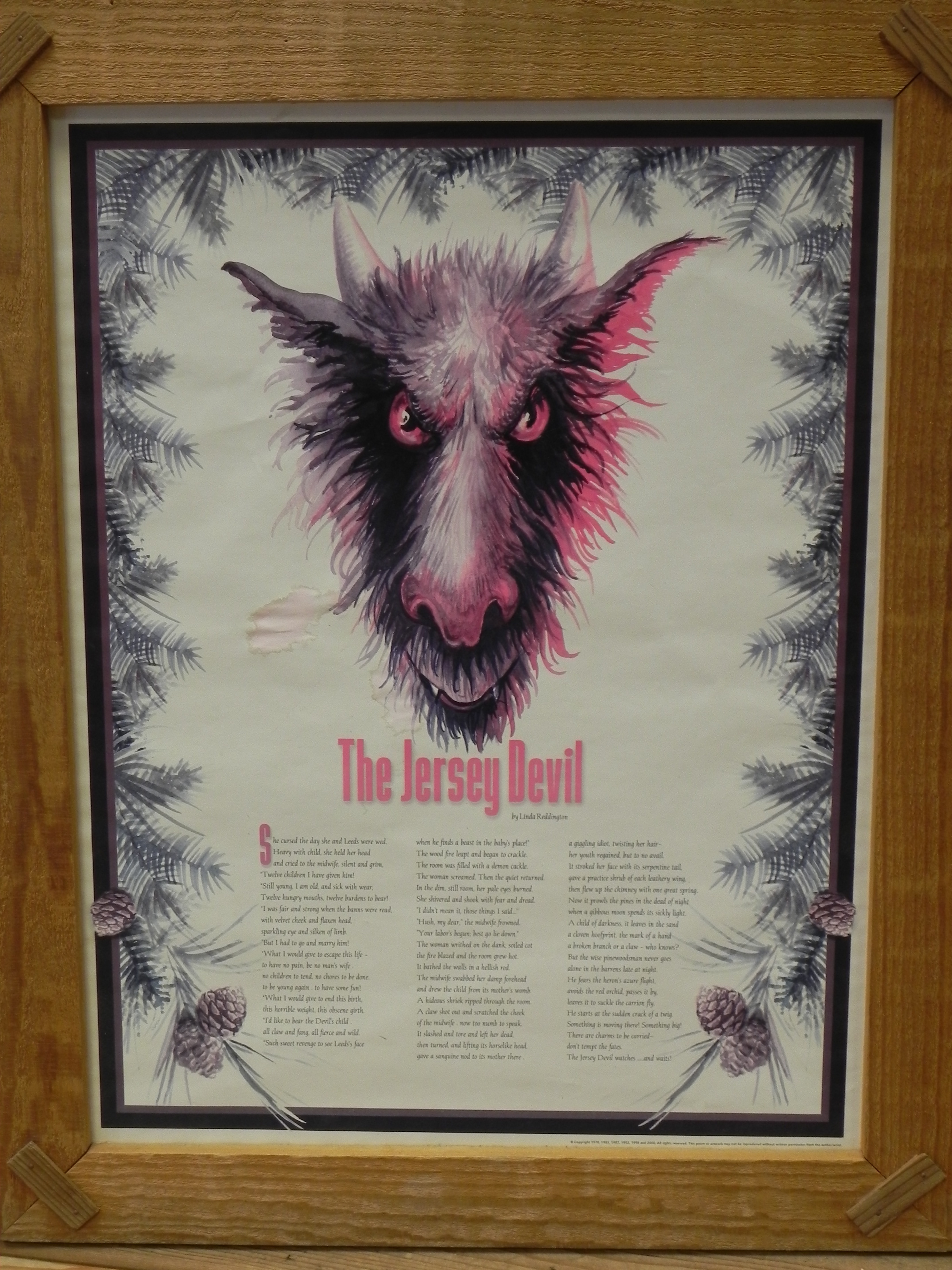
It’s the time of year for seeing things. I suppose that’s why there have been two supposed sightings of the Jersey Devil flying around the internet this past week. The credulous take these kinds of things for evidence, and the posters claim complete sincerity and who doesn’t want to believe? Still, the photos and videos fail to convince. It’s the time of year when we want to see monsters.

DSCN0128

While the origin story of the Jersey Devil is one of the main strikes against it for sheer impossibility: Mother Leeds, who had twelve children, finding herself pregnant with a thirteenth, wished that it would be born a devil. The cursed child, meeting motherly expectations, came out a devil, flew up the chimney, and has haunted southern New Jersey ever since. The folklore elements are thick in this tale: the thirteenth child, the exasperated mother, devils in the woods. This doesn’t, however, suggest much confidence in the literal truth of the story. This traditional tale circulated in the same region where legitimately strange things were seen, especially around the turn of the last century. Every now and again the devil reappears in a present-day venue. At one time the Jersey Devil was even the official state demon of New Jersey.

The ease of use of photo-altering software has taken us further and further from the truth. It is an impoverished world that has no mystery to it, but the easily hoaxed world of Photoshopped monsters will cast doubt on all contenders, I fear, forevermore. We can no longer trust the veracity of the lens. Our world has become an electronic illusion. The creature spotted in the Pine Barrens can be more readily believed without photographic proof. The sober, shaken witness who can’t explain what s/he saw one dark night is more believable than a goat with wings or a stuffed animal on a string. Our religious sensibilities urge us to believe in the impossible. Our cameras urge caution. After all, internet fame is often the only kind available to those whose videos and photos go viral. The devil, they say, is in the details.


Power of Gods

PowerOfGodsOnce a biblical scholar, always a biblical scholar. This stuff just can’t be unlearned. Suspension of belief, however, is a necessary component of enjoying fiction. I finally found time to slot in Nancy Madore’s Power of Gods, the second in her Legacy of the Watchers trilogy. In the novel she continues the tale of the djinn who infiltrate the world—well, actually, they have been here from the beginning—causing trouble for human plans. The interesting theme that shows up in this second volume is that people are ill-equipped to see the larger picture. With our limited imaginations and vocabularies, we can’t get beyond this world to see what’s really going on outside. Madore uses the literary conceit of djinn where many would probably use demons, but the result in similar. People are pawns in a cosmic game. Even less than pawns, really, but that’s as far as the analogy will go.

While empirical method is unrivaled in revealing the mechanisms of the physical world, life constantly reminds us that something more is going on. Biology doesn’t always play well with physics. And behind biology is the absolute drive to continue living. Life is addictive. Saying it’s biologically programmed doesn’t answer anything. Call them djinn or call them gods and angels, these beings represent the non-corporeal. At their best, religions also deal with that element of life that goes beyond, but also includes the body. Power of Gods adds, of course, speculative elements to all of this. HAARP is brought into it, and our own government is implicated in spiritual manipulation. Freedom of religion indeed.

To be human is to be subjected to forces we don’t understand. We label them, advertise them, and sell them, but we don’t comprehend them. Elements of life that should seem quite simple are among the most complex. When they get to a point that we are completely at a loss to name them, they become divine forces behind the mundane world that makes up far too much of existence. It’s clear that Madore has written her trilogy with people like biblical scholars in mind. We, after all, share the vocabulary and the concepts. And we understand the idea of an unseen world influencing us in unexpected ways.


Molly Picture

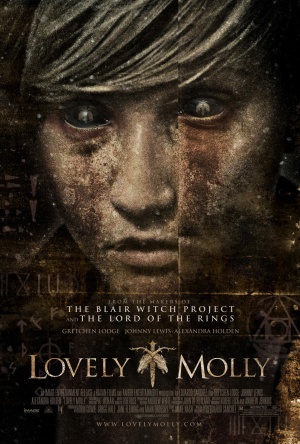
Lovely-molly-posterMaybe I’m getting out of practice with my horror movies—I don’t have time to watch them like I used to—but Lovely Molly left me a little confused. I suppose I’m more susceptible to big advertising than I’d like to admit, but I knew about Lovely Molly from the massive Times Square ads back when I was still with Routledge. I’m ambivalent about demonic possession movies, but I put it in my mental bucket list until I had a weekend evening alone to fire it up on Amazon Prime. As I’ve noted, it left me more confused than scared. Yes, watching it kept me tense, not knowing what was going to happen next (I knew nothing of the story beyond that it was a possession story) but as gruesome as a couple scenes were, the question of what’s going on never really got resolved. It’s pretty clear that Molly was abused as a child, turned to drugs to cope, and is having a breakdown after moving into her creepy childhood home. If her newlywed husband didn’t hear some of the sounds, it would seem to be a conventional breakdown story. Eduardo Sánchez doesn’t show us the monster until the very end, and even then, not clearly. I had to turn to online discussion groups to understand what I’d just watched.

While in this post-modern age no one is qualified to say what anything really means, if fans are to be believed, the DVD extra implicate the demon Orobas. I’m no expert on demons, and I couldn’t recall having heard the name before. In the “found footage” scenes where Molly eerily hums to herself while visiting the sites of childhood memory in the house, she does uncover what seems to be the symbol of Orobas. This is a horse-headed, horse-footed demon with the body of a man. Indeed, when she is being stalked by what she believes to be the ghost of her father, Molly hears horse hooves on the floor. In the final scene, she leaves a photo album for her sister to find with her father’s head covered with pictures of horse heads that she’d cut from his wall of framed pictures, apparently of prized beasts.

The real horror here, however, is in what seems to be a misogynistic implication, no matter how justified, that Molly (and her sister) are the murderers. Molly reveals that her sister killed their father, and Molly herself dispatches, it seems, the preacher, her husband, and the girl of the neighbor next door. She, however, is the one who had been victimized. If this is a case of possession, at least by implication, then the male demon is to blame, but it looks like Molly pays the price. The evidence is circumstantial and Molly disappears at the end, leaving open the room for a sequel. While I felt no need to sleep with the lights on after watching it, the movie has enough provocative material to make me think about it, trying to figure out what was supposed to have transpired. I suppose that many horror movies are more straightforward, but the more easily forgotten for being so.


Getting Exorcise

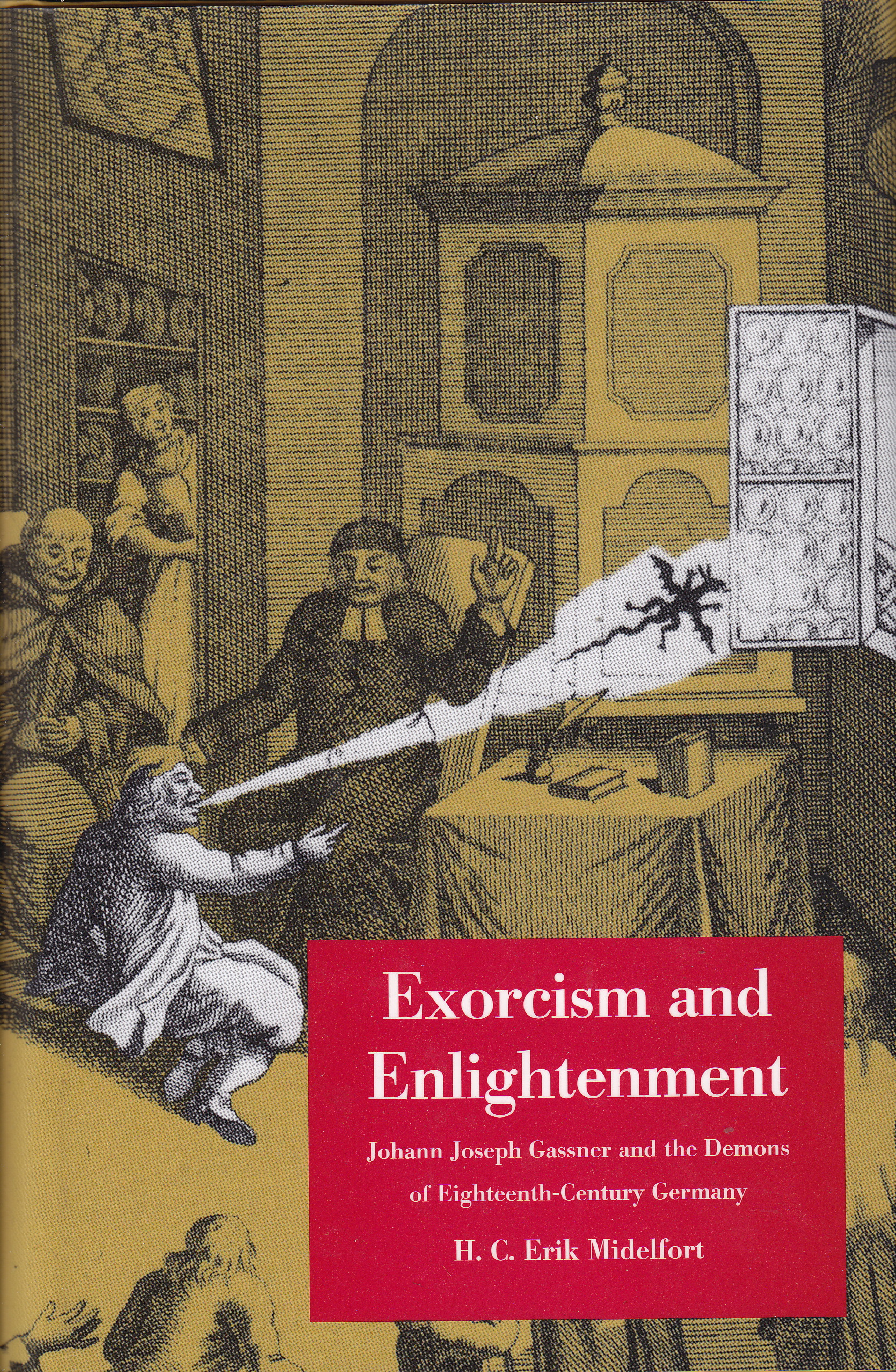
ExorcismTo be honest, I can’t recall having heard of Johann Joseph Gassner before. Given his role in the European witch-hunting culture, however, I must have read his name a time or two. As with most names out of context, it was quickly forgotten. H. C. Erik Midelfort, therefore, is to be congratulated with bringing out not only Gassner’s name, but his remarkable career. Exorcism and Enlightenment: Johann Joseph Gassner and the Demons of Eighteenth-Century Germany, like so many other books, came to my attention in a bookstore. Books on demons have a strange kind of draw to someone interested in both religion and monsters, and since it was on an overstock shelf, I found it impossible to let it lie. This proved to be a wise decision.

Midelfort proves himself one of the rare academics who doesn’t talk down to his readership, yet makes what could be a complex topic understandable. Complex is about the only word to describe what would become Germany in the Eighteenth Century. The remnants of the Holy Roman Empire left a divided region with prince-bishops—clerics with political control outside their own dioceses—vying for all kinds of authority. Although the Enlightenment was well underway, the region was embroiled in the controversy of a priest by the name of Gassner. Gassner was a healer, but also an exorcist. Believing that many torments suffered by the populace were demon-spawned, he used highly public and, to some, incredible exorcisms before healing those in need. His success was unquestioned, but the church, struggling between Catholicism and Lutheranism, as well as struggling to find a place in the Enlightenment world, found Gassner a bit of an embarrassment. What do you do with demons in a world where science says they don’t exist?

One of the most notable takeaways from Midelfort’s book, for me, is that the Enlightenment did not suddenly change the world. Even fully aware of empirical experimentation and the use of reason, the scholarly world did not utterly acquiesce to a subdued materialism. It still hasn’t. As the case of Gassner demonstrates, our comfortable, physically predictable world holds some surprises for us yet. At least for Gassner, believing demons don’t exist doesn’t stop them from tormenting people. As he cured his thousands, skeptics gathered (including his contemporary Franz Mesmer) to explain away what was happening. Even today, as Midelfort points out, we can’t explain the placebo effect. There’s no question, however, that it works. As does, if the media is to be believed, the occasional exorcism in the twenty-first century.


Fear and Dissembling

The ConjuringLast year, when The Conjuring was released, it quickly became one of the (if not the) top earning horror films of all time at the box office. Based on a “true case” of Ed and Lorraine Warren—real life paranormal investigators—the film is a demonic possession movie that ties in the Warren’s most notorious case of a haunted (or possessed) doll, with a haunting of the Perron family of Rhode Island. (The Warrens were also known as the investigators behind the Lutz family in the case of the “Amityville Horror,” showing their pedigree in the field.) Given that Halloween has been in the air, I decided to give it a viewing. As with most horror movies, the events have to be dramatized in order to fit cinematographic expectations. Apparently the Warrens did believe the Perron house was possessed by a witch. In the film this became somewhat personal as the dialogue tied her in with Mary Eastey, who was hanged as a witch at Salem (and who was a great-great (and a few more greats) aunt of my wife). Bringing this cheap shot into the film immediately made the remainder of it seem like fiction of a baser sort.

Witches may be standard Halloween fare, but when innocent women executed for the religious imagination are brought into it, justice demands separating fact from fiction. Writers of all sorts have toyed with the idea of real witches in Salem—it was a trope H. P. Lovecraft explored freely—but there is no pretense of misappropriation here. Lovecraft did not believe in witchcraft and made no attempt to present those tragically murdered as what the religious imagination made them out to be. The Conjuring could have done better here. It reminds me of Mr. Ullman having to drop the line about the Overlook Hotel being built on an Indian burial ground. Was that really necessary? (Well, Room 237 has those who suggest it is, in all fairness.) The actual past of oppressed peoples is scary enough without putting it behind horror entertainment.

A doctoral student in sociology interviewed me while I was at Boston University. She’d put an ad in the paper (there was no public internet those days) for students who watched horror movies. I was a bit surprised when I realized that I did. I had avoided the demonic ones, but I had been in the theatre the opening week of A Nightmare on Elm Street (on a date, no less) and things had grown from there. I recall my answer to her question of why I thought I did it: it is better to feel scared than to feel nothing at all. Thinking over the oppressed groups that have lived in fear, in reality, I have been reassessing that statement. What do you really know when you’re a student? As I’ve watched horror movies over the years, I have come to realize that the fantasy world they represent is an escape from a reality which, if viewed directly, may be far more scary than conjured ghosts.