The Fate of Goddesses

The goddesses Asherah and Astarte are sometimes confused, even by experts. Astarte, also known as Ashtart, Ashtarte, Athtart, and Astaroth, among other names, is the lesser attested of the two among the Ugaritic texts. Indeed, to read some accounts of the latter goddess, she becomes dangerously close to being labelled generic, the sort of all-purpose female deity embodying love and war, and sometimes horses. In the Bible Astarte lived on to become the bad-girl of Canaanite goddesses. Her corrupting ways were a conscious danger to the orthodox (as much as that is read back into the texts). She became, over time, literally demonized. It seems that originally she, like most goddesses, had a soft spot for humans. Since she wasn’t the one true (male) God, however, she had to be made evil. It is an unfortunate pattern as old as monotheism. One of my original interests in studying Asherah (not Astarte) was precisely that—the obviously benevolent divine female seems to have been chucked wholesale when the divine masculine walked into the room. Why? Well, many explanations and excuses have been given, but whatever the ultimate cause, Astarte lingered on.

IMG_1620

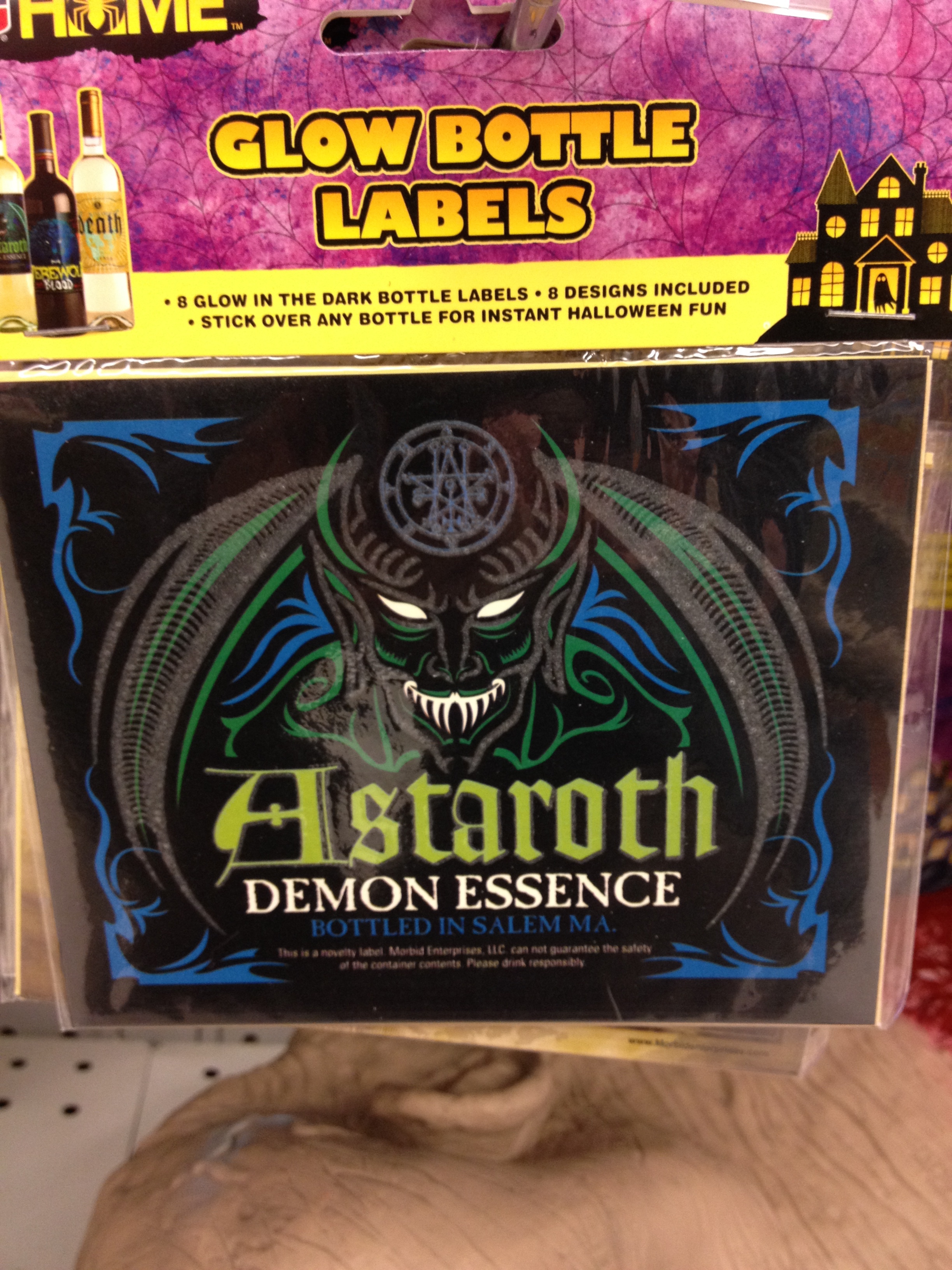
In a local pharmacy the other day, I was looking over the Halloween tchotchkes. Amid the usual assortment of pumpkins, skeletons, and ghosts, I found bottle labels reading “Ashtaroth Demon Essence.” Although I’ve spent a good deal of my life cloistered in academia, I was not surprised by this. I know that in popular culture the goddesses of antiquity live on as supernatural powers, sometimes good, sometimes evil. Astarte, once depicted as the friend to at least some of the humans devoted to her, is now commonly a demonic force. The image on the bottle label, however, was most unflattering. I know, this is just kid’s stuff. Still, as I stood there among last-minute costume seekers and distracted parents, I knew that I was witnessing the influence of ancient religions in an unexpected way. Did any of the goddesses survive as a force for good? How could they when the only god was male?

We know very little about ancient Astarte beyond the fact that she took away some of the luster of the omnipotent (as now conceived) deity of the Bible. A jealous God, as Holy Writ readily admits, visiting iniquity down to the third and fourth generation. (That might explain a lot.) Prior to monotheism benevolence and malevolence could arise from goddesses as well as gods. Compassion, it was believed, was largely a feminine trait. Monotheism decided for the jealous male instead. We won’t find a bottle label for the Almighty, although the accouterment of the arch-enemy are everywhere evident this time of year. And speaking of the diabolical, the Ashtaroth Demon Essence, I noted, was available at a steep discount.


Watchers and (Un)holy Ones

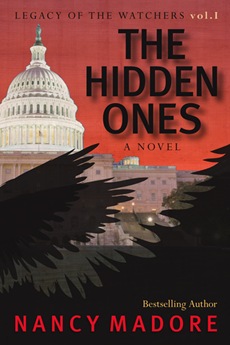
HiddenOnes Angels, demons, djinn, watchers, giants, and a healthy dose of fantasy pervade Nancy Madore’s novel, The Hidden Ones. In this present world where, I’m told, the supernatural is irrelevant, it is pleasant to come across a work of fiction that delves so deeply into the pagan roots of Judaism, Christianity, and Islam. Monotheism does have its own skeletons in its capacious closets. Madore is a novelist who insists on prying open those doors long shut, and spinning a tale that involves first responders, shady military officers, and a band of rather hapless archaeologists. And Lilith. Throughout the story Madore comes up with clever etiologies for stories that will appear in canonical form much later, and at one point I couldn’t help wondering if the screen writers of Noah had read her book. Well, actually, The Hidden Ones is the first of a trilogy, Legacy of the Watchers. I’m sure the next two books will contain many surprises as well.

The Hidden Ones put me in mind of Michael Heiser’s novel, The Facade. Both take on the mythology of the Nephilim, the fallen ones about which the Bible tells us enough only to leave us hungry. The early chapters of Genesis are like that. There’s so much going on that those of us reading it many centuries after it was written are left wondering what the full story was. The writers of the Bible had no compunction to disbelieve in monsters and beings beyond the human ken. Nor does the Bible attempt to systematize them in any sustained way. These creatures just are. As the old saying goes, however, fiction has to make sense—those who write with gods and angels have to make them fit into a system.

No doubt, the uncanny occasionally intrudes upon our rational world. The Hidden Ones presents one such intrusion that, ironically, takes some of the fact of the Bible while leaving the theology suspect. We know that even before the Hebrew Bible was complete ancient scribes were attempting similar things. The book Jubilees, for example, tries to fill in some of the unanswered questions of Genesis, including the watchers and details of the flood. Jubilees, however, never made it into the Bible thus depriving canonical status to the backstory that demonstrates how religion often chooses for ambiguity, leaving it to theologians to bring it all into a system. And novelists. And among those novels that tread where even J, E, P, and D quail, is The Hidden Ones.


Cowboys and Demons

Cowboys_&_Aliens

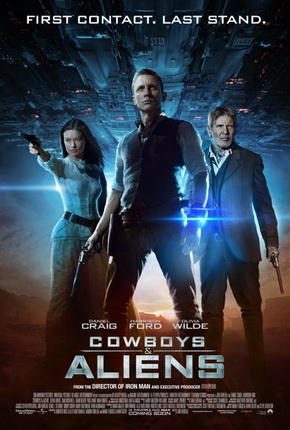
Cowboys & Aliens finally came down into my price range. For movies I’d have to view alone, I generally wait until they appear for free on some online movie service or for less then ten dollars at Target. I’ve been waiting for this one since 2011, but my patience paid off. Inspired, so the rumor goes, by the Roswell incident, the film follows the adventures of some old western stereotypes as they encounter the superior power of aliens. The aliens, it seems, are just as materialistic as humans, coming to the old west in an extraterrestrial gold rush. They abduct humans to learn their weaknesses (which really seems superfluous given the technological imbalance between the species) and anger a number of ornery hombres in the process. Then we have an old-fashioned shootout with ray guns versus bows, arrows, and bullets. Human devotion, however, defeats the evolved armor and flying machines of the—well, what are they exactly?

The cowboys scratch their heads, not quite having the consarned concept to categorize these flying machines and their occupants. The local preacher, who is a pretty handy shot, tries to help the confused cowboys, who settle on the term “demons” to describe the extraterrestrials. We forget that in the early part of the last century other galaxies had not yet been discovered, and although we knew of other planets, there was assuredly no way to get there from here. Ugly things that come from the sky are demons. This doesn’t lead to a whole load of speculation—nobody suggests praying to take care of the menace, although the Native Americans resort to a religious ritual to unlock the mystery of where the demonic hoard is hiding. Through her resurrection we discover that Alice is a good alien, planted in the town to stop the invaders from doing to the earth what they did to her planet. And winning the heart of Jake Lonergan (whose very name suggests lone gunman to insiders) along the way.

Since the movie is three years old, I won’t worry about spoilers—if you’re inspired to watch for the first time, however, you might want to do so before finishing this. When Alice figures out how to stop the alien mining operation for good, Jake is left, for the second time, with his woman being killed by demons. Woodrow Dolarhyde, realizing that the outlaw Jake isn’t such a bad guy after all, seeks to console him at his loss. At the end of the movie, in a camera angle that goes from Woodrow to Jake, the focus falls on the cross atop the local mission as Woody says, “She’s in a better place.” All aliens go to heaven. Literally. With echoes of the X-Files, Cowboys & Aliens is sufficient for a dark night where demons and angels are a little too close to tell apart.


War in Heaven

Van_Helsing_poster

Van Helsing, about which I’ve posted before, is not a great film, but it is perhaps the closest that modern cinema has to offer for my childhood Saturday afternoon viewing. Vampires, werewolves, and Frankenstein’s monster all appear together in a ménage à trois that Universal would’ve been proud to own in the 1960s. With lines cribbed from some of the Universal originals, plus some less believable chatter from Steven Sommers, the campy film is unrelentingly in dialogue with religion and its monsters. Indeed, the plot revolves around the church’s plan to save humanity from monsters by the employment of the eponymous van Helsing. I’ve probably seen the movie half a dozen times, and I’m a bit embarrassed to admit the this is the first time I’ve stopped to wonder at why, unlike Bram Stoker’s van Helsing, the one in the movie is named “Gabriel.”

It should’ve been obvious at the first viewing, but this time I was watching the movie with the intention of parsing its theology. In medieval Roman Catholic angelology, there are seven archangels. Two of them (or three, depending on whose Bible you are reading) are named in Holy Writ. Gabriel is, of course, one of them. The movie also shifts Dracula from being son of a Wallachian nobleman to being the “son of the Devil” (clearly by adoption). The Devil’s gift of resurrection (with which the movie is rife) comes with the vampiristic curse. And the climax of the film has the leader of God’s army (“the left hand of God”), Gabriel, battling the son of Satan. This is none other than the war in Heaven of which the Bible speaks. The leader of the archangelic army is actually Michael, but having “Mike van Helsing” as your lead just doesn’t carry the gravitas of Gabriel.

The movie opens with Dracula claiming that science has triumphed over God, and yet the mythology of monsters prevails. Frankenstein’s creation is morally pure, being a loving child of science, and the church declares him anathema. Throughout the movie all the monsters claim to want is to live, to survive. In fact, they are already resurrected. The werewolves get the dog’s share of the theology, however. They are infected or cursed rather than reborn. The war in Heaven has come to earth as angels and demons battle for supremacy. In the end, it is the human family chosen by God that goes extinct. I’m not sure all the theology adds up at the end of the film, but again, that is the very nature of mythology. And a film that can bring back a careless Saturday afternoon really doesn’t need to make sense at all.


Better Watch Out

Among the more intriguing mythologies of Noah, the movie, is the presence of the “Transformer-like” Watchers. The more biblically literate of the film’s viewers will know that Watchers are mentioned in the Bible, but in the book of Daniel—chronologically the latest book in the Hebrew Bible—and not in Genesis. Daniel does not tell us what Watchers are, but it uses the term in parallel with Holy Ones, implying that they are angels. In the apocryphal book of Enoch, there is quite a bit of mythology concerning Watchers, and they are tied back to the flood story by the strange first four verses of Genesis 6 that note the sons of God saw human women were beautiful and took them, populating the earth with giants as a result. The Bible, as typical, is very cryptic about all of this, leaving imagination to fill in the gaps. Watchers were later associated with fallen angels, and they are sometimes referred to as Grigori, the Slavic form of the name. Biblically we know practically nothing of them.

Watchers have long had a home in the paranormal speculation crowd. Associated with ancient astronauts, a modern mythology has grown up around who the Watchers supposedly really were. This is an outgrowth of the Judaic myth that came from the non-biblical texts that themselves grew out of such esoteric references as those to Enoch, nephilim (fallen ones), and giants, in Genesis. That antediluvian world was a fascinating period in which just about anything goes, but nothing is explained. Even the ark itself is described in terms so vague that it really can’t be reconstructed precisely. The Watchers, according to Genesis in any case, weren’t there. One gets the sense that ancient readers, anxious for a logical roadmap of the divine world, were quick to fill in the gaps that the Bible leaves.

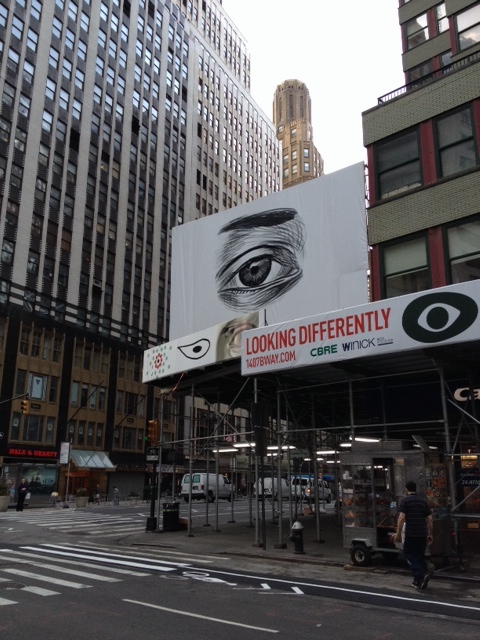
Although Christian theology would eventually declare God omniscient, this does not characterize the deity of the Hebrew Bible. Even before the discovery of Oceania or the New World, the ancient Mediterranean and West Asia were too large for any one God to know it all. Watchers were, most likely, members of the divine council whose purview was to view. Keep an eye on what people were up to. Fallen angels, later equated with demons, were a convenient way to explain evil in a world made by a deity who is only good. And who doesn’t know that feeling of being watched, especially when being naughty? According to Genesis 6 not even the children of God are exempt from such behavior. The Bible gives us plenty to work with, if we’re only willing to use our imaginations.

Somebody's eye is watching...

Somebody’s eye is watching…


The Tell-Tale Telegraph

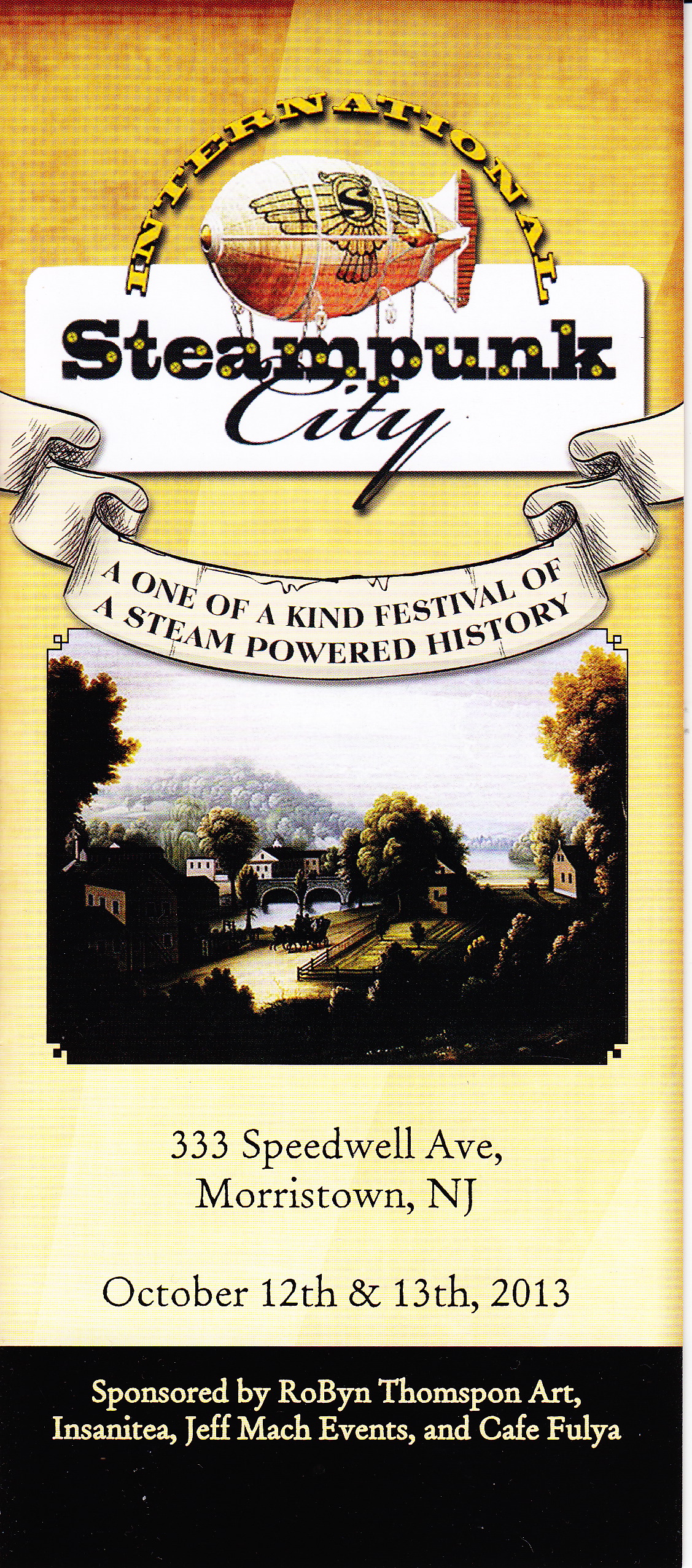
Steampunk CityThere’s a guy next to me with a robotic arm. Women with lace umbrellas and aviator googles walk by on the arms of Victorian gentlemen with walking sticks. A couple have an effervescing water-cooled device on their backpacks. I must be in Steampunk City. The forecast had predicted rain, but it is a beautiful October day in Speedwell, New Jersey. Steampunk City, an event dreamed up by Jeff Mach to make money for local museums, draws in a good crowd of the garishly bedecked, causing my wife and me to feel desperately underdressed. I’ve read my share of steampunk fiction, and I am really thrilled to see so many people taking an interest in such a literary event. I did wonder, however, what demonology had to do with it. Kevin Meares of Delaware Valley Demonology Research is giving a talk on demons, and it’s interesting to notice how the light laughter of customers from the booths outside wafts through the door where stories of possession are being told.

It is difficult to listen to Mr. Meares and believe that he hasn’t seen some pretty strange things. A practicing demonologist rather than the armchair variety, he has accompanied priests on exorcisms and is utterly convinced of the reality of the entities. When asked where demons come from, he relies on the Bible and Bible lore. Either they are fallen angels, remnants of a prior creation (thus the discrepancy between Genesis 1 and 2), or the offspring of the Nephilim of Genesis 6. Whatever they are, he has seen them in the dark, and people have died because of their activity. Being somewhat of a skeptic, I still find myself a little creeped out, kind of wishing I was outside with the laughing, costumed fiction readers.

Steampunk is often about alternate realities. A world where technology developed in the fog of steam rather than the neat circuitry of electricity. Speedwell, ironically, (and probably intentionally) is where the telegraph was invented and first demonstrated. It is a key site in the Industrial Revolution, the development that made the modern world what it is with smart phones, air-light laptops, and iCloud. I’m in the basement of an historic building having my rational worldview threatened by stories of demons. Although I’m wearing my nonplused face, I know that things will be different in the middle of the night. I’ve got brass gears in my pockets and supernatural entities in my head. I’ve met a watch maker outside who translates Aramaic manuscripts. What hath God wrought indeed, Mr. Morse? Yes, I’m in an alternate universe, and I may decide not to come back to the work-a-day one after all.


True Possession

Jheronimus_Bosch_050_detail_01

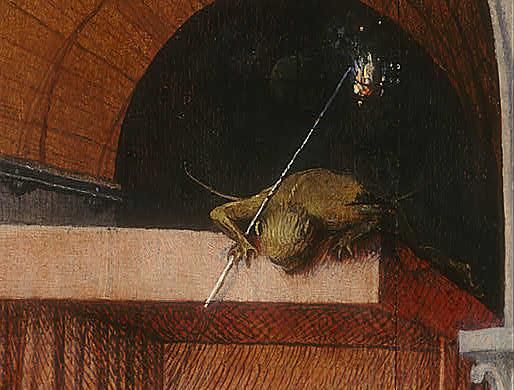
Demons are among the earliest of supernatural creatures. Although sources can be spotty, they appear in the first advanced civilization known, that of the Sumerians. Even with their technology and scientific sense, early people still knew that demons had great explanatory value. Why did things sometimes utterly fall part? Why did some people act so weird? Why did the good will of the gods not always shine through? Demons, while not exactly tricksters, are the demoted gods who cause problems. They also harbor possibilities too, if an article sent by a helpful relative is anything to go by. According to the BBC, a trio of styled and battle-trained young exorcists are about to take to the airwaves to ply their trade in a show called Teen Exorcists. Savannah and Tess Scherkenback join preacher’s daughter Brynne Larson as a trio of demon-dropping debutants ready to take on the powers of Hell. All three, according to the article, are home-schooled.

I’m not quite sure what to make of demons. Aware of more rational explanations of human psychoses and inevitable misfortune, there doesn’t seem to be much room for second-rate deities in the world any more. Still, writers like Matt Baglio and Malachi Martin narrate enough strangeness to make you wonder if we might’ve been a little too hasty in dismissing the supernatural. Especially after staying up late to watch The Exorcist. And it’s not just that it’s three young girls casting demons into the pit—according to Acts Philip’s daughters were prophets and Mark says people who didn’t even know Jesus were pretty handy with the rite. It’s the whole issue of demons. According to the BBC, the girls believe England is especially afflicted because of the Harry Potter novels. (The spells, they say, are real.)

The team of three and Rev. Larson do, unlike Ghost Hunters, charge for their services. And even a duck hunter on television can strike it rich. Simon, later known as Simon Magus, offered the apostles money to gain the power of the Holy Spirit, according to Acts 8. Rebuffed, Simon turned against the fledgling Christians. If there were reality shows back then, I suspect he’d have had one. The three girls are black belts in karate, adding to the television appeal, but demons, we’re told, are incorporeal. That’s right—they have to be fought without physical violence. Armed with Bibles and crosses (no crucifixes, since this is a Protestant exorcise) three young girls take on the dark side of the spiritual world. The chief of the demons, however, is named Mammon. Against that one there seems to be no defense.


Holy Hostage

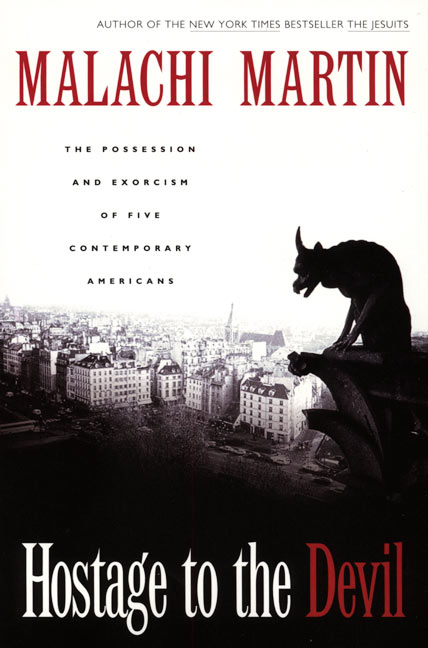
HostagetotheDevilA chance glimpse at a textbook shelf in a university bookstore made me aware of Malachi Martin’s Hostage to the Devil, although it is several years old. I was intrigued that a major, secular, state university would offer a course requiring a book about demonic possession. I’m not completely naive about college students, but this seemed just a tad extreme. Nothing is more dangerous than a book dangling in such a context, like the Necronomicon of Abdul Alhazred. The world of the demonic is freighted with arcane rules and a decided Catholic superiority. Even to the rational it can be insanely frightening. As I read Martin’s account, I frequently found myself puzzling over the unseen world he so meticulously describes—after all even the Bible has little to say about it. And Martin is a great lover of verbosity, detailing more than the reader needs to know about the five exorcisms he elaborates. If you want to know what a dying priest looks like, in great detail, you’ve come to the right place.

Perhaps the most jarring aspect of reading such a book is how such obviously intelligent people can come to such diametrically opposed worldviews while looking at the same evidence. Here was Malachi Martin, convinced that demons lurk about the world in great numbers. There is Richard Dawkins, convinced that we are nothing but particles and proteins walking around. Manhattan—the haunt of countless demons, or the febrile accident of firing synapses that means ultimately nothing? Although much of what Martin describes could probably be mental illness, one has the distinct impression Dawkins has never attended an exorcism. Both write with great authority and even greater conviction.

Hostage to the Devil is not an easy book to read. Martin’s style is smooth, like a novelist, but the length of his book keeps demons on your mind for a protracted period. Rationality can be worn down by attrition, and even the non-believer can be made to wonder. Would priests and their chosen attendants lie? Do the possessed really levitate, and contort, and cause objects to fly around the room in defiance of the physics so highly valued by atheists? For over 450 pages Martin will keep you wondering. You’ll also find out what an exorcist ate for his boyhood breakfast back in Ireland decades before facing the Prince of Darkness. Hostage to the Devil is a deeply disturbing book where the monsters we’ve all learned to shove deeply into the closet come springing back out. And the only effective help in the known world is the Catholic priest who happens to be an exorcist. And who can argue with that?


Creature Feature

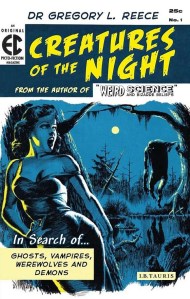
Gregory L. Reece’s Creatures of the Night is a strangely profound book. I picked it up to read on the plane home from Chicago and I wasn’t disappointed. Promising to explore ghosts, vampires, werewolves, demons and devils, Reece suggests that maybe the key to such fascination rests with the late Rudolf Otto. I had over a decade of students read Otto’s famous little book, The Idea of the Holy. Otto, whose palindromatic surname suggests something uncanny, characterized the holy as the fascinating mysterium tremendum, the wholly other. (I will refrain from calling it the wholly holy.) The mystery that makes us tremble. The monsters that haunt our nights and imaginations are aspects of this utterly other.

Along the way Reece proves an able tour guide. He recognizes, as I have repeatedly stated in this blog, that religion and fear are conjoined twins. He also knows how to get your skin crawling. For Reece there is no question that such things are real. Real doesn’t mean that they are physically lurking outside your window at night—for who is to say that only the physical is real?—but they are as real as religion. No doubt strange things have transpired in history and continue to occur. And the reason we go into church may ultimately be the same reason that we watch a horror film.

As Reece comes upon the topic of demons the air in the room (or plane, or bus) thickens. Here we have documented accounts of impossible events. No amount of rational training can remove the shudder from these stories. Explanations of epilepsy only go so far before terror takes over. By herding them together with vampires, werewolves, and ghosts, Reece stakes his claim that they all are real. Rational reductionists may shrink our world down so tightly that no room appears in the inn for our creatures of the night. But those who are honest, even among the reductionists, will admit to a mysterious tremor, even if unintentional, on a dark and stormy night.


Disease Divine

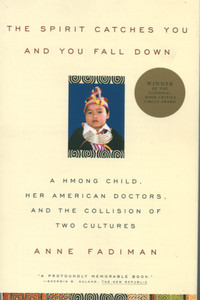
Diseases, for most people of the modern West, are difficult to diagnose as divine. At my wife’s urging, I’ve been reading Anne Fadiman’s The Spirit Catches You and You Fall Down: A Hmong Child, Her American Doctors, and the Collision of Two Cultures. I have a feeling I’ll be commenting on various aspects as I read through it, but something caught me almost immediately. Although the book is not about religion, the culture of the Hmong (about which I knew nothing just hours ago) is truly imbued with religion. Our medical science is, well, science (unless perhaps you’re from Athens, Georgia). Western culture since the Enlightenment has come to understand many of the body’s systems intimately, discerning just which chemicals to proscribe to treat this or that electro-chemical reaction in the body. And we consider it normal. Epilepsy, the condition of Lia Lee, is a disease that, as Fadiman points out, has had a long divine pedigree even in the west. The Judaic tradition at various stages considered it demonic possession, the Romans understood it as a kind of deity-induced madness.

Interestingly, Fadiman uses the case of Tony Coelho, an epileptic and congressmen, to make a point about the Hmong community. Coelho, she notes, had been intending to enter the priesthood but the Church has a canon forbidding ordination to an epileptic. This gave me a considerable pause. Clergy in many cultures must be “perfect” physical specimens. According to the Hebrew Bible, men who had certain deformities “down there” were disqualified, although, one notes, that they would have served fully clothed. Epilepsy, having been putative cured by Jesus many times, might seem a strange disqualifier from priesthood. I wondered why it was singled out from among the many maladies that might have seemed more pressing. Even in our enlightened age, epilepsy still bears the scars of the divine.

Narrating the experience of the Hmong in a Thai refugee camp, Fadiman notes that the subtext was often conversion. As she points out, for the Hmong medicine is religion. Although the missionaries had converted some, their very enthusiasm ensured that the Hmong would not generally go to them for treatment. Here is a stark difference between a people whose religion permeates every aspect of their lives and westerners for whom religion is compartmentalized in a different place than medical science. For the Hmong, wellness is part of a larger picture from which religious belief simply can’t be separated. For some epilepsy is a disease to be cured, if possible. For others it is a sign of a budding shaman. I look forward to reading more, as it is clear that by shifting perspectives, even the enlightened might have something to learn from those they deem uneducated.


Shopping for Fear

So I decided to visit a Halloween store. These have been showing up with metronomic regularity in September for several years now and are usually good for a cheap thrill. My personal preference for Halloween is more somber than garish, but the affirmation that other people enjoy a safe scare has a way of drawing me in. Those who read this blog on a regular basis know that I frequently point out commonalities between fear and religion. They both seem to hover around the same orbit in the brain, and, in some accidentals are very similar. Horror films therefore often indulge in religious imagery, and monsters do not infrequently partake of the divine. So it is no surprise to see my thesis borne out in shops intending to capitalize on fear.

I will freely admit that there may be cultural references that I’m missing here. A movie that I’ve neglected, or some television show or graphic novel may be informing some of the images in ways I can’t comprehend. Nevertheless, we all know of the power of the crucifix when it comes to vampires. I wasn’t aware that the cross had horrific effects on other species of monsters as well. Take this guy here. I’m not sure what he’s supposed to be—perhaps a zombie? It seems a little too corporeal to be a demon. The teeth just don’t look right for a vampire. In any case, he seems to have an extreme reaction to religion, with the cross melting right into his skull. Is there a conversion message hidden here somewhere? Of course it could be just a chinzy attempt to scare a real religiophobe. The cross has become the backup weapon against all supernatural evil.

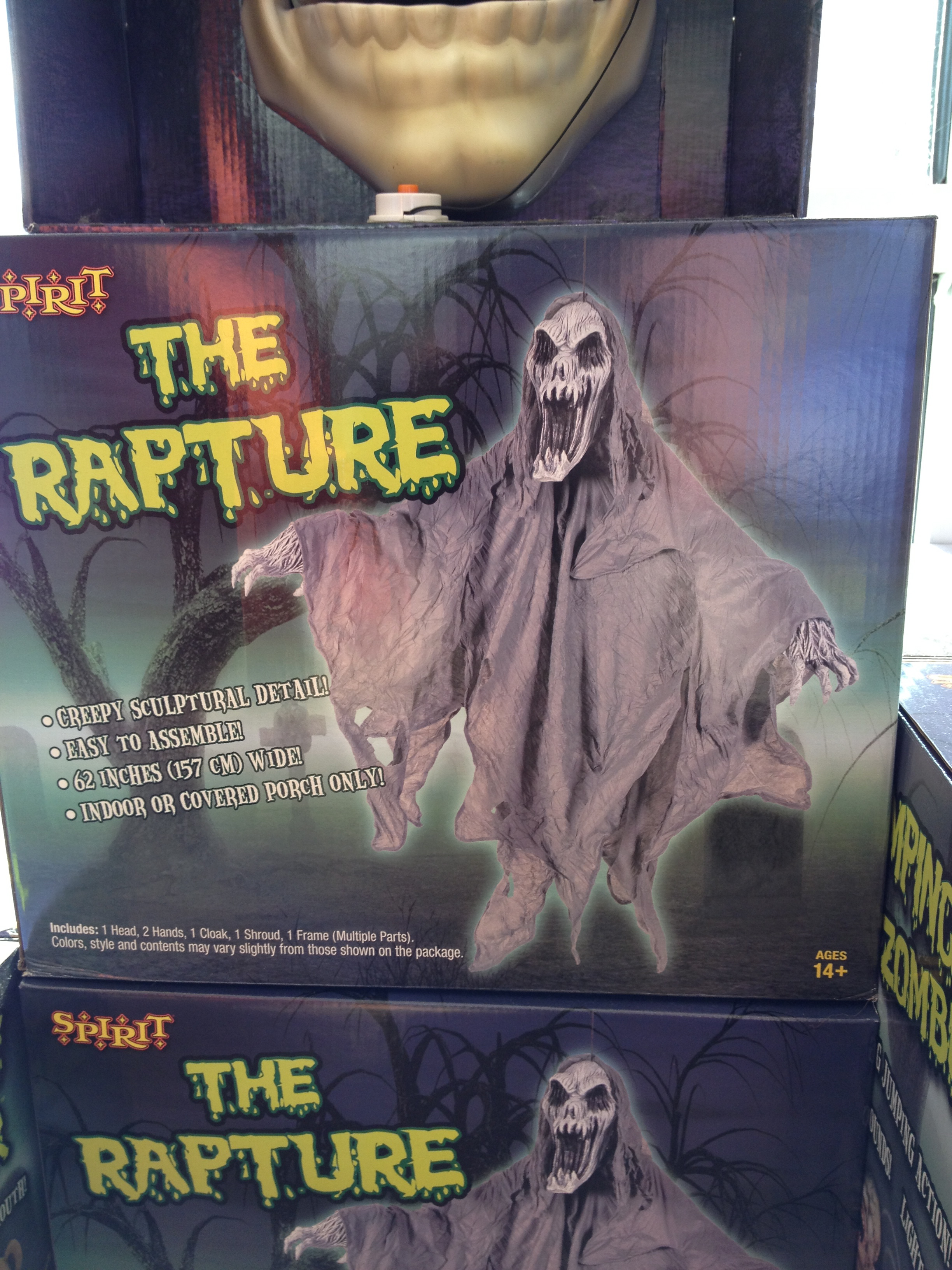
The use of a grim-reaperish ghoul rising from the grave to illustrate The Rapture was a new one on me. Last I heard only the squeaky clean and friends of the Tea Party got to go on the Rapture. (Well, the latter category might explain it.) The idea of the Rapture, as it was fabricated late in the nineteenth century, involved the chance for all the good Christians to escape before things really got rough down here for us normal folk. I would’ve thought that scary guys like this joining the heavenly crusade might take a little bit of the joy out of the occasion. Or maybe they’re being left here to haunt the rest of us. In either case it is clear that consumers respond to religious sounding language and symbolism when looking for a scare. Obviously there is plenty in the store with no religious significance at all, but finding hints of religion scattered in with the plastic scares does show a kind of Frankenstein’s monster of human sentiments and emotions. It’s only appropriate when the nights are now longer than the days.


Rite and Wrong

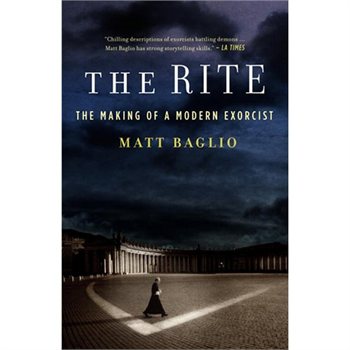
Anyone who’s never had anything very weird happen to her or him, raise your hand. Hmm, I thought so. Strangeness, whether prevalent or simply a unique event, is part of life. It is when we turn to explanations that the religious side of the equation suggests itself. Now I have a confession to make. When Borders was going out of business last year, I was in mourning. Those last poignant hours in my favorite bookstore I wandered the aisles picking up the books left behind by others, many of which I would not have otherwise purchased or read. One of those books was The Rite by Matt Baglio. I had seen the hype for the movie, and although the idea of possession terrifies me I’m not sure there’s anything here that can’t be explained by the likes of Carl Sagan’s Demon-Haunted World. Still, riding through the flickering lights of the Lincoln Tunnel on a bus on a gray and rainy morning, literal shadows of doubts creep in.

There is no doubt that events happen to us that seem to defy explanation. There is also no doubt that the enormous wealth of Christian mythology taken literally by Baglio defies all but the most gullible of readers. The problem is the black box. Nobody sees what goes on inside the locked chamber where the exorcist practices his art. Yes, it is a manly enterprise since the Catholic Church won’t admit of women priests. This was one books that left me tottering between what I know to be true and that shadowy place where doubts dwell. It is utterly certain that our perspective helps to determine what we see. A priest in a stuffy or chilly closed-off room believing a demon lurks therein will see the signs in the behavior of the victim. Throughout the book I kept pondering how so many possessed people lived in heavily Catholic Rome while in locales with more mixed religious traditions the phenomenon is rare.

Perhaps the most disturbing part of the story is the fact that Baglio readily admits: most of the possessed are women. In a religion where women have been marginalized as a matter of course from the early days, can this really be a surprise? And when the exorcist, a celibate priest, experiences sexual arousal how else can he interpret it but as demonic? The human mind is a fascinating system, capable of launching a body into stunning, adrenaline-induced feats of strength and endurance. It conjures gods and demons. And it can make a grown man cower on a dark and windy night with stories of possession racing through his head. I had a difficult time believing much of what I read in The Rite, but I do think perhaps it is now time to make a date with Carl Sagan. Lighting a candle in the dark is a very human thing to do.


The Evil Living

Returning home from my campus visits, I needed some brainless relaxation. Since we don’t have any television service at home, this means watching movies. I’d heard quite a bit about The Evil Dead over the years—a movie that was scary back in the 80’s when it appeared. Improvements in special effects and the intensity of engineered sound are capable of drawing a person into an alternate reality for a couple of hours these days, and the endless reiteration of earlier movie effects somehow robs the early thrillers of their impact. The Evil Dead, however, capitalizes on confusion about the menace and teeters on the brink of morality for the entire 85 minutes. Naturally, when looking for a source of fear, it seeks a religious agent. The source of the evil in the woods is narrated in a voice-over of the presumably dead scientist who has discovered Sumerian texts that release demons in the forest (mostly in the form of falling trees).

Sumerian is always a safe bet if you want a language that your viewers will not be able to identify. The earliest known recorded language, Sumerian is still difficult even for experts, and it conveys all the strangeness of long ago. We do know that the Sumerians recorded myths that involve what we might call “demons” today, but the possession of humans was a much later development—probably a pre-scientific way of explaining epilepsy. As our five students seek a weekend getaway in the woods, they become possessed and face the moral question of just when a person ceases to be human. At what stage does someone have the right to kill someone else? Perhaps unintentionally, the movie gives us the answer, “Never.” This kind of morality has a place in America, one of the very few “first world” nations in which the death penalty is still legal. Often promoted by those dead-set against abortion. Where do we draw the line saying a person has crossed over into the unforgivable other?

The Evil Dead has become a cult classic over the years. Its relatively low budget of less than half-a-million dollars brought an astonishing box office return on the investment. The gore, tame by more modern standards, does not mask that what is really at issue here: the question of right versus wrong. What is truly evil? Sumerians aside, what possesses people and drives them to destroy one another? The Evil Dead, like many horror films, reaches for a religious answer. As the supernatural fog begins to clear, however, we might not like what we see in the clear light of day. Religion may be an excuse, but the assaults upon one another are what Nietzsche famously called “human, all too human.” The sooner we clear our vision and pay attention to what is actually happening, the sooner we can combat the horror.


Persistence of Demons

Although released in April, Insidious is a film for the long nights of winter. At least with my schedule of keeping up with a culture that is moving too fast, this feels like a reasonable rationale for having just watched it. I tried not to read reviews of the movie when it came out since I prefer to experience the thrills first hand when I watch a film. Like many horror movies, Insidious revolves around the supernatural. Specifically, Insidious takes on the specter of the afterlife. Unlike The Exorcist, the demon in Insidious is not expelled by a priest, but by a psychic, borrowing a few celluloid feet from Poltergeist. Adding a couple of ghost hunters to the plot reinforces the idea of the secular demon that so often appears in the learned discussions of the TAPS team as they tilt with unseen entities on SyFy.

In an increasingly secular society, the fear of the dead is very much alive. Even a casual stroll through Barnes & Noble (the only show in town now) will demonstrate the popularity of the paranormal. Somehow sitting in pews listening to a sweaty orator go on about what he (sometimes she) thinks God is wanting us to do has disconnected us from the realm of the dead. Paul Tillich famously declared that God is a person’s “ultimate concern.” In an age when technology is hovering on the edge of keeping consciousness alive forever, people wonder what happens to the self when the body dies. Call it soul, consciousness, mind, or personality, we can’t deny—no matter how secular—that something inside makes each of us unique. The myth of flying about with angels playing harps doesn’t match everyone’s expectation of an afterlife any more. At least some of us hope for electric guitars.

Insidious opts for a realm like Limbo known as “the Further.” This is a place we have been before. The hopelessly corny The Seventh Sign gave us “the Guf” as a now empty federal reserve of souls. The Greeks gave us Tartarus and the Zoroastrians “the place of worst existence.” No matter what we call it, our brains like to believe there is some place out there that we go when the biomass we drive each day finally hits the wall. Increasingly it has become a negative place where darkness reigns. Insidious’s “the Further” is a hopeless realm of the dead, acting out their evil intent. There are no angels, but demons abide. It seems that we’ve outgrown the concept that angels are watching over us, but we can’t escape the creeping sensation that diabolical entities are peering at us from the shadows. During these long nights of winter, Insidious invites us to take a journey to where there is no heaven, but hell is surely not hard to find. All we have to do is close our eyes.


Nightmare Behind Holidays

Among the first mythical creatures to go extinct when the early rays of the Enlightenment began to filter through the blinds of superstitious antiquity, were demons. It was recognized that the activities attributed to demonic possession closely resembled epilepsy and psychological illness and that Occam’s Razor would remove any unseen entities with its no-nonsense straight-edge in one deft pass. And yet they remain. Among the ghost hunting crowd, demons have been recategorized from fallen angels to entities that have never been human. Their reality is assumed, and results of investigations, not surprisingly, support that assumption. It was, however, a Dirt Devil advertisement that created a desire to watch The Exorcist now when darkness comes early and the leaves have fallen from the naked branches and a chill has permeated the air.

As I watched the still disturbing film, I realized that I had also watched the Exorcism of Emily Rose and The Last Exorcism within the past few months as well. I am no fan of demon movies; even with no demonic forces out there, inevitably young women are tormented by what ultimately turns out to be a male establishment. My threshold for watching the suffering of others, even if only acted, is minimal. Movie makers—and often horror writers—know and exploit this, bringing us to face the real demons, the shadowy regions of our own minds. The Exorcist is particularly effective in this since it is Fr. Karras’s demon that ultimately wins out. Having never read the novel, I’m not sure whose idea it was to make the demon Pazuzu, but once again the origins of demons does not fit modern media’s expectations.

Pazuzu was a Mesopotamian “demon.” Akkadian doesn’t have a proper word for what the Judeo-Christian tradition would introduce as a fallen angel. Demons were simply a way of explaining profound misfortunes such as droughts, pestilence, or the Bush administration. Eventually such misfortunes became personified and took on the ability to possess a human being. Here is where psychology and neurology have come to banish demons. Part of the terror of The Exorcist is that such scientific explanations are laid flat in the face of real supernatural power. The lessons of over-consumerism, as evidenced in Black Friday eclipsing Thanksgiving for many (the lines were formed in many locations well before midnight, cutting into family time in order to get first crack at the bargains) show the demon more clearly. Holidays are measured in importance by the amount of money spent. Perhaps it is no wonder that Halloween’s demons have lingered through November and even to the end of the year.