
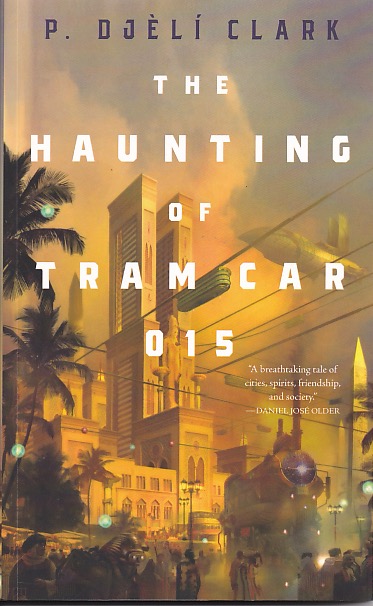
I really don’t like to walk out of an independent bookstore empty-handed. Many of them, however, are quite small and I have a list to which I try hard to stick. I do end up getting books I hadn’t intended to, to avoid said empty-handedness, and so I found The Haunting of Tram Car 015 by P. Djèlí Clark. It crosses various genres with elements of steampunk, horror, and fantasy. Set in Cairo in 1912, where a system of off-ground trams run, the Ministry of Alchemy, Enchantments, and Supernatural Entities is responsible for keeping the paranormal under control. Agents Hamed and Onsi of the Ministry are called in to handle, well, a haunted tram. Their department is on a budget and can’t afford a major exorcism—assuming the haunting is a djinn—and they have to find other means. Their first attempt fails but ultimately reveals that the entity is an al, from Armenian folklore.
Alk are baby-snatchers. Hamed and Onsi have to learn how to handle this dangerous entity before it can harm any women. That’s the basic idea. The novella introduces the reader to some North African/West Asian folklore and builds on both Muslim and Coptic ideas, as well as non-traditional religion. It’s a somewhat fun story as well. The agents resort to some unconventional means to deal with the al, and djinn are a regular part of daily life. As are androids, called eunuchs. This is, of course, an alternate reality, but one in which Cairo is a major city along the lines of London or New York. But with a distinctly North African feel. And a society that accepts all different races equally. Women, who are rallying for the vote, are the ones who identify and suggest the solution to the problem. It’s an optimistic story.
Djinn are often thought of as Islamic versions of demons, but “demon” is a slippery word. Christians adopted a Greek term that referred to entities both good and bad and made them pure evil. One of the things this story does is to treat each entity appropriately to its realm. There’s no lumping everything together into the “evil” basket. In fact, some of the characters have djinn as business partners and others, it is implied, are basically family friends. This is a worldview completely different from the way such things exist in our current cultural outlook. The story unfolds fairly quickly since this is a short book. There are a few horror elements to it, but mainly it is an imaginative vision of a world poised to celebrate equality, and everyone is better for it.


