
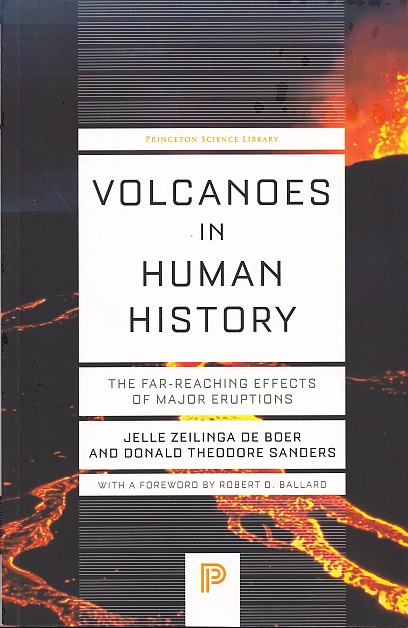
Nonfiction authors have to make decisions when writing books about collected, collective phenomena. Jelle Zeilinga de Boer and Donald Theodore Sanders had to decide which volcanoes to include in Volcanoes in Human History. The idea of the book is fairly straightforward—show how those sleeping monsters have sometimes long-term effects on human lives and culture. Some of the choices were no-brainers: Mount Vesuvius, Santorini, and Tambora, obviously. Toba, the largest known eruption, fell out of bounds because it went off long before Homo sapiens had learned to write. Indeed, that eruption almost led to our species’ extinction. Since I’ve been interested in volcanoes for about the last year or so, this book fit the bill. It gives several snapshots of what happens when the earth’s mantle starts pushing up into the crust on which we live. It also has lots of geology in it, some of which I struggled to understand.
The authors begin with the Hawaiian Islands, and the local mythology about Pele. Then they move on to Thera, which created Santorini and ended the Minoan civilization. Next, Vesuvius is not only the only active volcano on the European mainland, but its 79 CE eruption was the first written about by an eyewitness (Pliny the Younger). The chapter on Iceland is more about the various notable volcanic activities but tends to focus a little on Laki. Then comes Tambora, the most deadly volcano in human history. Krakatau, also known as Krakatoa, was also deadly but is quite well known, in part because of a book by Simon Winchester. It’s covered in the next chapter. Mount Pelée—not to be confused with Pele—in the Caribbean is next. In 1902 it wiped out an entire town of 30,000 people. Tristan da Cunha I’ll come back to. The last one covered is Mount St. Helens.
Tristan da Cunha is a place I’d never heard of. Located about as far from any continent as you can be in the Atlantic Ocean, it’s occupied by about 200 people. The founding humans were of European extraction, and the colony grew from 2 to about 300. In 1961 the volcano that comprises the island erupted, which led to the inhabitants being exposed to modernity for the first time in about two centuries. I found this utterly fascinating. All of the chapters have interesting information, but some of it is pretty heavy going concerning geology and plate tectonics, but it does have quite a bit of human interest as well. It made me glad that I live nowhere near a volcanic hot spot.

