Fossilized Ideas

In our current political climate, perspective helps quite a bit.  Indeed, one of the shortcomings of our conscious species is our inability to think much beyond the present.  In either direction.  Because of the biblical basis of western civilization, a significant portion of otherwise intelligent people believe that the world was created 6000 years ago.  I grew up believing that myself, before I learned more about the Bible and its context.  I also grew up collecting fossils.  Somehow I had no problem knowing that the fossils were from times far before human beings walked the earth, but also that the earth wasn’t nearly as old as it had to be for that to have happened.  Faith often involves contradictions and remains self-convinced nevertheless.

While out walking yesterday I came across a fossil leaf.  Unbeknownst to our movers last summer, I have boxes of fossils that I’ve picked up in various places that I’ve lived.  I find it hard to leave them in situ because of the fascinating sense of contradictions that still grabs me when I see one.  There was an impression of a leaf from millions of years ago right at my feet.  It was in a rock deeply embedded in the ground and that had to be left in place.  Never having found a floral fossil before this was somewhat of a disappointment.  Still it left an impression on me.  Perhaps when dinosaurs roamed Pennsylvania—or perhaps before—this leaf had fallen and been buried to last for eons.  How the world has changed since then!

After that encounter, I considered the brown leaves scattered from the recently departed fall.  Some lay on the muddy path, but few or none of them would meet the precise conditions required to form a fossil.  If one did, however, it would be here after humanity has either grown up and evolved into something nobler or has destroyed itself in a fit of pique or hatred.  We know we’re better than the political games played by those who use the system for their own gain.  The impressions we leave are far less benign than this ossified leaf at my feet.  The Fundamentalist of the dispensationalist species sees world history divided into very brief ages.  God, they opine, created the entire earth to last less than 10,000 years.  All this effort, suffering, and hope exists to be wiped out before an actual fossil has time to form.  It’s a perspective as fascinating as it is dangerous.


Evangelical Angels

Angels are everywhere at this time of year.  The Christmas stories of the gospels of Matthew and Luke have made them an indelible part of the tradition.  It’s not unusual for entirely secular individuals to be decorating with them and they are generally without controversy in public displays of holiday spirit.   A colleague once asked me why Americans were so credulous when it comes to a belief in angels—the numbers of believers are quite high, statistically.  I wonder if it’s because we need them.  Considering that the Republican Party is the Evangelical’s party, it’s no small wonder that even atheists embrace angels.  We all could use a little help from on high.  This time of year, such hope can be disguised behind tinsel and bows.

America must seem a strange country to those who immigrate (or had immigrated, when that was possible).  We wear our religiosity—and this is not the same thing as true religion—not only on our Christmas trees, but even on billboards by decidedly secular highways.  It’s as if even all the things America stands for, such as love of money, guns, and automobiles, only hold together with the saccharine glue of a sickly sweet religion.  A Bible-believing nation that has no idea what the Bible actually says and lauds a president who breaks at least a commandment a day and gains no reprimands.  We have shown our red neck to the rest of the world and yee-haw we are proud of it.  And we got the Good Book to prove it.

After all this shakes out we’ll be needing some angels, I suspect.  My colleague felt that sophisticates, big city skeptics, ought to be more willing to dismiss unenlightened beliefs such as those in spiritual beings.  The thing is, spiritual beings serve a very useful purpose.  They keep us honest—and I don’t mean in an Evangelical way; I’ve seen Evangelical honesty and it’s as corrupt as the Devil.  No, I mean that angels are important to show that we have hope.  Maybe they are secular angels—even the Bible doesn’t give any description of them at all, so how can you tell a secular from a religious angel?  That lack of pedigree doesn’t mean we don’t want them watching over us.  Belief is an important part of being human, secular or not.  The billboard space tends to go to those who want your money, and that applies to the ones that appear to be religious as well.  If this is the way the religious behave, we’d better hope there are angels everywhere.


Absalom v. Occam

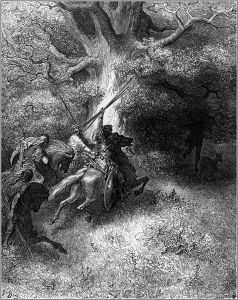
Getting a haircut is like going to confession.  You don’t go as often as you probably should, and you feel embarrassed and awkward when they ask how much you want taken off.  The penance of looking funny several days afterward ought to be punishment enough, without your head feeling cold once shorn of its natural covering.  At least in my experience.  The truth is I like long hair.  Biblical-length hair.  The truth is also that many people think it inappropriate for a guy my age.  I always eventually bow to peer pressure, but it can take a while.  Beautician forgive me, it has been six months since my last haircut.  Absalom, after all died because of his long hair. O Absalom!

This isn’t just idle musing on my part.  I grew up in the Evangelical tradition that is now ripping our nation apart.  One of the greatest markers of that faith is conformity.  In college I learned to call it the “Evangelical haircut.”  Any guy who had hair over his collar or ears was suspect of not being “Christian.”  I began to notice that this same mindset preferred well manicured lawns, cutting down trees and keeping outward appearances neat and tidy.  There’s no better way to mask what goes on internally than to present an outward look of a well-ordered world.  Getting a haircut always brings this back to me—it is a statement being made.  I’m not sure how to explain this to the poor girl standing there with scissors in her hand.  I don’t want to look Evangelical!

Of course, the beard helps.  Until recently Evangelicals didn’t permit beards.  The girls in college said they made men look unclean.  As if they were never washed.  And these days some Evangelicals have come to support the stubble beard—electric razors, those allies of Occam, can be purchased to keep the half-way bearded look fresh.  I prefer to get my money’s worth out of a haircut.  I also prefer to signal that I am not one of them.  Absalom may have been an overly ambitious young man, but despite Michelangelo’s famous statue, David the man was himself in all likelihood bearded and might’ve sported a mullet.  Samson wore dreds.  Uncomfortable with history, Evangelical illustrators in the ‘80s began portraying Jesus with a Roman haircut and neatly trimmed beard.  Perhaps I’m overthinking this, but now that I’ve got Samson’s fate in mind I find it difficult to open the door, knowing I’ll walk out after confession not feeling so much redeemed as just plain chilly.  Even Absalom, I remind myself, had his hair cut once a year.


Sinful Thoughts

Nothing is quite so scary as that which is undefined.  I learned that as an Evangelical child.  There’s a verse in the gospel of Mark—I’ll use Mark because it’s the earliest, by consensus—that reads, “Verily I say unto you, All sins shall be forgiven unto the sons of men, and blasphemies wherewith soever they shall blaspheme:  But he that shall blaspheme against the Holy Ghost hath never forgiveness, but is in danger of eternal damnation.”  Now, that was heavy stuff for a kid.  There was an unforgivable sin.  Naturally, the mind goes to what exactly blasphemy against the Holy Ghost might be.  I hadn’t learned much about context by the point, but Mark places this statement right after the good people of Capernaum accuse Jesus of casting out a demon by the power of Satan.  In context the unforgivable sin in stating that what comes from God is of the Devil.  By extension, vice versa.  Keep that in mind.

A few chapters later Jesus is describing sin again.  This time he lists: “evil thoughts, adulteries, fornications, murders, thefts, covetousness, wickedness, deceit, lasciviousness, an evil eye, blasphemy, pride, foolishness.”  If you read the news these characteristics sound very much like the repeated and continued behavior of 45.  Jesus himself cites this as evil—and here’s where it’s important to remember the unforgivable sin—to claim that such things come from God is blasphemy against the Holy Ghost.  Yet Evangelicals are doing precisely that.  Every time they exonerate Trump and his ground in behavior that for any other human being would be condemned as “sinful,” they are committing the unforgivable sin.  And they’re not even scared.

When I was a child, Evangelicals took the Bible seriously.  It was more important than anything—even railroading anti-abortion judges through to the Supreme Court.  Little known fact: Evangelicals of the 1950s supported abortion.  Since that time they’ve lost their faith.  And their mind.  Sucked into a political activism controlled by forces they don’t understand—if any man have ears to hear, let him hear—they committed the unforgivable sin that kept me awake countless nights with the fires of Hell roaring in my head.  I set aside the gospel of Mark and scratched my head.  How’d we come to this?  A nation, one might say a house, divided against itself.  The kind that Jesus, again speaking of Satan, declared could not stand.  No wonder Evangelicals avoid the Bible these days.  It is a very scary book.


Rich Rule

The perils of plutocracy should be obvious, but clearly they’re not.  This is somewhat ironic among its biblical fan base, which seems to be where the GOP draws its energy.  As the truth about Brett Kavanaugh becomes public knowledge, his religious supporters dig in their heels and blame the victims.  As one of the many who grew up far from privilege I found Shamus Khan’s analysis in the Washington Post eye-opening.  Khan makes the case that those who grow up in rich families and attend the “best schools” are endowed with the constantly reinforced message that the rules do not apply to them.  They can get away with things that others cannot and, in general, they are let off the hook for things that lead to imprisonment for other citizens.  What’s surprising is the Bible-thumpers applaud this.

It also explains more than Kavanaugh.  Trump is also a child of privilege and his entire term in office so far has been one of personal exceptionalism.  Many actual presidents were impeached or censured for acts far less offensive than those 45 commits.  The wealthy, however, are not held accountable.  Where is the Bible when we need it?  The Good Book is no friend to those who enjoy great riches.  In fact, one of the most constant refrains of Scripture is that against the privileged.  With great wealth comes great responsibility—the obligation to help those less fortunate.  The idea of getting away with what you can is hardly evangelical.

If the literalists can overlook the misuse of wealth, it is still more surprising that they can pardon lying.  Since the rules do not apply to the privileged, their own narrative bears the conviction of righteousness.  They can’t have made a mistake since their money proves them right.  Morality can be counted in dollars and cents.  It is for those of the underclasses to come up with high-minded ideals and hold themselves to them.  Wealth is its own justification.  Back in the days when America was young, the French lost patience with governance by the elites.  But then, the Fundamentalist class didn’t have much of a voice then.  It was the Age of Reason.  An Age out of which we’ve apparently grown.  Fake news, alternative facts, heavy-drinking frat boy justices, and women-groping presidents.  Can we not see the parallels with the other great plutocracy of the Roman Empire?  Ironically, it survives today only in the form of the church it sanctioned.


Binaries

Inside, outside, upside-down.  The more life moves toward binary code—what isn’t computerized these days?—the more scholars are moving away from simple binaries.  Just when I thought I was getting used to this sacred/profane divide, academics are scrapping it for more nuanced paradigms not based on any assumptions of presumed deities and their projected wishes.  Nothing as simple as “either/or” could justify all these salaries for stuff you can just look up on the internet, after all.  Still, binaries are a very human way of looking at the world.  Light and dark doesn’t mean there aren’t all the shades in between.  And the very basic difference between inside and outside may be far more helpful than it might appear.

Being inside a religious tradition—really being inside—creates a pattern of thinking that frames all of one’s experience of life.  While reading about the Book of Mormon recently this became clear to me.  Looking at it from the outside is something those on the inside have great trouble doing.  The same is true of various Eastern Orthodox Christian traditions, or Evangelicalism.  Those living on the inside of tightly constrained ways of thinking—believing—can’t see what it looks like from the outside.  I suspect that not all religions traditions fall into such ways of thinking; there are shades here.  “Mainstream” Christianities, for example, tend to blend at the edges and those inside might have an idea of how those on the outside view them.  Lutherans know the jokes about their outlooks and can even tell them.  Methodists and Presbyterians too.  They tend to conform a bit to expectations and  tend not to be extremist about things.  Being mainstream will do that to you.

It is unusual for a person to change religious traditions.  Those who do can see their former tradition from the outside—whether mainstream of not—with a kind of objectivity that frightens true believers.  Most religions have some tenets that look a bit unbelievable when viewed from outside.  Once seen from that perspective, however, there’s no unseeing it.  I grew up Fundamentalist.  After some time in the mainstream Methodist tradition I could see Fundamentalism from the outside.  When I eventually joined the Episcopal Church I had been viewing it from the outside my entire life up to that point.  Looking at faith traditions inside out offers perspectives otherwise not to be had.  Nobody wants to believe the wrong religion.  Perhaps that’s why it’s so difficult to look at your own from the outside.  You have to be willing to accept shades of gray, even if looking at it in a binary way.


Patriarchal Faith

One of the dynamics we see in present-day America is the worship of belief itself.  This is nothing new since faith is the “substance of things hoped for, the evidence of things not seen.”  It’s hard to trust in what you can’t see.  Trusting in trust may be tautological, but it’s also a natural development for something that evades proof.  If it goes too far, however, such religion becomes an idol.  Its teachings become secondary to its very existence.  Its rules, no matter how contradictory, must all be followed.  And those who believe are encouraged not to think too deeply about it since, if they did, this inherent inconsistency would be obvious.  The knee-jerk reaction of “the Bible says” is one such defensive measure.  I saw this all the time while teaching in seminary.

The other day I heard the melody of “Faith of Our Fathers” playing on the local church bells.  Interestingly, this is a Catholic hymn adopted by Protestants.  It’s kind of an anthem to this idea of worshipping the faith rather than the deity to which it points.  Consider the chorus: “Faith of our fathers, holy faith!/We will be true to thee til death.”  Originally a celebration of martyrs—those who found the courage to die in their steadfast belief—the hymn survives into an era when the perils besetting what used to be Christianity are less political and more scientific.  We live in a universe compellingly explained by science while politics has appropriated religion and counts on it to keep worshipping faith as an entity, regardless of distorted beliefs.  The hymn plays on.

Many public intellectuals are wondering about how evangelical Christianity could so easily divest itself of Jesus’ teachings and accept Trumpism.  Some have already begun to suggest that Trumpism is a “cult.”  (Religionists would say the proper term is “New Religious Movement,” since we no longer judge religions, no matter what forms of mind control they might prefer.)  The problem with experts on religion is that anyone can claim that sobriquet, bona fides or no.  Some of us have documented decades of official study of the phenomenon—those who paid attention in seminary and continued to pay for many years for a doctorate in this elusive field—but we’re are easily outshouted by those who take the words of this hymn literally, as they were meant to be taken.  Martyrdom comes in many varieties.  As I listen to the bells, I consider the implications.


Truth under Fire

As Evangelicals continue their unflinching support for Trump, Rudy Giuliani has at last said something that rings true with these “Christians.”  According to a Washington Post story 45’s lawyer declared, “Truth isn’t truth.”  This was regarding the Russia probe, something that would’ve led to the ouster of any real president by now.  We’re all used to Trump’s constant state of obfuscation after all these long months, and the former mayor of New York has just come clean—truth is what we want it to be, no more, no less.  It is a meaningless word, a chimera.  If the son of god in the White House has broken the law (and he has) then the truth is there’s no law to be broken.  Democracy is just a made-up word in the hands of the Republican Party.

Now, I don’t have much truck with politicians.  Leopards, according to a certain book, can’t change their spots.  Nevertheless, Evangelicals should object to Giuliani’s direct assault on their sacred text.  The Good Book, you see, is all about “the truth.”  But the truth isn’t the truth.  When it claims that Jesus died to atone for your sins, that can’t be the truth because the truth isn’t.  The only truth is what Trump personally wants.  And the GOP won’t lift a finger to stop him.  Long ago it was clear that the party of Lincoln had abandoned the will of the people they’re elected to lead, but if there were truth we’d see the deep, stinking muck of corruption everywhere within its doors.  At least you’d expect the neat and clean Christians to object.

A certain man about two millennia ago said, according to the Book, “I am the way, the truth, and the life.”  But Rudy says “Truth isn’t truth.”  The Beatles said they were more popular than Jesus and the public revolted.  Rudy says Trump has more authority than Jesus and the Evangelicals cheer.  The capacity for untruth has always been part of politics.  Most politicians know to lie discreetly, when fact-checking will reveal some ambiguity.  Now the gospel-truth is whatever comes from the unholy mouth of Trump.  There is no truth.  There are alternative facts.  There’s fake news.  Surely the Prince of Peace wouldn’t have cancelled a military parade.  Meanwhile someone once said “the truth will set you free.”  The great Giuliani has informed us, however, that there is no truth.  And if truth isn’t truth, there’s no hope of freedom.  At least according to a guy named Jesus, whoever he may be.  


Rewriting Dictionaries

When this is all over we’re going to need a whole lot of new definitions.  As news became public of the US government literally ripping crying children from their mothers’ arms and keeping them in cages, with the full blessing of the Republican Party, blame began to fly.  The liar-in-chief said it was the Democrats’ fault (of course), although they were the ones advocating for immigrants.  So he signed an executive order to stop what he started and proclaim himself a hero for doing so.  The images were so outrageous that even Evangelicals seem to have been shaken from their lotus-induced adoration of Trump to limply and lately raise a hand in protest.  Almost forgotten is the fact that in November of 2016, and even before, many were saying this was an Orwellian candidate.  We were warned that this would happen.  We walked into this with our eyes wide open.

Fox News, however, prefers to broadcast with its eyes shut.  A charming young man named Adolf can look appealing if you pardon the saliva dripping from his lips and the hatred in his eyes.  All you have to do is say “America” loud enough and long enough and the mindless will agree to just about anything.  This nation was founded on the abuse of children, after all.  That’s how you show you’re a big, strong, man, right?  That and carry your gun out in public where everyone can see it.  I can’t help but think overweening masculinity is the heart of the problem.

Another part is unclear definitions.  “Pertaining to or in keeping with the gospel and its teachings” is how Dictionary.com defines “evangelical.”  Problem is, there’s no part of the gospel that justifies the Grand Old Party.  I seem to recall Jesus saying something about “Let the children come to me, forbid them not.”  Or something like that.  And, oh yeah, “for such are the kingdom of Heaven.”  The Republican Heaven is starting to look a lot more like Purgatory to me.  The only difference is that Purgatory is intended to prepare the soul for Heaven.  Besides, what has any of that to do with Evangelicals—whoever they are?  They’re certainly not Catholic.  Unless Catholics support Trump and then they can be Evangelicals too.  Anyone’s allowed to join as long as their skin isn’t too dark.  This is a world where a police officer can become a prophet and a heart a spade.  As long as we can keep the brand everything will be just fine.


For It Is Written

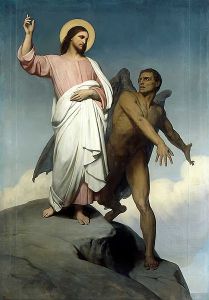
“The devil can cite Scripture for his purpose,” William Shakespeare wrote in his controversial Merchant of Venice. He was, in fact, using the Bible as the basis for this line. The story of Jesus’ temptation in the wilderness famously has Satan quoting the Good Book at him. It comes as no surprise, then, that Sarah Huckabee Sanders, following Jeff Sessions, uses the Bible to justify cruel and unusual practices of the Trump administration, according to a story in multiple media outlets. Trump himself doesn’t know the Bible well enough to quote it, but his minions feel that it can be summarized in one principle—obey the government. Oh, hi, Mr. Orwell, please take a seat over there; I’ll be with you in a minute.

Back in the days before leopards could change their spots, evangelical Christians tended to say that Jesus came to free them from the law. It seems that what they really meant was that Jesus came to allow them to cherry-pick the parts of the law that make the best cudgels against those they don’t like. Those who actually read the Bible know that it can generally be used to support either side of most arguments. Ironically, matters such as adultery *ahem, ah, Ms. Daniels, we weren’t expecting you here; please wait next to Mr. Orwell* are non-negotiable. Even Jesus said so. But let’s not talk about that—we’re too busy trying to pry children from their mother’s arms. Doesn’t the Bible say Rachel can’t be consoled because she’s lost her children?

That which is most holy is most horrible when it’s profaned. The Bible can hardly be called “holy” when found in the mouth of habitual liars. If Jesus were a gentile I’m sure he’d agree that whites have the right to do whatever they want in his name, right? Separating families because it’s the law is robbing Peter to pay Paul, then blaming Thomas. Sanders, Sessions, and their ilk pander to the biblically illiterate who like the sound of the phrase, “the Bible says.” Prooftexting, as anyone who takes the Bible seriously learns the first day of class, is cheating. Ah, Rev. Luther—I didn’t see you come in. What’s that you say? “Sin boldly”? Now there’s a message our government can live with. Especially if you let the Devil into the room. Yes, he’s welcome at the White House these days. And yes, he knows the Bible very well.


Evangelical Angst

Unless you know what it’s like to face life with no real prospects beyond making it to Heaven when you die, you can’t understand evangelical angst. That last phrase might seem odd to you. Aren’t evangelicals uber-smiley, happy people angry over the way society’s going? Yes and no. Many of them were raised (or converted into) a faith that holds out no hope for this world and that constantly reinforces the idea that what we like is bad. Having grown up in that world, I knew what it was like to be hoodwinked by an evangelist. I can’t remember the guy’s name, but he was famous. He came to my small town and packed a local Methodist Church. During his rambling, long sermon, he had us afraid for Hell burning under our feet. Grateful that we’d just managed to avoid it, he announced there would be three collections that night: the first was your normal tithe. The second time the plates came around you were to empty your pockets and purses of all change. The third time, you were to contribute to his private jet. If you gave over a thousand dollars your name would be inscribed on a plaque inside.

Almost as if nothing has changed in the decades since then, a Washington Post story expresses amazement that evangelist Jesse Duplantis is asking his followers for a fourth private jet. Uncomprehending, the world doesn’t show much curiosity as to why otherwise intelligent people would give to what is so obviously a scam. Or why such people would vote for Trump. The academic world doesn’t understand evangelical angst. As I sat in that audience that night, a poor kid from a poverty-level family, I fervently wished I had more money to give. Until he asked for his plane. My young doubts crept in, for I had more angst than most other evangelicals I knew. Was this really the Gospel?

Later I saw him on television. His personal mansion had literal streets of gold. Jesus, he said, wanted us to get ready for Heaven right here on earth. Did this turn his followers against him? Decidedly not. In fact, he may have believed it himself. You see, neuroscientists have learned that our brains have the evolved capacity to hold and dismiss reason simultaneously, for strong emotional stimuli. Sex, for example, or music. Or religion. These can motivate people beyond the realm of logic, and they often do. Evangelical angst says you’re not buying a scam artist a jet to spread the Gospel, it says your trying to avoid Hell. Rational or not. And that, it seems to me, is more than adequate ground for evangelical angst.


Doubting Normal

The problem with being mainstream is that you have a hard time impressing anybody. “Mainstream church does something normal” is hardly an eye-catching headline. So when mainstream Christianity’s in the media it must be abnormal. According to a recent Washington Post story, mainstream leaders are protesting Christianity leaving Jesus behind. To be fair, that’s an Evangelical speciality, but still. Without naming the elephant named Trump in the room, these mainstream leaders are doing what every Christian in the nation should be doing, which is objecting to the abuse of their brand. The Religious Right has been driving this car and from all indications RR is drunk. Dietrich Bonhoeffer, once the darling of Evangelicals, once wrote that it is a Christian’s duty to wrench the wheel from the hands of fascists. Now they call shotgun and select the tunes.

I could be getting this wrong. As the child of an alcoholic, I don’t know what’s normal. My wife must tire of hearing the question from me, “Is this normal?” I just don’t know. One thing I do know is that being unable to know what to expect has prepared me well for Trump’s destruction of America. I can’t tell if it’s normal or not, so good thing we have the two-faced Evangelicals to tell us it is. Those who watch religion might say it’s odd to have mainstream Christians on the moral high ground over their more self-righteous kin, but these seem to be strange times. Religion, like anything that can be used, can also be abused.

Even our Orthodox siblings know the score. The Orthodox Church basically went underground in Russia, which is, after all, a Christian nation. Stalin, at least, was honest. He couldn’t stand that mamby-pamby opiate of the masses. He had the fortitude to call himself an atheist. 45, on the other hand, calls himself whatever it takes to make himself look good. What? Christians are fashionable this season? Okay, I’m one of those. Even people who should know better (just because your daddy was an Evangelist doesn’t make you holy—too many Evangelists were caught with prostitutes to make that claim) have delighted to invite a lion into the sheepfold. I don’t know about you, but I’d be edging toward the fence just about now. Something doesn’t smell right in here. But then again, don’t take my word for it. The situation looks normal to me.


Redefinition

The striking thing about Evangelicalism is its protean nature. The earliest forms of this conversion-based “Christianity” began with the Reformation among Pietist Protestants. They sincerely believed in two things: the Bible and Jesus. Today Evangelicals deny both. They believe in Donald Trump. Racism and subordination of women are their two main foci. And yet, they wish to keep the brand. Daily we see the standards of traditional “Christianity” tumble: turn the other cheek, love your neighbor as thyself, if a man asks your cloak give him your coat also. All of this jettisoned like so much non-capitalist clap-trap. Thing is, it’s in the Bible. Thing is, it was said by Jesus. And also anyone who even looks at a woman with lust in his heart is guilty of adultery, let alone those who pay them off so they can grab another on the way out the door. All of that’s now “Christianity.”

The funny thing is that those who object to such behavior are what Evangelicals scornfully call “liberals.” So much for the group that just three short years ago advocated the reinstitution of biblical law. Now that 45 would have committed a capital crime according to such laws, they have changed the Good Book rather than rebuke the pastor in chief. Ironically, some of the children of famous evangelists have drunk deeply from that Kool-Aid. It’s fine to sleep around as long as you lie the right way at the right time. Bear false witness? What does that even mean? You’d think liberals were suggesting that those God loves are chasteneth by him, for goodness sake!

Many of us feel as though we woke up to an alternate reality in November of 2016. We supposed the Republican Party would show some backbone, but when they didn’t we weren’t all that surprised. What shocked us most is that the leopard has changed its spots. Those of us brought up with the Bible were led to believe this impossible. After all, who can change a hair from black to white (although some of us would rather have it go the opposite direction)? We thought that Holy Writ would guide the Evangelical heart. We thought they would remember who Jesus was. All of this is negotiable now. The only solid rock on which they build their church—those to whom they give the keys to the kingdom—are those that fall into goose-step behind a “leader” for whom the truth changes daily. Opportunist be thy name. Were Jesus alive to see all this, surely he’d weep.


Driving Truth

One of the problems with driving is that you can’t get pictures of billboards. Well, given the way people drive around here, I suspect that may not always be true. Nevertheless, I always think of billboards as trying to sell something. There’s sometimes fairly easy to shut out, but in long stretches of otherwise uninteresting road you fall into their trap. Now having grown up in western Pennsylvania, we always thought the people out east—Philadelphia was the largest city in the state, after all—were more sophisticated. It is around here, however, that I often see billboards selling evangelical Christianity. If you put out your wares, you’ve got something to sell. Money to make.

As I was traveling that stretch of somewhat plain highway 33 between Stroudsburg and Easton I noticed a billboard reading “In the beginning God created the heavens and the earth.” To shore up its academic credentials the billboard footnoted Genesis 1:1. An inspirational sunrise, if I recall, shown over the Bible. Of to the left—of course to the left!—was a small “no circle” and inside the famous skeletal progression from ape to human. The message was “no evolution.” The more I pondered this, the more strange it became. Most Americans are well aware that billboards aren’t exactly the locus of truth. They are gimmicks to try to get you into the store. Like the one a few miles down that advertises the world’s largest humidor; even those with no interest in tobacco might feel just a touch curious what such a place might look like. Why would you take your most intimate personal beliefs and put them on a billboard? Does that make evolution any less likely?

A strange perception has lately taken over this country. The idea that an individual’s wants equate with the truth. Shout it loud enough and it has to be true. Billboards would never stretch the truth, would they? Is that image enlarged to show texture or what? And wouldn’t a better choice of anti-evolution rhetoric have been Genesis 2? That’s where God makes Adam from lowly dirt. Yes, Genesis 1 gives us the dramatic six-day creation, but Genesis 2 manages to say it all happened in one day—isn’t that more in keeping with capitalistic ideals? Greater efficiency leads to greater profits, after all. And profits, we all know, are the real purpose behind billboards for any product under the sun.


What Lies Ahead

Things change. You’d think the fact that we all now carry the internet around in our pockets would’ve demonstrated that. What did President Nixon ever tweet? Conservatives, however, want it both ways. They want to pretend nothing has changed, but they still want to keep and reap the benefits of that change. This was shown most clearly by the ouster of Paige Patterson from his presidency of Southwestern Baptist Theological Seminary. Seminaries don’t make national news without a good scandal. (And some good scandals are never discovered.) This one involves demeaning statements made about women in Patterson’s long storm track through the Southern Baptist Convention, of which he was past president.

Journalists seem to only now be catching on to the fact that “conservative” is a codeword for misogyny. Thus it has always been. The fact that it would take nearly two millennia before women could take leadership roles in Christianity (and in some very large sects they still can’t) should’ve been a hint. It’s the old frog in the slowly heating kettle thing. Nobody notices until it’s too late. Since conservative Christianity has always downplayed the worth of women, it didn’t come to public notice until the #MeToo moment. Enough women had to speak up before society took notice of the obvious. Many men feel theologically entitled. Entitled to run things, and they live by the lie that things haven’t changed since Jesus strolled out of that garden tomb a couple thousand years ago. Well, apart from the fact that men no longer wear dresses and keep their hair short, in Roman style. But let’s not call it that, let’s say Evangelical style.

You see, the way you say things matters. Said a certain way, a misrepresentation of the truth is called a lie. It’s considered one of the greatest sins possible in the conservative lexicon. In another way, however, the same statement becomes doctrine, and that’s a whole different way of looking at things. Make it the fault of the Big Guy up there and the other big guys down here are off the hook. After all, the Almighty’s a bachelor. Such a theology has no possibility of treating women equally. Theologians say God is sexless. What’s that like? We have trouble imagining it. English has no neuter gender so we use the masculine pronoun and once we do thoughts go back to sexual features. It’s deeply ingrained. That doesn’t mean it’s the truth, however. After all, Mr. Patterson will still be kept on as theologian in residence. The more things change, the more they stay the same.