Beautiful Nature

When it comes to gardening, my philosophy is to let nature add the beauty where I lack the artifice.  Repeating patterns please the eye and sometimes unplanted “weeds” form a pleasing patchwork of ground cover, as long as they don’t get too high.  I trust nature to be beautiful in its own time.  There are some places, many actually, were the beauty simply shines.  The best we can do as humans is to try to imitate it.  We all know of scenic overlooks, scenic by-ways, scenic attractions.  When I was young I flattered myself at being handy with a pencil.  I still love to draw, but my years of neglect in favor of words has left whatever skill I had depleted.  Or rusty from disuse.  Our artificial lives (9-2-5, 9-2-5, 9-2-5) prevent much time from being spread between various forms of self-expression.  But I appreciate beauty.

The more academic among us with call it aesthetics.  I tend to think of it in Faustian terms.  I remember well learning in high school that should Faust ever say, “verweile doch, du bist so schön” (remain, you are so beautiful) Mephistopheles will have won.  There are many moments in my life when beauty nearly overwhelms.  As humans, however, we know that should we see it every day it will become prosaic.  We’ll feel the need to find something even more sublime.  Such things lead to concepts of Heaven.  That certainly isn’t the case for my front garden.  Time to spend weeding is about as rare as time to spend drawing, particularly, for the former, when it’s not raining, or too hot, or when a weekend is otherwise not too busy.

We’re nearing the end of the growing season.  The melancholy beauty of autumn is the most poignant turning point in the year.  My mind tends to go to extremes, so when I have to bundle up a little to start my morning jog I begin to worry about heating bills and being chilly until next May.  I’m not one to wish away any season, however.  There’s beauty in the abundance of summer, just as there is in the bleakness of winter.  At a recent art show I was once again reminded that I’m most attracted to painting that capture the essence of autumn or winter.  That hint of snow on the ground under clear blue skies, announcing that change is coming—that too is beauty.  I still have to harvest the weeds that got out of control these last few weeks, looking for the beauty in their persistent existence.

Weeding Lessons

Weeding can be a spiritual exercise.  This summer has been particularly challenging for my communing with the earth because of heat spells, soupy, rainy days for a week at a time, and generally just being busy with other things.  Yesterday I went out to the front garden and received a shock.  A couple of caveats, in my defense: like many people we tend to use the back door instead of the front.  With our parking space behind the house, this is understandable.  Another excuse is that I’m too exhausted after work to do weeding.  At that time of day the unadulterated sun is having its way with the front garden, and, hey, three’s a crowd.  We planted our garden in the hopes of reducing the mowing by a little bit.  It did that, but we soon learned that the expensive plants you buy tend to be shy.

And “ground cover?”  There’s three year mantra: first it sleeps, then it creeps, then it leaps.  Ours slept a couple summers and seems to be in its second summer of creeping.  In the midst of all this: weeds.  Weeds may be the ultimate symbol of hope.  Life is extremely tenacious.  It doesn’t take “no” for an answer.  My amateur adventures in gardening have taught me that weeds grow next to those paving stones you put down.  Then they start growing over said stones.  If you let them go long enough (as I say, the weather has been awkward), they create their own soil over the stones.  Meanwhile, cars line up at the hardware store to buy bag after bag of soil.  Weeds can make their own.

I’m actually an admirer of weeds.  I enjoy the aroma of raw earth when they force me to my hands and knees in front of the house.  I do envy that their 9-2-5 is just being.  Growing.  Soaking up the sunshine, rain, and carbon dioxide.  If there’s a hint of soil, or something that can help them create their own soil, they’re not shy at all.  I don’t mind that they make me go outdoors on a pleasant weekend morning.  There’s peace in the air and I don’t mind the exercise.  I am surprised at just how many plants can grow in such a small amount of space.  I do wonder how our neighbors put up with us, but yesterday it was rejuvenating for my soul to be out there.  Everyone is sleeping in on a Saturday morning, and I’m learning some free life lessons from the amazing plants we call weeds.


Hopeful Flowers

Our front yard is a bit of a wreck this year.  You see, none of us are natural gardeners and with two chronic illnesses among the three of us we’ve had some multi-day hospital visits and shifting of priorities.  The front yard hasn’t been one of them.  I’m able to get out around 6 a.m. on a Saturday, however, to do some weeding.  My philosophy this year is that if it’s not something people would consider an “ugly weed” and if it stays under six inches tall, I’ll let it grow.  We’ve planted some deliberate ground cover that doesn’t seem very deliberate, but it’s slowly taking hold.  And, of course, there are the ubiquitous dandelions.  I don’t really have a problem with dandelions but others think of them as weeds and they do, admittedly, have no sense of personal space.  They’ll grow right up under some intentionally planted flower and crowd it out.

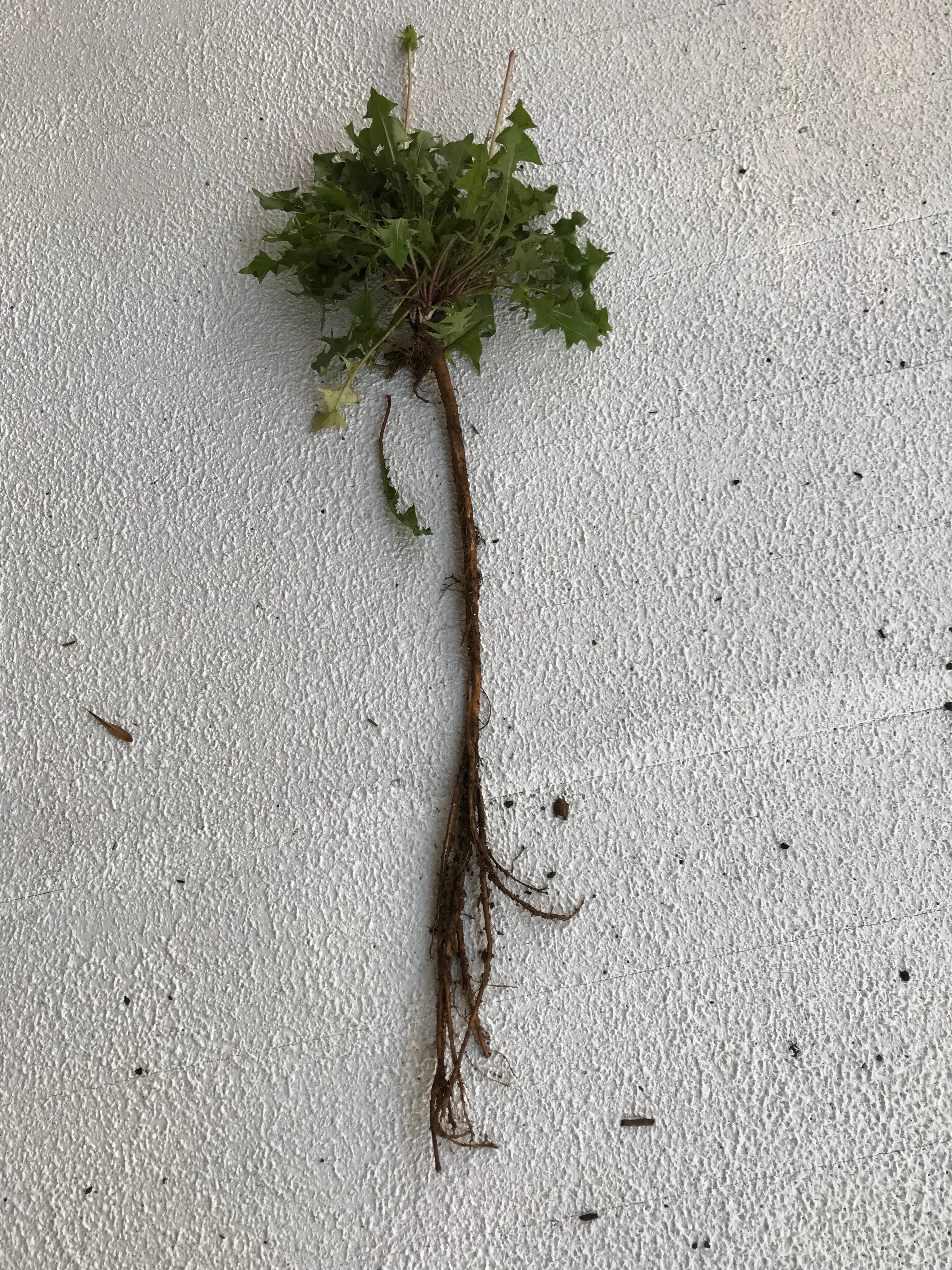
If you’ve dealt with dandelions, you know they have deep roots.  Well, it rained yesterday and the ground was soft enough that I was actually able to gentle one out the whole way today.  It was impressive.  Usually the root breaks off (a brilliant, if frustrating adaptation) less than an inch beneath the surface.  I thought to snap a picture before tossing this one on the compost pile (in the back yard, of course, inside the fence where it can’t be seen).  Talk about depth!  These yellow wildflowers with edible leaves and wine-making potential, are tenacious.  They have a very strong will.  Dandelions are perhaps the most strong-willed of plants.

With chronic illnesses, hope is essential.  Instead of getting angry at “weeds” I look at them as examples of just how mighty hope can be.  They find cracks that are so small that we overlook them.  The soil can’t always be great there, but they carry on.  Dandelions can reach impressive sizes (trust me on that one—I’m no gardener) and they don’t take “no” for an answer.  Such resilience gives me hope.  Were they more conscious (I’m sure they are at some level, but I surely hope it’s beneath the threshold of pain degree) they might well be dominant among the plants.  I missed mowing the lawn last weekend for being in the hospital with family, and it’s clear the dandelions have designs on taking over the place.  I see them and I find a deep peace.  Life finds a way, in spite of difficulty.