Credit Is Due

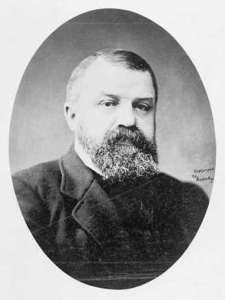
In an article on Nomad by Brandan Robertson, the issue of Larycia Hawkins at Wheaton College is discussed. Hawkins was suspended for stating that Christians and Muslims worship the same God. Robertson’s analysis, in my experience, is right on target. He suggests that when he was a student at Moody Bible Institute he was told that the school was a “discipleship institution” rather than an academic one. This leads Robertson to conclude that the school practices indoctrination rather than education. Although I’ve been saying similar things for years, there is a particular point that stands out here. Institutions like Wheaton and Moody, and others I could easily name, receive the benefits of academic accreditation for non-academic programs. These schools do educate; however, the education is not an academic one. Any faith group that has already declared that it has the final answers has no motivation to promote free inquiry. New information is dangerous, and indeed, is often treated as heretical. Accrediting bodies shrug their shoulders and say, “whatever.”

The purpose of academic accreditation is to ensure that a degree is worth the paper it is (computer) printed on. I could establish myself as an institution of higher education but the reason no one would take me seriously is that I’m not accredited as one. At the same time, schools like Bob Jones and Oral Roberts universities are given the seal of approval while teaching that the standards of higher education as recognized by any non-biased board are wrong. Revelation, not research, has already revealed the truth. And these schools grant degrees that have accreditor’s approval. Some of it is doubtlessly political. Other aspects are more difficult to fathom.

Dwight_Lyman_Moody_c.1900

I’ve known accrediting bodies to visit a campus where faculty and students give intentional and obvious warning signs that the school is not offering what it claims because of some point of doctrine. I have yet to see even a notation to come on a record because of this. And they call it education. Open minds, willing to accept what the evidence indicates, are classified together with those closed to new ideas. Just learn by rote what our favorite spokespersons have said and you’ll get your degree. The nation’s accrediting bodies won’t interfere. If I could only get them to visit my house, I’d start handing out degrees as well. Only to those who pay four year’s tuition, of course.


Go to, Let Us Make Brick

Next year marks a quarter century. It’s a sobering thought. A quarter century of attending the Society of Biblical Literature annual meeting. A lot has changed over the years. Much of the loss, I fear, has been of innocence. When I first flew into Kansas City, naive at 29, and still believing the world offered opportunities for those who would work hard enough, the academic job market was tight. I had no interviews whatsoever, and spent many hours in the employees’ hopeless lounge, dreaming that someone might call my name. Although no jobs came of it, I could hardly blame the academy for “market conditions” outside their control. An economy based on unadulterated greed and emulating the worst practices of the business world was eating higher education alive, from within. I had no way of knowing. For a couple of decades I attended more often than not, optimistic that the lies I’d been told might yet turn out to be false. That those who had the gifts and abilities would be recognized for what they were. I was so terribly young then.

Through a variety of roles I have continued to attend this conference for all these years. I have not seen so much hopelessness until this. Colleagues come to me, barely holding back tears. Conditions in our universities are bad and are getting worse. We have no students, but clients. The hours of preparation for the classroom are now being measured in metrics like “return on investment.” The basic vocabulary of higher education has evolved to the point that it is a new Tower of Babel. It sits on Wall Street and considers what is offered to our young as commodities. Nobody worries if they learn anything or not. The exchange of goods at personal advantage is the only way that one can exist in a market economy.

IMG_2610

The only hope any culture may dare to claim for its future lies in education. Those economies that have not suffered as much as our own are those where education is still revered. Where you don’t have to hold a MBA to speak with authority. Where truth might just be an abstract and where not all things can be measured in shekels. I have been attending this conference for a quarter century and never I have I seen despair such as this. I have to wonder about a nation that takes those highest achievers and those with the most initiative and slaughters their hopes on the altar of the angry deity of vain baubles of self-aggrandizement. We bet on futures that are no futures at all. My beard is whiter now, and my glasses stronger. I am still able to see, however, the folly of launching into the North Atlantic in early April before any kind of radar has been invented with lifeboats made only of money. I only hope I’m wrong.


Think Bigger

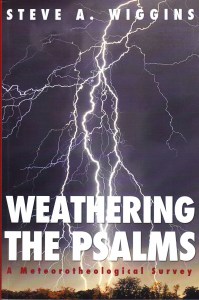
PlanetRagesI’ve spent a lot of time with academics. Having been one myself, I know something of their habits. Getting through a doctoral program involves, at least in some fields, becoming the specialist on a very tiny piece of information. Since people have been thinking about things for millennia, finding something new to say can be a challenge. Often, by the time they’re done, newly minted doctors know an incredible amount about a very specialized topic. This is, in many ways, simply an intensification of the human experience. We think small. Part of the problem is that our brains haven’t evolved to think big. Having learned an awful lot about the weather in the book on Psalms, I have instinctively taken an interest in natural disasters. Charles Officer and Jake Page share this interest, as is evident in When the Planet Rages: Natural Disasters, Global Warming, and the Future of the Earth. This, however, is a big idea book. Globally big.

Throughout the first two sections of the book, which deal with humans in the face of nature, God often comes up. As scientist and science writer (respectively) Officer and Page simply reflect common beliefs. Nowhere do they advocate invoking God, but they note that throughout history, in the face of just about any species of natural disaster, people have. Many people still do. Disasters and God. What a team! We worship what we fear. Once Officer and Page reach the third section of human impacts on nature, however, God drops out of the picture and the fingers are pointing solely at us.

When I read about what we’ve already done to this planet, I, as a colleague once said, start seeking another species to join. We have destablized the atmosphere so throughly that it will take at least ten-thousand years to return to it’s pre-Industrial Revolution state. Ten-thousand years. At the same time, the largest industrial pollutor (the United States) has jury-rigged politics so that only the wealthy can attain high office. Votes can be bought and we simply won’t sign the Kyoto Protocol. Those who knowingly doom their children are the smallest thinkers of all. We have changed the course of the biosphere well beyond our share of time, and even those scientist who deny global warming know that it is true. You don’t bite the hand that signs the pay check. After all, specialists have a tendency to be very small thinkers.


Yes, Virginia, There Are Ghosts

Universities find themselves in a strange position vis-à-vis the supernatural. I suspect that many institutions of higher education are slightly embarrassed at the fact that universities began primarily as training grounds for clergy. We’ve moved away from all that superstition and now believe that only science leads to knowledge. That’s why I find the University of Virginia’s magazine article on ghosts so refreshing. We all know better than to expect a straight answer from academics faced with the awkward question of belief, but the campus magazine invited six department representatives to a discourse on ghosts. The article, which can be accessed online, asked Art History, Anthropology, Religious Studies, Literature, Neurology, and Archaeology faculty about ghosts. At least they were willing to talk about the subject.

Edgar Allan Poe's room at the University of Virginia

Edgar Allan Poe’s room at the University of Virginia

Even in this world where skeptical ridicule is an accepted part of academic practice, we can’t quite let go of the idea of ghosts. They are among the most ancient of beliefs, and even despite the proliferation of apps that let you add specters for any occasion of selfie or digital shot, people still see them often enough to make academics wonder what is going on. Since science only studies that which can be measured, we suppose ghosts lie outside that realm. Those who’ve popularized “scientific” approaches to ghost hunting on television don’t bring their scientific credentials to the discussion. Anyone can be taught to use technology. (Well, not anyone—I sometimes still find my computer at complete odds with me. Technically, however, it is just an inert piece of matter.) From time to time serious scientists have turned their attention to ghosts. Results have been inconclusive.

As the leaves are beginning to fall, and the temperature follows suit, we know that many months of long nights lie ahead. Trees without leaves and air without warmth tempt our minds to believe that perhaps the microscope can’t reveal all that exists in this world. Halloween, after all, has become a major spending holiday and that assures its veracity. Driving through town, it is clear that it is quite an investment for some. Down in Charlottesville they are hunched over their desks, writing lecture notes and grading papers. As the wind blows that empty branch against your window on a overcast evening, however, it won’t matter what department you call home. There will be ghosts about tonight.


Dog in a Manger

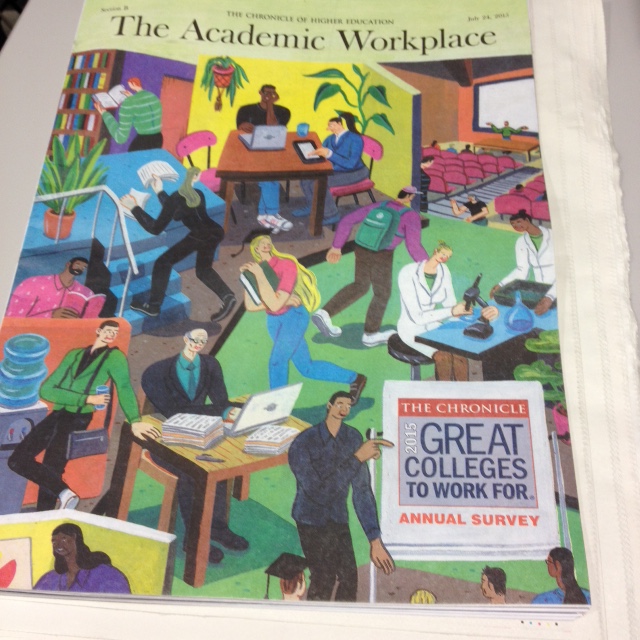
I’m easily amused. I suppose I never outgrew that sophomoric fascination with the little things that seem like big jokes. The other day, for instance, I was given a copy of the Chronicle of Higher Education to read. The supplement featured Great Colleges to Work For; what are we supposed to do with that? None of them have jobs, so why advertise? It’s so funny when those who have a great thing going advertise it, even though there’s nothing to it beyond bragging rights. Those of us who’ve tried repeatedly to get into higher education (and I even succeeded for nearly two decades, in some measure) would love to take a job at even the worst college to work for, but they’re not hiring either. Nobody is. So why does the Chronicle want to remind us that the fruit will always be just out of reach, and that the water will be just too low to sip—even if we’re bathing in it?

IMG_2417

The frustration that settles in when the laughter dies off is because everyone I know agrees that I should be teaching. Colleagues, tenured and not, former students, friends. “Why aren’t you a professor?” they say. Many of my best friends are. Full professors. Sabbaticals. Grants. Time that’s not spent on the bus or in the office. Perks of every sort. Ask them. Or ask the Chronicle. I can’t reach the grapes, but they’re probably sour anyway. I mean, I can’t help it that I spend hours on faculty webpages and see those who made the cut not writing the books I have like jets in a holding pattern over Newark. How can the get written when time is he one thing I haven’t got? (Oh, and money too, but you don’t need so much of that to write.) Any one of those Great Colleges to Work For appear on the advertisement pages? Anyone hiring a warmed over religion professor who reads a hundred books a year? Nah!

Just joshin’ ya. I poke fun at higher education like you can only tease a lover. I’m into exercises of nihilism as much as the next prof. Didn’t old Ecclesiastes say it centuries ago: learning is a zero-sum game? So the academic vehicle that doesn’t boost the number of jobs offered will continue to tell us where we should work, if there were any jobs. Perhaps professors of privilege demand more than I think. Just give me a classroom and a syllabus to teach her by. I’ve done so in very primitive conditions at a college that make no marks on the “Best of” scale. Real world experience, however, doesn’t count. We’re only telling you what you can’t have anyway. Isn’t that better than where you work now?


Interstices

College move-in weekend can be a stressful time. In our particular case it means crossing a couple of state lines and staying in a hotel. Well, I suppose we technically might manage to load, drive, unload, and drive in a day but that seems awfully abrupt. You need time to shop for those supplies that might have run out, wait for roommates to arrive, and spend the last quality time together before facing an empty nest for four months. So we find ourselves in a hotel. It’s the one closest to the university, but it is also the host to some kind of event that draws a lot of people but fails to make internet event calendars. We usually stay at this hotel, and they even emailed us at the start of summer to make reservations early. The clientele this weekend is a cross-section of town and gown. It’s a mixed group. In the hall I see other students about, but there are those here who’ve come for non-academic entertainment, whatever that might be.

The barking started about 6 p.m. I grew up with dogs and most members of my family still have dogs. In fact, evidence points to the dog—the wolf at the time—being the first of the domesticated animals. Before agriculturalists rounded up sheep and goats and cattle, the dog accompanied the hunter-gatherer and both engaged in a win-win scenario. The successful hunt of a large animal left food for both humans and their best friend. Ironically for dog-owning anti-evolutionists, dogs are among the most selectively bred of animals. Looking at a pug, or a maltingese, it’s difficult to conjure up images of the wolf pack. The dog next door, obviously lonely and abandoned, was the small, yippy sort with a high-pitched, insistent bark. It was clear there was more than one in there. And, of course, hotel doors are about the least soundproofed surfaces on the planet. It was like Fifi and company was in the room with us. When I turned in about 10, the barking was still going on, and the front desk said they were trying to locate the guests registered for that room.

What's that shining?

What’s that shining?

I grew up with dogs, and I understand the attachment. I do, however, sometimes wonder about the courtesy of others. Some actions impact other people in direct ways, and sometimes we just don’t think of the consequences. I don’t just mean dogs. Lying awake, listening to distraught pets, I thought of the point of higher education. It is an “industry” in which I have a strong investment. The point of it all is to make our life together on this planet better for everyone. There will always be those who can’t travel without their dogs. There will always be those who have to venture far from home to get the education they want. Can’t there be affordable hotels with doors to dampen the noise just a little bit? Or maybe some of us a just over-sensitive at times like this. Maybe it’s time for me to go back to school to try to figure it all out.


All’s Fair

The county fair is an institution that tastes like a real slice of Americana. My family’s been involved with our 4-H Fair for several years now. Long days sitting under tents in the August heat, showcasing to young people that a good time can be had without the usual kinds of diversions that lead to regrets and tattered dreams. For many kids the fair will be as close as they ever get to a cow, goat, or chicken. For the less rurally inclined, there are pets like cats, dogs, and small animals. For others there are model trains, rockets, and airplanes. Increasingly robots and more current forms of art such as steampunk and film-making are appearing. In short, there’s pretty much something for everybody there. I know that my entire family has benefited from the experience. I didn’t know about 4-H as a child, so this has been a pleasant awakening for me.

IMG_2408 copy

As I wondered the fairgrounds, something that I suppose I’ve noticed before hit me with a new clarity. The Arts and Sciences tents are right next to one another, and these represent the classic forms of liberal arts education. Yes, the Gideons and Right-to-Lifers are here, but they’re over in the commercial tent. They’re selling something. Education—true education—is free. Those who grow up on farms can learn an awful lot about science by watching animals. The more formal schooling, however, asks for deeper engagement. Creative writing helps to explore ideas that simply don’t flow in conversation. Photography forces you to look at something from someone else’s point of view. Science teaches close observation and practical extrapolation. This is like a little university set up in a grassy field with a very affordable tuition.

The old hiker’s mantra goes “take nothing but pictures, leave nothing but footprints.” This year there was a real emphasis on footprints. The kinds of footprints that many clubs chose, however, were carbon. Many adults have grown up in a culture of consumption and disposal. Our young are now trying to demonstrate for us the errors of our ways. Sure, there are resources to last for centuries yet, but they will not last forever. Who are we to suppose it is our right to take what we please and leave the mess for our young to clean up? A day at the fair always renews my sense of hope. These are all volunteers here, giving up the latter part of their summer to try to make the world a better place. Perhaps the ethics should come up from the young, rather than descending from generations that have put their own wants ahead of those who might truly make a difference.


The Ethics of Deception

In New Jersey you can’t pump your own gas. If you pull into a station with a line, you have to wait your turn. Once, on my way to an adjunct job, I pulled up to the next available pump. It was the only one free, and a car pulled up behind me to wait. Meanwhile the car at the pump in front of me pulled out. The attendant signaled the car behind me to the vacant pump and then walked back to tell me that my pump was out of order, I’d have to wait my turn. I left that gas station and have never gone back.  I think about that a lot. I don’t mind pumping my own gas, and I certainly don’t mind waiting my turn.  If someone is given preferential treatment, however, my primate blood starts bubbling.

Gas pump
 
Although I’m middle-aged, I keep starting my career out again at entry level.  I’m sure I’m not the only highly trained professional in this boat.  In fact, I keep an eye on LinkedIn so I know that it’s not at all rare.  As I sit and watch the available jobs go to those younger than me, I wonder about the ethics of it all.  After all, I’m very nearly the same age as the President, and that makes me shudder.  Here’s the ethical quandary:
 
When I was a student in the late 1980s and early 1990s, those of us in doctoral programs enrolled because we were encouraged to do so by the academy.  No one can see the future, of course, but in academia it seemed if it was status quo ante from here (then) to eternity.  There would be lots of jobs, and those of us with the talent were actively recruited to enter doctoral programs and—here’s the ethics part—help meet the need that was about to come!  Did we want to see university positions vacant?  Of course not!  So we gamely stepped up, read our brains out, defended theses (far more than 95 of them) and found ourselves in a world with no room for us.  I managed to get a job, unlike many of my colleagues.  When I was let go, however, I discovered that the viable jobs were being snapped up by younger candidates.  These were students who’d entered the fray after we already knew it was a dying market.  They had the virtue of being younger, and therefore cheaper, and so the academy blithely moved on to forget those of us who’d gone through when everything short of a promise told us there would be jobs. There’s an ethical issue here.  If you know there are no jobs, should you be giving first shot at the few there are to those who entered the system when there was a future?  We used to call it paying our dues.  Now, it seems, those who’ve paid into the system all their lives will get nothing from it.  I’ll be the guy at the gas station ready to fill your car.  If you pull in behind somebody else, you’ll have to wait your turn, however.  I’ll insist on it.


Don’t Answer Me

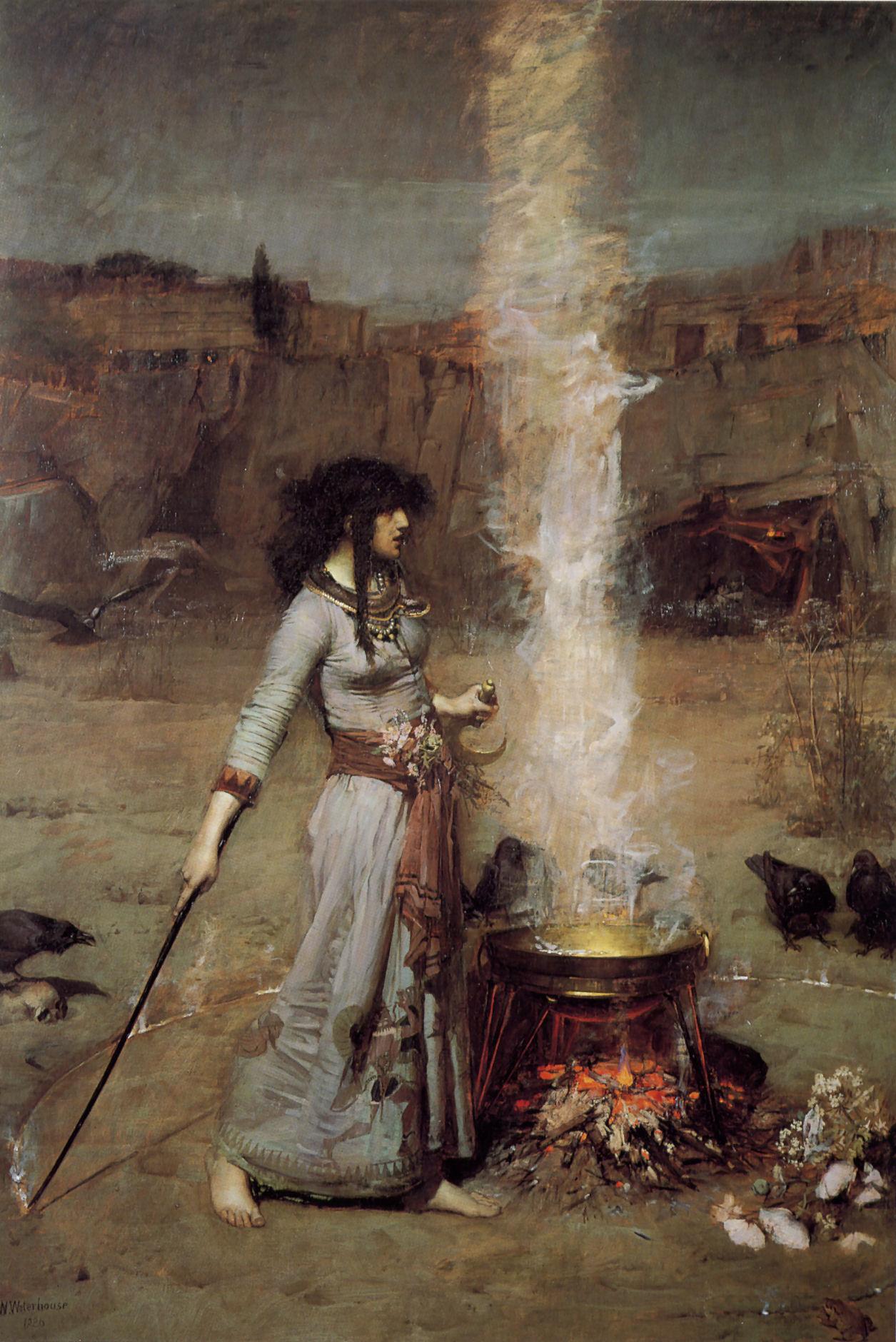
Non-directed reading sometimes follows its own track and a reader might become kind of an accidental expert. I wouldn’t claim that for myself, but I have noticed that scholars, until very recently, tended to give the cold shoulder to anything with a whiff of magic about it. Ancient magic is fair game, of course, but anything like post-Enlightenment magic is anathema, a veritable shibboleth of philistine sensibilities. No scholar worth their diploma would study such a lowbrow topic, let alone give it any credence. Popular culture, and increasingly political culture, tend to ignore academics, however. I have, in my exile from academia, become interested in those who consider themselves witches. I have, I realized recently, read quite a bit about the phenomenon and have been casting about for academic treatments that might fill in some of the gaps. It is a fascinating subject.

John_William_Waterhouse_-_Magic_Circle

Ironically, many religion scholars who swear by a mythological worldview of the first century, devalue magic, or Wicca. Many who study it handle it like a peculiar bug, something that might profitably be placed under the microscope as a living curiosity. The thing is, and I realize that academic institutions often shelter their inmates from the real world, many people still do believe in a kind of magic. It may not involve Harry Potter spells and wands, but everyday life outside the academy sometimes defies explanation. Scientists say it’s impossible, and scholars of religion are quick to lock step. Yet the number of those either openly or clandestinely joining occult groups appears to be increasing. Maybe they know something that the experts don’t?

While working on my academic paper for the Society of Biblical Literature annual meeting, I have run into the amazing void of interest in contemporary magic. The television series Sleepy Hollow has revived some popular fascination with the topic. The curious, however, have few scholarly resources to consult. Here is perhaps the paradigm that shows most clearly why higher education runs into trouble. Could it be that in the academy the Lowells talk only to Cabots, and the Cabots talk only to God? Have they forgotten how the common folk live? Those of us who grew up common are often not welcome in the academy. Our downmarket ways and simian brows mark us as the sort so gullible as to believe in some kind of magic. But the numbers are on our side. And the only option sometimes is to become your own expert.


Original Research

“But are you able to continue your research?” they ask. Academics can be so hopelessly naive sometimes. I recently had a notice on academia.edu that I was in the 30-day top 5 percent of page views. So I’m feeling like the Bruce Springsteen of academics for a few seconds. Meanwhile institutions who look at my record wonder why I haven’t produced anything lately. It’s really quite simple. Take a 40-hour work week (a foreign environment to most academics), add a daily commute of 3 hours, and subtract access to an academic library. As the old computers in sci-fi movies used to say, “does not compute.” My research these days is limited to material that is actually able to keep me awake on the bus (thus excluding most academic monographs) and those that I can afford to buy on an editor’s salary. My research has slowed considerably, in other words, due to circumstances beyond my control.

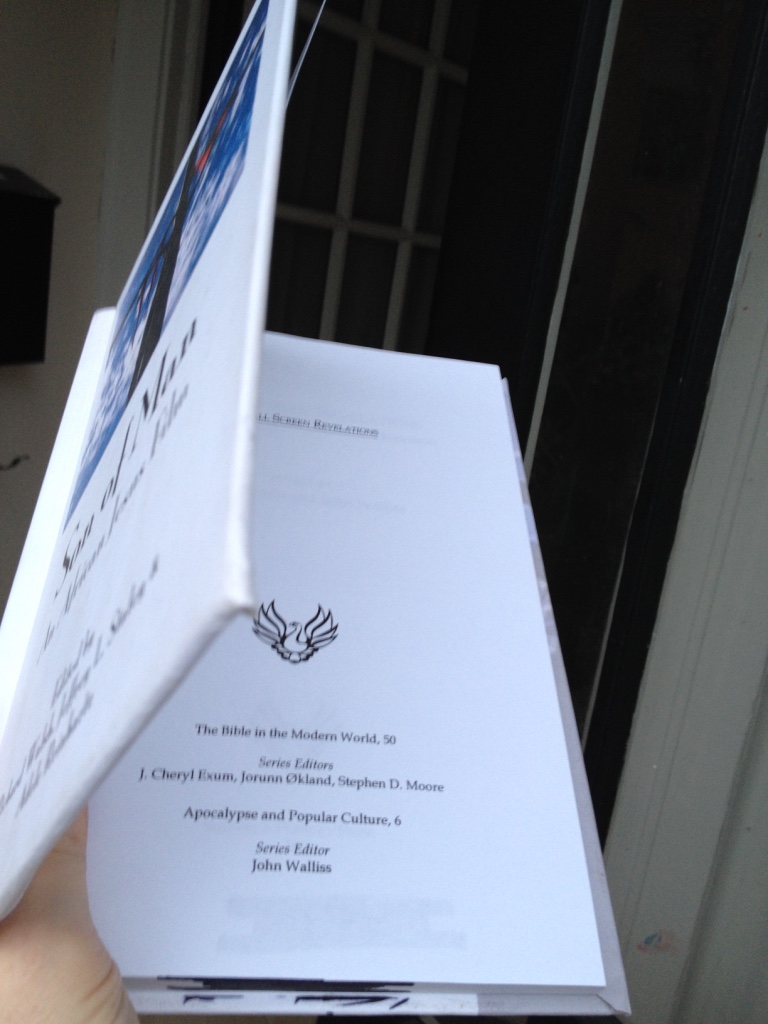
thumb_IMG_2163_1024That’s why I’m sitting here perplexed. Despite it all, I have had a paper accepted for presentation at the Society of Biblical Literature Annual Meeting this year. My project is on the Bible in Sleepy Hollow (thus the recent spate of books on Washington Irving and his hometown). Still, I had to challenge the budget and purchase a couple of things. The cover of my book has me confused. Son of Man, it says. Inside, however, is the text I need—Small Screen Revelations. (If you wonder why, watch Sleepy Hollow, or, if possible, come hear my paper.) The reason for the mismatch between the cover and content of my book is the price. A tome from the appropriately named Sheffield Phoenix Press, even used the volume costs almost $100. It’s just 200 pages. I managed to find a copy misbound for the bargain price of half that. Only an academic would pay $50 for a defective book just to get at the content. Am I able to continue my research? Reach for your wallets and see.

A large part of my job is spending time on university faculty webpages. Many of those I find haven’t published nearly as much as I have, but have comfy, tenured positions. Often it is because they’re the right brand. Catholics like Catholics, Presbyterians like Presbyterians, Baptists like Baptists. State universities hate them all. And once in a while I pull my doctoral robe out of my closet, press it to my face, and weep. I don’t know what a blue collar kid might have been thinking. Earn a challenging doctorate in an obscure field overseas and hope for a modest teaching position somewhere in the land of the most abundant colleges in the world? My race and gender should’ve come to mind long before I got that far. In some ways, I too am a misbound book. Am I able to continue my research? You be the judge.


Dis-Connected

One of the more bemusing academic exercises is the analysis of the working class. Sometimes sociologists or scholars of religion take it upon themselves to present the view of the underprivileged. While they certainly seem to get some aspects right, in truth, they frequently don’t have a clue. Growing up in a working class household is the only way to have the authentic experience. I am one of a few, and I should I say I know many, many academics, who grew up in an authentic blue collar environment. When I read my fellow religionists discussing what it must be like to be underprivileged, I think, why don’t they just ask? Oh yeah. That’s right, I don’t have a teaching position. Why not? I have no connections. I have no connections because a kid who grew up in small town in a poor family doesn’t know to go to Harvard. I applied to transfer to Harvard from Boston University and was accepted. I decided not to go. A guy with connections would’ve known better.

Those of my colleagues with university or seminary posts tell me that the authentic blue collar academic is a hot commodity. In my blue collar frankness, I would equate that statement with what one might find behind the hindquarters of a male bovine. When a rare academic job opens up, the connections circuit begin to whir. Those of us who are unconnected (and I know I’m not the only one) will be passed up for one-year replacement positions as well as non-tenure track positions. They’ll gladly hire us as adjuncts—the blue collar workers of the academic world. I have been an inside candidate before. Although I knew entire departments I was not hired. I guess I don’t know the right people, dang-nabbit. (Imagine a thigh slap in there, in case you want to visualize your narrator.)

Blue collar workers are hard workers. As everyone, friend and foe, knew at Nashotah House, I worked hard. I obey the foreman. It’s a skill I learned before I finished middle school when I took my first blue collar job. Don’t bother telling me the excuses since I’ve heard them all before. We had to hire a (fill in the blank). So-and-so was already in our mind when we advertised the job. Once a seminary trustee complained to me that he had to get up at 4 a.m. to catch his flight. I get up at 4 every day, sometimes earlier. He was also well known for having an expensive, frivolous, and vain collection. He was the rector of a large and very influential parish. No worries; the poor you’ll always have with you, but be careful not to let them join the conversation. They might interfere with your connections.

Tell, don't ask.

Tell, don’t ask.


Whack-A-Prof

My Ph.D. was conferred in 1992. Not by design, I’ve held several jobs since then. One thing I’ve noticed over and over is that supervisors enjoy knocking down the egghead. If you don’t know me you’ll have to take my word for the fact that I’m quiet, not self-promoting, and actually uncertain about many things most people seem to take for granted. Even in the classroom I never used my education to appear superior to students—education is about all of us learning together. At least ideally. I do know some people flaunt their doctorates. A friend told me of customers pulling into the gas station and insisting on being addressed as doctor. (It might help to know that in New Jersey you are not allowed to pump your own gas.) My friend wryly noted, then they don’t even fill the tank. I had my own similar experience working in a camera shop in a Boston suburb. A patron had “Ph.D.” printed on her checks after her name. Company policy was that the signature had to match the printed name exactly, including title. This particular customer, proud to have Ph.D. flashed before your eyes refused to sign it after her name. When the police had to be called, as per company policy, many of us stared sheepishly at our feet as she signed the cursed three initials and declared she would from then on take her custom elsewhere.

Some of us pursue advanced degrees because we have no talent for anything else. I’m a born teacher, and I have always found the classroom the most congenial environment in which to be. I have had several bosses, however, who seem to think that knocking the Ph.D. down shows just how clever they are. I don’t claim to be smart. I never have. I am a hard worker, I read a lot, and I try to make sense of what I read. Some of the smartest people I know have the least formal education. It’s rare that I don’t assume the janitor knows more than I do about any given topic. (Well, maybe Asherah is a place where I can claim some specialist knowledge.) Otherwise, I take your word for it.

Our culture, however, enjoys putting those in higher education in their place. I hear the conversations behind closed doors. While I don’t claim to know very much—in fact, the longer I’m alive the less I claim to know—I do know that America doesn’t value its educators. It’s not just the professorate. Teachers, those to whom we entrust the very future, have been perennial scapegoats for society’s ills. We don’t pay them well, and many of them have to take second jobs in the summer to make ends meet. I guess we showed them! Who’s the smart one now? I can’t claim to know much, but it seems to me that education is one of the pure goods in society. We can’t make progress without learning. Gifted teachers should be esteemed—not pampered, but appreciated. Of course, I can feel better about myself if I show that I know more than you do. The only cure for that, I suggest, is more education.

Photo credit: Anna Frodesiak

Photo credit: Anna Frodesiak


Incitatus Redux

What more is there to say about God and politics? Far too much, I fear. In a Sunday Review in the New York Times, Frank Bruni lays out a catalogue of what, in a rational universe, would be considered violations of the United States constitution by politicians who insist their (conservative) Christianity is the faith of the nation. This is, however, one of the philosophical conundrums of religious freedom. Religious believers are free to use their faith to try to change the system from within. And the fact that the media is telling us that religion has become irrelevant doesn’t help. Who should be afraid of what’s irrelevant? Can irrelevant substances harm you? Can irrelevant bullets kill you? Why, yes, they can! And so being told repeatedly by the media that religion is something we can safely lock into a box marked “Medievalisms Outdated” we step out the door to see politicians using a religion poorly understood to gain power. A recipe for an apocalypse, it sounds like to me.

Academics too readily fall prey to the media hype. University presidents and deans suppose that religion really is dead and shouldn’t be studied. Who’s going to help us through the morass of the upcoming election if people who understand religion are made indigent and put out on the streets? Good luck to the rest of society! We must, if we are to survive, understand religion. Its death, following shortly on that of God, was proclaimed early last century. And yet it’s showing no signs of dying. In fact, it’s just waking up. Who are we going to ask? Scientists? Accountants? Economists? What will you really learn about our laws being God’s laws in the minds of the wealthy and powerful? Don’t ask me—I’ve only spent some thirty-five years studying religion. What do I know?

I sometimes wonder what it must’ve been like to live in Rome as Alaric was whetting his sword among his Visigothic horde. Insane—literally insane—emperors wielded unchallenged power and lived lives of opulence amid the slaves and poor. Religion was front and center on the agenda, of course, because emperors were gods. You don’t have to listen too deeply to hear the same message even today. Those who proclaim God as the justification for their political ambitions know that God is the ultimate malleable deity. In fact, God can even be in the Oval Office. Lead can line your aqueducts and your horse can be made a senator. Lord knows an ass can be. And all the while let’s shut down the voices of those who’ve looked at religion, beginning in the Stone Age and up to now. If we want to grab power it’s vital that we keep it from public view that self-deification is as old as kingship and in a post-religious world, we have only to pretend.

Photo credit: Louis le Grand, Wikimedia Commons

Photo credit: Louis le Grand, Wikimedia Commons


Just Justice

494px-Martin_Luther_King_Jr_NYWTS

It was not intentionally because it was Martin Luther King Junior’s alma mater that I chose to attend Boston University School of Theology. King’s legacy there was certainly a perk, but I had found the seminary engaging because it had a rare combination, at least in my limited experience, of academic rigor and a strong sense of social justice. Too often, it seems, academic enterprises become dispassionate and social justice becomes one of those squishy human element sorts of things that really can’t be quantified. We pursue knowledge without really thinking if its impact will be positive or not. At least fair or not. Fairness is a concept rooted in belief, and, as studies of primates show us, it is very deeply embedded in us. What has it to do with academic achievement?

This Martin Luther King day, I’m concerned about how difficult social justice is to find, even in those places where we expect it to reside. Taking second place to doctrine in many churches, social justice is more of an uncomfortable requirement than a true passion. This winter I’ve noticed more and more homeless on the streets. Our “economy” seems to dictate that many have to be losers so that few can be big winners. Instead of helping them out, I see authority figures come along to shoo them out of the way before those who have jobs have to come that way. We don’t want to be reminded that we might lose everything as well. Affluent society requires victims, and we can be very academic about it.

I have to admit to relegating holidays to that mere Monday off work. The relentless wheels of capitalism ever turn, and only with reluctance do our companies grudgingly give us ten days spread throughout the year to recuperate. The next slated holiday comes in May. Will there be social justice by then? With the eventual warming of the air by that season, will we simply blend those without homes into the less well-dressed and pretend that we have achieved a fair society after all? What do we really celebrate today? Is it just another morning to sleep in, or is there something more to it? A dream that won’t be extinguished until fairness is established? Seems like a worthy idea, at least in theory. But until then you’ll find us at our desks, working to keep the system strong. And hopefully, we won’t forget to dream.


News Work

Bible_0001I’m confused. (Well, no surprises there.) I just read the cover story in last week’s Newsweek, “The Bible: So Misunderstood it’s a Sin,” by Kurt Eichenwald. No, the story didn’t confuse me. Nor did the fact that the Bible appeared on the cover of a major news weekly. What confused me is that the article says nothing new. Well, no doubt it will be new to many readers. The fact is, however, that anyone with a serious degree in biblical studies (and believe it or not, there are so many of them that jobs can’t be found for them all) knows all of this stuff already. What’s more, they have known it for decades. Scholars tend to write for other scholars. Some see the best-selling trade titles by publishers like Harper Collins making the New York Times bestseller list and imagine that their monograph on the obscure meaning of an obscure word in an obscure verse of a book that most people don’t even know is in the Bible will do the same. It won’t. Most academic monographs sell in the hundreds (not thousands or millions) and at the low end of the centuries mark at that. They are bought by libraries and read by peers only. In them we argue (for yes, I have written such books) important points that can only be understood by those with specialist training, and think we’ve changed the world. Newsweek gives the lie to that.

Long ago it became clear that scholars were failing to connect with the average person. That is the person who turns on the television and hears and sees the people Eichenwald shows to be impostors, and believes them. They are, after all, on television. The biblical scholars who know that these obvious fallacies are simple-minded are too busy trying to get tenure in a market—yes, a market—that finds education an annoying necessity. We won’t hire anyone without a college degree any more, and so we need universities. Universities, however, won’t hire without signs of erudition, including books that most people on the search committee can’t understand because they specialize in something different. Oh, and those studies must be published. Whether they are read or not is merely, well, academic.

Meanwhile the public doesn’t know that biblical scholars have long ceased debating the age of the world, the flood, the resurrection, or the end of the world. Scholars have bigger concerns on their minds: how am I going to teach more courses and still produce those learned disquisitions that a dozen of my closest colleagues will read and rebut? And serve on all those committees? And participate in the branding of the university, because, we all know that people will buy a trusted brand? Meanwhile on center stage are politicians who know nothing about the Bible beyond the fact that it brings down votes, big time, and they are telling us what they think it should say. Chances are most scholars of the Bible won’t read Newsweek to find the answers. I didn’t even know about it until a friend mentioned it on Facebook. Like most people I’m just too busy to notice. And a little confused.